

Footnotes have been removed from the HTML version of this report. For the footnoted version of this report, please download the PDF.
Please visit www.ukclimaterisk.org to view the other outputs from the Fourth Independent Assessment of UK Climate Risk (CCRA4-IA).
Acknowledgements
The Committee would like to thank:
The team that prepared this report and its analysis. This was led by Emma Pinchbeck, James Richardson, Richard Millar, Florence Bates and Olivia Shears, and included Rose Armitage, Hannah Barnett, Owen Bellamy, George Blake, Sandra Bogelein, Louise Brett, Marta Calore, Rachel Carr-Whitworth, Freddy Curtis, Selina Dagless, Eoin Devane, Stephen Dillon, Bianca de Farias Letti, Victoria de la Cruz, Joshua Deru, Caitlin Douglas, Kim Dowsett, Kieron Driscoll, Elizabeth Fuller, Jamie Gittings, Ruth Gregg, Esther Harris, Rachel Hay, Kate Heaphy, Robbie Herring, Gemma Holmes, Daisy Jameson, Ariana Jessa, Luke Jones, Sam Karslake, Miriam Kennedy, Adam Khan, Michael Lord, Grace Macready, Fatima Manji, Luke Maxfield, Moryse McInniss, Aaron McMahon, Frances Molesworth, Bea Natzler, Sarah Nelson, Emily Nurse, Chris Parker, Emma Patterson, Jessie Peramal, Karina Rodriguez Villafuerte, Simon Rayner, Andrew Romang, Elena Saggioro, Miranda Schroder, Viv Scott, Penny Seera, Rachel Sewell, Blánaid Sheeran, Bryony Sheridan, Thomas Smith, Rachael Steller, Thea Stevens, James Tarlton, Felicity Taylor, Seán Taylor, Indra Thillainathan, Emma Vause, Sophie Vipond, Scarlett Walker, Chloe Welsh, Eveline White, Hannah Williams, Kate Williamson, Louis Worthington, Fergal Wraith, Ken Wright, and Susie Wright.
Our previous Committee members, Dr Ben Caldecott, Professor Michael Davies, Professor Richard Dawson, and Professor Natalie Seddon.
Our expert advisor, Professor Richard Betts.
The Met Office and consortium of experts who produced the CCRA4-IA Technical Report. This was led by Professor Jason Lowe, Dr Mark Harrison, and Rachel Perks. It was supported by the lead authors: David Jaroszweski, David Dawson, Gregor C Leckebusch, Mark McCarthy, Dann Mitchell, John Newton, Dejan Mumovic, Clare Heaviside, Ting Sun, Oscar Brousse, Eleni Davidson, Nishesh Jain, James M. Bullock, Sevrine Sailley, Cristina Argudin-Violante, Carol Wagstaff, Emma Ferranti, Daniel Donaldson, Sarah Greenham, Xilin Xia, Andrew Quinn, Rachel Fisher, Matthew A Cole, and Robert J R Elliott.
Organisations and individuals who carried out research or chaired advisory groups to support this advice. These included Atkins Realis, Arup, CAG Consultants, Cambridge Econometrics, Climate Sense, Climate Visuals, Cranfield University, Edge Health, Dr Tim Fox, Greencroft Economics, HR Wallingford, Imperial College London, Ipsos, Louise Marix Evans (Quantum Strategy & Technology), Professor Elizabeth Robinson (London School of Economics and Political Science), Sayers and Partners, Sciencewise, URSUS, Paul Watkiss (Paul Watkiss Associates), Professor Rebecca Willis, and WSP.
The citizens who participated in our citizens’ panel and the experts who participated in our advisory groups.
A wide range of organisations and individuals who participated in workshops, engaged with us, submitted evidence, or met with the Committee bilaterally.
Foreword from the Chair
It is now nearly 20 years since the Climate Change Act was passed. In many ways, it has been a huge success; in that time the UK has reduced greenhouse gas emissions by 42%. But there has been little progress on preparing ourselves for the changing climate. We are already experiencing disruption and damage from the rapidly increasing risks from climate change in the UK today. These risks are not only eroding our cliffs, but also the fundamentals of our health system, our insurance sector, and our children’s schooling.
The public is concerned that we are unprepared for climate change. At the Climate Change Committee, our detailed reports conclude that they are right to be concerned. What governments have been doing on adaptation clearly isn’t working. It is time for change.
This report is about hope, not fear. We come with as many answers as questions. And we focus on solutions, not risks. Climate change and adaptation are complex and there are a lot of things about 2050 that we don’t know. But there are plenty of areas where we have enough evidence. Better cooling, flood protection, and a more secure water supply. Delivering these three solutions would take a large chunk out of what we need to do. And while that happens, we need a much stronger public debate about what we value as a society and how much we’re prepared to pay to protect it.
We must not let either the complexity of the issue or the unknowns of the future stop us from setting some sensible targets. We must get on with the things we know can deliver significant improvement to people’s lives.
The intent of this report is to kickstart the delivery of change. We can learn from what has worked for reducing emissions in terms of clear targets and policies. We can learn from examples of effective adaptation in parts of the UK and around the world.
While this report is aimed at the UK Government, the Northern Ireland Executive, the Scottish Government, and the Welsh Government, we hope many other organisations will find it useful as a guide to setting targets and measuring progress in a complex area. Governments cannot deliver adaptation alone, but they can set clear objectives and targets, supported by policy, regulation, and standards. Governments must engage in open debate about the costs and the benefits – and about the limits of the role of the state. As businesses, communities, and families, the rest of us want to know what we need to do for ourselves.
When the four UK governments publish their next national adaptation plans, it will be 20 years on from the passage of the Climate Change Act. To date, they have not been fit for purpose. But with this solution-focused report, we aim to leave no room for ambiguity. Whether or not to prepare for the changing climate is now solely a political choice.
This is the opportunity to show that government can create change for the better.
The opportunity to ensure a future to be proud of.
The opportunity for a well-adapted UK.

Baroness Brown of Cambridge DBE FREng FRS FMedSci
Chair of the Adaptation Committee
Executive summary
Climate change is undermining the UK’s security and prosperity. We are already experiencing serious impacts now, and further impacts are inevitable. By the middle of the century, the UK’s climate will be much more extreme than today. Hotter heatwaves could see 92% of existing homes overheat, creating dangerous conditions for vulnerable people. Peak river flows will be up to 45% higher, last longer, and be seen more frequently, driving increased flooding. Drier summers will mean shortfalls in water supply could reach over five billion litres per day, making drought more widespread. Without global emissions reductions, these risks may go past the point where the UK can protect itself with adaptation measures.
Under the UK’s Climate Change Act, the UK Government must assess climate risks every five years. The Climate Change Committee has a statutory responsibility to provide independent advice on these risks to inform the UK Government’s assessment and is tasked with compiling the evidence on climate risks. This report, and the accompanying CCRA4-IA Technical Report, do that. For the first time, the Committee is offering advice on potential solutions to address these risks. While this statutory responsibility is to the UK Government, the Committee hopes this report will provide evidence to support action by the governments of Northern Ireland, Scotland, and Wales, who helped to commission it. The report can also be useful to other organisations focused on action to adapt to climate change.
The UK was built for a climate that no longer exists today and will be increasingly distant in years to come. While efforts to keep global warming well below 2°C above preindustrial levels must remain a priority, the world is not yet on track for this. At a minimum, the UK should prepare for the weather extremes that will be experienced if global warming levels reach 2°C above preindustrial levels by 2050. At the high end of possibilities, reaching 4°C above preindustrial levels by the end of the century cannot yet be ruled out. This should be considered as part of effective adaptation planning.
We know what needs to be done to start preparing for a 2°C level of global warming by 2050. Cooling to protect from heat, increased flood preparedness, and improved water management are the highest priorities. Deploying these adaptations at scale will help avoid loss of life – particularly amongst those most vulnerable to climate impacts – and unnecessary damage and disruption to people and to the economy.
Hospitals and care homes must keep to safe temperatures for the sick and elderly during heatwaves. Land, crops, and habitats must be able to withstand the rising number of droughts. Supply chains, especially those for our food, must be resilient to climate shocks around the world. Adaptation actions need to ensure residual risks can still be insured, underpinning the property market and wider economy. Essential infrastructure must be resilient to rising heat and flood risks, with better coordination to avoid disruption, particularly in the energy and digital systems, cascading across sectors.
This report sets out climate risks, actions, and enablers across 14 key systems including health, land, and the economy. Breaking down our analysis in this way allows for clear recommendations and accountability. But climate risks do not simply sit in single systems. Many of the most dangerous risks will cascade across them. Further analysis could help understand the potential for avoiding these cascades, but the priority is action now to address known risks.
Adaptation can also operate across systems. The Committee has sought to take this into account in proposing objectives, targets, and actions – for example, minimising deaths due to extreme heat requires actions in health and social care, and in homes and communities.
The Committee estimates that investment of around £11 billion per year (range £7–£22 billion, 2025 prices) is needed from the public and private sectors. This will generate returns in the tens of billions. Whilst limits in data and methods mean both the investment and the returns are likely to be underestimated, investment of this order is manageable in an economy that currently invests around 50 times as much. Investment requirements are likely to be split in roughly equal proportions from the private and public sectors.
However, not every possible adaptation will be affordable. Government needs to lead a public dialogue about the level of resilience people expect and their willingness to pay for it. This can build on the results of our citizens’ panel, published alongside this report. The panel found that people want adaptation to limit harm and disruption to levels which are no greater than at present, recognising the costs of going further. People want to see adaptation happening now and for it to be done ‘properly’, with long-lasting preventative solutions.
The Committee agrees that adaptation cannot wait. Keeping people secure is a fundamental duty of the State. This is already being compromised by climate change. Adapting to climate change needs the same level of focus and commitment as geopolitical and other security threats. Damage is already happening which can be avoided. Taking action today is cheaper than taking action tomorrow. The main challenge is leadership, getting adaptation underway at sufficient scale and speed.
A well-adapted UK can only be created with action right across society. We need a new approach to adaptation in our governments to create national adaptation frameworks capable of driving the necessary action. This includes action from other public organisations, businesses, and households, across all four UK nations. We need increased ambition from government, captured in clear objectives. We need measurable targets to define what well-adapted means for the UK, in areas ranging from health to financial services. Targets, with clear ownership across government, need to be backed by delivery plans and sufficient resources.
Climate change
Global average surface air temperatures are now around 1.4°C above preindustrial levels and are continuing to warm at record pace. This is being driven by greenhouse gases released into the atmosphere, mostly from the global use of fossil fuels, agriculture, and land use change. The effects of human-induced climate change across the world are clear. Drought in the Horn of Africa from late 2020 to 2023, fatal flash flooding in Valencia in 2024, and wildfires in California in 2025 are just a few recent examples that demonstrate the devastating consequences of ongoing climate change. Unprecedented extremes are now regularly seen all around the world.
Even with rapid reductions in global greenhouse gas emissions, further climate change in the decades ahead is inevitable. Until the world reaches Net Zero CO2 emissions, with deep reductions in emissions of other greenhouse gases, global temperatures will continue to rise. It remains possible to keep warming globally to well below 2°C above preindustrial levels, but the world is currently not cutting emissions fast enough to achieve this. The world is currently on a path to around 2°C above preindustrial levels by 2050, with warming continuing thereafter towards 3°C by 2100 (Figure 1). International action since the 2015 Paris Agreement has reduced projected future warming. However, warming as high as 4°C above preindustrial levels by 2100 remains within the range of plausible outcomes on the current global emissions path.
The UK can end its contribution to ongoing global climate change by reaching Net Zero emissions. The Committee’s 2025 advice to the UK Government on the level of the Seventh Carbon Budget sets out how that can be achieved by 2050. However, it remains essential to prepare for the climate impacts already unfolding and the worse impacts to come in the decades ahead.
| Figure 1 Global warming under different emissions scenarios |
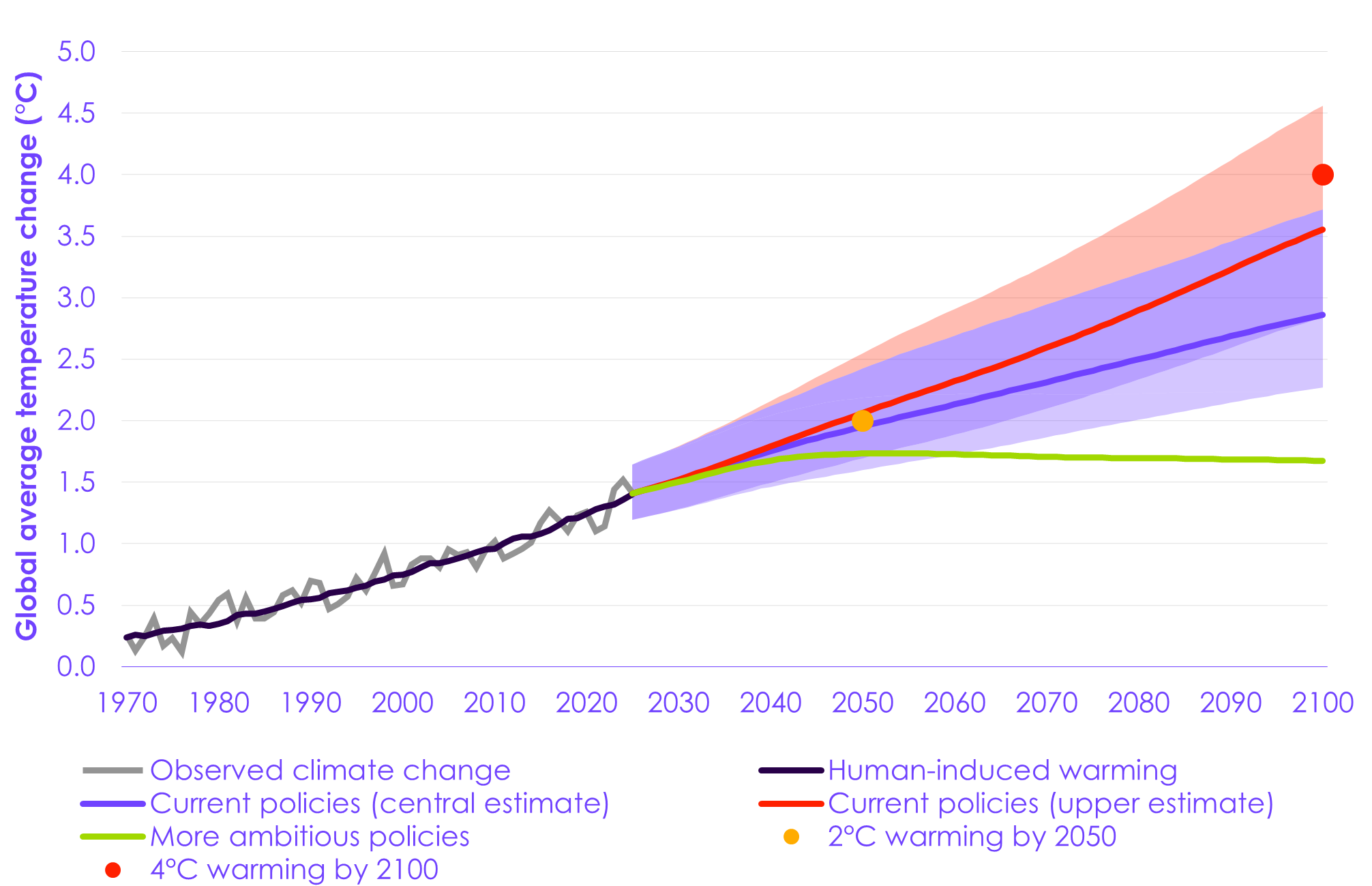 Description: Global temperatures have risen since 1970. Under current emissions scenarios, temperatures are projected to increase further to around 2ºC of warming by 2050. It is possible that under current emissions warming could reach 4ºC by 2100. More ambitious policies to reduce emissions could limit warming to around 1.7ºC by 2100. Source: Met Office (2025) Climate Dashboard – Tracking the Changing Climate with Earth Observations; Forster, P. et al. (2025) Indicators of Global Climate Change 2024: annual update of key indicators of the state of the climate system and human influence; Rogelj, J. et al (2023) Credibility gap in net-zero climate targets leaves world at high risk; United Nations Environment Programme (2025) Emissions Gap Report 2025: Off Target – Continued collective inaction puts global temperature goal at risk. Notes: (1) Current policies (central estimate) – the median expected effect of policies currently in place around the world. This scenario does not assume that existing Nationally Determined Contributions (NDCs) or Net Zero targets are delivered. (2) Current policies (upper estimate) – the upper end of the range of the expected effect of policies currently in place around the world. (3) More ambitious policies – the median outcome for a scenario in which global emissions decline rapidly, assuming all conditional NDCs and national Net Zero pledges are delivered. (4) The shaded bands show the 10–90 percentile ranges for these scenarios arising from climate response uncertainty. |
The impacts of ongoing climate change are increasingly visible in the UK. In summer 2022, unprecedented high temperatures, including record-breaking 40°C heat, caused the early deaths of over 3,000 people in England and Wales. Combined with widespread wildfires, emergency services experienced a 500% spike in 999 calls, putting huge pressure on their ability to respond. Human-caused climate change has made exceeding 40°C in the UK today at least 20 times more likely than it would have been in the 1960s.
The winter of 2023 to 2024 was the wettest October to March on record for the UK. Prolonged and repeated flooding displaced thousands of people and contributed to the second lowest arable harvest on record. The intensity of rainfall on stormy days during this winter was estimated to have been amplified by around 20% due to climate change.
Last year, 2025, was the UK’s hottest year on record. Very dry conditions were widespread, leading to the most destructive wildfire season ever recorded. Over 40,000 hectares burned, including the first wildfire over 10,000 hectares in the UK, which occurred in Scotland in June 2025.
Early 2026 was exceptionally wet in parts of the UK. Northern Ireland had its wettest January in 149 years, and long unbroken spells of rain have been seen in many parts of the UK, leading to widespread flooding. The impacts seen in the past few years, with swings between dry to wet periods, show that the UK remains inadequately prepared for the weather extremes already being experienced, let alone those coming in the future.
Priority risks under 2°C of global warming by 2050
By 2050, at around 2°C of global warming, the UK’s climate will be fundamentally different from the climate of today – which itself has already been altered by climate change. This will mean a wide range of hazards being felt in the UK, including increasing coastal erosion, risks of subsidence, and the effects of climate change overseas. However, there are three key hazards that drive fundamental challenges to the functioning of the UK.
- Intensifying heat: recent record hot summers (such as 2018, 2022 or 2025) will become the new normal summer – regularly stressing domestic agricultural production. Heatwaves lasting at least a week will be common – posing challenges for keeping vulnerable people sufficiently cool. In southern England, heatwaves could regularly exceed 40°C, and the hottest ones could be several degrees hotter than the record 2022 heatwave (Figure 2). Heatwaves hotter than 45°C could be possible.
- Growing flood risk: winter rainfall will rise with warming, meaning an average winter could be more like a wet winter today. The intensity of heavy bursts of rainfall throughout the year (not just in winter) could be around 15–60% higher than in the late 20th century – driving more risk of flash flooding and potential risks to life. Storms will have stronger extreme winds and bring more rain, and it is possible that they will be more frequent. This raises their potential to cause damage and disruption to property and infrastructure. Sea levels will be 20–45 cm higher around UK coasts than today, raising the severity and frequency of coastal flooding and coastal erosion.
- Rising drought and wildfire risk: despite bursts of increasingly heavy rain, summers will, on average, become drier. The number of days that have the potential conditions for serious wildfires could double, and the wildfire season will be longer, leading to increased exposure to the health harms from fire smoke and damages to infrastructure and buildings. Warm, dry weather will often arrive earlier in the spring and persist deeper into the autumn.
| Figure 2 Hottest temperatures recorded |
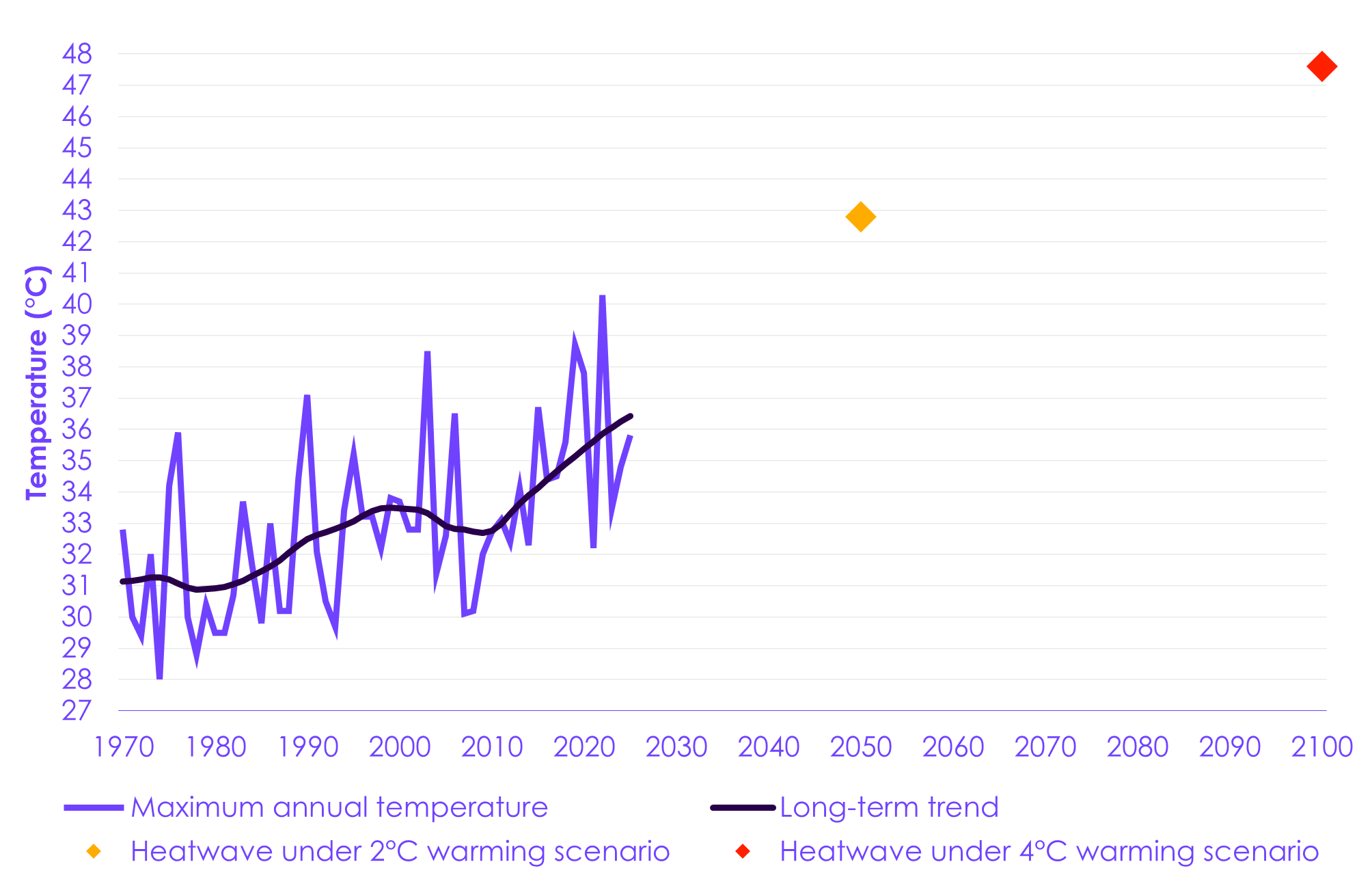 Description: The hottest temperature recorded each year in the UK has been increasing since 1970, with the trend increasing from around 31ºC to 36ºC, and the highest temperature of over 40ºC recorded in 2022. Under 2°C warming by 2050 and 4°C warming by 2100, extreme temperatures could be as high as 43ºC or 48ºC respectively. Source: Met Office (2025) Met Office Integrated Data Archive System (MIDAS) Land and Marine Surface Stations Database; Met Office (2025) UKCP Local Projections – on a 5km grid, bias corrected using scaled distribution mapping over the UK. Notes: (1) Data shows the maximum temperature recorded at UK meteorological stations for each year. (2) The long-term trend line is a loess smooth with a 50-year span that reveals the general trend in the data over a 50-year period. (3) Projection data are chosen to provide a similar likelihood to the 2022 40°C event. Corresponding events are shown in the maps in Figure 1.6. (4) The maximum temperature shown uses the fifth highest temperature value to avoid occasional single‑cell hotspots in the UKCP18 local projection data. |
If left unmanaged, climate hazards that are already threatening health, lives, livelihoods, and nature will rise further. The Committee concludes that eight climate risk areas are the highest priorities for action now – informed by the evidence summarised in the CCRA4-IA Technical Report. While not all aspects of climate change are predictable, these risks are well-enough understood to be addressed today. Priority adaptations, proposed targets, and recommendations for near-term actions by government are set out for each of these priority risks in the next section. Table 1 summarises the priority risks and a set of achievable proposed targets for 2050 or earlier to adapt to these risks.
| Table 1 Priority climate risks to the UK |
|
| Priority risk | Proposed adaptation target |
| Risks to the lives of vulnerable people from extreme heat | By 2050, excess heat-related mortality should be no greater, and ideally lower, than today’s annual average. |
| Risks of damage, disruption, and deaths from flooding | By 2050, the total number of residential properties impacted by flooding in the UK from all sources should remain no greater than today’s level. Levels of risk should be below today’s level in all parts of the UK where this is technically feasible and cost-effective. |
| Risks to water availability from drought | By 2040, water supply should be resilient to a 1 in 500-year drought. |
| Risks to the state of nature | By 2030, 30% of land should be protected for nature and by 2050 should be in good condition. |
| Risks to the viability of farming. | From now through to 2050, domestic food production as a share of food consumed should be sustainably maintained at 60% at least. |
| Risks of food insecurity and inflation | From now through to 2050, the impact of climate-related food price inflation on household budgets should be minimised. |
| Risks to the availability of insurance | From now through to 2050, the UK insurance protection gap should not grow due to climate change. |
| Risks of cascading impacts on infrastructure | From now through to 2050, critical infrastructure systems should continue to deliver reliable services and recover quickly from any disruption.[1] |
If global warming is allowed to reach 4°C above preindustrial levels by 2100, the UK’s climate will be unrecognisable, with potentially catastrophic impacts. Therefore, strengthened global efforts to reduce greenhouse gas emissions are essential to reduce the probability of reaching such high levels of warming. However, when planning assets with long lives, such as new settlements and long-lived infrastructure, the possibility of this much more extreme climate needs to be accounted for through flexible designs that can be upgraded if required over time.
As warming increases, so does the likelihood of abrupt climate shifts, cascading risks, and adaptation limits being reached – outcomes that would bring dramatic consequences for the UK and beyond. The ability of current tools to project these risks with confidence is still developing, and the full consequences of how these risks would play out across an interconnected world will not be entirely predictable. This means that the potential to underestimate the risks under such high levels of global warming is large.
Adapting to 2°C of global warming by 2050
Although climate risks are intensifying, the resulting damages are not inevitable. Proven and cost-effective adaptation measures are available for immediate deployment. Risks can be significantly reduced with established and cost-effective actions available to deploy now. Their implementation will be critical to protecting lives, infrastructure, and economic prosperity in the warming climate. Clear adaptation objectives, supported by targets to measure progress, are possible for all our outlined priority risks. These are set out below. The Committee also makes immediate recommendations for government to start addressing each these risks over the next few years.
1. Protecting from heat
Proposed target: by 2050, excess heat-related mortality should be no greater, and ideally lower, than today’s annual average.
Increasingly extreme and frequent heatwaves are the greatest risk to health in the UK from climate change. Annual heat-related excess deaths in heatwave periods already range from 1,400–3,000 each year, overwhelmingly concentrated among the elderly. By 2050, under 2°C of global warming, this could rise to 3,000–10,000 each year without additional adaptation. This would mean increased heat-related mortality in all parts of the UK, exacerbated by the UK’s ageing population.
Keeping people cool can avoid this increase in mortality. Cooling is especially important in people’s homes, care homes, and hospitals, where those particularly vulnerable to heat are most likely to be. New buildings should be designed to keep people cool from the outset. Low-cost passive cooling measures, such as natural shading, may be sufficient interventions in some parts of the country.
However, the intensity and duration of future heatwaves mean that we need to plan for more active cooling (such as air conditioning). Active cooling measures, alongside low-cost passive measures, are more likely to be needed for retrofitting existing homes (which make up the majority of homes that will exist in 2050). For some homes, relying entirely on passive measures to keep temperature to safe levels would either be not possible or too expensive.
Creating at least one cool room in a house through low-cost active cooling could help avoid significant national-level increases in heat-related mortality if deployed in the 30% most vulnerable urban households. Further rollout could reduce mortality further and would also be cost-effective. Households and businesses will and should increasingly install cooling for their own comfort and productivity. Additional support might be needed to ensure that sufficiently effective cooling can be accessed by those who are both heat-vulnerable and low-income. Increased levels of active cooling can be managed alongside the transition to a reliable low carbon electricity system (as modelled in our advice on the level of the Seventh Carbon Budget). Heat pumps which provide both low-carbon heating and cooling could help to ensure this is achieved at low-cost and with minimal disruption, particularly for new builds.
It will take time to roll out cooling in all the places where it is needed. While this happens, lives can be saved with other low-cost, no-regrets, and rapidly scalable adaptation actions. These include preventative healthcare visits to heat-vulnerable people, the creation of public cool spaces (as seen in other European countries), changes in working practices, and support to deliver changes in behaviour for those at risk. These actions, alongside cooling in the healthcare system, could avoid around 40% of projected heat-related mortality in 2050 and help to relieve the already significant pressures from heat on healthcare.
Recommendations for government
To drive forward adaptation in the next two years, government should:
- Invest in cooling for key public services. Cooling will be needed in critical settings such as hospitals, schools, prisons, and care homes in many parts of the country to protect wellbeing and often lives. Low-cost passive measures should be used, especially in new builds. In areas at greatest risk, active cooling will be needed alongside low-cost passive measures, to manage risk fully. To minimise cost and disruption, this needs to be aligned with the transition to low-carbon heating systems where possible. Regulations and standards can drive uptake in privately provided services such as care homes.
- Set maximum temperature regulations for workplaces. Maximum working temperature regulations would address the increasing risks that high temperatures pose to workers’ safety and incentivise the deployment of the necessary cooling. Businesses are largely responsible for investing in their own adaptations but must ensure that workplaces and working practices are safe for employees, including for those working outside.
- Accelerate the uptake of cooling for the most vulnerable. Most households will invest in cooling themselves. However, those who have low incomes and are already vulnerable (for example, low-income pensioners) might need additional support. Mechanisms could build on existing incentive schemes that reach these groups, including by supporting heat pumps capable of cooling as well as heating.
2. Managing flood risk
Proposed target: by 2050, the total number of residential properties impacted by flooding in the UK from all sources should remain no greater than today’s level. Levels of risk should be below today’s level in all parts of the UK where this is technically feasible and cost-effective.
There are nearly seven million properties located in flood-risk areas across the UK today. Annual flood damage is already estimated at £3.3 billion per year (2025 prices). By 2050, under 2°C of global warming, the number of properties at risk could increase by up to 40% and potential annual damages from flooding are projected to rise to £4.5 billion (2025 prices). Without additional action, places that are already at risk of flooding will flood more often and more severely, and new areas will be at risk of flooding.
Protecting properties from flooding wherever possible should be the priority for addressing growing flood risk. The cost and health impacts on those who are affected by flooding are great, and wider disruption to the economy is significant. Well-maintained flood protections and adequate drainage, in the right places, created for the right depth of flood water, are needed. It is vital that new developments are restricted from building in places that could be at flood risk today or later in the century, unless sufficient measures are implemented to protect them. Surface water flooding will be an increasingly important risk. This will need to be addressed by adequate drainage including through increased use of permeable surfaces, such as green space, in towns and cities.
However, even with improved large-scale flood protections, flood water cannot be kept from all homes and businesses under all conditions. Lower-cost measures to prevent water from damaging properties (such as one-way valves on wastewater pipes, flood doors, barriers, and covering air bricks) will be necessary, particularly for surface water flooding. A rapid rollout of property-level measures over the next five years in places that are already at risk of flooding could cut average annual flood-related losses by up to half. In other places, there will need to be challenging conversations with communities where flood protection is not viable, especially with rising sea levels. Evacuation plans, effective warning systems, and sufficient emergency response capability will all be needed in these places to live with some level of flooding risk. Managed relocations will be necessary in some cases to manage risk from coastal and potentially river flooding.
Keeping the aggregate level of flood risk across the country at levels similar to today will require significantly more investment than we are currently putting into flood risk management. Investment will be needed both for maintenance and strengthening of existing assets to appropriate standards, alongside new protection schemes. A sustained programme of investment of around £1.6–£2.2 billion each year (2025 prices) through to 2050 is required to keep overall risk similar to today’s levels. This funding will be mostly public but should leverage private investment where possible.
Recommendations for government
To drive forward adaptation in the next two years, government should:
- Invest more into long-term flood defence programmes. Investment in flood risk management must rise to around £1.6–£2.2 billion each year (2025 prices) across the UK to hold flood risks approximately constant at today’s levels despite climate change. This will ensure that large-scale programmes for building and maintaining flood protections (both traditional and natural) are sufficiently well-resourced over the long term. Protections must cover surface and groundwater, as well as river and sea flooding, and be delivered in time to reduce impacts on households. This investment would also support property-level actions, asset maintenance, and early warning and emergency response systems.
- Ensure new buildings are not increasing the risks of climate change impacts. Planning policy must be sufficiently robust to ensure new builds are fit for the future climate over their lifetimes (2°C global warming level by 2050 and considering 4°C by 2100) and don’t increase risks, either locally or for others. New developments should not be built in undefended areas at risk of existing and future flooding and coastal erosion. Climate resilience needs to be a core part of planning frameworks, reflective of the latest evidence. Compliance needs to be enforced.
3. Avoiding water shortages
Proposed target: by 2040, water supply should be resilient to a 1 in 500-year drought.
Water scarcity is becoming more prevalent. In April 2025, almost all of Scotland experienced an early warning of water scarcity. Parts of South East England remained in drought, requiring temporary restrictions on water use, until January 2026 following prolonged dry weather in summer 2025. By 2050, under 2°C of global warming, current projections estimate a five billion litre per day shortfall of public water supplies in England – with similarly rising risk in dry parts of Northern Ireland, Scotland, and Wales. Without action, this would create costly and widespread water restrictions that go beyond today’s hosepipe bans and lead to losses for water intensive industry and agriculture. Without adaptation, some areas of the UK may need to use options such as standpipes in the street and restrictions on access to water for non-essential uses, to avoid the taps running dry.
Effective water management is essential for dealing with rising drought risks. Some adaptation is underway, but action to manage drought risks will need to be increased and funded at a higher level over the decades ahead.
Storing excess water from wetter periods allows it to be used in drier ones. A sustained programme of investment in large-scale water storage – such as reservoirs – is vital. This investment can also help to address flood risks in periods of too much water. Small-scale storage, such as in industry or on farms, can also be effective. Water transfers, which move water from regions that have enough to those that do not, can help the UK to use its available water more flexibly.
Large water supply projects like reservoirs can take decades to build. However, drought risks are already rising. It is essential to take the immediate actions that are available to reduce the risks. These include increasing efficiency and behavioural changes in households and businesses, and improving leakage rates from the water system. It is estimated that these actions would meet up to 80% of the deficit in England over the next decade and will be similarly important in the other nations of the UK. While demand and leakage are decreasing, this is not happening fast enough to meet existing near-term or necessary long-term targets.
Together these adaptations can deliver improved water system resilience, with the UK becoming resilient to a more severe 1 in 500-year drought by 2040. Meeting this target would mean that we would not rely on emergency measures like standpipes for drought management – except in very rare circumstances. Funding for this adaptation would be provided from water users primarily via (regulated) bills in England, Scotland, and Wales, and from the taxpayer in Northern Ireland. Water efficiency labelling and smart metering, where the effects of different user choices are clear, are key to support actions by households on water efficiency.
Recommendations for government
To drive forward adaptation in the next two years, government should:
- Ensure regulation in the water sector maintains a clear focus on drought. Regulators need robust climate resilience mandates to drive investment. In the water sector, progress on adaptation is being made. However, it is not happening fast enough and it is struggling for attention above the challenges of dealing with the environmental effects of sewage. Public confidence in the water sector in England is low. Regulatory reforms that are being proposed in England and Wales must help to restore public confidence and maintain investment in drought resilience over the next decade. The regulatory system should support the linking of actions in the water sector that would manage both drought and flood risks (for example, partnership funding with Lead Local Flood Authorities).
- Ensure new development is drought sensitive. New homes should be built to use water efficiently. Minimum water efficiency standards for appliances can ensure more efficient appliances become the default for households and businesses. Water intensive infrastructure, such as data centres, should be sited and constructed without adding to regional drought risk, and with minimum standards to avoid the lock-in of less efficient technologies.
4. Supporting nature to adapt
Proposed target: by 2030, 30% of land should be protected for nature and by 2050 should be in good condition.
The UK is already one of the most nature-depleted countries in Europe, with further degradation being accelerated by emerging climate change impacts. Without additional adaptation, by 2050 under 2°C of global warming, there is a risk of widespread ecosystem loss and disruption. This includes globally unique ecosystems such as chalk streams – making existing nature restoration targets impossible to achieve. Unless they adequately consider climate change, nature restoration efforts risk creating small and fragmented habitats which are more vulnerable to species loss as the climate changes. This will mean that protection goals may not lead to land being in good ecological condition in 2050 and beyond.
The UK’s nature will change in response to climate change. To adapt well, habitats need to be healthy, diverse, connected, and well-managed. If successful, this climate resilient natural environment will provide benefits beyond adaptation. These benefits include reducing other risks not primarily driven by climate change, and maximising the health, economic, and societal benefits provided by nature. Greater diversity of terrestrial habitats at a genetic, species, site, and landscape scale will increase resilience through spreading risk and reducing climate-driven losses. Increasing habitat connectivity will enable species to move more easily and adjust their range as the climate changes. This will help maintain species diversity.
Actions to prepare for and reduce the occurrence and spread of wildfire in natural landscapes are increasingly important. Wildfire risk management needs to be built into other land management and nature restoration actions, such as woodland planting or habitat creation. Early warning systems and education can help prevent wildfires from starting and spreading.
These adaptations are needed for successful delivery of existing nature restoration goals – such as the ’30 by 30’ commitments that governments around the UK are signed up to. Regulations and public funding for nature restoration need to reflect the realities of the UK’s changing climate. Significant strengthening is required. Crucially, measurement, protection, and restoration of nature need to be forward-looking and focused on the species and habitats that can thrive under future local climate conditions, instead of past ones, in different parts of the UK. Current policies and designations for nature protect what we currently have and are not designed to accommodate a change in climate.
Recommendations for government
To drive forward adaptation in the next two years, government should:
- Invest public money in nature restoration compatible with future climate change. Actions on UK land are partly funded by public subsidies. Future subsidies should be targeted to support nature and to make growing food sustainable in a future climate. More coherent and joined-up land use frameworks and planning can integrate adaptation responses across landscapes, bring land users together, and scale up action to adapt.
- Make nature protection regulation forward looking. Habitat regulations and legislation are important tools to protect sites of environmental importance. Protected site designation and regulation, which drive approaches to management, need to move away from being based on current or past baselines. These are increasingly difficult (and at times no longer possible) to achieve as these sites change in response to climate change.
5. Keeping farming viable
Proposed target: from now through to 2050, domestic food production as a share of food consumed should be sustainably maintained at 60% at least.
UK farmers are already being impacted by the effects of extreme weather including flooding, heat, and drought. Challenging weather conditions for farming are often occurring in consecutive seasons and at unprecedented severity. For example, yields in the UK were over 10% lower than the 10-year average for crops like wheat and oats due to the hot and dry spring and summer in 2025. By 2050, under 2°C of global warming, the amount of high-quality farmland is predicted to drop from an average of around 40% of land in England and Wales (between 1961 to 1990) to just over 10% by 2050 without adaptation. In the worst years, disruption could make some farms unviable.
Farming needs to adapt to remain viable. What is produced and how it is produced will need to change to ensure farming can survive the bad years and flourish in the good ones. Resilient soil and water management practices and better use of technology will be needed across all farm types, as well as leaving more space to help nature adapt on farmed land.
Some farms will have to shift production entirely. New crops will need to be grown that are more appropriate for future climate conditions. Warmer weather brings some opportunities on this front – as do the required changes in farming for the UK to reach its Net Zero by 2050 target. Crops such as oranges or chickpeas will become viable in the south of the UK with warmer average temperatures.
Adaptation is required to maintain existing target levels of the proportion of food consumed that is produced in the UK at 60% (by value) at least. This will support a thriving farming sector in our future climate. Farmers will need new skills, training, and access to finance to help them adapt. Public subsidies for farming will need to incentivise the adaptation necessary for sustainable long term food production. These are a material share of income for many farms.
Recommendation for government
To drive forward adaptation in the next two years, government should:
- Support the viability of farming under climate change. Farmers must be enabled and encouraged to take adaptation actions (such as storing water on farms, changing farming practices, and varying what is produced) to keep farming viable. Government can enable farmers by providing access to the right skills, information, and training to empower farmers to make the appropriate decisions for their farms. Removing regulatory barriers to farmers adapting their business models, such as making it easier to store water on farms, can help facilitate action in the sector. Subsidies that continue to support agricultural production should be used to provide incentives to adjust farming models as needed to adapt.
6. Understanding the risks to food security
Proposed target: from now through to 2050, the impact of climate-related food price inflation on household budgets should be minimised.
Around 40% of the food we eat is imported. Therefore, international climate impacts can be just as important for food prices in the UK as domestic ones. By 2050, under 2°C of global warming, simultaneous crop failures in multiple major producer regions, or significant disruption of food supply chains, could lead to increased food prices and more volatile inflation. This would hit lower-income households the hardest. Climate change also raises the potential risk of food shortages across entire nutritionally important groups for sustained periods.
Food businesses across the entire value chain will need to develop measures to manage risks in the privately operated food system. Actions that could be taken to adapt include diversification and investment in resilience across supply chains, as appropriate to individual business models. These ensure that food of sufficient quantity and quality can be provided.
Government-led stress-testing of critical food supply chains will be needed to gain a better understanding of what can go wrong in food supply chains and where bottlenecks might exist. Government may also need to provide ‘top-up’ help to lower income households during food price shocks, as it does today in parts of the UK during unusually cold weather.
Objectives on food security, that consider climate risks, have already been set by the UK Government. However, supporting targets that operationalise the objectives, specifically for addressing the climate risk, are lacking. There is more work to do to determine the level to which food price shocks can be minimised, but progress against this target could start to be measured by assessing the change in price of a climate-impacted basket of goods.
Good information is vital in this sector. Private sector adaptation in the food system can be supported by enhanced corporate sustainability disclosures on climate risks and adaptation, under standardised approaches. These are not covered in sufficient detail under existing corporate disclosure regimes (such as the Taskforce on Climate-related Financial Disclosures) that large food supply chain businesses are subject to.
Recommendations for government
To drive forward adaptation in the next two years, government should:
- Improve information on climate risk in the food system. The Adaptation Reporting Power (ARP) is a key lever to gather information on climate risks and force key organisations to plan for climate change. Large food companies (including supermarkets) should be included in the scope of the next set of ARPs, and reporting under the power should be made mandatory, to provide critical information on risk management in the food system.
- Explore government-led adaptation. Government should also explore the viability of government-led adaptation in the food system. This should include systemic stress-testing in the medium to long term to work out what could go catastrophically wrong in the food system. It should also consider the potential for large-scale national food stockpiling to avoid risks of shortages across whole nutritionally important groups. It should also explore the use of policies to alleviate the impacts of food price inflation.
7. Maintaining access to insurance
Proposed target: from now through to 2050, the UK insurance protection gap should not grow due to climate change.
Flood-related insurance claims are rising. Home insurers have paid out more in claims than they received in premiums for the five years to 2024. By 2050, under 2°C of global warming, many homes and businesses, particularly in areas of high flood risk, may not be able to access insurance due to lack of coverage or high premiums. This impacts those with low incomes the most and threatens the viability of the property market, the local economy, and the sustainability of communities in these regions.
The UK’s insurance gap is a measure of the share of economic losses from natural catastrophes that is not covered by insurance. The UK’s overall protection gap was estimated at 29% in 2024, with an average of 22% over the past decade. This is low relative to most other countries, but without sufficient adaptation, the protection gap is expected to grow as climate risks increase and new climate risks emerge. A large insurance protection gap means many homes and businesses cannot access insurance due to lack of coverage or high premiums. It also puts stress on the financial sector, as banks face higher default rates on mortgages and business loans, and on public finances through disaster support needs.
A resilient and affordable insurance market is vital for enabling businesses and households to manage their risks and to recover quickly from climate events. Achieving this will depend on effective adaptation, so that residual risks remain insurable. It is also likely to require continued government involvement in the insurance market, building on experience with Flood Re, which has supported the availability of insurance for homes facing flood risks. New business models will help insurers to continue serving UK homes and businesses. Innovations could include incentives for adaptation, products that bring capital into insurance, and new risk-pooling mechanisms. Other climate risks, such as wildfire and increased subsidence may create risks to insurance provision and need to be better assessed and understood before potential issues arise.
Meeting this target will mean that most properties and activities can continue to access insurance across key hazards (particularly flooding) as the risk of damage increases.
Recommendation for government
To drive forward adaptation in the next two years, government should:
- Clarify the future of flood reinsurance. The 2039 end date for the Flood Re reinsurance scheme is already creating uncertainty in the property insurance market. It could start to have impacts on housing market decisions for properties that continue to be at flood risk. Government must provide clarity by undertaking an in-depth review leading to a publicly announced decision on the future of Flood Re within the next five years.
8. Adapting infrastructure to avoid cascading disruption
Proposed target: from now through to 2050, critical infrastructure systems should continue to deliver reliable services and recover quickly from any disruption.
Infrastructure systems are increasingly connected and so impacts to one system can cascade into other systems. By 2050, under 2°C of global warming, weather-related infrastructure damage and service disruption could be common. A key dependency comes from the electricity distribution system. Overheating of power systems in heat extremes could trigger power cuts with the potential to cause knock-on outages, such as to digital payments, transport systems, and public services, costing billions in losses and recovery. These costs will eventually be passed onto households – often impacting those on low incomes the most.
Key infrastructure systems need to be designed and maintained to work appropriately for the weather conditions expected over their lifetimes. This is the fundamental step in reducing the risks of cascading infrastructure failures. For shorter-lived infrastructure assets, it will often be most
cost-effective to replace assets at the end of their life with upgraded alternatives, designed to be resilient from the outset. But much of our infrastructure has long lifetimes and will need to be retrofitted.
Significant infrastructure investments are being made now in water, energy, and transport, giving a critical window to ensure that new assets in these systems are adapted for future climate. Standards should be set for infrastructure resilience consistent with an expected 2°C global warming level by 2050 and considering the possibility of 4°C global warming by 2100. For existing long-life assets, upgrading and maintenance will be essential to ensure that they can continue to function. Where affordability is constrained, actions will need to target the most vulnerable and critical parts of the network.
To deal with the potential for cascading risks, improved governance frameworks with clear roles and responsibilities are necessary to support coordination between critical infrastructure sectors and their key service users. There should be coordinated assessment and management of cascading climate risks between sectors and joint planning of the responses across sectors to extreme events. Government needs to facilitate this by setting clear responsibilities for addressing cascading risk. In particular, government needs to ensure regulators have responsibility to help their sectors to work together and fund the necessary action. Developing appropriate standards, methods, and metrics for cross-sector collaboration can help facilitate this.
Recommendation for government
To drive forward adaptation in the next two years, government should:
- Establish a more structured approach to managing interdependencies. Coordination is lacking in a range of areas to manage interdependencies effectively, particularly for Critical National Infrastructure (CNI). Implementing the recommendations from the North Hyde review, and the commitments from the UK Government’s response, would help to address this. Establishing clear responsibility for addressing interdependencies should be integrated within efforts to set infrastructure resilience standards by 2030.
The investment case for a well-adapted UK
The adaptation actions needed for the UK are mostly known and available today. The challenge is to deploy these adaptation actions with sufficient speed and at sufficient scale. Adaptation does not need to wait for the promise of future technological progress. We can start building a well-adapted UK with what we know and can see works today.
Adapting now can avoid unnecessary harm that is already happening today. Adapting now will cost the UK less than dealing with the damages and disruption from climate change. The measures identified in this report will bring benefits that will pay back the investments in them several times over their lifetimes (Table 2).
This report identifies an annualised investment need of at least £11 billion per year (range £7–£22 billion, 2025 prices) from today to the 2050s. Limits in data and methods mean this is likely to be an underestimate, but it gives a sense of the scale of investment needed. Most of this investment is dominated by three core adaptations of cooling, flood preparedness, and water management (Figure 3). Deployed at scale, these three adaptations could save tens of billions of pounds in climate impacts each year, averaged over their lifetimes. This scale of investment, shared between public and private sectors, is feasible for the UK economy. Total UK investment in 2025, across all categories, was £547 billion, around 50 times as much.
There is strong support from the public for a pragmatic programme of adaptation that will make a real difference to their lives. People want their health, homes, and livelihoods to be protected and they know that the UK is not yet prepared to deal with the impacts of climate change. Stepping up delivery does not have to be complex. The pragmatic principles for effective adaptation, set out in Chapter 3, provide an action-oriented guide to do adaptation well, avoid lock-ins, and take advantage of opportunities. Ambition can be set, effective actions identified, delivery enabled, and progress evaluated. Examples at local, national, and international levels increasingly show that these challenges can be overcome with sufficient will and leadership from government at both national and local levels.
| Table 2 A selection of UK-based benefit-cost ratios for adaptation actions |
||
| Hazard | Adaptation actions | Benefit-cost ratios |
| Flooding | Natural flood management. | 3:1–5:1 |
| Property flood resilience measures. | 5:1 | |
| Flood and coastal erosion risk management. | 5:1 | |
| Warming | Active cooling measures with some passive cooling (for example, loft insulation, shutters). | 3:1[2] |
| Heatwave plans. | 10:1–30:1 (for the 2040s) | |
| Drought | Demand-side water efficiency measures. | 1.8:1 |
| Rainwater harvesting and storage. | 2:1 (property level), 3:1 (community-level) | |
| Supplying water via transfers and storage infrastructure. | 11:1 (range 7:1–15:1 across England sub-regions) | |
| Multiple hazards | Proactive maintenance of existing infrastructure. | 5:1–10:1 |
| Emergency response, prevention, and protection by UK Fire and Rescue Services. | 6:1 | |
| Embedding climate resilience into new infrastructure. | 4:1 | |
| Notes: (1) This table highlights a selection of benefit-cost ratios (BCR) from external literature and bespoke research projects for the Well-Adapted UK report. It highlights feasible actions that are cost-beneficial today. These were selected as point estimates or ranges from robust literature sources. The costs included will vary by source, but broadly include the capital, operating, and maintenance expenditure required to deploy an action. (2) The benefits primarily refer to the directly avoided damages from climate change by implementing an adaptation measure, as well as co-benefits that can and have been quantified. These vary significantly by source. (3) The BCRs presented are from both retrospective and modelled studies. |
||
| Figure 3 Known investment needs for adaptation |
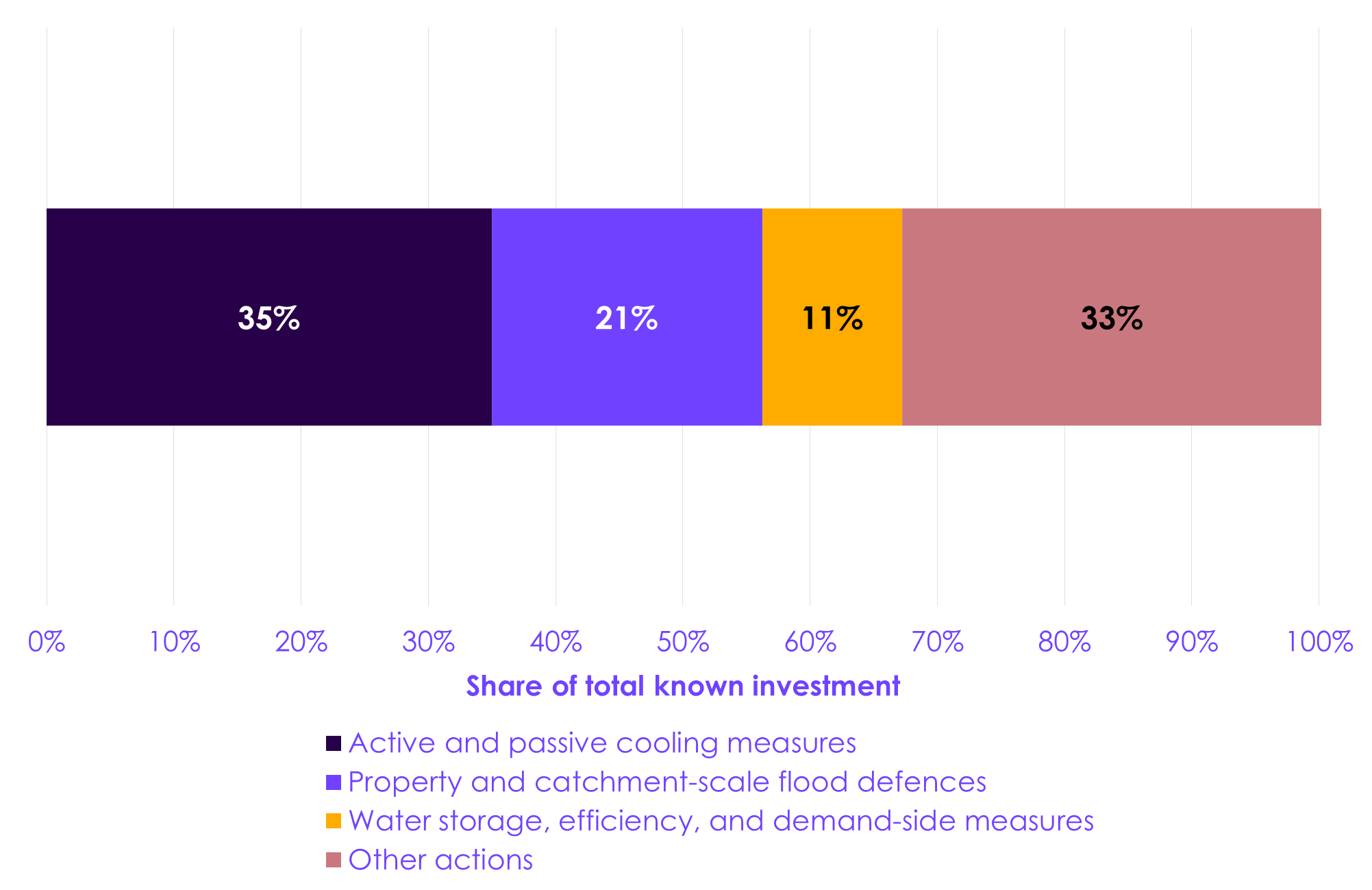 Description: Two-thirds of the known investment needed for key adaptation actions comes from three actions: cooling measures, flood risk management, and water storage and efficiency. |
Delivering a well-adapted UK
Delivering the adaptation set out in this report requires action from across society. Households will need to invest in their own resilience and change their behaviours to avoid unnecessary risks. Businesses will be responsible for investing in their own upgrades and will play critical roles in adapting privately operated systems such as food provision and infrastructure. Government must create the policy environment, with incentives, regulation, standards and information, as well as support to enable businesses and households to protect themselves. The public sector will need to fund adaptation actions which have large public benefits (such as flood protection and nature management), support low-income households who cannot meet the costs of adaptation, and adapt public services to protect their functioning.
Recommendations to build a better national adaptation framework
For too long, adaptation across the UK has suffered from a national approach and a framework that is not fit for purpose. A working adaptation governance framework that can give the public sector, businesses, and households clarity on their roles in delivering a well-adapted UK is urgently needed.
We recommend four steps which need to be taken now to establish an effective adaptation governance approach.
- Establish meaningful adaptation objectives, supported by targets, and assign ownership. Existing visions for adaptation lack meaningful objectives and measurable targets. These need to be put in place by the time of the next set of national adaptation plans (NAPs), due around 2028, even if they are not perfect. Objectives and targets can be improved over time and additional ones added as needed. In this report, the Committee propose a set of objectives and targets which can provide a starting point to adapt to a 2°C global warming level by 2050. On some, there is a need for a public dialogue on acceptable levels of risk and cost. Accountability for each target must be clearly allocated to the appropriate part of government. The relevance and adequacy of adaptation objectives should be reviewed regularly: the five-yearly assessment of the latest evidence of impacts required under the Climate Change Act would allow for that review.
- Create delivery plans, backed with the necessary resources to deliver the objectives. Delivery plans for each target must be put in place. For these plans to succeed, they need to be backed with upfront investment. Not all the actions or funding needs to come from government. However, government must provide clarity on who is expected to act and invest, what that looks like, and how it will be enabled. On current practice, we estimate that close to half of the investment needed over the next 25 years would come from the public sector. The next NAPs need to provide clarity on how much is currently being spent on adaptation and how this will be scaled up to the required levels during the next NAP period (around 2032) at latest.
- Monitor delivery progress against targets. A complete and consistent monitoring and evaluation framework needs to be put into operation to track outcomes of adaptation delivery. This report sets out what can currently be tracked and where monitoring needs to be strengthened, for each of the 14 systems covered. Government needs to use these monitoring frameworks to track progress towards adaptation targets and publish annual updates. Regular reviews of progress, within each NAP cycle, should be undertaken by government to allow ambition and plans to be adjusted as necessary and to ensure that adaptation resources are used effectively. The Committee will continue to provide independent scrutiny, as required under legislation.
- Improve tools, methods, information, and skills on adaptation. Improving the capacity across government on adaptation should be a priority for the NAPs. In too many places, adaptation is poorly understood, undermining effective action. Priorities include high-level standards, planning assumptions, and tools for climate risk assessment and adaptation action. These should focus on supporting the uptake of the principles for effective adaptation proposed in Chapter 3 of this report, across government and beyond.
Taking the next steps
Chapter 1 to Chapter 3 of this report cover the climate risks facing the UK and summarise the case for adaptation and how it can be done effectively. Chapter 4 to Chapter 17 contain a detailed analysis of what it means to be well-adapted to climate change in the UK across 14 key systems, as well as connections between those systems. This builds on the analysis in the CCRA4-IA Technical Report, which provides a detailed assessment of UK climate risks, and is published alongside this report. Objectives and targets, including but not limited to the proposed targets covered in this executive summary, are set out in each chapter to provide a starting point for measuring what a well-adapted UK could mean in each of those systems (see Annex 1).
It is now up to the UK Government to consider this advice and to lay a Climate Change Risk Assessment before Parliament by January 2027. It is then for the UK Government, Northern Ireland Executive, Scottish Government, and Welsh Government to respond with their next national adaptation plans.
A well-adapted UK is both necessary and achievable, but also urgent. Action is required right across society from households, businesses, and the public sector. Continued delay will lead to greater costs, more lives lost, and livelihoods ruined. The choice to move on from the failures of the past now sits clearly with government.
Chapter 1: UK climate change risk
Introduction and key messages
The UK is already experiencing the impacts of changing weather and climate, driven by rising greenhouse gas concentrations in the atmosphere caused by the burning of fossil fuels and changes in land use. This chapter sets out the evidence on current and predicted climate change and the risks this creates to the UK, now and in the future.
Our key messages are:
- The UK’s climate has already changed and impacts are being felt now across all nations. The ten warmest years in the UK have all occurred since 2000, and temperatures over 40°C were recorded for the first time in 2022. Heatwaves have become hotter, longer, and more frequent. Sea levels are rising around the UK’s coasts and heavy rainfall is becoming more intense. The impacts of these changes, driven by ongoing global greenhouse gas emissions, on health, communities, infrastructure, nature, and the economy are a reality today.
- Further climate change is inevitable. Global climate risks rise with each increment of global warming. Until the world reaches Net Zero CO2 emissions, with deep reductions in emissions of other greenhouse gases, global temperatures will continue to rise. Even under ambitious emission reduction scenarios, global warming will reach 1.5°C by about 2030. The world is currently heading towards around 2°C warming by 2050 and close to 3°C warming by 2100. Higher warming scenarios remain possible, potentially exceeding 4°C by 2100. Keeping to lower levels of global warming can still be achieved but requires more ambitious reductions in global greenhouse gas emissions than currently expected.
- Global warming of 2°C in 2050 will bring risks much more extreme than today. Hotter, longer heatwaves, which may regularly exceed 40°C in parts of the UK, will result in increased risk to life and health, and damage to our places, nature, and the economy. Wetter winters, more intense downpours in summer and autumn, and rising seas will drive up flood risk. Summers like 2018, 2022, and 2025 will become normal and extreme summers will become even hotter and drier, increasing drought risk. Wildfire hazards that only occur occasionally today, will be experienced in most years over larger areas, putting more pressure on emergency services.
- Global warming of 4°C by 2100 would pose fundamental challenges to society. Extremes in weather that are seen today would be more like average conditions in this scenario. The interactions of the extreme domestic risks, and the complex and cascading consequences of a world moved into unknown climate conditions, would severely compromise almost all aspects of life as we experience it in the UK today. Reductions in global greenhouse gas emissions remain essential to minimise the chance of these catastrophic damages.
This chapter sets out what we know about current and future UK climate risk. This brings together changes in weather hazards, exposure, and vulnerability into a combined assessment of climate impacts and risks (Box 1.1). Section 1.1 summarises the change in hazards facing the UK. Section 1.2 summarises important trends in the exposure and vulnerability to hazards over the coming decades. The effects of changes in hazard, exposure, and vulnerability combine to determine the overall risks from climate change facing the UK. This is summarised in Section 1.3.
| Box 1.1 Hazard, exposure, and vulnerability |
Climate change increases the risks to health, communities, infrastructure, nature, and the economy in the UK. The level of risk is determined by three key factors: the severity of the hazard that can cause damage, the level of exposure to the hazard, and the vulnerability of the people, places, and nature exposed to the hazard.
|
1.1 The changing climate
This section covers both the observed and projected climate changes globally and in the UK.
1.1.1 Global climate change
Concentrations of greenhouse gases in the atmosphere continue to rise mostly from the global use of fossil fuels, agriculture, and land use change. This is resulting in continued global warming and rising climate impacts around the world.[4] The extent of future warming and associated impacts depends on the speed of global efforts to reduce greenhouse gas emissions.
- The global climate system has already changed. Human caused warming of global average surface air temperature has reached 1.4°C above preindustrial level in 2025 and is rising at a record rate of around 0.25°C per decade.[5];[6] All of the observed global average warming (relative to preindustrial levels) is attributable to human activity. Observed global average long-term surface air temperature is rapidly approaching 1.5°C above preindustrial levels. In 2024, the average global temperature temporarily reached 1.55°C above pre-industrial levels, the highest in modern records.[7]
- Serious impacts from climate change are already being felt around the world. Record-breaking heatwaves, floods, and wildfires are becoming more frequent and intense across the globe. Unprecedented events are happening at increasing frequency, with serious consequences for health, communities, infrastructure, nature, and the economy (Box 1.2).[8];[9] These are assessed to have been virtually impossible without human-caused climate change. Global sea levels are rising at an accelerating pace, driven by glacier melt, the thermal expansion of warming oceans, and the melting of ice sheets in Greenland and Antarctica.[10] Glaciers are retreating at record rates, threatening freshwater supplies and increasing the risk of glacial lake outburst floods and glacial landslides.[11];[12]
Further global warming is inevitable. Current trends indicate that the world will reach 1.5°C of warming above preindustrial levels by 2030 and around 2°C by 2050 with warming continuing thereafter (Figure 1.1). Warming as high as 4°C above preindustrial levels by 2100 cannot yet be ruled out.
- Current emissions pathways point to around 2°C global warming level by 2050. Global warming will continue until the world reaches Net Zero CO2 emissions (the point at which the remaining production of CO2 emissions is balanced by removals, such as through tree growth or engineered removals), with deep reductions in other greenhouse gases.[13];[14] Even under the most ambitious global efforts to reduce global greenhouse gas emissions it will take several decades, at least, to transition fully away from fossil fuels. Based on currently expected global emissions, global temperatures could rise to nearly 3°C above pre-industrial levels by the end of the century.[15] Sea levels will continue rising for decades to centuries even when global temperatures stabilise.
- High warming outcomes, reaching 4°C global warming level by 2100, remain plausible and should be considered in long-term planning. There is still a possibility of higher and faster global warming if the global climate warms faster than expected to greenhouse gases or if global efforts to reduce emissions stall and start to reverse. In such cases, warming could reach near to 2.5°C by the 2050s and potentially exceed 4°C by 2100. Tipping points, such as the collapse of major ice sheets, dieback of the Amazon rainforest, and disruption of ocean circulation patterns, are possible under today’s climate but will become significantly more likely in high warming outcomes.[16] If triggered, these tipping points could lead to cascading effects that amplify global warming and make climate risks increasingly difficult to manage.
Global climate risks grow with each additional increment of warming, driving more frequent and more destructive record-breaking extremes. The UK cannot be isolated from these global changes. They will impact the UK directly and through connected global systems (such as supply chains and global commodity markets).
Global warming can still be limited to well-below 2°C, with temperatures peaking close to 2050. This can be achieved only if global emission reductions accelerate far beyond currently expected rates and countries strengthen and fully deliver both their near‑term pledges and long‑term Net Zero targets. Reducing future global greenhouse gas emissions from today’s rates would also lead to a slower rate of global warming, giving more time and space to adapt – particularly after 2050.[17] While global greenhouse gas emissions reductions are essential, they are not enough alone to avoid the impacts we are already experiencing, as well as those that will come in the next decades.
| Figure 1.1 Global warming under different emissions scenarios |
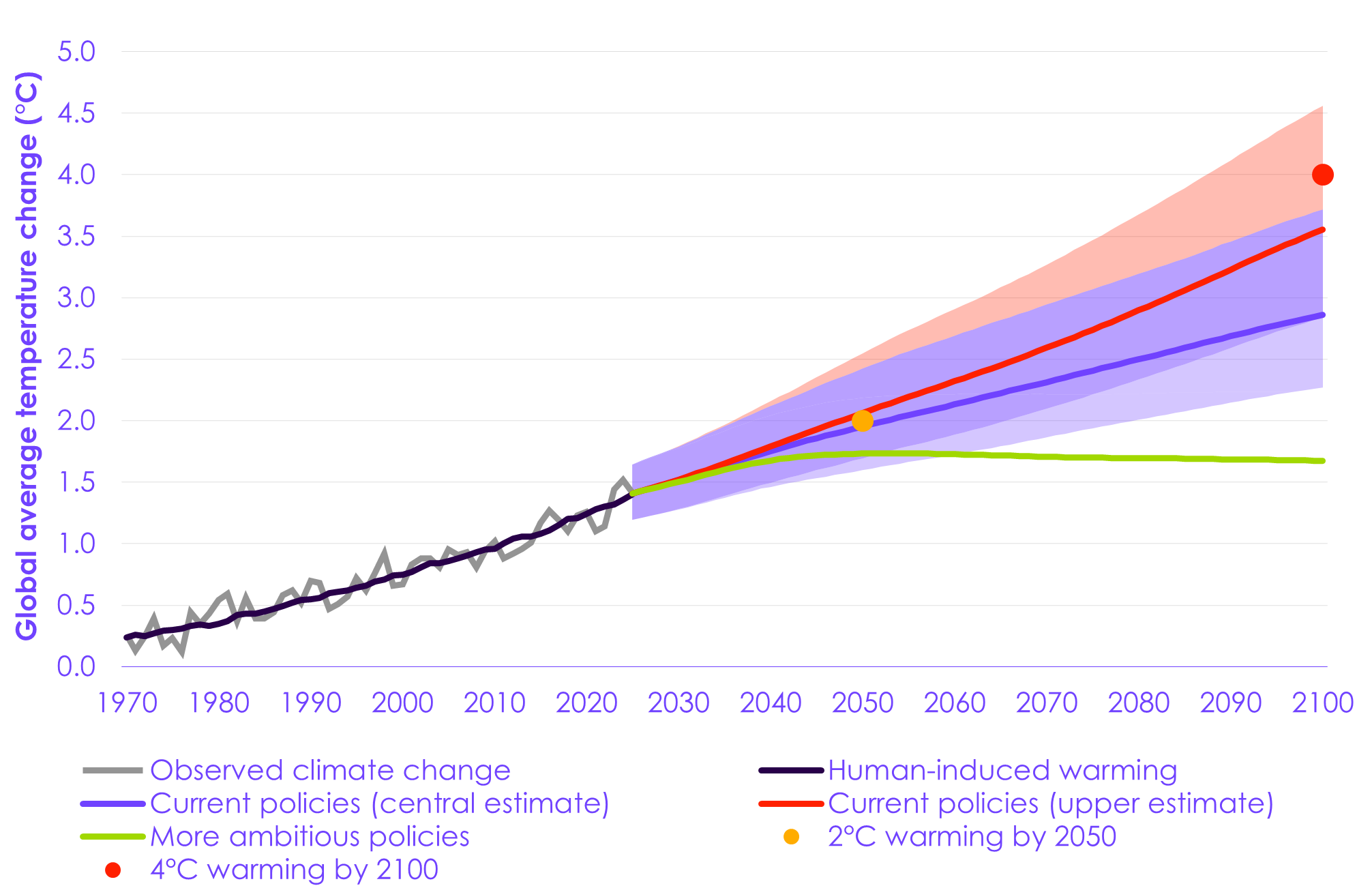 Description: Global temperatures have risen since 1970. Under current emissions scenarios, temperatures are projected to increase further to around 2ºC of warming by 2050. It is possible that under current emissions warming could reach 4ºC by 2100. More ambitious policies to reduce emissions could limit warming to around 1.7ºC by 2100. |
| Box 1.2 Global extremes since 2021 |
Since the publication of the last independent UK Climate Change Risk Assessment (CCRA3-IA) in 2021, extreme weather events, including strong storms, rainfall events, droughts, wildfires, and heatwaves, have caused widespread damage around the world. Many of these weather extremes are becoming more frequent and/or more intense due to climate change. For example, heatwaves are hotter and floods are deeper and more widespread. Some notable examples of extreme weather from the last five years are listed below.
These examples provide an illustration of the extremes possible in the current global climate and several are a proxy for the types of events that could occur in the UK, either today or in future decades. |
1.1.2 Climate change in the UK
Climate change is altering both the UK’s average climate conditions and the frequency and severity of extreme weather. This change in weather extremes will not be felt gradually but instead by sudden instances of record-breaking conditions.
This section summarises observed and expected changes in the average and extremes of the UK’s climate, drawing on observed trends and future projections. It outlines how the UK’s climate has already changed, what further changes are expected, and the implications for key hazards such as heatwaves, flooding, drought, and wildfire.
Observed changes
Recent decades have been warmer and wetter, and sea levels around the UK’s coast have been rising at an accelerating rate.[30] These changes are consistent with those expected as a result of climate change.[31]
- The UK has been warming faster than the global average.[32] Four of the last five years have been in the UK’s top five warmest on record (Figure 1.2). 2025 was the warmest year ever recorded across the UK. Record (or joint record) summer temperatures have been experienced across England, Northern Ireland, Scotland, and Wales in the last decade.
- Temperature records are now regularly being broken across the country. From 1900 to 1989, the maximum temperature recorded anywhere in the UK never surpassed 37°C. Since 1990, this threshold has been exceeded five times, signalling a shift toward more frequent and intense heatwaves (Figure 1.3). 40°C was exceeded for the first time in the UK in July 2022 and the warmest individual day was set in all four nations of the UK in either 2021 or 2022. Today, the chance of temperatures exceeding 40ºC somewhere in the UK is around 4% annually. This is 20 times higher than in the 1960s when the chance was estimated around 0.2% annually. There is a 50% likelihood of another 40ºC day occurring within the next 12 years, and we could even see temperatures as high as 45ºC in the current climate.[33]
- Winters in the UK are now wetter than a few decades ago. Winter half-years (October to March) have become wetter in recent years – 16% wetter than from 1961 to 1990 (Figure 1.4).[34] This has been driven largely by heavier rainfall, with a 7% increase in rainfall for each degree of local warming.[35] This observed shift to wetter winters is driving increased winter river flows and flooding.
- Extreme rainfall is increasing in all seasons. Intense downpours, including in the summer and autumn and often linked to thunderstorms, are happening more frequently.[36] This is because warmer air holds more moisture, so when rain does fall, it is heavier and more intense. This can lead to more surface water and flash flooding, especially in urban areas, as rainfall quickly runs off hard surfaces and overwhelms drainage systems. The 2021 London floods inundated properties, damaged infrastructure and disrupted transport – closing 30 underground stations.[37] Extreme rainfall events experienced in the winters of 2013 to 2014, 2015 to 2016, and 2019 to 2020 led to widespread flooding and insurance losses of around £2.8 billion (2025 prices).[38] Such events are now up to 2.6 times more likely than in 1965.[39]
- Sea levels have risen right around the UK coast. The largest rises are being seen towards the southern coast of the UK. The land in the north is still slowly rising after the weight of ancient ice sheets lifted when emerging from the last ice age, while the south is slowly sinking, making sea level rise even greater. Since 1901, the sea level around the UK has risen by about 20 cm and the rate of rise has accelerated in the last three decades (Figure 1.5).
The record climate conditions that have been seen in the UK over the last five years are driving impacts across the country as the weather fluctuates between adjacent periods of wet and dry extremes (Box 1.3). The extent and severity of these impacts highlight how the UK is already vulnerable to the weather conditions possible under today’s changed climate – let alone those expected in future.
| Box 1.3 Impacts from the patterns of climate extremes seen in the UK since 2021 |
Since the publication of CCRA3-IA in 2021, there have been several notable weather and climate extremes in the UK. These demonstrate that the effects of climate change are here now and are getting worse.
The fluctuation from dry to wet periods and back again seen over the last few years is indicative of the extreme swings that are possible today. The potential for having to deal with opposing wet and dry extremes, even in adjacent seasons, is one of the main challenges of climate change. |
| Figure 1.2 Change in temperature |

|
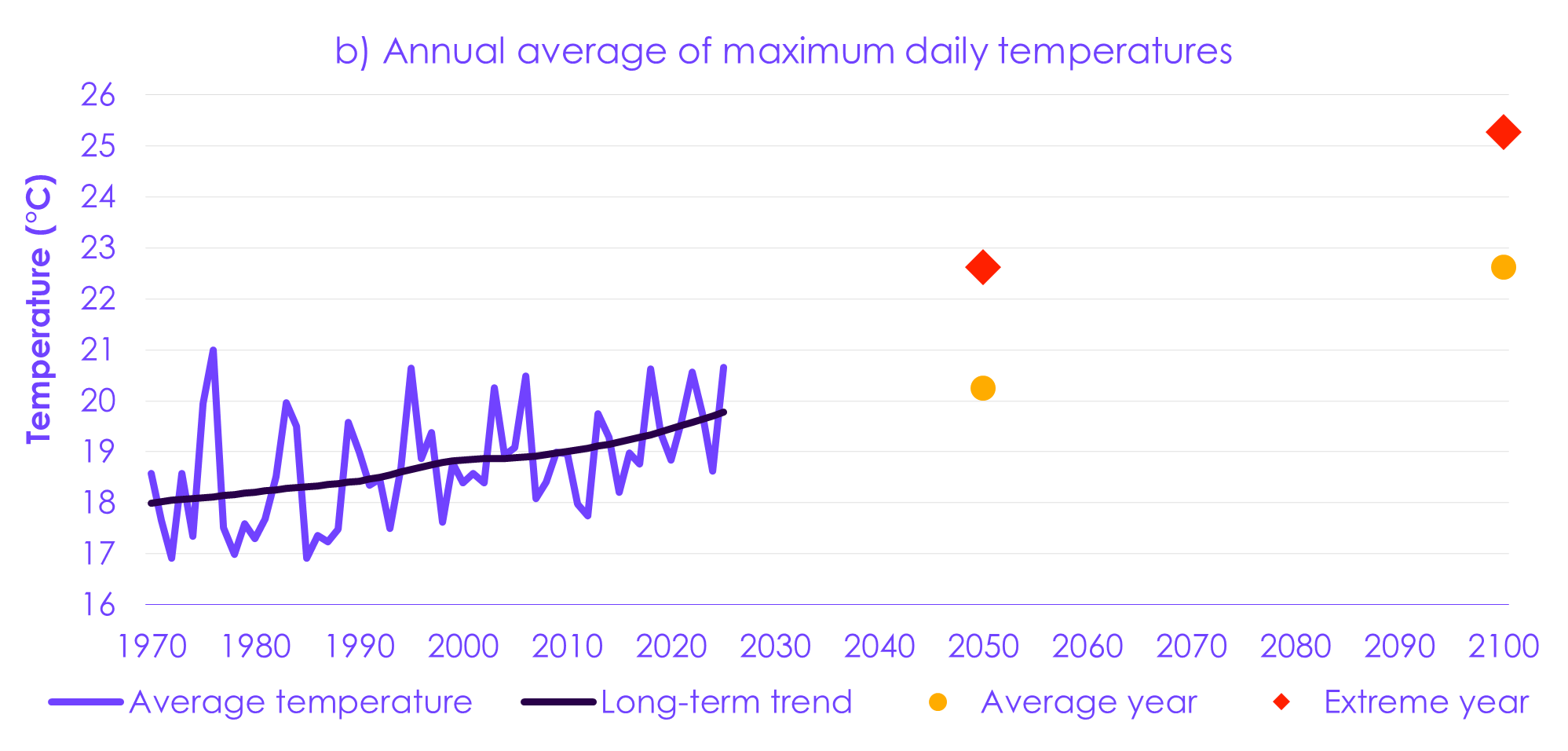 Description: Both annual average temperatures and daily maximum temperatures have increased in recent decades in the UK. Future projections show substantial further warming and extreme temperatures are expected under 2°C warming by 2050 and 4°C warming by 2100.
| Figure 1.3 Hottest temperatures recorded |
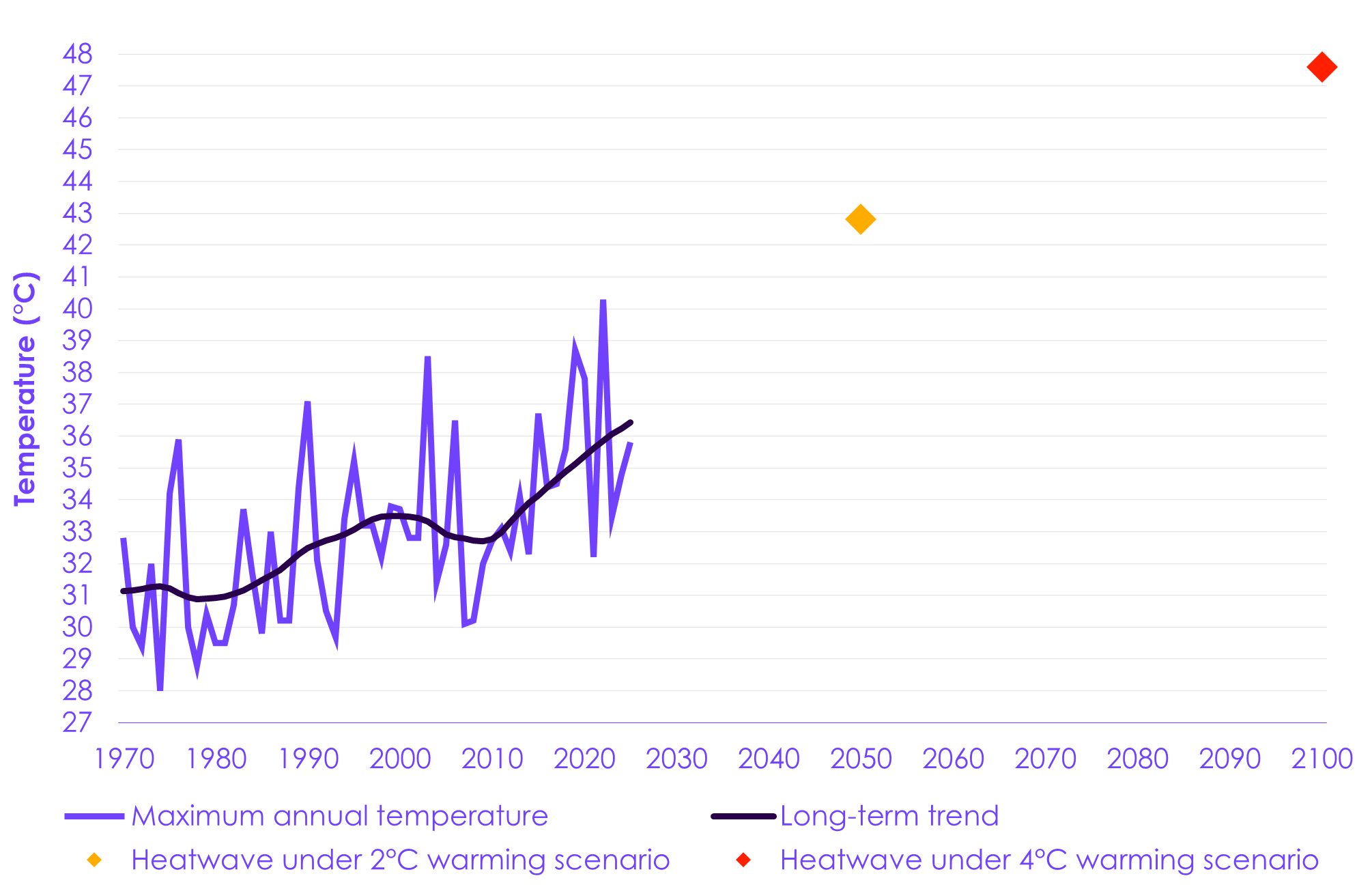 Description: The hottest temperature recorded each year in the UK has been increasing since 1970, with the trend increasing from around 31ºC to 36ºC, and the highest temperature of over 40ºC recorded in 2022. Under 2°C warming by 2050 and 4°C warming by 2100, extreme temperatures could be as high as 43ºC or 48ºC respectively. |
| Figure 1.4 Change in rainfall |
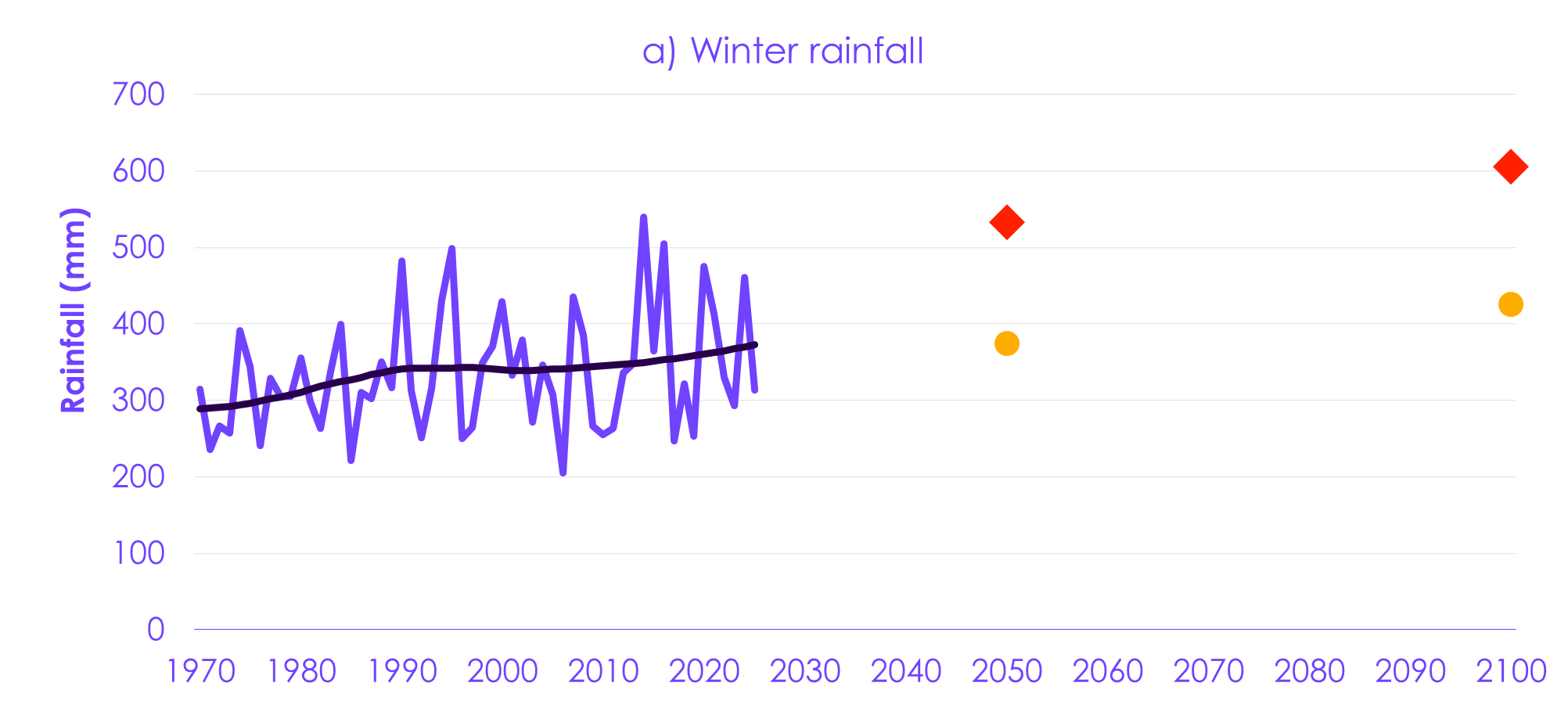  Description: UK winter rainfall shows a long-term increase since 1970, while summer rainfall shows large year‑to‑year variability from 1970–2020, with no strong long‑term trend. Projections for 2050 and 2100 show drier average and extreme summers under higher warming scenarios. |
| Figure 1.5 Change in sea level |
 Description: Relative to 1981–2000, average sea level has been steadily increasing since 1970 in the UK. Sea level is projected to rise substantially by the mid to late century under global warming scenarios. |
The UK’s climate at a 2°C global warming level in 2050
Further changes to UK climate will largely continue in line with continued global climate changes. Under 2°C of global warming, which is currently expected around 2050, the UK’s climate would look significantly different from today.
- Intensifying heat: by 2050, summers will be significantly warmer, with average summers likely to become much more like recent record summers such as 2018, 2022, and 2025, which all saw significant stresses on agriculture and nature (Figure 1.2). Warming will be strongest in the South East of England, but significant right across the UK.[54] The hottest summers will be potentially several degrees hotter than any summers we have had to date.
- Heatwaves in the UK will be more frequent, longer, and more intense than they are today. This will lead to increased health impacts, impacts on agriculture, and infrastructure disruption. Maximum temperatures could regularly surpass 40°C in many areas – and the hottest heatwaves could exceed 45°C (Figure 1.6).
- Heatwaves are likely to regularly feature tropical nights – overnight temperatures above 20°C that are very challenging to sleep in – that could extend for around a week.
- Heat hazards will continue to be more pronounced in urban areas due to the urban heat island effect where major UK cities can experience temperatures multiple degrees warmer than surrounding rural areas. This urban amplification of heat will likely only grow as the climate continues to warm.[55]
| Figure 1.6 Recent and projected maximum temperatures |
 Description: Extreme heat is projected to become more widespread and severe across the UK as global temperatures rise, especially in southern and central England. Under 4°C global warming level by 2100, much larger areas reach temperatures above 40°C. |
- Growing flood risk: flood risk will rise from river, surface water, and coastal sources. The estimated number of residential properties impacted by river, coastal or surface water flooding each year in the UK could rise by nearly 40% (Figure 1.7 and Figure 1.8). For the most intense short duration rainfall events in the 2050s, projected rainfall amounts are expected to increase by 15–60% compared to the late 20th century.[56];[57] Peak river flows will increase by up to 45% for some UK river catchments compared to the late 20th century, particularly in the north and west.[58] In general, western regions, low lying areas, and coastal regions will experience the greatest increase in flood risk in the UK.
- There will be an increase in the chance of extreme local downpours, often from thunderstorms, during summer and autumn, driven by warmer temperatures and evaporation. This will lead to significantly increased likelihood of urban and flash flooding (a sudden intense flood that quickly inundates streets, homes, and low-lying areas) due to increased run-off over urban surfaces and steep river catchments.
- Sea levels will continue to rise all around the UK coastline and are expected to rise by a further 20–45 cm by 2050, with the southern UK coasts most affected. This will lead to significantly increased coastal erosion and coastal flood risk. Waves generated by storms will more easily exceed the height of existing flood defences without additional adaptation. This trend will continue for centuries to come, even after global temperatures are stabilised.
| Figure 1.7 Current and projected properties flooded by rivers and the sea |
 Description: River and coastal flood risk increases as global temperatures rise, with many more properties in the UK exposed by mid‑century. Under 4°C global warming level by 2100, eastern coastal regions could see substantial increases in properties flooded. |
| Figure 1.8 Current and projected properties flooded by surface water |
 Description: Surface water flood risk increases across the UK as the climate warms. Under 4°C global warming level by 2100, many urban areas, including London, see large increases in properties exposed to surface water flooding, while increases in Scotland and Wales are generally smaller. |
- Increasing drought and wildfires risk: by 2050, the UK’s average summer is projected to be hotter and with less rainfall than today. Both higher temperatures and reduced rainfall will contribute to less available water at the land surface. Some years could see as little as half the rainfall as recent average summers.
- The volume of water in rivers during dry periods is expected to decrease by around 30% compared to the late 20th century average – driving significant shortfalls for both people’s use and the natural environment (Figure 1.9).[59]
- Extreme agricultural drought, where the ground becomes so dry that plants struggle to survive, would become three times more likely than in the late 20th century.[60]
- These dry, hot summers increase the risk of drought and wildfire. This is especially the case in the south and east of England but will also be prevalent across the UK. By 2050, the number of high fire risk days could double compared to late 20th century average and the wildfire season will extend into late summer and early autumn (Figure 1.10).[61]
| Figure 1.9 Projected change in water available in rivers during droughts |
 Description: Under 2°C global warming level by 2050, most regions in Great Britain experience moderate reductions in low flow river volumes, with the largest declines in southern and eastern England. Under 4°C global warming level by 2100, reductions intensify significantly, with major decreases across England and parts of Wales, indicating much drier river conditions during droughts. |
| Figure 1.10 Projected number of days with very high wildfire danger |
 Description: Compared to 1981–2010, the number of days with very high wildfire danger in the UK will increase with climate change, especially in southern and eastern England. Under 2°C global warming level by 2050, the number of very high wildfire danger days increases across much of England and Wales. Under 4°C global warming level by 2100, large parts of England experience dramatic increases, with many areas exceeding 75–100 high‑risk days per year. |
- Stronger winds: although observed UK wind records show no clear long-term trend in storminess, new evidence from state-of-the-art climate models suggests that climate change will make damaging windstorms more frequent and more severe.[62];[63] These windstorms can have large impacts on infrastructure functioning – particularly for power networks. Weather prediction models show that storm Eunice, which struck the UK in February 2022, was made more intense by climate change. Similar storms will strengthen further as human-driven warming continues.[64]
There is increasing evidence that current climate model projections may underestimate the frequency and severity of extreme events, particularly heatwaves and heavy rainfall.[65];[66];[67] The projections shown in this section, based on the current generation of climate models, could occur earlier than indicated. This emphasises the need to prepare for these ongoing changes today.
The UK’s climate at a 4°C global warming level in 2100
Under a 4°C global warming level in 2100, the UK would face a fundamentally different climate. Many events considered extreme today would become commonplace in the future. Extreme weather conditions would regularly be seen that far exceed anything that we’ve experienced to date.
- Commonplace extreme heat: an extreme summer like 2022 or 2025 would be considered significantly cooler than average – requiring fundamental changes in agriculture around the UK.[68] Temperatures exceeding 40ºC could become a recurring event every two to three years.[69] Heatwaves would not only be hotter but also much longer. The ‘tropical night’ (where temperatures do not drop below 20ºC) would become a common occurrence in UK summers, creating large challenges for those vulnerable to heat who need to get respite from the heat at night.
- Extremely large flood risks: some of the wettest winters on record today would be considered close to an average winter by 2100. The most extreme rainfall events would increase by 15 –75% and the frequency of intense, short-duration rainfall events that could cause flash flooding (rates exceeding 20 mm per hour) would increase fourfold.[70];[71] Peak river flows are projected to increase by up to 85% leading to a significant increase in the magnitude and frequency of damaging river flooding across the UK.[72] Sea levels are projected to rise by up to 1.15 m, significantly threatening coastal ecosystems, such as salt marshes. High-impact, low-likelihood scenarios involving ice sheet collapse could result in sea level rise reaching 1.4 m in 2100 and potentially 5 m in 2150.[73] Storm surges that currently occur once every 100 years could occur every single year or even multiple times a year by 2100.[74]
- Extreme drought risk and frequent wildfire: the UK’s average summer would receive close to half the rainfall of a typical summer today. Combined with the much hotter temperatures, drought would be very common, particularly in southern and central England. A summer as dry as 2018 (one of the driest on record) would be considered normal by 2100 standards. This would challenge the viability of much of current agriculture across the country. The amount of water in rivers at times of low flow could be around half of that seen in the late 20th century.[75] Wildfire conditions like those experienced in central and southern European countries today will become normal in the UK. The number of ‘high fire weather days’ – days with critical combinations of heat, low humidity, and wind – would be five-fold higher than would have been seen in pre-industrial conditions.[76] The increase in wildfire risk will be greatest in the south and east of England (Figure 1.10).
Higher warming scenarios in the second half of the century increase the likelihood of crossing global climate tipping points. If triggered, tipping points could also have significant impacts on the climate changes seen in the UK in the second half of the century (Box 1.4). This further reinforces the necessity for considering very drastic changes in the UK’s climate by the end of the century, alongside the more certain changes that will occur by 2050.
| Box 1.4 Impact of global climate tipping points on the UK’s climate |
Tipping points in the global climate system have the potential to cause significant and irreversible impacts on the weather and climate of the UK. These are not likely to have significant effects on the expected climate change for the UK by 2050. However, over longer timescales they could have large impacts on UK climate.
While evidence is strong that these tipping points exist, the global temperature threshold at which they occur is much more uncertain. More global warming means increased likelihood of tipping points occurring. However, it remains the case that most of these potential tipping points with large impacts on UK climate are unlikely to be realised before late in the century at earliest. This means that regardless of long-term change, there is a clear need to be adapting now to the hottest conditions, with higher flood and drought risk expected in 2050. |
1.2 Exposure and vulnerability to climate impacts across the UK
The impact of climate hazards on the UK depends not only on the severity of the hazards faced, but also on the exposure and vulnerability of health, communities, infrastructure, nature, and the economy (Box 1.1). Understanding how exposure and vulnerability vary across the UK, and how they might change in future, is key to allowing resources to be used most effectively to drive the largest reductions in risk.
- Climate impacts disproportionately affect some groups more than others. Vulnerable groups are at higher risk from climate change as they are more sensitive to the impacts of the hazard or less able to adapt to the hazard, due to socioeconomic or other factors.
- Some people are disproportionately impacted by climate change due to their age, sex, disability, ethnicity or other legally protected characteristics. This can be due to where they live or work, the types of services they use, and other socioeconomic or health-related factors. For example, pregnancy can increase vulnerability to overheating as it limits the ability of the body to regulate its temperature (see Annex 3).
- Social deprivation and vulnerability to climate impacts are closely linked, but not interchangeable (Box 1.5). For example, many low-income households are disproportionately vulnerable to flooding due to lower rates of insurance coverage and limited access to property adaptations.[78] At the same time, some people are vulnerable to flooding despite not facing financial barriers, due to other factors such as reduced mobility.
- Vulnerability to heat and flood risk is currently highly variable across the UK. Sensitivity to heat and flooding hazards and the capacity to adapt to these can vary sharply between adjacent neighbourhoods or households (Figure 1.11). Key factors influencing this variation include differences in health status, disability, age structure, housing quality, access to cooling or flood-resilient infrastructure, strength of local social networks, and availability of public services.
- There is significant uncertainty regarding how exposure and vulnerability will change in future. Future exposure and vulnerability are dependent on socioeconomic and demographic change, changes in infrastructure, planning and services, and wider societal changes over time. Some trends are easier to project, for example the UK will have a larger proportion of older people over time and the UK’s economy is expected to be larger than today. However, factors such as the health of the population, future levels of poverty and inequality, domestic migration patterns, and technological developments, are much harder to project.
An improved understanding of how exposure and vulnerability might evolve and how it interacts with changing hazards remains an area for further development.
| Box 1.5 Mapping the UK’s spatial distribution of social vulnerability |
The Climate Change Committee (CCC) commissioned analysis of the spatial distribution of vulnerability to support CCRA4-IA. The aim of the analysis was to review spatial indicators of social and business vulnerability to climate impacts, collate key metrics available across the UK, and develop aggregated indices for use across CCRA4-IA.
The analysis finds that vulnerability varies significantly both across the UK and within specific regions, and that there is some correlation between exposure to hazards and vulnerability to them, but that this is limited. The analysis also finds that there are overlaps between indicators of deprivation and indicators of vulnerability to climate impacts, but they are not interchangeable. In practice, this suggests that an accurate assessment of climate risks requires explicit consideration of both exposure and vulnerability.
Full methodology, key findings, and supporting datasets are available on the UK Climate Risk website.[79] |
| Figure 1.11 Vulnerability to flood and heat hazards by region |
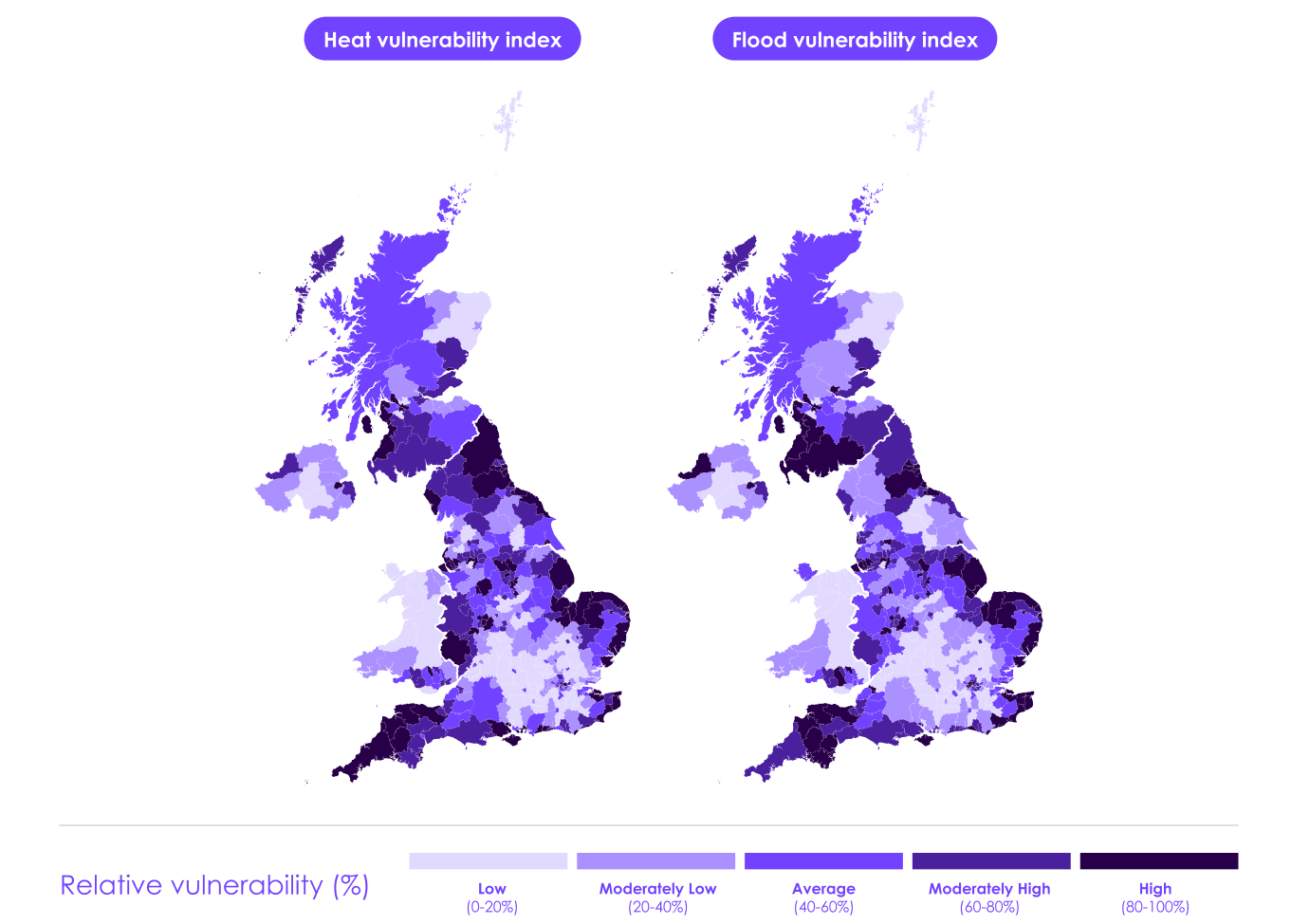 Description: Both heat and flood vulnerability display a varied pattern across the UK with areas of highest vulnerability located in coastal local authorities. Different local authorities face distinct climate‑related pressures. Source: Sayers, P. et al (2025) Spatial indicators of vulnerability to climate related hazards in the UK. Notes: (1) Figures show the relative vulnerability of each neighbourhood, by category, to heat (left) and flooding (right). This does not consider the relative exposure of each neighbourhood to climate hazards, only their relative vulnerability when exposed to climate hazards. ‘High’ shows the neighbourhoods in the top 20% most vulnerable neighbourhoods. ‘Low’ shows the neighbourhoods in the lowest 20% for relative vulnerability. (2) Relative vulnerability has been derived at Lower Layer Super Output Area (LSOA) scale and aggregated to local authority regions. (3) Vulnerability is defined as the susceptibility to harm of different groups and systems when exposed to climate hazards, and is shaped by both their sensitivity to hazards and their capacity to adapt to them. |
| Figure 1.12 The link between exposure, income deprivation, and vulnerability |
 Description: Neighbourhoods that are more vulnerable to overheating and flooding tend to be more exposed to overheating and flooding than neighbourhoods that are less vulnerable in the UK. However, exposure alone does not reliably identify vulnerability. Vulnerability to overheating and flooding is also closely linked to income deprivation. |
1.3 Future climate risks to the UK
The changing climate hazards – together with the exposure and vulnerability to those hazards – create risks to the UK’s health, communities, infrastructure, nature, and economy. This section both summarises the evidence on these risks to the UK, provided by the CCRA4-IA Technical Report and adds the Committee’s assessment of priority risks for adaptation in the next years.[80]
1.3.1 Summary of the CCRA4-IA Technical Report
The CCRA4-IA Technical Report provides a detailed assessment of the evidence on the risks to the UK from climate change. The assessment considers 41 risks and two opportunities, assessing the magnitude and urgency for each risk and opportunity across England, Northern Ireland, Scotland, and Wales (Box 1.6). The results of this assessment are summarised in Annex 2.
There are several headline conclusions from the CCRA4-IA Technical Report:[81]
- The outlook for risks to the UK from climate change is now worse than it was five years ago. Since the CCRA3-IA Technical Report was published in 2021, climate change has continued at record rates with more severe impacts being experienced in the UK and across the world. Adaptation efforts have not kept up with this rising risk. We have also learned more about the risks that face the UK in the future. Higher resolution climate modelling is predicting more intense future extremes than those suggested by previous climate projections, indicating that risks to society could be higher than previously assessed.
- Many risks will increase to dangerous levels under currently expected climate change. Under a 2°C global warming level by 2050, almost one-third of the 41 risks are assessed as having very high magnitudes. This means a critical level of impact in a typical year, such as economic losses in the order of billions of pounds per year, thousands of deaths per year, or the loss of entire species groups. In a year with more extreme weather, higher impacts would be expected. By the 2080s, under a high scenario consistent with 4°C global warming level by 2100, the number of risks with very high magnitude levels increases to over half of the 41 risks (Figure 1.13).[82]
- 27 of the 41 risks received an overall urgency score as either ‘critical action needed’ (the highest urgency category), or ‘more action needed’.
- Urgent risks include those that reach high or very high magnitude levels by the 2050s or before, with high or medium levels of confidence. There is sufficient confidence in the magnitude for these ‘critical action’ risks to merit the roll-out of large-scale anticipatory adaptation, beyond the adaptation already underway or planned. For example, risks to health and the built environment from heat are expected to impact millions of people by 2050 and damages from flooding are anticipated to remain in the billions of pounds, even with adaption.[83]; [84] Risks to the macroeconomy are in the order of 4-8% of UK GDP or tens of billions of pounds of damages by the 2080s.[85];[86]
- Adaptation planned today is insufficient to lower risk magnitudes. In nearly all cases, the assessment finds insufficient evidence that planned adaptation is enough to lower the magnitude scoring of the risk against the background of climate change.
- Urgent investigation is required to better understand the long-term need for action for some risks. 12 risks are scored as ‘critical investigation’. These have a high or very high magnitude score under a 2°C global warming level by 2050 but the assessment finds confidence in the magnitude of this impact is low.[87] More research is urgently required to gain a better understanding of these risks and determine the adaptation that might be required. For most risks, confidence is higher in the near-term. We know enough to support the case for more action on adaptation to address the risk today, alongside the needed investigation to improve confidence of the impacts in the long term.
- Connections between risks amplify climate impacts. The CCRA4-IA Technical Report identifies several connections within the infrastructure sector. For example, there is high reliance on supply from the energy system across other parts of the sector, including transport, water supply, and digital and telecoms. The infrastructure system is also connected with other sectors. For example, high temperatures during the July 2022 heatwave led to cooling system failures at data centres supplying two major London hospitals, leading to large numbers of treatment delays and resulting in £1.5 million additional costs to the NHS (2025 prices).[88] The land, nature, and food sector is also highly connected. Agriculture, forestry, fisheries, and aquaculture industries rely on healthy and functioning ecosystems. Climate-related impacts on ecosystems cascade into these industries, affecting the wider economy.
- Overseas climate risks increase vulnerability at home. Climate change impacts overseas can act as ‘imported’ risks for the UK. For example, the UK is vulnerable through food supply systems, as around 40% of food consumed domestically is imported – around 18% of UK fruit and vegetables are produced in regions particularly vulnerable to climate change.[89] In the health sector, trade and travel create pathways for the introduction of climate-sensitive infectious diseases. UK businesses are also at risk from disruption to international supply chains, with 20% of the economic value of global supply chains originating in regions particularly vulnerable to climate change.[90] As such, the potential impacts from climate change are likely to be greater than the sum of individual risks and opportunities.
| Figure 1.13 Increasing risks from climate change |
 Description: Risks from climate change increase in magnitude at higher global warming levels. The proportion of risks assessed as ‘very high’ magnitude increases to nearly one-third by 2050, and over half by 2100. |
|
Box 1.6 |
| The CCRA4-IA Technical Report provides a synthesis of the most up-to-date climate risk evidence, including peer-reviewed literature and other quality-assured evidence. The report is produced by a consortium of expert authors, led by the Met Office. Authors consulted with government, external stakeholders, and the CCC to reformulate the 61 risks and opportunities used in CCRA3-IA Technical Report, to a new set of 43 (41 risks and two opportunities). The new risks and opportunities focus on a single receptor (such as the road transport system) or hazard (such as heat risks to buildings and communities) across five sectors: health; built environment and communities; infrastructure; land, nature, and food; and the economy.[91] The report uses a step-by-step methodology to assess the urgency of action needed for each risk and opportunity.[92] Urgency scores combine information on both the expected magnitude of risk and confidence in the evidence base.
Magnitude and confidence are assessed multiple times:
There are six categories of ‘urgency’ score. They describe the need for:
The risk assessment method has been updated since the CCRA3-IA Technical Report to include the addition of two new urgency scores – ‘critical action needed’ and ‘critical investigation’. The new categories have been added to identify more clearly the very highest impact risks and opportunities. A new ‘very high’ magnitude category is also added. This threshold is reached when thousands of deaths or billions of pounds of economic damages are experienced or projected per year. The ‘high’ magnitude threshold (in both CCRA3 and CCRA4) is reached if hundreds of deaths or hundreds of millions of pounds of economic damages are experienced or projected per year. |
1.3.2 Advice on priority risks for adaptation
Over the last five years, our understanding of UK climate risks has continually improved. There is now a well-established and robust evidence base to understand how climate change will affect the UK and serve as the basis for pragmatic adaptation action. The evidence shows clearly that climate risks are more severe and adaptation more urgent than in our previous assessment in 2021. Adaptation action is not keeping pace with increasing level of risk.
This section synthesises the Committee’s advice on the eight priority areas of climate change risk that are the highest priorities for adaptation. It draws on the evidence of the CCRA4-IA Technical Report, additional evidence produced for this report, and trends in exposure and vulnerability to climate risk expected over the coming decades.
In Chapter 4 to Chapter 17, we set out the key actions, enablers, and policies needed to respond to these priority risks and the wider risks identified in the CCRA4-IA Technical Report across our 14 systems. In these chapters, we highlight actions that can be delivered now to address these priority areas, as well as the wider picture of what will be needed to be well-adapted under 2°C of global warming by 2050.
The Committee’s eight priority risk areas are below:
- Risks to the lives of vulnerable people from extreme heat: annual heat-related excess deaths in heatwave periods in recent years range from 1,400–3,000, concentrated in vulnerable groups. By 2050, under 2°C of global warming this could rise to 3,800–10,000 per year across the UK. Increased heat-related mortality will be seen in all parts of the UK and will be exacerbated by the UK’s ageing population.[94]
- Risks of damage, disruption, and deaths from flooding: across the UK, there are nearly seven million properties located in flood risk areas, and annual flood damage is estimated at £3.3 billion per year (2025 prices).[95];[96] By 2050, under 2°C of global warming, up to 40% more homes are projected to be impacted by flooding than present day and around 48% more properties are expected to be at risk of coastal erosion in England with current shoreline planning. Projections suggest potential total annual damages from flooding could rise to £4.5 billion (2025 prices) across the UK, if today’s standards of protection are maintained (and not adjusted for climate change).[97] Places that are already at risk of flooding today will see the frequency and extent of flooding increase and new areas will flood. The growing severity of flooding means that more people may have to evacuate their homes during flood events, and people are more likely to be out of their homes for longer.
- Risks to water availability from drought: temporary measures to manage water scarcity have been common in recent years. Parts of South East England remained in drought until January 2026 following prolonged dry weather in summer 2025. In April 2025, almost all of Scotland experienced an early warning of water scarcity.[98] By 2055, under 2°C of global warming, current projections are for a five billion litre per day shortfall for public water supplies (for homes and businesses) in England, with similar risk levels in parts of the other nations.[99] This would create costly and widespread water restrictions that go beyond today’s hosepipe bans, such as the need for standpipes in the street, or stopping non-essential access to water for farming and industry.
- Risks to the state of nature: the UK is already one of the most nature-depleted countries in Europe – partly driven by emerging climate change impacts. Recent years have seen record wildfires damaging particularly moorland and grassland habitats. By 2050, under 2°C of global warming, climate change (from multiple hazards) will accelerate the decline of the UK’s natural environment, with the potential for widespread ecosystem loss and disruption – including in ecosystems that are globally unique, such as chalk streams.
- Risks to the viability of farming: farmers are already being impacted by the effects of flooding, heat, and drought, often in consecutive seasons and at unprecedented severity. For example, yields in the UK were over 10% lower than the 10-year average for crops like wheat and oats due to the hot and dry spring and summer in 2025.[100] By 2050, under 2°C of global warming level, the amount of high-quality farmland is projected to drop from an average of around 40% of land in England and Wales (between 1961–1990) to just over 10% by 2050. In the worst years, this disruption is likely to make some farms unviable.
- Risks of food insecurity and inflation: roughly 40% of the food we eat is imported and international climate impacts can be more important for food prices in the UK than domestic ones. Foods hit by extreme weather are already rising in price and contributing to recent inflationary pressures. Extreme heat in summer 2022 caused food prices in Europe to increase by 0.7 percentage points.[101] By 2050, under 2°C of global warming, simultaneous crop failures in multiple major producer regions could lead to increased food prices, hitting those on low incomes the hardest.
- Risks to the availability of insurance: flooding related claims are rising and home insurers paid out more in claims than they received in premiums for the five years to 2024.[102] By 2050, under 2°C of global warming, many homes and businesses, particularly in areas of high flood risk may not be able to access insurance due to lack of coverage or high premiums.
- Risks of cascading impacts on infrastructure: the cascading impacts of increasingly connected infrastructure systems are clear today. For example, in 2022 the July heatwave caused the failure of two data centres operated by Guy’s and St Thomas’ NHS Foundation Trust resulting in £1.5 million (2025 prices) in unexpected ICT costs.[103] By 2050, under 2°C of global warming, weather-related infrastructure damage and service disruption could be common. For example, the sagging of power lines in heat extremes could risk triggering power cuts with the potential to cause knock-on outages such as to digital payment, transport systems, and public services. These impacts could cost billions of pounds.
Chapter 2: The case for adaptation
Introduction and key messages
This chapter sets out the case for taking pragmatic action to adapt today. Further action will be required in the future to fully address the risks set out in Chapter 1.
Our key messages are:
- Climate change is already driving significant costs in the UK, which will rise in the future.8F8F[104] Without additional adaptation, the cost of climate change could rise to the equivalent of around 1–5% of GDP per year by 2050. That would imply an estimated cost of £60–£260 billion per year, compared to estimated GDP of around £4.8 trillion, in 2050 (2025 prices).[105] These impacts to our health, communities, infrastructure, nature, and the economy will increasingly undermine the security and prosperity of our society.
- Adaptation can reduce these impacts in many areas and is cheaper than facing the damages. Many adaptation measures are effective and high value for money. Acting now is cheaper than acting later, especially where adaptation can be designed in, rather than needing to be retrofitted later. Numerous actions are low-cost or low-regret, can be scaled now to avoid locking-in future climate impacts, and come with significant co-benefits. Prioritising those most vulnerable to climate impacts can also help ensure the most cost-effective adaptation action.
- The UK can manage the investment required to be well-adapted. Delivering the key actions set out later in this report requires an estimated total additional investment of around £11 billion per year (range £7–£22 billion, 2025 prices), shared between the public and private sectors. This is a manageable level of investment for the UK economy and is worthwhile to avoid the worst risks of climate change. Acting now can avoid higher costs in the future and prevent avoidable damages. This delivers long term savings for both public and private actors, and improved wellbeing for citizens across the UK. This investment estimate only covers actions with sufficient evidence on investment requirements, which is only a sub-set of key actions and systems in the report, so is likely to be an underestimate of the total.
- The largest share of this investment is likely to come from cooling, flood risk management, and water management. Roughly two-thirds of these costs can be attributed to three broad categories of actions: passive and active cooling (35% of total investment); flood risk management (21% of total investment); and water storage, efficiency, and demand-side measures (11% of total investment).
- Government, businesses, and households all urgently need to act to adapt to climate change. There is a strong public mandate for well-targeted, effective, and transparent investment in adaptation. An effective combination of public, private, and household investment will be required. Clarity from government on where public sector investment will be focused is needed to help identify where private and household actions are required.
- Government should lead a serious public dialogue on adaptation. This would ensure that the public understands the potential impacts of climate change, and the costs, effectiveness, and implications of actions to adapt. It would also enable government to better understand the public’s priorities and preparedness to pay.
2.1 Cost-effective adaptation
2.1.1 Costs of climate change
Climate change will have a significant impact on health, communities, infrastructure, nature, and the economy in the UK. Chapter 1 set out the hazards and risks to the UK from climate change. These hazards are costing money, causing damage, and impacting people’s health today. Damages will grow significantly under a 2°C global warming level by 2050 without additional adaptation.
Estimates of the overall cost of climate change across all hazards (and including the effects on the UK of climate change overseas) vary as they come from a range of sources and modelling approaches. Based on a range of available estimates, under scenarios which are roughly equivalent to a 2°C global warming level in 2050 and without additional adaptation, climate change damages in the UK could grow from the equivalent of 0–2% of GDP today to 1–5% of GDP by 2050 (Figure 2.1). This could be roughly equivalent to £60–£260 billion in annual damages in 2050 (2025 prices).[106];[107];[108] Costs at the end of the century will depend strongly on the future of global greenhouse gas emissions. They could rise substantially to 4–10% of GDP in a high emissions scenario of above 3°C global warming level by 2100.[109]
| Figure 2.1 Estimates of the total cost of climate change |
 Description: Climate change is expected to have severe impacts as a share of UK GDP by the end of the century. |
Current estimates of the overall cost of climate change on the UK are limited in number and scope and have significant limitations. Existing models likely underestimate the risk, as they reflect specific impacts and often don’t account for connections between systems and hazards, or international factors. Some estimates do attribute a large share (often with wide uncertainty ranges) of the cost to systemic, catastrophic, and difficult-to-quantify risks.[110] However, assessing the investment required to address these systemic risks is difficult due to limited evidence. For example, the economic evidence for adaptation actions costed in this report tend to be in areas with more
well-understood and quantified risks. The Economics Advisory Group for CCRA4-IA considers how future research can capture the costs and benefits of adaptation to systemic risks (Box 2.1).
| Box 2.1 Economics Advisory Group for CCRA4-IA (EAG) |
| The Economics Advisory Group is a group of academic and industry leaders convened by the Climate Change Committee (CCC) to advise on the use of economics throughout the assessment. The group identified the ability to appraise systemic climate change risks as a key gap in adaptation planning and appraisal. Systemic risks are risks which are locally triggered (either domestically or internationally) and then amplified, often at the interconnections between systems. They can also be triggered by compounding pressures between systems. They are characterised by a deep uncertainty over their consequences and likelihood. Examples of climate-triggered risk that can be considered systemic are:
The group’s paper, which is published alongside this report, provides a framework for how adaptation appraisal across government can use economics to understand and adapt to systemic climate change risks.[111]
Beyond making the case for action on systemic risks, government can also take actions today to make society more resilient to systemic risks, including:
|
The following section explores the evidence for the direct benefits of adaptation in reducing damages from climate change. Section 2.1.4 explores how indirect benefits, or co-benefits build the case for action.
2.1.2 Adaptation can directly reduce damages from climate change
The costs of climate change impacts are not inevitable. Adaptation action can avoid some, or in many cases most, of these costs under a 2°C global warming level by 2050.
Cost effective climate adaptation refers to implementing adaptation measures that achieve the greatest reduction in climate related risks and damages for the lowest possible cost over time. That considers both direct benefits, in the form of avoided losses from climate change hazards, and indirect benefits, such as the co-benefits for health, the environment, and the wider economy.
- The benefits of adaptation can be maximised by prioritising actions which have the highest value for money and incorporating actions into the design of assets and infrastructure from the outset. Delaying adaptation is likely to lock-in future impacts and necessitate costly retrofit later for many interventions.
- Low-cost, low-regret actions can be implemented to reduce the damages from climate change today, while longer-term investment is directed towards actions with longer lead times. This will be critical as climate change worsens.
- Targeting adaptation towards people or assets that are particularly vulnerable to and at risk from climate impacts is key to making interventions the most effective. For example, implementing adaptation measures in residential buildings in the 30% most at-risk regions across the UK reduces the total heat-related mortality risk by approximately 63%, equivalent to 3,600 excess heat deaths avoided annually in the 2050s.[113]
There is clear evidence that well-designed adaptation action can deliver strong returns through reducing future climate damages. For decades, investment in disaster risk reduction (such as through flood risk management) has avoided damages to communities and businesses, and saved lives.
- UK-specific estimates from a range of adaptation case studies show benefit-cost ratios (BCRs) typically range from 2:1–10:1.[114];[115]
- European case studies of adaptation action by the European Investment Bank and European Environment Agency demonstrate positive cost-benefit ratios for adaptation projects.[116];[117]
- Global studies show good BCRs for adaptation, with the highest BCRs found across adaptation to extreme weather events (median BCR of 6.4:1, ranging from 3:1–13:1), and adaptation of infrastructure (median BCR of 5:1, range 3:1–8:1).[118];[119]
For all the major climate risks to the UK there is evidence of cost-effective adaptation solutions that can be deployed today using proven technologies or known changes in practices and approaches (Table 2.1). Rolling out these adaptation measures at scale is a key component of delivering a well-adapted UK. The evidence on the benefits of national-scale rollout of these, and other, effective adaptation actions is growing (Box 2.2). Modelling demonstrates that a cost-effective adaptation rollout across the UK can make a significant difference to the level of residual climate risks seen in future across key systems and hazards (Figure 2.2).
| Table 2.1 A selection of UK-based benefit-cost ratios for adaptation actions |
||
| Hazard | Adaptation actions | Benefit-cost ratios |
| Flooding | Natural flood management. | 3:1–5:1[120] |
| Property flood resilience measures. | 5:1[121] | |
| Flood and coastal erosion risk management. | 5:1[122] | |
| Warming | Active cooling measures with some passive cooling (for example, loft insulation, shutters). | 3:1[123];[124] |
| Heatwave plans. | 10:1–30:1[125] (for the 2040s) | |
| Drought | Demand-side water efficiency measures. | 1.8:1[126] |
| Rainwater harvesting and storage. | 2:1 (property level), 3:1 (community-level)[127] | |
| Supplying water via transfers and storage infrastructure. | 11:1 (range 7:1–15:1 across England sub-regions)[128] | |
| Multiple hazards | Proactive maintenance of existing infrastructure. | 5:1–10:1[129] |
| Emergency response, prevention and protection by UK Fire and Rescue Services. | 6:1[130] | |
| Embedding climate resilience into new infrastructure. | 4:1[131] | |
| Notes: (1) This table highlights a selection of benefit-cost ratios (BCR) from external literature and bespoke research projects for the Well-Adapted UK report. It highlights feasible actions that are cost-beneficial today. These were selected as point estimates or ranges from robust literature sources. The costs included will vary by source, but broadly include the capital, operating, and maintenance expenditure required to deploy an action. (2) The benefits primarily refer to the directly avoided damages from climate change by implementing an adaptation measure, as well as co-benefits that can and have been quantified. These vary significantly by source. (3) The BCRs presented are from both retrospective and modelled studies. |
||
2.1.3 Limits to adaptation
Cost-effective adaptation would help avoid significant additional costs from climate change to the UK, but it does not mean that additional costs can be avoided completely – adaptation has limits. Even well-designed adaptation measures cannot fully prevent losses once climate hazards exceed the level at which human physiology, ecosystems, and physical processes can be maintained. It will also not be cost-effective to adapt to all the potential extreme impacts of climate change or maintain the level of service we experience today in all systems under all circumstances. However, in many cases, the costs of reducing impacts can still outweigh the damages avoided overall – particularly at high levels of risk.
Adaptation cannot serve as a replacement for emissions reduction efforts but is an essential complement. Until the world reaches Net Zero CO2 emissions, with deep reductions in other greenhouse gases, global temperatures will continue to rise. This will inevitably lead to increasingly extreme weather, including in the UK.
| Box 2.2 Modelling cost-effective adaptation in the UK |
The CCC commissioned four bespoke analytical projects to understand the impact of climate change hazards on specific adaptation challenges in the present day, the 2030s, and 2050s, and to establish what a cost-effective adaptation response at a national scale might look like.[132];[133];[134];[135] The projects followed a consistent climate and economic framing and methodology, which considered central (2°C global warming level by 2050) and high (2.5°C global warming level by 2050) climate scenarios and socio-economic variables (such as population) (see Annex 2).[136] The research areas were prioritised to address identified gaps in the evidence base. The four projects focused on:
Combining the damages modelled in these projects alone indicates an average annual economic cost of around £7 billion today. This could grow to £10 billion in the 2030s and £18 billion in the 2050s, under a central scenario of climate and socio-economic projections.[137] This could more than double to £20 billion per year in the 2030s and £42 billion per year in the 2050s, under a high impact scenario of warming and socio-economic vulnerability. The projects assessed the impacts of delivering a package of adaptation actions at a national scale to manage risk from the present day to the 2050s. The modelling aimed to find the best combination and deployment of actions, aiming to maximise the benefits of adaptation (risk reduction and co-benefits) across the population and minimise the investment needed – this is referred to as the cost-effective adaptation package. The final packages target the highest risk regions, populations, and sectors first, to maximise value for money. Modelled actions are rolled out progressively over the present-day, 2030s, and 2050s to reduce the increasing risk of climate change as it progresses, considering lead times for new infrastructure, and additional benefits or costs from combining actions. Across the urban heat, health, and water scarcity projects, cost-effective adaptation packages are able to maintain climate impacts at around current levels by reducing future damages by 52% in the 2030s and 62% in the 2050s under a central climate and socio-economic scenario.[138] The national packages have a benefit-cost ratio (from benefits and costs accrued from the present-day to the 2050s) of 3:1 (urban heat project), 1.3:1 (health project), and 45:1 (water scarcity project).[139] |
| Figure 2.2 Potential for additional adaptation to reduce costs from climate change impacts |
 Description: Cost-effective adaptation packages at a national scale can significantly reduce the damages expected from climate change hazards across the UK. |
2.1.4 Co-benefits strengthen the case for action
Co-benefits, or indirect benefits, can substantially strengthen the case for many adaptation actions. Co-benefits are generally realised in the short term and are often independent of whether the hazard occurs. For example, green and blue spaces in urban settings (such as parks) have cooling benefits, reduce urban heat exposure, and can support local flood management. They are also associated with a range of co-benefits relevant to health. For example, they can be used for recreation that supports physical activity and mental health. Adaptation actions can also improve resilience to non-climate hazards, such as improving water storage which can help manage other non-climate supply shocks.
There are many examples of adaptation actions with co-benefits and programmes where co-benefits have been appraised (Box 2.3).
- The Triple Dividend of Resilience is a framework for analysing the direct and indirect benefits of adaptation. The World Resources Institute used this framework to evaluate the benefits of 320 adaptation investments in 12 countries, finding an average benefit-cost ratio of 10.5:1 when including direct and indirect benefits (known as first, second and third dividend benefits). Half of the evaluated adaptation projects yielded co-benefits for reducing emissions.[144]
- Of the 120 actions appraised across the research on cost-effective adaptation undertaken for this report, 44% of actions were found to have co-benefits. Examples include water efficiency measures such as leakage reduction, rainwater harvesting, and more efficient irrigation. These can reduce energy use for pumping and treatment and reduce water bills.
- There are examples of co-benefits in the UK today: London’s green spaces provide co-benefits valued at £6.5 billion per year (2025 prices, discounted at 3.5% over 30 years), including £1.2 billion per year (2025 prices, discounted at 3.5% over 30 years) in avoided health costs.[145]
| Box 2.3 Co-benefits case study: Leeds Flood Alleviation Scheme |
| The appraisal of the Leeds Flood Alleviation Scheme (LFAS) is summarised here as an illustration of how co-benefits can be quantified. The LFAS is a flood scheme that combines engineered and natural flood management solutions to extend protection along the River Aire catchment in Leeds to a 1 in 200-year flood until 2069.
|
2.2 Investment for a well-adapted UK
The level of investment needed to deliver a well-adapted UK depends on judgements about the level of resilience that government wants to achieve. In Chapter 4 to Chapter 17 of this report, we set out evidence for a possible level of ambition for adaptation in the UK and the key actions at a UK or national scale for delivering this.
Existing evidence was sufficient to determine investment for many key actions in the health, built environment and communities, public services, water, transport and land systems (see Chapter 4, Chapter 5, Chapter 6, Chapter 8, Chapter 10, Chapter 13). However, there are many actions with insufficient specificity or available evidence to estimate investment needs, particularly across the wastewater, energy, waste, and food security systems, and adaptation actions by businesses and finance (see Chapter 8, Chapter 9, Chapter 11, Chapter 15, Chapter 16). In addition, there are significant gaps in evidence over the share of current and planned investment that can be attributed to adaptation.
An indicative assessment of the investment needed for these actions suggests that the costs of this investment are manageable for the UK economy. This estimate is not comprehensive of all actions across the Well-Adapted UK report and is highly stylised. It does not account for investment required to manage unquantified, systemic, and catastrophic risks, which make up a proportion of the costs from climate change (Box 2.1).[152] The estimate is likely an underestimate, as it does not account for all systems and actions. However, the benefits of adaptation are also typically underestimated (even though BCRs are often positive).[153][154] As such, the assessment provides a useful guide to the scale of investment that will be needed across the economy to adapt to climate risks. This analysis is the first of its kind to date. Further analysis is needed to develop a comprehensive estimate of the investment needed for adaptation across the UK.
- Gross investment in adaptation across the UK would need to be around £11 billion per year (range £7–22 billion, 2025 prices).21F21F[155] This is equivalent to around £350 billion over 2025 to 2059. The annual level is roughly equivalent to 2% of the annual investment in the UK in 2025 (such as in residential housing development or construction of new factories).[156];[157] Whilst this represents a significant investment mobilisation, this is a feasible uplift across an economy the size of the UK. These costs could decrease in the future as adaptation scales up, although there is limited evidence on this point. Costs will vary significantly at the local scale as adaptation is highly place specific.
- The largest share of this investment is likely to come from cooling, flood protection and water management. Roughly two-thirds of these costs can be attributed to three broad categories of actions: passive and active cooling (35% of total investment), flood risk management (21% of total investment), and water storage, efficiency and demand-side measures (11% of total investment) (Figure 2.3).
- There is high value for money for adaptation actions in these key areas. A UK-scale cost-effective package of adaptation actions to reduce extreme heat impacts in the built environment could have a BCR of 3:1 from the present-day to the 2050s.[158] Flood risk management could have a BCR of 5:1.[159] Water storage, efficiency, and demand-side measures have BCRs which range from 2:1 to 11:1.[160];[161];[162]
- Applying these BCRs to the estimated investment needs for these actions suggest that these actions alone could deliver average annual benefits of tens of billions of pounds.
- This investment will require contributions from the public and private sector. Approximately 35% of this investment is in areas that have tended to be funded by the public sector, with 42% likely to fall within private sector delivery, and 23% undetermined. This estimate is based on an assessment of the current funding norms of similar actions in each system.
| Figure 2.3 Known investment needs for adaptation |
 Description: Two-thirds of the known investment needed for key adaptation actions comes from three actions: cooling measures, flood risk management, and water storage and efficiency. |
2.3 Public attitudes and priorities for adaptation
Support from the public for a sustained transition towards a more climate resilient society is vital – alongside a clear value for money case – to make the case for adaptation. Public willingness to pay will inevitably impact the extent of adaptation actions that can be achieved and the level of residual risk and disruption that society has to live with. Understanding public priorities for adaptation enables decision makers to navigate societal choices more confidently, consider trade-offs, and help prioritise actions. In addition, households play a crucial role in adapting to a changing climate and therefore public experiences, expectations and knowledge about adaptation are important in shaping a well-adapted UK.
Section 2.3.1 summarises evidence on current public attitudes towards climate risks, impacts and adaptation in the UK. Section 2.3.2 then summarises CCC-commissioned research on public priorities for adaptation, where public attitudes were explored in more detail.
2.3.1 Public attitudes towards climate risk and adaptation
Research into public attitudes towards climate and adaptation consistently highlights high levels of concern, experiences of more extreme weather events and calls for more action to adapt to climate change in the UK.
- The UK public remains highly concerned about climate change and its impacts.
- In summer 2025, 79% of respondents to the UK Public Attitudes Tracker said they were very or fairly concerned about climate change and this level of concern has remained stable over past years.[163] Similarly, 72% of respondents to a 2024 to 2025 Ipsos poll reported that they were concerned about the impacts of climate change that were already being seen in Great Britain, up from 64% in 2022.[164]
- More in-depth research processes, where participants first learn from experts about climate change and its impacts before engaging in discussion, show this concern increases. Many participants use terms like ‘anxious’, ‘sobering’, ‘scary’, ‘worried’ or ‘shocked’ when describing how they feel about the impacts of climate change.[165];[166]
- Long‑running tracking data show that climate change and the environment consistently rank within the top ten issues facing the country. While topics such as the economy, health or immigration consistently rank highest in these polls, climate change and the environment remain one of the prominent secondary issues in public opinion.[167];[168];[169]
- People say that they are already experiencing negative impacts of climate change and believe that these impacts will worsen in the future.
- In a 2023 UK-wide survey, 69% of respondents said the country is already experiencing climate change impacts. More than half of respondents reported they have experienced discomfort during a heatwave, while 28% experienced heat-related health issues. Nearly 10% had suffered flood damage to their homes. Respondents also thought that climate change impacts will be worse by 2050.[170]
- Other studies similarly show that people feel they are already impacted by climate change or expect to be in the future (for example in the next 10 years).[171];[172];[173];[174];[175];[176];[177]
- The public generally believes the UK is not well-prepared for the impacts of climate change and would like to see more action.
- A 2024 UK-wide survey found that 78% of respondents thought the UK was not very or not at all prepared to deal with climate impacts and only 16% thought the UK is making good progress in adapting to the risks.[178]
- Other studies also highlight a widespread view that the UK is not well-prepared for the impacts of current and future extreme weather events.[179];[180];[181]
- A 2023 UK-wide survey found that 70% of respondents thought that climate change needs to be addressed urgently or extremely urgently and reported high support for a whole list of adaptation actions. Surveys further highlight that large majorities expect government to take a leading and proactive role in preparing the country for climate impacts.[182];[183];[184]
- The Defra public dialogue on adaptation also highlighted widespread support for swift action to help England prepare for climate impacts. Participants emphasised that government should have acted sooner and stressed the need for an immediate response.[185]
2.3.2 Public priorities for adaptation
Whilst evidence shows a clear public mandate for adaptation, this does not identify what people see as adaptation priorities for the UK. We convened a citizens’ panel on adaptation to explore people’s concerns about climate change in the UK and their priorities for adaptation in several key areas (Box 2.4).[186];[187];[188]
| Box 2.4 The Climate Change Committee’s citizens’ panel on adaptation |
Here we summarise key aspects of the citizens’ panel methodology and key findings from the initial learning workshops. A detailed description of the methodology can be found in the full supporting research published alongside this report.[189]
|
The overarching findings from the citizens’ panel are:
- Panel members saw effective adaptation as keeping the level of harm and disruption from climate impacts the same as today or slightly lower, despite a worsening climate. Panel members explored different impacts, potential adaptation options, and the estimated investment requirements for adaptation as well as the long-term costs of inaction. By the end of the process, they thought that in a well-adapted UK, if all the right decisions were made, the UK would experience the same or slightly less harm and disruption than at present, despite a worsening climate. Although participants hoped for a significantly lower level of harm and disruption in the future, they felt this was unrealistic given the scale of investment required for adaptation and increasing climate change impacts.
- Panel members wanted adaptation to start now and be done ‘properly’. They stressed the importance of investing in long-term, preventative solutions rather than relying on short-term fixes or focusing solely on recovery. This should include learning about successful solutions from countries that already experience more extreme weather and designing new developments so they can withstand current and future climate impacts, to avoid having to adapt them later.
- The panel argued for effective targeting of adaptation investment. They wanted to see value for money investments and transparency in adaptation spending from government and private companies.
- Panel members felt that the priority for government support should be to keep vulnerable people (often identified as young children, older people, and people with health conditions) safe, and support those on low incomes. The emphasis on protecting vulnerable groups is in line with findings from other public dialogues on adaptation.[190];[191]
- Panel members considered benefits beyond adaptation as value for money, and favoured options with co-benefits, such as nature-based solutions, even if they were more expensive. They recognised that government needs to address complexities (such as space, landownership, and maintenance) and ensure these actions are effective. In addition, they thought the increased use of nature-based solutions would lead to more public access to nature. Recent YouGov polling of 3,000 voters also found that nature-based solutions were the preferred adaptation approach, even when trade-offs around increased taxes or bills and space requirements were highlighted.[192]
- Trust and confidence in government were low, with panel members frequently citing perceived inefficiencies in government spending. Larger surveys reflect this amongst the UK public, and other deliberative processes have also found low trust in government linked to concerns about government spending priorities.[193];[194];[195];[196] Panel members’ willingness to pay and desire for adaptation investment were conditional on money being spent effectively and transparently, with a preference for ring-fenced adaptation funding.
- Panel members frequently expressed frustration that private companies have not fulfilled their responsibility to invest in resilient infrastructure. This is also reflected in larger surveys about water in England and Wales, where people express dissatisfaction with how water companies approach issues around wastewater and sewer flooding, and environmental protection.[197] Panel members argued that companies should contribute their share to adaptation investment. Where adaptation costs are passed on through bills or consumer good prices, panel members wanted full transparency to ensure funds are directed to adaptation rather than company profits.
- The panel recognised that it would be difficult for many to pay for adaptation measures. There are existing pressures on household finances which make it hard to pay for adaptation using personal finance, or through increased bills and taxation. Panel members expressed a strong sense that many households are already overstretched, that household costs have significantly increased, and that it would be unacceptable or not possible for the public to shoulder high additional costs for adaptation. This is in line with recent YouGov polling of 3,000 voters that found a strong preference to pay for adaptation measures through a reduction of government spending elsewhere, over increased taxes or bills.[198] Panel members were split on whether it is fair for people who are less affected by more extreme weather to contribute towards adaptation in more at-risk areas. However, in the final workshop, most agreed that some level of shared responsibility for adaptation across climate change impacts was important.
- Panel members felt comfortable arguing for elements of personal responsibility. This included choosing where to live, adapting one’s home, and making behavioural changes to prepare for climate impacts. They saw an important role for government in providing the information needed to enable these actions. This was also reflected in panel members considering how they can strengthen their personal resilience and preparedness, for example by signing up to flood and disruption alerts, and by keeping blankets in cars and emergency supplies at home. However, panel members also highlighted clear limits to personal responsibility, such as lack of information or financial resources.
- Levels of concern and investment appetite varied across different climate impacts. Interest tended to be higher where people had personal experience of impacts or felt less agency to adapt themselves. Flooding was seen as the most concerning impact, particularly for those directly affected, while transport impacts were viewed as significant because they affect everyone. The impacts on utilities in the home and overheating in homes were considered less concerning overall, except in relation to vulnerable groups such as older people or those with health conditions. Concerns about nature were particularly focused on where impacts on nature clearly have direct consequences for people, such as in relation to food production.
- These findings were likely influenced by the fact that most panel members were from the Greater Manchester area, where residents have more direct experience of flooding and its impacts than of overheating. Nevertheless, this perspective aligns with findings from a 2024 UK-wide survey, in which the majority of respondents identified flooding as the most pressing climate change-related impact to address and named heatwaves and extreme heat less frequently.[199] These findings may point to a pattern of people underestimating negative heat impacts. Research finds that while people acknowledge increasing heat risks for others, few perceive themselves at risk, sometimes despite having previously experienced negative heat-related health impacts.[200]
The findings from this citizens’ panel exercise have informed our advice on the role of the public across the analysis of effective adaptation in key systems covered in Chapter 4 to Chapter 17.
2.4 Role of government, private sector, and households in building a well-adapted UK
Building the case for adaptation requires clearly articulated and well-reasoned roles for government, businesses, and households in undertaking and investing in adaptation.
2.4.1 The role of government
The UK Government, the Northern Ireland Executive, the Scottish Government, and the Welsh Government have a fundamental role in protecting citizens and the economy from the impacts of climate change. Government plays several roles in adaptation and may intervene to achieve outcomes that would not occur privately, or to support vulnerable groups.[201]
Chapter 4 to Chapter 17 of this report highlight the appropriate balance of these roles that national governments need to play to drive forward adaptation within each system. There are also roles for local government, combined authorities, and government agencies (Box 3.8 and see Section 3.1.3).
- Governance: government should establish robust and clear frameworks, targets, and ownership for addressing climate risks. This provides the underpinning structure for all other actors to play their roles. Government can also provide clear signals to the private sector on where it will be investing in adaptation, to encourage private actors to fill gaps. Our investment analysis uses historical spend to estimate the share of future adaptation investment that may fall to public or private actors (see Section 2.2). This finds that around 39% of investment is likely to fall to the public sector, in the absence of other policy.
- Public provision: adaptation actions, such as flood risk management schemes, often have characteristics of public goods. Public goods are non-excludable (they often benefit whole communities, with shared benefits that are difficult to limit to those who pay) and non-rival (one user’s benefits do not reduce the benefits captured by another user). This means private companies or households will likely not invest at sufficient levels, requiring government intervention. Government can provide and deliver public goods through its agencies and local government. Government has a role in funding adaptation for low-income households who might not be able to afford to invest in adapting themselves. Government can also ensure the availability and affordability of insurance, through programmes like Flood Re. Government must provide adaptation for its own property and services, as these will face increased damages as climate change progresses. The cost of doing so will fall to public provision.
- Regulation: government can provide incentives for businesses and households to invest in adaptation through well-designed regulations, such as inclusion of overheating standards for new residential buildings, as in Part O of the Building Regulations in England. It can also provide market-based incentives, such as Build Back Better, which incentivises households to implement flood resilience measures through lower insurance premia.[202];[203]
- Economic regulation: setting appropriate resilience standards is also a key lever for adaptation in regulated sectors. Regulators can also provide a mandate for climate resilience action through licensing conditions. Government can promote adaptation in economically regulated sectors by setting climate resilience duties for regulators.
- Information provision: adaptation requires significant information and coordination to allow public and private actors to understand and act on climate risk. Information on climate risk is provided by government in many forms (such as publicly available climate risk data from the Met Office).[204] Clear and understandable information must be provided alongside sufficient training and capability building to ensure this data can be properly used. Well-targeted public information can also help households understand their own climate risk, and behavioural adaptations that could help reduce risk. For example, evacuation advice in a flood event or advice on what to do in a heatwave.
Government has an additional incentive to act proactively on adaptation, as it will disproportionately bear the cost of damages, whereas adaptation costs will be shared between government, private companies, and households. This has been seen in crises such as the COVID-19 pandemic but is also expected for weather and climate induced crises.[205] In emergencies, government bears the bulk of the expense because the costs of reactive response are likely to fall on the public purse, through increased provision of public services. By contrast, proactive adaptation allows costs to be shared with, or borne by the beneficiaries of increased resilience, and be spread over time, compared to an acute cost shock.
Climate change damages pose a more acute financial liability to government than insured private actors, who spread the cost of climate change over time through their premia. This is due to government’s role as a formal and informal ‘insurer of last resort’.
In some cases, government takes ‘insurer of last resort’ functions explicitly to ensure the affordability of insurance (for example, Flood Re for flood risk, or Pool Re for terrorism risk). This means that they take on risk that private actors cannot, to provide protection and stability during acute shocks.[206] This liability will continue to increase as climate change worsens. Government also informally acts as an ‘insurer of last resort’ as it can bail out people or businesses during crises, for example, the UK Government’s energy support policies following Russia’s invasion of Ukraine in 2022.[207]
2.4.2 The role of businesses
The private sector will have a key role in adaptation. Our investment analysis uses historical spend on similar assets to estimate the share of adaptation investment from the public and private sector, finding that around 42% of this cost will likely fall to the private sector without other policy. This does not include all actions that businesses will take to adapt their own assets, workforce, and operations, which indicates this is likely an underestimate.
Chapter 16 outlines objectives, targets, and actions for businesses and financial institutions in adapting to climate change. Businesses should continue to manage their own risk, capitalise on opportunities and provide safe and productive workforces. Actions include understanding, planning for and managing operational and supply chain risks, identifying opportunities for adaptation goods and services, and improving facilities and implementing behavioural change to support workers. Financial institutions should manage climate-related financial risks and continue to offer suitable financial products as climate change progresses. There needs to be sufficient adaptation across the economy to allow these products to continue to be provided without substantially raised prices. Financial institutions should quantify and integrate climate risks and adaptation into financial decisions, account for physical risks in capital holdings and work with government to develop innovative ways to maintain available and affordable insurance.
The private sector can also drive innovation in adaptation solutions and expand the resources available for adaptation across the economy through private finance which allows costs to be repaid gradually over time (see Section 3.1.3).
2.4.3 The role of households
Households and individuals have a role to play in delivering a well-adapted UK. Findings from our citizens’ panel research suggest that people expect to take some personal responsibility for their resilience to climate and weather extremes. The actions that people take will vary depending on their exposure, vulnerability, risk appetite, and understanding of these factors. There are some key low-cost actions which households can take to improve their resilience across different risks covered in this report (Box 2.5).
|
Box 2.5 |
People want to understand how they can contribute to their personal and wider climate resilience. There are three key practical steps households can take to increase resilience to a range of climate risks.
|
Chapter 3: Principles for effective adaptation
Introduction and key messages
We largely know what is needed to prepare for climate risk – the challenge is deciding when and where to prioritise adaptation action and how to implement it.
This chapter sets out ten principles for effective adaptation. These provide an actionable basis to design and deliver adaptation across different systems. We use these principles to help identify what good adaptation looks like and where improvements in national-level adaptation programmes are required.
Our key messages are:
- Adaptation can be done now – we know what effective adaptation looks like. The UK can respond to climate risks in most cases. There are examples of effective adaptation being delivered today. We don’t have to wait for new solutions and technologies.
- Government needs improved ambition. Government needs to set ambition and articulate it in the form of robust objectives and measurable targets, with clear accountability: who, what, where, when, how, and how much, to ensure delivery. This strong framework is essential to get adaptation on the table across government and beyond.
- Government, businesses, and households need to back ambition with resources. To deliver adaptation action, government needs to identify the resources and investment to deliver adaptation. Government needs to decide and communicate what it will pay for, and what it expects businesses and households to take responsibility for.
3.1 Ten principles for effective adaptation
The principles for effective adaptation are a guide to what good adaptation policy making looks like at a national scale. The principles are grouped into the four steps of the adaptation policy cycle (Figure 3.1):
- Set ambition: establish objectives and targets for adaptation and climate resilience, underpinned by a climate risk assessment.
- Identify actions: design an effective adaptation response.
- Enable delivery: ensure the necessary enabling factors are in place for delivery.
- Evaluate progress: monitor and evaluate delivery, embedding lessons into current and future adaptation.
These principles are an evolution of the set developed as part of the Committee’s Third Independent Assessment of UK Climate Risk (2021) (CCRA3-IA) for the UK’s Third Climate Change Risk Assessment (CCRA3). They have been updated to reflect the most up-to-date analysis on delivering adaptation policy in the UK.
The ten steps for effective adaptation should be read as guiding principles and can be applied at a range of spatial scales and levels of policy making. While this report focuses on the application of these principles at a national government level, examples of their application at different levels are included throughout this chapter and across our 14 systems (see Chapter 4 to Chapter 17).
| Figure 3.1 Ten principles for effective adaptation |
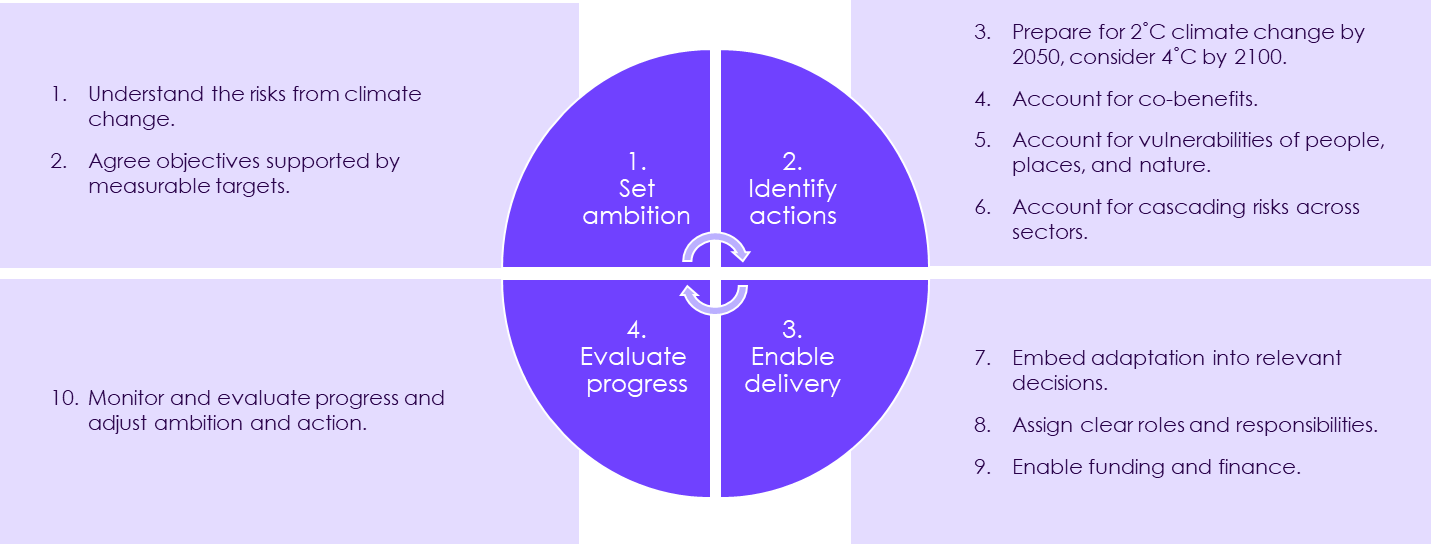 Description: There are four key steps in the adaptation policy cycle: set ambition, identify actions, enable delivery, and evaluate progress. These four steps organise the ten guiding principles for effective adaptation. |
3.1.1 Set ambition
The first step in adaptation is to set clear ambition, informed by an assessment of the current and future climate, and an understanding of what the public expect and are willing to pay for. The ambition needs to be embedded in clear objectives, accompanied by quantitative and time-bound targets, to provide direction on what is needed to respond to climate change. This helps government, agencies, and the private sector plan, coordinate, budget for, and evaluate progress on climate adaptation.
Setting ambition and targets is likely to be an iterative process. Once actions are identified, and their costs and scale of impact on the risk assessed, targets should be reviewed to ensure they are both affordable and achievable.
Principle 1: Understand the risks from climate change
Evidence on changing hazard, exposure, and vulnerability should be assessed through a climate risk assessment and underpin ambition for adaptation policy. Climate risk assessment should focus on climate risks that are already apparent today and those expected under a climate scenario of 2ºC global warming level by 2050. Assessment should also consider the risks under a 4ºC global warming level by 2100 to stress test a plausible high-end scenario. It is important to consider both weather extremes and changes in climate averages to fully understand the climate risks (see Chapter 1).
To inform decision making, climate risk assessments need to be conducted at a range of scales. National-level climate risk assessment should establish the parameters for what the UK, and its constituent nations, should prepare for today and in the future. Local, site-specific or sector-specific assessments can be used to understand risks at the right scales to inform the design and implementation of adaptation programmes.
The UK already conducts high-quality climate risk assessments. The UK Government is mandated to publish a Climate Change Risk Assessment (CCRA) every five years under the Climate Change Act (2008).[208] Climate risk assessment is also embedded in the Cabinet Office’s National Risk Register (NRR) and Chronic Risks Analysis (CRA), which provide an opportunity to integrate climate adaptation into cross-government planning (Box 3.1). To facilitate climate risk assessment at programme-level scale, there is a range of climate information and best-practice examples available for the public sector and private sector to use. These provide tools and templates for decision makers to follow:
- National climate projections have been developed and are publicly available. The Met Office has been developing and publishing bespoke climate projections for the whole UK since the 2000s. This information is available for government, academics, and businesses to use, with the most recent projections published in 2018 (UKCP18).[209] Guidance is available on how to use the projections to help understand what a 2°C global warming level by 2050 would look like in the UK.[210] Developing more impact-oriented and accessible information on current and future climate and weather extremes should be a priority for further iterations of UK climate information.
- Templates to enable use of climate information at appropriate scales are available. Examples include the Met Office’s Local Authority Climate Service, which provides tailored information at local levels, and the Environment Agency’s example risk assessment for industry.[211];[212] Clear guidelines for climate risk assessment frameworks can help ensure that best practice is followed consistently.
To set ambition, government departments must consider how climate risks interact with policy objectives and public safety. This may require clearer guidelines, and more people with relevant skills to make use of climate risk information or conduct bespoke programme-level climate risk assessment. Establishing clear and simple standards for climate risk assessment across government, aligned to this principle, will help mainstream robust climate risks assessment where needed.
|
Box 3.1 |
| The National Risk Register (NRR) is the public-facing document outlining the most serious, high-impact risks facing the United Kingdom, published by the Cabinet Office. The NRR has a near-term (next five year) focus to understand how changes in climate seen today could affect weather extremes in the next few years. Emergency responses to these near-term risks are then prepared. The risks are scored on a scale of one to five for magnitude of impact and likelihood. These scores are plotted on a matrix to compare and prioritise threats.[213] This approach complements the UK Government CCRA, which has a longer-term focus, to prepare the UK specifically for changes to climate and weather extremes from today through to the 2080s.
The NRR includes a structured assessment of climate risks to support UK resilience planning. It focuses on acute risks and identifies weather and climate hazards such as storms, heatwaves, flooding, and drought. The NRR’s approach for assessing climate risk involves:
The NRR is supplemented by the UK’s Chronic Risk Analysis (CRA), carried out by the Cabinet Office and the Government Office for Science. This analysis was first published in 2025 and summarises 26 medium to long-term risks, including climate change, which may increase the likelihood of risks identified in the NRR. Like the NRR, the CRA is aimed at resilience practitioners who prepare for emergencies. The NRR and CRA consider climate change risks at a high level. The UK CCRA process is a regular (five yearly) assessment of specific hazards and impacts. The CCRA-IA provides an evidence base to inform this, for example by assessing present-day risks and how these change under plausible future climate scenarios out to the 2080s. The different assessments can support each other, by using evidence from the UK Government CCRA and CCRA-IA on the trajectories, urgency, and impact of specific risks over longer time periods in future NRRs and CRAs. This could enable more long-term thinking and integration of evidence on the direction of change of specific risks into emergency preparedness frameworks across the UK. |
Principle 2: Agree objectives supported by measurable targets
Objectives provide direction for agencies on what is needed to prepare for climate change. At a minimum, the ambition set by adaptation objectives needs to prepare the country for the weather extremes that will be experienced under a 2ºC global warming level by 2050 – a central estimate on the current trajectory. The objectives also need to consider what is affordable and cost-effective to deliver when setting the level of ambition. This will require the UK Government and national governments to make difficult decisions on trade-offs across policy areas. In many areas this requires a much more engaged public debate, about what is both acceptable and affordable, which needs to be started now.
National adaptation objectives must cover critical areas of our lives, have clearly measurable and time-bound targets, and articulate a clear role for government departments (Box 3.2). Objectives and targets should be set relative to a baseline of today’s level of resilience so that progress towards them can be clearly tracked.
|
Box 3.2 |
| The Adaptation Committee advised national government in October 2025 on what a vision for a well-adapted UK looks like today and in the future.[214]
The letter advised that to drive effective adaptation, national governments should be setting adaptation objectives to operationalise a vision of a well-adapted UK in which:
Adaptation objectives must be associated with clearly measurable and time-bound targets, articulate a clear role for government, and come with explicit delivery accountability for government departments. Objectives should be set relative to a baseline of today’s level of resilience so that progress towards them can be clearly tracked. Proposed objectives and targets across systems, aligned with this high-level vision, are provided in Chapter 4 to Chapter 17, alongside evidence on system adaptation. |
To date, the Northern Ireland Executive, Scottish Government, Welsh Government, and the UK Government have not set clear national-level objectives with time-bound and measurable targets in their national adaptation plans (NAPs).[215];[216];[217];[218] Beyond the NAPs, there are some time-bound measurable targets relevant to adaptation set by the UK Government or regulators for water, land, energy, nature, and transport (Box 3.3).[219] These are mainly policy areas that are either regulated or have department-level adaptation plans in place.
Whilst this is a good step forward, some existing targets do not adequately consider climate risk as they were not set for adaptation objectives. For example, there is an existing target to bring 80% of Sites of Special Scientific Interest within protected landscapes into favourable condition by 2042 in England. This target was set to contribute to the Department for Environment and Rural Affairs’ (Defra) national and international commitments to restore nature. It could also support efforts on preparing land for climate risks but does not currently account for climate change out to 2042 (see Chapter 13).[220]
|
Box 3.3 |
| The Climate Change Committee (CCC) commissioned a review of existing targets relevant to climate adaptation and existing indicators available to monitor progress across the UK for the 14 systems used in this report. This helped to inform our analysis on proposed targets for adaptation ambition in each system. The review provided evidence on how objectives and targets, and their associated actions and enablers, could be tracked, highlighting key monitoring gaps (see Chapter 4 to Chapter 17). A summary of this research is published alongside this report.[221]
The review of existing targets in the UK and in similar jurisdictions overseas found that adaptation-relevant targets remain rare. This is especially the case outside of regulated sectors such as water and wastewater, energy, and the built environment. The review identified 66 existing adaptation targets that were relevant to the CCC’s systems, measurable, and time-bound. No relevant existing targets were identified for digital and telecoms, food security, sea, and waste. Where targets were identified, few set the direction on what adaptation is seeking to achieve at a UK or national-level. Examples of relevant existing targets in the UK included:
The review of existing indicators across the UK identified 96 existing indicators with potential to track progress on adaptation across the CCC’s systems. Identified indicators covered monitoring climate hazards and impacts, rolling out of adaptation actions, and specific enablers. There were very few indicators that directly measured whether the desired outcomes were being achieved. As with the targets, most indicators identified were in regulated systems, or areas strongly influenced by government. Examples included:
The full list of indicators currently available for the CCC to track progress on adaptation are available on the CCC’s Adaptation Monitoring Framework. The review highlighted key gaps in capability to track progress on adaptation across the UK. The commissioned project developed proposed action plans for how to close a selection of these monitoring gaps. Data gap action plans were developed for indicators in built environment and communities, health, digital and telecoms, food security, land, sea, and waste systems, as well as a cross-cutting indicator for local authorities’ capacity to prepare for adaptation. Action plans focus on where existing monitoring levers can be used, rather than introducing entirely new processes. For example, adding questions relevant to overheating to existing national housing surveys. If implemented according to the proposed timelines within each action plan, these plans have the potential to close critical data gaps by 2030. |
A lack of clear and measurable adaptation objectives and targets leaves government decision makers, delivery bodies, businesses, and households without a clear direction on what the UK seeks to achieve across key sectors. Subsequently, we often lack strong enablers and policy levers to deliver adaptation on the ground. Other countries are increasingly showing that improvements in clear and measurable national adaptation plans are possible and can be implemented (Box 3.4).
|
Box 3.4 |
Recent years have seen increasing efforts in national and international frameworks on climate adaptation to develop clear, time-bound adaptation objectives and targets. Whilst further improvements in monitoring and evaluation capacity are required to strengthen these targets, this is a step forward in driving clear direction on adaptation.
|
3.1.2 Identify actions
Delivering effective adaptation requires prioritising actions that are most effective. Effective adaptation action considers the costs of delivery, the potential for climate risk reduction, and the feasibility, scalability, and co-benefits of the action. In addition, the impacts on vulnerable people, and potential for reducing the impacts from cascading risks, need to be considered.
Principle 3: Prepare for 2°C of climate change by 2050, consider 4°C by 2100
Adaptation decision making should prepare for the UK’s climate under 2°C global warming level by 2050 and consider the climate under 4°C global warming level by 2100. The UK’s climate has already changed and will continue to do so (see Chapter 1). Climate change is altering the UK’s climate by changing both average climate conditions and the frequency and severity of extreme weather. Effective adaptation accounts for uncertainty in project and programme design and delivery, helping to manage variation in current and future climate.
To account for uncertainty, decision makers should adopt an approach that matches their level of risk tolerance – lower tolerance calls for more precaution – and take account of the relative costs.
- Precautionary approaches build-in a tolerance to a wide range of plausible futures at the outset. These are most suited to situations where it is possible and cost-effective to plan and deliver for a range of scenarios, or where the ability to adjust decisions at a later stage is limited or very expensive.
- For example, British Electricity Authority purposefully built the UK’s ‘supergrid’ infrastructure to accept future upgrades, in anticipation for future demand increases. As anticipated, an upgrade was required in the 1960s from 275 kV to 400 kV. The precautionary design approach made the upgrade cheaper and easier and has meant that the pylons originally used 70 years ago are still in use today.[227]
- Flexible planning approaches keep options open for future adjustments. This means taking ‘no regrets’ actions – actions that are sensible in a range of future outcomes – now. At the same time, planning should be carried out for a range of further actions which can be flexed depending on the level of future risk. These actions are often delivered through a phased approach. Flexible planning is useful in situations where uncertainty is high and actions can be adjusted when new evidence is available.
- For example, the Thames Estuary 2100 plan is a world-leading example of flexible adaptation planning to manage flood risk for London. The plan implements a pathways approach, identifying sequences of options that could be implemented depending on how sea level and river conditions unfold. Action is taken to keep options open for the future, for example by securing land early that may be needed for flood prevention measures in the future. This requires active monitoring of indicators, such as rising sea level, to trigger actions when they need to be implemented.[228]
Progress has been made on how to account for different climate scenarios in policy making. This has been achieved through the provision of guidance and updates to policy appraisal mechanisms. Examples include: HM Treasury’s latest version of the Green Book (published in 2026); Defra’s guidance on Accounting for the Effects of Climate Change (published in 2025); Spending Review 2025’s requirement for some department bids to assess policy impacts on climate risk under 2ºC and 4ºC global warming levels by 2100 and to outline actions to address any negative impacts identified.[229];[230];[231];[232] Defra’s guidance and mechanisms aim to provide a consistent methodology for assessing climate impacts and incorporating adaptation into policy appraisal. However, uptake of the guidance remains low, and lack of resources limits how well it can be implemented in policy planning.
Principle 4: Account for co-benefits
Actions to adapt to climate change have co-benefits and costs on wider social, economic, and environmental outcomes beyond reducing climate risks.[233] For example, adaptation actions can bring co-benefits to physical and mental health, air and water quality, education and skills development, and economic output.
Co-benefits can be particularly large for nature-based adaptation. There is an increasing number of examples of where these actions are effective and have strong public support (Box 3.5). Decision makers can achieve more effective outcomes by accounting for co-benefits and costs, and considering trade-offs when appraising adaptation policy options. Adequately appraising wider benefits and trade-offs means the measured cost-effectiveness and value for money of adaptation action can increase or decrease. However, this must ensure that adaptation delivers on the primary aim of reducing climate risk.[234]
National governments already have well-established guidance and frameworks available to inform policy decisions. These include but are not limited to: The Green Book, Better Regulation Framework, National Infrastructure and Service Transformation Authority (NISTA) Gate Review, and Enabling a Natural Capital Approach.[235];[236];[237];[238];[239] These provide guidance and tools that require decision makers to appraise the direct and indirect impacts of their policy options on other environmental, social, and economic factors. However, as operationalising guidance is resource intensive and remains optional, the application is low. There are limited examples of their use on large-scale schemes.
|
Box 3.5 |
| Nature-based solutions are actions to protect, sustainably manage, and restore natural and modified ecosystems in ways that address societal challenges to provide both human wellbeing and biodiversity benefits.[240] Nature-based solutions are often recognised for delivering co-benefits for people, places, and nature, and are often popular measures with the public.[241];[242];[243] In many cases, nature-based approaches have demonstrated significant benefits through avoided costs from the impacts of climate hazards. They have also demonstrated additional co-benefits, arising when ecosystem services such as carbon sequestration or human well-being are considered alongside the adaptation benefits.[244] Examples of accounting for co-benefits of nature-based solutions include:
|
Principle 5: Account for vulnerabilities of people, places, and nature
Some people, places, and nature are more vulnerable to climate risks than others. For example, babies and young children are more sensitive to heat as they are less able to regulate their body temperature, and older people are often more vulnerable to flooding due to reduced mobility.[248] Understanding how vulnerability varies across the UK is key to establishing where climate risk is highest and where adaptation resources can be used most effectively to drive the largest reductions in climate risk and protect vulnerable groups.
Government can help support adaptation that accounts for vulnerability by providing information and guidance to identify those most vulnerable to climate impacts. An understanding of local context is needed for adaptation to identify relevant hazard, exposure, and vulnerability, and ensure that the right actions are prioritised. Local level examples are increasingly showing how this can be done effectively (Box 3.6).
Government has various levers for embedding vulnerability in adaptation planning, with some good practice in place. These include but are not limited to: the Civil Contingencies Act, the Public Sector Equality Duty, and the National Biodiversity Climate Change Vulnerability Assessment.[249];[250];[251] However, vulnerability is often not clearly defined in planning or consistently translated into tangible outcomes for vulnerable groups.
There is often a greater focus on vulnerability of people rather than of places and nature. However, ecosystems, buildings and other assets can also vary in their vulnerability to the impacts of climate hazards across the UK. For example, migratory woodland birds are particularly vulnerable to climate impacts such as rising temperatures, as these affect their wintering and breeding habitats, as well as the timing of their migrations.[252] An effective assessment of vulnerability should consider the vulnerability of infrastructure, physical layout and surrounding natural environments, as well as socioeconomic factors such as population age and health.
At a local level, fragmented datasets are a key barrier to action. The development of datasets on vulnerability, such as the Met Office Local Authority Climate Service, can help to address this gap.[253]
|
Box 3.6 |
| Consideration of vulnerability is particularly important when delivering adaptation at a local level. We engaged with local councils and organisations involved in delivering local adaptation measures to discuss key lessons and considerations for integrating vulnerability and exposure into climate adaptation plans.
The Resilient Roch project has delivered property flood resilience in areas of Rochdale with high exposure and vulnerability to flooding, and increased flood awareness and access to emergency support.[254]
Climate Ready Clyde (CRC) is a cross-sector initiative to deliver an adaptation plan and measures for the Glasgow City Region, with community engagement at the core of its activities.
In both cases, addressing vulnerability was enabled by targeted community engagement. Spatial data on vulnerability were used to inform decision-making, but engagement was needed to support this. For example, data identified some areas as containing mostly high-income homeowners. However, in reality many properties in the area were informally sublet to low-income temporary residents. Identification and communication with these residents were supported by collaboration with existing local networks and organisations that had an established local presence and were both trusted and well known. As well as identifying vulnerable residents, engagement itself was also used to increase community resilience to climate impacts. For example, through providing information on emergency response services and supporting behavioural adaptation measures such as increased awareness and uptake of flood insurance. Stakeholders involved in the projects reported that funding remains the key barrier to considering vulnerability in adaptation. Councils in both cases often had to deliver measures to address multiple issues at once and faced barriers in aligning funding schemes to do this. For example, improving building fabric conditions alongside energy efficiency and flood prevention. In addition, adaptation funding often only covered physical adaptation measures (for example, grants for flood doors), meaning councils faced significant resource constraints in delivering the supporting engagement needed to consider vulnerability effectively. In Rochdale this was made possible through innovation funding, which enabled the project to consider multiple different measures at a property and neighbourhood level. |
Principle 6: Account for cascading risks across sectors
The connections between infrastructure, people, and nature provide opportunities for a failure in one sector to affect other connected sectors – known as cascading risk.
Effective adaptation requires decision-makers to identify connections between sectors and manage these connections to reduce their impacts. However, not all risks can be prevented or foreseen.
It is possible to learn from and identify effective actions from analysing past events where impacts did, or did not, spread across sectors. Analysing past instances of electricity and digital disruption highlights measures such as back-up energy supply, equipment maintenance, and clear roles and responsibilities for coordinating response, as priority actions to minimise cascading failures (Box 3.7).
Collaboration, data sharing, and clear reporting are required for effective management of cascading risks. There are good examples of organisations identifying connections across sectors in the reports produced under the fourth round of the climate change Adaptation Reporting Power (ARP4).[258]
The Cabinet Office, National Energy System Operator, National Cyber Security Centre, and National Protective Security Authority have developed the Critical National Infrastructure (CNI) Knowledge Base. This enables national governments to visualise and understand opportunities for impacts to spread across CNI sectors across the UK.[259];[260] The data includes information on what assets or systems are critical to delivery of a function and what the impact would be if that asset or system failed. This creates a map of dependencies between sectors and identifies the opportunities for cascading risks to occur. The CNI Knowledge Base has high potential to enable management of impacts spreading across sectors or regions. However, considerable work is outstanding to provide a full picture of ways in which impacts could spread across systems and to find ways to make this information available in ways that do not undermine security.
|
Box 3.7 |
We analysed impacts of previous electrical and digital disruption in the UK to understand what sectors and households can do to minimise their exposure and vulnerability. Some key lessons are provided below.
|
3.1.3 Enable delivery
Planning for adaptation will not lead to reduced impacts on people and society unless these actions can be delivered effectively on the ground. This requires adaptation to be embedded in relevant policy making processes, for there to be clear roles and responsibilities for delivery, and access to the necessary funding and finance to deliver it.
Principle 7: Embed adaptation into relevant decisions
Decision making in key areas, such as housing and infrastructure, can improve or worsen climate risk by changing exposure and vulnerability to hazards. Consequently, decisions on adaptation need to feed into wider policy making in these areas. When this is done well, policies, programmes and projects do not increase current levels of climate risk and give priority to policy options with strong adaptation benefits. This helps reduce the need for costly and resource-intensive action in the future.
At national government level, there are several key policy areas where adaptation needs to be embedded to prevent climate risk increasing and wider unintended consequences. This requires decision makers to have a good understanding of adaptation options. Integrating adaptation needs to be simple to understand and to be compellingly communicated. Examples of key areas include:
- House building: the siting and design of new houses needs to ensure future overheating and flood risks are prevented, not locked in.[269] If done well, embedding adaptation into policy making can save retrofit costs in the long-term (see Chapter 5). For example, Part O of the Building Regulations in England requires new residential buildings do not increase current levels of climate risk whilst also actively improving climate resilience through requirements on overheating.[270] Development also needs to take account of increased water stress in areas where water shortages exist already or are predicted under future climate.
- Infrastructure development: investments into infrastructure roll-out could lock in a lack of resilience to future weather or require costly retrofits if adaptation needs are not included in system design and delivery today (see Chapter 9).[271];[272] It may be appropriate to design long-lasting assets to be readily upgradable as part of enhancement programmes, as conditions change in the future.
Regulation and standards play a critical role in embedding climate risk reduction measures into key areas such as housing, infrastructure, finance, and food supply. Standards can support regulation by providing clear guidance and direction, as well as improving investor confidence, product marketability, performance, and safety. Standards should be regularly reviewed to account for the most up-to-date risk evidence.
Principle 8: Assign clear roles and responsibilities
Adaptation is implemented by a range of actors: national governments, public sector, local authorities, businesses, and households. Effective adaptation delivery requires clearly established roles and responsibilities to coordinate between these actors. All relevant actors should understand their responsibilities and how they will collaborate and coordinate with others.
At a national level, clear responsibility across government departments is necessary to ensure ownership and accountability for delivering adaptation objectives and targets in their policy areas. There is currently a lack of ownership of adaptation across government that is limiting the effectiveness of delivery. A lack of accountability, and a lack of clarity on adaptation ambition, means that other parts of government (for example, local authorities, regulators, and delivery bodies) often struggle to give climate adaptation priority within their overall responsibilities.
Local government will be responsible for delivering a large proportion of adaptation actions. Local authorities must navigate interactions with government and neighbouring local authorities, as well as national and regional agencies and regulators, for example, the Environment Agency or the Scottish Environment Protection Agency (SEPA). This creates a network of overlapping responsibilities and dependencies, where effective adaptation requires coordination across governance levels and sectors. Clear adaptation leadership at national government level, including mandates and responsibilities for local adaptation delivery, can help to drive it up the agenda (Box 3.8).
Effective action also requires government to articulate responsibility for households and businesses. In cases where roles and responsibilities have been assigned effectively, we have seen significant action on climate adaptation. For example, the Environment Agency’s statutory duty for managing flooding from the main rivers and the sea in England and Ofwat’s regulatory power and climate resilience duty set out a clear remit for delivery by businesses.[273];[274] This clarity allows for prioritisation and supports implementation through long-term funding pipelines.
|
Box 3.8 |
Local authorities play a key role in the UK’s response to climate change.[275];[276] The adaptation policy landscape for local government is complex and multi‑layered. Different local government tiers hold varying responsibilities, and arrangements differ across England, Northern Ireland, Scotland, and Wales.
The CCC commissioned engagement with local authorities from England, Northern Ireland, Scotland, and Wales working on adaptation to support the development of the Well-Adapted UK report. This engagement identified four themes that, in the view of local authorities, support the effective delivery of local adaptation.[277] This is summarised in supporting research published alongside this report.[278]
|
Principle 9: Enable funding and finance
Adaptation actions often, but not always, require both funding and financing. Funding for adaptation ensures that measures will be paid for, while financing helps spread this payment over time to make upfront costs manageable. Delivering adaptation at scale requires sufficient and well-targeted funding and finance by both the public and private sector.
Currently, there is limited understanding of spending on adaptation in the UK, the funding required to deliver adaptation at a national scale, and the role of the private sector (see Chapter 2). Funding for adaptation is a significant barrier to enabling adaptation inside and outside of national government, with limited and competing access to funding across departments. Decision makers should clearly set out responsibilities for delivering and funding adaptation to support public and private investment and provide a mandate for public and private organisations to act.
Government has a role in investing public money into adaptation, particularly where there is a clear public good or to support vulnerable people, places, and nature. Public funding can be used to directly deliver adaptation, which will ultimately be paid for by the taxpayer. Public funding and finance can also be used to reduce the risk for private actors to invest in adaptation, which can incentivise private contributions. Increasing private funding is key to delivering adaptation. This is particularly important where benefits are more concentrated at the household or business level.
Identifying clear funding sources enables access to finance for adaptation in the UK. To date, incentivising private funding has been most successful in the UK where the risks and their costs are visible, and benefits of adaptation are captured by those making the contribution. For example, flood defences and water resources management.[279];[280] Government can help increase private contributions to adaptation by:
- Clearly setting out where public investment will be prioritised (such as through an adaptation investment strategy), to provide more certainty to the private sector on where they will need to invest.
- Creating incentives or regulations to encourage private funding of adaptation where appropriate. For example, encouraging adaptation action by businesses or households through resilience standards in regulated sectors, or market-based incentives – such as taxes or subsidies.
- Providing information through guidance or standards on how organisations can use data to assess their own climate risk. Where public data are provided, this must be fit for purpose.
- Increasing awareness and information to help households understand their climate risks.
Public funding can also play an important role in helping incentivise private contributions to adaptation in mixed models (Box 3.9).
|
Box 3.9 |
Examples of successfully using public and private funding to reduce climate risk are documented around the UK. Two examples of relevant projects are summarised below:
|
3.1.4 Evaluate progress
A process to evaluate whether adaptation efforts are delivering against their intended outcomes is critical to achieve UK or national level adaptation objectives. Lessons from this process can be used to adjust planned adaptation ambition and action.
Principle 10: Monitor and evaluate progress and adjust ambition and action
Regular monitoring tracks whether policies and programmes are being delivered as planned, achieve their intended outcomes, and use resources efficiently. Evaluation allows programme impact and effectiveness to be assessed and means that decision makers and delivery bodies can be held to account. Lessons learned can then be used to improve the relevance and specificity of objectives and targets, and the design and delivery of current and future policies and programmes.
An iterative approach ensures that adaptation is resource-efficient whilst deploying measures that effectively reduce climate risk. To achieve this, monitoring and evaluation frameworks need to assess whether adaptation is on track against clear and measurable adaptation targets. This requires tracking indicators for adaptation actions and enablers, and assessing whether the policies and plans in place are sufficient to deliver the scale of action required (Figure 3.2).
Adaptation policy making requires monitoring, evaluation, and learning to be incorporated at a range of scales – from national cross-sectoral policy to specific adaptation interventions delivered at the local level. This ensures that adaptation can deliver effectively. At the national-level, Defra, Scottish Government, and Welsh Government have published monitoring and evaluation frameworks to accompany their national adaptation plans, with the Northern Ireland Executive due to finalise their framework in 2027.[284];[285];[286] As these develop there is prospect of starting to monitor and evaluate adaptation more effectively (Box 3.10).
|
Box 3.10 |
The third Scottish National Adaptation Plan’s (SNAP3) monitoring and evaluation framework was published in 2024 and includes four key elements:[287]
|
There is a good understanding of what works across a range of commonly deployed adaptation actions for reducing physical climate risk. Novel adaptation actions have less established evidence on how effective they are in different locations, across different scales, and over different time periods. This lack of formal evidence is particularly critical for nature-based solutions, and the co-benefits and costs they might bring.
The priority is to deploy successful adaptations at pace. Alongside this, concerted effort to conduct evaluation into the effectiveness of more novel actions and programmes is required to develop our understanding of the full range of options for adaptation. This can be done by public and private organisations, but data must be shared to ensure maximum benefit.
| Figure 3.2 Illustrative example of assessing progress in adapting to climate change |
 Description: Progress assessment of adaptation can show the proportion of adaptation actions that are on or off track to deliver government ambition on climate risk reduction, now and in the future. |
3.2 Applying the principles for effective adaptation across critical systems
Chapter 4 to Chapter 17 applies the ten principles for effective adaptation to discrete system level evidence to assess key actions, enablers, and policies, and to inform meaningful recommendations to national government departments.
The systems cover all risks identified in the CCRA4-IA Technical Report and map to the adaptation programmes developed by the UK Government, the Northern Ireland Executive, the Scottish Government, and the Welsh Government.[289] These systems break down the adaptation challenge into manageable and coherent units and consider existing key actor responsibilities. This is designed to help assign ownership for coordinating an adaptation response, with our systems intended to map to policy areas.
Some climate change risks and adaptation actions will cut across systems. Risk impacts in one system can be reduced or amplified by action or inaction in other systems. Achieving the proposed objective and targets in one system will depend on actions being implemented at the necessary pace and scale in other systems. For example, achieving the health system target – of maintaining today’s annual average of excess heat-related mortality – depends on adaptation measures being delivered in homes and the urban environment, as well as in health and care settings. Similarly, actions and policy levers in the land system to deliver objectives for maintaining good ecological health can lead to cross-cutting benefits, such as reducing surface water run-off in downstream communities. Considering connections and enabling cross-sector policy action will be required to deliver a well-adapted UK. Key connections for each system are indicated in each chapter.
- Health: assets, facilities, and operations to protect and maintain population health and deliver health and social care.
- Built environment and communities: cities, towns and villages, buildings, and the communities that live and work in them.
- Public services: facilities and operations of public services (outside of health and social care), focusing on education, justice, and emergency services.
- Cultural heritage: heritage sites and cultural landscapes, heritage buildings, and fixed and moveable assets. For example, UNESCO sites, archaeological landscapes, heritage listed buildings, statues, artwork, and historic documents.
- Water and wastewater: public water supply and wastewater infrastructure and services.
- Energy: production or generation, storage, transport, and distribution of electricity and fuels (including gas, oil, bioenergy, sustainable aviation fuel), as well as emerging systems for hydrogen and carbon transport and storage.
- Transport: infrastructure and services for roads (including trunk and local roads, bus and active travel), rail (including passenger, freight, metro, and light rail), aviation (including airports and air-travel operations), and maritime infrastructure (including ports, inland waterways, ferries, and shipping).
- Waste: waste services and waste management sites, including historic waste sites, waste tips from the mining industry, and nuclear waste sites.
- Digital and telecoms: digital and telecoms infrastructure and services, including data centres which store and process digital information, and public and private electronic communications networks.
- Land: terrestrial and freshwater habitats and ecosystems, and commercial activities that depend on land, such as farming and forestry.
- Sea: marine environment in UK waters, including marine habitats, marine fisheries, and aquaculture.
- Food security: international production and the sourcing, importing, processing, manufacturing, and distribution of food. This includes imported inputs to UK agriculture.
- Economy and finance: businesses’ assets, operations, and supply chains, the financial sector, and the broader economic strength of the UK.
- National security and international engagement: UK national security, foreign policy, and development interests, relating towards global adaptation goals.
Delivering effective adaptation action is urgent, provides substantial benefits, and can be done. Many actions and key policy levers already exist in some form, and there are examples of good practice to learn from. For each system, the principles for effective adaptation have been applied across these four sections:
- Set ambition: this section sets out what climate risks and opportunities national governments need to prepare for in today’s climate and in the future climate (under a 2ºC and 4ºC global warming level by 2050). This underpins the ambition for a well-adapted UK in each system, setting a clear direction for government on what they need to achieve to be prepared. To clarify the path to becoming well-adapted, measurable time-bound targets are proposed that suggest an effective level of adaptation for key areas (Box 3.11).
- Identify actions: this section sets out the priority adaptation actions required to deliver the adaptation ambition in each system. The priority adaptation actions are selected based on the costs of delivery, the potential for climate risk reduction, and the feasibility, scalability, and co-benefits of the action.
- Enable delivery: this section sets out the required roles and responsibilities, enablers, and policy levers to implement the adaptation actions and achieve the ambition in each system. These include a range of enablers and policy actions such as data and monitoring processes, information provision, funding, and regulation and standards.
- Evaluate progress: this section sets out mechanisms to monitor and evaluate each objective and target, to ensure that progress to reduce climate risks remains on track. Existing indicators to monitor climate adaptation are highlighted, along with key gaps that remain.
|
Box 3.11 |
The Well-Adapted UK report advises the UK Government on the path to adapt to the current and future climate. This is underpinned by 21 objectives that cover critical areas of our lives, consider what is cost-effective to deliver, and suggest clear roles for government departments. To drive action, the objectives are accompanied by proposals for clear, measurable, and time-bound targets. The objectives and targets proposed across Chapter 4 to Chapter 17 are summarised in Annex 1.
For each of the targets identified in the Well-Adapted UK report, we set out the key variables to track progress and the recommended direction of travel. We have recommended target levels for each variable where there is sufficient evidence on what is affordable and cost-effective to deliver. Targets have not been proposed for all areas across the UK, prioritising areas assessed as most at risk from climate change in the CCRA4-IA Technical Report.[290] Setting targets for adaptation is the responsibility of government. The advice recognises that the UK Government, the Northern Ireland Executive, the Scottish Government, and the Welsh Government may choose to propose alternative targets where they have different priorities, trade-offs to consider, or further evidence. The target levels should be iterative, to accommodate new and evolving evidence on effective adaptation action. |
Chapter 4: Health
Introduction and key messages
This chapter covers climate adaptation for public health and the ability to deliver health and social care. It is split into two subsystems covering these areas:
- Population health: including impacts from extreme weather and climate-sensitive infectious diseases on mortality (deaths) and morbidity (illness) at a population level and the public health adaptation actions required to reduce climate change risks.[291]
- Health and social care: including impacts from extreme weather on the functioning of the health and social care system, in terms of its estates and staff, and the adaptation actions required to reduce climate change risks.
Our key messages are:
- Heat is the deadliest single climate-related health threat in the UK. Without additional adaptation action, excess heat-related deaths in heatwave periods are projected to increase from 1,400–3,000 in the UK today, to 3,000–10,000 by 2050. Heat-related Accident and Emergency (A&E) attendances and emergency hospital admissions would also increase. The greatest impacts will fall on people and communities at higher risk of poorer health.[292] Incorporating cost-effective adaptation measures across public health and the health and social care system could reduce projected heat-related health impacts. Further reductions are possible through delivering adaptation actions in the wider built environment (see Chapter 5).
- Heat and flooding threaten the ability to deliver quality and accessible care. Cost-effective adaptation is possible. Risk assessments and adaptation plans for cooling and reducing flood risk across these settings are needed now alongside dedicated climate adaptation funding. A coordinated approach to deliver low-carbon heating, cooling, ventilation, and improved air quality is needed. Other actions in the health system such as workforce training, capacity management, and effective monitoring can help minimise disruption. Strengthening flood resilient infrastructure, early warning systems, and continuity planning help protect public health and safeguard health and social care services from flooding impacts.
- Social care remains underprepared for escalating climate risks. There is little evidence that climate risks are being considered sufficiently in the sector. Guidance on climate risks exists for the sector, but it does not always appear to be effectively disseminated down to working-level staff, who often lack the knowledge and resources to act.[293]
Adaptation overview
This chapter sets out the ambition for a well-adapted health system and the actions, enablers, and policies required to deliver it. Figure 4.1 provides a summary of this in a monitoring map – a more detailed version of this figure is available in the Climate Change Committee’s Adaptation Monitoring Framework.
Adaptation in the health system is connected to other systems covered in this report. Ensuring that people and communities remain safe and healthy during extreme weather depends on coordinated action across multiple systems. Poor-quality housing increases health risks while built environment adaptations can reduce them (see Chapter 5). Effective emergency response systems are critical to manage climate-related health impacts (see Chapter 6). Health and social care systems rely on resilient infrastructure services (see Chapter 8, Chapter 9, Chapter 10, and Chapter 12). Climate-adapted workplaces reduce occupational health risks (see Chapter 16). Strengthening resilience across other systems such as water, waste, and food security will also protect public health (see Chapter 8, Chapter 11, and Chapter 15).
| Figure 4.1 Monitoring map for the health system |
 Notes: a more detailed, interactive version of this figure is available in the Climate Change Committee’s Adaptation Monitoring Framework. |
4.1 Set ambition
This section sets out the necessary ambition for adapting to the risks from climate change in the health system.
4.1.1 Climate risks to the health system
The health system manages the climate risks identified in Chapter 3 of the CCRA4-IA Technical Report, across England, Northern Ireland, Scotland, and Wales (Table 4.1).[294]
- Population health: the increasing intensity, frequency, and duration of heatwaves and higher summer temperatures will significantly increase heat-related deaths and illness. This will disproportionately affect people who are more exposed to heat, less able to adapt and at higher risk of poorer health outcomes. Even short spells of high temperatures and hot nights can lead to heat-related health impacts.[295] Heat can exacerbate underlying illnesses including cardiovascular disease, respiratory disease, diabetes, and dementia. Climate change is also increasing other health risks, including risk of injuries, adverse mental health effects from flooding and other extreme weather events, impacts on food safety and nutrition, and increased risk of climate-sensitive infectious diseases.
- Health and social care: increasing heatwaves, higher temperatures, and other hazards will also cause additional pressures to the running of the health system through increased demand for services, disruption, and equipment failure. There will be impacts on the health and wellbeing of staff and patients, leading to poorer patient outcomes and increased costs. Cascading risks such as power outages, water shortages, and transport disruptions could further amplify these challenges.
Climate change is already having impacts on health today:
- Annual heat-related excess deaths in recent years range from around 1,400 to 3,000 during heatwave periods.[296];[297] In 2024, there were 1,311 heat-associated deaths in England, 37 in Scotland and 557 in Wales.[298];[299];[300] In England, 36% of heat-related mortality in 2024 occurred in hospitals, while almost 38% occurred in care homes, and 27% in personal residences.[301]
- Heat has been associated with short, same-day increases in demand and pressure on services.[302] Modelled estimates show that heat-related A&E attendances currently account for 6% of average daily total attendances across the UK on extreme heat days, whereas heat-related emergency hospital admissions account for 4% of the average daily total.[303];[304]
- During the 2022 heatwave, a research survey of care homes staff found that social care practitioners were often negatively impacted by the heat, which affected quality of care.[305]
- The UK Health Alliance found that around 26% of the healthcare facilities in England (including care homes) are at risk of flooding and this is projected to rise to almost 32% by 2040-60.[306]
- There has been movement of new mosquito vectors (specifically Aedes albopictus that can carry diseases such as dengue fever and chikungunya) and pathogens northwards through Europe, with areas of France seeing local outbreaks of dengue fever and chikungunya.[307];[308] As a near-neighbour with similar climate trends, France provides an early warning of how vector-borne disease risks could emerge in the UK. Climate modelling suggests the area around London is already suitable for the establishment of Aedes albopictus.[309]
Without additional adaptation, under a 2°C global warming level in 2050:
- Excess heat-related mortality during heatwave periods is projected to increase from 1,400–3,000 per year currently, to 3,000–10,000 per year by 2050 across the UK, assuming no change in population or level of adaptation.[310] Most of these deaths are projected to occur in England and Wales, but excess heat-related mortality in Scotland and Northern Ireland is also projected to increase.[311]
- UK-wide heat-related hospital attendances and admissions could triple by 2050 compared to current levels. These impacts are disproportionately concentrated in London.[312]
- The number of hospitals at risk of flooding from rivers, the sea, and surface water is projected to increase from 26% currently to 32% in the 2050s.[313]
- Wider health impacts from floods, particularly to mental health, are expected to increase in line with increased exposure.[314]
- Heatwaves and warmer annual temperatures can facilitate the development, geographical spread, and active season of vectors like mosquitoes and ticks, raising the risk of diseases such as dengue and Lyme disease.
- Food and water-borne diseases may increase, including an increase in the area of UK coastline which is suitable for the growth and survival of Vibrio bacteria, due to warming coastal waters.[315]
Under a high-end scenario, on track for around 4°C global warming level by 2100, without additional adaptation:
- Heat-related mortality is projected to increase further, potentially to 10,000 to 18,000 per year by the 2080s assuming population growth.[316]
- Most of England could become suitable for the Aedes albopictus mosquito as early as the 2040s or 2050s.[317] Most of Northern Ireland, Scottish Lowlands, and Wales may also become suitable for the Aedes albopictus mosquito by the 2070s.[318] Dengue fever could become endemic in London during the 2060s.[319]
- Future climate projections with increases in extreme rainfall and flooding also show a spread of certain Culex mosquito species that can transmit West Nile virus (WNV) to humans carried by migratory birds. While the risk of infection with WNV is currently low, it is predicted to increase into the second half of the century throughout lowland England and parts of Wales.[320]
This chapter focuses mostly on impacts from heat and flooding. The CCRA4-IA Technical Report also covers risks to health from other extreme weather, such as climate-sensitive infectious disease, wildfires, drought and storms, and risks to health from changes in air quality, and food safety and nutrition (Table 4.1). Most of these risks require more investigation, for example the health risks of wildfire and drought are less well documented than those from flooding and temperature in a UK context.[321]
While increasing heat is a major climate risk to health, moderate cold weather is the greatest risk for health and mortality in the UK. The negative health outcomes and deaths from cold are expected to continue until late in the century (2070s).[322]
| Table 4.1 Climate risks to health |
|||||
| Risk | England | Northern Ireland | Scotland | Wales | Overall |
| H1: risks to people from heat | Critical action needed | Critical investigation | Critical action needed | Critical action needed | |
| Critical action needed | |||||
| H2: risks to people from extreme weather, excluding heat | More action needed | More action needed | More action needed | More action needed | |
| More action needed | |||||
| H3: risks to people from changes in air quality | Critical investigation | Critical investigation | Critical investigation | Critical investigation | |
| Critical investigation | |||||
| H4: risks to people from climate-sensitive infectious diseases | More action needed | More action needed | More action needed | More action needed | |
| More action needed | |||||
| H5: risks to food safety and nutrition | Further investigation | Further investigation | Further investigation | Further investigation | |
| Further investigation | |||||
| H6: risks to health and social care delivery | More action needed | More action needed | More action needed | More action needed | |
| More action needed | |||||
| Source: Mitchell, D. and Newton, J. (2026) Health and Wellbeing In:CCRA4-IA Technical Report. | |||||
4.1.2 Objective for a well-adapted population health subsystem
Objective: public health systems prevent, prepare for, and respond to climate-related health risks ensuring communities remain safe and healthy under the current and future climate.
Achieving the objective would reduce climate-related illness and death, leading to a better quality of life for individuals, longer lives, reduced strain on the healthcare system, and lower time lost from work and other productive activities.
To deliver on this objective, we suggest setting a national-level target to reduce heat-related mortality. This is a key area for a target in national-level adaptation programmes and would have a subsequent benefit of reducing heat-related morbidity. National governments may choose to propose alternative targets where they have different priorities, trade-offs to consider, or further evidence (Box 3.11).
Minimising excess heat-related mortality and morbidity
Heat is currently the deadliest climate-related health threat in the UK. Heat-related illness leading to A&E attendances and emergency hospital admissions will also need to be addressed to avoid significant summer pressures on the health and social care system.
The damages from heat-related impacts in the health sector are modelled at £538 million per year (2025 prices) today and could grow by 144% in the 2030s, and 245% by the 2050s. A cost-effective package of adaptation actions can reduce these impacts.
While the target has been proposed in the population health subsystem, meeting it will require significant action in the built environment and communities system (see Chapter 5).
Proposed target: by 2050, excess heat-related mortality should be no greater, and ideally lower, than today’s annual average.
- Meeting this target will ensure that the risk of heat-related mortality does not increase, despite rising temperatures increasing exposure to heat. In addition, taking steps to meet this target will reduce pressures on health services from rising temperatures, protecting capacity and patient outcomes by reducing heat-related hospital attendances and admissions.
- We have proposed the target level as maintaining deaths at a level equivalent to, and ideally lower than, today’s average over a rolling period by 2050. This aligns with climate projections, policy planning cycles, and the timeframe in which adaptation measures can be fully deployed. Evidence commissioned for this report that this target is achievable and cost effective includes:
- A combination of passive adaptation measures and active cooling within residential buildings can cost-effectively reduce modelled annual heat-related mortality. In the 2050s this could be close to, and potentially lower, than present-day levels (see Chapter 5).[323]
- Adaptation measures across the health and social care system and public health can also reduce extreme heat-related mortality and morbidity. In 2050 heat-related mortality could be reduced by almost 40% compared to projected levels with a cost-effective adaptation package (Box 4.1). This cost-effective package has a 1.3:1 benefit-cost ratio from the present-day to 2050s. The package costs close to £14 billion and accrues benefits exceeding £17 billion (2025 prices).[324]
- Evidence from our citizens’ panel and previous public engagement on adaptation by Defra supports ambitious adaptation to prevent deaths and impacts on vulnerable people in particular.[325];[326]
- Progress towards this target can be measured using heat-related excess mortality or mortality rates (see Section 4.4). In addition, assessing trends over time can provide supporting evidence of progress, including whether rising temperatures are being decoupled from increases in mortality.
- This target should be measured using a multi-year average and using a robust definition of heat-related mortality. Governments will need to develop and set out the detailed design of the target and mechanism for delivery. This includes how best to account for demographic change, socioeconomic inequality, and the complexity of mortality statistics.
4.1.3 Objective for a well-adapted health and social care subsystem
Objective: health and social care services provide quality and accessible care that is maintained during extreme weather under the current and future climate.[327]
Achieving this objective would mean that the health and social care system will be available and providing quality care under all conditions, including in both winter and summer peaks of weather-related pressure.
To deliver on this objective, we propose national-level targets for reducing the impacts of extreme weather on the physical NHS estate and care homes. National governments may choose to propose alternative targets where they have different priorities, trade-offs to consider, or further evidence (Box 3.11).
Functioning and safe NHS estates in extreme weather
An important source of disruption to the health care system is the lack of resilience of the physical NHS estate to extreme weather. NHS estates are at increasing risks from heat and flooding.
Proposed target: by 2035, all healthcare buildings and other essential assets should maintain safe and appropriate temperatures and should be at low risk (less than 1% chance for any given year) of flooding.
- Meeting this target will keep healthcare services safe and operational during floods and heat extremes, protecting patients, staff, and equipment, and reducing service disruption and long-term costs.
- We have proposed the target indoor temperature level to be ‘safe and appropriate’ rather than a specific temperature range. This reflects that some areas of hospitals may need to be relatively cooler or warmer depending on needs. For example, existing guidance for temperatures in England recommends temperatures from 18ºC to 28ºC in general wards and 18ºC to 25ºC for more sensitive areas, such as birthing and recovery rooms.[328]
- Adaptation actions are effective at reducing the extent and duration of uncomfortable indoor temperatures. Retrofitting existing facilities in high-risk locations will be key to meeting our proposed target alongside ensuring that new buildings are resilient from the beginning. Both passive and active cooling measures and on-site flood resilience measures will be required for estates at risk.
- Progress towards this target could be monitored via robust, consistent temperature monitoring on wards or by modern temperature control systems. Flood risk adaptation progress could be monitored through regular flood risk assessments of healthcare buildings, tracking the proportion of facilities at low flood risk or with appropriate flood protection measures in place, alongside trends in flood-related service disruption (see Section 4.4).
Safe and comfortable care homes during high temperatures
The social care sector is underprepared for escalating climate risks. There is little evidence that climate action is taking place and existing guidance does not always appear to be effectively disseminated down to working level staff.[329]
Proposed target: by 2040, all residential care homes should be able to maintain indoor temperatures between 16ºC and 26ºC.
- Meeting this target will ensure that residents and staff will be protected from heat-related illness and mortality and can maintain safety and quality of care during extreme temperatures. It will also reduce emergency healthcare demand linked to overheating in care settings.
- We have proposed this target to reflect the urgency of heat risk to the care sector. Care home residents are among the most heat-vulnerable.
- We have proposed the target indoor temperature level of 16ºC to 26ºC based on existing regulations for minimum working temperatures and evidence for appropriate upper temperature limits for health.[330]
- Adaptation actions are effective at reducing the extent and duration of uncomfortable indoor temperatures. We can deliver many of these actions today and there are opportunities for delivering them alongside upgrades to the care estate. Where delivery may take longer, there are low-regret operational actions which can reduce risk in the interim (see Section 4.2.2).
- Progress towards this target can be measured by the proportion of care homes meeting the agreed thermal comfort threshold. This may require indicators on indoor temperature monitoring (see Section 4.4).
4.2 Identify actions
The following section sets out the priority adaptation actions required to achieve the climate adaptation objectives for population health, and health and social care. These actions focus on reducing heat risk, the most urgent risk for the UK, and to prepare for flooding, climate-sensitive vector-borne diseases, and mental health impacts.
Adaptation actions across the health and social care system are an investment in health and wellbeing. Estimates suggest the known investment needed to deliver adaptation in the health system could be around £0.7– £1.7 billion per year (2025 prices).420F420F[331]
4.2.1 Actions in the population health subsystem
A mixture of actions is required to build an effective pathway to reducing risk to population health. This includes social interventions, surveillance and monitoring, emergency response systems, and management of green and blue infrastructure. Relative contributions of different types of actions will vary with location and contextual factors such as targeted actions for vulnerable groups. Public health agencies, local authorities, and other sectors will play a key role in implementing these actions.
Social interventions
- Behaviour change: behavioural changes by individuals can be highly effective at avoiding impacts on health in high-risk settings and for vulnerable individuals. Appropriate and accessible information and guidance, delivered through effective communication channels, are needed to enable change and are often seen as low-regret actions.[332] For example:
- Minimising health impacts during high temperatures by staying hydrated, avoiding sun exposure, avoiding exercising during hot hours, wearing light clothes, and maintaining safe indoor environments. Heat advice and information services that support behaviour change have been shown to have a benefit-cost ratio of 26:1 by the 2050s.[333]
- Avoiding contact with flood water and taking note of advice on safe drinking water.
- Preventing mosquito and tick bites by wearing long clothing, using repellents, using screens or keeping windows closed, removing pools of standing water, and checking for ticks after outdoor activities.[334]
- Personal evacuation planning to help vulnerable individuals remove themselves from harm’s way when facing the prospect of flooding.
- Public cooling spaces: using pre-existing cool public spaces and buildings to help keep vulnerable people cool can bring cost-effective reduction in excess heat-related mortality. These have been found to have a benefit-cost ratio of 1.7:1 by the 2050s. However, they can be hard to access for some of the most at-risk groups who are potentially less mobile.
- Preventative healthcare: in-person visits by health care or community workers to people at highest risk of heat-related impacts during (or shortly before expected) heat events can reduce mortality and hospital use.[335];[336] However, as these require increasing community healthcare staffing, they are also relatively costly, and therefore less cost-effective in northern regions. Health professionals and clinical management can also play a role in reducing impacts, by providing specialist, targeted advice for patients using heat-sensitive medication or who may require additional support.[337]
- Mental health treatment for those exposed to flooding: trauma-focused therapy, alongside measures to reduce climate risk, can be effective with some evidence reporting a drop in Post-Traumatic Stress Disorder diagnoses of flood-affected children.[338];[339]
Surveillance and monitoring
Actions on surveillance and monitoring are key for health adaptation. They are required to ensure that appropriate interventions are used where and when they are needed and to assess the effectiveness of ongoing strategies. Section 4.4 outlines data that are currently available and the key gaps that should be filled.
- Surveillance and monitoring of climate hazards and impacts: flooding, heatwaves, wildfire, and storms can be tracked and monitored, allowing public health agencies to issue timely warnings and take preventative action.
- Surveillance and monitoring for climate-sensitive diseases: Preventing establishment of climate-sensitive vectors such as mosquitoes and ticks is more effective than managing invasive species when they are widespread.
- Strong monitoring and contingency planning enable rapid detection of new diseases or vectors to support quick, targeted public health responses (such as vector control and public awareness campaigns).[340];[341] In the UK, contingency plans that outline the steps to be taken by relevant agencies and local authorities if invasive species become established are required.
- The extent to which the UK can delay and prevent Aedes albopictus (the mosquito vector of dengue and other pathogens of public health importance) from becoming established in the UK depends in part on the scale of resources invested in surveillance and control.[342]
- There is strong evidence for the impact of weather and climate on some pathogens commonly spread through contaminated food and water (such as Campylobacter, Salmonella, and Vibrio), but evidence on many others is currently scarce.[343] Enhanced pathogen monitoring is the first step to strengthening this evidence and identifying adaptation actions to reduce health impacts.[344]
Early warning systems and response
Early warning systems allow people and health services to prepare for extreme weather, reducing exposure, injuries, illness, and deaths linked to climate-related hazards (see Chapter 6). Existing surveillance and early warning systems include the Met Office’s Severe Weather Warning Service, UK Health Security Agency’s (UKHSA) heat alert system, and invasive mosquito monitoring.
- Heat alerts: alerts issued by the UKHSA are currently activated in England only and cover defined heatwaves. Heat-health alerts issued by UKHSA should be considered in other nations or be targeted based on local-level risk.
- Local warnings: strengthening multi-channel local warnings, alongside careful management of repeated alerts to avoid response fatigue, is required to ensure all regions and at-risk people are reached (see Chapter 6).[345]
Green and blue infrastructure
Green and blue infrastructure has many functions and benefits to people and biodiversity. It can improve amenity and help with health and wellbeing, for example by providing shade and cooling, and reducing air and noise pollution.[346];[347]
- Green and blue spaces: high quality and well-distributed green and blue spaces reduce heat exposure, mitigate the urban heat island effect, and support physical activity and wellbeing (see Chapter 5). Their effectiveness depends on quality of design. Accessibility and safety are key features to maximise co-benefits, such as encouraging physical activity.
- Building and maintaining safe water bodies: this can reduce breeding of endemic mosquitoes and harmful algal blooms. Preventative actions include designing water features with moving water and limited emergent vegetation.[348];[349]
4.2.2 Actions in the health and social care subsystem
A mixture of cooling and flood resilience actions, and changes to the way the health system operates are needed across the subsystem to ensure quality and accessible health and social care.
Buildings and estates
These measures include healthcare building-level and estate-level actions, to provide cooling and flood resilience. These measures can provide large risk reductions. They require up-front capital investment, but their relative costs and effectiveness vary depending on whether they are being retrofitted or included at build-stage and the type of building they are applied to.
- Cooling measures: investing in retrofitting existing healthcare facilities is likely to provide high net benefits, with a benefit-cost ratio of approximately 2:1 if patients are cooled in a hospital setting.[350] In most areas of England and Wales, addressing the health impacts of heat by installing low-cost passive cooling for those buildings most at risk is estimated to be cost-effective within the next five years.[351]
- Passive measures include insulation of buildings, shutters and blinds, night-time ventilation, and maximising green space. Several measures, such as internal blinds or curtains, are lower cost and relatively easy to install, while still reducing heat gains.[352] In healthcare buildings, external shading in hospitals can reduce heat by 2ºC on hot days, rising to 4ºC on peak heat days.[353] Various passive physical adaptations have the potential to be cost-effective and reduce heat risk, although some behavioural interventions, such as window and door opening, may be equally effective at reducing exposure to heat.[354]
- There are, however, limitations to passive measures in some clinical areas and types of building (for example, patient safety means that windows typically don’t open widely). Passive measures can also be relatively high cost to add to existing buildings, with some measures more appropriate for new builds. In some parts of the UK, such as London and southeast regions, passive measures alone will not be effective enough to reduce indoor temperatures to comfortable levels during periods of high temperatures.[355]
- Active cooling measures can ensure temperatures remain at a safe level in health and social care settings. Active cooling is typically air conditioning, which can be provided by dedicated units, or built-in, ducted systems. Some types of heat pump which provide low-carbon heating in winter can also provide cooling. Active cooling will be needed in hospitals in some areas of the UK, where clinically appropriate.
An average capital investment need of around £114 million per annum has been estimated for cooling in healthcare settings (2025 prices). This assumes all at-risk hospitals install heat pumps that can provide cooling during a cost-effective phased roll-out from London and South East England from 2040, and in all other regions in England and Wales by 2050.[356]
The most appropriate choice of system will vary depending on the specific characteristics of each site.[357] The costs and benefits of these options should be considered as part of natural maintenance and replacement cycles. This means upgrades take place without additional disruption and as part of the move toward low-carbon heating.
-
- In small care homes, with limited insulation and high thermal mass, active cooling in lounges using portable air-conditioners can be the most cost-effective measure to reduce heat.[358] Cost-effectiveness of investing in cooling in care home settings varies widely by region. A targeted approach will need to be taken both across the UK, to prioritise the right mix of cooling.[359]
- Site-level flood resilience: hospitals may require both building and estate-level defences, as well as wider defences. For example, sustainable drainage systems (SuDS), permanent external barriers, protected access routes, waterproofing electricals, building redundancy for critical areas such as theatres, labs and IT, and keeping essential equipment away from basements.[360];[361] Care homes in flood risk areas would benefit from property-level measures as documented in Chapter 5. Undefended new facilities should not be built in areas at high-risk of flooding.
Operations
Operational adaptation actions help to ensure that services can continue to operate safely, and that staff know how to reduce impacts on health from extreme weather on patients and themselves. They include workforce training, business continuity plans, and emergency planning and are generally lower cost than infrastructure measures.
- Capacity building: evidence suggests that current heat-health guidance produced by UKHSA for care home providers and clinicians is not always being implemented effectively.[362] Training for medical, nursing, pharmacy, and allied health professionals would strengthen their ability to anticipate, recognise, and manage climate related health risks. This would help to prevent avoidable complications and ease pressure on services during periods of high demand. England, Scotland, and Wales already have some healthcare climate education programmes and regulatory guidance in place to support this.[363]
- Extreme weather business continuity plans: the number of clinical and non-clinical staff absences from excess-heat events are currently around 500,000 per year and are projected to rise to between 1.1 and 2.0 million in the 2050s.[364] Absences can disrupt services through delays, cancellations, safety concerns, and increased reliance on temporary staff. Business continuity planning can outline how to manage absences alongside wider adverse weather planning. For example, through workplace heat protection policies and flexible staffing where possible.
- Occupational support: Chapter 16 covers detail on options to reduce impacts from extreme weather, such as heat, on the health of workers. Within the health and care system, the following actions should be in place to protect staff health and wellbeing: providing occupational health support, hydration stations, cool areas, ensuring appropriate breaks are taken, adapting Personal Protective Equipment (PPE), and providing support for safe travel during extreme weather.
- Emergency scenario planning: undertaking risk assessments and stress-testing health systems to identify vulnerabilities is a first step in developing effective rapid response protocols for climate-induced emergencies. This evidence can then be used to design and refine emergency protocols that clarify roles, improve coordination, and standardise response actions. For example, by extending heatwave scenario planning based on the July 2022 heatwave for extended durations, mirroring the ‘Winter pressures’ planning within NHS operations.[365]
|
Box 4.1 |
| This research aimed to understand a cost-effective adaptation package at a national scale to the risks of extreme heat on health and healthcare outcomes. The analysis focused on actions delivered across public health and health and social care settings. The full method and results can be found in the supplementary report from Edge Health and Greencroft Economics (2026).[366] Understanding the risk Under a central scenario, the extreme heat-related risk to mortality, A&E attendances, and hospital admissions is valued at £1.3 billion per year in the 2030s and £1.9 billion per year in the 2050s (2025 prices). In the high-impact scenario, these risks increase significantly, to £3.5 billion per year in the 2030s and £4.3 billion per year in the 2050s (2025 prices). Risks and impacts vary across the UK and the population, with the greatest absolute impacts seen in London and southern England, but the steepest relative increases expected in historically cooler regions. Extreme heat-related deaths and hospital admissions mainly affect people aged 75+, while A&E attendances are disproportionately higher in younger groups.
Cost-effective adaptation at a national scale
The adaptation measures need to be rolled out over time and across regions, to reflect the evolution of the extreme heat-related health risks, and how these vary across the UK. For example:
This package would require total investment across the present day to 2050s of £14 billion per year, to avoid costs estimated at £17 billion per year, making the overall benefit-cost ratio 1.3:1 from the present-day to 2050s (2025 prices). The package should be deployed in higher-risk regions first to maximize cost-effectiveness. |
| Figure 4.2 Potential for additional adaptation to reduce impacts from heat within health and social care settings |
 Description: Cost-effective adaptation packages at a national scale can significantly reduce heat-related impacts to health and social care across the UK. |
4.3 Enable delivery
This section sets out key enablers and policies to deliver the adaptation actions, set out above, at the required scale and urgency for a well-adapted health system.
4.3.1 Enablers
Many of the actions highlighted in the previous section will be delivered by the public sector or households directly (Table 4.2). The most important enablers to drive action across public health and health and social care are sufficient resources, planning, good data and monitoring, and engagement:
- Resources: while the health system is almost exclusively publicly funded, approximately 37% of care home residents are self-funded.[367] Both financial and human resources are needed:
- Investments in physical infrastructure need long-term, predictable funding, which can be difficult within the health system. Many adaptation needs can be addressed by climate-proofing routine asset replacements (for example, upgrading heating systems) rather than through new investments. Support through targeted funding, incentives, and clear retrofit standards may be needed, especially for care homes where most provision is privately operated.[368]
- Embedding climate resilience into regulation guidance would also strengthen incentives, alongside additional resources (financial, technical, and human) for surveillance, monitoring, and early warning systems for climate hazards.
- Effective adaptation requires sufficient human resources to scale up provision during emergencies. This includes having staff dedicated to emergency planning and response, vector surveillance, and training on climate-related health risks. Adequate staffing levels and flexible workforce deployment are needed to maintain service continuity and meet increased demand during extreme events.
- Clear plans, roles, and responsibilities: climate risks should be considered alongside core operational and financial priorities to support better resourcing, coordination, and integration into continuity plans.[369] Clearly defined adaptation roles or dedicated leads within public health agencies and NHS Trusts and Boards would help ensure these risks are recognised and acted on in day to day decisions.[370] Better understanding of climate risks and adaptation actions will also strengthen the evidence base for prioritising investment in adaptation across hospitals and social care. Current levels of planning are mixed:
- In England, all NHS Trusts have completed Green Plans setting out plans for decarbonisation, with guidance for adaptation included in the next iteration.
- Northern Ireland’s draft third Climate Change Adaptation Programme (NICCAP3), includes an action to assess the direct impact of climate change on service delivery across health, although the final plan is not yet published.[371]
- All 22 NHS Boards in Scotland have already completed climate change risk assessments and 18 have developed adaptation plans as of December 2024.[372]
- NHS Wales has created a Climate Adaptation Toolkit to help health and care providers assess and address climate risks. All organisations are encouraged to develop, publish, and implement climate change response plans, covering adaptation planning.[373]
- There is little evidence of adaptation planning in the social care sector across the UK. Clear guidance and help, for example via a dedicated sector climate risk assessment toolkit should be developed and available to help all care homes and community providers assess their climate risk by 2030.
- Data and monitoring processes: stronger monitoring, information governance, and data sharing of climate risks would improve understanding of risks and help target interventions. For example, robust, UK-wide thermal monitoring in healthcare buildings can help assess risk, guide interventions, and track progress. Primary care records could support targeted engagement and preventative action for vulnerable groups. It is also important to have meteorologically informed early warning systems to enable appropriate responses.
- Engagement, awareness, and support: many actors are needed to deliver health adaptation, but the public, especially vulnerable groups, often underestimate their risk and the need for protective behaviours.[374];[375] Engagement and awareness can be supported by:
- Action-orientated warnings, alerts, and information campaigns that improve understanding of climate risks and encourage protective behaviours. These are low-cost and can reach many people. Even modest behaviour changes can deliver benefits that outweigh costs.[376];[377];[378]
- Guidance for health and social care staff to ensure alerts, information, and protective measures are understood and acted upon. Guidance exists, however levels of awareness and implementation among staff has been found to vary. Not all health workers were fully aware or engaged with the existing alerting systems and corresponding plans.[379];[380];[381];[382] Staff priorities in care settings, like valuing warmth over cooling, can also conflict with recommended protective actions.[383]
4.3.2 Policies and plans
The key policy areas for adaptation planning within the health system are devolved. For adaptation delivery, clear governance, regulation, public provision, and information provision are important across all nations.
Existing policy action
The key policy areas within the health system – public health delivery and national health services – are fully devolved and primarily publicly funded. Social care provision includes public and private providers of services to support vulnerable individuals in their own home, as well as in residential or nursing homes. Across all these, government has three main levers: setting direction and guidance, funding, and regulation.
Existing policies that are already helping to implement adaptation actions discussed in Section 4.2 are set out below.
- Governance: existing levers that collectively set strategic expectations for climate-related public health and resilience activity include the Health and Care Act 2022 (England), the UK National Adaptation Programmes (NAPs), and the Well-being of Future Generations (Wales) Act 2015.[384];[385];[386];[387];[388];[389] Specific commitments for health-system duties include England’s NHS Climate Adaptation Framework and Risk Assessment tool, NHS Scotland’s Climate Emergency and Sustainability Strategy 2022–2026, and the Welsh Government’s health and social care climate emergency programme.[390];[391];[392]
- Regulation: there are existing UK-wide and nation-specific regulations to drive action on cooling and flood resilience, for example regulations for overheating in new residential buildings in England, Scotland, and Wales.[393];[394];[395] In England, these regulations for overheating also include new care homes. Regulatory bodies, such as the Care Quality Commission (CQC) and care inspectorates in Northern Ireland, Scotland, and Wales, can assess safety and emergency preparedness, although climate is not a fully explicit requirement in assessments.
- Information provision: existing public-health policy includes England and Scotland’s adverse weather and health plans, Scotland’s population health framework 2025 to 2035, surveillance, guidance, local resilience planning, and vector contingency plans.[396];[397];[398] In terms of emergency planning, national planning and Emergency Preparedness Response and Recovery (EPRR) frameworks exist for each nation, alongside UK-wide Civil Contingencies legislation.[399];[400] EPRR duties across health trusts and boards support preventative care and robust business continuity during extreme weather.
Policy actions for a well-adapted system
To move towards a well-adapted health system, national governments will have to provide regulation, long term public resources, and information:
- Introduce regulatory levers that embed climate adaptation within statutory health, building and environmental standards, and provide quality adaptation planning.
- Building, planning, and environmental health regulations and resilience standards should ensure that both new and refurbished healthcare facilities are resilient to heat, flooding, and poor air quality. Including climate resilience into regulators’ assessments would create an incentive to ensure residents are protected from extreme weather impacts.
- Criteria for risk assessment and adaptation plans should be developed in each nation, to evaluate both completion and quality, alongside defining key performance indicators, such as heatwave-related waiting times and staffing pressures, to monitor how well the plans work in practice.
- Provide funding specifically for adaptation measures. Funding adaptation measures for heat risk would have an overall benefit-cost ratio of 1.3:1, saving lives and keeping people healthy and ultimately reducing burden on the healthcare system.[401]
- Sustained government funding is needed to support heat-health community outreach, staff climate training, and behaviour-change guidance. These will need to be delivered alongside health-tailored climate risk monitoring, green and blue infrastructure, early warnings, and strengthened surveillance of hazards, vectors and vector-borne diseases.
- Multi-year capital investment is also required to deliver cooling and flood-resilience retrofits across NHS Trusts and Boards, aligned with routine maintenance and mitigation efforts to maximise health and emissions co-benefits. As most social care providers are privately owned, financial incentives that can reduce finance barriers could support installation of cooling and flood resilience upgrades.
- Funding pilots in hospitals and care homes can provide a first phase to test solutions and evaluate impact and scalability before wider roll-out. Measures with multiple co-benefits should be assessed. Pilots that test new monitoring tools, such as indoor temperature sensors, can also help justify wider adoption and provide a better understanding of risks and when to act.
- Ensure that there are appropriate targeted guidance, clear communications, and education programmes to encourage behaviour change, especially tailored to people who may be most at risk but do not recognise themselves as at risk.[402] These can reduce pressures on health services and ensure that health, social care, and public health staff understand how to manage or reduce risks to patients, residents, and themselves.[403]
| Table 4.2 Responsibilities for delivering adaptation across the health system |
|
| UK Government |
|
| National governments |
|
| Government agencies |
|
| Local authorities |
|
| Private sector |
|
| Public and civil society |
|
| Notes: National governments includes the role of the UK Government in England; and in Northern Ireland, Scotland, or Wales where powers sit with the UK Government for that nation but are devolved to other nations. | |
4.4 Evaluate progress
Effective adaptation requires monitoring and evaluation to assess whether delivery towards objectives and targets is contributing to reducing climate risk. This section sets out the current capability to track progress against the proposed targets in the health system, and priority gaps for monitoring and evaluation.
4.4.1 Tracking progress on adaptation
There are some existing indicators to measure progress towards the proposed targets for a well-adapted health system:
- Minimising excess heat-related mortality and morbidity: heat-related mortality data is available for England, Scotland, and Wales.[407];[408];[409] In addition, UKHSA model the expected number of heat-associated deaths in each heat episode recorded between June and September each year. This approach allows a comparison of observed deaths in a summer with what would have been expected based on temperatures alone.[410] For morbidity, excess number of ambulance call outs or number of people admitted to hospitals during heat periods can be calculated using NHS statistics.[411] Since 2025, Public Health Wales (PHW) collects data on heat-related morbidity in Wales.[412]
- Functioning and safe NHS estates in extreme weather: data on overheating incidences in NHS Trust estates in England is available.[413] However, improvements are required in the recording of this data to ensure it is reported consistently and accurately. Northern Ireland, Scotland, and Wales do not currently collect this data. There are good datasets available for assessing flooding. These include flood hazards (for example, national flood risk assessments), some indicators on the delivery of flood defence projects and the protection provided, and data linking the impacts of flooding to health.[414];[415]
- Safe and comfortable care homes during high temperature: there is no data on the disruption to social care services by heatwaves. There is no data on adaptation uptake.
To track progress on adapting to risks beyond heat and flooding to the health system, data and monitoring processes are available for climate-sensitive infectious disease. For example, UKHSA biennial zoonoses disease surveillance reports and the European Centre for Disease Prevention and Control vector maps.[416];[417];[418] There is strong evidence for the impact of weather and climate on some pathogens such as Campylobacter, Salmonella, and Vibrio, but for many other climate-sensitive water and food-borne diseases the evidence is currently lacking.[419]
4.4.2 Addressing monitoring and evaluation gaps
We have identified the following priority gaps, and opportunities to address them, for monitoring and evaluating whether adaptation is achieving the objective and targets proposed for a well-adapted health system:
- Consistent data and monitoring of health impacts. Northern Ireland should begin to monitor heat-related mortality in line with other nations. All nations should begin to regularly track heat-related morbidity by monitoring indicators such as excess A&E attendance and emergency admissions during extreme heat days, and weather-related staff shortages. The granularity of heat-related health impact data should be increased to include information on the exacerbation of underlying health conditions. Where possible these data should be disaggregated by conditions that might define increased vulnerability.
- Data on the thermal performance of NHS estates and care homes. All nations should begin collecting robust, comprehensive, regular data on temperatures in hospitals and care homes (for example, via automatic data collections through building management systems). They should monitor whether instances of overheating (where thermal comfort standards have been exceeded) impact health, wellbeing, or performance.
- Flood-related service disruptions and proportion of healthcare estate assessed as at flood risk. There are limited data tracking defended properties, including health and social care buildings. Gaps include monitoring risk reduction from estate-scale measures like property-level flood resilience and SuDS (see Chapter 5). These can be tracked for example through regular flood risk assessments, incident reporting systems, and real-time monitoring of critical assets.
- Better information on the uptake and effectiveness of adaptation actions. There is a lack of data on uptake of adaptation measures, how actions can be practically implemented, how much they cost, and how much they can reduce risk and improve health outcomes. Undertaking pilot schemes and emergency scenario planning would fill some of these gaps. Shared data on risks, health outcomes, local vulnerabilities, and lessons across the four nations would accelerate the spread of best practice. Regular cost-benefit analysis and evidence building should be updated as interventions are implemented and climate-related health hazards change.
- Increased understanding of climate impacts from other risks identified in the CCRA4-IA Technical Report. This would provide a better understanding of risk, attribution, and adaptation needs. More research is needed on how climate change increases the risks of climate-sensitive infectious diseases, drought, wildfires, changes in air quality, and impacts on food safety and nutrition. Enhanced pathogen monitoring is also needed to help identify adaptation strategies for climate-sensitive diseases.
Chapter 5: Built environment and communities
Introduction and key messages
This chapter covers climate change adaptation to our settlements (cities, towns, and villages), buildings, and the communities that live and work in them.
Our key messages are:
- The risk of extreme heat in homes and offices is projected to be four times higher in the 2050s, than present day. Overheating leads to an increased risk of death and illness, and reduced productivity. A combination of actions in the built environment and communities, and across the health system, such as use of cooling, can reduce the risks significantly and hold excess heat-related deaths in heatwave periods to today’s level or lower.
- Existing homes will require adaptation measures to make them more resilient. Retrofitting homes with adaptation measures can reduce flooding and overheating risk. Integrating climate resilience with measures to reduce emissions in houses – such as heat pumps which provide clean heating and cooling – provides a dual benefit, saving money and reducing disruption from installing multiple measures.
- Public investment is needed to adapt our homes and communities to river, coastal, and surface water flooding. A combination of engineered flood defences and natural flood management, together with maintenance of existing assets, can ensure the risk is kept similar to or lower than today’s level. Household level actions can also significantly reduce the impacts from flooding.
- New buildings and developments should be built to be resilient to flooding, overheating, and coastal erosion. The UK’s building stock must be fit for purpose in the future. This will require clear resilience standards in planning and building regulations.
Adaptation overview
This chapter sets out the ambition for a well-adapted built environment and communities system, and the actions, enablers, and policies required to deliver it. Figure 5.1 provides a summary of this in a monitoring map – a more detailed version of this figure is available in the Climate Change Committee’s Adaptation Monitoring Framework.
Adaptation in the built environment and communities system is connected to other systems considered in this report. The adaptation of the built environment and communities to heat is also key to adapting to the health risks from climate change (Chapter 4). Adapting to flooding risks in the built environment and communities is closely connected with wider landscape management which can help to slow and store water, and the drainage and wastewater management system where there are levers for managing surface water (Chapter 13 and Chapter 8).
| Figure 5.1 Monitoring map for the built environment and communities system |
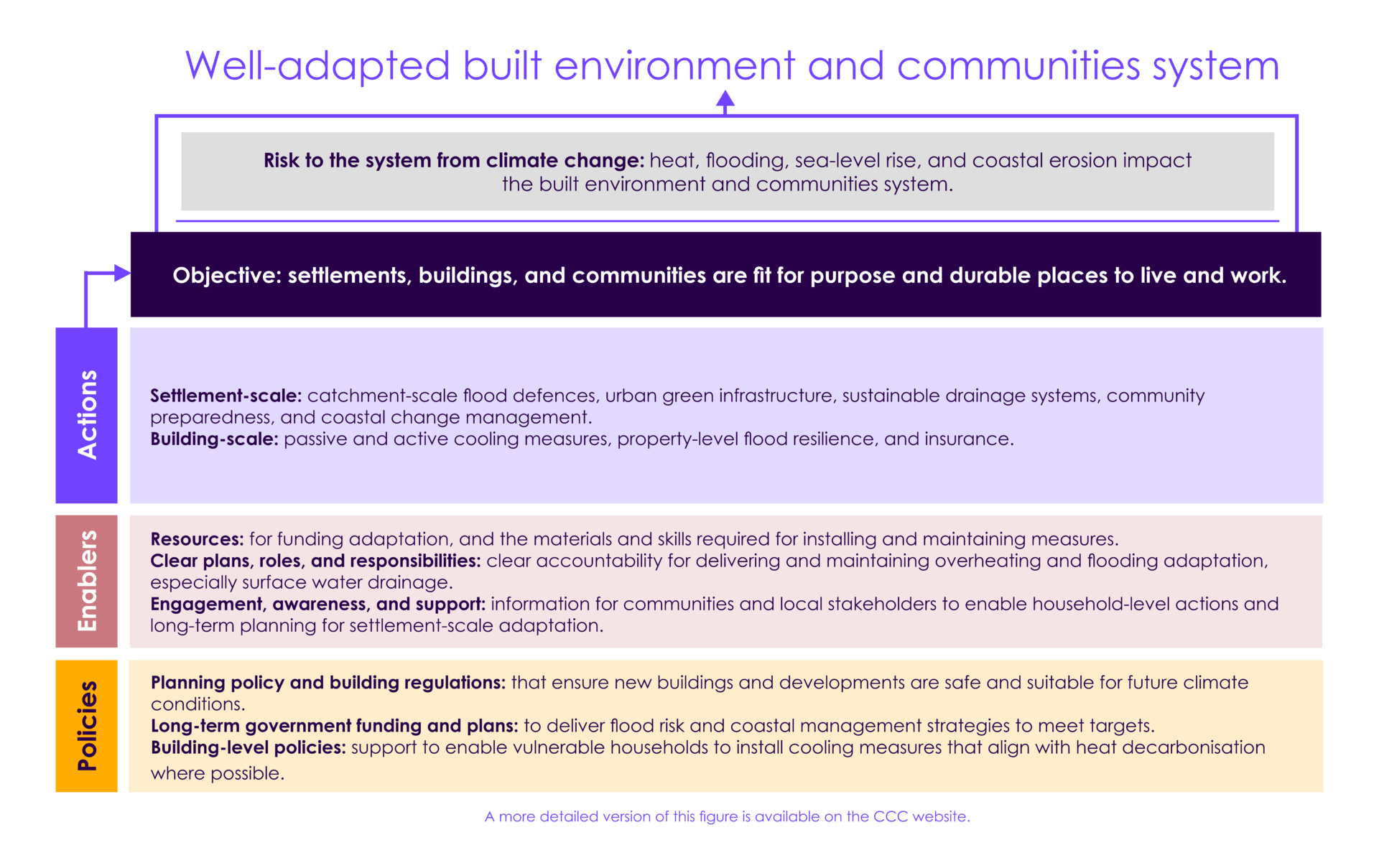 Notes: a more detailed, interactive version of this figure is available in the Climate Change Committee’s Adaptation Monitoring Framework. |
5.1 Set ambition
This section sets out the necessary ambition for adapting to the risks from climate change in the built environment and communities system.
5.1.1 Climate risks to the built environment and communities system
The built environment and communities system manages climate risks identified in Chapter 4 of the CCRA4-IA Technical Report, across England, Northern Ireland, Scotland, and Wales (Table 5.1).[420]
Climate change is increasing average temperatures and the likelihood of extreme temperatures, resulting in increased risk of overheating in buildings, and subsequent impacts on health, comfort, and productivity. This is a particular risk in urbanised areas, where a concentration of roads and buildings made of heat-absorbing materials can raise local temperatures (the urban heat island effect).
More intense periods of rainfall increase the risk of communities being flooded and they may be flooded for longer periods of time. Consecutive wet and dry periods can increase subsidence and landslide risk. Rising sea levels will increase coastal flooding and erosion, damaging buildings and impacting communities along the coast. Windstorms will be more frequent and severe, damaging buildings.
Climate impacts on the built environment and communities are already being seen today:
- Over half of UK homes are already at risk of overheating.[421]
- In England, there are 6.3 million properties located in flood risk areas; Northern Ireland has 45,000 properties at risk, Scotland has 400,000 properties at risk, and Wales has 245,000 properties at risk from all types of flooding.[422] Across the UK, flood damage is estimated at £3.3 billion per year (2025 prices).[423]
- England has some of the most rapidly eroding areas of the coast in Europe with rates of retreat in parts of Yorkshire, Norfolk, and Suffolk around 2–4 metres per year.
- Extreme weather is causing disruption and damage to properties across the UK. Storm damage claims totalled £138 million (2025 prices) in 2023. Increasing rainfall is also contributing to 1.3 million households in England experiencing damp issues. In Scotland, 10% of homes reported damp or condensation in 2023.[424]
Without additional adaptation, under a 2°C global warming level in 2050:
- The risk of overheating is projected to be 4.2 times higher in a typical summer than present day. 86% of the monetised risk would be in England.[425] 92% of existing homes would overheat (see Figure 5.2). Smaller properties, some properties that have been converted from other uses, and top floor flats (particularly those that are south facing and single aspect) will face higher exposure to overheating.[426]
- 27% more homes are projected to be at risk of flooding and coastal erosion in England by 2050 than present day.[427] The number of properties impacted by flooding from all sources could rise by up to 40%, with potential annual damages from flooding projected at £4.5 billion (2025 prices) across the UK.[428] A large proportion of future risk is from surface water flooding, which can occur at different times of the year to when we see flooding now. This will be most felt in urban areas where paved surfaces prevent water soaking into the ground, increasing volume and speed of surface water flows.
- There will be an estimated 3,500 properties at risk of being lost to coastal erosion in England, 650 in Scotland, and 400 in Wales.[429] Around 30% of the shoreline in England that is currently planned to be maintained (a ‘hold the line’ policy) is projected to become financially unviable to defend.[430]
- The risk of subsidence is projected to increase, with 11% of properties in Great Britain affected by subsidence by the 2070s. Most properties at risk are in London and the South East of England.[431] Wind-driven rain is expected to increase, with particular risk to the building fabric of westerly and southerly facing buildings.[432]
Under a high-end scenario, on track for around 4°C global warming level by 2100, without additional adaptation:
- All homes are projected to be at risk of overheating in summer (Figure 5.2), requiring some type of intervention to reduce indoor temperatures.[433]
- Annual damages from flooding could rise to between £4.1–£7.5 billion (2025 prices). Coastal flooding damages are projected to increase at least three times from around £0.5 billion to £1.5 billion (2025 prices).[434]
- By the 2080s, sea levels are projected to increase by about 0.6m in London and 0.4m in Edinburgh, which would likely cause an accelerated rate of erosion. This level of sea-level rise would require significant defences for settlements and in some places, it would likely require relocation further inland.
| Figure 5.2 Present day and projected homes at risk of overheating |
 Description: In the UK, the proportion of existing homes at risk of overheating increases from just over half in the present day, to over 90% under a 2°C global warming scenario. Under a 4°C global warming scenario, all existing UK homes are at risk of overheating. |
| Table 5.1 Climate risks to the built environment and communities system |
|||||
| Risk | England | Northern Ireland | Scotland | Wales | Overall |
| BE1: Risks to buildings and communities from heat | Critical action needed | Critical investigation | Critical action needed | Critical action needed | |
| Critical action needed | |||||
| BE2: Risks to buildings and communities from flooding | Critical action needed | Critical action needed | Critical action needed | Critical action needed | |
| Critical action needed | |||||
| BE3: Risks to buildings and communities from coastal change | More action needed | Further investigation | Further investigation | Further investigation | |
| More action needed | |||||
| BE4: Risks to buildings and communities, excluding from heat, flooding, and coastal change | More action needed | More action needed | More action needed | More action needed | |
| More action needed | |||||
| BE5: Risks to indoor environmental quality | More action needed | More action needed | More action needed | More action needed | |
| More action needed | |||||
| BE9: Risks to households from changing energy demands | More action needed | Sustain current action | Sustain current action | More action needed | |
| More action needed | |||||
| Source: Mumovic, D. et al (2026) Built Environment In: CCRA4-IA Technical Report. | |||||
5.1.2 Objective for a well-adapted built environment and communities system
Objective: settlements, buildings, and communities are fit-for-purpose and durable places to live and work under the current and future climate.
Achieving this objective would ensure built environments and communities are functioning well, accommodating homes, businesses, and activities that support everyday life, now and under future climate conditions. The terms ‘fit for purpose’ and ‘durable’ are principles which are defined in the UK Government’s National Design Guide, which describes these qualities for buildings and places.[435]
To deliver on this objective, we suggest that national-level targets on both increasing heat and flooding risks are required. We do not currently have sufficient evidence to set meaningful targets for other hazards in the system. Targets for coastal erosion would require a judgement on which areas of the coastline should be defended or allowed to retreat. Targets on subsidence, landslide risk, and wind-driven rain would require more evidence on the exposure to these risks and possible cost-effective adaptation actions to address them. National governments may choose to propose alternative targets where they have different priorities, trade-offs to consider, or further evidence (Box 3.11).
Preventing indoor overheating
Buildings across the country are already at risk of overheating even under present-day climate extremes. This will increase even further without adaptation actions to reduce the extent and duration of uncomfortable and hazardous indoor temperatures. Targeting adaptation towards the homes of the most vulnerable people could significantly reduce future heat-related deaths and was supported by our citizens’ panel on adaptation (see Box 5.1).
Proposed target: by 2050, the most vulnerable populations should be protected from overheating and most homes in the UK should not overheat.
- Meeting this target will ensure that uncomfortable and hazardous indoor temperatures are avoided in most people’s homes. Heat-related illness will be reduced and work productivity will be less affected, for example due to improved sleep. Alongside adaptation measures in the health system, this could ensure excess deaths during heatwaves in the future are kept similar to or lower than today’s level (see Section 4.2).
- Some population groups are particularly vulnerable to extreme heat. These people should be targeted so that the buildings where they live are well-adapted and the likelihood of heat-related deaths and illness is minimised. Vulnerability here includes older people, young children, those who are socioeconomically deprived, and those with underlying health conditions or who are pregnant.
- 92% of existing homes are at risk of overheating in 2050.[436] Most of the risk of heat-related mortality (57%) in the 2050s can be avoided by adapting 30% of the most vulnerable urban households (Box 5.3). Much of this will need to be retrofitted (Box 5.5).[437] Further reductions in risk from overheating (including risk of illness or reduced work productivity) can be achieved with higher prevalence of adaptation measures, whilst still being cost-effective (Box 5.3). We expect most households will take action to adapt to overheating without government incentives.
- The proposed target can be met using a combination of active and passive cooling measures. There is likely to be a role for active cooling which is cost-effective, able to address risk during periods of extreme temperatures, and aligned with delivery of a Net Zero energy system.
- To measure progress against this target, we propose tracking key indicators on number of properties overheating, active and passive cooling retrofit, and new build compliance (see Section 5.4.2).
|
Box 5.1 |
The Committee convened a citizens’ panel to explore people’s concerns and adaptation priorities in relation to different climate change impacts in the UK (see Chapter 2). Overheating in UK homes was one of the issues discussed.[438]
|
Limiting overall flood risk
Flood risk is significant today and will rise further with climate change, causing increased damages to property, risk to life, and disruption to businesses and services. The citizens’ panel consistently identified the flooding of homes as the most concerning climate change impact for affected households. They argued strongly for government to invest in preventing flood impacts on UK homes (see Box 5.2).
Proposed target: By 2050, the total number of residential properties impacted by flooding in the UK from all sources should remain no greater than today’s level. Levels of risk should be below today’s level in all parts of the UK where this is technically feasible and cost-effective.
- Meeting this target will ensure that damage to property is limited, lives are not put at risk, and disruption to businesses and services is minimised. While some households may continue to experience flooding, the cost to households and total recovery time will be minimised.
- There is strong evidence that tackling flood risk is possible. A combination of flood defences, sustainable drainage systems, property-level measures, early warning, and behavioural practices can be delivered in flood risk areas to reduce the damages from flooding. Investing around £1.6–£2.2 billion per year across the UK in these options could keep annual flood damages down to a similar or lower level than today. It could also keep the number of properties flooded down to a similar or lower level than today (see Figure 5.3 and
Box 5.4). - Going beyond this level of risk reduction, in the context of growing overall risk due to climate change, will face practical challenges. Increasing the height of existing flood defences may not always be technically feasible or economically viable. When dealing with surface water, sustainable drainage systems or increasing piped drainage may face limitations due to soil conditions, constraints on space, existing infrastructure, or topography.
- In some specific locations it may be possible to reduce the level of flood risk beyond today’s level. Government should fund this where the business case demonstrates a positive benefit-cost ratio. In other places, the risk of flooding will increase, and, in some cases, communities may need to relocate.
- To measure progress against this target, we propose tracking key indicators on change in number of properties at flood risk over time, area and homes protected by flood defences, and installation of property flood resilience measures (see Section 5.4.2).
| Figure 5.3 Present day and projected flooded properties |
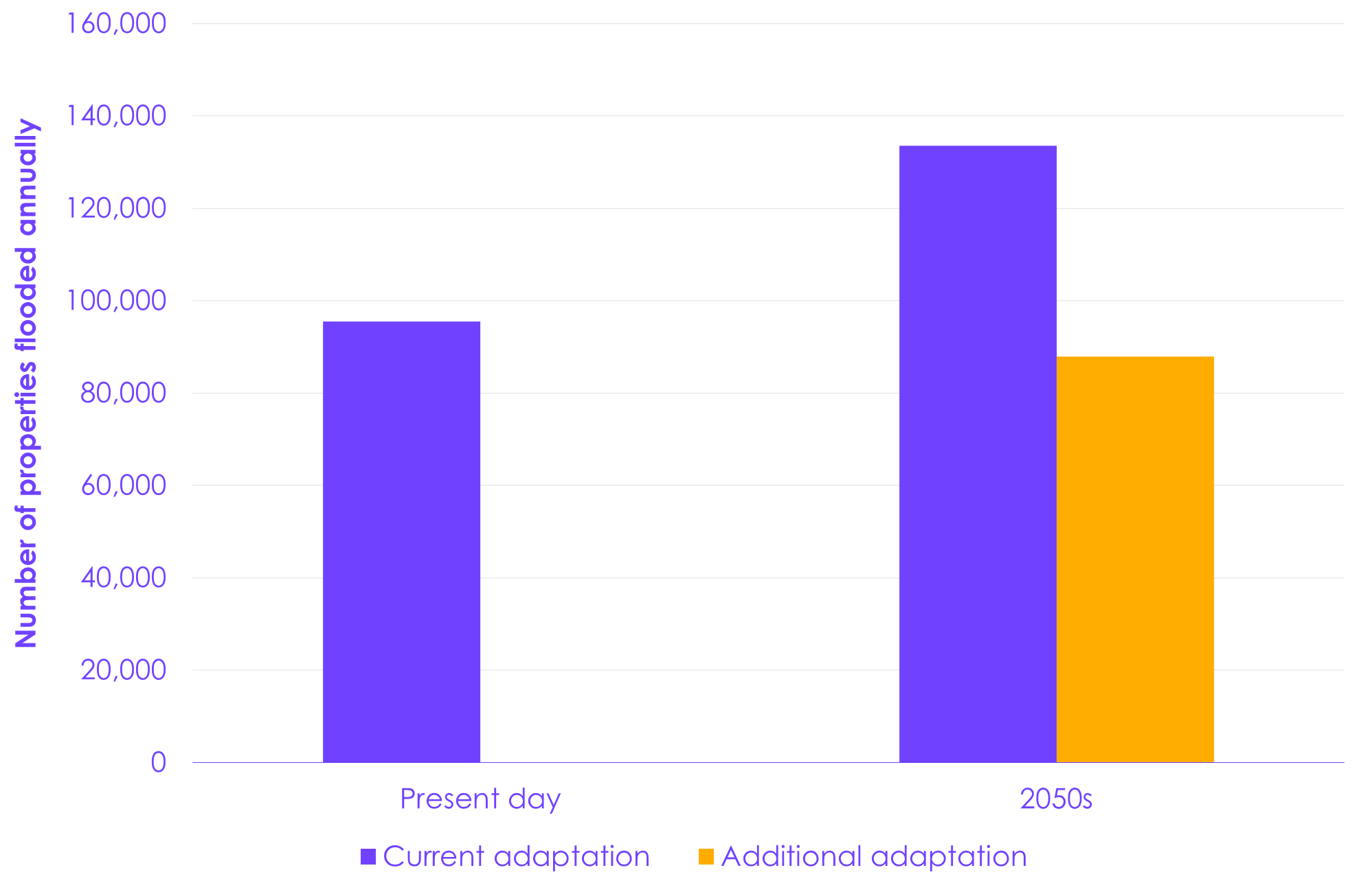 Description: The number of properties damaged by flooding in the UK is expected to increase due to climate change under current levels of adaptation. If a higher level of adaptation is adopted, the total number of properties damaged by flooding could be kept to around today’s level. |
|
Box 5.2 |
The Committee convened a citizens’ panel to explore people’s concerns and adaptation priorities in relation to different climate change impacts in the UK (see Chapter 2). Among the issues discussed was flooding of UK homes.[439]
The panel’s strong concern about flooding of homes, compared with their relatively lower concern about overheating, was likely influenced by the panel’s location. Nevertheless, this perspective aligns with findings from a 2024 UK-wide survey, in which the majority of respondents identified flooding as the most pressing climate-related impact to address. In contrast, heatwaves and extreme heat were named less frequently.[440] |
5.2 Identify actions
The following section sets out the priority adaptation actions required to achieve the climate adaptation objectives for built environment and communities. These actions must be deployed for new and existing developments, at both the settlement and building scale.
Estimates suggest the known investment needed to deliver adaptation in the built environment and communities system could be around £5.4 billion per year (range £3.4–£10.7 billion, 2025 prices).[441]
5.2.1 Actions in the built environment and communities system
Settlement scale
These actions reduce risk on larger scales and within the community. For example, managing flood water across catchments and reducing the effects of urban heat islands. These measures can provide significant risk reduction but require capital investment and proactive planning.
- Catchment scale flood defences: these defences can be a mix of engineered ‘hard’ defences and natural defences.
- Engineered flood defences, which involve building artificial structures and walls to control water, are highly effective at reducing risk from flooding. For every £1 currently invested in flood defences (including maintenance of existing defences), around £8 of damages are avoided.[442]
- Natural flood management (NFM) protects, restores, and mimics natural processes to slow and store water. This helps reduce the risk of floodwater in the surrounding built environment. NFM can reduce peak river flows by up to 10% and has been shown to have benefit-cost ratios of between 3:1 and 5:1 across Great Britain, based on reduced flood damage alone.[443] NFM also provides co-benefits by improving air and water quality, sequestering carbon, supporting mental and physical health, and increasing biodiversity (see Section 3.1.2). When considering co-benefits, NFM projects have shown overall benefit-cost ratios of up to 17:1.[444];[445]
- Urban green infrastructure: for example, street trees, parks, wildlife areas, and waterways. These can provide natural cooling and shade during hot weather, and can absorb water in heavy rainfall, reducing surface water runoff. These measures have co-benefits for biodiversity, health, and wellbeing. However, they can have longer timescales for being put in place and can be relatively expensive. The citizens’ panel favoured adaptation options with co-benefits, such as nature-based solutions, if they are effective and complexities (such as space and maintenance requirements) are managed.
- Urban green infrastructure has been shown to reduce temperatures by up to 8.5°C.[446] Under future climate conditions, these types of measures may be less effective as high temperatures, droughts, and waterlogging can reduce their cooling and drainage potential. Alternative species of trees and vegetation may need to be introduced to ensure green infrastructure remains effective under future climate conditions.
- Trees and green spaces can provide multiple benefits including reducing stormwater runoff, removing pollution from the air, and storing carbon. London’s green spaces provide services valued at £6.5 billion per year, including £1.2 billion per year in avoided health costs (2025 prices).[447] The total annual value of ecosystem services in UK urban areas was around £17.6 billion in 2025 prices.[448]
- Street-level infrastructure can take longer to install than household cooling measures and could be significantly more expensive than targeted installation of air conditioning units.
- Sustainable drainage systems (SuDS): green roofs, permeable paving, swales, soakaways, and rain gardens can slow water runoff and allow water to soak into the ground or evaporate. This reduces the likelihood of surface water flooding.
- Capital costs of landscaped SuDs can be lower than comparable conventional drainage schemes. For example, on average, SuDS could save almost £12,000 (2025 prices) in capital costs per new home in Wales.[449]
- Sustainable drainage systems can also reduce the volume of surface water entering the wastewater system, therefore reducing the risk of overwhelming the wastewater system (see Chapter 8).
- Community preparedness: preparing for extreme weather events such as heatwaves and flooding events depends on people understanding their heat and flood risk, taking pre-emptive action, and responding to flood and weather warnings. The citizens’ panel saw an important role for government in providing the information needed to enable more community preparedness.
- Property flood resilience measures may require some action from building owners or occupiers, for example putting in place flood barriers or airbrick covers. They need to be notified of flood alerts.
- Targeted support might be needed at a local level to support households which are particularly vulnerable to climate risks. For example, community cool spaces can provide shelter from the sun, allowing people to cool down during periods of extreme heat (see Chapter 4).
- Coastal change management: managing changes resulting from sea level rise and coastal erosion can include nature-based solutions to enhance natural habitats or physical structures to protect coastal land (see Chapter 13). Around 18% of the UK coast is currently protected in some way.[450] In some cases, managed coastal retreat may be required, where it is no longer feasible or cost-effective to defend the current coastline.
- Coastal management actions are site-specific and will depend on the value of land at risk, including community or cultural value. Long term planning is essential to ensure decisions are proactive and key stakeholders are included in the process.
- Some communities in the UK are already planning for managed retreat or a ‘do nothing’ approach in response to coastal erosion and coastal flooding. This allows natural processes to continue instead of defending the current coastline. For example, the coastal management strategy for Hayling Island in Hampshire includes some stretches of coastline which are unlikely to be publicly defended in future. Options for these areas have been developed, such as leaving land and asset owners to privately maintain defences or relocate as needed.[451]
Building scale
These measures manage risk to the individual building, reducing the damage to structures and impacts on occupants from flood water, heat, and storms. Measures can be highly effective and low-cost, and include cooling, property level flood resilience, and insurance.
- Cooling measures: active cooling, for example air conditioning, provides a way of reliably reducing internal temperatures to comfortable levels and will be needed to complement passive measures (such as ventilation and blinds) in some homes (Box 5.3).
- Passive cooling measures can reduce temperatures inside homes, in some cases by 14°C.[452] However, in extreme temperatures, passive cooling measures may not be effective at maintaining comfortable temperature levels indoors. This is partly because of the building fabric and design of typical houses in the UK today. Passive measures are also likely to be relatively expensive and can take a longer period to install. As a result, they may be more appropriate for new buildings rather than retrofitting to existing ones.
- Some cooling measures may not be possible or effective in certain types of homes. For example, most flats will not benefit from roof insulation and listed buildings may have restrictions on what can be installed.
- In future climate conditions of 2°C global warming, around 22% of the UK’s housing stock would require active cooling, like air conditioning, to cope with overheating.[453]
- Active cooling is cost-effective and can be provided by heat pumps as well as by portable units and other solutions, meaning households can have both clean heating and cooling. There is likely to be abundant solar electricity, combined with battery storage, in summer months when cooling demand is highest, providing a low-cost supply of clean electricity.
- Evidence from other countries shows that large increases in the penetration of active cooling have been correlated with a falling fraction of mortality attributable to heat (Figure 5.4). However, there are multiple other factors, beyond active cooling that could also contribute to this falling sensitivity of mortality to heat.[454]
- Impacts of increased use of active cooling will be manageable within the future low-carbon energy system. For example, we estimate that in 2050, the rollout of cost-effective active cooling could be less than 1% of total electricity demand from our Seventh Carbon Budget pathway. This is in line with the assumed increase in electricity demand modelled in the Seventh Carbon Budget to account for future cooling needs.[455]
- Use of active cooling could contribute to the urban heat island effect, but the switch from internal combustion engine to electric vehicles will provide an offsetting reduction in temperatures.[456];[457];[458] This means the net effect could be limited.
- Passive cooling measures can reduce temperatures inside homes, in some cases by 14°C.[452] However, in extreme temperatures, passive cooling measures may not be effective at maintaining comfortable temperature levels indoors. This is partly because of the building fabric and design of typical houses in the UK today. Passive measures are also likely to be relatively expensive and can take a longer period to install. As a result, they may be more appropriate for new buildings rather than retrofitting to existing ones.
- Property level flood resilience (PFR): PFR includes measures to stop water entering homes (such as flood doors, barriers, and air brick covers) and measures to reduce the damage caused by floodwater (such as raised electrics and tiled flooring). Some PFR measures can be installed quickly. By targeting the most vulnerable homes, they can have a quicker impact than construction of defences which can take several years. PFR also results in shorter recovery time after experiencing flooding. They can also reduce stress and anxiety felt about flooding by residents, giving them some control over their own flood defence.
- The Environment Agency (EA) estimate that deploying PFR at scale in England could result in a potential additional 16% reduction in flood risk, when combined with other adaptation measures and defences.[459] Flood Re estimates that full uptake of PFR across all suitable properties, when used effectively, could reduce average annual flood losses by up to 50%.[460] The citizens’ panel was unanimous that Flood Re should mandate the uptake of funded property level resilience measures under the scheme (uptake is currently voluntary).
- Insurance: houses and other buildings are still expected to face damages from storms and flooding in the future climate from extreme weather events, even with preventive adaptation actions. The risk of subsidence will also increase in future, as cycles of wetter winters and drier summers affect soil conditions. Insurance supports building owners to recover after these events. Government schemes, such as Flood Re, can support the insurance industry to ensure all households are insured and insurance is affordable (see Chapter 16).
- Flood Re is a joint initiative between the UK Government and insurers which aims to make flood cover under household insurance more affordable. In the absence of Flood Re, annual insurance premiums for recently flooded homes would likely be 20 times higher, around £8,000–£10,000 (2025 prices).[461]
| Figure 5.4 Air conditioning and modelled change in heat deaths |
 Description: USA, Japan, Spain, and Canada have seen an increase in uptake of air conditioning over time. This is compared to the modelled heat deaths. For all four countries, the modelling showed a decrease in heat deaths over the same time period. |
|
Box 5.3 |
| This research aimed to improve understanding of the optimal national-level adaptation response to the risk of overheating in the urban built environment in the UK. This analysis focused on testing the cost-effectiveness of building-scale and urban-scale adaptation measures for reducing the risk of extreme heat on mortality, productivity, and sleep. It modelled central and high-impact scenarios, comprised of climate and socio-economic variables. Full method and results can be found in the supplementary report from Arup (2026).[462] Understanding the risk The heatwaves in 2022 resulted in 2,985 excess deaths in England.[463] The expected annual number of heat-related deaths in a hot year, accounting for population change, could increase from present-day levels of 1,900 by 60% by the 2030s, and by 204% by the 2050s under a central scenario. The heat impacts are associated with an economic cost of £3.3 billion annually in the 2030s and £7.6 billion annually in the 2050s, accounting for mortality, productivity, and sleep impacts (2025 prices). Impacts are more extreme under a high-impact scenario, where annual heat-related excess deaths are expected to increase by 335% from present-day levels in the 2050s. The risk varies across the UK depending on average regional temperatures and types of building. Generally, larger cities and the southeast of England are at the highest risk of overheating. The risk is also higher for vulnerable groups, particularly the elderly, where there is a higher incidence of pre-existing conditions that may be exacerbated by overheating. The project modelled a range of adaptation actions to reduce overheating risk. The project identified and appraised both active and passive adaptation measures for buildings and urban streets. A combination of these measures was found to be cost-effective, offering value for money risk reduction. In the cost-effective adaptation package, households use ventilation and receive internal shading (blinds), loft insulation, and air conditioning (provided either by air-to-air heat pumps or portable units). Air conditioning is used to create at least one cool room when internal temperatures rise above 26°C. The cost-effective adaptation package is delivered to the 30% most vulnerable urban areas across the UK. A sensitivity expanding this to the top 70% of urban areas ranked by vulnerability was also modelled.
Demand for cooling may be higher than modelled given the additional benefits of measures, such as improved comfort. For able-to-pay households, the expectation is that these adaptation costs will fall to households. The cost-effective package has an estimated per-household lifetime cost of around £2,500 (2025 prices). |
| Figure 5.5 Potential for additional adaptation to reduce risks to people from overheating in urban buildings |
 Description: With current levels of adaptation, overheating impacts are projected to increase significantly by the 2050s. However, with additional adaptation (cost-effective and at a national scale), impacts can be limited to closer to today’s level. |
|
Box 5.4 |
| This research explored alternative adaptation responses to the changing risk from river, coastal, and surface water flooding in the UK resulting from climate change. The analysis focused on the relationship between investment and different outcomes of future flood risk, including keeping the risk to the same level as today. Full method and results can be found in the supplementary report from Sayers, P. et al. (2026).[464] Understanding the risk There is no single accepted assessment of today’s flood risk. Drawing upon the latest detailed data from government flood teams, 95,000 homes are flooded per year (on average) and there are expected annual damages of around £3.3 billion (2025 prices) in direct and indirect damages across the UK.[465] Under a 2°C global warming level in 2050, if flood defences were maintained to today’s condition but not raised to adapt to climate change, this would increase to 134,000 properties flooded per year and £4.5 billion (2025 prices) of expected annual damage. This would comprise £2.5 billion from river and coastal flooding and £2 billion from surface water flooding (2025 prices). The number of properties flooded and expected annual damages varies across the UK, with the highest number of properties and damages in England. Under a more extreme scenario of around 4°C global warming level by 2100 and no adaptation, damages could increase by 150% from present-day levels. Cost-effective adaptation at a national scale The research modelled the costs and benefits associated with a range of adaptation actions to reduce flood risk at a local level across the UK, over the period to 2100. These included flood defences, increased drainage, property-level measures, early warning systems, and behavioural practices. Relocation was not considered in the modelling. Each of the adaptation measures were applied to varying levels in a series of alternative adaptation portfolios, representing a range from no adaptation to higher ambition adaptation. Higher ambition adaptation considered more extensive delivery of all adaptation measures across all of the UK. The analysis suggests that investing in high levels of adaptation would be cost-effective and could reduce flood risk in future to below today’s level.
The cost-optimal level of investment is within the range identified above (average annual investment of £1.6–£2.2 billion). The risk reduction modelled is spread across the UK, so while overall risk may be projected to stay the same or reduce, some parts of the UK may still experience increased levels of flooding and damage. |
5.3 Enable delivery
This section sets out key enablers and policies to deliver the adaptation actions set out above at the required scale and urgency for a well-adapted built environment and communities system.
5.3.1 Enablers
Many built environment and communities actions will be delivered by households or local authorities (Table 5.2). The most important enablers for these actions to happen are appropriate resources, clear plans, and information and engagement.
- Resources: actions in the built environment and communities system require sufficient funding, materials, and workforce capacity. This includes for building and installing measures and then maintaining them at their design standard. A recent review found a shortage in trained professionals for installing property flood resilience measures was a key barrier to delivery.[466] Settlement-scale actions are typically funded by government. Building-scale actions are more likely to be funded by the owners or occupiers, in some cases with support from government-backed schemes.
- Clear plans, roles, and responsibilities: these should ensure accountability and ensure that adaptation measures are delivered and maintained consistently, across both flooding and overheating.
- Further steps are needed to clarify roles and responsibilities for different types of flooding. These are different in England, Northern Ireland, Scotland, and Wales, and sometimes require collaboration where catchment areas fall across national or local authority borders. Ownership of surface water drainage features is ‘fragmented’, there is a ‘lack of clarity’ around roles and responsibilities, and there is ‘uncertainty’ over who is responsible in England.[467] In Scotland, responsibility for flood risk management is ‘complex’ and can be ‘difficult to navigate’.[468]
- Engagement, awareness, and support: Ensuring communities are engaged and well-informed about future climate risks and extreme weather events can enable household-level adaptation actions and decisions. In addition, long term planning for settlement-scale adaptation actions requires local stakeholder engagement, for example when proposing installation of flood defences or potential coastal retreat.
5.3.2 Policies and plans
The key policy areas for adaptation within the built environment and communities system are devolved. Existing policies include planning policy, buildings regulations, and flood risk management. Further policies will be needed to deliver a well-adapted UK.
Existing policy action
Some policies for addressing flooding and overheating are in place, including planning policy and building regulations, funding for flood defences at the settlement scale, and support for household actions.
- Planning policy and building regulations: these are the main policy levers for ensuring that new buildings and developments will not be at risk of overheating, flooding, or damage from coastal erosion, subsidence, or landslides. Spatial planning, flood and coastal erosion risk management, and building regulations are fully devolved. They are generally determined at national level. The coast is covered by non-statutory plans developed by local councils, coastal groups, and agencies (such as Shoreline Management Plans in England and Wales, and Coastal Change Adaptation Plans in Scotland).
- Across England, Northern Ireland, Scotland, and Wales, spatial planning policy includes steps to assess flood risk, direct new development away from the areas at highest risk and ensure safety for the development lifetime. Expert agencies, such as the Environment Agency (EA), Natural Resources Wales (NRW), and Scottish Environmental Protection Agency (SEPA) are statutory consultees on planning applications for flood risk.[469];[470];[471]
- In Northern Ireland, local councils are the lead partners for spatial planning, and the Department for Infrastructure (DfI) is a statutory consultee. This is unlike other parts of the UK where planning policy is set at a national level and local plans must work within the national framework.
- Buildings standards in Scotland require that buildings are designed and constructed to avoid any threat to the building or occupants from flooding and to reduce the risk of overheating. Specific standards are set for reducing overheating in England and Wales. In England, flood risk is considered across different parts of planning and building regulations. The complexity of tests, exemptions, and guidance for flooding creates ambiguity, particularly for managing surface water flooding.[472] The Welsh Government have published clear guidance for local authorities to reduce flood risk and develop away from high risk areas.[473] Building regulations in Northern Ireland do not cover overheating and flood risk, although there has been previous consultation on updating these.
- Government provides funding for large-scale flood defence projects: strategic direction is set from national policy in England, Northern Ireland, Scotland, and Wales. Responsibility for delivery and implementation of projects varies across different parts of the UK. Flood and coastal risk management policy play an essential role in protecting the existing building stock from current and future flooding and coastal erosion.
- In England, the Environment Agency has strategic oversight of flood and coastal erosion and is responsible for delivering the UK Government’s flood investment programme. Recent changes to the flood and coastal erosion funding policy in England will balance funding between building new flood defences and maintaining existing defences, and will have a wider spread of resilience actions, such as NFM, SuDS, and PFR measures.[474] Risk management authorities for surface water include lead local flood authorities, highways authorities, water and sewerage companies, and internal drainage boards.
- In Scotland, local authorities are responsible for delivering flood defences and responding to coastal change. Current flood risk management investment in Scotland prioritises large schemes and hard defences. The Scottish Government provides funding to support these activities through the local government settlement.[475];[476] The Scottish Environment Protection Agency produces flood risk management strategies and provides forecasting, advice, and flood warnings. Surface water flooding is managed between Scottish Water, local authorities and Transport Scotland.
- In Wales, flood defences are delivered by Natural Resources Wales and local authorities. NRW is responsible for managing risk from main rivers and flooding from the sea. Local authorities are responsible for managing the risk associated with ordinary watercourses, surface water, and coastal defence works, which can include managing both coastal erosion and flooding. Water and sewerage companies are also responsible for managing flooding from water and sewage systems. NRW and local authorities receive capital and revenue funding from the Welsh Government which is used to deliver a range of flood risk management activities.[477]
- In Northern Ireland, the Department for Infrastructure delivers flood defences through the Flood Risk Management Plan, in collaboration with district councils and NI Water. This includes new defences, maintenance, NFM, PFR, and flood warnings.[478]
- Building-level policies: there are some existing policies which support adaptation actions.
- Air-to-air heat pumps, which provide air conditioning as well as heating, are eligible for a £2,500 (2025 prices) grant through the Government’s Boiler Upgrade Scheme in England and Wales. They are not currently supported by schemes in Scotland or Northern Ireland.
- The Warm Homes Plan includes policies which will support adaptation alongside decarbonisation in England and Wales. As well as the Boiler Upgrade Scheme, it commits to increasing insulation retrofits in rented homes and provides funding for heat pumps and energy efficiency measures. The Scottish Government is planning regulations to increase insulation retrofits in private rented homes and provides grants and loans for energy efficiency measures.[479]
- After a household experiences flooding, some home insurance policies include the ‘Build Back Better’ scheme which includes property resilience measures as part of flood repairs and is available across the UK.
Policy actions for a well-adapted system
To move towards a well-adapted built environment and communities system, national governments will have to provide clear and pragmatic regulation and sufficient funding of large-scale public adaptation to match ambition. National governments will also need to create economic incentives to support private adaptation actions by businesses and households (Table 5.2).
- Policies for adapting the existing building stock should be focused on the most vulnerable people and places to achieve the greatest impact. In most cases, decisions about how and when to invest in building-level adaptation measures should be for individual households to manage. They will need to consider these alongside other home upgrades. Policy should focus on supporting the most vulnerable people and places (for example, the elderly) to adapt to overheating and flooding.
- Government subsidies or grants may be required to ensure uptake of household adaptation measures for the most vulnerable groups or households. In some cases, mechanisms already exist to deliver adaptation measures through retrofitting (Box 5.5). In other cases, such as in social housing, government may be able to directly target measures to vulnerable groups.
- Policy should align with other government objectives where possible. For example, supporting air-to-air heat pumps which can provide cooling and clean heat.
- Clear resilience standards in planning and building regulations can ensure new development is suitable for future climate conditions. Planning policy should require that new building development avoids undefended areas at risk of existing and future flooding and coastal erosion as a first principle. Building regulations should ensure that new buildings and developments are built to be resilient to flooding and overheating to make them fit for purpose in the future. The citizens’ panel argued strongly for ensuring that new developments are designed to withstand climate impacts. Planning policy must also be sufficiently robust, enforced, and monitored to ensure new buildings are not increasing risk to climate change impacts.
- Incorporating adaptation measures during construction is typically cheaper than retrofitting them later. For example, costs for installing property-level flood resilience measures to existing homes can be between £1,500–£12,500, whereas including flood protection at construction stage for new builds can cost £1,000 per new home (2025 prices).[480];[481]
- Between 2013 and 2022, 110,000 (1 in 13) new homes in England were built in the highest risk flood zones. This increased to one in nine new homes in 2022 to 2024.[482];[483] Continued development in high-risk areas highlights the importance of enforcement of regulations and standards to ensure that new homes are built with the required adaptation measures to be flood resilient.[484]
- Housing safety and performance monitoring, such as those carried out for Energy Performance Certificates, could be a way to monitor safety for climate risks including indoor temperatures and flood resilience. For example, Flood Re are trialling the use of Flood Performance Certificates which set out the level of flood resilience of a property.[485]
- Long term funding and plans are required to deliver flood risk and coastal management strategies to meet targets. Public funding will need to deliver flood risk reduction through new projects, maintain and upgrade existing flood defences, and increase drainage. Government will need to set out plans for areas where significant flooding or coastal erosion risk remains (for example, because it is too technically challenging or expensive to address). This could include the potential need to relocate some communities.
- Investing around £1.6–£2.2 billion per year across the UK in flood protection could keep annual flood damages, and the number of properties flooded, down to a similar or lower level than today.
- While significant risk reduction can be achieved from a combination of hard flood defences and natural flood management, some residual risk to properties will remain in future. Some households will not be protected by flood defence measures (including at settlement and property levels), and defences may be overtopped during extreme weather. It is therefore likely that there will be some parts of the UK where the impacts of flooding cause people to relocate voluntarily, or when damages or insurance are no longer affordable. Government will need to plan proactively, facilitate information sharing, and provide support to local authorities and households.
- In 2019, the EA published an economic assessment of future flood and coastal risk management. This found that £1.3 billion (2025 prices) of annual investment will be needed over the 50-year period from 2014 to 2063 to maintain flood risk across England at around current levels.[486] This assessment was based on flood risk data from 2013. Updated long term investment scenarios for the next 50–100 years are expected to be published in 2026 using the latest cost and flood risk data.[487]
- NRW found that maintaining and upgrading assets to keep pace with future climate conditions in all places where it is economically viable would require a 40% increase on current funding levels to £22 million (2025 prices) on average annually. This scenario protects 81% of the properties at risk in some way. This would leave the remaining 19% (22,000) of at-risk properties with no further funding to maintain or enhance existing defences, allowing the defences to deteriorate over time.[488]
- Wider government policies may be able to reduce funding requirements for flood protection. For example, agri-environment payment schemes can incentivise landowners to manage their land to enable multiple outcomes, including reducing flood risk downstream (see Section 13.3).
| Table 5.2 Responsibilities for delivering adaptation across the built environment and communities system |
|
| National governments |
|
| Government agencies |
|
| Local authorities |
|
| Private sector |
|
| Public and civil society |
|
| Notes: National governments includes the role of the UK Government in England; and in Scotland, Wales, or Northern Ireland where powers sit with the UK Government for that nation but are devolved to other nations. | |
|
Box 5.5 |
| The residential building sector is the UK’s second highest-emitting sector, accounting for 12% of greenhouse gas emissions in 2023. Under the balanced pathway in the CCC’s advice on the UK’s Seventh Carbon Budget, these emissions will fall by 66% by 2040 through deploying low-carbon electrified heating systems (predominantly heat pumps), and energy efficiency measures, such as draught proofing and insulation. As existing buildings make up the vast majority of the future building stock, retrofitting the existing stock will be crucial to emissions-reduction efforts.[489] There is an opportunity to embed climate adaptation measures alongside emissions reductions to save money, reduce disruption, and reduce climate risk.
Integrating climate resilience with emissions reduction measures in retrofitting residential buildings could:
Integrating mitigation and adaptation retrofitting measures could include:
Actions required to overcome barriers and enable combined retrofit delivery include:
|
5.4 Evaluate progress
Effective adaptation requires monitoring and evaluation to assess whether delivery towards objectives and targets is contributing to reducing climate risk. This section sets out the current capability to track progress against the proposed targets in the built environment and communities system, and priority gaps for monitoring and evaluating progress.
5.4.1 Tracking progress on adaptation
In the built environment and communities system, there is mostly a good understanding of the climate risks and some existing monitoring on progress in reducing climate risk, such as the condition of flood defences. In general, there is a good understanding of what works in this system, particularly for addressing risks from heat and flooding. However, improved indicators are needed to monitor progress against the two proposed targets on overheating and flood risk, and the effectiveness of adaptation actions.
- Preventing indoor overheating in high-risk buildings: there are good data on outdoor temperature projections and exposure to overheating, particularly in England.[492] Data on properties experiencing overheating are collected through surveys for England, Scotland, and Wales. However, data on uptake of cooling measures are limited.
- Limiting overall flood risk: there are good datasets available for assessing flood hazards (for example, national flood risk assessments) and indicators on the delivery of flood defence projects and protection provided by defences.[493] There is existing monitoring and mapping of coastal hazards across the UK. For example, the Environment Agency’s national erosion and flood risk maps, and Northern Ireland’s coastal monitoring and adaptation planning project. These do not look at impacts and require further development to assess how the number of people and assets at risk is changing.
5.4.2 Addressing monitoring and evaluation gaps
We have identified four priority gaps to monitor and evaluate adaptation in a well-adapted built environment and communities system. These are on overheating data and monitoring, flood risk, losses from coastal erosion, and subsidence and insurance coverage.
- Regularly collected, national-level data on overheating is needed to monitor the impact of higher temperatures on households. This includes data on the number of properties overheating, and on installation of active and passive cooling. Current indicators are not sufficient for assessing delivery of cooling as they do not monitor actual indoor temperatures and risk in buildings. There are opportunities to leverage existing data collection to address this gap, such as adding regular questions on adaptation uptake to housing surveys. For example, the Energy Follow Up Survey in England or the Housing Survey for Wales.[494]
- There are limited data tracking long term flood risk and defended properties. Indicators are not collected consistently across England, Northern Ireland, Scotland, and Wales, with particular gaps including monitoring risk reduction from smaller-scale measures like PFR, and impacts of groundwater flooding.
- Monitoring is needed on properties and land lost to coastal erosion. The number of properties, total damage, and area of land lost or damaged by coastal erosion is not recorded consistently across the UK. This makes it difficult to monitor the impacts of coastal erosion and flooding. Agencies responsible for coastal erosion across the UK could agree a common methodology for recording these data and collecting it annually. There are opportunities to address this gap, such as aligning and integrating existing datasets across England, Northern Ireland, Scotland, and Wales to establish a consistent UK baseline for assessing annual coastal change.[495]
- Further investigation is needed into the expected damage to properties from subsidence and the extent of insurance coverage. There are gaps in understanding of the risk of potential damages from subsidence due to climate change, as well as a gap in evidence on the extent to which buildings insurance policies currently cover subsidence. Filling this gap would require collaboration with the insurance industry, as well as more investigation into the impact of climate-related subsidence. There is also a lack of evidence on risks from storms and wind.
Chapter 6: Public services
Introduction and key messages
This chapter covers climate change adaptation to the facilities and operations of public services outside of health and social care. The system is split into two subsystems:
- Services: the facilities and operations of UK public services, particularly education and justice. Adaptation actions, enablers, and policies are relevant to other public service buildings and facilities across the UK.
- Emergency services: emergency response capability and our ability to prepare for and respond to extreme events.
Our key messages are:
- Climate change poses significant risks to the assets and operations of key public services in the UK. Public facilities and services are particularly impacted by rising temperatures, more frequent and intense heatwaves, and extreme rainfall events. It is essential for society that these services retain a level of functioning at least as good as, and ideally better than, today under the future climate. This is particularly the case for schools and prisons, due to occupants that are at increased risk.
- Adaptation actions to make public services climate resilient focus on buildings, estates, and operations. Several can be low-cost and easy to implement, such as staff training and flexible capacity, while others may be more costly but can bring greater benefit, for example, retrofitting passive and active cooling measures.
- Emergency services are already responding to more frequent extreme weather and adapting operations. Climate change will place increasing pressure on response services. While existing emergency preparedness structures and warning systems provide a foundation, they must be strengthened to remain effective against increasing risks of flooding, wildfires, and heatwaves.
Adaptation overview
This chapter sets out the ambition for a well-adapted public services system, and the actions, enablers, and policies required to deliver it. Figure 6.1 provides a summary of this in a monitoring map – a more detailed version of this figure is available in the Climate Change Committee’s Adaptation Monitoring Framework.
Adaptation of public services is connected with other systems considered in this report. Chapter 4 covers health, including health and social care services. Public buildings sit within the wider built environment including planning systems, building-safety regulations, and flood risk management (see Chapter 5). Impacts to sport and leisure facilities and events cross over between public services and cultural heritage (see Chapter 7). Wildfires are impacted by land management, particularly in the uplands, where the largest wildfires typically occur (see Chapter 13).
| Figure 6.1 Monitoring map for the public services system |
 Notes: a more detailed, interactive version of this figure is available in the Climate Change Committee’s Adaptation Monitoring Framework. |
6.1 Set ambition
This section sets out the necessary ambition for adapting to the risks from climate change in the public services system.
6.1.1 Climate risks to the public services system
The public services system manages the climate risks identified in Chapter 4 of the CCRA4-IA Technical Report, across England, Northern Ireland, Scotland, and Wales (Table 6.1).[496]
- Services: climate change increases risks to public services by raising the likelihood and severity of hazards such as heatwaves and flooding. These events affect the health and wellbeing of people in public buildings, many of whom have limited ability to adapt. Climate-related weather events can also result in physical damage to assets and impact the operation of the service, for example, through closures and disruption affecting staff attendance. Extreme weather is already impacting the delivery of key public services in the UK. For example:
- High temperatures can affect school children’s ability to concentrate. There is an estimated average of 1.7 days of extreme overheating in schools and 4.3% cumulative lost learning time during the school year in England, under the current climate.[497]
- In January 2025, all schools across Northern Ireland were advised to close in response to Storm Éowyn.[498] Many schools in Scotland and Northumberland were also forced to shut.[499]
- Emergency services: emergency responders face growing challenges due to climate change. There is a greater risk to safety of emergency workers, straining of capacity, and disruptions to emergency response infrastructure. For example, floods, storms, heatwaves, and wildfires increase demand for fire and rescue, police, and environmental incident response services.[500] Climate hazards are becoming more extreme, widespread, and unpredictable, which increases the challenges to providing accurate early warnings and prediction of extreme events:
Without additional adaptation, under a 2°C global warming level in 2050:
- It is projected that the average number of days per year that indoor temperatures reach or exceed 35°C in 20,000 English schools will increase by 70% compared to present day.[503];[504] This could lead to:
- 8.2 average days per year of learning lost per pupil, compared with an estimated 6.7 days per year currently.[505];[506]
- Lower educational outcomes and earnings. Taking an exam on a 32°C day leads to around a 10% lower likelihood of passing compared to a 22°C day.[507] An additional day of absence for the typical student between Years 10 and 11 has been associated with a 0.8% decrease in total yearly earnings at age 28.[508]
- Flood risk from all sources for schools in England is projected to increase from around 21% currently to 26% by 2040 to 2060.[509]
- Of Ministry of Justice (MoJ) assets in England and Wales, 65% are projected to be at high or very high risk of overheating in summer.[510] Sites in Wales and South West England are particularly at risk.
- Emergency services will be required to respond to more extreme weather events. There is a growing risk to emergency services from climate impacts, with projections showing a 20% increase in the number of emergency service facilities at risk of flooding by 2040 to 2060 in England.[511] Across the UK, there are millions of properties in flood-risk areas. Of those living in England, 1.9 million people are at high risk of flooding (defined as greater than 1% annual probability). Future flood risk in the UK is set to remain high and worsen in the coming decades across all nations. This means more people may be impacted by dangerous flooding events requiring emergency response.[512]
- Weather suitable for wildfires is projected to double in frequency during the summer (from a 1981 to 2010 reference period).[513] There is a particular risk of wildfires over the moorland regions of Northern England, Wales, and Scotland.[514]
Under a high-end climate scenario, on track for around 4°C global warming level by 2100, without additional adaptation:
- Schools are projected to face around 90 days per year above 26°C and up to 24 days per year exceeding 35°C, a sixfold increase from current levels. Cumulative lost learning time could reach 14 days annually, with school children in southern England experiencing ‘severe’ cognitive performance loss for over 80% of the spring and summer months.[515];[516]
- The percentage of MoJ assets at high or very high risk of overheating from increased maximum summer temperatures is projected to rise to 73%.[517]
- The frequency of wildfire hazard days is projected to increase substantially, reaching a fivefold increase (from a 1981 to 2010 reference period), with the percentage frequency of very high fire danger in summer reaching 46% in England. Heatwaves will also become longer and more intense.[518]
Evidence of future risks to Northern Ireland, Scotland, and Wales is limited compared to England. Flooding is expected to have a slightly greater impact in Wales compared to England, while heat-related risks are generally lower.[519]
| Table 6.1 Climate risks to public services system |
|||||
| Risk | England | Northern Ireland | Scotland | Wales | Overall |
| BE7: Risks to facilities delivering public services, excluding health and social care | More action needed | Further investigation | Further investigation | Further investigation | |
| More action needed | |||||
| BE8: Risks to local resilience planning and emergency service response capabilities | Critical investigation | Critical investigation | Critical investigation | Critical investigation | |
| Critical investigation | |||||
| Source: Mumovic, D. et al (2026) Built Environment In: CCRA4-IA Technical Report. | |||||
6.1.2 Objective for a well-adapted services subsystem
Objective: services operate safely during extreme weather at levels at least as good, if not better, than today under the current and future climate.
Achieving this objective would ensure that service operations and facilities are able to maintain safe and good quality provision now and under future climate conditions.
- The term ‘safe’ ensures that the people within those buildings are protected from harm and able to continue learning, working, or living with minimal disruption.
To deliver on this objective, we suggest national-level targets for reducing heat and flooding risks to schools and prisons are required. National governments may choose to propose alternative targets where they have different priorities, trade-offs to consider, or further evidence (Box 3.11).
There is insufficient evidence to suggest meaningful targets for other public services, although it is important that these are also resilient to current and future climate conditions.
Preventing indoor overheating and flooding in schools
High indoor temperatures can disrupt learning in schools by causing discomfort, reducing concentration, and increasing health risks for students and staff (see Section 6.1.1). Flooding can make sites unsafe, disrupt access and learning, and result in high-cost damages.
Proposed target: by 2050, internal temperatures of learning environments should remain between 16°C–25°C and school sites should be at low risk (less than 1% chance for any given year) of flooding.[520]
- Meeting this target will ensure that schools are safe and functional places when there are high temperatures, protecting staff, pupils, and learning. It will also ensure that schools at high risk are better protected from flooding, minimising disruption to pupils, staff, and learning, and damage to buildings. Alongside managing thermal comfort, schools should ensure appropriate ventilation and good indoor air quality.
- We propose a target indoor temperature range of 16°C–25°C, informed by existing minimum workplace temperature regulations and guidelines on upper limits for comfort and cognitive performance in school spaces with normal levels of activity.[521];[522]
- All sources of flooding can cause disruption to schools. However, schools are at most risk from surface water flooding, compared to river and coastal flooding. Local authorities have some key responsibilities for managing surface water flooding across the UK, whereas schools themselves can implement day-to-day measures, such as emergency plans.
- Adaptation actions are effective at reducing the extent and duration of uncomfortable indoor temperatures. We can deliver many of these actions today. Where delivery may take longer, there are low regret operational actions which can be delivered in the interim (see Section 6.2.1). Wider flood risk measures are the responsibility of environment and flood agencies, but there are actions for tackling surface flood risk which can be delivered by local authorities or schools to meet this target. Small-scale sustainable drainage systems (SuDS) are one example (see Section 5.2). There is limited data on the cost-effectiveness of adaptation actions in education settings (see Section 6.4).
- Progress towards this target can be measured using indicators on indoor temperatures in school buildings, the proportion of schools at low risk of flooding, and the implementation of flood mitigation measures. These already exist in some cases. For example, the Department for Education (DfE) already records a metric of learning days lost and collects some data on classroom temperatures in England (see Section 6.4).
Preventing indoor overheating and flooding in justice facilities
High temperatures can create unsafe working and living environments and are linked with increased violence, which can further influence safety. Flood events can disrupt operations by damaging infrastructure, restricting movement, and creating safety risks.
Proposed target: by 2050, internal temperatures of prison and justice facilities should remain between 16°C–26°C and sites should be at low risk (less than 1% chance for any given year) of flooding.
- This target will ensure that prisons are safe and functional places when there are high temperatures, or where they are at risk of flooding. This will protect staff and inmates, minimising disruption and damage to buildings. Other justice facilities include probation sites, courts, and tribunals. Justice departments should assess which are priority areas for ensuring resilience to climate impacts.
- We have proposed the target indoor temperature level at 16°C–26°C. The low end of this range is based on existing regulations for minimum working temperatures.[523] This high end is based on evidence from HM Prison and Probation Service for upper temperature limits within prisons where adaptation action should be taken.[524]
- Adaptation actions in the built environment can reduce the extent and duration of uncomfortable indoor temperatures which impact both occupants and staff in justice facilities. There are also actions that can reduce flood risk to prison estates, such as SuDS (see Section 5.2). While some building level interventions may take longer to be delivered, there are low regret operational actions which can be undertaken in the interim (see Section 6.2.1). There is limited data on the cost-effectiveness of adaptation actions in justice facilities (see Section 6.4).
- Progress towards this target can be measured using indicators on indoor temperatures in buildings, the uptake of adaptation measures, and the number of prison buildings at low flood risk.
6.1.3 Objective for a well-adapted emergency services subsystem
Objective: emergency response services effectively anticipate, prepare for, and manage adverse weather-related impacts under the current and future climate.
Emergency services are an essential service for society and should be available and effective in all weather conditions the UK will face today and in the future. Achieving this objective would ensure that service facilities and operations can act quickly to protect people, infrastructure, and essential services, even as extreme weather-related incidents become more frequent and severe. The Climate Change Committee’s (CCC) citizens’ panel felt strongly that adaptation actions should prioritise emergency service operations.[525]
To deliver this objective, we suggest a specific target to ensure emergency services meet operational standards during extreme weather. Emergency services are required to respond to the population within target emergency response times. These targets should be maintained in future climate conditions. National governments may choose to propose alternative targets where they have different priorities, trade-offs to consider, or further evidence (Box 3.11).
Emergency response operations
During the 2022 heatwave, fire and ambulance services, and some utility sector workers, reported that their resources and capacity were stretched to their limits. Across the hottest days of the year in July 2022, fire control rooms in England experienced a 500% increase in 999 calls compared to the daily average.[526] The London Fire Brigade (LFB) reported that staff responded to unprecedented demand during the month. An incident review highlighted that LFB could do more to ensure access to the resource requirements of wildfires.[527] Responders to a London School of Economics and Political Science (LSE) review felt that while the country coped with the 2022 heatwaves, a long, more intense heatwave would have exceeded their ability to respond effectively.[528];[529]
Proposed target: by 2030, all emergency services and incident responders should be equipped and resourced to meet emergency services’ target response times under all weather events.
- This target will ensure that responders should be able to reach the population within target emergency response times, as both service facilities and operations will be prepared.
- This target is suggested because climate change is increasing the frequency and severity of extreme weather, which already delays emergency response and puts lives at risk. For example, around 84% of the population in England can be reached by ambulance within the seven-minute target window for life-threatening incidents.[530] However, for areas at risk of flooding under a present-day 1 in 30-year river or coastal flood, this drops to 70% and for a 1 in 100-year flood it is 61%. Setting a target for 2030 highlights the urgency of this, while aligning with infrastructure upgrade, fleet renewal, and workforce planning cycles.
- Adaptation actions, such as climate resilient vehicles and facilities, can ensure responders operate safely and reach incidents even during extreme weather (see Section 6.2.2).
- Progress towards this target can be measured by the percentage of emergency responders meeting target times during adverse weather events. It can also be assessed by the proportion of services equipped with assets that have undergone climate risk assessments or implemented adaptation measures (see Section 6.4).
6.2 Identify actions
The following section sets out the priority adaptation actions required to achieve the climate adaptation objectives for the public services and emergency services. These actions focus on estates and operations as key areas to prepare public services for climate change.
Estimates suggest the known investment needed to deliver adaptation in the public services system could be around £500 million per year (range £0.2–£1.1 billion, 2025 prices).[531]
6.2.1 Actions in the services subsystem
A mixture of building, estate, and operational actions will be required to reduce risk to key public services. Estate actions must be deployed at the site, building, and asset scale, and in new and existing service facilities and estates. Operational actions increase resilience through ensuring that public services have enough capacity and capability to maintain services during extreme weather.
While the targets set out above are solely focused on education and justice facilities, the actions described below could be implemented across other public services.
Building and estates actions
These measures include estate-level actions for example, site design, drainage systems, and cool pavements. They also include building-level actions such as passive and active cooling and building-level flood resilience (see Section 5.2). Other actions include adapting vehicles and protecting critical equipment. Some of these actions are already being delivered or there are plans in place to support delivery (see Section 6.3).
Building and estate-level actions can provide large risk reduction. However, the relative costs and effectiveness of reducing risk for each of the measures vary depending on the level of risk, whether they are being retrofitted or included at build-stage, and the type of building that they will be applied to. In some public buildings, such as prisons, making changes to the estate is challenging. New buildings should be built as climate-resilient from design stage.
Estate actions mostly require up-front capital investment and proactive planning, particularly for retrofit. Doing these at the same time as planned maintenance could provide more cost-effective solutions with less disruption.
- Outdoor shading: permanent structures such as trees, canopies, and temporary awnings provide shade and increase outdoor comfort in sites such as school playgrounds or outside school gates. Grounds shade sails were the most frequently recommended measure across Climate Action Plans in 60 schools in London. Pergolas and sail shades are relatively low unit cost (£1,900–£5,500 in 2025 prices) and effective for providing shade and cover.[532]
- Passive cooling and ventilation: passive cooling strategies, such as indoor shading from blinds, shutters, and insulation alongside ventilation can help to reduce indoor temperatures.[533]
- Passive cooling is generally cheaper and easier to incorporate into new buildings than to retrofit into existing ones. However, several measures, such as shading from trees, enhanced natural ventilation, blinds, and simple insulation upgrades, are low cost and relatively easy to add to existing buildings, while still reducing heat gain.
- The cooling potential of passive measures is limited by low performance under extreme heat, high retrofit costs for some measures, and unsuitability to some public buildings. For example, security concerns mean that designs like openable windows cannot be used in some prisons.
- Active cooling: during intense and prolonged heatwaves, or in certain types of buildings or circumstances, active cooling such as air conditioning may be necessary to reduce indoor temperatures to comfortable levels. This is particularly the case in urban areas in South East England.[534]
- Active cooling can be provided by dedicated air conditioning systems and through some types of heat pump, which can provide low-carbon heating as well as cooling.
- The most appropriate choice of cooling system will vary depending on the specific characteristics of each site.[535] The costs and benefits of these options should be considered as part of natural maintenance and replacement cycles. This means upgrades take place without additional disruption and as part of the move toward low-carbon heating.
- Surface water flood alleviation: for example, installing SuDS, such as rain gardens, permeable paving, water storage, and landscaping. A UK study found that retrofitting SuDS on public buildings, including schools, delivered a return on investment in less than three years.[536] A school-specific feasibility study in Cardiff estimated that SuDS interventions across five schools’ sites could reduce runoff by 50% and yield a minimum of £856,000 (2025 prices) in combined benefits across education, amenity, and health.[537]
- Asset adaptation: it may be cost-effective to deploy measures specifically to prevent key assets, such as generators, computers, and vehicles, from being impacted by climate events. Measures will depend on the hazard and the asset but could include locating key infrastructure off the ground floor, ensuring vehicle spaces (such as for transporting pupils) are elevated from flood risk and shaded, and that the vehicles have appropriate air conditioning.
Operations
Operational actions include flexible capacity, changes to rostering and timetabling, and building understanding for key staff on climate change-related risks and how to prevent them. These measures improve the resilience of service operations to a climate hazard. Many of these actions are low-regret and can be introduced quickly and begin delivering benefits immediately. They can provide practical, near-term improvements in service continuity and responsiveness while long term building-level adaptations are developed and put in place.
- Rostering and timetabling: for example, cross-training staff or having on-call staff to cover for those unable to attend due to climate-related travel or health issues can improve resilience. Adjusting staff shifts to avoid peak heat hours, and scheduling maintenance and outdoor activities in cooler parts of the day can also help.
- Flexible capacity: in the event of extreme weather, it is important that public service operations can be flexible but also recover quickly. For example, back-up facilities for catering and exercise provision in prisons. In terms of the occupational health of staff, services should provide health support, hydration stations, and cool areas. They should also ensure appropriate breaks are taken, adapt uniforms where appropriate, and provide support for safe travel during extreme weather.
- Behaviour change and staff training: building the understanding of key staff of climate change-related risks and how to prevent them can reduce disruption beyond physical adaptations. This could include adverse weather guidance on protocols for managing service delivery, and staff and user safety. For example, HM Prison and Probation Service has published heatwave-specific operational guidance for prisons.[538]
6.2.2 Actions in the emergency services subsystem
Across the UK, emergency response structures are well-established, particularly for flooding.[539] However, a mixture of buildings, equipment, and capability measures are required to ensure emergency services are fully prepared for all types of extreme weather events expected in a future climate. A comprehensive approach to reducing risk and achieving effective response goes beyond physical adaptation measures. It requires communities to understand their risk, take early actions to prepare, and respond to warnings.
Buildings and equipment
Building and equipment measures increase the capability of services, through adapting buildings and assets. As above, these measures include site design, such as drainage systems and cool pavements, as well as building-level actions, such as passive and active cooling and building-level flood resilience (see Chapter 5). The most appropriate interventions across public buildings will need to consider the specific circumstances of each asset, given the wide range of building types, ages, and locations. This includes prisons and older building stock that were often designed to keep heat in.
- Building and asset measures: these include constructing or retrofitting fire stations, ambulance depots, and police facilities to withstand flooding, extreme heat, and storm damage, for example, via raised floors, flood barriers, and heat-reflective roofing; relocating or waterproofing storage areas for critical equipment and vehicles in flood prone areas; air conditioning vehicles; improving insulation and ventilation systems to maintain safe indoor temperatures for staff during heatwaves; and ensuring more wildfire trucks and protective equipment are available.
Capability measures
Capability measures increase the capability and capacity of emergency response, through providing information and operational improvements.
- Operational measures: organisational responses can be strengthened through revised emergency response protocols, enhanced staff training and wellbeing support, flexible staffing models, and scenario-based exercises. For example:
- Operation Helios, a scenario stress test on London’s responses to prolonged 40°C heatwaves, aims to help support long term approaches to managing the risk of extreme heat. It includes the development of a regional plan for adapting to higher temperatures.[540]
- The response to wildfires is very different to fires in an urban setting. The fire service needs to be trained and adequately equipped to tackle wildfires.
- There have been examples of recent local-level investments to improve response capability. For example, the London Fire Brigade invested in four off-road wildfire response vehicles and enhanced training for all firefighters, including 30 newly trained Wildfire Support Officers.[541]
- Surveillance and early warning systems: high resolution weather forecasts already support emergency services with timely alerts, such as via the Met Office National Severe Weather Warning Service and UK Health Security Agency’s heat-health alerts. However, improving how and where alerts and warnings are issued could allow emergency services and the public to better anticipate when and where impacts are likely to occur. For example:
- Strengthening multi-channel local warnings, alongside careful management of repeated alerts to avoid response fatigue, could ensure all regions and at-risk people are reached.[542] The UK’s Emergency Alerts system is undergoing testing, with plans to send location-based warnings to mobile phones during life-threatening emergencies, such as wildfires, severe flooding, or extreme storms.
- Tailoring alerts and warnings to higher-risk groups may increase behavioural response, as many at-risk individuals do not self-identify as intended recipients.
- Targeted surveillance of wildfires, such as via cameras and satellites, can reduce wildfire risks by enabling early detection of fires and better prediction of fire behaviour.
- Community behaviour measures: these include evacuation plans, regular public drills, and simulations, check-in systems for vulnerable residents, and first aid and basic response training. Evidence on the cost and overall benefits of these measures is limited, as they can vary by scale and how they are implemented.
6.3 Enable delivery
This section sets out key enablers and policies to deliver the adaptation actions set out above at the required scale and urgency for a well-adapted public services system.
6.3.1 Enablers
Many of the actions highlighted in the previous section will be delivered by national governments via the relevant public services (Table 6.2). The most important enablers are outlined below.
- Resources: delivering adaptation measures in public services requires investment in both capital and operational capacity, which can often be aligned to existing asset replacement cycles.
- Adaptation actions such as retrofitting schools and prisons depend on both up-front capital funding and long-term revenue budgets for maintenance.
- Services also need sufficient system capacity and flexibility to continue to operate under prolonged and intensified weather events. It is essential that services have enough personnel to operate and respond effectively to current and future weather events.
- Understanding what resources are required will take planning, potentially using existing procurement cycles to upgrade and update equipment. This could include, for example, new training and upskilling to address emerging risks, and ensuring that equipment, such as ambulances, fire trucks, and personal protective equipment are climate resilient.[543]
- Clear plans, roles, and responsibilities: clearly defined roles enable more effective decision-making, better communication, and more efficient allocation of resources. In England, the fire and rescue service responds to floods but has no statutory duty to do so, unlike the rest of the UK. This makes it harder to ensure consistent and safe resourcing for flood incidents.[544]
- Data and monitoring processes: better data and forecasting improve preparedness and response capabilities. For example, regional flood alerts give staff and building occupants time to prepare and maintain capacity, reducing damage and disruption. Taking action ahead of a flood can cut damages by around 40%, lowering the risk of later mental health impacts.[545]
- Engagement, awareness, and support: households and public service providers need to know what to do in an extreme weather event and in response to alerts and early warnings, including emerging risks such as wildfires. For example:
- The EA’s survey of public flood risk perception suggests that a declining proportion of people in England know how to find out about flood warnings or know what actions to take in a flood. Just under half of respondents say they know what to do when a flood warning is issued.[546]
- Evidence to Parliament shows that the public is often unsure who is responsible for managing specific extreme weather risks.[547]
- The CCC’s citizens’ panel highlighted a strong need for timely, clear, and actionable weather warnings and alerts.[548] Participants emphasised the importance of receiving information in advance about potential disruptions. Also important are clear explanations of what is happening, why it is occurring, what actions they should take, and how long disruptions are expected to last. While some participants were aware of existing alert systems, others expressed a desire to sign up for alerts, indicating a need for improved visibility and accessibility. A strong theme was the importance of targeted support for vulnerable people during weather-related events.
6.3.2 Policies and plans
The key policy areas within the public services system are mostly devolved, with some reserved areas. Devolved areas include education, non-residential buildings regulations, and policing and justice (except in Wales where policing and justice are reserved). Reserved areas are civil contingencies, national security, and defence. Adaptation delivery requires regulation and standards, information provision, and governance across all nations.
Existing policy action
The policy levers for adaptation in public services include building regulations and standards to ensure new public buildings are built to be resilient, mandated adaptation reporting for public bodies, and UK-wide resilience frameworks for emergency services.
- Building regulations and standards are the main levers for ensuring that new public buildings are designed and built resilient. New prisons must adhere to specific standards and design principles to mitigate overheating risks. For example, in England and Wales, these are primarily driven by the Building Research Establishment Environmental Assessment Method. Some measures are in place to improve the condition of the school estate.
In England, new schools must follow standards and in Scotland the £2.5 billion (2025 prices) Learning Estate Investment Programme aims to improve the condition of the school estate.[549] - Climate change risk assessments and adaptation reporting are mandated for some services and can drive adaptation. UK Greening Government Commitments require departments to carry out climate change risk assessments for estates and operations and to develop adaptation action plans. In England and reserved national policy areas, the Adaptation Reporting Power (ARP) process has been a useful tool for prioritising and understanding adaptation across organisations and for local authorities.[550] In Scotland, the public bodies reporting duty plays a similar role. New regulations in Northern Ireland mandate that 40 specified public bodies must report on climate change, with the first set of adaptation reports due in early 2026.[551]
- Policy levers for emergency preparedness and response are driven by UK-wide resilience frameworks. The Civil Contingencies Act (2004) sets statutory duties on Category 1 responders to assess flood risk and plan for, respond to, and maintain business continuity during extreme weather events.[552];[553] The National Risk Register is the public-facing document that outlines the UK Government’s assessment of the most significant risks facing the country.[554] UK Government and national resilience frameworks provide guidelines, processes, and practices designed to improve preparedness for, response to, and recovery from major crises and emergencies (see Box 3.1).[555];[556]
- Local or regional-level organisations also set out community risk registers and coordinated response plans at local levels. These include Local Resilience Forums (LRFs) in England and Wales, regional resilience partnerships in Scotland, Emergency Preparedness Groups in Northern Ireland, and Public Service Boards in Wales.[557];[558] These organisations are composed of a wide range of agencies, including the police, ambulance services, local authorities, and health and environmental agencies. However, in England only 5% of LRFs had updated and published community risk registers on heat, cold, and flood risks, as of early 2024.[559]
Policy actions for a well-adapted system
To move towards a well-adapted public services system, national governments will have to set regulation and provide funding for delivering adaptation in public service facilities.
- Ensure that building regulations and design standards for public buildings incorporate resilience standards suitable for future climate conditions. This should cover delivery of new buildings and regulation for including adaptation in routine upgrades or lease renewals. Clear design standards for climate resilience of public buildings and assets should be in place for new and existing assets. Policies must also define how thresholds for weather warnings and alerts are set, and how they are communicated to the public. This should include managing frequency to avoid response fatigue and maintain effectiveness over time.
- Building upgrades, new public estates, and emergency response capabilities will require public funding.
- Dedicated, multi-year capital funding for retrofitting cooling and flood resilience measures will be needed. Aligning adaptation with ongoing maintenance and with climate change mitigation planning would minimise disruption and costs and maximise co-benefits with emissions reduction. Grants or incentives will be needed for private owner prisons to undertake overheating and flood resilience retrofits.
- Emergency response services should be resourced to ensure capabilities are fit for the current and future climate. The 2022 heatwaves revealed gaps in emergency preparedness for extreme heat and wildfires, particularly due to limited response capacity and inadequate equipment.[560]
- Increased resources are needed for meteorological infrastructure, digital systems, and training for local authorities and community-based workers in responding to weather warnings and alerts.
- Clear remits for different government departments, delivery bodies, and responders can improve joint working. This includes for those risks that span different departments and for emerging risks such as wildfires, for which cross-government coordination is lacking.[561] There should be a statutory duty for fire and rescue services in England to respond to flooding, supported by appropriate funding and resources.[562] Climate risk and adaptation action reporting for public bodies across all nations should mandated, alongside existing estates strategies and procurement cycles. Incorporating climate-related risks into annual reports supports accountability and transparency on how these risks are being managed.
- Governments can ensure that public services and emergency responders have accessible and reliable climate information. This should be accompanied by clear operational guidance. With more actionable information, agencies can pre-position staff, equipment, and supplies in high-risk areas, reducing response times and increasing overall resilience. Clearer operational guidance will help organisations move from reactive to proactive planning. This includes enhanced forecasting and weather alerts delivered through appropriate channels for different response teams and populations.
| Table 6.2 Responsibilities for delivering adaptation across the public services system |
|
| UK Government |
|
| National governments |
|
| Government agencies |
|
| Local authorities |
|
| Private sector |
|
| Public and civil society |
|
| Notes: National governments includes the role of the UK Government in England; and in Northern Ireland, Scotland or Wales where powers sit with the UK Government for that nation but are devolved to other nations. | |
6.4 Evaluate progress
Effective adaptation requires monitoring and evaluation to assess whether delivery towards objectives and targets is contributing to reducing climate risk. This section sets out the current capability to track progress against the proposed targets in the public services system, and priority gaps for monitoring and evaluation.
6.4.1 Tracking progress on adaptation
In the public services system, there is a reasonable understanding of the climate risks to key services in England, for example, education and justice. More investigation is needed in some areas, such as emergency response.[563] Evidence of a similar quality is currently unavailable for other public service facilities and in the other UK nations.[564]
There are some services that must adhere to the UK’s Greening Government Commitments, the Adaptation Reporting Power (for England and reserved national policy areas), and Scotland’s Public Bodies Reporting Duty. These are key levers for collecting data on climate risk and adaptation efforts across public services.
There are some existing indicators to measure progress towards the proposed targets for a well-adapted public services system.
- Preventing indoor overheating and flooding in schools: lost days of learning is a metric that has been available previously for England, although it is not clear if this will be updated annually. Surface water flood risk indicators are available, although these predominately track the climate risk level and are not sufficient to understand if specific adaptations to prevent flood risk in public service buildings are working.
- Preventing indoor overheating and flooding in justice facilities: within Northern Ireland all modern prison cell accommodation constructed since 2007 benefits from Building Energy Management Systems, which allow monitoring and tracking of individual cell temperatures. It is not clear whether similar data is collected in other nations. Some data is available from national environment agencies on the number of prisons at low flood risk.
- Emergency response operations: real-time environmental data on the extent, severity, and progression of hazards is available, as is data on response times for most emergency services and uptake of warning services.[565] Within the public services system progress evaluation would likely be led by the lead government department for each public service or local resilience forums or partnerships.
6.4.2 Addressing monitoring and evaluation gaps
To track progress effectively against the quantitative indicators discussed above in Section 6.2 there are several areas that require further data. For many of them, there is a clear role for governments to lead the development of the evidence base as part of setting out a vision for a well-adapted UK.
Key evidence gaps for this system are around impact data and analysis on the implementation of adaptation actions. There is some evidence on smaller scale delivery, but actions are not consistently delivered or tracked throughout the sector, with cost-benefit information a particular gap. We also lack evidence on the costs avoided through making services more resilient and what an acceptable level of resilience is in different services. There are additional gaps in actions to manage cross-sectoral connections between systems and adaptation in other more local services.
- Robust, regular data on hazard incidence and impact in public buildings is needed to guide adaptation actions and resources. This includes thermal monitoring in education and justice buildings to assess risk and guide interventions that could be integrated within modern heating and cooling control systems. Having a better understanding of impacts would also be beneficial, including national-level data on annual damages to schools and prisons from flooding, the number of weather-related school closures, and the number of staff unable to attend work due to extreme weather. There is limited data on financial costs, operational delays, and physical demands on emergency services.[566]
- Data and analysis of the uptake and effectiveness of adaptation actions can help target adaptation action. There is a lack of data on the uptake of adaptation measures, how actions can be practically implemented in challenging public buildings, how much they cost, and how much they can reduce risk. Undertaking pilot schemes could fill some of these gaps and improve the understanding of risks. It could also help to target interventions and generate real-world learning to support wider rollout across UK, providing there is sufficient monitoring and evaluation of the impacts.
- Data on the financial and operational impacts of extreme weather on emergency services can help monitor risk and impacts. This includes data on future demand for responders and potential resource shortfalls, and the effectiveness of actions to reduce risk. Without metrics to assess this risk, it will remain difficult to evaluate preparedness or target investments based on future emergency response capacity.[567]
- The percentage of emergency responders meeting target times during adverse weather is needed to assess progress. Alongside this, data on the proportion of services equipped with assets that have undergone climate risk assessments or implement adaptation measures is required. This could be collected via existing adaptation reporting or resilience standard mechanisms.
- Improved data on the effectiveness of early warning systems and how they influence behaviour would help strengthen and tailor future warnings. Improving the evidence on how warning systems work for different people and communities would help better inform frontline workers and the public on how to prepare for weather extremes. This could be collected via post-event surveys and community engagement or digital analytics from warning services.
Chapter 7: Cultural heritage
Introduction and key messages
This chapter covers climate change adaptation in the cultural heritage sector. It focuses on four aspects of cultural heritage:
- Heritage sites and cultural landscapes: includes sites designated by the United Nations Educational, Scientific and Cultural Organisation (UNESCO); cultural and archaeological landscapes; parks and gardens; and battlefields. Many of these are managed by a mixture of private owners and large charitable bodies (for example, the National Trust).
- Heritage buildings: includes listed heritage buildings and other buildings of significant heritage value. Most buildings are managed by private owners and charitable organisations.
- Fixed assets: such as statues, monuments, bridges, and protected maritime wrecks. These assets are often managed by charitable organisations and local governments.
- Moveable assets: such as artworks, historic documents, and other collections. Moveable assets are owned by a wide range of actors, including private collectors, charitable heritage organisations and trusts, museums, galleries, and libraries.
Intangible cultural heritage, which includes cultural events, language, traditional skills and knowledge, sports, music, and creative industries, is also at risk from climate change (Box 7.1).
Our key messages are:
- The UK’s cultural heritage is at risk of loss from climate change. Climate hazards, in particular flooding, coastal erosion, and storms, threaten the physical integrity of heritage collections, buildings, sites, and landscapes. Without adaptation, this will result in reduced public access, damage, or even complete loss. Protecting the UK’s cultural heritage for its historical significance and economic benefits has value for current and future generations.
- Asset owners need to identify the full scope and number of cultural heritage assets at risk from climate change. This is needed to understand the long-term risk to cultural heritage from climate impacts, the adaptation options available to asset owners, and the scale of investment required. Identifying sites and assets at risk of loss or irreversible damage, and how to manage them, is a key priority.
- Asset-specific adaptation plans are needed for heritage assets. Plans need to be context-specific because the nature of heritage assets and the adaptation options available varies widely. Developing and implementing these plans will require increased specialist skills and expertise alongside stakeholder engagement. Where losses of heritage assets are unavoidable, innovative options such as digitisation provide a way of proactively preserving some cultural value for future generations.
Adaptation overview
This chapter sets out the ambition for well-adapted cultural heritage and the actions, enablers, and policies required to deliver it. Figure 7.1 provides a summary of this in a monitoring map – a more detailed version of this figure is available in the Climate Change Committee’s Adaptation Monitoring Framework.
Adaptation in the cultural heritage system is connected to other systems considered in this report. Many heritage sites are part of natural and farmed landscapes and may be managed for both nature and cultural heritage objectives (see Chapter 13). There are a high number of heritage buildings and cultural heritage in urban environments in the UK (see Chapter 5).
| Figure 7.1 Monitoring map for the cultural heritage system |
 Notes: a more detailed, interactive version of this figure is available in the Climate Change Committee’s Adaptation Monitoring Framework. |
|
Box 7.1 |
| Intangible cultural heritage – such as sporting and music events – form an important part of UK culture. High-profile examples include the London Marathon, Glastonbury, Glasgow’s Celtic Connections, Heart of Wales 7s, and Fleadh Cheoil na hÉireann. Climate change risks will impact festivals, sport, and music events. These risks are connected to multiple systems within this report: health, built environment and communities, and public facilities and emergency response (see Chapter 4, Chapter 5, and Chapter 6).
Festivals, sports, and music events are regularly impacted by the weather today. This disruption can incur potentially large financial losses for event organisers, professional sportspeople and performers, associated businesses, and councils. Festivals contribute £2.05 billion to the UK economy, while the music industry contributes £6.8 billion, with the wider creative industries sectors adding £129 billion collectively in 2023 (2025 prices).[568];[569] Sport contributed an estimated £20.7 billion (2025 prices) in 2023.[570] Examples of climate-related impacts on these sectors include:
Climate change impacts will increasingly pose risks to the operation of these events and participant safety. Increasing heat extremes may result in serious and potentially fatal health impacts for cultural events and their participants. Dehydration and heatstroke in summer are key concerns. Events may also be forced to postpone or cancel due to severe weather and flooding, affecting participants’ ability to exercise, and their health, recreation, sense of community, and cultural identity. Adaptation actions for sport and music events are often centred on prudent risk management: planning for severe weather, ensuring access to water, shelter, and medical support, monitoring weather conditions, providing weather-related health and safety information and alerts, reducing crowd densities, and having back-up dates where possible. Government supports adaptation of events through appropriate health and safety regulations, which require organisers to assess and manage risk. Event venues may need to be changed or upgraded, or dates or playing seasons adjusted to reduce exposure to dangerous climate conditions, particularly in mid-summer and mid-winter. Organisers should ensure suitable protection and facilities are available for potential future conditions. Temporary measures for major events with high demand and queues for public transport may be required, for example, shading at bus shelters, train stations, and walking or cycling routes. Examples of event adaptation include:
|
7.1 Set ambition
This section sets out the necessary ambition for adapting to the risks from climate change in the cultural heritage system.
7.1.1 Climate risks to the cultural heritage system
The cultural heritage system manages the climate risks identified in Chapter 4 of the CCRA4-IA Technical Report, across England, Northern Ireland, Scotland, and Wales of the UK (Table 7.1).[580]
Cultural heritage in the UK is already at risk from climate hazards, in particular flooding, coastal erosion, and storms. These hazards threaten the physical integrity of cultural heritage collections, buildings, sites, and landscapes, resulting in reduced access, damage, or potentially complete loss. Climate change will result in periods of higher intensity rainfall and higher sea levels, increasing the rate of damage and deterioration to heritage assets and sites.
Climate change driven hazards could result in partial or complete loss of at least some historic assets by amplifying background environmental processes such as weathering and erosion. However, the full scope of UK heritage assets and number at risk from climate change now and in the future is currently unknown.
- In England, the Heritage at Risk register, managed by Historic England, shows 792 Grade I and II listed structures (3.5%) are ‘at risk’, as well as 2,206 scheduled monuments (11%), 969 listed places of worship (6.6%), and 103 registered parks and gardens (6%). However, this covers all risks, not just climate change related risk.[581]
- The National Trust manages over 500 sites and estimates that a relatively small proportion of these are currently at high risk from climate change-related hazards, with 5% of sites in England currently classified as high risk and 30% classified as medium-to-high risk.[582]
- Historic England suggests £4.3 billion (2025 prices) is required to repair England’s built heritage that is currently in poor condition.[583] Although this figure is not solely related to risk from climate-related hazards, assets in poor condition are likely to be more vulnerable and at higher risk of climate change impacts and this figure provides a broad indication of scope. Historic England also estimate that the current total demand for work on traditional buildings is around £28 billion per year, of which over £15 billion uses traditional materials and techniques (2025 prices).[584]
Without additional adaptation, under a 2°C global warming level in 2050:
- The number of heritage sites and assets facing high risk of damage from climate change is projected to rise significantly. The National Trust predicts that over 70% of their sites could be at medium or high risk by 2060.[585] Confidence in the extent of this increase remains low because we have limited evidence, and impacts are different for each asset.
Under a high-end scenario, on track for around 4°C global warming level by 2100, without additional adaptation:
- 10% of all buildings in Great Britain could be impacted by subsidence, many of them heritage buildings.[586]
- The National Trust found that the proportion of their sites at high risk could increase to 17% by 2060, and at medium-to-high risk to 71%.
- Across England and Wales, historic canals, bridges, and locks are assessed to be at severe risk of structural failure and damage due to flooding, erosion, and extreme weather.[587]
| Table 7.1 Climate risks to cultural heritage |
|||||
| Risk | England | Northern Ireland | Scotland | Wales | Overall |
| BE6: Risks to cultural heritage and landscapes | Critical investigation | Critical investigation | Critical investigation | Critical investigation | |
| Critical investigation | |||||
| Source: Mumovic, D. et al (2026) Built Environment In: CCRA4-IA Technical Report. | |||||
7.1.2 Objective for a well-adapted cultural heritage system
Objective: cultural heritage is managed and maintained to preserve value for current and future generations under the current and future climate.
Achieving this objective means that cultural heritage is managed and maintained to sustain its value for the future in a feasible way. This is not the same as ensuring that all cultural heritage is fully preserved in its current condition and protected from all risk (including those from climate change). Across the cultural heritage sector, there is a recognition that the physical loss of some assets is likely to be unavoidable. For example, sections of Hurst Castle have collapsed into the sea due to coastal erosion, requiring an adaptation response which included making affected areas safe, structural reinforcement, and sea defences.[588] However, in some cases their value can be managed for future generations if done so proactively, such as through digitisation and monitoring. For example, the local community has recorded the historic human and animal footprints that are continually being exposed and destroyed by tidal action on the beach at Formby Point.[589]
The most appropriate objective for individual cultural assets (for example, buildings, artefacts, or places) needs to be determined for each asset – considering its cultural value, the risks it faces, and the opportunities to adapt – and will vary across assets. This requires sufficient evidence on scope and potential costs of different adaptation measures.
To deliver on this objective, we suggest national-level targets to drive long term adaptation planning and implementation of measures to manage key cultural heritage assets.[590] These are key areas for targets in national-level adaptation programmes. However, national governments may choose to propose alternative targets where they have different priorities, trade-offs to consider, or further evidence (Box 3.11).
Long-term adaptation planning for managed heritage
Cultural heritage asset owners and managers need information and long-term plans to determine the appropriate management strategy for climate risks to cultural heritage. While management strategies will vary for different assets, all will require high-quality adaptation planning that first identifies which assets are at risk from current and future climate conditions. For each asset at risk, planners need to decide an appropriate long-term objective, assess the actions available that will meet the objective, and make proactive decisions about the management approach. Engagement with relevant stakeholders is also important in this planning to ensure cultural value is maintained and that management strategies have the support needed to be delivered in the long term. This objective is also essential to increase understanding on the full scope of adaptation required for heritage assets in the UK.
Proposed target: by 2035, all cultural heritage assets managed for public good that are deemed ‘at risk’ should have a long-term adaptation plan.
- Meeting this target will ensure sites and assets at risk of loss or irreversible damage are identified and management strategies are agreed. This may include a pathway for managing loss or alternative strategies to preserve cultural value such as digitisation. Loss may be unavoidable if an asset is in an unsustainable state or location, such as an eroding coastal site.
- Formal planning is recommended for all organisations that manage heritage assets for public benefit rather than private individuals, such as homeowners of listed buildings. Owners of listed buildings already have a legal obligation to maintain their properties in good condition and prevent deterioration, which is likely to help reduce some climate change impacts. Private individuals may struggle to complete plans to a satisfactory level, over and above current obligations, without access to additional funding and expertise.
- Despite not currently being able to track what share of at-risk cultural heritage assets have appropriate planning in place, there are examples of good planning within the sector showing this can be achieved. Undertaking appropriate adaptation planning for cultural heritage requires skills and resources but is not something that needs a lengthy lead time to complete. Given the irreplaceable nature of some cultural heritage, it is a priority that this planning is conducted in the near term for all relevant assets.
- Progress against this target can be measured by reporting from heritage organisations about their planning and whether plans are being reviewed regularly, as risk and vulnerability change over time (see Section 7.4).
Actions to manage heritage assets
Delivering the actions within plans for managing climate risk to cultural heritage is essential. Planning alone will not be sufficient to achieve the objective of managing cultural heritage for current and future generations.
Proposed target: by 2050, climate risks for all at-risk cultural heritage assets should be managed.
- Actions should be undertaken in line with the timeframes identified during planning, with actions for higher risk assets given priority. For plans seeking to build resilience against hazards expected under a 2ºC level of global warming in 2050, actions should be delivered by this date at least.
- Managing heritage assets requires undertaking the adaptation actions identified in plans. As the nature of the actions will vary depending on the management strategy identified for individual assets, and are not yet known at a national scale, the delivery of these actions can only currently be tracked in line with the stated adaptation plans once created.
7.2 Identify actions
The following section sets out the priority adaptation actions required to achieve the climate adaptation objectives for cultural heritage.
7.2.1 Actions in the cultural heritage system
Adaptation actions for cultural heritage are context-specific and vary based on asset type, current condition, location, and climate risk exposure. However, many actions are broadly applicable to the different asset categories (heritage sites and cultural landscapes, heritage buildings, fixed assets, and moveable assets). For example, increased maintenance and repair are appropriate for buildings and fixed assets, as well as moveable assets that have sustained damage or deterioration. Closure periods and digitisation may be suitable regardless of scale, from facilities that house moveable assets like artwork, to entire heritage sites.
- Physical protection: actions that maintain or improve the physical state of an asset or that reduce the risk by changing the surrounding environment. Improved condition of physical assets increases durability and resilience to environmental impacts and reduces long term cumulative damage. Measures may include:
- Increased maintenance and repair: for example, increased frequency of inspections, repair of weathered masonry, timber, or roofing, treatment of biological growth, repointing and sealing of joints to prevent water damage. High levels of maintenance and prompt repair will be increasingly important for most built assets.
- Flood and storm protection: for example, flood barriers and drainage improvements, coastal defences, and roof strengthening (see Chapter 5).
- Additional protection: for example, installing building measures for thermal and moisture control, controlled climate systems, slope stabilisation to counter erosion and subsidence, and treatment of sensitive materials or protective coatings.
- Operational actions: actions associated with opening and access, and health and safety. These measures help protect both visitors and staff, as well as sensitive areas. For example, seasonal or temporary closure periods during extreme weather, restricted access to vulnerable areas, adjusted visitor routes and improved accessways, and emergency preparedness protocols.
- Technological and innovative interventions: measures that incorporate technology, digital solutions, or newer methods. For example, installation of sensors and early warning systems for extreme weather events, digitisation of collections and physical assets, monitoring or recording at risk information (including Light Detection and Ranging (LiDAR) scans of archaeological sites), virtual online tours, and interpretive reconstructions.
- Other actions, including managing loss: other actions intended to help manage the value of assets that are likely to be lost due to climate-related hazards. For example, temporary or permanent asset relocation, replicas of assets, transformation of use (such as using historic buildings as community centres or places to stay), and ongoing monitoring and evaluation of an asset’s physical state to help inform if and when additional actions are needed.
Across these action types there are examples of actions being used to adapt cultural heritage (Box 7.2). These successful examples (and others) can be used as models to learn from.
|
Box 7.2 |
|
Actions vary widely based on asset type, current condition, location, climate risk exposure, and stakeholder values. For example:
Additional protection and defences:
Operational actions:
Technical and innovative interventions:
|
7.3 Enable delivery
This section sets out key enablers and policies to deliver the adaptation actions set out above at the required scale and urgency for well-adapted cultural heritage system.
7.3.1 Enablers
Many of the actions highlighted in the previous section will be delivered by both public and private heritage organisations, charities and trusts, as well as private individuals (for example, heritage homeowners).
- Resources: sufficient funding is required to support the development of adaptation plans and subsequent actions. Adaptation costs are currently unknown across the UK and may be additional to current maintenance and running costs. The sector currently relies on philanthropy, fundraising, and membership schemes, often through charities, trusts and foundations, to manage maintenance of many heritage assets. Public grants are also available which organisations can apply to.
- Public funds are provided directly to some public bodies which manage cultural heritage assets. As an indication of current spending, in 2024/25, the Department for Media, Culture and Sport provided £83 million (2025 prices) to Historic England, which accounted for 85% of its income.[600]
- Government have recently increased funding for heritage, and culture more broadly, although not specifically for adaptation. For example, of the UK Government’s £270 million Art Everywhere Fund, £15 million is pledged for Heritage at Risk, £25 million for the Museum Estate and Development Fund, and £4.85 million for the Heritage Revival Fund (2025 prices).[601]
- Training is required to increase capacity and capability for planning and delivering adaptation action within the heritage sector. This includes for undertaking climate risk assessments, assessing appropriate adaptation actions, and developing practical trade skills, such as methods for working on traditionally constructed houses. Investment in Local Planning Authority capacity, specifically archaeology and conservation roles, may also be required to aid and process planning consents.
- Clear plans, roles, and responsibilities: asset-specific adaptation plans, with emergency response plans for severe weather events where appropriate, are needed for all at-risk tangible heritage assets. The first step is to identify at-risk heritage assets (for example, via a similar process to the National Trust climate hazard map).[602] Context-specific adaptation plans then need to be developed to understand the local risks, potential acceptable future states of each asset, the costs, and ultimately decide the adaptation approach and actions. Plans must adopt a long-term view.
- One plan per asset is not required, rather, adaptation of each at-risk asset should be considered in some form. This could be within a site-specific plan for high-value assets or within an overall plan per organisation.
- Data and monitoring processes: data is required to understand the climate risks for each asset to help inform decision-making. Good data is required on future climate risk, costs of climate damage, and cost-effectiveness of adaptation actions to understand which are best suited to a particular heritage site or asset. Data are currently held by multiple organisations, so a shared platform that facilitates knowledge-sharing and learning would assist decision-making.
- Engagement, awareness, and support: stakeholder engagement can enable successful delivery. Early engagement with stakeholders helps to identify values, priorities, and an acceptable long-term vision for assets that are managed for the public good. Increasing awareness of adaptation can also improve support for projects. Culture is inherently values-based, so the long-term vision, actions, and priorities depend on what people value and whether there is social licence for change.
7.3.2 Policies and plans
While most policy areas are devolved, some reserved functions remain. These include international obligations (for example, UNESCO treaties) and UK-wide funding (for example, the National Lottery Heritage Fund). Cultural heritage governance involves multiple actors (Table 7.2). Key groups of actors and their responsibilities include:
- Government departments set legislation and provide funding, supported by government-funded arms-length bodies that deliver policy and expertise.
- Local authorities oversee museums, libraries, and historic sites at the community level.
- Many independent heritage organisations, which are generally privately funded through memberships and fundraising, manage the day-to-day operation of assets and advocate for conservation.
Existing policy action
There is currently no UK-wide adaptation legislation for cultural heritage. Cultural heritage is instead covered by a mix of legislation and regulations delivered through international agreements, national policy, and by public bodies and the wider culture sector. For example:
- International agreements currently mandate protection and conservation of globally important sites. This includes agreements which protect and regulate UNESCO sites. These agreements typically result in strong preservation measures and provide benefits such as high tourism resulting in increased funding.[603] Adaptation is becoming increasingly embedded as a requirement in these policies.[604]
- National policy, planning regulations, and legislation often mean heritage assets must be maintained to a minimum condition. Any change to the physical structure is regulated and requires consent. Legal frameworks differ across the UK: examples include the Historic Environment (Wales) Act 2023; the Historic Environment Scotland Act 2014; the Ancient Monuments and Archaeological Areas Act 1979 for England and Wales; and the Historic Buildings and Ancient Monuments Act 1953.
- National reporting requirements encourage adaptation by some organisations. Some organisations are invited to report on their progress in adapting to climate change under the Adaptation Reporting Power (ARP) in England and equivalent reporting mechanisms in other parts of the UK.[605]
- Arms-length bodies and other heritage management organisations receive public grants and raise their own funding to deliver action. UK-wide and national grant schemes, such as the National Lottery Heritage Fund, are also used for adaptation projects. Many heritage organisations already have climate adaptation strategies at an organisation-level. Examples include Historic England, English Heritage, and the National Trust.
Policy actions for a well-adapted system
To move towards a well-adapted cultural heritage system, a mix of regulations, guidance, and funding will be needed.
- Improved regulations and guidance can ensure that adaptation for heritage assets accounts for climate change while maintaining cultural value. Many existing policies and regulations are focused on preventing harm and maintaining condition, rather than promoting appropriate adaptation action. To improve this, heritage organisations should be required to plan for future climate conditions and share these plans for others to learn from. Clear guidance should be in place around the adaptation options available for all asset types, taking account of trade-offs where there are different competing objectives. Key gaps in current policy frameworks include policies and guidelines on dealing with permanent change and loss, better integration of natural and cultural heritage legislation, and supply of specialised skills for working on traditionally constructed buildings.[606]
- Public provision that considers future climate conditions can support long term planning and adaptation action. This could include requiring the consideration of future climate conditions and adaptation planning as a criterion for any heritage projects that receive public funds. Consideration of future climate and adaptation is not currently a condition for many grants.
| Table 7.2 Responsibilities for delivering adaptation across the cultural heritage system |
|
| UK Government |
|
| National governments |
|
| Government agencies |
|
| Local authorities |
|
| Private sector |
|
| Public and civil society |
|
| Notes: National governments includes the role of the UK Government in England; and in Northern Ireland, Scotland, or Wales where powers sit with the UK Government for that nation but are devolved to other nations. | |
7.4 Evaluate progress
Effective adaptation requires monitoring and evaluation to assess whether delivery towards objectives and targets is contributing to reducing climate risk. This section sets out the current capability to track progress against the proposed targets in the cultural heritage system, and priority gaps for monitoring and evaluation.
7.4.1 Tracking progress on adaptation
In the cultural heritage system, there is limited monitoring of the impacts of climate risks to cultural heritage and the effectiveness of adaptation efforts across the UK. There is some local-level capability, but there is limited national-level reporting mechanisms for monitoring progress against the two proposed targets across the four nations:
- Long term adaptation planning for managed heritage: there are no existing national indicators to track adaptation planning in the culture sector.[607]
- Actions to conserve heritage assets: National-level indicators to track progress are limited.[608] Existing monitoring data on adaptation actions are mostly kept within individual organisations, and adaptation-specific actions are often not segregated from actions for climate change mitigation or general maintenance purposes. However, existing risk registers and grant reporting could provide an opportunity to report on climate change risk and progress against indicators. For example:
- Historic England’s Heritage at Risk database includes data on the number of assets, separated by asset type, that are considered ‘at risk’ (although not specifically risk from climate change).[609]
- Some organisations collect some data on adaptation funding, such as the Historic Environment Scotland indicator on proportion of Historic Environment Scotland grant applications that include adaptation measures.[610]
7.4.2 Addressing monitoring and evaluation gaps
There are several priority knowledge gaps for the cultural heritage system, to better understand the long-term scope of climate risk and for addressing climate hazards for the range of heritage assets.
- Evidence on long term risk to cultural heritage from climate impacts is needed to direct adaptation efforts. There is currently insufficient public data to estimate the full extent of assets at risk or the timeframes of impact, the investment required for adaptation, or the rate of delivery towards indicators and targets (see Section 7.1.1).[611] Improved reporting from asset managers on long-term trends (for example, via heritage risk registers) will be needed to close this gap, as could commissioned longitudinal studies to assess cumulative impacts over time and studies that forecast future risk to heritage assets.
- Evaluation of innovative adaptation actions to conserve heritage value is required to understand their cost and effectiveness. New methods and innovative solutions offer proactive ways to conserve heritage value, especially for assets at risk of partial or complete loss. Supporting pilot projects testing innovative adaptation interventions (for example, the state-of-the-art monitoring sensors being trialled at Kenwood House) would be valuable.[612] Reporting both costs and effectiveness of innovative adaptation actions should also be included within national-level monitoring programmes to help other organisations to scope and budget effective adaptation actions.
- National-level evaluation of adaptation actions can inform the scale of adaptation required and identify knowledge gaps. Proposed indicators to measure progress, adapted from the list of potential Global Goal on Adaptation indicators, could include:[613]
- The number of heritage assets with long term adaptation plans and with emergency preparedness and response plans for climate change-related hazards.
- Number of identified at-risk cultural heritage storage facilities for moveable assets, fixed assets, buildings, and sites and landscapes, with adaptation measures and/or climate-resilient restoration implemented.
- Number of cultural landscapes with nature- or ecosystem-based adaptation interventions implemented.
- Number of at-risk heritage objects digitised and publicly available, as a climate risk contingency.
Chapter 8: Water and wastewater
Introduction and key messages
This chapter covers adaptation in water supply and wastewater infrastructure and services. This includes public water and wastewater services provided by utilities. These utilities may be privately-owned or not-for-profit (as in England and Wales), or fully government-owned (as in Northern Ireland and Scotland). It also covers non-utility, commonly known as private, supplies.
We have split the water and wastewater system into two subsystems:
- Water: this includes the infrastructure needed to deliver and manage public water supply. It also includes private water supply, which is water not provided by a water utility, to both homes and businesses.
- Wastewater: this includes the infrastructure needed for collecting, transporting, treating, and disposing of used water and rainwater to protect public health and the environment.
Our key messages are:
- The water and wastewater system is not fit for the current, let alone future, climate. Droughts are leading to shortages and restrictions on use. Sewage floods inside homes and into waterways due to heavy rainfall. These risks are expected to increase in all four nations.
- Water and wastewater utilities need to accelerate and improve delivery of adaptation. A more climate resilient water and wastewater system is achievable but needs faster action. Demand and leakage are not decreasing fast enough to meet existing targets. Plans are in place in most UK nations to develop new supply options. However, these will not be completed for years or even decades, reinforcing the need for early action on demand and leakage. Many water utilities have registers of properties at risk of sewer flooding but need to more rapidly implement measures to protect these properties, while increasing wastewater treatment capacity to meet growing demands.
- Households and businesses have a key role. They need clear, consistent messages to understand why they are asked to reduce water use and why what they flush and what chemicals they discharge matters for adapting to climate change. Water and wastewater utilities also need to lead by example through cost-effective management of issues people care about, like leakage and sewage, to build trust.
Adaptation overview
This chapter sets out the ambition for a well-adapted water and wastewater system and the actions, enablers, and policies required to deliver it. Figure 8.1 provides a summary of this in a monitoring map – a more detailed version of this figure is available in the Climate Change Committee’s Adaptation Monitoring Framework.
Adaptation to water and wastewater is connected to other systems covered in this report. The adaptation of wastewater to flooding is key for reducing risk of flooding in the built environment (see Chapter 5). Beyond climate change, key considerations in this system include population growth and environmental goals, such as reducing pollution and maintaining minimum water levels for nature (see Chapter 13).
| Figure 8.1 Monitoring map for the water and wastewater system |
 Notes: a more detailed, interactive version of this figure is available in the Climate Change Committee’s Adaptation Monitoring Framework. |
8.1 Set ambition
This section sets out the necessary ambition for adapting to the risks from climate change in the water and wastewater system.
8.1.1 Climate risks to the water and wastewater system
The water and wastewater system manages the climate risks identified in Chapter 6 of the
CCRA4-IA Technical Report, across England, Northern Ireland, Scotland, and Wales (Table 8.1).[614]
Climate change is already impacting water and wastewater. Currently, drought is the most significant climate hazard for the water subsystem, with the potential for supply shortages and use restrictions. Extreme heat worsens drought impacts by driving up water demand. Heavy precipitation, flooding, and storms damage key water infrastructure and degrade water quality. Wildfires pose increasing risks to water quality, including drinking water quality.[615]
- In Northern Ireland, drier summers and limited capacity to store increased winter rainfall reduces year-round availability.[616] In April 2025, almost all of Scotland experienced an early warning of water scarcity.[617] Parts of South East England remained in drought in January 2026 following prolonged dry weather in summer 2025.[618]
- In 2023 in Lough Neagh, Northern Ireland, higher surface water temperatures and flooding driven by climate change led to an unusually long and widespread harmful algal bloom. This included toxic microalgae never seen before in Ireland.[619];[620]
Changing rainfall patterns are straining wastewater infrastructure. This is because, in the UK, both rainwater and wastewater (used water from toilets, bathrooms, and kitchens) are generally transferred to wastewater treatment works through the same system.[621] During heavy rainfall, the capacity of this combined system can be exceeded, leading to sewer overflow. When heavy rain follows drought, this causes more heavily contaminated overflows with greater health and environmental risks.[622]
Some private sector water users, particularly in agriculture, industry, and power generation, rely on private water supplies.[623] Approximately 2.5% of the population in Scotland, 1% in England and Wales, and less than 1% in Northern Ireland also rely on private water supplies. These supplies can be more vulnerable as they are usually reliant on one source of supply.[624];[625];[626]
Water and wastewater utilities acknowledge climate risks and identify adaptation actions in plans. However, their reporting generally offers little quantitative evidence of progress.[627]
Without additional adaptation, under a 2°C global warming level in 2050:[628]
- Droughts will be more frequent and intense, often coinciding with increased heat. This increases domestic and commercial water demand, for example, for irrigation and cooling.[629] This will result in increased water shortages.
- By 2055, there is projected to be a five billion litre per day shortfall for public water supplies in England.[630] Across the UK, there could be a 320 million litre annual average shortfall of private water supply for agriculture, industry, and power (Box 8.2).[631]
- Heavy rainfall will be more frequent, which places greater burdens on the wastewater system and leads to more sewage discharges and environmental impacts.[632] This will also lead to more flooding. In England, 34.4% of water pumping stations and treatment works are currently at risk of flooding. As a result of climate change this is expected to increase to 38.2% by 2040 to 2060.[633]
Under a high-end scenario, on track for around 4°C global warming level by 2100, without additional adaptation, the frequency and intensity of all hazards will increase, leading to increasing impacts.
- Severe drought which affects neighbouring water resource zones at the same time, and the co-occurrence of drought and extreme heat, will become more likely.
- Heatwaves where temperatures reach 40°C could occur every few years. The UK’s average summer is projected to be up to 50% drier in the most extreme scenarios, particularly in southern and central England (see Chapter 1).
- The number of areas prone to both flood and drought is likely to increase, increasing the concentration of contaminants in wastewater.[634]
| Table 8.1 Climate risks to water and wastewater |
|||||
| Risk | England | Northern Ireland | Scotland | Wales | Overall |
| I1: Risks to delivery of infrastructure services from interdependencies with other infrastructure systems | Critical action needed | Critical action needed | Critical action needed | Critical action needed | |
| Critical action needed | |||||
| I9: Risks to water supply and wastewater systems | More action needed | More action needed | More action needed | More action needed | |
| More action needed | |||||
| Source: Ferranti, E. et al (2026) Infrastructure In: CCRA4-IA Technical Report. | |||||
8.1.2 Objective for a well-adapted water subsystem
Objective: water service delivery is safe and reliable under the current and future climate.
Achieving this objective means water is available when users need it, while maintaining sufficient water supply for future use and the natural environment. A safe water system is compliant with relevant standards, such as drinking water quality standards. A reliable water system maintains basic service during climate-related weather extremes. Basic service provides for hydration, health, and sanitation, identified as the highest priorities by household water users (Box 8.1).[635];[636]
To deliver on this objective, we suggest national-level targets for long term drought resilience and protecting water bodies are required. These are key areas for targets in national-level adaptation programmes. However, national governments may choose to propose alternative targets where they have different priorities, trade-offs to consider, or further evidence (Box 3.11). Investing in adaptation action for the water system is cost-effective (Figure 8.3 and Box 8.2).
|
Box 8.1 |
The Committee convened a citizens’ panel to explore people’s concerns and adaptation priorities (see Chapter 2). Water discussions centred mainly on climate impacts disrupting household water supply (outages) rather than drought‑related shortages.[637]
|
Ensuring long term drought resilience
Poor drought preparedness harms quality of life, slows economic growth, and is already restricting new housing needed for a growing population (Box 8.2).[638];[639]
Proposed target: by 2040, water supply should be resilient to a 1 in 500-year drought.
- Meeting this target means that by 2040, we should no longer rely on emergency drought measures like standpipes.[640] Temporary use bans (also known as hosepipe bans) and other mechanisms to manage demand are likely to still be needed.[641]
- For this target to be effective, it must be set against future climate conditions: a 1 in 500-year drought in 2040.[642] It must also ensure water utilities can treat and supply water fast enough to meet peak demand. This becomes more challenging during combined drought and heat events, when reduced availability coincides with higher demand.[643];[644];[645]
- This proposed target aligns with the existing standard for England and Wales. Achieving this level of resilience by 2050 would cost from £22.8–£26.6 billion (2025 prices). This is less than the £31.6–£50.6 billion cost of maintaining current levels of resilience and relying on emergency measures for more severe droughts (2025 prices).[646]
- An equivalent target does not currently exist in Northern Ireland and Scotland. The Northern Ireland Department for Infrastructure recommends stress testing based on a 1 in 200-year drought.[647] Scottish Water’s reporting on water availability in business plans is based on meeting demand during a worst historic drought.[648]
- We propose that the same target should be applied throughout the UK, unless evidence suggests this target level would not be cost-effective in Northern Ireland and Scotland.
- Adaptation actions are effective at reducing demand for water, improving water system performance, and increasing water supply. Supply‑focused actions take time to implement, so work needs to start now to address growing water shortages. Actions with more immediate effects can bridge the gap in the meantime (see Section 8.2).
- Progress towards this target can be measured using indicators on supply-demand balance, available headroom, peak demand, available and planned treatment, and storage capacity (see Section 8.4). These should include projections under different future climate scenarios.
Safeguarding the resilience of water bodies
Water is abstracted from rivers, lakes, and other water bodies by water utilities for public water supply, and by the private sector. Without safeguards, climate-driven water scarcity could lead to over abstraction, with negative impacts on the natural environment.
Proposed target: by 2050, all water bodies should achieve sustainable abstraction criteria.
- Meeting this target will ensure that sufficient water is left in water bodies, and that it is of sufficient quality, to meet the needs of the environment – particularly during drought.[649]
- We have proposed that all water bodies achieve these sustainable abstraction criteria based on an extension of shorter-term existing targets in England. However, more evidence is needed to confirm that it is cost-effective to achieve this level.
- In England, the 25 Year Environment Plan aimed for ‘sustainable abstraction’ in 90% of surface waters and 77% of groundwater by 2021. These targets were not met. In 2022, 85% and 73% respectively met these criteria.[650]
- All nations have water body quality targets. However, Northern Ireland, Scotland, and Wales do not have sustainable abstraction targets which address the sustainability of the amount of water taken from these water bodies.[651];[652];[653]
- Adaptation actions are effective at reducing demand for water. These actions reduce the amount of water abstracted from water bodies. Managing abstraction licencing appropriately in a changing climate is also essential to achieve this target (Box 8.2 and see Section 8.3).
- Progress towards this can be measured using indicators on river flow volume and groundwater recharge, as well as water abstraction data (see Section 8.4).
8.1.3 Objective for a well-adapted wastewater subsystem
Objective: wastewater management limits negative impacts on people and the environment under the current and future climate.
Achieving this objective means internal and external sewer flooding and sewage discharges into water bodies, caused by extreme weather, would be less frequent. To deliver on this objective, we suggest national-level targets for limiting wastewater impacts on people and property via internal and external sewer flooding.
There are existing objectives and targets seeking to reduce storm overflows, which are driven principally by non-climate factors. These goals will become increasingly difficult to meet due to climate change.[654];[655] Adaptation to address surface water flooding will also help deliver this objective (see Chapter 5).
Limiting impacts on people and property
Internal sewer flooding occurs when sewage enters a building or passes below a suspended floor: for example, sewage backing up into and flooding a home.[656] External sewer flooding happens within the grounds of a residential, public, community, or business property: for example, sewage flooding the entrance to a school.[657]
Proposed target: by 2050, properties at risk of internal and external sewer flooding in a 1 in 50-year storm event should have decreased.
- Meeting this target will reduce the impacts of sewer flooding by requiring early action that prevents disruption and costly remediation.[658]
- We have proposed a target based on a 1 in 50-year event to align with an existing metric that wastewater utilities in England and Wales use to test their resilience. However, this metric does not include a target level.[659]
- Some wastewater utilities have voluntarily set a target related to this metric. Thames Water set targets to protect 100% of properties in the Thames Valley and 95% of properties in London from sewer flooding in up to a 1 in 50-year storm. Achieving these targets is expected to cost £20.5 billion (2025 prices) from 2025 to 2050 (or approximately £820 million per year). Without further action, the number of properties at risk of sewer flooding in a 1 in 50-year rainfall event is expected to increase by 31% between 2025 and 2050. This represents a rise from 315,600 properties to 414,300 properties at risk.[660]
- Other nations use different thresholds. For example, Northern Ireland Water has a target to remove 57 properties from the registers of properties at risk of internal sewer flooding by the end of the current price control period (2026 to 2027). This covers properties at risk of flooding once in 20 years and once or twice in 10 years.[661]
- For this target to be effective it must be set against the climate conditions of coming decades, not today’s climate. It should also require that measures implemented to achieve this target do not increase exposure to risks during storm events with a higher or lower return period or increase risks elsewhere to other properties.[662];[663]
- We cannot set a quantified target level for the decrease in risk. This is due to insufficient UK-wide evidence on the number of properties at risk and the costs of achieving a particular target level. Further research would be needed to determine this.
- Adaptation actions can reduce sewer flooding risk by boosting system capacity and reducing the chance of flooding in or around individual properties (see Section 8.2).
- Progress towards this can be measured using observed sewer flooding data and projections of the proportion of properties at risk in a 1 in 50-year event under different climate scenarios and adaptation actions (see Section 8.4).
8.2 Identify actions
The following section sets out the priority adaptation actions required to achieve the climate adaptation objectives for water and wastewater. For water, these actions focus on reducing water demand, improving water system performance, and managing supply. For wastewater, these actions focus on overflow management and improving wastewater system performance.
To effectively reduce climate risk, interdependencies on other systems also need to be addressed (Box 3.7). Many water utilities are already implementing these actions, but uptake needs to be accelerated and expanded.[664] Adaptation actions to keep staff safe are required, such as providing appropriate personal protective equipment (PPE) for increasingly extreme heat (see Chapter 16).
8.2.1 Actions in the water subsystem
For water, a combination of demand reduction, supply management, and improved system performance is required. Key adaptation actions for both public and private water could cost around £1.2 billion per year (range £0.9–£2.6 billion, 2025 prices) but will avoid reactive measures that are generally more expensive.[665]
Demand reduction
Demand reduction eases pressure on water supplies, especially during drought and extreme heat. Measures such as improving the water-efficiency of buildings and appliances, and changing water use behaviour are effective and essential, particularly while more water storage is being developed. More than 60% of England’s water deficit to 2055, and up to 80% in the next decade, will need to be met through demand and leakage reduction, until supply options come online.[666] Experience from other European countries shows that reducing per person usage is achievable and can cut water and energy bills (from reduced heating of water) (Figure 8.2).[667];[668]
A range of actions are available to reduce demand:
- Water efficient products and new development design: includes measures such as installing low-flow fixtures (like taps and toilets), and water-efficient landscaping with smart irrigation.[669];[670];[671];[672] Water efficiency measures are among the most cost-effective adaptation actions across systems.[673]
- It is more cost effective to install some measures from the start in new buildings than to retrofit buildings later. However, many small appliances in existing buildings can readily be replaced with more efficient products that perform well and can reduce water and energy bills.[674] Water efficiency standards support this by ensuring a minimum level of efficiency in new build and replacement products (see Section 8.3.2).
- Non-potable water reuse can be cost-effective in specific settings, like rainwater collection for data centre cooling.[675] Water recycling provides a steady, reliable supply that is not as affected by droughts or other shortages.[676];[677] British Standards Institution (BSI) guidelines and codes of practice are available to support water reuse design and management.[678];[679];[680];[681];[682]
- Behavioural changes: can reduce demand, and water and energy bills. Many people want to save water but lack clear guidance.[683] Water efficiency labelling and smart metering, where the effects of different user choices are clear, are key to support this (see Section 8.3.2). Temporary use bans also reduce demand during drought.[684]
- Efficiency in private water use for agriculture, industry, and power generation: implementing a package of adaptation actions could reduce anticipated economic losses in these systems by £2.9 billion (2025 prices) in the 2030s. Examples of adaptation actions include irrigating at night, switching to drought-resistant and drought-tolerant crops, and grey water reuse (Box 8.2).
| Figure 8.2 Average water consumption in the UK and Europe |
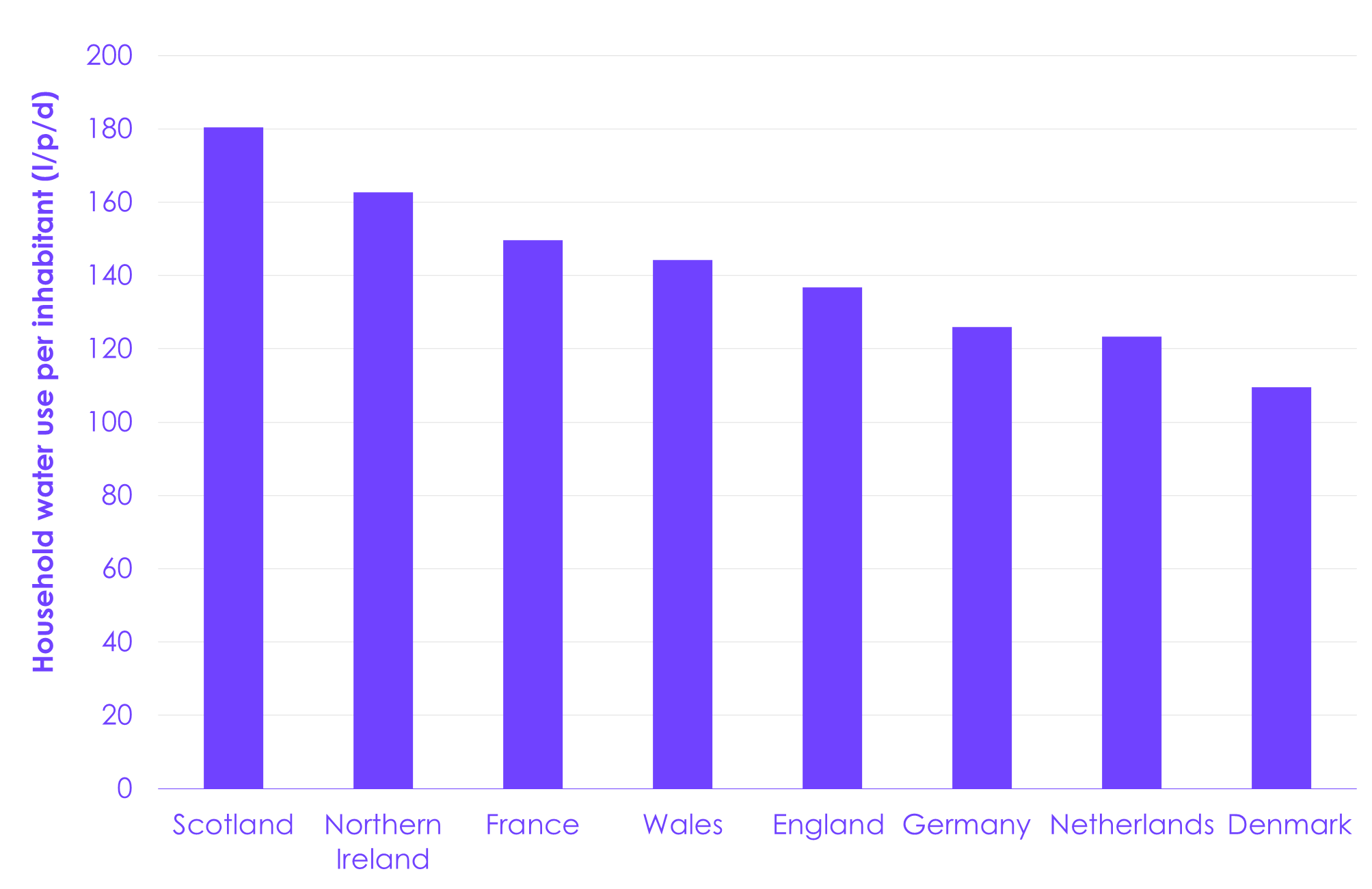 Description: Water consumption across the UK nations is greater than the selected European countries, with the exception of France which is higher than Wales and England. Scotland has the highest water consumption at 180 litres per day. |
Water system performance improvements
System performance improvements include measures to reduce leakage of water from the system and to limit system outages due to other climate impacts.
- Leakage reduction: in 2023 to 2024, 19% of water put into supply in England was lost to leakage. Approximately 75% of this leakage was from pipes owned by water utilities.[685];[686] Not all leaks can be fixed cost effectively, such as those that are small and hard to access. Key adaptation measures to reduce leakage include:
- Prioritising repair of the largest and most damaging leaks and using sensors and leak detection alarms to alert water utilities and customers. This allows leaks to be addressed more quickly, avoiding much more costly damage and waste of water.[687] Smart meters can similarly highlight unexpected usage likely related to a leak.
- Reducing water pressure can cut leaks caused by burst pipes and can lower overall demand. However, this is more challenging and expensive in hilly areas where extra pressure is needed to pump water over these landforms. Water utilities also have to engage with customers regarding their water pressure needs and expectations.[688];[689]
- Flooding and erosion protection: this includes raising assets like control kiosks and using fitted submersible pumps. Where rising flood and erosion risk makes a site unsuitable and protection is not feasible, relocating assets may be required.[690] This prevents water supply interruptions due to key asset failure.
- Redundancy for single sources of failure: users reliant on a single water source are more vulnerable to shortages or asset failures.[691]
- This includes many public water supply customers. For example, Birmingham relied solely on the Elan Valley Aqueduct until a £293 million (2025 prices) backup was added in 2020.[692]
- Private supplies are also typically single‑source because redundancy is not always feasible or cost‑effective. Strong emergency supply plans are essential.
Supply management
More water storage and supply are needed to manage drought risk. Building reservoirs and interconnectors, and improving raw water quality and treatment capacity, increases available supply and allows water to be moved where it is needed.
New supply actions include big engineering projects which are costly and take time to deliver. Therefore, it is essential to start funding and developing these measures now. Key adaptation measures to manage water supply include:
- Reservoirs: increase water supply by storing winter rainfall for use in drier, hotter summers. Their size and location must reflect expected future demand and scarcity. In addition to large-scale water utility reservoirs, water can also be stored in smaller on-site reservoirs to increase resilience at a site level. This adaptation action is cost-effective at many sites for agriculture, industry, and power under a range of future climate scenarios (Box 8.2).
- Interconnectors and water transfers: allow water to be moved from surplus areas to those facing scarcity via tanker trucks or infrastructure like pipes and aqueducts.[693] The canal network can provide these links while offering amenity and recreation value.[694]
- Pollution management to protect raw water quality: through measures like riverbank buffer zones and sustainable drainage systems (SuDS) (Box 13.1 and see Chapter 5). These measures slow down surface water runoff before it reaches natural water bodies. This helps limit the movement of sediment and other pollutants, reducing the amount of pollution entering our water sources.[695];[696] Scottish Water estimates that 15% of its investment needed to meet drinking water quality standards from 2027 to 2033 is due to climate change.[697] Water utility upstream investment to reduce pollution from agricultural runoff has a potential 6:1 return on investment.[698]
- Increasing water treatment capacity and efficiency: through appropriately sized assets and improved monitoring and innovation in water treatment processes.[699] This ensures enough drinking‑quality water can be produced from available supplies.
| Figure 8.3 Potential for additional adaptation to reduce impacts from water scarcity in private water supply |
 Description: Cost-effective adaptation packages at a national-scale can significantly reduce the impacts of water scarcity on private water supply in industry, power, and agriculture sectors in the UK. |
|
Box 8.2 |
|
This research aimed to improve understanding of the cost‑optimal adaptation response to climate change driven water scarcity. It focused on private water supplies for agriculture, industry, and power generation in the UK. The analysis focused on reducing water scarcity impacts on agricultural yield and quality, industrial production, and power generation, under central and high impact scenarios, which were comprised of climate and socio-economic variables. The full method and results can be found in the supplementary report from WSP (2026). [700] Modelling indicates that water scarcity currently causes direct economic losses of about £3.8 billion (2025 prices) annually in UK agriculture, industry, and power generation. These sectors have adapted their operations to deal with current levels of water scarcity but could be more productive without these existing constraints. The project finds that, without adaptation, expected annual economic losses could increase from present-day levels by 10% by the 2030s, and by 50% by the 2050s. By the mid‑2050s, losses could reach £5.8 billion (2025 prices) per year under a central scenario (see Figure 8.3). In a high impact scenario, the changes are even more substantial, with a 68% increase in economic losses from present-day levels to £6.9 billion (2025 prices) in the 2050s. The project modelled a cost-effective adaptation response to water scarcity in the three sectors. It identified an optimal package of adaptation actions, while noting many adaptations are highly site specific. The project also explored some measures which increase supply or reduce demand in the public water supply system, subsequently benefitting private supply. Actions deployed in the present-day out to the 2030s:
Actions deployed in the 2040s and 2050s:
The cost-effective package could reduce losses from water scarcity across all sectors by 68% in the 2030s ( reducing losses from £4.2 to £1.3 billion per year) and 69% in the 2050s (reducing losses from £5.8 to £1.8 billion per year) under a central scenario (2025 prices). Under a high impact scenario, the reduction could be 58% in the 2030s and 69% in the 2050s (with losses reducing from £6.1 to £2.5 billion per year and £6.9 to £2.2 billion per year, respectively (2025 prices)). This would require £1.3 billion in investment nationally to deliver £58.5 billion in benefits, of which £45 million can be attributed to co-benefits (2025 prices). The overall package has a benefit-cost ratio of 45:1. |
8.2.2 Actions in the wastewater subsystem
Key wastewater adaptations focus on keeping surface water out of the system and improving overall performance, which is crucial during heavy or prolonged rainfall. This is supported by adaptation to reduce surface water flooding and adaptation for freshwater ecosystems (see Chapter 5 and Chapter 13).
Overflow management
Key adaptation measures to prevent surface water entering the wastewater system include:
- Surface water separation: keeps rainwater out of combined sewers, preserving capacity for wastewater.[701] This also increases the predictability of the volume of water that needs to be treated, as surface water volumes vary with weather conditions, but wastewater volumes do not. However, while this is cost-effective for new builds and high priority sites, retrofitting across the existing combined sewer network is more costly and disruptive.[702]
- At site level, commercial properties can prioritise disconnecting large roofs and car parks from combined sewer systems and use SuDS. Examples of SuDs include rain gardens and swales, which separate surface water from wastewater and have a benefit-cost ratio of between 1.5:1 and 3:1, along with a range of co-benefits (Box 13.1 and see Chapter 5).[703];[704] Larger detention basins can temporarily store runoff and release it slowly, offering similar cost-effectiveness.[705]
- Reducing impermeable surface area: decreases the volume and rate of surface water runoff (see Chapter 5).
Improving wastewater system performance
Key adaptation measures to prevent and address wastewater pipe blockages and increase the capacity of the wastewater system to manage higher flows during increasingly heavy rain include:
- Behavioural actions: that prevent blockages, help avoid sewer flooding, and keep systems functioning under more variable climate-driven flows. Clear public campaigns promoting simple steps (like putting bins in bathrooms) have led to sustained reductions in blockages of up to 60%.[706]
- Asset modifications: such as non-return valves and screens on Combined Sewer Overflows (CSOs) can reduce sewer flooding and associated pollution.[707] Sensors can identify blockages, allowing them to be prioritised and fixed rapidly.[708]
- Increasing asset capacity: increases the volume that the wastewater system can treat, helping it cope with peak flows during increasingly heavy rainfall.[709] For example, the Thames Tideway Tunnel diverts substantial volumes of wastewater, cutting sewer flooding and reducing combined sewer overflows by up to 95% in a typical year.[710]
- Improve treatment processes: through measures such as final effluent disinfection to protect water quality in high priority receiving water bodies, such as bathing waters.[711] Decentralised treatment and reducing pollution at source may also be considered where cost-effective or needed to enable growth.[712];[713]
8.3 Enable delivery
This section sets out key enablers and policies to deliver the adaptation actions set out above at the required scale and urgency for a well-adapted water and wastewater system.
8.3.1 Enablers
Many of the actions highlighted in the previous section will be delivered by water and wastewater utilities, as well as by other water abstractors and users, such as agriculture and industry (Table 8.2). Delivering these actions requires sufficient resources, effective engagement, and adoption of innovative technology.
- Resources: regulated funding settlements will provide most of the public water and wastewater system’s financial resources and need to be sufficient to enable the ambition set out above. However, additional funding may still be needed. For example, partnership funding with Lead Local Flood Authorities can enable larger scale action by pooling scarce resources and more effectively tackling wastewater and flooding challenges in an integrated way (see Chapter 5).[714]
- Once resilience standards are set, these need to inform funding decisions. Reporting on adaptation could be aligned with funding cycles to ensure adaptation commitments are funded.[715]
- Engagement, awareness, and support: key actors outside of the water and wastewater system need to be engaged on how they contribute to and can help address issues in the system. For example, building design and retrofit standards are the responsibility of actors in the built environment system. Reducing runoff will require actions across systems, from farmers to transport.
- Citizens’ panel members felt that the public should be encouraged to use water more efficiently through efficient appliances and the use of smart meters.[716] Campaigns that explain why saving water matters, give tailored feedback and highlight economic losses lead to stronger, longer-lasting reductions.[717] For example, ‘you used more water than X% of neighbours’ or ‘not upgrading your shower head costs you £X a year’.
- Technology and innovation: are needed to both improve our understanding of the water and wastewater system and enable more agile adaptation action in a changing climate. For example, data generated from smart sensors monitoring asset health, water quality, and other factors can be combined and analysed to enable smarter management across the water and wastewater system.[718];[719] Innovation in water efficiency and holistic system approaches to wastewater management can help achieve goals in these areas.[720]
- There are also opportunities for innovation in the way we manage surface water flooding and water supply. These can avoid having too much water at some times and locations, and too little water when and where we need it (see Chapter 5).
8.3.2 Policies and plans
Water and wastewater policy is devolved. Services are publicly owned and operated in Northern Ireland and Scotland and delivered by a regulated private sector in England and Wales (including one non-profit water company that provides services in most of Wales and part of England).
Existing policy action
All national governments set a variety of laws and regulatory standards that are relevant to the water and wastewater system and play roles in setting direction and regulating the sector.
- Standards: these include water quality standards and the framework for water abstraction licensing by water utilities and other private sector water abstractors. Building standards with requirements for water efficiency and wastewater management, and limits on discharges of pollutants from other sectors play an important role.
- Direction: national governments provide direction to water regulators on balancing economic, social, and environmental priorities for the water sector. In England and Wales, the regulator, Ofwat, sets adaptation and other spending priorities through price reviews. In Northern Ireland and Scotland, funding is allocated to a publicly owned water and wastewater utility. This funding comes from bills in Scotland and taxes in Northern Ireland.
- Environmental regulation: environmental regulators in each nation issue and set conditions in a range of areas relevant to adaptation, including on water quality, water abstraction, and wastewater discharge permits, and review compliance.
Policy actions for a well-adapted system
To move towards a well-adapted water and wastewater system, national governments will have to provide clear and pragmatic policy and strategic direction.
- Minimum water efficiency standards for appliances can ensure more efficient appliances become the default for households and businesses. Minimum standards for new water users, such as data centres, can also avoid lock-in of less efficient technologies.
- The United States introduced mandatory minimum water efficiency standards in 1994, and voluntary labels for products that exceed minimum standards. From 1999 to 2016, water use declined by 22%, largely attributed to more efficient appliances.[721]
- Australia’s Water Efficiency Labelling Scheme saves 12.4 litres per person per day, rising to a projected 19.5 litres by 2036.[722] Over 80% of Australians use the label when making purchasing decisions.[723] Minimum water efficiency standards for products were introduced in 2025.
- All UK nations have banned wipes containing plastic. However, requirements for ‘flushability’ labels have not been developed, allowing blockage-causing products to be marketed as ‘flushable’.[724]
- Legislative proposals for UK-wide water‑efficiency and ‘flushability’ labelling exist but are not yet in place. No proposals currently exist for minimum water‑efficiency standards for appliances.
- Powers for regulators to require and fund more ambitious adaptation action. Following the Cunliffe review, the Department for Environment, Food, and Rural Affairs (Defra) and the Welsh Government are exploring regulatory reform and setting new water and wastewater system targets.[725];[726] The strategies and plans of the public water companies in Northern Ireland and Scotland increasingly recognise the importance of adaptation, which needs to be translated into concrete, funded action.
- Joined-up planning and regulation between water and wastewater and other sectors. This includes updates to building standards for resilient and water efficient design and retrofitting (see Chapter 5).[727] Restrictions on point source pollution from agriculture and industry will reduce pollution of wastewater. Abstraction licensing reform will need to consider future climate impacts.[728]
| Table 8.2 Responsibilities for delivering adaptation across the water and wastewater system |
|
| UK Government |
|
| National governments |
|
| Government agencies |
|
| Local authorities |
|
| Water and wastewater utilities |
|
| Private sector |
|
| Public and civil society |
|
| Notes: (1) Ownership of water and wastewater utilities can be private, non-profit, or government-owned. Therefore, depending on ownership, responsibility may fall to governments, private sector, or civil society. (2) National governments includes the role of the UK Government in England; and in Northern Ireland, Scotland, or Wales where powers sit with the UK Government for that nation but are devolved to other nations. | |
8.4 Evaluate progress
Effective adaptation requires monitoring and evaluation to assess whether delivery towards objectives and targets is contributing to reducing climate risk. This section sets out the current capability to track progress against the proposed targets in the water and wastewater system, and priority gaps for monitoring and evaluation.
8.4.1 Tracking progress on adaptation
In the water and wastewater system, there is a good understanding of the climate risks and some existing monitoring of adaptation efforts. However, improved indicators are required to monitor progress against the proposed targets in this system across all nations in the UK.[731]
- Ensuring resilience to drought: water companies in England and Wales publish data on progress towards achieving long term resilience to a 1 in 500-year drought. The same data is not publicly available for Northern Ireland and Scotland as there is no target for long term drought resilience requiring reporting of this data. Data on peak demand is not available in any nation. However, future reporting on Scottish Water’s business plan will include reporting on resilience to a worst historic drought and capability to meet peak demand.[732]
- Safeguarding the resilience of water bodies: water body health data is available in all nations, but sustainable abstraction data is only available in England.[733];[734];[735];[736]
- Addressing impacts of wastewater on people and property: some internal and external sewer flooding data is available in England and Wales, but generally relates to observed sewer flooding, rather than to a 1 in 50-year storm event and varies by wastewater utility. Some data is available on properties at risk of flooding at more frequent return periods in Northern Ireland.[737] Scottish Water’s business plan reporting will include observed sewer flooding and properties at risk.[738] While observational data helps show current impacts, limited information on future at‑risk properties hampers proactive adaptation.
8.4.2 Addressing monitoring and evaluation gaps
There are priority gaps to monitor and evaluate whether adaptation is achieving the vision of a well-adapted water and wastewater system. We have identified the following gaps and opportunities to address them.
- Collect and publish water use data. Northern Ireland and Scotland lack observational data on key metrics such as per capita water consumption due to a lack of metering – available data is based on modelled estimates. Observational data would allow behaviour change communication and adaptation action to be targeted to higher water users and tailored to their actual use, improving the cost-effectiveness of these actions.
- Ensure access to data on private water abstraction. This data is confidential and commercially sensitive and therefore generally inaccessible. Water abstraction data was reported in the past by the Environment Agency for England, but recent data is not currently available.[739] Availability of data elsewhere in the UK varies by nation and local authority. Available data is focused primarily on the location of abstraction sites and permitted volumes, rather than actual volumes abstracted.[740];[741];[742] Data at an aggregated, anonymised level would enable more informed, holistic management of water resources, as private water abstraction will affect water available for the public system, and vice versa.
- Collect data on vulnerability to single points of failure. This data is not available across all nations regarding customers connected to a single source of supply. Some data is available on the number and proportion of customers reliant on private water supplies, but some customers connected to the public water supply are also vulnerable to single points of failure. Access to this data would enable prioritisation of adaptation actions to address the most important single points of failure in the system.
- Improve data and understanding of the impacts of wastewater on nature. Data on storm overflow discharges is available in all nations, but outside of England and Wales this data is limited, as not all storm overflows are monitored.[743];[744];[745];[746] Further analysis is needed in all nations to better understand the impacts of climate change on storm overflow discharges, and therefore the changes needed to existing plans to ensure targets are met.
- Improve data and understanding of the effectiveness of nature-based solutions. This is particularly needed regarding the ability of these solutions to achieve resilience to certain target design specifications. Currently engineered solutions are often favoured where infrastructure needs to meet a defined standard, due to the clearer evidence base regarding the ability of engineered solutions to meet these specific standards.
- Produce integrated mapping and hydrological models of the water system. The water system is complex, and most models only explore a specific aspect or geographical area. This fails to consider the interconnected nature of the system. Groundwater in particular is not well understood. Modelling of acute droughts (as opposed to long term water scarcity) also requires improvement (see Box 8.2). Improved understanding of the water system would enable more targeted, cost-effective adaptation action. This modelling should consider where different adaptation actions will be most beneficial based on the characteristics of the catchment and surrounding topography.
Chapter 9: Energy
Introduction and key messages
This chapter covers climate change adaptation in electricity and fuel supply. Electricity supply covers the generation, storage, and transport of electricity. Fuel supply covers the production, storage, and transport of fuels including gas, oil, bioenergy, and sustainable aviation fuel, as well as emerging systems for hydrogen, and supporting infrastructure such as CO2 transport and storage.
Our key messages are:
- Flooding, high winds, increased heat, and drought already present risks to the energy system. These risks are expected to increase as the climate changes. Multiple hazards coinciding can further amplify these risks. Disruptions in electricity supply can create cascading risks across the economy that, if not addressed, could reach billions of pounds per year of losses by the 2050s. While there has been progress in adapting to flooding, it is necessary to ensure the energy system is well-adapted to the full range of climate hazards.
- Upgrades to the energy system provide a once-in-a-generation opportunity to build in resilience. The UK is embarking on a significant phase of infrastructure build, both to build new energy assets and to replace existing ones. Designing resilience in from the outset is key to ensuring this infrastructure can cope with the impacts of climate change. The UK Government has recognised this need and work is underway. Next steps should include fast-tracking the review and development of appropriate targets and standards, and capitalising on the opportunities offered by new technologies to improve outcomes, including for vulnerable customers.
- The UK Government should provide clarity on the future of the gas grid to support resilience planning. This would support infrastructure owners and regulators to take an informed view of asset lifetimes and associated resilience needs.
- A more structured approach to managing interdependencies is required to better support resilience. Co-ordination is lacking in a range of areas to effectively manage interdependencies, particularly for Critical National Infrastructure (CNI). Implementing the recommendations from the North Hyde review will help address this, including through delivering the commitments set out in the UK Government’s response.
Adaptation overview
This chapter sets out the ambition for a well-adapted energy system and the actions, enablers, and policies required to deliver it. Figure 9.1 provides a summary of this in a monitoring map – a more detailed version of this figure is available in the Climate Change Committee’s Adaptation Monitoring Framework.
Adaptation in the energy system is connected to all other systems covered in this report. Other systems depend on reliable energy supply to deliver resilience for society more widely. For example, risks in the energy sector can spread to other infrastructure sectors with substantial impacts. Disruptions in electricity provision can cascade into failures across water and wastewater, transport and digital communications systems (see Chapter 8, Chapter 10, and Chapter 12). Failures can occur through disruptions to monitoring, control, and electric pumping; traction, signalling, and control systems; and telecommunications and payment systems respectively.
Resilience to climate risks in the energy system is also connected to adaptation actions delivered in other systems. For example, disruptions to transport can prevent operators from accessing sites for repairs during outages (see Chapter 10). The energy system is also increasingly digitally connected and managed (see Chapter 12).[747]
| Figure 9.1 Monitoring map for the energy system |
 Notes: a more detailed, interactive version of this figure is available in the Climate Change Committee’s Adaptation Monitoring Framework. |
9.1 Set ambition
This section sets out the necessary ambition for adapting to the risks from climate change in the energy system.
9.1.1 Climate risks to the energy system
The energy system manages the climate risks identified in Chapter 6 of the CCRA4-IA Technical Report, across the England, Northern Ireland, Scotland, and Wales (Table 9.1).[748]
Electricity networks are vulnerable to damage through flooding, high winds, and increased heat, creating risks of localised disruptions.[749] Heat and drought can reduce efficiency and capacity across electricity networks and in generation. Heat can reduce generation efficiency, and a lack of water can inhibit processes such as cooling.[750]
For the fuel supply system, flooding and water scarcity are of most concern. Changing weather patterns can cause soil movements and increase the risk of subsidence and landslips to fuel supply infrastructure. Water is needed for processes such as cooling and hydrogen production.
There are also interdependencies between fuel and electricity systems, such that risks facing one also pose risks to the other. For instance, petrol pumps, gas boilers, and gas networks rely on electricity for operation.[751];[752] Gas and hydrogen are important in the provision of dispatchable power in the current and future electricity system.[753]
Climate impacts are being felt today, with multiple hazards sometimes occurring simultaneously. Most recently, Storm Gorretti combined strong winds with heavy snow resulting in widespread power cuts.[754];[755];[756] Storm Babet brought heavy rainfall and strong winds that disrupted electricity supplies in affected areas.[757] Other storms, such as Storm Arwen and Storm Éowyn, have caused power losses affecting a large number of customers: over one million and around 600,000 respectively. In some areas, restoring power took one week.[758];[759] Storm Éowyn forced the shutdown of the Triton Floating Production, Storage, and Offloading (FPSO) vessel for four days.[760] Coastal erosion on parts of the eastern UK coastline is occurring faster than expected, with associated risks for nearby nuclear assets requiring protective measures.[761] Heat has also had impacts. For example, the heatwave in July 2022 caused some assets to overheat and contributed to 15,000 properties losing power in Yorkshire, Lincolnshire, and the North East.[762] The cascading impacts of energy disruption are already significant.[763];[764]
Without additional adaptation, under a 2°C global warming level in 2050:
- Excessive rainfall and flooding will increase in frequency and magnitude. This can cause damage to generation facilities. However, evidence quantifying impacts to generation assets remains limited. Asset owners report that climate risks are incorporated into the design of new plants.[765] Excessive rainfall and flooding can also pose a risk to electricity network assets, such as substations, transformers, and switchgear, and to fuel supply infrastructure.[766] In England, 22.1% of electricity infrastructure is currently at risk of flooding. This is expected to increase to 25.9% by 2040 to 2060 due to climate change.[767]
- Gas networks identify flooding and river erosion as high risks.[768];[769] Where new assets such as hydrogen infrastructure are located in low-lying estuaries, risks of river flooding, tidal surge, and water-supply stress coincide.[770];[771]
- Intense storms and wind can damage electricity assets due to flying debris, particularly poles, overhead lines, and substations. In the UK, windstorms are the leading cause of power outages, primarily through the uprooting and breakage of trees impacting overhead lines. Antecedent rainfall, wind direction, and seasonal factors such as leaf cover may amplify the risk of whole trees or large branches breaking or being uprooted.[772]
- The impacts of storms and coastal flooding are projected to be greater as sea level rises. Storms, coastal flooding, and coastal erosion can affect the operation of fuel supply assets which are often clustered in low-lying coastal zones. This can pose risks to assets such as refineries, future carbon capture utilisation and storage (CCUS) and hydrogen infrastructure, and disrupt the delivery of fuels at ports.[773]
- Lengthening of the growing season is expected to pose an increased risk to assets. Faster growth increases the likelihood of trees and bushes breaching statutory clearance distances for electricity distribution network assets. Increased tree limb failure may also become more common due to increased disease or other environmental stressors.[774] Heat-related sagging of power lines, combined with faster tree growth, increases the risk of contact during heatwaves.
- Higher temperatures are projected to increase failure of electrical switchgear and increase the risk of supply interruptions, due to sagging power lines or breakdown of insulation in transformers or underground cables.[775];[776] They can also accelerate component wear and reduce the efficiency of thermal and solar plants. Extreme heat can also cause shrink-swell in clay soils, leading to bending or cracking of buried pipelines.[777] The number of days conducive to wildfire activity is projected to double, increasing wildfire risk to exposed assets. While an increase in high temperatures will be widespread across the UK, the greatest increase in frequency is expected in the South East of England.[778]
- Multiple hazards are projected to coincide, amplifying future risks to the energy system. Climate projections suggest the need to be prepared for more combined heatwave-drought summers, and for more winters with both extreme winds and flooding.[779]
- Risks to infrastructure networks, including energy, from interdependencies could reach approximately billions of pounds per year by the 2050s.[780]
Under a high-end scenario, on track for around 4°C global warming level by 2100, without adaptation:[781]
- High temperature extremes are projected to increase even further.
- For electricity networks, existing assets are expected to have similar vulnerabilities to today, but to be affected by increased weather hazards.
- For fuel supply, increased risks are also expected in high warming scenarios to 2050 and beyond, as climate hazards intensify.
Under both central and high warming scenarios, the CCRA4-IA Technical Report assigns greater uncertainty to fuel supply risks to 2050 and beyond. This reflects uncertainties associated with changing energy infrastructure which could affect levels of exposure and vulnerability to climate risk. For instance, the coastal concentration of new assets, the location and design of new pipeline corridors, or the closure or conversion of existing refineries.[782]
| Table 9.1 Climate risks to energy |
|||||
| Risk | England | Northern Ireland | Scotland | Wales | Overall |
| I1: Risks to delivery of infrastructure services from interdependencies with other infrastructure systems | Critical action needed | Critical action needed | Critical action needed | Critical action needed | |
| Critical action needed | |||||
| I2: Risks to electricity generation | More action needed | More action needed | More action needed | More action needed | |
| More action needed | |||||
| I3: Risks to electricity transmission and distribution systems | More action needed | More action needed | More action needed | More action needed | |
| More action needed | |||||
| I4: Risks to fuel supply systems | Critical investigation | Critical investigation | Critical investigation | Critical investigation | |
| Critical investigation | |||||
| Source: Ferranti, E. et al (2026)Infrastructure In: CCRA4-IA Technical Report. | |||||
9.1.2 Objective for a well-adapted energy system
Objective: the energy system is reliable, minimising climate-related disruption, and maintaining current levels of service under the current and future climate.
Achieving this objective for the energy system would mean homes and businesses have reliable and resilient supply. The energy system would at least maintain current levels of service and continuity of supply without widespread or prolonged failures. Priority customers with additional resilience needs would receive appropriate additional protections.[783]
To deliver this objective, targets covering the full range of energy sources will be important to drive appropriate adaptation across the energy system.
Here, we set out targets focused on electricity as a starting point, given the established evidence base and the need for an increasingly electrified economy. A resilient fuel supply system is implicit, as it underpins a resilient electricity supply, but governments may also wish to set explicit targets for the fuel supply system. For instance, the Climate Change Committee’s (CCC) advice on the UK’s Seventh Carbon Budget (2025) notes the role of hydrogen and gas with carbon capture and storage in providing low-carbon dispatchable power. For gas, there are existing security of supply standards which could serve as a starting point to set targets. These include the statutory N-1 and
1-in-20 standards, which test the system’s ability to meet demand if the largest single gas asset fails and during a severe peak-demand winter, respectively.
National governments may choose to propose alternative targets where they have different priorities, trade-offs to consider, or further evidence (Box 3.11).
Maintaining electricity service levels
Adaptation will be needed to maintain service levels in electricity supply and ensure minimal disruption to customers. This aligns with government priorities to secure continuity of supply, protect consumers and businesses from costly disruption, and ensure vulnerable customers are protected.[784] A focus on outcomes for end users enables the resilience of the system to be captured. At present, end-user reliability is generally measured using the number of customer interruptions and customer minutes lost at distribution level.[785]
Proposed target: from now through to 2050, the electricity system should maintain service levels at current levels of resilience or higher.
- There is currently limited dedicated evidence considering whether the current levels of disruption can be maintained under further climate change – despite its importance to an increasingly electrified society.
- Ofgem is currently leading efforts to inform setting a long-term climate resilience goal, as part of the next price control for electricity distribution (RIIO-ED3).[786];[787] This includes stress testing to assess what investments or actions may be needed to maintain resilience against extreme heat, flooding, and windstorms.[788]
- Where infrastructure is new, or assets are replaced, the incremental cost of upgrades to integrate resilience is generally expected to be small relative to the total costs. Evidence is currently lacking to inform a full assessment of the costs and benefits associated with delivering a resilient energy system in the UK (see Section 9.4.2).
- In the absence of bespoke evidence, the priority should be seeking to invest to at least maintain current service levels. Examples of areas where targeted improvements could be considered include cross-sector dependencies, CNI, vulnerable energy users, or maximum outage durations.
- The target is proposed to be ongoing from now to reflect the need to design resilience into the significant infrastructure build and asset replacement expected over the next five to 10 years, and to align with Ofgem’s price controls.[789];[790]
- The citizens’ panel found some tolerance for disruptions. However, this was balanced with strong concerns for more vulnerable households and the need to meet energy needs for heating, refrigeration, and medical equipment. Bill impacts were also a strong concern
(Box 9.1). - To monitor progress against this target, we propose Ofgem could use existing service-level indicators, such as customer interruptions and customer minutes lost. There is scope to improve these, for instance through improved use of cause codes, and weather-corrected data on disruptions (see Section 9.4.1).[791];[792]
|
Box 9.1 |
The Committee convened a citizens’ panel to explore people’s concerns and adaptation priorities in relation to different climate change impacts in the UK (see Chapter 2). Among the issues discussed were the impacts of climate change on household utilities. Discussions covered both energy and water supply. Here, we report findings specific to energy (see Chapter 8 for findings on water).[793]
|
Recovery of electricity supply
Even in a well-adapted electricity system, it is not always possible or cost-effective to avoid loss of supply in the most extreme weather events. A cost-effective approach to resilience includes an appropriate mix of measures to reduce the likelihood of interruptions, limit their scope, and to ensure rapid restoration of service. Rapid recovery of electricity supply is a critical element of resilience and is already reflected in recovery standards and guidelines today.
Proposed target: from now through to 2050, following a climate-related reduction or loss of electricity supply, the supply needs of priority customers should be met within a defined number of hours, with 100% of customers restored within a defined timeframe thereafter.
- We have not specified the timeframes for recovery, or which subset of customers should be prioritised, because there is scope to evolve targets here relative to existing standards. Recovery targets should be developed through consultation with relevant stakeholders. Existing standards can serve as a minimum starting point.
- The National Energy System Operator’s (NESO’s) electricity system restoration standard requires 100% of electricity demand to be restored within five days of a total or partial shutdown of the Great Britain (GB) electricity system. This is accompanied with an interim target of restoring 60% of electricity demand within 24 hours in all regions. The standard will come into effect on 31 December 2026.[794]
- Ofgem’s Guaranteed Standards of Performance require network operators to compensate customers if power is not restored within a defined timeframe after severe weather events. For category one storms, compensation payments start at 24 hours and for category two storms at 48 hours.[795];[796];[797]
- Currently, standards for recovering supply focus on grid restoration. While standards for grid restoration must remain central to recovery targets, new technology could offer opportunities to enhance or set additional standards that prioritise restoring access to energy. This could enable supply needs to be met more rapidly, and for recovery to be better targeted. For instance, greater use of local solutions could support vulnerable customers in advance of full grid restoration.
- Utility companies currently provide additional support to customers on the Priority Services Register (PSR), such as the provision of emergency power for those using medical equipment which is reliant on electricity.[798];[799];[800];[801] Many owners of CNI also have their own standby sources of power, as suggested by UK Government guidance.[802]
- Emerging technologies such as bidirectional chargers, solar panels, and batteries offer opportunities to better target resilience and recovery, including for vulnerable customers. This could enable the evolution of standards for supporting vulnerable customers.
- Maintaining rapid recovery of energy supply, particularly as a priority for vulnerable groups, was strongly supported in our citizens’ panel.
- To monitor progress against this target, existing indicators could continue to play a role. These include NESO’s forecasting of restoration performance against targets, monitoring of customer minutes lost, and the tracking of payments under Ofgem’s Guaranteed Standards of Performance. There is scope for enhancing granularity to look at recovery of supply for subsets of customers that could be prioritised, and to better monitor long duration interruptions (see Section 9.4.1).
9.2 Identify actions
The following section sets out the priority adaptation actions required to reduce climate risk and achieve the climate adaptation objective for energy. The types of climate hazards expected to impact the energy system in the future already occur and are addressed in other countries. Many of the solutions are well-understood.[803];[804];[805];[806] Adaptation is important to make existing infrastructure resilient and to ensure new infrastructure is adapted to the range of possible future climate conditions during its lifetime. The UK is embarking on a significant phase of infrastructure build, to build new energy assets and to replace existing ones as they age. This provides an opportunity to build resilience in from the start. It is often easier and more cost-effective to do this than to retrofit later.[807];[808]
9.2.1 Actions in the energy system
These include adaptations to the infrastructure itself or to system design, changes in the way that infrastructure is operated and maintained, or measures to improve emergency preparedness and response.
Infrastructure and system design
Infrastructure and system design can be used to address a range of climate hazards, including flooding, windstorms, and heat. Measures include asset siting, system design, and infrastructure protection and asset hardening. Actions in each of these areas already form part of existing adaptation strategies. Planning policy and standards drive siting decisions and infrastructure protections, and resource adequacy assessments inform the supply mix.
- Asset siting: siting decisions can reduce the level of exposure of energy assets to climate hazards like flooding and drought. For energy infrastructure that requires water, siting these outside regions of expected water scarcity can help manage drought risks.[809] For flooding, national planning policy requires that development is directed away from areas at highest risk and that, where this is not possible, any developments in a flood-risk area can be made safe for their lifetime.[810]
- System design: for networks, building redundancy avoids single points of failure, for example, by connecting an area to more than one substation, or installing multiple supply points for CNI.[811];[812] Increased levels of international interconnection can enhance system flexibility during stress events such as extreme heat.[813] Alongside this, system design must account for the possibility that interconnected countries experience stress-events simultaneously. Dimensioning the system appropriately and diversifying supply remains key.
- NESO has recommended that CNI or essential service sites strengthen the resilience of supply points. This could include ensuring the loss of one supply point does not affect the whole site and maintaining the ability to switch load quickly between supply points.[814]
- Wind and solar energy are by nature distributed, reducing exposure of the system to the loss of a single asset. Diversifying the type and location of energy generation technologies can further reduce exposure to climate-related risks. This is because climate-related risks tend to impact one geographical area at a time.[815];[816] Diversifying low-carbon fuel supply chains can reduce vulnerability to localised climate hazards or disruption.[817]
- Demand flexibility is an important part of the mix and can be used to prevent outages during extreme weather events. However, flexibility provision can also be dependent on digital infrastructure, requiring electricity.[818];[819]
- Infrastructure protection and asset hardening: this includes reinforcing existing energy assets, and designing new ones appropriately, so they can operate safely under more frequent and intense weather extremes. Actions below set out measures to address a range of hazards including flood, heat, high winds, and drought.
- Although new assets are being built to strong flood protection standards, there are still legacy assets at risk of flooding today.[820] Adaptation measures include flood barriers, elevating equipment, and improved drainage.[821] For fuel supply, measures include raising the height of telemetry equipment and protecting pipes with rock armouring.[822] It might not always be possible to site new assets outside of flood-prone areas; for instance, where there is a need to locate assets close to water supplies or on the coast. In these cases, infrastructure can be protected from flooding by building above expected future flood levels and implementing flood tunnels and sustainable drainage systems (see Chapter 5).[823]
- In generation and storage, protection measures for heat include upgrading cooling systems, oversizing, and use of alternative battery chemistries.[824] For electricity networks, increasing pole or tower heights reduces the impact of cables sagging during extreme heat.[825] Ambient temperatures above 40ºC require air cooled equipment like transformers and switchgear to have reduced capacity (de-rating), enhanced cooling, or higher design temperatures.[826];[827] Where de-rated capacity is insufficient for required loads, this can also drive reinforcement needs.[828] Recent research suggests cooling demand growth could bring forward reinforcement needs (Box 9.2).
- Risk of damage to overhead lines from falling or flying debris can be reduced by widening managed corridors in critical locations. Selective undergrounding of overhead lines most exposed to high winds, and use of insulated cables for specific areas, are effective in reducing risks from wind. Widespread undergrounding of cables remains a high regret option due to the high costs involved and is often impractical on steep inclines or in very rocky terrain.[829]
- For existing infrastructure, adaptation options for drought risk include on-site water storage, water reuse and recycling schemes, investment in water transfer infrastructure, and retrofitting or modifying cooling technologies.[830] However, there is often a trade-off between increasing water or energy use. Costs for thermal technology cooling also need to be considered (see Chapter 12). Water scarcity should be factored in when permitting hydrogen developments and should inform the water source used.[831];[832];[833] Bioenergy crops can be protected from drought by irrigating at night, using precision irrigation, switching to drought-resistant and drought-tolerant crops, and using tied ridging or contour ploughing (Box 8.2). Metal fuel supply pipes at risk of subsidence and ground movement, often related to drought, can be replaced with more durable plastic pipes.[834]
|
Box 9.2 |
Historically, the GB electricity system has generally managed to deliver a highly reliable supply of electricity. System-level resilience measures usually ensure that faults do not lead to widespread supply interruptions. However, electricity networks have been found to be the most vulnerable energy asset to climate-driven extreme heat and heatwaves, and some system-level vulnerabilities are already evident.[835]
As heating electrifies, network capacity will increase to meet a growing winter peak. Future electricity demand is still expected to be highest in winter, with generation capacity expected to be sufficient to meet summer cooling needs.[842] See our report on Delivering a reliable decarbonised power system for further discussion. However, some reinforcement needs could also be brought forward by cooling demand:
Research in this area remains nascent, but early findings suggest cooling demand could necessitate earlier reinforcement on some parts of the network:
|
Operation and maintenance
These actions deliver resilience through regular operations and maintenance. These are particularly important in responding to increased risks from windstorms and heat, which are associated with higher failure rates for assets such as overhead lines and transformers. While inspections, maintenance, and vegetation management are established parts of current operational practice, their scope, timing, or frequency may need to evolve to adapt to climate change.
- Regular inspections and preventive maintenance: identifying weather-related degradation early, such as corrosion, sag, or insulation wear, enables timely asset replacement and reduces failures. Prioritisation of assets for inspection and maintenance can also draw on climate risks. For instance, carrying out more regular pole inspections in wind-prone areas.
- Vegetation management: electricity and gas network operators have identified vegetation management as a low-regret option to respond to higher temperatures, wildfires, and windstorms.[848];[849];[850];[851] It prevents disruption caused by falling trees or debris during storms, or by trees coming into contact with sagging lines during heatwaves. It can also improve wildfire resilience.[852] However, operators have noted it can be challenging to implement in areas where landowners and communities do not want trees cut back or removed.[853] In some instances, trade-offs may be required between energy resilience, nature, and public acceptance.
- 32% and 23% of faults were caused by falling trees during Storm Arwen and Storm Eunice, respectively. Electricity North West estimated that over 100,000 households were protected during Storm Arwen by the tree cutting programme.[854]
- As the growing season lengthens, more vegetation management will likely be required by operators. By 2050, a conservative estimate of additional annual spend by Distribution Network Operators (DNOs) on tree cutting for existing lines could be in the order of £6–£17 million (2025 prices).[855];[856];[857];[858]
- Appropriate species selection and vegetation management can also protect solar farms from flooding, waterlogging, erosion, and wildfires.[859]
Emergency preparedness and response
These measures can alter the impact or duration of disruptions caused by climate hazards, by enabling rapid recovery. While emergency preparedness and response measures are widely used, there is scope for new technology to play more of a role in the future.
- Emergency response: actions to anticipate, respond to, and recover from extreme events include early warning systems, staff training and protection measures (see Chapter 6), and incident management protocols and processes.
- For asset owners, these protocols can include mechanisms that trigger communication with customers, enable movement of staff, or facilitate deployment of equipment, such as emergency pumps to remove floodwater.[860];[861] For customers, such as CNI sites, incident management protocols can be used to develop plans around loss or impairment of energy supplies.[862] Testing and rehearsing plans can ensure that emergency procedures work in practice and that organisations are prepared to co-ordinate effectively. Continuous improvement of emergency response procedures is a low regret, cost-effective alternative to infrastructure upgrades when outages can be restored quickly.[863]
- Backup power: can provide alternative sources of supply in the event of a power cut. This can include the use of generators, which are widely used already, or more innovative backup power approaches such as batteries, solar, and vehicle-to-everything (V2X).
- Appropriate stocks of backup energy can aim to match the potential estimated duration of supply interruptions. Facilities relying on batteries for backup power can ensure that storage systems are correctly sized and maintained at adequate levels.[864]
- V2X allows for electric vehicles to operate bidirectionally, charging from the electricity grid but also discharging to the grid, building, or home as needed. This enables users to shift demand and benefit from cheaper electricity. When a building or home also has the functionality to operate independently from the grid (known as islanding), V2X can enable the vehicle to act as a backup power source in a power cut. For public buildings, pilots such as Rural Energy Resilience V2X have tested the use of V2X for community warm spaces.[865]
9.3 Enable delivery
This section sets out key enablers and policies needed to deliver the adaptation actions at the required scale and urgency for a well-adapted energy system.
9.3.1 Enablers
Many of the adaptation actions highlighted in the previous section will be delivered by the private sector (Table 9.2). The most important enablers for delivery are the provision of appropriate resources, clear plans and responsibilities, and effective use of technology and innovation.
- Resources: to fund adaptation actions for existing and new infrastructure. As the UK embarks on a significant phase of infrastructure build, there is an opportunity to invest now to make new assets resilient from the outset.
- Significant build is planned over the next five to 10 years, both to replace existing assets as they age and to build new energy assets. NESO anticipates 1,000 km of onshore and 4,500 km of offshore network infrastructure is needed by 2030, over double the total built in the last decade.[866] Over half of the current combined cycle gas turbine fleet is expected to close by 2035.[867] Under the UK Government’s Clean Power 2030 plan, installed generation capacity is planned to grow from 111 GW in 2024 to between
213–227 GW by 2030.[868] - Where possible, it is easier and more cost-effective to build resilience into infrastructure projects at the design stage rather than retrofitting later.[869];[870] The need for resilient infrastructure design is recognised as a strategic objective of the UK Government’s Energy Resilience Strategy.[871] Investment to support this can be facilitated by a regulatory framework which effectively joins up longer-term risk assessment with price control investment decisions. Ofgem has work in train to deliver this, for instance through developing agreed approaches to measuring and valuing resilience.[872]
- Significant build is planned over the next five to 10 years, both to replace existing assets as they age and to build new energy assets. NESO anticipates 1,000 km of onshore and 4,500 km of offshore network infrastructure is needed by 2030, over double the total built in the last decade.[866] Over half of the current combined cycle gas turbine fleet is expected to close by 2035.[867] Under the UK Government’s Clean Power 2030 plan, installed generation capacity is planned to grow from 111 GW in 2024 to between
- Clear plans, roles, and responsibilities: to facilitate effective co-ordination and delivery, and support the private sector to take informed decisions about adaptation needs.
- Governance arrangements for resilience in the energy system are complex, and clear ownership and effective co-ordination between bodies is vital to deliver a resilient system. Well-designed governance arrangements can facilitate cross-sector
co-ordination both within the energy sector and with other sectors such as water, transport, and telecoms. This allows risks and solutions to be evaluated on a system-wide basis. This co-ordination is particularly important where essential services, including those provided by CNI customers, depend on continued energy supplies. - Clarity on the future of the gas grid, and UK fuel sector more widely, is important to enable private sector actors and regulators to take an informed view of asset lifetimes and associated resilience needs. This supports effective targeting of resilience spend, reducing the risk of stranded investments.
- Targets and standards provide clarity to the private sector over the levels of resilience to be achieved. Standards have been shown to be highly effective in driving action. For instance, ETR138 sets out requirements for grid and primary substations to be protected against a 1 in 1,000-year flood event. This has made a significant difference in reducing the number of critical customers supplied by electricity substations at risk of flooding (from 10,800 in 2015 to 2016 to 210 in 2023 to 2024).[873];[874]
- Governance arrangements for resilience in the energy system are complex, and clear ownership and effective co-ordination between bodies is vital to deliver a resilient system. Well-designed governance arrangements can facilitate cross-sector
- Technology and innovation: to improve the range and timeliness of adaptation actions, improving resilience outcomes. Lessons can also be drawn from other countries with similar climactic conditions to those we expect to face in the future, such as France.[875]
- At asset-level, innovation in areas such as asset condition monitoring, data analytics, and asset management can improve timely replacement or enhancement. For example, asset-level vulnerability mapping can help identify points of failure. Drone inspections are used by several network operators already for this purpose.[876];[877] Monitoring, communication, and modelling developments would permit improved testing of future vulnerabilities and better management of risk in ‘real time’.
- At household-level, further innovation in home battery technology, V2X, and solar can provide households with additional backup options during power outages. This can supplement system-level resilience. Scaling trials, standardising equipment, and delivering a supportive regulatory and policy framework could further drive costs down and facilitate uptake. Targeted support could have a role in meeting costs for vulnerable consumers or locations.
9.3.2 Policies and plans
Governance arrangements in the energy system are complex. For Scotland and Wales, energy is largely a reserved matter, although some powers are devolved. In Northern Ireland, energy policy is generally devolved, although overlapping competencies remain.[878]
- In Great Britain, electricity generation is part of the GB energy market. Ofgem regulates the energy markets in Great Britain, regulating the companies that make, move and sell energy. NESO operates the electricity system in real time and has been charged with providing advice on system planning, security of supply, and system resilience.[879] Environment agencies are responsible for environmental regulation, including environmental permitting and abstraction licensing, flood risk management, environmental planning, incident response, and spatial planning advice. In England, it is the Environment Agency; in Scotland, the Scottish Environment Protection Agency; in Wales, Natural Resources Wales.
- In Northern Ireland, electricity generation is part of the Single Electricity Market for the island of Ireland and market design and operation are shared.[880] The Utility Regulator is the economic regulator for electricity and gas companies. The System Operator for Northern Ireland (SONI) is the electricity transmission system operator. SONI has a role in planning for future energy needs. The environmental regulator is the Northern Ireland Environment Agency.
- A wide range of other bodies are involved in regulation and oversight. For instance, the North Sea Transition Authority (NSTA) and the Health and Safety Executive (HSE) have roles regulating the oil and gas sector. The Crown Estate and Crown Estate Scotland are responsible for seabed leasing for offshore wind and marine energy.[881];[882]
Existing policy action
Policy levers to drive and monitor adaptation vary across different segments of the energy system:
- Regulation: price controls are an important lever for supporting energy network resilience. For transmission and distribution network companies, price controls cap their revenue subject to meeting reliability, cost, and investment targets. Ofgem’s price controls have introduced requirements for distribution and transmission companies to submit climate resilience strategies as part of their business plans. The Utility Regulator’s price controls require business plan strategies to consider how climate change could impact networks and outline adaptation actions to manage risks to services.[883] Other regulatory frameworks, such as the Environmental Permitting Regulations, Water Resources (Abstraction and Impounding) Regulations, and the Control of Major Accident Hazards Regulations also help drive resilience across the system more widely.
- Strategic planning: system operators have a role in considering climate resilience in network planning.[884];[885] In Great Britain, NESO’s whole-system advisory role includes the production of a Strategic Spatial Energy Plan, which sets out future generation and storage needs. It also includes assessing the resilience of the energy system, understanding the impacts of extreme weather hazards now and in the future. Planning authorities and arms-length bodies have roles to play in siting decisions, and in considering the cumulative needs and impacts of the energy system and associated infrastructure.[886]
- Information provision: under the Adaptation Reporting Power (ARP), reporting authorities in Great Britain are requested to produce reports on what they are doing to adapt to climate change.[887] This includes electricity transmission and distribution system operators, gas networks, trade bodies like Energy Networks Association (ENA) and Energy UK, and Ofgem. However, there are current gaps in segments that are not invited to report, including individual energy generators, crude-oil, refined-product or multi-product pipelines, and import terminals. Large entities in the private sector are mandated to align disclosure with the Task Force on Climate-related Financial Disclosure (TCFD) requirements. The framework requires companies to disclose actual and potential impacts of climate-related risks and opportunities and disclose how they are managed (see Chapter 16).[888]
Policy actions for a well-adapted system
The energy system is largely a regulated, private sector-led system. The regulated environment offers opportunities for a co-ordinated and strategic approach to delivering resilience. Progress is in train, through a range of initiatives such as the UK Government’s forthcoming Energy Resilience Strategy, the North Hyde Implementation Plan, and Ofgem’s work for RIIO-ED3. Areas requiring continued UK Government focus include facilitating timely resilience targets and standards, providing clarity on the future of the gas grid, improving management of interdependencies, and improving reporting.
- Timely and appropriate targets and standards can ensure that the investments we are making now are fit for the future. System-wide energy resilience targets and standards, covering all climate hazards, would set clear expectations on the levels of resilience to be achieved. Standards are important both for system-level infrastructure and for household-level technology. The development of targets and review of standards will need to be fast-tracked if we are to future-proof the significant investment planned for our energy system over the next five to 10 years.
- While infrastructure standards have been key in driving improvements for some climate hazards, not all types of climate hazard are covered. Some standards also use historical weather data and may need updating considering climate change.[889]
- For example, ETR 138 could be kept updated with the latest flood maps, including surface water maps to better capture risks from heavy rain, and widened in scope to include additional network assets (beyond substations). Similarly, ETR 132 on overhead network resilience could consider a wider scope to cover lower-voltage lines. Standards for deriving thermal ratings of overhead lines could be updated to consider higher ambient temperatures.
- Work to update targets and standards is in train or planned. Fast-tracking the development of targets and standards to align with the planned pace of build would ensure the new investments being made now in the energy system are future proof.
- Ofgem is currently leading efforts to inform setting a long-term climate resilience goal as part of the ED3 price controls.[890]
- The Department for Energy Security and Net Zero (DESNZ) is leading an Energy Resilience Strategy, due in autumn 2026. It will set out the UK Government’s strategic priorities to ensure a secure and resilient energy system. It is planning to set an ambition for system resilience and consider the need for enhancements to design standards to address climate change impacts.[891];[892] Any standards review would follow this strategy.
- Under the UK Government’s 10-year infrastructure plan, the Cabinet Office also plans to lead a cross-sector review of existing resilience standards, including energy, by the end of 2026. As a result of this review, new or strengthened standards are expected to be in place by 2030.[893]
- A supportive regulatory and standards framework is an important facilitator for household-level resilience. This includes standards for V2X capability and streamlined approvals processes. The UK’s transition to clean energy, supported by the Warm Homes Plan’s expansion of rooftop solar and home battery storage, also presents a window of opportunity to embed household resilience through effective policy design.
- While infrastructure standards have been key in driving improvements for some climate hazards, not all types of climate hazard are covered. Some standards also use historical weather data and may need updating considering climate change.[889]
- Clarity from the UK Government on the future of the gas grid would support resilience planning. This would support infrastructure owners and regulators to take an informed view of asset lifetimes and associated resilience needs.
- A more structured approach to managing interdependencies can better support resilience. This includes implementing the recommendations from the North Hyde review, and delivering the commitments set out in the UK Government’s response. Co-ordination has been identified as lacking in a range of areas to effectively manage interdependencies, particularly for CNI.[894] More co-ordinated assessment and management of climate risks between the energy sector and other critical infrastructure and services, and joint planning for responses to extreme events, would improve resilience outcomes.
- NESO has reviewed the causes of the incident at North Hyde substation which supplies electricity to Heathrow airport and resulted in significant disruption. Weaknesses identified include network operators not being aware customers connected to their networks are CNI, CNI operators not having priority within the electricity legal or regulatory framework, and the need for CNI, the UK Government, and regulators to establish a more structured approach to energy resilience.[895]
- In response to NESO’s North Hyde Review, the UK Government has set out its implementation plan to address NESO’s recommendations.[896] This includes action to reduce risks through design, such as considering the need for new specifications or standards. It also includes action on restoration arrangements, for example whether CNI customers should be treated differently. Further action focuses on improving liaison with and resilience of CNI, such as guidance for engagement between key parties in preparing for disruption and responding to incidents.
- The governance structures set out as part of the UK Government’s response to NESO’s North Hyde report should also support more co-ordinated management of risks. They include the Major Energy Risk Board, co-chaired by Cabinet Office and DESNZ, which oversees the cross-government risk planning and preparedness process for significant energy risks, and the newly established Energy Security and Resilience Taskforce. Further governance developments are being considered, for example the need for a Whole Energy System Emergency Coordinator.[897]
- Wider mandatory adaptation reporting would provide greater transparency regarding adaptation action in the sector. Governments can improve their evidence bases on climate risks, particularly around generation and the wider fuel sector, by calling on all relevant entities to submit adaptation reports.
| Table 9.2 Responsibilities for delivering adaptation across the energy system |
|
| UK Government |
|
| National governments |
|
| Government agencies |
|
| Local authorities |
|
| Private sector |
|
| Public and civil society |
|
| Notes: National governments include the role of the UK Government in England; and in Northern Ireland, Scotland, or Wales where powers sit with the UK Government for that nation but are devolved to other nations. | |
9.4 Evaluate progress
Effective adaptation requires monitoring and evaluation to assess whether delivery towards objectives and targets is contributing to reducing climate risk. This section sets out the current capability to track progress against the proposed targets in the energy system, and priority gaps for monitoring and evaluation.
9.4.1 Tracking progress on adaptation
In the energy system, there are a range of indicators available to measure progress towards adaptation objectives.[900] Below, we summarise existing indicators available to track progress against the proposed targets for the electricity system.
- Maintaining electricity service levels: end-user reliability is generally measured using the number of customer interruptions and customer minutes lost at distribution level. Data on asset-level resilience also supports monitoring. For instance, data on substations at risk of flooding, length of network cleared of vegetation, and on the health and criticality of energy assets is reported to Ofgem via the price control process.
- While cause codes are recorded for customer interruptions and customer minutes lost, there are data quality challenges. Climate drivers across the system are not reliably captured. Weather-corrected data on disruptions due to weather would help determine whether disruptions were increasing or decreasing year-on-year due to changes in weather, or due to other factors such as adaptation action.
- The data on asset resilience is not routinely aggregated and published. It was made available and analysed in our 2025 progress report on adapting to climate change.
- Recovery of electricity supply: NESO tracks compliance to the Electricity System Restoration Standard by monitoring the system’s ability to restore electricity demand after a shutdown. Ofgem’s Guaranteed Standards of Performance track payments made by DNOs to a customer if they fail to meet specified standards of performance, including supply restoration. Data on customer minutes lost and customer interruptions due to extreme weather is reported to Ofgem via the price control process.
- NESO uses a probabilistic model to forecast restoration performance against targets. It monitors compliance through regular reporting to Ofgem and DESNZ, annual assurance frameworks, restoration plans, testing, and practical exercises such as control room-focused drills.
- Customer minutes lost and customer interruptions data currently do not have the granularity to look at recovery of supply for PSR or CNI users. As part of their review of reliability metrics, Ofgem is currently considering potential new ways to monitor performance to reduce long duration interruptions (greater than 12 hours) under normal conditions. This could include an additional weighting in customer interruptions or customer minutes lost, or a new metric, if deemed appropriate.
- As above, not all data is routinely aggregated and published.
For electricity generation, there are indicators for reliability, such as forecasts for Loss of Load Expectations (LOLE), where the target is below three hours.[901] On the fuel side, gas security of supply is primarily monitored through the statutory N-1 and 1-in-20 standards. These standards test the system’s ability to meet demand if the largest single gas asset fails and during a severe peak-demand winter, respectively. These are complemented by indicators such as storage adequacy, diversity of supply, import dependence, and flexibility.[902] Nonetheless, there remains a need for better measuring and monitoring of climate resilience in the energy sector.[903] This could include taking account of long-term weather variability and the impacts of climate change.
9.4.2 Addressing monitoring and evaluation gaps
Current reporting does not consistently cover all segments of the energy system. There is limited evidence to understand the full range of climate hazards posing a risk to the system. There is also limited evidence on the cost-effectiveness of adaptation actions.
- More quantitative evidence and evaluation is needed to understand risks, potential impacts, and adaptation options across the energy system. There is good evidence in some parts of the system, but it remains limited for others, such as electricity generation (including distributed generation) and fuel supply (including hydrogen, CCUS, liquid fuels, and bioenergy). Extending ARP reporting could help fill this gap. There is also scope to better understand the downstream impacts of interdependencies (Table 9.1).[904]
- ARP reporting is more limited for generation assets relative to evidence available for gas and electricity networks.[905];[906]
- Monitoring in fuel supply could consider nascent segments like hydrogen and CCUS. Potential metrics could include the share of assets protected from or exposed to climate hazards, emergency response procedures in place, or the number of sites with climate resilience assessments in place.
- The impacts of extreme weather events on transport and energy are broadly understood. However, more research is needed on the downstream impacts on other infrastructure services.[907]
- There is a disparity in the level of evidence across hazards. Evidence is stronger for some hazards, such as flooding, but weaker for others, such as storms and heat. For instance, more research is needed to understand why some storms are responsible for larger power outages than others, and how this may change in future. Further research is also needed to understand the thresholds of vulnerability of individual assets to heat and its significance for system impacts on networks.[908]
- For electricity networks, more data is collected in relation to some hazards and associated adaptations than others. Data is collected on interruptions, which includes cause codes for a range of hazards such as wind, heat, flooding, and ground subsidence, although there can be data quality challenges with their use. Data on flooding protection and tree cutting is reported to Ofgem, but other adaptation measures are not regularly reported. Ofgem’s current efforts to set climate resilience indicators as part of ED3 price controls could help address this evidence gap at distribution level. It would be valuable to extend these efforts to other segments of the energy system.[909] Ofgem has also noted the need for forward looking metrics that consider the levels of resilience to future high impact, low probability events.[910]
- More evidence is needed on the cost-effectiveness of adaptation actions. Some data is collected by Ofgem. However, there would be value in expanding its coverage, in greater standardisation and comparability, and in routine publication. This, alongside greater research in this area, would allow better prioritisation of adaptation actions and assessments of value for money across the system.
- Evidence is currently lacking to inform a comprehensive assessment of the costs and benefits associated with delivering a resilient energy system. There is a body of evidence on the economic impacts of electricity outages, for instance through studies on the Value of Lost Load (VoLL). However, these studies do not generally capture the impact of long or widespread outages. Published evidence on the cost of adaptation actions and the extent to which adaptation actions translate into avoided damage or disruption remains limited. This makes it difficult to prioritise adaptation actions or assess value for money across the system. Ofgem’s price controls contain some relevant cost information but are not public or routinely aggregated. Ofgem is leading an exercise to assess what investments or actions may be needed, and their associated costs, with a focus on the electricity distribution system in the first instance.
Chapter 10: Transport
Introduction and key messages
This chapter covers climate change adaptation to the transport system, which includes roads, rail, maritime, and aviation.[911]
Our key messages are:
- Flooding, subsidence, wind, and heat are increasing threats to the transport system due to climate change. Key adaptations are well-established, but impacts will worsen without increased investment. As well as safety, resilience standards for reliability and recovery should inform efforts to minimise disruption from climate hazards.
- Road and rail operators will need to prioritise adaptation investment given the size of these networks and constrained public resources. Depending on the public’s willingness to pay, it may not be possible to maintain all existing routes under future climate conditions.
- Businesses should fund and deliver adaptation for privately owned infrastructure (most of aviation and maritime). For nationally or regionally significant airports or ports, government should set standards, monitor climate risks, and facilitate action on interdependencies.
Adaptation overview
This chapter sets out the ambition for a well-adapted transport system and the actions, enablers, and policies required to deliver it. Figure 10.1 provides a summary of this in a monitoring map – a more detailed version of this figure is available in the Climate Change Committee’s Adaptation Monitoring Framework.
Although the transport system’s connected design offers some built-in redundancy, it also means that problems in one mode of transport can trigger knock-on effects in other modes. This is especially the case for aviation and maritime services that rely on connecting road and rail links.
Adaptation in the transport system is also connected to other systems considered in this report. Energy is required for fuelling or charging vehicles, and telecoms for signalling, communication and navigation (see Chapter 9 and Chapter 12). Adaptations in the built environment and land systems to reduce flood and subsidence risk are required to protect transport infrastructure (see Chapter 5 and Chapter 13). Likewise, road access is required for servicing energy, water, and digital and telecoms systems.[912] Transport also interacts with several international risks (see Chapter 17).
| Figure 10.1 Monitoring map for the transport system |
 Notes: a more detailed, interactive version of this figure is available in the Climate Change Committee’s Adaptation Monitoring Framework. |
10.1 Set ambition
This section sets out the necessary ambition for adapting to the risks from climate change in the transport system.
10.1.1 Climate risks to the transport system
This transport system manages the climate risks identified in Chapter 6 of the CCRA4-IA Technical Report, across England, Northern Ireland, Scotland, and Wales (Table 10.2).[913]
Flooding from rivers, the sea, and surface water poses the biggest threat across all transport modes. This causes inundation of sites and damages assets. Subsidence and erosion are key risks to road and rail earthworks and coastal assets, with the former increased by more extreme cycles of dry and wet weather. High winds can cause obstructions and reduce operational safety. Extreme heat, particularly in southern England, is an increasing risk to the health of passengers and staff, the integrity of tarmac and rails, and the functioning of equipment.
Risks from today’s conditions are relatively well understood. However, future risks are less well understood, particularly regarding local roads. There is limited evidence on maritime and aviation risks, and connections between transport modes and with other systems, such as energy and international systems.[914]
At a UK level, extreme weather is not currently a leading cause of disruption in road or rail – statistics are not available for aviation and maritime. However, climate change is already impacting the transport system today:
- Impacts include disruption and damage to assets (Table 10.1), causing economic losses and restricting access to essential services.[915] In some cases, impacts can be significant, particularly when acting on different modes at the same time or when single points of failure, such as bridges, are affected. In the worst instances, climate hazards can also pose a risk to life.
- Extreme weather accounted for 10% of Network Rail attributed delay minutes across Great Britain in 2024 to 2025, with a higher proportion in Scotland.[916];[917];[918] There has been a 50% increase in adverse weather impacts over the past five years compared to the previous ten, and a shift from cold weather hazards to flood, heat, and subsidence (Figure 10.2).[919];[920] 2023 to 2024 was the worst year of flooding impacts on the railway.[921] In Northern Ireland, disruption from extreme weather to rail services in 2023 to 2024 reached almost four times the three-year average.[922]
- Three people were killed in 2020 by a derailment at Carmont in Scotland, caused by debris washing out from a drain after heavy rainfall.[923]
- Less than 10% of delay on England’s trunk road network is attributed to severe weather.[924];[925] Weather impacts on roads contributed to between 2–6% of collisions in 2024 in Great Britain.[926] Weather was listed as the cause of 3% of traffic casualties in Northern Ireland in 2024.[927] Since 2022, flooding has restricted Scotland’s trunk network for an average of 62 days each year, compared with the 2015 to 2017 average of 20 days.[928] Delays on England’s trunk roads from flooding have more than doubled since 2015.[929]
- Published statistics for extreme weather-related impacts to UK aviation and maritime are not available. Aggregate data for European aviation attributes approximately 3% of average minutes delay per flight to weather, but it is the leading cause of airport-related delay.[930] In a survey of international cargo ship operators, 93% report climate-related disruption.[931]
- Storm Bram in December 2025 led to widespread disruption to ferry and flight services across England and Scotland, and Storm Eunice caused hundreds of flight cancellations and the closure of the Port of Dover in 2022.[932];[933]
- Weather-related safety incidents are rare in maritime and aviation, with a small number of lifeboat rescues and injuries reported in recent years due to stormy and turbulent conditions.[934];[935]
| Figure 10.2 Weather-related rail delays |
 Description: Delays to rail in England, Scotland, and Wales from flood, heat, subsidence, and wind hazards have increased since 2010. |
| Table 10.1 Cost impacts of extreme weather events |
||
| Event | Mode | Direct (repair, revenue) and indirect costs (economic) |
| 1997–2015 closures to Port of Dover | Maritime |
|
| 2013–2014 winter floods | Road, rail, aviation, maritime |
|
| 2015–2016 winter floods | Road, rail |
|
| 2016 landslip | Rail |
|
| 2021 severe rainfall | Rail |
|
| 2022 heatwave | Rail, aviation |
|
| 2025 Storm Éowyn | Road, maritime | |
Without additional adaptation, under a 2°C global warming level in 2050:
- Impacts from key hazards will become more common, widespread, and severe, increasing costs from damage to infrastructure and disruption, restricting access more often, and increasing risk to transport users.
- Road repair costs related to floods and heavy precipitation in the UK could reach £500 million per year by the 2040s (2025 prices).[949] The percentage of the road network in England in areas at risk of flooding could rise from 38% today to 46% by 2050.[950]
- The percentage of the rail network in England at risk of flooding could rise from 37% today to 54% by 2050.[951] Extreme rainfall events, such as the one which caused the fatal derailment at Carmont, are expected to become 15% more likely than today.[952] A European-wide study estimated that annual flood damage to rail systems would increase by 281% under 2ºC of global warming.[953]
- The estimated value of annual damages and trade lost due to climate impacts at the Port of London is projected to more than treble, from less than £200 million today to more than £680 million by 2050 (2025 prices).[954]
Under a high-end scenario, on track for around 4°C global warming level by 2100, without additional adaptation:
- The ability of transport systems to absorb impacts will be considerably diminished, resulting in more frequent and longer periods of transport services being unavailable across all modes.[955]
- Increasing sections of transport infrastructure could become unviable due to flood exposure and increased frequency of storm surges.[956];[957] For example, projected sea level rise of up to 1m in the South East of England by 2100 implies potentially re-siting or abandoning coastal transport infrastructure.[958]
- Extreme heat will be an increasing challenge, for example railway disruption from tracks buckling and overhead power line damage is expected to increase from one day per year in the present climate to over 14 days per year at 4ºC for England.[959] The number of days where high temperatures affect road tarmac (above 26ºC) is expected to increase from eight per year to nearly 50.[960] Higher temperatures affecting aircraft lift may require longer runways or lighter take-off capacities.
- The impact of extreme weather could reach billions of pounds per year, although confidence in this is low due to a lack of evidence.[961]
| Table 10.2 Climate risks to transport |
|||||
| Risk | England | Northern Ireland | Scotland | Wales | Overall |
| I1: Risks to delivery of infrastructure services from interdependencies with other infrastructure systems | Critical action needed | Critical action needed | Critical action needed | Critical action needed | |
| Critical action needed | |||||
| I5: Risks to road transport systems | Critical investigation | Critical investigation | Critical investigation | Critical investigation | |
| Critical investigation | |||||
| I6: Risks to rail transport systems | More action needed | More action needed | More action needed | More action needed | |
| More action needed | |||||
| I7: Risks to aviation and maritime transport systems | Critical investigation | Critical investigation | Critical investigation | Critical investigation | |
| Critical investigation | |||||
| Source: Ferranti, E. et al (2026) Infrastructure In: CCRA4-IA Technical Report. | |||||
10.1.2 Objective for a well-adapted transport system
Objective: transport is safe and reliable, with disruption to critical parts of the network kept as low, or lower, than today’s level.
To achieve this objective, acceptable safety standards and reliability of the highest priority parts of the network must be maintained today and under a 2°C global warming scenario.
To deliver on this objective, we suggest national-level targets for transport safety and reliability for road and rail, given these are primarily the responsibility of government. Similar targets could be adopted for high priority aviation and maritime operations. While there is a consensus across the literature that the benefits of adaptation in transport outweigh the costs, evidence to determine the cost-optimal level of adaptation is limited, particularly on the benefits of adaptation, and trade-offs for investment.[962] National governments may choose to propose alternative targets where they have different priorities, trade-offs to consider, or further evidence (Box 3.11).
|
Box 10.1 |
The Committee convened a citizens’ panel to explore people’s concern and adaptation priorities in relation to different climate change impacts in the UK (see Chapter 2). Among the issues discussed were the impacts of climate change on the UK transport system (road and rail).[963]
|
Maintaining transport safety
Currently, weather accounts for a minority of transport safety incidents, but climate change will increase the occurrence and severity of extreme weather risks.
Proposed target: from now through to 2050, trunk road accident rates should continue to decline on current trends, despite climate change.
- Meeting this target will ensure that trunk road transport accident rates continue to improve despite increasing climate hazards, particularly extreme rain and flooding.
- National Highways has a target to reduce the number of serious accidents by 65% by 2035 based on a 2022 to 2024 baseline. Transport Scotland aims to reduce the rate of serious accidents by 50% by 2030 against a 2014 to 2018 average.[964];[965];[966] Reported road fatalities in Great Britain showed no change in trend over the decade to 2024.[967] This follows a historical trend of rapidly falling numbers of road fatalities from 1979 to the late 2000s.
- Adaptation actions are effective at reducing accident risks from extreme weather but cannot avoid risk entirely. Actions are commonly employed today, including physical improvements to infrastructure such as drainage and road surface materials, and operational adaptations such as speed restrictions and road closures (see Section 10.2).
- Progress towards this target can be measured using indicators on accident rates and their contributing causes (see Section 10.4.1).
Proposed target: from now through to 2050, high risk rail accidents associated with extreme weather should be as low as reasonably practicable.[968]
- ‘As low as reasonably practicable’ is an already existing framework that aims to reduce risk to the lowest level possible unless the required cost is ‘grossly disproportionate’ to the safety benefit.
- There were five high risk derailments between March 2024 and April 2025.[969] There could be grounds for specifying a target for zero serious accidents with a climate-related cause, but this needs further investigation as to practicality and cost. A similar ambition could be set for passenger aviation and maritime.
- Adaptation actions are effective at reducing the risk of rail accidents due to extreme weather and there are currently low rates of serious accidents on the railway. Physical adaptations such as drainage, slope stabilisation, and flood defences can help improve safety resilience to climate hazards. Meeting this target also requires operators to cancel or amend services if safety thresholds are breached (see Section 10.2). These actions are commonly employed today, but the extent of the network makes it challenging to address all potential vulnerabilities.
- Progress towards this target can be measured using indicators showing the number of high-risk train accidents and their causes (see Section 10.4.1)
Maintaining reliability of high priority routes
Currently, available evidence suggests that climate hazards are not a leading cause of disruption on the trunk road or national rail network. However, when events occur disruption can be severe and climate change is increasing these risks.
Proposed target: from now through to 2050, disruption to high priority road and rail routes from climate hazards should be as low, or lower, than today’s level.
- We define our target for reliability in terms of avoided disruption (delays, cancellations, closures). We have proposed a level no worse than today, reflecting the importance to people’s lives and the economy of priority routes. However, we lack evidence on the costs and benefits of a specific level. Government will need to work with operators to define more precise quantified targets for reliability.
- Trunk road operators and Network Rail have targets to reduce disruption in the current regulatory periods. However, there has been no assessment of the cost-effectiveness of reducing disruption as risks from climate change continue to increase over time.
- It is unlikely to be cost-effective to reduce or even maintain current levels of disruption across all road and rail routes. For lower priority routes, it will be necessary to accept increased disruption, and potentially even some permanent route closures. This will require engaging transport users to manage and agree expectations.
- As this target is set at a national level, we propose it applies initially to trunk roads and main line rail lines. However, an assessment should be made of which routes are highest priority, considering different factors such as volume of traffic and access to key sites or services. This could draw on existing efforts by transport operators to determine resilient networks (see Section 10.3.1).
- It won’t be possible to maintain operations in all climate conditions, so this reliability target should be informed by resilience standards, covering both performance (delay and cancellations) and recoverability (see Section 10.3.2).
- Progress towards this target could be monitored using metrics on weather related delay (and cancellations for rail) but further refinements to weather attribution and normalising for year-to-year variability would be needed.
10.2 Identify actions
The following section sets out the priority adaptation actions required to achieve the climate adaptation objectives for transport. These actions include a combination of physical and operational adaptations, including contingency measures. These types of actions can be applied across all modes, but specific measures will vary.
Estimates suggest the known investment needed to deliver adaptation in the transport system could be around £1.8 billion per year (range £0.9–£3.7 billion, 2025 prices).[970]
10.2.1 Actions in the transport system
Physical adaptations
For new infrastructure, considering climate risks in siting and design choices is more cost-effective than remedial repair or retrofitting. However, much of the transport system is made up of long-life assets, so actions to upgrade and protect existing infrastructure are essential. As these actions can be expensive, they should be targeted at the most vulnerable and most critical parts of the network (see Section 10.3).
- Drainage: drainage, including engineered drains and sustainable drainage systems (SuDs), is a key adaptation to reduce risks from flooding and landslides across all modes. New infrastructure and developments adjacent to transport infrastructure should ensure drains are specified for expected rainfall volumes out to 2050.
- National Highways are currently updating the drainage standard, which will increase capacity of new drains by up to 35%.[971] 93% of drains on trunk roads in England predate the last drainage standards update in 2006.[972] Drains on the rail network have been replaced without enhancing capacity.[973] Effective drainage is especially important for tunnels, and for metro and light rail in cities across the UK.
- Drainage costs vary significantly depending on type, setting, and specification, and drainage must be maintained regularly. A project to upgrade existing drainage and install new pipes and chambers on a 10-mile stretch of the M6 motorway cost £4.6 million in 2021(£5.4 million in 2025 prices).[974] Network Rail have budgeted £108 million per year for upgrading drains to improve climate resilience across the rail network between 2024 and 2029 (2025 prices).[975]
- Flood protections: coastal and fluvial flood defences such as sea walls and rock armour can resist damage to roads, bridges, railways, and ports. Raising or moving existing assets can also be effective across all modes.[976];[977];[978];[979] Larger engineered interventions are high cost, so their use is likely to be targeted to only the most exposed assets, where alternatives are limited.
- Rock armour has been deployed in multiple locations in Wales and the border regions rail network, including those which sit on a floodplain.[980] This can protect bridges from scour, prevents railway washout, and reduces the time taken for repairs after storms or flooding. The Port of Immingham is installing rock armour and new lock gates to protect port infrastructure.[981]
- In general, it is not cost-effective to re-route or re-site large sections of existing infrastructure, so strengthening protections in-situ may be the only viable adaptation. For example, following collapse of the railway line in Dawlish in 2014, Network Rail assessed re-routing options, but these were found to be poor value for money. Instead, Network Rail invested £170 million over 10 years to rebuild the line and construct new sea defences (2025 prices).[982];[983];[984] In some cases, managed retreat may be justified.
- Stabilising earthworks: reinforcing earthwork stability can ensure the safety of roads, inland waterways, and in particular railways, as rainfall saturation and erosion can cause landslides and derailments. In addition to drainage, this involves strengthening earthworks by renewing and reinforcing embankments, soil and rock cuttings, including regrading or installing retaining structures.
- Network Rail manage 190,000 earthworks assets, most of which are over 100 years old and so not designed for today’s, let alone the future, climate.[985] Of the £560 million per year (2025 prices) Network Rail have attributed to improving climate resilience from 2024 to 2029, £260 million per year (55%) is being invested in strengthening earthworks (2025 prices).[986] Lidar technology can detect and monitor movements in earthwork slopes allowing Network Rail to prevent landslips before they occur.[987]
- Heat resistance: road and runway surfaces and rail renewals can make use of more durable materials. New buildings, interchanges, and vehicles can integrate airflow, shading, and air conditioning.
- Heat-resistant bitumen increases the strength and flexibility of high-traffic asphalt. Oxfordshire, Kent, Staffordshire, and Essex councils have trialled the use of a polymetric binder containing graphene. The lifetime cost saving is approximately 25% due to reduced cracking and rutting.[988] Luton airport is exploring advanced runway materials to withstand higher temperatures.[989]
- On the railway, overhead power lines can be replaced with ‘auto-tensioning’ cables to prevent sagging, while expansion gaps and laying rail on reinforced concrete slabs can prevent buckling.[990] The latter is four times more expensive than traditional sleepers, so is only used on the most critical and vulnerable sections of track.[991] In future there could be scope to geographically optimise the stressing of track to reflect changing winter and summer temperatures.
- Ventilation and air conditioning, and materials such as solar film, can be used to cool buildings, for example airport terminals.[992] Shading at bus shelters, train stations, and along walking and cycling routes can reduce surface temperatures during extreme heat.
- Reinforcing structures to withstand high-winds: supports for tall structures can be strengthened. Examples include communication masts, overhead lines, or signage.
Operational adaptations
It is not possible to design the transport system to be entirely resistant to climate hazards, so operational adaptations are critical. This includes maintenance, operational adjustments to prioritise safety, and contingency measures to minimise and recover quickly from disruption. Unlike physical adaptations, operational adaptations typically have small upfront costs but require ongoing resourcing. Asset management and technological innovation, including sensors and other monitoring tools, can target action and reduce costs (see Section 10.3.1).
- Preventative maintenance: maintenance is vital for resilience of transport systems. Examples include clearing drains and vegetation, maintaining pumps, dredging harbours and waterways, dressing and patching tarmac, painting rails, and tensioning cables.
- Maintenance spending is generally considered cost-effective because it maximises asset utility and avoids disruption and repair costs later.[993];[994];[995] Preventative maintenance is particularly cost-effective as it enables operators to target the highest value for money interventions and minimise disruption.[996];[997] A review into railway earthworks renewals found that reactive projects were on average 125% more expensive than planned renewals.[998];[999]
- Adjusting operations: it is sometimes necessary for transport operations to alter service schedules, routes, or reduce speed limits. In the most extreme conditions this also includes cancelling services or closing routes altogether. These options are relatively low cost to implement as they are largely behavioural, but lead to lost revenue, costs to passengers, and reduced productivity.[1000]
- Technology can help optimise these adjustments by providing better information on emerging risks (see Section 10.3.1).
- Pro-active operational adjustments could offer resilience through redundancy. For example, changes to air traffic control scheduling could build in greater buffers to absorb disruption under current and future weather conditions, but this is a trade-off with operational efficiency.[1001] Communicating changes to schedules and routes, with clear instructions, as early as possible is key to reducing disruption to transport users (Box 10.1).
- Contingency measures: these involve dedicating resources to protect and restore critical parts of the system in the event of a severe disruption. They include training and equipping response teams and ensuring redundancy of key enabling systems, such as power supply, as well as having clear plans to manage impacts (see Section 10.3.1).
- For example, local authorities use resilient network plans to identify key routes, like bridges. In some instances, it can be appropriate to nominate certain roads to channel flood water away from properties and critical infrastructure (see Section 10.3).
10.3 Enable delivery
This section sets out the key enablers and policies to deliver the adaptation actions set out above at the required scale and urgency for a well-adapted transport system.
10.3.1 Enablers
Most of the adaptations outlined in the previous section are already established across transport modes. However, implementation is mixed, particularly for long-term climate resilience.
- Resources: as roads and rail are public infrastructure, adaptation spending is primarily funded by general and local taxation, with some funding from passenger fares and fees charged to freight companies. Aviation and maritime infrastructure and services are generally privately operated and funded, although inland waterways are publicly funded.
- Network Rail’s March 2025 delivery plan update identified that £520 million per year of expenditure activities over Control Period 7 (April 2024 to March 2029) will deliver primary climate resilience benefits (2025 prices).[1002] These form part of an overall maintenance and renewals budget of £6.4 billion per year which is expected to deliver improved reliability in current climate conditions.[1003];[1004] Transport for London (TfL) allocated £1 million for climate adaptation in 2023/24 rising to £2 million in 2024/25 and is aiming to embed adaptation measures in its day-to-day business activities.[1005];[1006];[1007]
- For local roads, preventative maintenance is a key feature of effective adaptation, but funding pressures impede delivery.[1008];[1009] Some adaptations, such as road surfacing, are funded by capital budgets on an annual basis from several different funds.[1010] Spending on routine and other maintenance has steadily declined in recent years from £2.1 billion in 2010 to £1.3 billion in 2025 (2025 prices), as local authority finances have become more constrained.[1011] The Department for Transport’s (DfT) maintenance grant allocation for 2025/26 is up to £1.6 billion (2025 prices).[1012]
- Clear plans, roles, and responsibilities: adaptation and resilience planning is a key step in determining and prioritising action. This practice is relatively mature in rail but there is room for improvement, while evidence is more limited for other modes. The interconnected nature of the transport system, and interdependencies with other systems, requires clear assignment of climate risk responsibility and understanding of potential cascading impacts.
- The 2014 Transport Resilience Review recommended that infrastructure owners and government collaborate to define a critical network of railways, highways, ports, and airports to prioritise for resilience improvements.[1013] The majority of local authorities in England have published a ‘resilient network’ plan. However, implementation across other modes is less clear.
- Network Rail are developing resilience categories which could guide this work in rail (Table 10.3).[1014] In addition, Network Rail has published regional Weather Resilience and Climate Change Adaptation (WRCCA) plans for the current and previous control periods which has been recognised as an example of international good practice.[1015] Several other national and local transport agencies, including National Highways, Transport Scotland, Translink, and TfL, have also published adaptation plans, whereas dedicated plans in aviation and maritime are more limited.
- DfT’s Climate Adaptation Strategy for Transport sets out a range of actions to achieve a responsive, reliable, and safe transport system in the face of growing climate risks.[1016] While many of the actions are a work in progress, this dedicated strategy for improving adaptation sets a good example among risk owning government departments.
- Data and monitoring processes: information on climate risk exposure and asset condition is essential for targeting and optimising adaptation actions. There is evidence of good practice across several transport modes, but local authority efforts are more limited.[1017];[1018] More evidence on the cost-effectiveness of adaptation interventions is needed to enable effective decision making on adaptation spending.
- Several fourth round Adaptation Reporting Power (ARP4) reports from transport operators include reporting on changing climate risk ratings.[1019] Transport Scotland and Translink are identifying climate vulnerability on their network, while National Highways are tracking vulnerability of flood hotspots[1020];[1021];[1022];[1023] Network Rail’s understanding of drainage vulnerability is limited.[1024] A lack of information on the condition of local roads has been identified as a barrier to improving their resilience, but mandated local highway maintenance transparency reports should help address this.[1025]
- Across transport modes, innovative technologies are being used to monitor and communicate relevant risk information. For example, Network Rail have fitted sensors to remotely monitor track temperature and used laser imaging technology to monitor earthwork movements.[1026];[1027] These technologies can be highly cost-effective.[1028];[1029]
| Table 10.3 Network Rail’s draft resilience categories for categorising different parts of the rail network |
|
| Resilience category | Definition |
| Resist | The railway system in this part of the network must be able to resist shocks and stresses to prevent an impact on infrastructure during all but the most extreme weather. |
| Rapid recovery | The railway system in this part of the network must be able to absorb shocks and stresses to minimise the impact on infrastructure so that the network is available within 24 hours of the weather event ending. |
| Bounce back | The railway system in this part of the network should be able to absorb shocks and stresses to minimise the impact on infrastructure so that the network is available as soon as possible after the event ends and within a maximum of seven days. |
| Fix on failure | The railway system in this part of the network could experience prolonged disruption whilst repairs are carried out following an infrastructure failure (weeks to months). |
| Re-route/close | The railway system in this part of the network will no longer be able to function in its current alignment. The infrastructure will need to be closed and/or re-aligned or services using the infrastructure here will need to be permanently re-routed or alternative transport methods identified. |
| Source: Network Rail (2026) Unpublished.Note: This draft framework has been shared with the CCC by Network Rail to illustrate emerging thinking about how different lines of route may adopt different resilience standards. | |
10.3.2 Policies and plans
Key policies for strategic and local roads, and maritime, are devolved, as is rail policy in Northern Ireland. Rail in Great Britain and aviation are largely reserved with some devolved elements. Local delivery across all nations is important (Table 10.4).
- Trunk roads are administered by National Highways in England, by the relevant Trunk Road Agents in Wales, by Transport Scotland in Scotland, and by the Department for Infrastructure in Northern Ireland.[1030] Local roads are maintained by local authorities with capital funding from DfT and revenue funding from the Ministry of Housing, Communities and Local Government (MHCLG).[1031]
- Network Rail, an arms-length public body, owns and maintains most of the railway in Great Britain, but is soon to be merged with passenger services to form Great British Railways (GBR).[1032];[1033] Freight services and some freight branch lines are privately operated. Translink is sponsored by the Department for Infrastructure to oversee bus and passenger rail services in Northern Ireland.
- Metro and light rail services are mostly publicly owned and either publicly or privately operated.
- Most aviation and maritime infrastructure and services are typically privately owned and operated, but some are publicly managed or franchised, such as Scotland’s ferry services. Some others are run by independent trusts such as the Canal and River Trust or numerous Trust Ports, such as Dover.
Existing policy action
Key existing policy levers sit with central and local government, as well as public agencies which operate transport. These include funding, planning policy, and resilience oversight.
- Government determines spending levels and priorities for road and rail. In England, five-year funding settlements for National Highways are determined by government through the Road Investment Strategy (RIS). The UK and Scottish Governments determine rail funding settlements through five year Control Periods. The latest determinations of these settlements made clear the need to adapt to climate change.[1034];[1035];[1036] Local authorities in England rely on annual grants from the DfT and MHCLG for capital and maintenance funding for local roads.[1037] Trunk road funding in Scotland and Wales, as well as Translink funding in Northern Ireland, is determined by the relevant national government, typically on an annual basis. The DfT’s Road Safety Strategy outlines its priority of reducing casualties on roads in Great Britain by 65% from a 2022 to 2024 baseline, from 2026 to 2035.[1038]
- Government decides planning policies and design codes which determine climate resilience of new infrastructure. National Highways is responsible for updating the Design Manual for Roads and Bridges (DMRB), which informs design specifications in other national trunk road agencies and local authorities. National Highways have made some progress in incorporating climate risks into the DMRB, but this work continues.[1039] Network Rail is in the early stages of incorporating climate risk into design standards.[1040];[1041] The UK Government shapes planning decisions for major infrastructure projects, including transport, via the National Planning Policy Framework (NPPF) and National Policy Statements (NPS) for nationally significant infrastructure. While both the NPPF and NPS include relatively strong requirements on flood risk, consideration of other climate hazards could be clearer.[1042];[1043]
- Government is responsible for infrastructure resilience and is identifying resilience standards. The UK Government’s 10-year Infrastructure Strategy committed the Cabinet Office to map existing resilience standards for critical infrastructure sectors, including transport, by the end of 2026. This exercise will inform efforts to refine or supplement existing standards, alongside an assessment of the costs of achieving them, with a view to informing public spending decisions from 2030 onwards.[1044] More broadly, resilience oversight is embedded into legislation and local government duties, supporting preparedness for climate-related risks to the transport system.
- The DfT’s Climate Adaptation Strategy for Transport, published in December 2025, re-iterated the UK Government’s commitment to establish resilience standards across all modes, and committed Network Rail to agree expected levels of service during adverse and extreme weather by the end of 2027.[1045]
- Government requests adaptation reporting from operators and risk owners. Transport operators are requested to report under the Adaptation Reporting Power (ARP).[1046] National Highways, Network Rail and a small number of local authorities, port operators, and airports submitted reports in the fourth round in 2025.[1047]; [1048] These provide valuable insight into the maturity of climate risk and adaptation planning across transport. Operators outside of England, such as Translink and Transport Scotland, have published dedicated adaptation plans that provide similar insights to those gained from ARP4 reports.[1049]
Policy actions for a well-adapted system
To move towards a well-adapted transport system, the most important policy priority is to set resilience standards and to use these to determine funding for adaptation. There is also a need to use policy levers to improve access to essential information through disclosure of vulnerability to climate hazards, cost-efficacy of adaptation, and design and planning requirements.
- Resilience standards to determine reliability expectations and funding requirements. Mapping and determining any new resilience standards for transport infrastructure is key.[1050] This will guide expectations, including from the public, about how reliable the transport system will be in a changing climate. It will be important that these are informed by public expectations and willingness to pay. It will also inform a view of how much investment is required to deliver the standards and target adaptation investment to the most cost-effective interventions. This applies to both public investment, for example road and rail price settlements, and private sector investment, for example in aviation and maritime.
- Improving guidance and reporting on climate risks and adaptation. Access to the information needed to identify and respond to climate risks in the transport system has improved. However, there are several opportunities to further strengthen this, including:
- Strengthening reporting of climate risk preparedness and research to explore climate risks to interdependencies between transport modes.[1051]
- Improving guidance for infrastructure planners and operators on integrating climate adaptation within investment decisions and improving evidence on the cost-effectiveness of adaptation in transport.
- Relevant design codes and planning policies embedding appropriate consideration of climate risk. This includes updating relevant design manuals and codes, and ensuring key planning requirements properly consider exposure to climate hazards.
| Table 10.4 Responsibilities for delivering adaptation across the transport system |
|
| UK and national governments |
|
| Government agencies |
|
| Local authorities |
|
| Private sector |
|
| Public and civil society |
|
| Notes: National governments includes the role of the UK Government in England; and in Northern Ireland, Scotland, and Wales where powers sit with the UK Government for that nation but are devolved to other nations. | |
10.4 Evaluate progress
Effective adaptation requires monitoring and evaluation to assess whether delivery towards objectives and targets is contributing to reducing climate risk. This section sets out the current capability to track progress against the proposed targets in the transport system, and priority gaps for monitoring and evaluation.
10.4.1 Tracking progress on adaptation
In the transport system, there is some existing monitoring of climate risks and their impacts, but these could be developed to improve capability to track the impact on safety and disruption.[1052]
- Reporting safety incidents related to climate hazards: National Highways, Transport Scotland, and Network Rail already report accident rates. These could be better disaggregated or attributed to climate hazards. Reporting from all UK nations and transport modes would be beneficial to help track progress towards the proposed targets on maintaining transport safety.
- Reporting disruption to transport services from climate hazards: some data are published on average minutes delay and service cancellations due to weather extremes for trunk roads in England and Scotland and rail in Great Britain, but there are issues with attribution and year-to-year weather variability. No such data are publicly available for aviation or maritime.
10.4.2 Addressing monitoring and evaluation gaps
In addition to improving existing attribution reporting to road and rail, we have identified the following gaps to monitor and evaluate effective adaptation. Addressing these gaps will help to track progress against the proposed targets, and better understand the risks identified as ‘critical investigation needed’ in the CCRA4-IA Technical Report (Table 10.2).
- Evidence on the costs and, in particular, benefits (avoided losses and damage) of adaptation actions to inform investment. This would support the optimisation of adaptation actions and inform decisions on adaptation investments.
- Resilience standards and key performance indicators to set targets and focus adaptation efforts. As the UK Government completes its work to finalise resilience standards, it should confirm appropriate KPIs to monitor their delivery.
- Improved reporting of disruption from climate hazards to high priority aviation and maritime operations. This would help to inform government oversight. Through working with private aviation and maritime infrastructure and service owners, government could establish monitoring and evaluation frameworks for disruption caused by weather to improve understanding of what’s at risk.
Chapter 11: Waste
Introduction and key messages
This chapter covers climate adaptation to waste services and waste management sites, including historic waste sites, waste tips from the mining industry, and nuclear waste sites.
Our key messages are:
- The waste system’s most significant climate risks are to disused mining tips and historic landfills. Heavier rainfall increases the risk of landslides at mining tips, which can threaten communities, with a particular concentration of high-risk sites in Wales. Many historic landfill sites are in areas at risk of coastal erosion and flooding, which can lead to the release of hazardous waste.
- Government action is needed to reduce these risks. Disused mining tips can be adapted by improving drainage and adding defences. Historic landfills can be defended, the waste treated to stabilise or remove hazardous materials, or the waste excavated to another site.
- Better data and monitoring are needed to prioritise and determine appropriate adaptation actions at sites that pose the greatest risk. Governments also need to clearly assign responsibility and provide sufficient resource for adapting priority sites.
Adaptation overview
This chapter sets out the ambition for a well-adapted waste system and the actions, enablers, and policies required to deliver it. Figure 11.1 provides a summary of this in a monitoring map – a more detailed version of this figure is available in the Climate Change Committee’s Adaptation Monitoring Framework.
Adaption in the waste system is connected to other systems considered in this report. Adapting historic waste sites is connected to coastal change and flood management for the wider built environment (see Chapter 5). Municipal and commercial waste sites and services are dependent on adaptation in the transport and energy systems (see Chapter 10 and Chapter 9).
| Figure 11.1 Monitoring map for the waste system |
 Notes: a more detailed, interactive version of this figure is available in the Climate Change Committee’s Adaptation Monitoring Framework. |
11.1 Set ambition
This section sets out the necessary ambition for adapting to the risks from climate change in the waste system.
11.1.1 Climate risks to the waste system
This waste system manages the climate risks identified in Chapter 6 of the CCRA4-IA Technical Report, across England, Northern Ireland, Scotland, and Wales (Table 11.1).[1053]
The most urgent present-day climate risk to the waste system is landslides from extreme rainfall at mining tips. Mining tips are large mounds of soil, rock, and waste mining materials created during mining activity. Coal tips are mining tips resulting from coal mining, common in regions of the UK with a coal mining history. The greatest risk from landslides is in South Wales, where many tips are situated on steep terrain and close to housing or infrastructure.
Flooding and coastal erosion also pose a risk to historic landfill sites. Modern landfills are regulated and must be capped to prevent waste leaching into the environment. However, older sites did not consider climate change when they were sited and often have no barrier between the landfill and surrounding earth, which means that flooding or erosion can cause the release of hazardous materials into the environment.[1054]
Beyond mining tips and historic landfills, the wider municipal waste system, including collections, recycling and treatment, also faces risks from climate change, for example from overheating or flooding. However, these risks are relatively localised and can be addressed through actions by local authorities and waste management businesses (see Chapter 6 and Chapter 16).
Climate change is already having an impact on mining tips and historic landfill sites:
- 368 out of the 2,590 coal tips in Wales are currently categorised as posing a potential risk to public safety due to landslides, as well as sites in other nations which have not been assessed.[1055] In 1966, a coal tip in Aberfan collapsed following heavy rain, destroying a school and causing 144 deaths.[1056] More recently, there have been a number of landslides caused by extreme rainfall. At Hatfield Colliery in South Yorkshire in 2013, a coal tip landslide damaged a railway line, and landslides in Wales at Tylorstown in 2020 and Cwmtillery in 2024 caused significant damage to infrastructure and homes.[1057];[1058];[1059]
- 4,759 of the nearly 20,000 historic landfill sites in England are situated in areas with a 1% annual probability of fluvial flooding or 0.5% annual probability of coastal flooding. 79 sites were assessed to be at risk of eroding by 2025.[1060];[1061] A significant number of these sites contain unknown and potentially hazardous materials, and their flooding or erosion poses a pollution risk to the environment and public health.
Without additional adaptation, under a 2°C global warming level in 2050:
- Increased rainfall and storms will increase the potential for mining tip landslides and the number of sites which require adaptation. Increased flooding and coastal erosion also puts more landfill sites at risk. Without intervention, 169 historic coastal landfill sites in England will be at risk of coastal erosion by 2055. If Shoreline Management Plans (SMPs) are implemented, the number of sites at risk would reduce to 140.[1062] There are likely further sites in Northern Ireland, Scotland, and Wales which have not yet been identified.
- The risk of widespread disruption to municipal and commercial waste services and sites from climate change remains low in magnitude and likely to be localised to individual sites or local areas. Local authorities and waste companies are well placed to deliver effective adaptation as part of business continuity and risk management. Interdependent risks from other infrastructure sectors, such as transport or electricity disruption, will need to be considered. Risks to nuclear waste are low as this area is already tightly regulated.
Under a high-end scenario, on track for around 4°C global warming level by 2100, without additional adaptation:
- Coastal flooding, erosion, and sea level rise will place more historic landfill sites at risk. Sellafield nuclear site becomes vulnerable to sea level rise if its existing coastal defences are not maintained.[1063]
- Without intervention, 222 historic coastal landfill sites in England and will be at risk of coastal erosion by 2105. If SMPs are implemented, the number of sites at risk reduces to 165.[1064]
| Table 11.1 Climate risks to waste |
|||||
| Risk | England | Northern Ireland | Scotland | Wales | Overall |
| I1: Risks to delivery of infrastructure services from interdependencies with other infrastructure systems | Critical action needed | Critical action needed | Critical action needed | Critical action needed | |
| Critical action needed | |||||
| I10: Risks to waste management systems, excluding wastewater systems | Further investigation | Further investigation | Further investigation | Critical investigation | |
| Critical investigation | |||||
| Source: Ferranti, E. et al (2026) Infrastructure In: CCRA4-IA Technical Report. | |||||
11.1.2 Objective for a well-adapted waste system
Objective: waste sites are managed safely and do not harm people or the environment under the current and future climate.
Achieving this objective would mean that historic waste sites are proactively monitored, and action is taken when climate hazards create a risk to public safety or to the environment from hazardous waste. Progress on delivering this objective can be measured by assessing the number of high-risk sites and actions being taken to reduce risks.
To deliver on this objective, we suggest national-level targets for adapting historic landfill sites and mining tips are necessary. Climate risks to municipal and commercial waste services and infrastructure should be monitored but are not a priority for target setting. National governments may choose to propose alternative targets where they have different priorities, trade-offs to consider, or further evidence (Box 3.11).
Mining tips
The potential for landslides at mining tips due to extreme rainfall and waterlogging poses a risk to public safety.
Proposed target: by 2035, all mining tips should have been assessed and tips in the highest risk categories should be effectively adapted to ensure they are no longer a risk to public safety from landslides.
- Meeting this target will ensure risk is well managed at sites which are a concern for public safety. At lower risk sites, a consistent monitoring regime is sufficient for managing the risk.
- We have proposed the target level based on existing approaches for categorising coal tips in Wales. In Wales, coal tips are currently classified into four risk categories relating to factors including their size, geometry, site history, and proximity to people or infrastructure.[1065] There are 368 tips in Wales in the highest two categories, which are classified as currently posing a potential risk to public safety. We propose a target date of 2035 to undertake adaptation at high-risk sites, due to the potential risk to life.
- Non-coal mining tips and mining tips in other nations have not been assessed consistently for their risk level. Risk is expected to be lower than the risk from coal tips in Wales, due to the concentration of sites in South Wales and geography of the South Wales Valleys. However, it is important that other sites are screened for their risk level, and if sites are identified in other nations that pose a risk to public safety, that adaptation actions are implemented with similar urgency.
- Adaptation actions at mining tips can be effective at improving safety and bringing wider benefits (see Section 11.2). The benefits from the Welsh Government implementing a monitoring and adaptation regime to manage this risk has been shown to outweigh the costs by a benefit-cost ratio of 1.5:1.[1066]
- Progress towards meeting this target can be measured by developing indicators to track the number of tips in each category for England, Northern Ireland, Scotland, and Wales. For example, the approach taken to coal tips in Wales could be adapted for measures of all mining tips (see Section 11.4). When high-risk tips are effectively adapted, their risk category can be downgraded and therefore monitoring the number of tips in each category could be a proxy for monitoring progress in adaptation.
Historic landfill sites
Many historic landfills contain unknown and potentially hazardous materials and pose a pollution risk to the environment and public health if damaged by flooding or erosion.[1067] Some sites may contain only inert materials, which would be low risk if released to the environment and may not require adaptation action.
Proposed target: by 2030, all sites should have been assessed and categorised by risk level to identify the sites where adaptation is most needed. By 2050, all sites classified as at high risk of harm from the release of hazardous waste into the environment due to flooding, waterlogging or coastal erosion, should be effectively adapted.
- Meeting these targets would ensure that historic landfill sites are not harming public health or the environment following floods or erosion.
- We propose the first target as currently there is a lack of site-specific data to identify the volume and toxicity of materials which could be released from vulnerable sites, and to assess how pollutants might disperse to impact humans and ecosystems.[1068] This makes it challenging to identify which sites require intervention, and to define a target with specific parameters. Better monitoring is first needed to identify which sites are the highest risk, and these data can be used to develop indicators to monitor progress.
- We then propose a target with a longer timeframe of 2050 for adapting the high-risk sites, in the absence of evidence that this could be done earlier. However, sites that are already known to be at risk and do not require assessment first should be addressed immediately. If evidence finds that adaptation of all high-risk sites could be achieved more quickly, this target should be brought forward.
- There is a strong case for adaptation at higher risk sites (see Section 11.2). Adaptation of the Trow Quarry landfill site in South Shields, an actively eroding site containing hazardous materials, cost £2.7 million and was assessed to have £21.8 million of benefits over a 50-year lifetime, indicating a benefit-cost ratio of 8.9:1 (2025 prices).[1069];[1070]
- Progress towards this target can be measured by taking a similar approach to that proposed for mining tips, classifying historic landfills into risk categories (see Section 11.4). Indicators to monitor the number of sites in each risk category could be a proxy for progress in adaptation.
11.2 Identify actions
This section sets out the priority adaptation actions required to achieve the climate adaptation objective for waste. These actions focus on reducing the risk of landslides at disused mining tips and for protecting historic landfill sites.
11.2.1 Actions in the waste system
These actions focus on measures for disused mining tips and historic landfill sites as the areas facing the most significant climate risk.
- Operators of municipal and commercial waste sites and services should also be monitoring the risk from climate hazards and implementing adaptation actions. The risk of widespread disruption to these services from climate change is low, and adaptation actions are equivalent to the expectations on local authorities and businesses (see Chapter 6 and Chapter 16).
- Risks relating to nuclear waste sites are already tightly regulated. Coastal defences are in place to protect sites vulnerable to flooding and erosion, which should be maintained.
- Across the waste system, action will need to be taken to protect workers exposed to extreme weather (see Chapter 16).
Disused mining tips
These actions reduce risk of landslides at disused mining tips.
- Improving drainage and slope stabilisation: the main approaches for reducing the risk of landslips from disused mining tips are to improve the drainage of the site and to stabilise slopes.[1071];[1072];[1073] Slopes can be re-profiled and stabilised with erosion control matting or with planting.[1074]
- The costs of earthworks and drainage will vary depending on site geography and estimates range from £100,000 to over £1 million per tip (2025 prices).[1075] The Welsh Government estimated in 2021 that remediation would cost at least £580 million (2025 prices) over the next 15 years, although this number is being updated.[1076]
- However, remediation works following a major landslip can be more costly. For example, remediation following the Tylorstown landslip cost £15 million (2025 prices), including emergency drainage, reinstatement of a riverbank, and the relocation of a large volume of material.[1077] Besides costs, the potential risk to life and from wider damages makes an urgent case for adapting high-risk sites.
Historic landfill sites
These measures apply to historic landfill sites. The viability and cost of each approach will vary depending on the site-specific context and geography, and in practice a mixture of measures may be most appropriate.
- Defending the waste site: waste sites can be defended by either installing a coastal or flood defence, or a new cover system to the landfill. This protects landfill sites from erosion or flooding and reduces the risk of pollutant release into waterways.
- The cost of coastal or flood defences can vary significantly depending on the site and type of defence (Table 11.2). Case studies have estimated costs of £2.7 million to defend sites with coastal revetments, up to £12 million for installing a sea wall, with limited evidence available for inland sites (2025 prices).[1078] More costly schemes may only be viable in cases when other types of infrastructure or homes would also be protected.
- The decision to defend a stretch of coast should also consider the impacts on the adjacent coastline.
- Treat wastes to stabilise or remove hazardous materials: wastes can be treated so they are stabilised, or the most hazardous materials are removed. This could involve physical extraction and sorting of hazardous materials or applying chemical or biological agents to de-contaminate or stabilise the materials.[1079]
- Excavation of wastes to another site: wastes can be permanently removed and re-located to another site. Full excavation of a site is often the costliest option, particularly where sites contain a large volume of material.[1080] Partial excavation is an option, particularly when only certain parts of the site are vulnerable or contain hazardous materials (Table 11.2).
- Landfill mining to recover and reuse excavated materials could be an option to improve cost effectiveness. However, this is a novel approach requiring further research.[1081]
| Table 11.2 Case study examples of adaptation actions and costs for historic landfill sites |
|||
| Action | Case study | Cost | Action |
| Treat the waste | Lynemouth, Northumberland | £5 million (2025 prices) | Wastes were excavated, treated offsite to remove hazardous materials, and then the remaining inert materials were used to backfill the excavations. This was assessed as cheaper than building a defence.[1082];[1083] |
| Defend the site | Trow Quarry, South Shields | £2.7 million (2025 prices) | Rock revetments were installed to protect the site from erosion. This was assessed as significantly cheaper than the full excavation of the waste.[1084] |
| Excavate the waste | Lower Otter Restoration Project, Devon | £17.5 million (2025 prices) | Partial excavation of the Lower Otter landfill was combined with capping the rest of the landfill and wider nature restoration works to a tidal estuary.[1085];[1086] |
| Note: There is very limited case study evidence on the costs of adaptation action, making cost estimates uncertain. | |||
11.3 Enable delivery
This section sets out key enablers and policies to deliver adaptation actions at the required scale and urgency for a well-adapted waste system.
11.3.1 Enablers
The actions highlighted in the previous section will be delivered by local authorities, government agencies, and in some cases private landowners (Table 11.3). The most important enablers for these actions to happen are sufficient resources, clear responsibilities, and data and monitoring processes for local authorities and government agencies to fund adaptation.
- Resources: are needed to help responsible bodies fund adaptation actions. Often local authorities own historic waste sites, or it is challenging to identify a liable private landowner, which means that the costs of adaptation fall to local authorities or government bodies.
- Funding constraints on local authorities are commonly identified as a barrier to adapting historic waste sites, given the potentially significant cost.[1087]
- Currently the landfill tax is cited as a financial barrier to excavating and relocating wastes in historic landfills. Governments could consider whether exemptions may be appropriate in circumstances where excavation is the best adaptation option.[1088]
- Clear plans, roles, and responsibilities: are needed to ensure that responsible bodies can act on climate risks to mining tips and historic waste sites. This could help to ensure monitoring is consistent and provide accountability for addressing the risk.
- Wales has recently set up a public body with the responsibility for ensuring the safety of all tips in Wales (Box 11.1). In Great Britain, the Mining Remediation Authority is responsible for managing tips that it owns, but this is less than 1% of the total number of tips.[1089] Local authorities can act to undertake emergency works on other tips, but this is generally on a more reactive basis and there is no obligation for proactive monitoring.
- For historic landfills, local authorities in England, Scotland, and Wales have powers to monitor and manage sites causing pollution. However, often these powers are not being used due to a lack of technical expertise and resources. In Northern Ireland, regulation giving local authorities powers to enforce remediation has not been commenced.[1090]
- Data and monitoring processes: are key to assessing which waste sites require adaptation action. Better data are needed to make an initial assessment of which historic landfills require adaptation. Whilst there is already a relatively good understanding of the scale of risk posed by coal tips in Wales, assessments also need to be made for coal tips in other nations and non-coal mining tips. Monitoring is then needed at high-risk sites to assess whether conditions change.
- Assessments by local authorities to identify which historic landfills require adaptation action are not consistent and data to inform this are missing or patchy. Historic landfill maps are not publicly available for Northern Ireland or Scotland. Good data on changing exposure to erosion rates and flooding would also support this.
- The Department for Environment, Food and Rural Affairs (Defra) are undertaking a desk review to assess which coastal landfill sites in England have a higher risk profile using existing datasets. However, sampling and monitoring of sites identified as higher risk is needed to fully understand the type of intervention required. Data to inform prioritisation are also needed for inland sites and in Northern Ireland, Scotland, and Wales.
- Data to assess the costs of adapting historic landfills are limited to a very small number of case studies, which makes it challenging for local government to build a business case for action.
- Whilst the risk of disruption to municipal and commercial waste services and sites is low, better monitoring of how much disruption is related to climate hazards would enable governments to assess if further action may be needed in the future.
11.3.2 Policies and plans
The key policy areas for adaptation planning within the waste system are devolved. National governments set the overarching policy framework, with local authorities responsible for monitoring land contamination and enforcing remediation of historic waste sites when public health is at risk. Local authorities also manage waste services which are typically delivered through contracts with waste companies.
Existing policy action
Local authorities have some regulatory powers to manage historic waste sites.
- Mining tips: local authorities have some powers to intervene when mining tips pose an imminent risk to public safety, via the 1969 Mines and Quarries (Tips) Act. However, there are no obligations on local authorities to monitor sites or take proactive adaptation action.
- The exception to this is in Wales, where the Disused Mine and Quarry Tips Act (2025) gives responsibility, powers and funding for proactively managing the risk from mining tips to a public body (Box 11.1).
- Historic landfills: most local authorities have powers to manage contaminated land and are usually the funder of adaptation action via government grants.
- In England, Scotland, and Wales, local authorities are required to inspect their areas to identify contaminated land and have powers to require remediation works on contaminated land under Part 2A of the Environmental Protection Act (1990). Land is designated as contaminated if significant harm to human health, non-human receptors or waterways is demonstrated to be occurring or imminent. However, local authorities have also reported that limited investigations of landfill site contents have been carried out, and few historic landfills which are eroding have been legally designated as contaminated, meaning there is no requirement to act at these sites.[1091];[1092]
- In Northern Ireland, similar powers were legislated under Part 3 of the Waste and Contaminated Land (NI) Order 1997, but they have not been enacted, meaning there is currently no duty for local authorities to identify contaminated land or enforce remediation.[1093]
- Funding for adaptation largely sits with local authorities, which have some access to government grants for flood and coastal erosion management to protect the built environment. However, grants for remediating contaminated land are not available for schemes where the only benefit is avoiding environmental damage, and those available are likely not sufficient for the scale of adaptation needed.[1094] Defra grants for managing contaminated land were withdrawn in 2017.[1095] The Welsh Government’s Contaminated Land Capital Grant programme operated from 2005 to 2011 and in 2017 to 2018, but was then withdrawn.[1096];[1097]
Policy actions for a well-adapted system
To move towards a well-adapted waste system, national governments will have to undertake the following policy actions.
- Assign responsibility and sufficient resource for managing mining tips in England, Northern Ireland, and Scotland. This will improve knowledge of which sites require adaptation and accountability for delivery.
- The Welsh Disused Mine and Quarry Tips Act is a good example of how mining tips can be managed. However, this kind of approach is absent from other nations (Box 11.1). This means that the risk from mining tips outside Wales is not being consistently monitored, and powers to intervene are weaker.
- Clarify responsibility and assign sufficient resource for managing historic landfill sites. This should include developing a framework for assessing when intervention is required, and compelling landowners or local authorities to intervene immediately at sites which pose an imminent risk.
- In Northern Ireland, the commencement of powers to manage contaminated land is needed, alongside appropriate guidance and resource for councils for monitoring and enforcement.
- In England, Scotland, and Wales, local authorities have powers to manage historic landfills, but they are not being fully used due to a lack of capacity and technical expertise. Funding and better guidance is needed to overcome this barrier, including defining a methodology for systematically assessing the risk level and the threshold at which intervention is required. For sites which pose an imminent risk, responsible bodies should be required to adapt sites immediately.
| Table 11.3 Responsibilities for delivering adaptation across the waste system |
|
| National governments |
|
| Government agencies |
|
| Local authorities |
|
| Private sector |
|
| Note: National governments include the role of the UK Government in England; and in Northern Ireland, Scotland or Wales, where powers sit with the UK Government for that nation but are devolved to other nations. | |
|
Box 11.1 |
|
In 1966 a coal tip collapsed above the village of Aberfan, Wales, leading to 144 deaths.[1100] In recent years landslides at coal tips in Wales have become more frequent, with a major landslide in 2020 in Tylorstown, following Storm Dennis, and in 2024 at Cwmtillery, following Storm Bert.[1101];[1102] Prior to the legislation, the Mining Remediation Authority was funded by the Welsh Government to inspect and categorise many of the coal tips in Wales, but this legislation formalises this role and provides greater powers for intervention. The Act establishes the Disused Tips Authority for Wales, a new public body with the responsibility to:
To date the UK and Welsh Governments have allocated £220 million in funding to address this risk, out to 2030 (2025 prices).[1104] The efforts to address disused tip safety in Wales serve as a useful example of how governments can strengthen monitoring and risk mitigation at historic waste sites. |
11.4 Evaluate progress
Effective adaptation requires monitoring and evaluation to assess whether delivery towards objectives and targets is contributing to reducing climate risk. This section sets out the current capability to track progress against the proposed targets in the waste system, and priority gaps for monitoring and evaluation.
11.4.1 Tracking progress on adaptation
In the waste system, there is mostly a poor understanding of the climate risks and monitoring of adaptation actions. Outside of recent work to classify the risk level of coal tips in Wales, there is a lack of indicators to monitor progress against the proposed targets.[1105]
11.4.2 Addressing monitoring and evaluation gaps
There are priority gaps to monitor and evaluate whether adaptation is achieving the vision of a well-adapted waste system. We have identified the following gaps and opportunities to address them for the waste system.
- Evidence on the number and risk level of disused mining tips for England, Northern Ireland, and Scotland. These data are missing for non-coal mining tips and mining tips outside of Wales.
- Wales has developed a registry of disused coal tips and classified their risk level. However, non-coal mining tips have not yet been assessed, and equivalent data are not available for other nations. This will enable a full assessment of the scale of risk from mining tips across the whole UK.
- Evidence to identify which historic landfills require adaptation intervention is needed to direct adaptation efforts. Data on what is contained in historic landfill sites are poor and existing datasets to identify the locations of sites have been shown to be patchy.[1106] There is a need to improve existing records and combine this with new site-specific data. This should involve:
- Updates to historic landfill maps in England and Wales to include any new evidence on the location of sites, and the publication of historic landfill maps for Northern Ireland and Scotland.
- A review of existing data to identify the priority sites which are of most concern. Defra is currently undertaking this type of assessment for historic coastal landfills in England, but this should be extended to other nations and to inland sites.
- Site level sampling and assessment of high priority sites, to assess the volume and toxicity of materials which could be released from vulnerable sites, and how pollutants might disperse to impact people or the environment. This will provide the evidence needed to assess whether adaptation actions are required.
- Evidence on exposure and adaptation in permitted waste management facilities. There are currently no sector-wide data available on the exposure of permitted waste management facilities in the UK to climate-related hazards, or on the adaptation measures these sites have implemented to address risks. There is an opportunity to leverage existing data collection to address this gap. For example, the Environment Agency’s audits can be aggregated to better understand climate risks relevant to permitted sites across England, alongside the adaptation measures introduced to reduce these risks.[1107]
Chapter 12: Digital and telecoms
Introduction and key messages
This chapter covers climate adaptation to digital and telecoms infrastructure. This includes data centres which store and process the digital information which underpins all economic activity, and public and private electronic communications networks.[1108];[1109]
Our key messages are:
- The digital and telecoms system is most at risk from its dependency on energy. Energy supply is itself vulnerable to a range of climate-hazards. This risk can be reduced by building in energy supply redundancy and availability of competing networks.
- Flooding and high winds already threaten the telecoms sector, while extreme heat and water shortages increasingly challenge data centres. These risks will intensify as the climate changes. Careful site selection and infrastructure protection can help reduce these risks.
- The private sector should deliver climate resilience as part of service continuity. For non-critical uses the market should be left to determine the optimal level of resilience.
- Government and regulators need to ensure resilient connectivity for critical services and vulnerable customers. Confirming data centres and climate resilience are within Ofcom’s mandate will support this, as will enhancing reporting of adaptation plans and climate-related impacts.
Adaptation overview
This chapter sets out the ambition for a well-adapted digital and telecoms system and the actions, enablers, and policies required to deliver it. Figure 12.1 provides a summary of this in a monitoring map – a more detailed version of this figure is available in the Climate Change Committee’s Adaptation Monitoring Framework.
Adaptation in the digital and telecoms system is connected to other systems considered in this report. Climate resilience of digital and telecoms systems is increasingly important for society, particularly for Critical National Infrastructure (CNI) (Box 12.1).[1110] In turn, the resilience of digital and telecoms also has important dependencies on climate adaptation in other CNI sectors, in particular water for cooling of data centres, energy supply to power services, and transport to access sites (see Chapter 8, Chapter 9, and Chapter 10).[1111];[1112];[1113]
| Figure 12.1 Monitoring map for the digital and telecoms system |
 Notes: a more detailed, interactive version of this figure is available in the Climate Change Committee’s Adaptation Monitoring Framework. |
12.1 Set ambition
This section sets out the necessary ambition for adapting to the risks from climate change in the digital and telecoms system.
12.1.1 Climate risks to the digital and telecoms system
This digital and telecoms system manages the climate risks identified in Chapter 6 of the CCRA4-IA Technical Report, across England, Northern Ireland, Scotland, and Wales (Table 12.1).[1114] Reporting on incidents and quantitative risk assessments is limited or not publicly available, reducing sector-wide visibility of future climate risks and preparedness.[1115]
Initial evidence suggests that the main climate risk to the digital and telecoms system is from its fundamental dependency on the power system, which itself is vulnerable to a range of climate-hazards (see Chapter 9). However, further evidence is needed to understand how climate change is altering the risk profile of power failures to the system.
- In the telecoms sector, 20% of significant resilience incidents had a power-related root cause in 2023 to 2024, but just 10% in 2024 to 2025.[1116];[1117] Storms cause longer-duration power outages compared to other factors. An Irish study found that during storms around 20% of outages last longer than 24 hours compared to 1% outside of storm events.[1118] In the data centre sector, power system failures were responsible for over half of impactful outages in 2024.[1119] However, it is not currently possible to disaggregate climate-induced power failures.
Firms identify flooding and high winds as significant hazards to telecoms assets like masts, cabinets, and telegraph poles, which if damaged can lead to localised disruptions.[1120];[1121] Data centres are also vulnerable to flooding, as well as extreme heat and water shortages. Clustering increases the risk that one climate event impacts multiple sites simultaneously.[1122]
- Higher temperatures can overwhelm data centre cooling systems causing equipment to overheat and reducing functionality. Cooling failures cause 13% of impactful outages for data centres.[1123] Data centres consume water to run cooling systems and typically get their water from the public water supply. Water shortages due to drought could impede performance of cooling systems, depending on their water demands.[1124]
- Data centres are often clustered close to economic hubs to minimise latency.[1125] This increases vulnerability to climate hazards which act across the same region. Around 80% of UK data centres are located around the M25 motorway and a second cluster in Manchester.[1126];[1127]
Climate impacts are being felt today. Across the UK, extreme weather events such as storms and heatwaves have led to network outages.[1128] For example, in 2024 storms Isha and Jocelyn disrupted broadband connectivity for 5,200 customers in Northern Ireland.[1129] In 2021, Storm Arwen led to prolonged power outages that disrupted thousands of mobile cell sites across the UK, impacting all four mobile operators, as well as copper and fibre overhead network services.[1130] The 2022 heatwave caused cooling systems at some data centres in London and South East England to fail, leading to temporary loss of cloud services for affected customers.[1131]
Without additional adaptation, under a 2°C global warming level in 2050:[1132];[1133]
- Rainfall will be more frequent and intense, causing flooding of key digital and telecoms assets, interrupting communication and data services more often.
- Severe storms and high wind speeds will be slightly more frequent. This will pose an increased threat to free-standing telecoms infrastructure, such as telephone masts and telegraph poles.
- Droughts and heatwaves will be more frequent and severe, sometimes occurring together. By the 2050s, extreme heatwave-drought events (with a 1% chance of occurring today) are expected to become five times more likely. This could further stress cooling systems for data centres.
- These hazards also act on the energy system, with impacts spreading to digital and telecoms.
Under a high-end scenario, on track for around 4°C global warming level by 2100, without additional adaptation:
- Weather events will be much more extreme in terms of frequency, severity, and extent. Therefore, weather events will likely lead to greater impacts for the sector in terms of disruption, scale, or extent by 2050, with even greater impacts by 2080.
- Heatwaves where temperatures reach 40ºC could occur every few years and the UK’s average summer is projected to be up to 50% drier in the most extreme scenarios, particularly in southern and central England (see Chapter 1). This will place additional pressure on cooling requirements in this system, increasing energy and water requirements during peak demand.
| Table 12.1 Climate risks to digital and telecoms |
|||||
| Risk | England | Northern Ireland | Scotland | Wales | Overall |
| I1: Risks to delivery of infrastructure services from interdependencies with other infrastructure systems | Critical action needed | Critical action needed | Critical action needed | Critical action needed | |
| Critical action needed | |||||
| I8: Risks to digital and communications systems | Further investigation | Further investigation | Further investigation | Further investigation | |
| Further investigation | |||||
| Source: Ferranti, E. et al (2026)Infrastructure In: CCRA4-IA Technical Report. | |||||
|
Box 12.1 |
| Every part of the economy is reliant on digital and telecoms systems for communication and storing and processing information quickly and reliably. This includes CNI, such as emergency services, energy, and transport. This dependency is increasing.[1134] CNI designation In recognition of this critical function, communications is designated as one of 13 CNI sectors.[1135] This covers telecoms and data infrastructure, including data centres. Designation enhances government support and oversight for preparedness for critical elements of those sectors.[1136];[1137]
Emergency services and other CNI dependencies on data centres and telecoms
Other CNI sectors rely on data centres to store and process critical data, and telecoms networks to communicate critical information.
|
12.1.2 Objective for a well-adapted digital and telecoms system
Objective: data centres and telecoms maintain continuity of service for emergency services and critical infrastructure under the current and future climate.
Achieving this objective requires targeted physical adaptations of key telecoms and data centre assets, as well as redundancy measures. Doing so will enable digital and telecoms providers to ensure continuity of service for critical functions, in the context of a changing climate. Progress can be monitored via reporting critical service interruptions or failures attributable to climate hazards.
To deliver on this objective, we suggest national-level targets for continuity of service are required. National governments may choose to propose alternative targets where they have different priorities, trade-offs to consider, or further evidence (Box 3.11).
Continuity of service
Disrupted digital and telecoms services can limit access to and the effectiveness of emergency services, and other essential services provided by critical infrastructure.
Proposed target: from now through to 2050, there should be no losses of service to CNI functions, including emergency calls, due to climate-related hazards.
- The target focuses on essential and emergency services, whose resilience the UK Government is ultimately responsible for. For non-essential uses, where consumers have a choice of service and network providers compete partly based on reliability, the market can be left to determine the optimal level of resilience.
- Meeting this target will ensure that data centres and telecoms operators can provide reliable services underpinning emergency services and critical infrastructure. We have proposed a ‘no loss of service’ ambition for emergency services and CNI due to their critical importance to the functioning of society and their increasing dependence on the digital and telecoms sector. Current market dynamics and regulatory or legal requirements already support the system’s resilience. In practice there may be unprecedented events which interrupt services for very short periods, but where this occurs, recovery should happen quickly.
- We align our definition of critical infrastructure with the UK Government’s CNI definition and existing legal requirements on telecoms providers for Operators of Essential Services.[1149];[1150] We include the ability for the public to contact emergency services within the scope of this target based on the existing requirements on telecoms providers set out in Box 12.1.[1151]
- Data centre providers already deliver continuity of service to customers based on service-level requirements. Tier 4 data centres, which are the highest tier of reliability, have an expected uptime of 99.995% (less than 30 minutes of downtime annually).[1152];[1153]
- Adaptation actions are effective at reducing risks from flood, heat, and wind, as well as building redundancy to withstand power disruptions. Most of these actions are already being delivered today, but determining the optimal level of adaptation to deliver the objective is a decision for government, regulators, and the market (see Section 12.2 and 12.3).
- Progress against this target can be tracked via incident reporting, such as Ofcom’s annual Connected Nations Report. This could attribute critical outages or interruptions to climate hazards.[1154]
12.2 Identify actions
The following section sets out the priority adaptation actions required to achieve the climate adaptation objective for data centres and telecoms. These actions focus on reducing risk from flooding and heat, as well as drought for data centres and wind for telecoms. In addition, the section highlights the role of redundancy of assets and networks in supporting climate resilience, particularly for dependency on power supply. All adaptation actions identified in this section are being deployed today, but to varying degrees.
See Chapter 16 for measures needed to keep staff safe while working within the digital and telecoms system, especially when repairing damage during extreme weather.
12.2.1 Actions in the digital and telecoms system
Adaptations to flooding, heat, and wind hazards, and redundancy to enable uninterrupted connectivity, are already well established within the digital and telecoms sectors. Operators of these systems compete based on providing secure, reliable, and responsive connectivity, and there is good technical expertise to identify and design adaptive solutions.
Physical adaptation of digital and telecoms assets
These actions reduce climate risks to data centres and telecoms by designing and upgrading physical assets to withstand the main hazards acting on them. These are actions that should be considered at the planning and design stage, considering changing exposure to climate hazards through to 2050.
Flooding and wind
- Infrastructure siting and protection from flooding and wind: site selection and physical measures such as equipment elevation, flood defences, and improved drainage, including sustainable drainage systems, can reduce vulnerability to flooding for both data centres and telecoms (Box 13.1).[1155];[1156] Actions such as strengthening mobile masts and towers, or tensioning, rerouting or undergrounding cables, can reduce telecoms vulnerability to high winds.[1157]
- Fibre rollout reduces flood risk to telecoms: the switchover from the Public Switched Telephone Network (PSTN) to fibre-based digital systems will be completed by January 2027.[1158] It will reduce flood vulnerability in the telecoms system. Fibre is inherently water resistant and only requires power at each end of the line rather than along the line (as is the case for the PSTN) – reducing susceptibility from water ingress.[1159] Fibre is also more resistant to extreme temperatures.
- As of July 2025, full fibre, known as Fibre to the Premises (FTTP), was currently available to 78% of the UK’s households and is expected to reach 96% by May 2027 (Figure 12.2).[1160];[1161] However, as of the end of 2024, an estimated 12.5 million homes were connected by Fibre to the Cabinet (FTTC), which involves fibre to the street cabinet, with copper cables connecting the cabinet to the premises.[1162] Therefore, these premises are vulnerable to flood hazards to cabinets and copper cables.
| Figure 12.2 Homes with full fibre broadband connection in each UK nation |
 Description: Access to full fibre broadband has increased across England, Northern Ireland, Scotland, and Wales from 2016 to 2025. Northern Ireland had the fastest uptake, reaching 95% in 2025. |
Heat and drought
- Cooling systems designed to withstand extreme heat: to maintain continuity of service, data centres serving CNI functions will increasingly have to adopt cooling systems. These need to be capable of withstanding temperature extremes expected at 2ºC of global warming through to 2050.
- Keeping IT equipment within acceptable temperature thresholds is a key functional requirement of data centres. There is variation across the sector in the capacity of cooling systems to withstand temperature extremes, depending on the technology used and the age of the facility.[1163] Rather than there being a technical operating limit, cooling capacity is generally a function of power and water demands, and by extension cost. Cooling systems have an asset life of between 10–15 years, so there is opportunity for upgrading existing stock through natural replacement rates.[1164]
- Reduce water demand: data centres can reduce their vulnerability to water shortages by adopting more water efficient cooling systems, storing water, re-using treated wastewater, and integrating onsite water harvesting.[1165]
- The amount of water used by a specific data centre varies significantly, depending on its size, the local climate, and in particular the design of its cooling system.[1166] Water use will also depend on the safe operating temperature of the data centre’s IT equipment. It takes twice as much water to maintain servers at 26ºC compared to 35ºC.[1167]
- There is currently no requirement on data centres to report how much water they use. However, a 2025 TechUK and the Environment Agency survey found that 51% of sites used a waterless cooling system, 5% used water-based cooling, and 44% used a hybrid system.[1168]
- While data centres can be designed to be highly water efficient, there is a trade-off between increasing water efficiency and energy efficiency for cooling, which is measured by Power and Water Usage Effectiveness (PUE and WUE). Data centre providers will optimise cooling systems depending on the availability of water.[1169]
Redundancy of inputs and services
These actions enable digital and telecoms systems to absorb the impacts of climate hazards by providing backup availability of key functional inputs and alternative connectivity. These actions are particularly relevant to reducing risk associated with the system’s fundamental dependency on the energy system.
Redundancy for power and other key inputs
- Power supply redundancy: for data centres, actions include backup generators, onsite batteries and solar, as well as providing entirely independent grid connections.[1170] For telecoms, this includes backup generators and batteries at key nodes in the network, such as masts and street cabinets, as well as in-home batteries for vulnerable customers.
- For calls over broadband, Ofcom expects telecoms providers to enable access to emergency services for a minimum of one hour in the event of a power outage at the premises.[1171];[1172] For most people, redundancy is delivered via mobile network access.[1173] For the small number of people solely dependent on their landline, providers are required to offer at least one solution, such as a battery-backup, free of charge.[1174];[1175]
- Mobile networks also use battery units at masts to absorb the impact of power cuts. The appropriate duration of battery backup is a matter of debate. Currently around two thirds of the population would be able to make emergency calls in short duration power outages up to around one hour. Ofcom estimates it would cost £1 billion (2025 prices) to extend backup to ensure almost everyone can maintain access to the emergency services for up to four hours. This is estimated to cover around 93% of power-related outages, based on current outage data.[1176] Given redundancy provided by overlapping mobile masts, it is not necessary to provide battery backup across all sites.[1177]
- We lack sufficient evidence to provide a view on the optimum level of battery-backup to absorb climate-related power outages to affect telecoms. This would benefit from further investigation, considering the full range of adaptations available.
- Redundancy for other key inputs: as well as providing backup power supply, data centre and telecoms providers also make use of redundancy for other key inputs. For instance, for cooling, water supply, and network connections, including multiple fibre connections.
- Best-in-class data centre facilities have a cooling capacity of twice the maximum predicted requirement.[1178] Facilities serving CNI functions may also consider contingency water supplies such as via a tanker.
- Core sites contain providers’ most critical network and service functions. Ofcom’s resilience guidance notes that core sites are expected to have physically separate and diverse transmission connectivity paths to cater for failures of network nodes or links. Core sites are also expected to have resilient connectivity to other core sites using separate and diverse transmission.[1179]
Service redundancy
- Telecoms network redundancy: the main source of telecoms redundancy comes from most users being able to access services via several separate networks (Figure 12.3). This includes landline customers able to access mobile services when the landline is unavailable, or vice-versa. It also includes mobile customers being able to access another mobile network if their service providers’ is unavailable. Satellite services offer further resilience.
- Only a very small number of people lack access to any fixed line or mobile networks today, and close to 90% of people have access to both landline and mobile connections. This share is slightly higher in rural areas compared to the rest of the UK. Just over 80% of people have access to all mobile networks, but the share is slightly lower in rural areas. Some mobile networks share some of the same infrastructure such as masts, so access to multiple services may not always offer redundancy.
- Satellites can provide an alternative means of communication when telecoms networks are disrupted, particularly for customers in poorly served areas. Take-up of satellite broadband is increasing but remains limited because broadband plans such as Starlink are more expensive.[1180] In 2025, there were 110,000 satellite connections across the UK, a more than doubling from 42,000 in 2023.[1181];[1182] Ofcom has recently adopted a regulatory framework for satellite-enabled phones services, with early deployment likely to cover rural areas where mobile networks are unavailable.[1183]
- Data storage redundancy: redundancy in customer data storage behaviour can reduce the impact of data centre outages. For example, customers can save key data in more than one location.
| Figure 12.3 Access to landline and mobile services |
 Description: Across the UK, including just for rural areas, approximately 90% of adults have access to both landline and mobile services. For mobile services, nearly all adults have access to at least one network, but fewer have full coverage from all mobile networks, with rural areas showing a larger gap. |
12.3 Enable delivery
This section sets out key enablers and policies to deliver the adaptation actions set out above, at the required scale and urgency for a well-adapted digital and telecoms system.
12.3.1 Enablers
Many of the actions highlighted in the previous section will be delivered by the market (Table 12.2). Data centres and telecoms operators compete on service reliability. Firms assess risks from a range of climate-hazards and are taking action to mitigate these through infrastructure design, upgrades, and business continuity planning. The private sector can be expected to deliver resilience by design where there is a business case for doing so, and for non-essential uses the market can be left to determine the optimal level of resilience.
However, there is an important role for governments and regulators in ensuring the market works effectively, and that connectivity for essential and emergency services is maintained. Clear plans and responsibilities to manage interdependencies and strengthen oversight of climate risks are an important enabler. Better information and data to enable the market and regulators to make informed decisions on adaptation are also essential.
- Clear plans, roles, and responsibilities: to ensure effective oversight of climate-resilience across digital and telecoms, confirming the extension of Ofcom’s resilience mandate to cover data centres is essential. There could also be benefit in clarifying Ofcom’s resilience mandate explicitly includes climate resilience (see Section 12.3.2). There are also opportunities to improve coordination on interdependencies (Box 12.2).
- Given the key dependency on the power system, effective coordination and engagement with the energy sector is critical for effective functioning of telecoms and data centres. The Electronic Communications Resilience and Response Group
(EC-RRG) is a valuable cross-government and telecoms industry forum to promote resilience. Currently, Distribution Network Operator’s cannot give telecoms networks priority for restoring power supply following an outage.[1184] The UK Government is set to develop guidance to electricity network operators on the restoration of CNI customers following unplanned events. It will also consider whether legislative or regulatory changes are needed.[1185]
- Given the key dependency on the power system, effective coordination and engagement with the energy sector is critical for effective functioning of telecoms and data centres. The Electronic Communications Resilience and Response Group
- Data and monitoring processes: enhanced reporting of climate-related incidents affecting CNI functions and adaptation plans would enable regulators and the market to identify and respond effectively to climate risks.
- While the digital and telecoms sector has a mature understanding of resilience issues, understanding of how climate change affects these is relatively nascent. For example, whether increased storminess affects the duration of power outages and, therefore, battery-back up requirements.
- Adaptation reporting is limited and, for telecoms operators, often on a confidential basis. To date, Adaptation Reporting Power (ARP) submissions have been received from the regulator, a small number of trade organisations, and a limited set of operators. ARP reporting currently covers telecoms operations (although individual operator returns are voluntary and confidential) and does not extend to data centres. Available evidence is typically high-level and qualitative.[1186]
|
Box 12.2 |
|
In the 2022 heatwave, temperatures exceeding 40°C caused outages of data centres serving St Thomas’ and Guy’s hospitals in London. To improve the resilience of their digital and telecoms system, the National Health Service (NHS) has been working to better understand how the full digital supply chain can be resilient to climate risk using a systems thinking approach.[1187];[1188] Through interviews, workshops, and document reviews with internal and external stakeholders, the NHS and Transform UK produced a digital resilience systems map. The map outlines the complex relationships between key actors in the system (data centres, energy providers), external forces that affect them (heatwaves, flooding), and smart interventions (nature-based solutions, integrated planning processes). This has enabled the NHS to track interdependencies and cascading impact chains from key climate events, produced by projecting consequences of changing variables in their online, interactive tool. This supports the design and implementation of adaptation measures. For instance, incorporating climate risks into registers, enabling digital professions to reduce climate risk, and supporting business case teams to meet Green Book adaptation requirements. Specific recommendations from the work include:
This process has already identified previously unknown vulnerabilities and points of failure, and equipped teams to ask the right questions of other team members, suppliers, and partners. This also suggests that clearer guidance on minimum resilience standards for procurement of data centre services could reduce risks to CNI functions. Phase 2 of this project will move beyond proof of concept and aim to test the model at local scale in Somerset to produce bespoke evidence-led guidance for the digital chapter of the Integrated Care Boards Adaptation Plan. |
12.3.2 Policies and plans
The key policy areas for adaptation planning within the digital and telecoms system are reserved. Services are delivered by private companies and the sector is regulated by Ofcom. National governments play a role in supporting effective deployment and resilience of digital and telecoms, such as CNI oversight and support for rural broadband (Table 12.2).
Existing policy action
Some policies to support resilience in the digital and telecoms sector are in place, including guidance from Ofcom, CNI designation, and government subsidies to support the rollout of new technologies.
- Regulation: Ofcom regulates the telecoms sector in the UK and is expected to assume a regulatory role for large data centres in future. Ofcom’s periodic reviews of telecoms markets shape investment priorities and competition and provides guidance on key issues. Ofcom has recently issued resilience guidance for telecoms providers that included network redundancy, traffic prioritisation, and incident reporting.[1189]
- Governance: the UK Government has designated the telecoms sector and data centres as CNI (Box 12.1). This can enable greater government support in recovering from and anticipating disruption. There are also several laws governing digital and telecoms resilience.
- The Communications Act 2003 and the Telecommunications (Security) Act 2021 provides the main legislative framework to ensure the ‘security, integrity and availability’ of telecoms networks.[1190] This includes maintaining uninterrupted access to emergency services during outages and minimising the impacts of incidents.[1191] The Telecommunications (Security) Act 2021 specifies resilience against disruption from natural events such as flooding.
- The Cyber Security and Resilience Bill is expanding on Network and Information Systems (NIS) regulation to cover datacentres. As part of this, data centres meeting a specific capacity threshold (large co-location data centres and enterprise data centres) will be classified as Operators of Essential Services. As such, they will be held to higher standards including stricter incident reporting. The legislation is also expected to expand Ofcom’s mandate to cover data centres.[1192]
- Economic incentives: governments can provide targeted subsidies and incentives to rollout new technologies where the market alone will not deliver the necessary scale or pace. For example, Project Gigabit aims to expand coverage of fibre to rural communities across the UK, in doing so supporting climate resilience through access to services.[1193]
Policy actions for a well-adapted system
To move towards a well-adapted digital and telecoms system, national governments will have to establish clear regulatory mandates and reporting requirements that embed climate resilience.
- Confirming data centres and climate resilience as part of Ofcom’s mandate. This would help strengthen oversight of climate risks and support the implementation of key adaptation actions, for example through guidance.
- Part of Ofcom’s remit is to oversee resilience of the telecoms sector. They have provided valuable guidance on resilience measures, including for several climate change risks.[1194] However, Ofcom does not currently have regulatory oversight of data centres, which is expected to be confirmed by the Cyber Security and Resilience Bill. Separately, clarifying that Ofcom’s resilience mandate explicitly includes climate change hazards would help ensure sufficient oversight and guidance to manage climate risk in the sector.
- Mandatory reporting of climate risks, plans, and impacts for providers of critical services. This could be achieved by compelling providers to respond under the Adaptation Reporting Power, which has seen limited voluntary responses from the sector to date. Doing so would require legislation. To track progress towards our suggested target requires reporting of climate-related incidents to CNI functions within the digital and telecoms sector. The appropriate means of reporting will need to be carefully considered given the sensitivity of such information.
| Table 12.2 Responsibilities for delivering adaptation across the digital and telecoms system |
|
| UK Government |
|
| Government agencies |
|
| Local authorities | |
| Private sector |
|
| Public and civil society |
|
| Notes: National governments include the role of the UK Government in England; and in Scotland, Wales or Northern Ireland where powers sit with the UK Government for that nation but are devolved to other nations. | |
12.4 Evaluate progress
Effective adaptation requires monitoring and evaluation to assess whether delivery towards objectives and targets is contributing to reducing climate risk. This section sets out the current capability to track progress against the proposed targets in the digital and telecoms system, and priority gaps for monitoring and evaluation.
12.4.1 Tracking progress on adaptation
In the digital and telecoms system, there are very limited indicators to measure direct progress towards adaptation objectives.[1197]
- Continuity of service for CNI and emergency services: the Uptime Institute publishes data on data centre continuity of service, but this is not attributed to data centres serving CNI functions. Ofcom currently tracks metrics such as lost customer hours and number of reported resilience incidents over a given threshold.[1198];[1199] Ofcom reports the root cause of the incident, such as natural phenomena, but does not attribute incidents to climate hazards.[1200]
12.4.2 Addressing monitoring and evaluation gaps
There are priority gaps to monitor and evaluate whether adaptation is achieving the objective and targets proposed in this system. We have identified the following gaps and opportunities to address them.
- Consistent climate incident or resilience reporting across the telecoms and data centre subsystems. There are opportunities to leverage existing data collection mechanisms to address this gap, such as establishing standardised incident reporting on climate-related service disruptions across operators, coordinated by Ofcom. This could then be used to track the number of data centre and telecoms outages due to climate hazards, and the number of customers or critical functions affected by these outages. This would enable a greater understanding of climate impacts on data centres and telecoms.[1201]
- Data on the rate of implementation of the adaptation measures identified above, and their effectiveness to address climate impacts. These data would enable prioritisation of adaptation action based on an improved understanding of what is currently working in the system, and where the gaps are.
Chapter 13: Land
Introduction and key messages
The land system covers the natural environment on land, including terrestrial and freshwater habitats and ecosystems. It also includes commercial activity that depends on land, such as farming and forestry. The land system can be split into the major terrestrial habitat types in the UK including farmland, uplands, woodland, freshwater, and coastal margins, as defined by the UK National Ecosystem Assessment.[1202]
Our key messages are:
- Farmers are already incurring economic losses due to climate, and this will increase without adaptation. With good adaptation, we should be able to maintain the proportion of food produced in the UK under climate change, but what is produced might not look the same as today. Actions such as farm water storage and crop diversification can increase resilience to chronic climate hazards and extreme weather. However, it will not be possible to protect against all extremes.
- Habitats and landscapes will not all be able to stay the same as today, even with adaptation. Climate change will alter some of the species and habitats that will thrive in the UK. Current policies and designations for nature protect what we currently have and are not designed to accommodate a change in climate. Adaptation will be made more difficult by the current poor state of nature in the UK.
- Climate impacts to land occur at a scale bigger than individual woodlands, rivers, or farms. Action needs to be scaled up to be joined up and more impactful. Landscape scale interventions, including catchment management, farm clusters, or actions across protected landscapes, will have the biggest wins for helping nature to adapt. These landscape scale actions are also more likely to provide co-benefits for different land users, for example for farmers, land managers, and wider society.
Adaptation overview
This chapter sets out the ambition for a well-adapted land system and the actions, enablers, and policies required to deliver it. Figure 13.1 provides a summary of this in a monitoring map – a more detailed version of this figure is available in the Climate Change Committee’s Adaptation Monitoring Framework.
Adaption in the land system is connected to other systems covered in this report. Adapting to acute and chronic climate change is connected with the sea system through land to coast interactions, particularly for coastal margins (see Chapter 14). Freshwater habitats and water management both depend on a resilient supply of water (see Chapter 8). There are also close connections to the food security system, as domestic food production is inherently linked to domestic food supply chains and processing. Domestic food production will influence food imports (see Chapter 15).
Adapting the land system is critical for systems that depend on ecosystem services provided by healthy land (Box 13.1). There is an important link to nature’s role in carbon storage and sequestration, through habitats such as woodland, peatland, saltmarsh, and seagrass.
| Figure 13.1 Monitoring map for the land system |
 Notes: a more detailed, interactive version of this figure is available in the Climate Change Committee’s Adaptation Monitoring Framework. |
|
Box 13.1 |
|
This chapter covers how land needs to adapt to benefit both nature and the assets that directly come from land, such as food and timber. However, land can help wider society adapt through the services it provides. These services include nature-based solutions such as flood management, or urban cooling. Nature-based solutions are covered across different systems in this report. The provision of these services is dependent on resilient land under a future climate.
|
13.1 Set ambition
This section sets out the necessary ambition for adapting to the risks from climate change in the land system.
13.1.1 Climate risks to the land system
The land system faces climate risks and opportunities identified in Chapter 5 of the CCRA4-IA Technical Report, across England, Northern Ireland, Scotland, and Wales (Table 13.1).[1203]
Multiple climate hazards impact land. These include acute and chronic changes in temperature and rainfall, sea level rise, changed river flows, increases in wildfires and drought, and an increase in invasive non-native species (INNS), pests, pathogens, and diseases.
The UK is already facing significant nature loss and land degradation from a range of pressures, including climate change. Since the 1970s, UK species have declined by about 19%, and nearly one in six species (16%) are now threatened with extinction.[1204] A poor quality natural environment will make adaptation harder.
Climate change will accelerate the decline of the UK’s natural environment with the potential for widespread ecosystem loss and disruption. Nature will not be able to naturally adapt as fast as the climate is changing, making adaptation interventions necessary. Climate change will also alter what the natural environment looks like in the UK, with changes to landscapes and species – with some species disappearing and others arriving.
Impacts from changing climate and weather are being felt today.
- Farmers in England were expected to lose over £800 million in revenue due to the impacts of the hot and dry spring and summer in 2025 (2025 prices).[1205]
- The UK experienced the largest wildfire in living memory in Scotland in 2025, burning over 11,800 hectares of moorland and woodland.
- Bark beetle has now become established in parts of the UK. Recent outbreaks of bark beetle in European forests have been devastating, with some areas experiencing a 38% loss of forest cover in 2022.[1206]
Without additional adaptation, under a 2°C global warming level in 2050:
- In England and Wales, the land surface classified as ‘high quality farmland’ is expected to reduce from an average of 38% (1961 to 1990) to 11%. Heavier rainfall is expected to intensify soil erosion by at least 15%.[1207];[1208] Arable crops will be threatened by drought, with the worst year in 20 causing 20% yield loss in wheat in South East England.[1209]
- Drought and heat will lead to reduced tree growth and loss of newly planted trees. Changes in temperature can alter the natural synchronisation of seed production, threatening UK trees such as the common beech.[1210]
- Wetlands and freshwater habitats will be at increased risk from water availability. For example, a climate risk assessment on a wetland in southern England found up to 75% of designated site features at risk due to reduced water availability.[1211] Chalk streams and the species they support are a globally rare ecosystem of which 85% are found in England. These streams are already at risk from increasing temperatures and drought, with climate change exacerbating the risk of local extinction of these habitats in the future.
- Over a million hectares of open, semi-natural habitats in England are potentially at risk from wildfire today.[1212] Days with ‘very high’ wildfire danger in the summer in the UK could double in a 2°C world.[1213]
- Sea level rise and increased storminess will increase coastal erosion and lead to a loss of coastal habitats such as saltmarshes, mudflats, and sand dunes, and the species they support.
Under a high-end climate scenario, on track for around 4°C global warming level by 2100, without additional adaptation, there will be significant and hugely damaging impacts and risks across the land system. There is high likelihood of irreversible loss for some species and habitats.
- The risk of drought, extreme heat, flooding, and pests and pathogens will all rise, with the potential for significant damage to agricultural land and the viability of some types of food currently produced in the UK. For example, the Fens, which contain almost half of the UK’s Grade 1 agricultural land, may see a 16-fold increase in flood risk, and an increase in the number of months experiencing severe drought to 110 months in a 30-year period.[1214]
- Days with ‘very high’ wildfire danger in the summer are projected to increase fivefold.[1215]
- River flows will be more variable, with low river flows (the seasonal minimum) in summer expected to decrease by up to 58%.[1216]
| Table 13.1 Climate risks and opportunities to land |
|||||
| Risk or opportunity | England | Northern Ireland | Scotland | Wales | Overall |
| N1: Risks to terrestrial and coastal ecosystems | More action needed | More action needed | More action needed | More action needed | |
| More action needed | |||||
| N2: Risks to freshwater ecosystems | More action needed | More action needed | More action needed | More action needed | |
| More action needed | |||||
| N4: Risks to soil ecosystems | Critical investigation | Critical investigation | Critical investigation | Critical investigation | |
| Critical investigation | |||||
| N5: Risks to natural carbon stores and sequestration | More action needed | More action needed | More action needed | More action needed | |
| More action needed | |||||
| N6: Risks to agriculture | More action needed | More action needed | More action needed | More action needed | |
| More action needed | |||||
| N8: Risks to forestry | More action needed | Sustain current action | More action needed | More action needed | |
| More action needed | |||||
| N9: Opportunities for agriculture, forestry, fisheries, and aquaculture | Further investigation | Further investigation | Further investigation | Further investigation | |
| Further investigation | |||||
| Source: Bullock, J. M. et al (2026). Land, Nature, and Food In: CCRA4-IA Technical Report. | |||||
13.1.2 Objective for a well-adapted land system
Objective: land is healthy, diverse, and managed for the future, whilst productivity is maintained without degrading the land under the current and future climate.
Achieving this objective will result in habitats on land and in freshwater which are resilient to the future climate conditions that they will experience. It will support the ability to maintain food production (at least at today’s levels).
Governments around the UK already have objectives and targets for improving the natural environment. Delivering these in a changing climate will become harder and will require actions that consider expected future climate conditions. This means the natural environment in the future, that is compatible with this objective, will not look exactly the same as the past. Evidence on people’s engagement with nature and climate change suggest that people understand this need for change (Box 13.2).
To deliver on this objective, national-level targets on delivering improved landscape health under a changing climate, increasing connectivity of habitats, and resilient woodland and food production are required. National governments may choose to propose alternative targets where they have different priorities, trade-offs to consider, or further evidence (Box 3.11).
|
Box 13.2 |
| The Committee convened a citizens’ panel to explore people’s concern and adaptation priorities (see Chapter 2). Among the issues discussed were the impacts of climate change on nature in the UK and nature-based solutions.[1217] Panel members were introduced to the impacts of a changing climate on nature in the UK and ways to support nature adaptation and resilience against climate impacts. They then learned about the level of estimated government investment needed to enhance nature’s resilience against climate shocks and the concept of nature-based solutions.
|
Improving landscape health under climate change
A healthy natural environment, with reduced pressures (such as pollution) will have larger and more diverse habitats and species populations, and better functioning natural processes. Healthier and larger species populations are better able to respond to climate shocks. Natural functioning habitats are more able to change and evolve in response to climate change.
Proposed target: by 2030, 30% of land should be protected for nature and by 2050 should be in good condition.
- Governments around the UK already have existing ambitions and targets for improving land health and condition. However, these targets will need to be met considering current and future climate change.
- Meeting this target will ensure the UK meets its commitments under the Global Biodiversity Framework to effectively protect and conserve 30% of land for nature by 2030 (30 by 30 target), even considering pressures from climate change. By 2050 or before, this land should also be in good condition and managed effectively for climate change. Meeting this target is likely to require changes to protected site management to better respond to climate change.
- In 2025, 10.6% of land was covered by protected areas in the UK.[1218] Progress on the extent and condition of protected areas differs across the UK nations. For example in England, only 7.1% of land is in good condition and able to contribute towards England’s 30 by 30 target.[1219] In Scotland, 18% of land is covered by protected areas, but only 65% of protected features in these areas are in good condition.[1220];[1221] Currently 11% of the protected areas of Wales count towards the 30 by 30 target.[1222]
- Climate change will increase the cost of meeting current biodiversity targets. In England, under a 2°C global warming scenario in 2050, this will likely require an additional £240 million a year (2025 prices) to meet the 2030 to 2042 biodiversity targets.[1223] This is expected to be even higher, approximately £390 million a year (2025 prices), under a 4°C global warming scenario. For the UK, this could cost in the region of £440 million to £730 million (2025 prices) additional spend per year over the same period.[1224]
- Indicators on the extent and condition of protected and conserved areas on land can be used to measure against this target (Figure 13.2) (see Section 13.4). Healthy land is measured through its condition, with healthy protected species or habitats assessed as being in good or favourable condition. Assessments of the management effectiveness of protected and conserved areas can help to assess if these areas are achieving what they were set up to. The uptake of adaptation management plans can indicate the consideration of climate risk for these sites.
| Figure 13.2 Extent of protected areas on land |
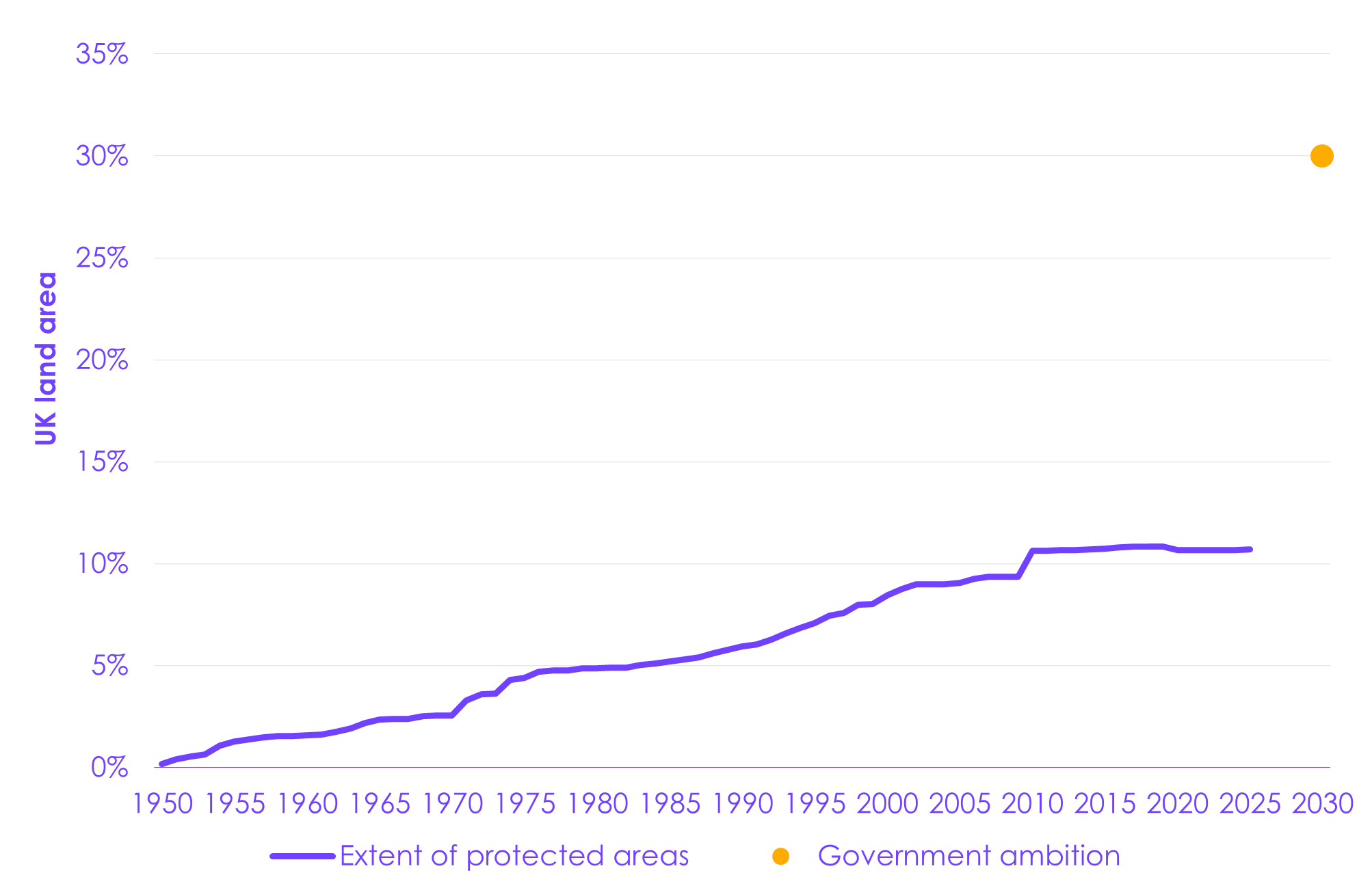 Description: The extent of protected areas on land and freshwater in the UK has increased since 1950 but has remained stable for at least the last 15 years. |
Increased habitat connectivity
Small and isolated populations created through habitat fragmentation are more vulnerable to species loss as the climate changes. Connecting habitats is critical to resilience as it supports larger and more genetically diverse species populations and allows species to move as the climate and local conditions change. A greater diversity of species and habitats increases resilience through spreading risk.
Proposed target: by 2050, habitat connectivity should be increased through the creation of a defined level of good quality ecological corridors.
- Meeting this target will increase the resilience of species and habitats in the UK through connecting habitats and helping to maintain wild species’ genetic diversity. More analysis is needed to determine the appropriate scale of ecological corridors for this target.
- National governments do not have existing quantified targets on connectivity or diversity. Targets that exist include those on species recovery (for example, in England to increase species abundance by at least 10% above 2030 levels by 2042) and commitments to create nature networks (for example, in Scotland and Wales). There is a target under the Global Biodiversity Framework to maintain genetic diversity within populations of wild and domesticated species by 2050, safeguarding their adaptive potential.
- Indicators on the abundance and distribution of priority species can be used as a proxy to help measure progress against this target (see Section 13.4). Data exists for some parts of the UK on the ability of species to move between habitats and on genetic diversity in wild species. Work is underway to improve indicators on connectivity and diversity in the future, for example in Scotland.
Domestic food production
The UK currently produces 60% (by value) of the food we consume. Climate change and extreme weather will cause this figure to fluctuate, and over time, without adaptation, this level may be more difficult to achieve. This target covers only domestic production. Targets on food price, availability and imports are covered in the food security system (see Chapter 15).
Proposed target: from now through to 2050, domestic food production as a share of food consumed should be sustainably maintained at 60% at least.
- Achieving this will ensure the UK meets food production targets (while maintaining per capita consumption levels) even under climate change. This target can, by proxy, help to show the uptake and effectiveness of adaptation actions on farmland and the long-term sustainability of production. This target must be met in a sustainable manner that does not degrade the land that food production relies upon, both now and in the future.
- The UK Food Strategy commits to keeping domestic food production at broadly the same level in the future.[1225] Consistent with our Seventh Carbon Budget advice, the 60% domestic food production target can be maintained whilst reducing greenhouse gas emissions. This could be achieved through crop yield improvements and a redistribution towards more (climate-resilient) crop production for human consumption, as the UK diet shifts to consuming lower carbon foods.
- Data on domestic food production rates can be used to measure progress against this target (Figure 13.3). However, this data cannot disentangle climate from other impacts on food production. Indicators on the uptake of adaptation actions on farmland and the health of the land can indicate the rate of adaptation and the sustainability of production (see Section 13.4).
| Figure 13.3 UK food production to supply ratio |
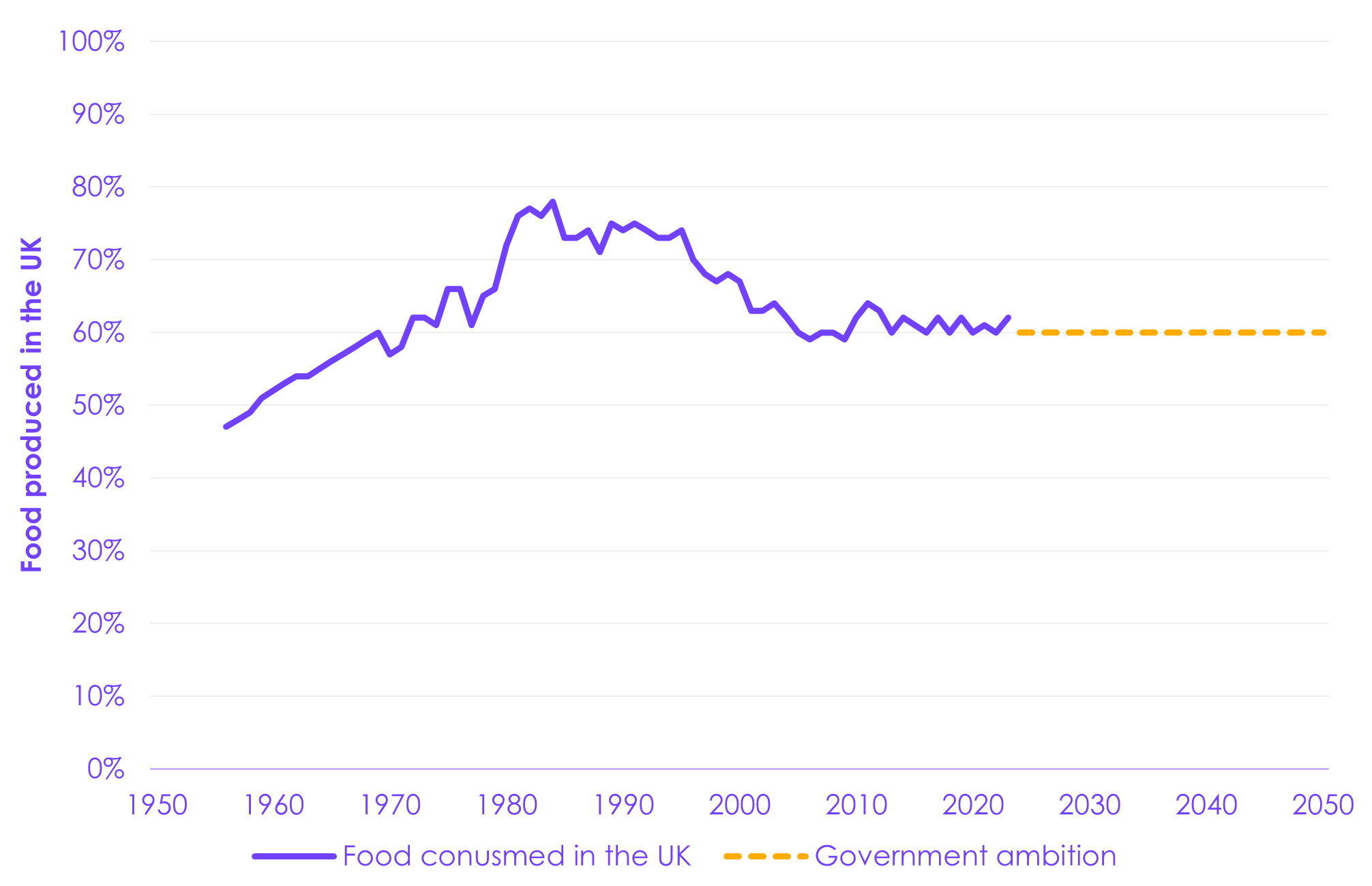 Description: Since the early 2000s, around 60% of the food consumed in the UK was produced in the UK. |
Resilient tree planting
Climate change will impact UK woodland and forestry and will require an increase in resilient practices to support the health of newly planted trees and maintain timber production. This means planting will need to include species that will thrive under expected climate conditions. There needs to be a diversity of species to avoid risks that arise from monocultures such as rapid spread of tree pests or diseases, or the spread of wildfire from more flammable species such as pine.
Proposed target: by 2030, all trees planted should be suitable for a future climate, and no more than 65% of an area of planting should be covered by a single species.
- Meeting these targets will increase the resilience of UK woodlands and timber production.
- Trees that are suitable for a future climate will vary depending on location in the UK, and local site conditions. The target on tree planting diversity will need to be reviewed after 2030 to ensure it remains appropriate under a future climate.
- There is current guidance from the UK Forestry Standard on species suitable for different conditions and climate (right tree, right place). Consistent with the UK Forestry Standard, trees planted should be suitable for the climate in the 2050s as a minimum, apart from short rotation forestry which operates at a timescale of 10 to 20 years. To maintain or establish a diverse forest composition, the UK Forestry Standard guidance states that no more than 65% of the area is allocated to a single species on one site. The Seventh Carbon Budget advice assumes that annual planting rates in the UK reaches 56,000 hectares by 2035 and that the mix of tree species planted, comprising both broadleaves and conifers, are suitable for the future climate. Based on these annual average planting rates, the cost of adapting new woodland planting in the UK is estimated to be £65 million per year to the 2040s.[1226]
- Data on tree planting rates and type, and on species diversity can be used to measure against this target (see Section 13.4).
13.2 Identify actions
The following section outlines the priority adaptation actions required to achieve the climate adaptation objective for land. These actions focus on reducing both acute and chronic climate risks to the land system. Actions will be implemented at a range of scales, from species or site-specific actions to a landscape scale.
Estimates of the investment needed for a well-adapted land system could be around £1 billion per year (range £0.7–£1.7 billion, 2025 prices).[1227]
13.2.1 Actions in the land system
As land type and climate risk are not uniform across the UK, these actions may have a different prioritisation in different parts of the country, and across different land-use types.
Cross-landscape actions
There are several actions that sit across the land system that are relevant for all land-use types.
- Increase diversity and connectivity: greater diversity of habitats and commercial activities on land at a genetic, species, site, and landscape scale will increase resilience through spreading risk and climate-driven losses. Increasing habitat connectivity will support species to move and adjust their range as the climate changes and will help maintain species diversity. These actions will support the target on habitat connectivity.
- Mixed farming (with crops and livestock) and a reduction in monocultures across a whole farm or landscape can reduce losses from climate and weather shocks. Although there can be costs associated with mixed farming in the short term through a reduction in average output, farmers are likely to have greater resilience through avoiding catastrophic losses in a single year. Research shows mixed farming can increase profitability in the long term (such as over 20 years).[1228] Increased diversity can improve habitat and food production resilience, for example, creating multi-species grasslands to increase resilience to drought.
- A mix of tree species, diversity, and age in woodlands and commercial forests will spread the risk from extreme events or pests, pathogens, and diseases as not all species will be impacted by the same climate risks, or to the same extent. Analysis across sites in Europe show that mixing beech and oak in forests can increase productivity in some sites by up to 30% compared to monocultures of trees.[1229] There are some trade-offs with planting a greater diversity of trees, such as increased up-front time and cost in planting and sourcing a diverse range of species.
- Nature networks on land and freshwater use corridors or stepping stones to connect habitats that have been fragmented, or between existing and new habitats. For example, joining up small and fragmented areas of woodland or wetlands across a landscape.
- Manage INNS, pests, pathogens, and diseases: biosecurity measures, such as cleaning equipment and responsible sourcing of plant and tree stocks from pest and disease-free areas, can reduce the introduction and spread of INNS. A greater diversity of species and habitats can also reduce the spread of INNS, pests, pathogens, and disease through a landscape. Monitoring and contingency planning are essential for understanding and tracking outbreaks of harmful INNS, pests, pathogens or diseases. However, eradication of risk once INNS, pests, and pathogens are established is often difficult and costly.
- Many harmful INNS, pests, pathogens, and diseases are driven by milder winters, warmer temperatures and increased humidity. The impacts of INNS are estimated to cost the UK more than £2.6 billion per year (2025 prices) and are expected to increase in the future.[1230]
- The increase in parasite outbreak (Haemonchus contortus) in lambs due to higher temperatures is projected to affect between 61% and 66% of lambs in the UK, depending on the nation, by 2050.[1231] Adaptation responses to reduce this risk include vaccination and moving livestock away from areas prone to disease risk.
- Wildfire management: actions to prepare for and reduce the occurrence and spread of wildfire are increasingly important, as this risk increases in the UK from a combination of high temperatures and a decrease in soil moisture.
- Wildfires can be managed or contained through management of fuel loads, fire breaks, rewetting of peat or creation of ponds. Rewetting peat has been shown to be an effective wildfire break in the Tywi Forest in Wales in 2025.[1232]
- Early warning systems and education can help prevent wildfires or their spread. For example, fire contingency plans, wildfire risk mapping, and danger rating systems. The response to wildfires is very different to urban or household fires, making it critical that the fire service is trained and adequately equipped to tackle wildfires. Wildfire management needs to be built into other land management actions such as woodland planting or habitat creation.
- Wildfire management plans in the UK for peatland and woodland could cost an estimated £38 million a year up to the 2040s.[1233]
| Figure 13.4 Number of wildfires above 30 hectares |
 Description: After a low wildfire year in 2024, the number of large wildfires peaked in 2025, with 181 recorded in the UK. |
Farmland
Farmland covers semi-natural habitats such as meadows, hedgerows, and grasslands. This also covers the commercial and land-use elements of farmland, such as soil condition, water use, livestock health, and agricultural outputs (food and fibre).
Actions for farmland can be split broadly into categories that improve the resilience of the land and the habitats that rely upon it, as well as those that maintain food production or yields. There is a high degree of overlap between the two, particularly in the long term.[1234]
- Uptake of resilient soil and water management practices: soil and water are the basis for food production on farmland. Soils in good condition (for example, with good structure and organic matter content) are more able to buffer against drought and are less susceptible to erosion from heavy rainfall. Resilient water management such as on-farm water storage reservoirs and rainwater harvesting can increase resilience in dry periods or drought.
- Relatively low cost and effective actions to reduce water demand in agriculture include irrigating crops at night, switching to drought resistant crop varieties, and using precision irrigation (see Chapter 8).[1235]
- Soil degradation through compaction, erosion, and loss of soil organic matter costs around £1.6 billion a year (2025 prices) in England and Wales.[1236] Examples of actions to support soil resilience include reducing tillage, adding organic matter, increasing plant diversity, and using cover crops on bare soil. It is estimated that £440 million (2025 prices) additional investment per year (from 2022 to 2032) is needed to transition to more sustainable soil management in the UK.[1237]
- Change type or timing of farm practices: farm planning needs to be responsive to the weather and longer-term changes in climate. This may include changing the timing or location of farm activities such as harvesting, moving livestock, or moving current agricultural production to more climatically suitable areas. Climate will also require a shift to growing different crops to better suit a future climate in some parts of the UK. Warmer temperatures in the UK could be suitable for produce such as oranges, chickpeas, and soybeans, particularly in the south of the country.[1238]
- Technology and precision farming: there is a role for technology to increase farm resilience, especially in housed farming systems. Precision farming – where technology such as sensors or mapping is used to target inputs – can result in more efficient water and nutrient use. For example, precision irrigation has been shown to boost crop yields. Genetic selection of crops or livestock which are more suitable for a future climate can reduce risk and improve yields under climate. For example, the development of drought or heat-resistant wheat varieties.
- Increase on-farm biodiversity to support nature to adapt: natural and semi-natural habitats such as hedgerows, field margins, and planting trees on farmland can increase the size, connectivity, and diversity of farmland habitats. These habitats can also enhance farming systems. For example, through supporting pollination, pest control, water filtration, providing shade or shelter, and reducing soil erosion.
- Agroecology, which considers ecological principles in farming, requires less inputs than conventional farming, lowering the cost and potentially boosting crop yield. However, farmers may need to be incentivised as the cost of creating the habitats and the loss of some productive land on which to create them affects the short-term profitability of these systems.[1239]
- Nature-based adaptation actions, such as planting trees for shade, can reduce risk of heat to crops and livestock by 35% over 50 years, but benefit-cost ratios are driven by wider ecosystem services such as carbon sequestration (Box 13.3).[1240]
|
Box 13.3 |
| This research aimed to improve understanding of heat-related climate risk to farmed landscapes across the UK, and how adaptation options could reduce this risk whilst supporting agricultural productivity, nature, and providing wider ecosystem benefits.[1241] This analysis focused specifically on heat risks to six key agricultural components (wheat, barley, oats, dairy cattle, free range hens, and lambs) for which measurable impacts caused by defined heat thresholds were identified in the literature. Together, these components account for approximately 50% of income from UK farming. Understanding the risk Heat stress is already causing economic losses of £205 million (2025 prices) annually across the six components covered by this research. This is particularly driven by losses from wheat and barley. Modelled losses to milk and egg production are currently limited overall, although recent losses from livestock were recorded in the 2025 heatwave. Projected losses across all the agricultural components analysed show significant variation across the UK under a central climate scenario. Modelled results indicate that expected annual losses could increase from present-day levels by 34% by the 2050s, this is valued at £275 million (2025 prices) annually. In a high impact scenario, the maximum average annual loss for wheat in England in 2050 is almost four times higher than in the present day, and losses of barley peak in 2050 at over three and a half times higher than the present day. The greatest agricultural losses occur in England, particularly the southeast, due to higher temperatures and distribution of wheat, oat, and barley production. Impact on lamb production is higher in Wales and Scotland due to higher density of sheep farming in this area. Losses from high temperatures are greatest for wheat, and in the east of England, expanding geographically to the midlands and southeast by the 2050s. Losses to wheat in England are projected to roughly double by the 2050s under the central scenario to £92 million (2025 prices) annually. Whilst the average annual losses fall within the current yearly variation (in-year average) for the modelled agricultural components, in individual ‘bad’ years, annual losses could be severe at both farm and national scales in extreme climate events. At a UK scale, economic losses from a modelled ‘extreme year’ (from a high climate and business-as-usual agriculture scenario) could be £2.3 billion in the 2030s and £1.9 billion in the 2050s (2025 prices). A range of different adaptation interventions for these risks were assessed. The most effective adaptation actions to address heat risks to the modelled agricultural components were increasing the diversity of cultivars and increasing soil water holding capacity. For livestock, effective measures for adaptation were those that were also recommended for good practice, such as vaccinating livestock against disease, and moving livestock from disease prone areas. The modelling showed there can be significant co-benefits from wider ecosystem services such as soil improvement, carbon storage, and biodiversity for many adaptation actions. This is particularly true for alley cropping for cereals, planting trees for hens, and soil water holding measures for cereals. Most measures could be deployed relatively rapidly, but other actions (for example, agroforestry or silvopasture measures) require longer lead times until they become effective. The analysis identified key areas of research needed to undertake a fuller analysis on this topic in the future. This includes a full assessment of the direct benefits and costs across the sector, which requires more evidence on climate risk thresholds relevant to UK farming or nature within farmed landscapes. More information is also needed on the effectiveness of adaptation measures in addressing specific climate risks, and on the cost of adaptation measures. |
Uplands
Upland ecosystems include mountains, blanket bog, and heathland. Mountains and more northerly distributed habitats in the UK have a high sensitivity to climate change as there is a limit to the extent species and habitats can change their range northwards or upwards.[1242] Climate change will likely change some features of upland landscapes in the UK.
- Rewet blanket bog and peatlands: blocking drainage to keep water tables high in upland bog and peatlands will help protect these habitats from climate risks such as high temperatures and drought. These actions also help to safeguard the important ecosystem services these habitats provide, such as carbon sequestration and natural flood management. The Seventh Carbon Budget advised that 79% of the area of upland peatland in the UK is under restoration by 2050. The cost of peatland restoration in the UK in the uplands that is attributed to adaptation is estimated to be £13 million a year up to the 2040s.[1243]
- Minimise soil erosion: heavy rainfall can cause erosion of soil, especially on bare slopes. As well as loss of soil, erosion can pollute watercourses and damage freshwater habitats. Actions can be taken to reduce this risk such as re-vegetation of bare soil.
- Assisted movement of species: upland species are particularly vulnerable to climate change as cool-adapted species will eventually run out of space to shift their range north and uphill as the climate warms. Manually moving species to different locations where they could thrive in the future can tackle this risk. Permissions are required for such species movements, requiring an assessment of the effect on the area species are being moved to. For this reason, this action has not been currently undertaken at scale in the UK other than for commercial forestry. The rate of climate change and impact on species may require more assisted range shifts in the future.[1244]
Woodland
Woodland covers natural and semi-natural woodland habitats and commercial forestry. The natural and commercial elements of the woodland system do not always directly overlap. However, some plantations and commercial forests are managed in a way that supports woodland ecosystems, meaning there are many cross-cutting actions and potential for co-benefits through adaptation. These actions will support the target on resilient tree planting.
- Species and site selection for future climate: principles such as ‘the right tree in the right place’ consider tree species selection based on future climate conditions. Considering these future conditions in different parts of the country is particularly important for woodland as trees take decades to mature and can live for hundreds of years. Actions include consideration of species or seed provenance to better suit future conditions in the UK, for example, drought or disease resistance or heat tolerant species.
- Research by Forestry England has identified a core list of ‘species for the future’ which have the best chance to thrive in England’s future climate. These include species such as redwood, field maple, and Macedonian pine.[1245]
- Natural regeneration of woodland: allowing woodlands to expand naturally from local seed sources can help species adjust to local climate conditions. Such natural regeneration can be more resilient to wind and drought risk through the trees having deeper roots than planted trees, and through creating greater genetic diversity.[1246];[1247] Risk from INNS, pests, and disease can be reduced as plants are not brought into an area from elsewhere. Natural regeneration will have lower costs than tree planting but may still require forest management to maintain resilience, and any tree harvesting will likely be more expensive.
- Resilient woodland practices: woodland and forestry management practices can be adjusted to respond to weather and climate. For example, changing rotation or practices to reduce losses of planted trees during drought or storms, or woodland design and management to reduce the spread of wildfire. The UK Forestry Standard sets out the foundation for sustainable forestry in the UK, and the latest edition focuses on resilience to climate and increased pests and diseases.[1248]
Freshwater
Freshwater ecosystems include rivers, lakes, wetlands, and fenlands, and commercial activity in freshwater via freshwater fishing. Climate risks could lead to altered freshwater habitats and potentially the loss of these habitats. Adaptation actions focus on maintaining water levels for healthy habitats and tackling increasing water temperatures.
- Catchment-scale management of water levels: freshwater habitats are dependent on good water quality and natural flow. Climate change and human-induced pressures can exacerbate these pressures, resulting in increased pollution levels, low flows, and algal blooms. Holistic management of water across a catchment is needed to tackle pressures from too much or too little water. This could include using wetlands, peat, or soil management to keep water in the catchment and recharge groundwater. This management needs to be based on future and not historical water conditions.
- Regulation of water use considers the levels of abstraction in water bodies that is required to support a healthy water environment now and in the future.
- Riparian shading to reduce water temperatures: river water temperatures are expected to rise in summer months by 0.6°C each decade in England. By 2080, these increased river temperatures are expected to threaten populations of brown trout and salmon.[1249] Shading riverbanks by planting trees can reduce river water temperatures by 2°C –3°C.[1250] Therefore, shading can provide climate refugia for species as water temperatures rise. Riparian planting and wetland vegetation also has the benefit of reducing erosion and pollution entering freshwater.
- Research in Southern England found that shading just 20–40% of a waterbody was effective in keeping temperatures below the threshold suitable for brown trout, but recognised higher levels of shade would be needed as the climate warms.[1251]
Coastal margins
Coastal margins include coastal habitats such as saltmarsh, mudflats, sand dunes, machair, rocky foreshores, and estuaries. These natural ecosystems are important sea defences as they take the energy out of waves, for carbon sequestration, as well as for a range of other ecosystem services. Adaptation actions need to recognise that the coast is a changing environment and will need to be managed as such. This may involve allowing or facilitating a habitat to change to a different state.
- Create new coastal habitats: this will offset habitat that is lost through coastal squeeze – where habitats such as saltmarshes are prevented from moving inland as sea level rises due to hard structures such as coastal flood defences or buildings. It can also be effective as part of wider flood risk and coastal change management (see Chapter 5).
- In Medmerry, Sussex, 183 hectares of new intertidal habitat was created to manage flood risk and create new habitat to offset coastal squeeze. The project cost £38 million but direct economic benefits of £120 million are expected from the scheme, for example, through increased flood protection, reduced coastal defence maintenance, and amenity value through tourism (2025 prices).[1252]
13.3 Enable delivery
This section sets out key enablers and policies to deliver the adaptation actions at the required scale and urgency for a well-adapted land system.
13.3.1 Enablers
Collaboration at a landscape level is an essential enabler to scale up adaptation action and achieve adaptation outcomes. This includes catchment or landscape approaches to water use, landscape-scale funding (for example through landscape recovery funds in agri-environment schemes), and sharing knowledge and skills across landscapes (for example, through catchment-based approaches or farm clusters).
Many of the actions highlighted in the previous section will be delivered by national governments and government agencies, and by private landowners, including farmers (Table 13.2). Enablers cut across all elements of the land system but will likely have different levels of importance for each habitat type.
- Reduce non-climate pressures on habitats: climate vulnerability analysis shows that degraded habitats are more sensitive to climate change.[1253] A natural environment in good condition with reduced pressures such as pollution, is less vulnerable and therefore more resilient. A healthy natural environment also has more abundant and diverse species mixes making it more resilient to climate impacts. This enabler will support adaptations across all habitat types and in all parts of the UK. Environmental protection, designation, and its regulation are essential to support good ecological condition on land.
- Resources: funding is required to deliver many of the adaptation actions. Such funding is often needed up-front with a lag before benefits are seen, and benefits are often dispersed across different locations or actors. Funding that is targeted or designed for multiple benefits can address multiple climate risks and often provide benefits beyond adaptation.
- Data and monitoring processes: monitoring can be used to understand where risk or vulnerability is highest, and to target adaptation actions spatially and for greatest impact. Monitoring is also essential to inform adaptive management of the land system and its components, for example, understanding thresholds of impact or timings of change. This enabler will support all actions that require an understanding of risk, impacts, vulnerability, and effectiveness of adaptation actions. Actions to adapt land are very specific to a location or geography, so data must be available at an appropriate scale.
- Monitoring data may also include weather forecasting and early warning systems for commercial activities to inform business planning such as the timing of farming or forestry activities, and changes to risk such as monitoring disease or wildfire risk.
- Engagement, awareness, and support: sharing knowledge and skills is needed to support the buy-in and roll-out of adaptation actions and change from current business as usual to address climate risks. This is particularly true for areas where change may be seen to impact cultural ties to a landscape, or ways of working such as traditional farming methods.
- Public or cultural acceptance of change may be needed for more transformative changes in the land system, for example, landscape change in national parks. Once they understood the impacts of climate change on nature, members of the Climate Change Committee’s (CCC) citizens’ panel on adaptation accepted, in a pragmatic way, that some changes to nature are unavoidable (Box 13.2).
- Sharing knowledge and skills at a landscape scale can help drive the uptake of adaptation actions and support integrated adaptation. Farm clusters are a good example of where groups of farmers in a locality can come together to tackle climate risk at a scale bigger than an individual farm.
13.3.2 Policies and plans
The key policy areas for adaptation planning within the land system are devolved. These include environmental protection, agriculture, and planning. For adaptation delivery, economic incentives, governance, and regulation are important across all nations.
Existing policy action
Existing policy action is delivered by government departments with an environmental, agriculture, and rural remit and associated government agencies and arms-length bodies (ALBs). Policies for nature, farming, and forestry are fully devolved.
- The UK Government is responsible for international commitments such as the Global Biodiversity Framework, but implementation is devolved.
- Governments in England, Northern Ireland, Scotland, and Wales set environmental and agriculture legislation and the frameworks and strategies to meet these. Each government undertakes strategic planning and sets targets to deliver against commitments. For example, through environmental plans and strategies, land-use planning and land-use frameworks, biodiversity strategies or agricultural reform. Government agencies and ALBs can deliver environmental protection and regulation, including protected site designation and water regulation.
- Governments in England, Northern Ireland, Scotland, and Wales, and their agencies or ALBs allocate and implement funding for example, through the Nature for Climate Fund and agri-environment payments.
Policy actions for a well-adapted system
Key levers for adaptation include economic incentives to deliver adaptation actions and joined-up land-use planning that can better account for competing demands and complex interactions on land. Regulation needs to be designed to better account for changing climate risk and to protect species and habitats into the future.
- Public funding to support adaptation actions. Public funding is key to delivering adaptation actions in this system and should be targeted to address the biggest climate risks in different parts of the country. Government directly funds some activities such as nature restoration and protection. Public subsidies currently pay for a range of adaptation actions, for example, farm payments for ecosystem services. This funding needs to be better used to drive adaptation. For example, farming subsidies can be better aligned to fund actions that support farmers to adapt to different climate risks in different parts of the country.
- Coherent, joined-up land use frameworks. These can drive integrated adaptation across landscapes, bring land users together and scale up action to adapt. Such landscape-scale strategies need to be aligned with plans for future farming and food production, as well as meeting nature restoration and other government targets under climate change. They must be forward-thinking, planning for the landscapes, farming, and forestry we will need in the future under climate change, and not just maintaining what we have now.
- National parks and national landscapes cover up to 25% of UK nations, and include interests on nature, farming, forestry, and cultural heritage. This makes them important for delivering joined-up adaptation actions at scale. Adaptation needs to be embedded into all planning, delivery, and monitoring across these designated landscapes.
- As adaptation on land is different across parts of the UK and for different land-use types, priorities for adaptation will need to be considered at an appropriate spatial scale. As well as national strategies, local strategies such as Local Nature Recovery Strategies (LNRS) can deliver adaptation actions such as nature connectivity through the planning system across a local authority. River Basin Planning can target adaptation actions to different river catchments.
- Regulation which accommodates adaptation. This includes future-proofing protected sites and landscapes. A wide range of regulatory activity is covered under the land system including for agriculture, forestry, water, and habitats. For example, habitat regulations and legislation are important tools to protect sites of environmental importance through designation, as well as the ongoing management, assessment, and enforcement of activity in these areas. Protected site designation and regulation are based on current or past baselines, which is increasingly difficult (and at times no longer possible) to achieve as these sites change in response to climate change.
- Protected sites and landscapes need management plans that protect nature in a way that enables habitats and species most appropriate for the future climate, as opposed to the current or past, to thrive. This could involve changes to species protected or facilitating habitats to enter a different natural state. Work is already underway for some Sites of Special Scientific Interest (SSSIs) and protected landscapes to consider how these can be managed adaptively in response to climate change. This may require changes to legislation, site designations or boundaries, or different management approaches in the future.
| Table 13.2 Responsibilities for delivering adaptation across the land system |
|
| UK Government |
|
| National governments |
|
| Government agencies |
|
| Local authorities |
|
| Private sector |
|
| Public and civil society |
|
| Notes: National governments includes the role of the UK Government in England; and in Scotland, Wales or Northern Ireland where powers sit with the UK Government for that nation but are devolved to other nations. | |
13.4 Evaluate progress
Effective adaptation requires monitoring and evaluation to assess whether delivery towards objectives and targets are contributing to reducing risk. This section sets out the current capability to track progress against the proposed targets in the land system, and priority gaps for monitoring and evaluation.
13.4.1 Tracking progress on adaptation
In the land system, although there is a relatively good understanding of climate risks, there is a poor understanding of how these risks join up, flow through the natural environment, or play out at a local level. There is very little monitoring on the impact of risks or the effectiveness of actions in reducing them. We currently have limited capability to directly monitor objective-level progress against the proposed targets and will often need to rely on proxies for monitoring purposes.[1254]
- Landscape health and condition under climate change: indicators exist to measure the size and health of protected terrestrial and freshwater habitats, such as the extent of protected habitats in favourable or recovering condition. However, there are no indicators to assess how this health is impacted by climate risk, the effectiveness of adaptation actions, or the extent of action needed to address this.
- Increased habitat connectivity: there is currently no UK-wide indicator available to measure connectivity of habitats or wild species diversity.
- Domestic food production: indicators are currently available to measure UK food production, but we cannot measure the direct impact of climate on this production over time. Some data exists to track climate risk to land, for example, rate of soil loss or loss of good quality agricultural land. Some data exists on the uptake of actions that could support adaptation by farmers through agri-environment schemes or to improve the health of the land such as soil health. However, these data do not show the effectiveness of these actions in reducing climate risk.
- Resilient tree planting: data currently exists on tree planting type and diversity. UK-wide data does not currently exist to measure the rate of trees planted suitable for a future climate.
There are several action, enabler, or risk indicators which can be used as proxies to help assess adaptation progress for the land system. For example, seabird or farm bird populations, agricultural water abstractions, number of low river flow incidents and the number of wildfires.
13.4.2 Addressing monitoring and evaluation gaps
There are several priority gaps to monitor and evaluate whether adaptation is achieving the objective and targets for land. We have identified the following gaps and opportunities to address them.
- Information on climate-driven changes to land. This can feed into adaptive management practices and direct adaptation efforts. There is currently poor data to understand where a natural, semi-natural or agricultural environment is transformed by climate risk or needs to be managed differently. For example, climate impacts on protected sites or features, or changes to coastal habitats and rates of coastal squeeze across the UK.[1255] Indicators are in development to monitor soil health, for example in Northern Ireland, but these cannot currently assess climate risks to soils across the UK (see Table 13.1). Such data are often costly to collect and needs to be collected consistently over time to see trends. This information is key for adaptive management of landscapes and understanding which adaptation options to implement and when.
- Information on the effectiveness of adaptation actions on land. Further research is needed to track the uptake or effectiveness of adaptation actions in the natural environment. This includes data on the uptake of actions to track against targets on habitat diversity and connectivity at a UK scale, or on the effectiveness of actions to adapt farmland.
- Forecasting climate risk into the future. Most monitoring and evaluation focusses on the current condition or function of landscapes against a past baseline and can only be used as a proxy to understand climate risk and adaptation. More indicators are needed that are specific to adaptation and can track change over time.
Chapter 14: Sea
Introduction and key messages
This chapter covers climate adaptation for marine habitats and marine fisheries, and aquaculture within UK waters. It does not cover Crown Dependencies or overseas waters.
Our key messages are:
- The seas are already changing due to climate change and will continue to do so. There are limited adaptation actions to prevent change, as impacts are predominantly driven by ocean temperature and chemistry. The marine environment is already in a poor state, which will make adaptation harder. It will be increasingly important to improve resilience through removing non-climate pressures such as marine pollution or unsustainable fishing practices.
- Fisheries and aquaculture industries can adapt their practices in response to climate change. This will require changes to what we fish in the UK. We are already seeing a shift in species’ geographical ranges in UK waters, which will continue as the climate changes. Adaptation in the fishing industry more broadly will generally involve diversification of farmed and caught fish stocks and species.
- Marine protections today are not set up for the future. Changes are needed to current marine management to respond to climate change. This may involve creating forward looking management plans that account for changing species, changing conservation focus or setting up protections with boundaries that can change in response to climate impacts.
Adaptation overview
This chapter sets out the ambition for a well-adapted sea system and the actions, enablers, and policies required to deliver it. Figure 14.1 provides a summary of this in a monitoring map – a more detailed version of this figure is available in the Climate Change Committee’s Adaptation Monitoring Framework.
Adaptation in the sea system is connected to other systems considered in this report. Adaptation required in coastal margins are an important interface between marine and terrestrial environments (see Chapter 13). Adaptation of the fisheries and aquaculture sector is connected to international trade and supply chains because the UK imports much of the fish we eat and exports much of what is caught or produced in UK waters (see Chapter 15). Warmer waters in seas increases the prevalence of shellfish pathogens (such as Vibrio bacteria) which can impact human health (see Chapter 4).
| Figure 14.1 Monitoring map for the sea system |
 Notes: a more detailed, interactive version of this figure is available in the Climate Change Committee’s Adaptation Monitoring Framework. |
14.1 Set ambition
This section sets out the necessary ambition for adapting to the risks from climate change in the sea system.
14.1.1 Climate risks to the sea system
The sea system covers climate risks and opportunities identified in Chapter 5 of the CCRA4-IA Technical Report, across England, Northern Ireland, Scotland, and Wales (Table 14.1).[1256]
Marine ecosystems globally are estimated to hold between 50–80% of life on earth and are home to a huge number of plants and animals, including migratory species. They provide critical ecosystem services such as food provision, climate regulation, heat circulation, oxygen production, and carbon sequestration. The sea also supports culture, tourism, and recreation. Marine habitats in the UK are currently in a poor state, despite existing regulation and protection.[1257]
The sea is impacted by a range of climate impacts including increasing sea surface temperature and marine heatwaves, ocean acidification, and changes to ocean currents and salinity.[1258] These changes are already happening and are leading to stress on current ecosystems and shifting species types and locations. This has subsequent impacts on offshore fisheries operations and aquaculture.
- The marine environment is on the front line of climate impacts. Marine species are extending their distributions northwards by around 72 km per decade on average, much faster than rates for terrestrial species (at an average of 17 km a decade).[1259]
- The frequency of marine heatwaves has approximately doubled since the 1980s.[1260] In the summer of 2025, waters in the south of the UK reached 1.5°C–3°C above the 1982 to 2012 average.[1261] The UK seas had their warmest start to the year in 2025 since records began, changing the types and abundance of species seen in UK waters, including octopus, squid, bluefin tuna, and mauve stinger jellyfish.
- Warmer temperatures and ocean acidification are changing the abundance, distribution, and seasonal timing of plankton production. Research shows plankton biomass generally decreases as waters warm, which has consequences for whole marine ecosystems as plankton are the basis of the marine food web.[1262]
Without additional adaptation, under a 2°C global warming level in 2050:
- UK waters could experience marine heatwave conditions, relative to today’s climate (2000 to 2019 baseline), for 66% of the year.[1263]
- A continued northward shift in the geographical distribution of plankton production from warming seas will impact UK fish, marine mammal, and seabird populations. This could lead to a mismatch in timing of predator and prey relationships. UK seabirds such as puffins, fulmars, and arctic terns are expected to decline by more than 70% when projecting links between species abundance and climate factors such as air temperature, precipitation, and sea surface temperature.[1264]
- More mobile aquatic species may be less impacted by climate, whereas species attached to the seabed are more vulnerable. For example, around 85% of cold-water corals in the North Atlantic are expected to be exposed to acidic waters (by the 2060s).[1265] Marine species tied to breeding grounds or specific conditions for breeding, such as the humpback whale or grey seal, are more likely to be impacted by changes to ocean temperature, impacting habitat suitability and breeding success.[1266]
- Warming UK seas will support the spread of some commercially valuable species while negatively impacting others. Warmer conditions in UK waters could become favourable for warm-water species such as sardines and seabass.[1267] Climate projections show a 15–20% decrease in cold-water species biomass (in southern UK waters) and a potential increase of 5–10% of warm-water species biomass (in northern UK waters).[1268]
- Over time, marine animal biomass is expected to decline, and fish will become smaller as sea waters warm.[1269];[1270] The productivity and biomass of 18 key commercial fish species are projected to decline within European waters by at least 15%. However, the changes are not uniform.[1271]
- Losses in revenue of £123 million (2025 prices) across the UK are estimated from a reduction in the biomass of fish and shellfish.[1272] Losses in total employment in fisheries and associated industries could reach 20%, with larger vessels (more than 10 metres) and associated industries bearing most of these.[1273]
- For aquaculture, warming conditions will lead to a rise in disease outbreaks including sea lice, fish diseases, and shellfish pathogens, with subsequent increased mortality.[1274]
Under a high-end scenario, on track for around 4°C global warming level by 2100, without additional adaptation:
- UK sea surface temperature is expected to increase by 3°C and UK waters could experience marine heatwave conditions relative to today’s climate (2000 to 2019 baseline) for 93% of the year.[1275]
- The productivity and biomass of 18 key commercial fish species is estimated to decline by over 40%.[1276]
- Increasing ocean acidity will impact shellfish aquaculture with a predicted reduction of 25% and 10% in shell growth for mussels and oysters respectively.[1277] Total losses to the UK economy from shellfish production and consumption could be between £29–£111 million (2025 prices).[1278]
| Table 14.1 Climate risks and opportunities to the sea |
|||||
| Risk or opportunity | England | Northern Ireland | Scotland | Wales | Overall |
| N3: Risks to marine ecosystems | More action needed | More action needed | More action needed | More action needed | |
| More action needed | |||||
| N5: Risks to natural carbon stores and sequestration | More action needed | More action needed | More action needed | More action needed | |
| More action needed | |||||
| N7: Risks to fisheries and aquaculture | More action needed | More action needed | More action needed | More action needed | |
| More action needed | |||||
| N9: Opportunities for agriculture, forestry, fisheries, and aquaculture | Further investigation | Further investigation | Further investigation | Further investigation | |
| Further investigation | |||||
| Source: Bullock, J. M. et al (2026) Land, Nature, and Food In: CCRA4-IA Technical Report. | |||||
14.1.2 Objective for a well-adapted sea system
Objective: seas are healthy and diverse, with climate-responsive management practices for habitats and fisheries under the current and future climate.
Achieving this objective will result in marine habitats in good condition, with larger and more diverse habitats, and more species diversity. Better connection between habitats allows species to move, reducing their vulnerability to climate impacts. Fisheries practices and marine protection will be suited to species, habitat types, and species distributions in the UK under climate change.
- A healthy marine environment is measured through its condition (or environmental status). Being in good condition means the environment is ecologically diverse and dynamic, clean and productive, and the use of the marine environment is at a level that is sustainable. Protected species or habitats in Marine Protected Areas (MPAs) are healthy when they are assessed to be in favourable condition.
To deliver on this objective, we suggest national-level targets on the health of marine ecosystems and the continued sustainability of fish stocks under climate change are required. These are key areas for targets in national-level adaptation programmes. National governments may choose to propose alternative targets where they have different priorities, trade-offs to consider, or further evidence (Box 3.11).
Health of marine ecosystems under climate change
The marine environment is already in a poor state and current targets on marine habitat condition will be harder to achieve under climate change. The latest OSPAR assessment (the Convention for the Protection of the Marine Environment of the North-East Atlantic) concludes that although some pressures to marine ecosystems, such as pollution, are reducing, the health of marine ecosystems is still declining – with human pressure and climate change driving this.[1279]
Proposed target: by 2030, marine protected areas should have adaptation management plans in place, and by 2050, should be in favourable condition.[1280]
- Meeting this target will ensure MPAs are healthy under current and future climate conditions. This is likely to require changes to marine management to better respond to climate change.
- All UK nations have signed up to the target under the Global Biodiversity Framework to protect and effectively manage at least 30% of the world’s land and sea for nature by 2030 to halt biodiversity loss. Analysis suggests increasing the proportion of protected and well-managed sea in the UK could require an additional investment of £60 million a year between 2022 and 2032 (2025 prices).[1281]
- The current coverage of marine designations at sea in the UK is 38%.[1282] In England, the statutory Environment Act target is for at least 70% of protected features in MPAs to be in favourable condition by 2042. In 2022, it was estimated that 44% of designated features in English MPAs were in favourable condition.[1283] In Northern Ireland, 87% of marine habitat features were in favourable condition in 2024.[1284]
- Management of marine habitats can pose a direct trade-off with some wild capture fisheries. Increased marine protection can reduce the area of the sea which can be fished (for example, in Highly Protected Marine Areas in England).
- Progress against this target could be measured by tracking indicators on the effective management and condition of features in MPAs, as well as data on the number of adaptation plans for protected areas (see Section 14.4).
Fish stocks sustainable under climate change
Climate change is altering the size, distribution, and type of fish stocks in UK waters. Fisheries practices need to ensure stocks are sustainable under a future climate – balancing the amount and type of fish caught and left to breed in the sea. Forward-looking and sustainable practices will ensure fish stocks are maintained under future climate conditions, whilst protecting the habitats these species rely on.
Proposed target: by 2050, commercial fish stocks should be sustainable under 2°C of global warming.
- Sustainable stocks are defined as those where fishing levels are low enough to maintain a stable population under climate change. Latest data shows 53% of assessed UK fish stocks met this criterion in 2021.[1285]
- As climate change impacts the size and distribution of fish and puts pressure on marine habitats, sustainable fish stocks under a 2°C warming scenario may mean a reduction in some catches from the present day (in the short term at least), as well as a change to what is caught. Building adaptation into flexible management of fishing licences and quotas will allow the fishing industry to exploit opportunities provided by new species.
- Progress against this target could be measured by tracking the environmental status of commercial fish stocks, or the proportion of fish stocks sustainably managed (see Section 14.4).
14.2 Identify actions
The following section sets out the priority adaptation actions required to achieve the climate adaptation objectives for the sea. These actions focus on measures for marine habitats and fishing practices, as the areas facing most significant climate risk.
14.2.1 Actions in the sea system
Adaptation actions for the marine environment include actions to protect and restore marine habitats and to develop climate-resilient fisheries and aquaculture operations and practices. There is significant overlap across these two categories of actions, including co-benefits and trade-offs. The UK seafood industry relies heavily on wild capture in the UK, meaning this activity is directly linked to the health of marine habitats.
A marine habitat with reduced external (non-climate) pressures, such as pollution and disturbance, will be healthier and therefore more resilient to climate impacts, with more abundant populations and more diverse species mixes. There are also benefits for blue carbon – the carbon stored and sequestered in marine habitats. A reduction in non-climate pressures on marine ecosystems is a key enabler for good adaptation (see Section 14.3).
Marine habitats
Measures to address climate risks to marine habitats focus on preparing for and responding to climate change through increasing the size of protected habitats, increasing the join-up between habitats (connectivity), and increasing habitat diversity.
- Create larger, more connected, protected habitats: to increase resilience and allow species to move as the climate changes. This action will help deliver against the target on the health of marine ecosystems under climate change.
- Creating larger, more joined up and diverse marine habitats will generally be achieved through protection and designation. Areas currently under marine protection show an increase in spawning stocks, an increasing size of individuals, population size, enhanced biodiversity, and ecosystem structural complexity.[1286] The direct benefits from protection can spill out into surrounding marine environments.
- Studies estimate the value of marine protection can outweigh the cost of preservation.[1287] For example, analysis on reducing or ending sand eel fishing in the North Sea found a 6–27% increase in fish, seabird, and mammal populations. While the number of commercial fish landings decreases, the value of landings increases due to the presence of higher value fish.[1288]
- As well as managing overfishing and allowing species to recover, protected areas can be designed to facilitate connectivity and create safe areas for vulnerable species as the climate changes. Connectivity may need to cross national boundaries and requires international cooperation outside UK waters.[1289] Research shows that climate change impacts, including marine heatwaves, are projected to decrease ecological connectivity by 50%, impacting the movement of vulnerable species.[1290]
- Current marine protection in the UK protects existing ecosystems or specific habitats or species. These fixed protections, based on current conditions, may need to change or evolve as climate alters the marine environment. Marine protection must consider future climate conditions and be flexible and responsive to climate change.
Marine fisheries and aquaculture practices
The way in which fisheries operations and practices are undertaken can be changed to be more resilient to climate change. This will include the diversification of the fishing and aquaculture industry in response to changing marine conditions. These actions will help deliver against the target on sustainable fish stocks under a future climate.
- Diversify the range of fish caught or farmed: the industry must adapt to changing species in UK waters and changing conditions. Cold water species such as cod and haddock will decline in UK waters as their distributions move northwards. UK waters will see an increase in fish requiring warmer waters which could create new opportunities and markets. Fishing different species may require a shift in markets and changes to fishing practices or locations, licensing, or quotas.
- Increasing the genetic diversity of managed fish stocks and aquaculture, through different species, managing genetic diversity (using DNA techniques), or selective breeding, can increase the resilience of stocks and the wider fish population. More diverse stocks can reduce vulnerability to climate impacts, for example by making disease less likely to spread.[1291] There is currently low species diversity in UK aquaculture – 97% of the stock value is attributable to salmon production.[1292]
- There may be opportunities due to more valuable fish species occurring in UK waters. For example, tonnage of tuna landed by UK vessels in 2023 increased by 885% on the previous year, with a value of almost £10,200 a tonne (2025 prices).[1293] In comparison, the price per tonne (in 2024) from Scottish vessels was £3,329 for cod and £1,129 for haddock (2025 prices).[1294]
- Make fisheries and aquaculture operations climate resilient: including changes to assets or fishing gear, more sustainable catch methods to protect fish stocks or marine habitats, and changes to aquaculture infrastructure or disease management practices.
- Maintaining (or increasing) wild fish stocks through sustainable management will increase resilience as healthier stocks will be more resilient to climate shocks. This may require a reduction in fishing, at least in the short term.
- Severe winter storms and wave heights are likely to increase in the future under climate change.[1295] Investment in resilient equipment such as stronger fishing cages or fishing cables will increase resilience to storms. During Storm Amy in October 2025, almost 75,000 farmed salmon were released from sea pens in Loch Linnhe in the Scottish Highlands, with losses for the industry. There are also implications for local ecosystems, for example, through changing the genetics of wild salmon populations.[1296]
- Aquaculture can be undertaken or located in a way that increases its resilience to climate. For example, fish enclosures should not be too close together and should be located away from migratory routes of wild species to reduce disease spread. Relocation of aquaculture to deeper water could reduce storm damage to enclosures and help to protect against marine heatwaves.
Cross-cutting actions
Actions to manage existing and new harmful invasive species, pests, pathogens, and diseases in UK waters are relevant for both marine habitats and commercial fisheries and aquaculture.
- Prevent the spread and manage impacts from disease, pests, pathogens, and invasive non-native species (INNS): these impacts will change in type and distribution as temperatures warm. Actions include biosecurity measures to reduce the spread of INNS, such as through ballast water or via vessels, and targeted removal where risks are high. Monitoring or early warning systems are essential to understand water conditions and detect the presence of new diseases, pests, pathogens, and INNS. For example, monitoring to detect high risk conditions for bacteria and pathogens that accumulate in shellfish (such as Vibrio bacteria) and impact public health.
- Salmon aquaculture in some parts of Scotland has had to invest in barriers to deal with new species occurring (such as jellyfish) and new measures to tackle increasing algal blooms, as well as the development of new vaccines to manage diseases.
- Once INNS are established in the environment, they are costly or impossible to eradicate. For example, an impact assessment calculated the costs of eradicating the topmouth gudgeon in England (Pseudorasbora parva) – an introduced fish which eats the eggs of native fish and spreads disease – at £4.3 million per year initially over a
10-year period (2025 prices).[1297]
14.3 Enable delivery
This section sets out key enablers and policies to deliver the adaptation actions, at the required scale and urgency for a well-adapted sea system.
14.3.1 Enablers
Many of the actions highlighted in the previous section will be delivered by industry and national governments (Table 14.2). To ensure the actions are successfully implemented, key enablers such as reducing non-climate pressures on the marine environment, increasing engagement, and data and monitoring are required. There are good examples of adaptation and innovation within the fishing and aquaculture industries. Research and development are important to continue this.
- Reduce external pressures on the marine environment: reducing marine pollution and harmful fisheries practices (such as bottom trawling) will increase the health, and therefore resilience, of marine habitats and ecosystems. This enabler will support the target for a healthy marine environment and will support actions to increase the resilience of marine habitats and fisheries operations. This will generally be achieved through better marine management and protection.
- The marine environment is currently in poor condition with only 13% of UK MPAs defined as having implemented all the management measures required to achieve conservation objectives as of 2023.[1298];[1299]
- Fully protected marine areas with no fishing can on average increase total fish biomass by over 600%, organism size by over 25%, and species richness by over 20% relative to unprotected areas nearby.[1300]
- Data and monitoring processes: to better understand the climate driven changes in the marine environment, and the impact of these on marine habitats, fisheries, and aquaculture. This could include monitoring of water conditions or of species populations in UK waters and early detection of diseases. This enabler is particularly important to support actions to manage impacts from diseases, pests, pathogens, and INNS, as well as to understand the need for and effectiveness of all adaptation actions in response to changing marine conditions.
- Monitoring will support the understanding of mortality of fish at sea and changing pest and disease risks from climate change, and how these impact the whole marine ecosystem. Monitoring changes in species distributions will support industry to manage and explore opportunities in new conditions and inform adaptive management of marine habitats and marine protection. UK marine monitoring programmes focus on the ecological condition of the marine environment, with little monitoring on climate impacts or understanding the effectiveness of adaptation responses.
- Close relationships between industry operators, government agencies, and the scientific community (such as through the Marine Climate Change Impacts Partnership) are needed to collect and act on this data and feed monitoring back into policy. Data collected for other purposes can be used to inform adaptation responses, for example, data on fish catch size and type.
- Engagement, awareness, and support: more awareness of climate change impacts and adaptation options is required for the fishing industry. For example, learning from fisheries practices in other countries with species we might want to fish or develop markets for in the future. This will generally be led by industry and government agencies and will support actions to diversify the range of fish caught at sea and on resilient fisheries and aquaculture operations.
14.3.2 Policies and plans
The key policy areas for adaptation planning within the sea system are devolved. These include policies for marine protection, designation, and fisheries management. For delivery of the adaptation actions in the sea system, good governance, regulation, and international collaboration are required.
Existing policy action
The policy levers for this system are driven by the UK Marine Strategy Regulations (2010), Fisheries Act (2020), and Marine and Coastal Access Act (2009). Marine Spatial Planning informs sustainable planning in the marine environment, for example relating to offshore industry and renewable energy. These policies focus on marine development, conservation, and the sustainable management of fish stocks in UK waters.
- The UK Marine Strategy sets out the framework for assessing, monitoring, and taking action to achieve good marine environmental status. The three-part strategy is legislated at the UK level and is required to be updated every six years, but its implementation is devolved.
- The designation and management of marine protection is set by governments in England, Northern Ireland, Scotland, and Wales.
- The Fisheries Act (2020) explicitly covers climate adaptation within the objective for fish and aquaculture activities to adapt to climate change. Fisheries Management Plans (FMPs) set out the action needed to achieve sustainable fish stocks for key species. Fisheries and aquaculture industries are regulated and licenced through agreements and quotas. FMPs are devolved and are coordinated across the UK through a legally binding UK Joint Fisheries Statement. They are updated at least every six years and are monitored and reviewed more regularly to ensure they remain relevant.
Policy actions for a well-adapted system
Key policy actions will be those that support the protection of the marine environment in a way that is suitable for a future climate, support the fishing industry to maximise opportunities that climate will pose (such as fishing different species), and work internationally to consider adaptation actions outside UK waters.
Government has a role in enabling adaptation within the fishing and aquaculture industry, but many actions to adapt sit within the industry itself (Table 14.2).
- Strengthened marine governance is key for delivering actions to adapt the marine environment. There is currently poor coverage of adaptation within the UK Marine Strategy, and consideration of adaptation within FMPs needs to be strengthened.
- Management of marine designated areas such as MPAs, Special Areas of Conservation (SACs), Marine Conservation Zones (MCZs) or Highly Protected Marine Areas (HPMAs) increases resilience through removing external pressures and supporting a naturally functioning, healthy, and diverse marine environment. Protection will be key in delivering actions to increase the size, connectivity, and diversity of marine habitats and increasing the resilience of fisheries operations. Such protection needs to be managed and enforced and should be informed by regular monitoring of change. A network of connected MPAs will support species to move as the climate changes.
- Marine designation and protection are based on historical baselines and specific species or marine features. They do not currently account for changes to marine habitats and ecosystems. The suitability of such protections is likely to change in the future. Without a more flexible (or adaptive management) approach we may be protecting the wrong species or the wrong locations. Examples of an adaptive management approach include building climate modelling into long term management plans, designing boundaries for long term protection, and undertaking specific adaptation actions such as habitat restoration. For example, in Australia the Central Eastern Marine Park established boundaries that provide ecological connectivity that allow for shifts of habitats and species.[1303]
- FMPs need to include more detail on climate impacts to fish stocks and include adaptation management plans to address these risks.
- Flexible marine regulation, including licencing and quotas, is necessary to support adaptation in fishing and aquaculture. Fishing and aquaculture require licensing and consents which could be used as a lever to support adaptation. These may need to become more flexible to apply under changing conditions.
- Quotas and agreements can be used to reduce pressures of overfishing for marine habitats. Current quotas are based on historical data and agreements between nations. Dynamic fishing quotas may support greater resilience as populations change and shift distributions.
- Licencing and quotas can also be used to support the fishing industry to exploit opportunities that climate will bring, such as fishing different species.
- International collaboration is required to negotiate and plan for changes in marine fisheries outside UK waters. This includes via trade agreements, licencing, and quotas.
| Table 14.2 Responsibilities for delivering adaptation across the sea system |
|
| UK Government |
|
| National governments |
|
| Government agencies |
|
| Local authorities |
|
| Private sector |
|
| Notes: National governments includes the role of the UK Government in England; and in Northern Ireland, Scotland, or Wales, where powers sit with the UK Government for that nation but are devolved to other nations. | |
14.4 Evaluate progress
Effective adaptation requires monitoring and evaluation to assess whether delivery towards objectives and targets is contributing to reducing climate risk. This section sets out the current capability to track progress against the proposed targets in the sea system, and priority gaps for monitoring and evaluation.
14.4.1 Tracking progress on adaptation
There are no indicators which directly measure progress towards an adaptation objective for the sea system.[1304] It is likely proxies will have to be used which show trends on the state of the marine environment rather than extent of adaptation. There are currently no indicators which track climate impacts to MPAs, or on the effectiveness of adaptation actions in these areas.
- Health of marine ecosystems under climate change: the health of the marine environment is measured through its environmental status or condition. A range of indicators are available to track different elements of the health of the sea, such as the extent and condition of MPAs, the status of threatened habitats or species, the number of INNS in the marine environment, the health of sea floor (or benthic) habitats, and the abundance of some marine birds and mammals. However, indicators on condition are limited to measuring current status, often against a past baseline. It is difficult to attribute change in these indicators to climate rather than wider impacts or pressures.
- Fish stocks sustainable under climate change: indicators exist on the proportion of fish stocks harvested sustainably and the mean temperature of catch. These indicators cannot directly measure the uptake of practices that support adaptation. Monitoring data on fish stocks and landings are collected for some commercial fish species to inform licencing and quotas. This can be used to better understand climate-driven changes to marine fish stocks and potentially wider marine species, through counting other species that appear in nets. The value of the fishing and aquaculture industry in the UK can be used to assess the overall success of the industry but can only be used as a proxy for how resilient the industry is to climate. The number of FMPs with detailed adaptation management plans can be used to measure progress on adaptation.
14.4.2 Addressing monitoring and evaluation gaps
There are priority gaps to monitor and evaluate whether adaptation is achieving the objective of a well-adapted sea system. We have identified the following gaps and opportunities to address them for the sea system.
- Monitor how climate risks impact the marine environment. There are significant gaps in our understanding of climate risk in the sea system. There are opportunities to leverage existing data collection mechanisms to better understand the impact of marine heatwaves on marine habitats and fisheries, and how this impact might change in the future.[1305] Monitoring is also essential to understand water conditions and detect the presence of new diseases, pests, pathogens, and INNS in the sea, including projecting how this might change in the future. There is also a need to better understand the attribution of impacts to climate, as opposed to other pressures. For example, whether fish stocks in specific regions are declining due to climate or overfishing.
- Understand the effectiveness of measures to address climate risk and the speed of marine recovery to inform adaptation planning. There are significant gaps in understanding the effectiveness of adaptation measures. For example, the effectiveness of actions to increase connectivity and diversity within MPAs or diversify the range of fish caught, and the speed in which these actions show benefits.
- Indicators are needed which are specific to climate or adaptation. There is a lack of indicators to directly measure climate impacts or progress towards an adaptation objective in the marine environment. New indicators are needed which will measure and track climate impacts on marine habitats and fisheries, in particular how climate is impacting protected areas and fish stocks. Indicators are also needed to measure the diversity of fish stocks and the uptake of resilient fisheries and aquaculture operations. There is a need to work with industry to understand and track changes in the uptake of climate resilient practices and equipment.
Chapter 15: Food security
Introduction and key messages
This chapter covers climate change adaptation to the UK food security system. Our definition of this system includes the international production and sourcing, importing, processing, manufacturing, distribution, and retailing of food and inputs to UK agriculture. This report covers UK food security as a separate system to UK food production. Adaptation actions for UK food production (farming and fisheries) are covered in the land and sea systems (see Chapter 13 and Chapter 14).
Our key messages are:
- Climate change is disrupting the global food system with growing impacts to food production and supply chains. This is expected to impact UK food security through higher and more volatile prices, and increased risk of supply variability or temporary shortages.
- Government needs to understand what could go catastrophically wrong in the food system. This requires systemic stress-testing in the medium to long term. Actions for government include providing information to the market and use of policies to alleviate the impacts of food price inflation.
- Food businesses across the entire value chain need to understand the impacts of climate change and how they can adapt. They have a role in developing measures to manage their risks. Some actions that could be taken to adapt include diversification and investment in resilience across supply chains, enabled by enhanced disclosures.
Adaptation overview
This chapter sets out the ambition for a well-adapted system on food security, and the actions, enablers, and policies required to deliver it. Figure 15.1 provides a summary of this in a monitoring map – a more detailed version of this figure is available in the Climate Change Committee’s Adaptation Monitoring Framework.
Adaptation in the food security system is connected to other systems considered in this report. Most notably, upstream impacts to food security come from the domestic production of food and feed and resilience of international supply chains (see Chapter 13, Chapter 14, and Chapter 16). Energy inputs and transport also impact food security upstream (see Chapter 9 and Chapter10). Diets and nutrition are connected to the system on food security downstream at the level of consumption (see Chapter 4).
| Figure 15.1 Monitoring map for the food security system |
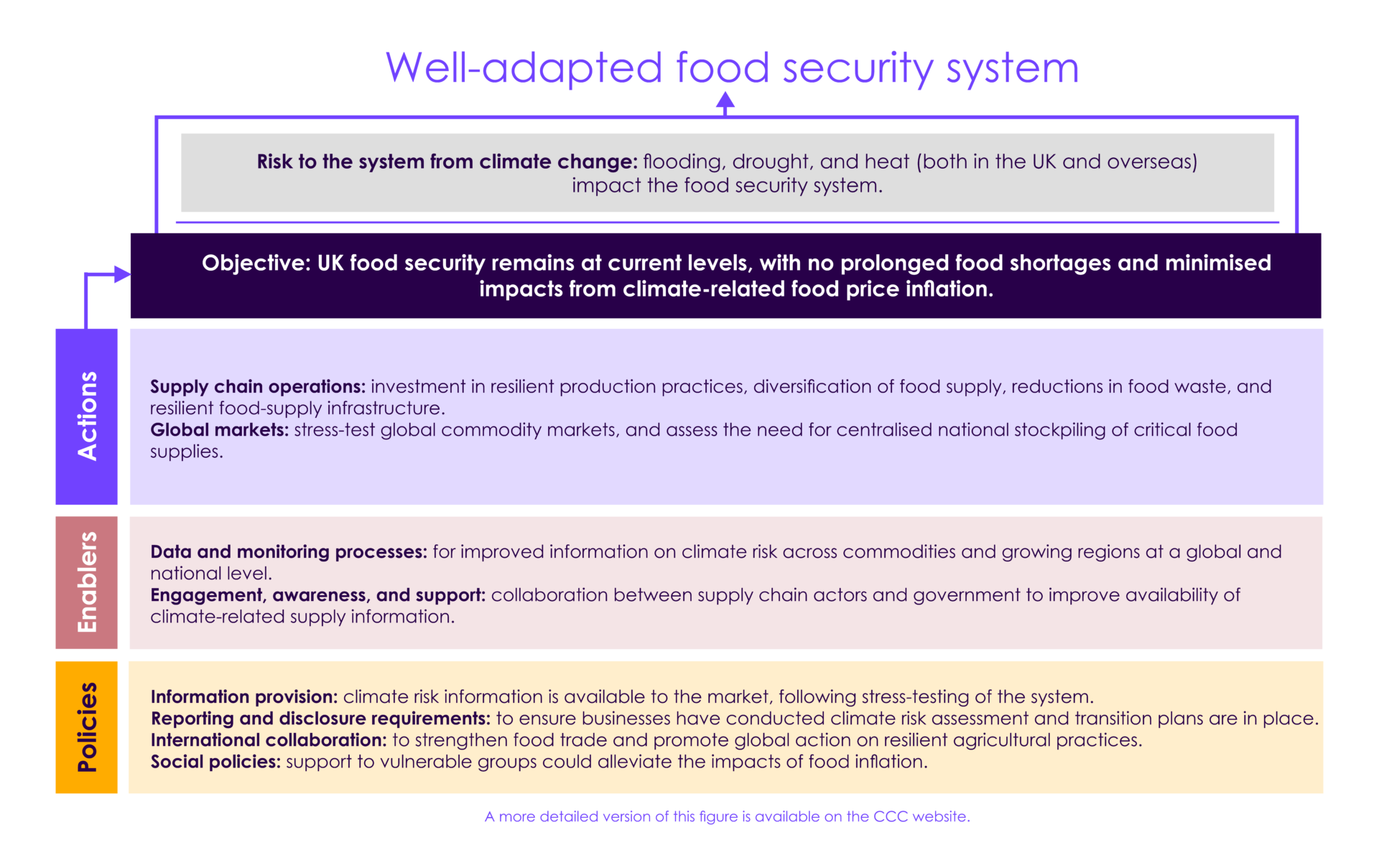 Notes: a more detailed, interactive version of this figure is available in the Climate Change Committee’s Adaptation Monitoring Framework. |
15.1 Set ambition
This section sets out the necessary ambition for adapting to the risks from climate change in the system on UK food security.
15.1.1 Climate risks to the food security system
The system on food security manages the climate risks identified in Chapter 5 of the CCRA4-IA Technical Report, across England, Northern Ireland, Scotland, and Wales (Table 15.1).[1306]
Climate change threatens food security in the UK through impacts on global supply chains, including on fertiliser and feed inputs, and affordability of food. UK food supply is situated in a global food system which determines the availability and price of food at home. In 2023, the UK relied on imports for roughly 40% of food consumed.[1307]
Flooding, drought, heatwaves, and increased average temperatures are hazards to food production, processing, and transport for UK food supply chains, domestically and internationally. Long term changes in average climate and extreme events will increasingly cause disruptions to food production in climate-vulnerable regions, which can rapidly spread through UK food supply, processing, and prices.
Climate-induced impacts to the system can cause food to become more expensive, which particularly affects lower income households. Prices will be affected regardless of whether production is domestic or imported, since UK producers have the option of exporting if international prices are higher. Climate change will impact domestic harvests, so increased domestic production does not avoid climate shocks. Many imported products will not grow in the UK or can only be produced seasonally (see Chapter 13).
Impacts from climate change are already being seen today:
- Around 18% of the UK’s fruit and vegetables come from nations at high and moderate risk to climate change, making the UK’s supply of foods associated with healthy diets susceptible to climate change-related disruptions.[1308]
- Yields of crops that are predominantly grown in the south and east of Europe have already been impacted by climate hazards.
- In 2022, orange production reached its lowest level in nearly a decade following adverse weather conditions in Spain.
- 100 cases of crops being destroyed by heat, drought, floods, and other climate extremes from 2023 to 2024 have been mapped.[1309]
- Food price rises have been linked to recent climate shocks, including in the UK. For example, the cost of a kilogram of tomatoes rose by 41% from January 2020 to January 2023 following disrupted harvests in Morocco. This was due to flooding and cold temperatures that came after a period of persistent long-term drought and several heatwaves.[1310]
Without additional adaptation, under a 2°C global warming level in 2050:
- Mean global yields of maize are projected to decrease by 4.6% and rice by 0.9% in 2050, and suitability of growing regions for wheat and soybean are expected to shift.[1311];[1312] On average, due to higher CO2 concentrations offsetting the negative impacts of warming, wheat yields could increase by 1.7% globally and up to 4% in Europe, by 2050. However, this increase in yield would come with steeper global price spikes.[1313];[1314] Global yields of fruit, vegetables, starchy roots, and legumes are projected to decline in all regions by 2050.[1315]
- Agricultural productivity is expected to grow with increased global food production due to more inputs and improved efficiency from technology.[1316] Reduced food waste will improve productivity across the value chain. It is unclear how these trends will interact with climate change and extreme weather shocks, shifting growing regions, and diet change. Overall, it is expected that reductions in agricultural yields due to climate change by 2050 will be smaller than projected increases due to improved technology and productivity growth.[1317]
- Frequency of simultaneous crop failures is projected to increase in multiple major producing regions (breadbaskets), leading to increased global food prices. Historically, such losses have led to a global production deficit of as much as 20% for a given commodity.[1318]
- 52% of legumes and 47% of fruit are projected to be imported by the UK from climate-vulnerable countries, increasing the likelihood of supply disruptions and shortages, and climate-related food price inflation.[1319] In 2013 this figure was 32% for fruit and vegetables.[1320] This reflects the increasing climate risk exposure of key countries from which UK food is imported like Spain and Morocco. It may be possible to switch sourcing to other regions during climate shocks, but price effects would remain. Sourcing may also naturally move in response to climate change. Rather than continuing to grow in regions that no longer suit these crops, production may shift to regions newly suitable, where they exist.
- Higher temperatures could persistently increase annual food and headline inflation. By 2060, annual food price inflation of 1.1–1.8% above the underlying long-term rate of inflation is expected across Europe due to the impacts of extreme heat alone.[1321] When added to the baseline, this additional inflation builds up over time and can have substantial impacts, although the overall impact may be reduced through product substitution.
Under a high-end climate scenario, on track for around 4°C global warming level by 2100, without adaptation:
- More significant risks to global food production are expected. Mean global yields could decrease by 22% for maize and 9% for rice.[1322] Wheat yields could increase by up to 18%.[1323]
- The probability of crop yield failures under a high warming scenario is projected to be up to 25 times higher than today by 2050 across global breadbaskets.[1324]
| Table 15.1 Climate risks to food security |
|||||
| Risk | England | Northern Ireland | Scotland | Wales | Overall |
| N10: Risks to food security | Critical action needed | Critical action needed | Critical action needed | Critical action needed | |
| Critical action needed | |||||
| Source: Bullock, J. M. et al (2026) Land, Nature, and Food In: CCRA4-IA Technical Report. | |||||
15.1.2 Objective for a well-adapted food security system
Objective: UK food security remains at current levels, with no prolonged food shortages and minimised impacts from climate-related food price inflation under the current and future climate.
Achieving this objective would make the UK food system resilient to climate-related shocks and support the availability of healthy and sustainable diets, now and under future climate change. This is consistent with the UK Government’s ambition in its forthcoming food strategy.[1325]
To deliver on this objective, we suggest that targets on climate-related food shortages and food price inflation are required. National governments may choose to propose alternative targets where they have different priorities, trade-offs to consider, or further evidence (Box 3.11). Objectives on food security, that consider climate risks, have already been set by government. However, supporting targets that operationalise the objectives, specifically for addressing the climate risk, are currently lacking.
Preventing climate-related food shortages
Food shortages across entire nutritionally important groups for sustained periods would constitute a serious threat to food security.[1326] While these have not been seen in the UK in recent times, risks from climate change will persist.
Proposed target: from now through to 2050, there should be no climate-related food shortages across entire nutritionally important groups in the UK.
- Meeting this target will ensure availability of food supply and nutrition in the UK, including through periods of extreme weather and climate shocks in growing regions and across trade routes. Nutritionally important groups refer to the food groups outlined in the Eatwell Guide.[1327];[1328]
- We have suggested an ambitious target of no shortages because the UK food industry can manage additional risks through adaptation. To date, the food industry has demonstrated an effective response mechanism to supply shocks through flexible alternative sourcing, but this is not guaranteed to continue in an increasingly volatile global context (see Chapter 17).
- For example, UK food supply chains for meat, fresh vegetables, and bread responded to COVID-19 shocks by quickly identifying alternative suppliers, modifying sourcing strategies, reallocating resources, and using new transport routes to offset regional disruptions.[1329];[1330] Digital expansion, including online grocery platforms and increased collaboration across supply chain tiers and industry-wide, ensured continued availability for consumers.[1331]
- 64% of fresh produce imported to the UK comes from just 10 countries with almost a quarter coming from Spain alone in 2024. Overall diversity of fresh produce import regions has reduced in recent years, with greater concentration of supply from climate-vulnerable regions. However, flexibility in switching supply has been observed with rapid increases in imports from Morocco and Egypt coinciding with reduced imports from the Netherlands.[1332] Where there have been dips in imports following supply shocks, such as the implementation of Brexit trade regulations combined with Covid-19 restrictions in 2021, quick recovery of import supply has been observed.
- The impacts of climate change are being felt by UK farmers today and will continue to worsen without adaptation (see Chapter 13). However, food security and climate resilience present opportunities for UK farmers alongside these risks. As adaptation improves the ability of farming businesses to withstand climate shocks, a mix of domestic production and imports can reliably deliver healthy diets under climate and geopolitical stress (see Chapter 13 and Chapter 17).
- Food supply in the UK is dependent on the transport system, and meeting this target will require the necessary adaptations to transport infrastructure (see Chapter 10).
- 36% of food imports to the UK in 2023, amounting to £24 billion (2025 prices), relied on the cold chain.[1333] Given our reliance on imports, UK cold chain resilience may be affected by heatwaves and infrastructure in other countries as well as in the UK.[1334]
- 62% of fresh produce imports from the EU, and around a quarter of all food imports enter the UK via Dover and the Channel Tunnel. While risks of disruption are generally well-managed, ability to divert food imports depends on shipping and port capacity.[1335]
- Progress against this target could be measured by tracking UK dietary energy supply as measured by the UN Food and Agriculture Organisation’s (FAO) Food Balance Sheets.[1336];[1337] Consumer reports of food availability such as the Food Standards Agency Consumer Insights Tracker or the Department for Environment, Food, and Rural Affairs’ (Defra) Family Food survey can also highlight broad trends on food purchases(see Section 15.4).[1338];[1339] It may be possible to develop indicators based on news and social media reporting of shortages, though data quality and consistency issues would need to be addressed.
Limiting the impact of climate-related food price inflation
A significant impact of climate change on UK food security will be through higher and more volatile food prices which will have a greater impact on vulnerable groups.[1340];[1341] Food is an important component of household inflation with macroeconomic impacts, weighted at 11.3% in the UK Consumer Price Index (see Chapter 16).[1342]
Proposed target: from now through to 2050, the impact of climate-related food price inflation on household budgets should be minimised.
- Meeting this target would shield consumers, particularly vulnerable groups, from the impacts of climate-related food price inflation and volatility. Data to establish a target level of reduced impact on household budgets is limited, and further work would be needed to quantify this target.
- In 2023, food price inflation in the UK reached its highest point in 45 years (Figure 15.2).[1343] As a result of the 2022 summer heatwave in Europe, annual food price inflation in the UK increased by around 49% that year.[1344] Extreme heat has been proven to directly cause higher food prices, as impacts on agricultural production translate into supply shortages and food price inflation.[1345] In 2023, households experiencing high levels of food security made up approximately 83% of UK households monitored in the Family Resources Survey, a decrease of four percentage points since 2019.[1346]
- Participants of the Climate Change Committee’s (CCC) citizens’ panel on adaptation expressed concern around the impact of climate change on food security and prices (see Chapter 2). Polling shows that people believe that increased costs of food due to supply chain instability is the second biggest impact of climate change on the UK over the coming decades.[1347]
- Lower-income households are more sensitive to food price shocks given expenditure on food is a greater proportion of their income. The average household spent 11.3% of their income on food in 2023/24, compared to 14.3% for the lowest income households.[1348]
- We suggest a household-level food price target as this is where policy could be most effective. Although adaptation options exist to improve global resilience, they are unlikely to eliminate the effects of climate-related food price inflation and volatility.
- The UK is exposed to fluctuations in global commodity prices which are expected to become more volatile with climate change impacts. Food prices will be dependent on these impacts and the level of adaptation at the global level.
- Domestic production alone is not scaled enough to provide the population with sufficient and reliable food supply for a healthy diet and is also exposed to the same fluctuations seen globally. Therefore, the UK is dependent on the global food system and its associated climate-related price shocks.
- Progress against this target could be measured by assessing the change in price of a climate-impacted basket of goods, and changes in household food security.[1349] Separately tracking the prices of imported and UK-produced goods could provide useful insight (see Section 15.4).
| Figure 15.2 The relationship between food prices and inflation |
 Description: Food and beverage prices have been a driver of change in inflation observed over time in the UK. |
15.2 Identify actions
The following section outlines the priority adaptation actions required to achieve the climate adaptation objective for food security. These actions focus on global markets and operational actions to improve the climate resilience of supply chains. See Chapter 13 and Chapter 14 for actions to ensure climate resilient production in domestic farming and fisheries respectively.
15.2.1 Actions in the food security system
Supply chain operations
Given the central role of industry in food provision, most adaptation actions for the food system will take place within supply chains. Food businesses, like any other business, have a role in developing measures to manage their risks (see Chapter 16). While the exact actions are for businesses to decide, actions could include:
- Investment in resilient production practices: risks to food production (domestic and international) are one of the key vulnerabilities of the UK’s food supply to climate impacts. Agricultural adaptations improve food security by building longer term resilience into the production system (for example, from pests and diseases) and reducing the likelihood of simultaneous disruptions globally due to climate shocks (see Chapter 13).
- Increasing climate-driven heat stress in key growing regions can impact the availability and productivity of labour. Adaptation actions include encouraging improved communication with workers on working conditions, shifting working hours to cooler times of day, and providing shading (for example, using tree cover).
- Investment is required in capacity building, skills, and technology for local farmers and producers to improve sustainability and efficiency, including reducing food waste. Some food businesses are already investing in sustainable production practices to support the resilience of growers to climate change. For example, Marks and Spencer have committed to working with fresh produce growers overseas to support their resilience to climate change and product quality, and tackle water stress, carbon reduction, and biodiversity loss.[1350]
- Diversification of food supply chains: diversifying food, fertiliser, feed, and fuel supply chains at every stage can spread risk and build resilience during short term climate shocks.[1351] This means higher supply is maintained than otherwise, if production in one region fails. This is especially important for avoiding single points of failure (such as international transport bottlenecks) which can have significant impacts on food prices, although the risks are poorly understood.[1352] While alternative routes are generally found during such disruptions, increased transport and insurance costs as well as delays often translate to higher food prices. For example, restrictions on the Black Sea ports in 2022 led to a rise in global commodity prices, with wheat and maize prices rising by 58% and 38% respectively.[1353] There may be initial costs associated with investing in increased diversification, but co-benefits of resilience to non-climate pressures could also materialise. This action may be cost-effective in the long run as returns are seen when climate shocks inevitably arise.[1354]
- Food businesses are already taking this action as it is central to ensuring continuous, reliable supply, and ensures they remain competitive.[1355] For example, Nestlé is reducing its climate risk exposure by diversifying sourcing origins from highly exposed geographies, switching countries of raw material origins, and increasing sourcing flexibility so that 60% of materials can be bought from multiple vendors and origins.[1356]
- Reductions in food waste: by weight, total food waste in the UK across farming, retail, manufacturing, and households (10.2 million tonnes in 2021 to 2022) amounted to approximately one quarter of what was purchased for consumption in the home that year (39 million tonnes).[1357] Fresh vegetables and fruit account for over a third of total waste. This provides a clear opportunity to improve efficiency and resilience since fresh produce supply is particularly exposed to climate risk.[1358] Globally, 28% of the agricultural land area is used to produce food that is wasted, while the amount of food loss due to a lack of an effective cold chain is enough to feed an estimated one billion people.[1359]
- In our Seventh Carbon Budget (2025) advice Balanced Pathway, UK food waste falls by 39% from farm to household by 2030 compared to 2021, and by 45% by 2040. By 2050, we assume a reduction in waste of 51%. As well as being a mitigation measure to reduce emissions, reductions in food waste are also an adaptation measure, as they will reduce UK vulnerability to climate disruption of food supplies.
- Resilient food supply infrastructure: necessary transport and storage infrastructure across food supply chains should be resilient to climate impacts (Box 15.1, see Chapter 10).
- The UK cold chain is a fully integrated temperature-controlled environment for the transport and storage of temperature sensitive products from the point of source or manufacture through to the point of use. Almost half of the food and beverages produced and sold by UK manufacturers consist of chilled or frozen products, worth around £50 billion (2025 prices) per year.[1360]
- Cold chains can fail during periods of intense heat, risking business viability and consumer safety. At least 50% of refrigeration equipment will not be designed for operation in an ambient temperature of 40°C or above by 2050. It will be vital to adapt cold chains to higher temperatures under the current and future climate. Designing for a 40°C ambient temperature offers significant resilience for maintaining food at a safe temperature. Upgrades to infrastructure have high upfront costs but will be necessary under the future climate where returns on investment will be seen through avoided losses. Building this into natural replacement at end of life will help to avoid locking in risk and ensure that new equipment is future-proofed (Box 15.1).
Global markets
Food provision in the UK is delivered through the private sector and climate risk is embedded within the market. The actions below would ensure that government is aware of the key points of failure in the food system and be prepared for a range of threats to food security under different climate scenarios, including severe and prolonged shocks.
- Stress-testing global commodity markets: systemic stress-testing of global commodity markets (including fertiliser, feed, and fuel) and the UK’s ability to respond to shocks under different scenarios can help ensure the UK food system is strong enough to withstand severe climate scenarios. This could help to avoid worst-case impacts within commodity markets as part of a broader climate-informed supply chain strategy (see Chapter 16).[1361];[1362] This requires identifying the key points of failure in the system then responding with appropriate contingency measures. At the same time, engaging industry in preparedness response will provide a safeguard against more disruptive or combined global climate shocks. This could be particularly valuable to help identify adaptation against the biggest climate impacts, as well as behavioural responses of other actors to these impacts. For example, the effect of potential export bans from producer countries to the global food system.
- In July 2023, India (which accounts for 40% of global rice trade) imposed an export ban on non-basmati white rice due to erratic monsoon and drought patterns to stabilise their domestic prices. This led to price increases in global rice markets, with subsequent panic-buying in Asia and North America further pushing up prices including for the UK.[1363]
- Assess the need for centralised national stockpiling of critical food supplies: several countries maintain emergency national or regional food reserves to stabilise supply during climate disasters, buffer national food price shocks, and soften disruptions in trade due to export bans.[1364] Some governments set targets for reserve size to ensure market stability during climate-induced shortages – Indonesia aims for reserves equal to 20% of total demand.[1365] While generally considered an effective strategy to insulate against volatility, stockpiling is costly to maintain and generates economic benefits only in extreme cases.[1366];[1367];[1368] There is also a decentralised approach of encouraging stockpiling at the household level. This reflects current government guidance for emergency preparedness to store supplies lasting several days.[1369] The cost of this approach is likely similar to national stockpiling but is instead taken on by individuals.
- Several European countries have recently established and expanded national food stockpiles as a buffer against global risk. Switzerland maintains mandatory stockpiles covering three to four months, administered collaboratively with private companies. While Germany doesn’t have a legal supply period, its smaller state-owned reserves are accompanied by public preparedness initiatives where citizens are urged to stockpile food and water for up to 10 days in their homes.[1370]
|
Box 15.1 |
| The CCC commissioned a two-part study to assess the climate resilience of the UK’s cold chains for food and medical supply to heatwaves and rising ambient temperatures.[1371];[1372] The results are summarised here: Understanding the risk The UK cold chain today shows good levels of overall resilience. As climate change intensifies, existing reactive measures will not be sufficient. The cold chain system has several key vulnerabilities:
Enabling action for business
|
15.3 Enable delivery
This section sets out the key enablers and policies to deliver the adaptation actions at the required scale and urgency for a well-adapted food security system.
15.3.1 Enablers
Given the competitive food industry environment, many adaptation actions are expected to be delivered by market forces and industry (Table 15.2). However, potential risks due to inadequate long-term investment in climate resilience within a competitive market should be considered by policymakers. The most important enabler for these actions is strengthened data and monitoring processes to help business identify the most suitable options for their circumstances and for government to understand climate resilience of the system in the round.
- Data and monitoring processes: the food sector has identified a need for improved information on climate risk under different warming scenarios and across commodities and growing regions.[1373] Good data is essential for both businesses and government to make informed adaptation decisions. Therefore, improved data and monitoring at both the national and global level are needed.
- Across food supply chains, priority climate risks can be identified by the private sector through comprehensive risk mapping and assessment of production regions, trade routes, storage facilities, and existing stocks in the UK. These can then inform the right adaptation decisions through strategic resilience planning.
- Engagement, awareness, and support: collaboration between supply chain actors and with government (within competition law and commercial confidentiality) can improve collective traceability and availability of climate-related supply information. This includes through data sharing and transparency initiatives. Examples of such initiatives include the Food Data Transparency Partnership (government and industry) and the Food Industry Intelligence Network (between industry actors).
15.3.2 Policies and plans
The responsibility for key adaptation policy areas for food security is split between UK and national governments (Table 15.2). These include food system policy and international collaboration (centralised), and information provision (devolved). A holistic approach is needed to deliver a resilient, healthy, and sustainable food system given the close interlinkages with nature, farming, and international cooperation – with global food security also being a key pillar of the UK’s international development obligations (see Chapter 13, Chapter 14, and Chapter 17).
England, Northern Ireland, Scotland, and Wales have their own food strategies that take account of the local context. While delivery is local, the food strategy for England aims to coordinate across the nations and consider wider UK food security. International trade policy is centralised for the UK.
Existing policy action
Current roles of government policy in this system include:
- Setting out overall food strategies and action plans. These outline overall policy goals to food system actors. They are in place in England, Northern Ireland, Scotland, and Wales.
- Facilitating information provision. Requirements for climate risk disclosure, such as the Taskforce on Climate-related Financial Disclosures (TCFD) and HM Treasury’s Transition Plan Taskforce on climate transitions, help to provide relevant risk-focused information into the market.
- International trade, multilateral environmental policy, and international aid. These can be strong determinants of where food products can be more easily imported from, and of global resilience.
Policy actions for a well-adapted system
To move towards a well-adapted system, the UK and national governments will have to clearly communicate climate risk information and guidance to the food industry and implement climate risk disclosure mechanisms. This requires continuing to engage in global multilateral action in climate-resilient food production. They will also need to ensure that price shocks do not impact accessibility to food through social policies.
- Market signalling through communicating climate risk helps to develop a shared view of the systemic risk to food security. Government can ensure that climate risk information is made available to the private sector following stress-testing of the system.
- Sharing information on climate risks and the UK’s exposure with industry enables better preparation for climate shocks. Industry would be able to assess their ability to deliver under different climate scenarios, make informed adaptation decisions, and potentially co-develop a response with government.
- Current industry initiatives aimed at addressing climate risk lack coordination and consistency due to competition policy. Government could have a role in facilitating more strategic and joined-up thinking across the food sector. For example, the Food Industry Intelligence Network was set up for primary producers, food manufacturers, food retailers, and food service organisations to improve supply chain assurance through collaboration and data sharing. Similar networks that are sensitive to competition law could be used for sharing climate information.
- Requiring food businesses to have transition plans and disclose their climate risks under the Adaptation Reporting Power (ARP). This would help to ensure that sufficient industry plans for adaptation are in place. This could include providing guidance for climate risk assessments, and designing and deploying climate adaptation action plans, as well as education and training on mapping and addressing priority risks. The Welsh Government already offers such training to food businesses. Mapping and assessing climate risk across food supply chains can identify the priority risks and inform the right adaptation decisions via climate resilience action plans.
- International collaboration bilaterally and within multilateral fora can strengthen food trade and promote global action on climate-resilient agricultural practices. International trade agreements that include food can help to avoid barriers to importing food from producing regions during climate and other shocks. More sustainable and resilient farming practices around the world, strengthened through multilateral engagement and international aid, will also boost overall food security and indirectly improve the resilience of key food imports to the UK.
- Providing policy support to vulnerable groups could alleviate the impacts of climate-driven food price inflation. Higher and more volatile prices may have to be accepted as an impact of climate change on the UK food system. Targeted support for purchasing food that mirrors existing schemes in other sectors such as the Winter Fuel Allowance, the Warm Homes Discount, and Cold Weather Payments which are specifically directed at price volatility, could be assessed by government. Policies such as direct payments to vulnerable groups for food or subsidies in response to climate shocks would alleviate household food insecurity due to climate-driven inflationary pressures.[1374] Maintaining a strategic national reserve of critical food supplies could be another way to manage temporary price spikes.
| Table 15.2 Responsibilities for delivering adaptation across the food security system |
|
| UK Government |
|
| National governments |
|
| Private sector |
|
| Public and civil society |
|
| Notes: National governments include the role of the UK Government in England; and in Northern Ireland, Scotland, or Wales where powers sit with the UK Government for that nation but are devolved to other nations. | |
15.4 Evaluate progress
Effective adaptation requires monitoring and evaluation to assess whether delivery towards objectives and targets is contributing to reducing climate risk. This section sets out the current capability to track progress against the proposed targets in the food security system, and priority gaps for monitoring and evaluation.
15.4.1 Tracking progress on adaptation
The complexity of the food security system makes it difficult to track the impact of adaptation interventions. Some data on food availability and prices are available to monitor progress against the two proposed targets:
- Preventing climate-related food shortages: a range of indicators related to food imports are available to track food availability in the UK, with some that consider climate vulnerability. These include climate change vulnerability of food production by food group.[1375];[1376] Other useful indicators include the global availability of food, and total factor productivity growth of global agricultural systems that capture the overall impact of climate events. These could help to identify possible effects on UK food variables.[1377]
- Limiting the impact of climate-related food price inflation: while data on food price inflation is readily available, there are no existing indicators to track climate-specific drivers. Proposed indicators under the United Nations Framework Convention on Climate Change’s Global Goal on Adaptation, such as prevalence of moderate or severe food insecurity associated with climate-related drivers and events, would more directly highlight climate impacts on food security if data could be disaggregated to the UK level.[1378];[1379]
15.4.2 Address monitoring and evaluation gaps
There are priority gaps to monitor and evaluate whether adaptation is achieving the vision of a well-adapted food security system. We have identified the following gaps and opportunities to address them.
- Develop indicators to measure climate specific impacts. This would enable better monitoring of adaptation progress in relation to climate impacts on both food prices and availability. While data the impact of climate shocks on global agriculture, and UK food availability and prices are available, there is a gap in understanding the extent to which they interact. Attributing specific impacts to climate change can catalyse adaptation action and contribute to a better understanding of how climate shocks might impact food security in future.
- There are opportunities to leverage existing data collection to address this gap. For example, existing data streams can be connected to assess the percentage of priority international food supply chains that meet an agreed minimum resilience standard. Further developing indicators such as the proportion of households with access to a given nutrition basket could also help to track adaptation progress more effectively.[1380]
- Gathering regional and local data on the availability of broad nutritional groups to consumers (for example, on supermarket shelves) is required to understand whether there are shortages.
- Build on existing modelling to reduce uncertainties around systemic risk. This will contribute to a better understanding of the role climate change plays in amplifying systemic risks to food security, and in turn what adaptation is needed. This includes the impacts of climate-driven disruption of global commodity markets, or extreme weather on future climate-induced food price inflation.
- Research and modelling that incorporates extreme weather is needed, taking account of co-impacts (for example, accessibility to healthy and sustainable diets) and availability of low-carbon diets.[1381] This will contribute to a better understanding of how climate impacts to food security will interact with other systems and global risks.
- Interdisciplinary research accounting for behaviour change, and encompassing health and nutrition, climate change mitigation, global risks, and the economic resilience of UK farmers and food producers, could contribute to better understanding systemic risk.
Chapter 16: Economy and finance
Introduction and key messages
This chapter covers climate adaptation of business assets, operations, and supply chains, the financial sector, and the broader economic strength of the UK. This system is split into three subsystems:
- Business: organisations that produce goods and services for UK and international markets.
- Finance: firms that provide financial goods and services to individuals and businesses in the UK and abroad. These services include savings, lending, investments, and insurance.
- Macroeconomy: the strength and direction of the UK’s economy, usually measured by indicators including GDP, employment, inflation, and government borrowing.[1382]
Our key messages are:
- Innovation in insurance is needed to maintain coverage and affordability, and this will likely require continued government involvement. New business models will help insurers to continue serving UK homes and businesses. Innovations could include incentives for adaptation, products that bring capital into insurance, and new risk pooling mechanisms.
- A viable insurance sector depends on adaptation in other systems. A resilient and affordable insurance market is vital for enabling businesses and households to manage their risks and to recover quickly from climate events. Achieving this will depend on effective adaptation across systems so that residual risks remain insurable.
- Financial institutions will be better prepared for climate conditions if they can quantify climate damages and adaptation. The costs of damages and benefits of adaptation could then be incorporated into risk assessments, modelling, and the prices of financial products. Financial institutions are not yet sufficiently accounting for climate change, despite recent progress. This has implications for financial markets, price stability, and the macroeconomy.
- Regulations can protect workers or enable coordination under changing climate conditions. Appropriate regulations may include maximum working temperatures or clear climate resilience standards. Alongside regulating, governments can support businesses by addressing market failures and providing incentives for adaptation.
- Businesses are best placed to choose their desired level of adaptation and the appropriate adaptation actions. These decisions will sit alongside government regulations and other policies. Business will need suitable information to make these decisions. Governments may be best placed to deliver accessible adaptation information in some cases, such as for small businesses.
- Governments can build fiscal resilience by considering climate-related spending needs when setting budgets. The costs of climate impacts are rising, and governments will be responsible for some of these costs. They should consider climate-related spending when setting budgets and should assess how existing spending can support adaptation.
Adaptation overview
This chapter sets out the ambition for a well-adapted economy and finance system, and the actions, enablers, and policies required to deliver it. Figure 16.1 provides a summary of this in a monitoring map – a more detailed version of this figure is available in the Climate Change Committee’s Adaptation Monitoring Framework.
Adaptation in the economy and finance system is connected with all other systems in this report, since businesses and financial institutions operate across all sectors. Adaptation in the built environment is essential for businesses and banks (see Chapter 5), and insurers rely on adaptation across all systems to keep losses within insurable bounds. Businesses and the finance sector will undertake or enable some adaptation actions in other systems. The macroeconomy subsystem fundamentally relies on adaptation across the whole economy, and a stable macroeconomy is required for effective adaptation in other systems.
| Figure 16.1 Monitoring map for the economy and finance system |
 Notes: a more detailed, interactive version of this figure is available in the Climate Change Committee’s Adaptation Monitoring Framework. |
16.1 Set ambition
This section sets out the necessary ambition for adapting to the risks from climate change in the business, finance, and macroeconomy subsystems.
16.1.1 Climate risks to the economy and finance system
The economy and finance system manages climate risks and opportunities identified in Chapter 7 of the CCRA4-IA Technical Report, across England, Northern Ireland, Scotland, and Wales (Table 16.1).[1383]
Climate change increases risks to the UK’s businesses, financial system, and macroeconomy. Extreme weather can cause substantial damage to homes, businesses, and infrastructure. This puts stress on public and private capital and drives up insurance claims, loan defaults, and volatility in financial markets. Worsening climate conditions in the UK and abroad can lead to supply chain disruptions that increase food and commodity prices, contributing to inflation. Extreme heat can directly harm workers and labour productivity, reducing economic output in some sectors.
- Business: climate hazards, including storms, flooding and heatwaves can disrupt day-to-day operations, supply chains, and affect workers’ health and productivity. The impact of these risks depends on a business’ sector, location, and size. With reduced insurability, some businesses could become unviable and fail.
- Finance: UK financial institutions (FIs) face growing climate-related damages to their financial assets, both domestic and abroad, and rising payouts on insurance contracts. These risks may limit their ability to make investments and offer affordable loans and insurance to homes and businesses. At scale, this would reduce capacity to recover from climate events and create risks to financial stability and economic growth.
- Macroeconomy: the performance and stability of key macroeconomic objectives can be negatively affected by all climate-related impacts across sectors. This may reduce GDP, create inflationary pressures, and increase public sector debt.[1384] Systemic risks amplify economic damages.
Climate change is already affecting the economy and finance system. The Bank of England (BoE) considers climate change a current, and growing, threat to the UK’s financial system.[1385] Damage to UK residential property is estimated to cost £785 million (2025 prices) every year.[1386] Across both homes and businesses, insurers paid an estimated £1.6 billion (2025 prices) for weather-related property damage in 2025.[1387] Climate change also affects supply chains and prices – more than a third of UK businesses (39%) report climate-related supply disruptions.[1388] Past severe weather events in food-producing countries increased global food prices by more than 30%, affecting UK prices.[1389]
Without additional adaptation, under a 2°C global warming level in 2050:
- Based on a range of available estimates, climate change damages in the UK could grow to 1–5% of GDP by 2050, under scenarios which are roughly equivalent to a 2°C global warming level in 2050 (see Chapter 2).
- Annual damages to business properties could exceed £1.1 billion (2025 prices).[1390] Businesses could also face increasing climate-related supply chain disruptions, affecting UK production and prices.[1391] Heatwaves already affect workers – around a third of those surveyed report that the 2024 summer heatwave harmed their health, although only 4% reported an illness or injury at work.[1392] Lower worker productivity is estimated to cost up to £1.3 billion (2025 prices) in lost earnings annually.[1393] These impacts will worsen as climate conditions deteriorate.
- Banks who participated in the BoE’s climate scenario exercise estimated potential credit losses on lending could be 50% higher than in a future with no climate change. Participating insurers estimated average annual payouts would be at least 50% higher.[1394] These estimates are uncertain – actual losses and payouts could be much larger.
- The UK Government’s public sector net debt would be much higher than in a baseline scenario with no climate change by the second half of the century. The Office for Budget Responsibility (OBR) estimates additional debt equivalent to 33% of 2073/74 GDP under a 2°C scenario.[1395];[1396] Public finances can be affected by direct costs, such as higher road maintenance, or indirectly, such as through lower business profits and tax receipts.
Under a high-end scenario, on track for around 4°C global warming level by 2100, without additional adaptation, all impacts are likely to be substantially larger than in a 2°C scenario. Evidence of potential impacts in a 4°C scenario is limited and subject to significant uncertainty.
- Based on a range of estimates, aggregate climate damages could cost 4–10% of UK GDP each year by the end of the century.[1397]
- Globally, physical climate impacts could affect up to 6% of the value of physical assets in S&P’s international stock indices.[1398] This could have severe impacts in the UK due to the international exposure of the UK financial sector and its substantial contribution to GDP, exports, and price stability.[1399]
Even this growing body of evidence may understate economic impacts. Limited understanding of how risks are transmitted, cascading and systemic risks, and tipping points mean current models likely underestimate potential impacts on the UK economy (Box 2.1).[1400];[1401]
| Table 16.1 Climate risks and opportunities to economy and finance |
|||||
| Risk or opportunity | England | Northern Ireland | Scotland | Wales | Overall |
| E1: Risks to UK macroeconomic performance and stability | Critical action needed | Critical action needed | Critical action needed | Critical action needed | |
| Critical action needed | |||||
| E2: Risks to domestic and overseas physical assets of UK businesses | Critical action needed | Critical action needed | Critical action needed | Critical action needed | |
| Critical action needed | |||||
| E3: Risks to domestic and international supply chains and resource inputs of UK businesses | Critical investigation | Critical investigation | Critical investigation | Critical investigation | |
| Critical investigation | |||||
| E4: Risks to the productivity and availability in labour in the UK | Critical investigation | Critical investigation | Critical investigation | Critical investigation | |
| Critical investigation | |||||
| E5: Risks to financial institutions and the financial system | Critical action needed | Critical action needed | Critical action needed | Critical action needed | |
| Critical action needed | |||||
| E6: Risks to public finances | Critical investigation | Critical investigation | Critical investigation | Critical investigation | |
| Critical investigation | |||||
| E7: Risks to household finances | Critical investigation | Critical investigation | Critical investigation | Critical investigation | |
| Critical investigation | |||||
| E8: Opportunities to UK businesses and financial institutions from delivering adaptation goods and services | Critical investigation | Critical investigation | Critical investigation | Critical investigation | |
| Critical investigation | |||||
| Source: Cole, M. A. and, Elliott, R. J. R. (2026) Economy In: CCRA4-IA Technical Report. Notes: Risks and opportunities within the economy chapter often integrate components from other chapters. For example, the risk to domestic and international supply chains considers risk to food and pharmaceutical imports within the context of maritime transport, touching on components of health, food and transport. This wider scope, whilst a real feature of the economy and finance system, means that the high and very high magnitude thresholds (annual damages or forgone opportunities of hundreds of millions, and billions of pounds) are reached more easily. This results in all economy risks scoring either critical action needed or critical investigation. |
|||||
16.1.2 Objective for a well-adapted business subsystem
Objective: businesses can manage climate risks and have opportunities to prosper, deliver goods and services, and provide safe and productive workplaces under the current and future climate.
Achieving this objective would ensure that UK businesses can swiftly recover from climate impacts to their operations or supply chains and provide reliable employment in workplaces that do not harm health. Prospering businesses have opportunities to grow, generate profits, and create jobs. They can remain competitive, productive, and insurable under current and future climate.
To deliver this objective, we suggest targets on access to climate information, adaptation planning, and health of employees. Businesses, especially small businesses, need better access to adaptation information.[1402] Large businesses can lead the way in adaptation action by integrating adaptation planning into core business functions, drawing on their greater resources, capacity, and influence. It is important that all businesses have working practices and environments that protect their workers’ health during extreme weather. National governments may choose to propose alternative targets where they have different priorities, trade-offs to consider, or further evidence (Box 3.11).
Businesses have access to appropriate climate information
Businesses need information to make climate-informed decisions. Only 29% of UK businesses currently assess climate risk, partly due to a lack of appropriate information.[1403];[1404]
Proposed target: by 2030, all businesses should have access to useful climate risk and adaptation information.
- Meeting this target will enable businesses to make climate-informed decisions and identify appropriate adaptation actions.
- While many large businesses can already access climate information, the proposed target of all businesses reflects the outstanding needs of small and medium-sized enterprises (SMEs). SMEs often lack the resources, time, or expertise to make use of existing climate risk information, which can be inaccessible, expensive, or hard to action.[1405]
- This target can and should be delivered in the next five years. It will largely be achieved through the provision of additional climate information that closes gaps in the existing evidence landscape. We estimate this will cost £7.5 million per year (2025 prices).[1406]
- Progress against this target can be measured using surveys to assess businesses’ access to information, such as in the Business Insights and Conditions Survey.[1407]
Integration of high-quality adaptation plans into business functions
Adaptation plans set companies’ ambitions for climate resilience. They help to identify preferred actions, set targets, and establish monitoring and accountability.[1408] They are most effective when integrated into other corporate strategies, such as investment, business continuity, or decarbonisation plans. The Transition Planning Taskforce recommends adaptation and decarbonisation plans be developed together to create climate-ready transition plans.[1409] For critical infrastructure providers, planning is regulated through the Adaptation Reporting Power (ARP).
Proposed target: by 2035, all large companies should have high-quality adaptation plans integrated into core business functions.
- Meeting this target will support the adoption of appropriate adaptation actions by large businesses to help businesses prosper under the future climate.[1410]
- Developing adaptation plans can be resource intensive. We have proposed the target of all large companies because they have the necessary resources and capabilities. Their adaptation decisions can also affect many workers and customers due to their size or market share. This aligns with the implementation of climate disclosure regulation to date.
- Adaptation plans can be integrated into business planning over the coming decade. The UK Government consulted on transition plan regulation in 2025, focused on decarbonisation.[1411] The body of guidance for adaptation plans is small but growing, building on the lessons of, and extensive resources for, decarbonisation plans.[1412] We estimate this will cost around £330 million per year across all large companies (2025 prices), with substantially higher benefits.[1413];[1414];[1415]
- Progress against this target can be monitored using surveys for businesses and those who may use adaptation information, such as investors and insurers. The results can help to assess the uptake and quality of adaptation planning.
Protecting workers from high temperatures and other climate impacts
Climate impacts can affect workers’ health. Working in high temperatures can lead to an inability to concentrate, fatigue, nausea, loss of consciousness, and death.[1416] It is mostly a concern for outdoor workers or those in hot environments such as bakeries and foundries.[1417] There is no maximum working temperature in the UK, unlike other countries such as Spain (Box 16.1).[1418] However, existing health and safety regulations require employers to provide reasonable indoor temperatures and to protect outdoor workers from adverse weather, including heat.[1419]
Other climate impacts, such as floods, can also affect workers and disrupt business continuity (Box 16.1). Managing all hazards is important for protecting the workforce and limiting productivity impacts of climate change. Our proposed target focuses on high temperatures due to the breadth of potential impacts from heatwaves. With more evidence on the health and productivity effects of other climate impacts in the UK, this target could be expanded.
Proposed target: from now through to 2050, rates of workplace illness and accidents due to heat should not rise.
- Meeting this target will mean workers are adequately protected from future increases in the frequency of extreme heat. It will also help businesses maintain productivity.
- We have proposed the target of maintaining current rates of illness, as we expect adaptation actions can be swiftly implemented to counter changing climate conditions. Some important actions, such as adjusting working hours, do not require capital investment.
- Progress against this target could be measured using reported data on workplace health incidents caused by heat stress. This is not currently monitored but could be tracked under health and safety reporting requirements.
16.1.3 Objective for a well-adapted finance subsystem
Objective: financial institutions manage climate-related financial risks and can continue to offer financial products without substantially raising prices under the current and future climate.
Achieving this objective would ensure that current and future climate and adaptations are accounted for in financial decisions by FIs and reflected in the price of financial products. This would help to deliver a resilient financial system with minimal disruptions due to climate events. Continuing to offer financial products, including insurance, without substantial increases in prices, will help maintain access for most households and businesses. This is essential to supporting economic stability, growth, and to enabling recovery from climate events.
Financial risk models that capture physical climate impacts are required to deliver this objective. Maintaining insurance protection is key to ensuring that businesses and homeowners can recover from climate impacts. These are key areas for targets for UK adaptation. We do not propose targets for how FIs respond to quantified climate risks – FIs are best placed to decide their preferred approach, in line with their own risk appetite. However, the financial sector can only manage or insure against a certain amount of risk, and meeting the proposed targets will also require sufficient adaptation elsewhere in the UK economy.
Physical climate impacts incorporated into financial risk models
Physical climate impacts expose FIs to losses, for example by reducing the value of investments or increasing the likelihood of loan defaults. The Prudential Regulation Authority (PRA) sets expectations for how regulated banks and insurers manage climate-related risks. The PRA’s first expectations for climate risk assessments were issued in 2019. There has been notable progress, but capability and implementation gaps remain.[1420] New PRA expectations, issued in December 2025, strengthened the guidance for quantifying physical climate risks and scenarios.[1421]
Proposed target: by 2030, all Prudential Regulation Authority-regulated banks and insurers should be quantitively assessing current and future physical climate risks and how adaptation interventions can reduce these risks.
- Meeting this target will help regulated banks and insurers include climate-related financial exposures into their existing risk management processes.[1422] This supports financial stability.
- We have proposed that all PRA-regulated banks and insurers meet this standard. These FIs are important for the stability of the UK’s financial system. They also have the resources and growing capabilities to quantify physical climate risks.
- This target will largely be delivered over the next five years with FIs’ continued capability development, supported by PRA supervision. We estimate this will cost around £36 million per year (2025 prices), with substantially higher benefits.[1423]
- Progress against this target can be measured using the PRA’s annual adaptation reports, which assess regulated firms’ risk management capabilities.
Prevent increases in the insurance protection gap
Insurance is vital for a resilient economy. By transferring risk to insurers for a fee – the insurance premium – households and businesses face predictable costs instead of bearing the full risk of a climate event. Risk pooling allows insurers to spread these risks across many policyholders and offer affordable premiums. In an efficient insurance market, insurance payouts can enable swift repair and recovery, reducing financial impacts and stress for those affected by a climate event.
The insurance protection gap measures the share of economic losses from natural catastrophes that is not covered by insurance. A large insurance protection gap means many homes and businesses cannot access insurance due to lack of coverage or high premiums. It also puts stress on the financial sector, as banks face higher default rates on mortgages and business loans, and on public finances through disaster support needs.[1424]
The size of the protection gap varies by hazard and by customer type – such as homeowners, renters, small businesses, and large corporates. The UK’s overall protection gap was estimated at 29% in 2024, with an average of 22% over the past decade.[1425] This is low relative to most other countries. It reflects the UK’s mature insurance market, the long-standing practice of including natural hazards in standard policies, and the role of Flood Re, a public-private reinsurance initiative due to end in 2039.[1426] Without sufficient adaptation, the protection gap is expected to grow as climate risks increase.
Proposed target: from now through to 2050, the UK insurance protection gap should not grow due to climate change.
- Meeting this target will mean that most properties and activities can continue to access insurance across key hazards (particularly flooding) as the risk of damage increases. The target also recognises that it may not be possible or desirable to insure some properties.[1427]
- Delivering this target will require significant adaptation in the built environment, so that residual risks remain insurable (Chapter 5). Insurers, in collaboration with the UK Government, will also need to develop insurance models that pool climate risks adequately and provide incentives for risk-reducing actions by policyholders.
- Progress can be measured using data on the insured and uninsured losses in the UK, monitored by insurers. This is currently available at an aggregated UK-wide level.[1428]
16.1.4 Objective for a well-adapted macroeconomy subsystem
Objective: the macroeconomy swiftly recovers from climate impacts and maintains stability across key economic objectives under the current and future climate.
Achieving this objective would support a macroeconomy in which climate risks and impacts do not damage UK living standards, business performance, international competitiveness, or investment.
Adaptation of fiscal and monetary responses to climate change are required to deliver this objective. Maintaining macroeconomic conditions is primarily a job for the UK Government and the BoE, and the proposed targets reflect the critical role of fiscal and monetary policy in building a resilient UK economy. The proposed targets maintain the UK Government’s flexibility over its macroeconomic objectives, while ensuring climate is factored into how these objectives are met.
Macroeconomically relevant supply chains will also need to adapt. We do not propose targets for this action. This would require additional evidence or judgements about the most important supply chains, and the appropriate level of resilience. With this information, future targets could reflect the UK’s desired level of macroeconomic resilience to supply chain disruption.
Maintaining fiscal sustainability under more extreme climate conditions
Governments are likely to face increasing and volatile spending needs due to climate events.[1429] The OBR estimates significant climate-related fiscal impacts to the UK Government in the longer-term, including an increase to annual borrowing by almost 3% of GDP by 2073/74 in a central scenario (the UK Government borrowed 5.1% of GDP in 2024/25).[1430];[1431];[1432]
Sustainable fiscal management means that the UK Government’s budgets meet the fiscal rules, which constrain decisions on spending and taxes and are set by the UK Government itself. The 2024 fiscal rules require the current budget to move from deficit to balance or surplus and the UK Government’s net financial liabilities to be decreasing as a share of GDP, both by 2029/30.[1433]
Proposed target: from now through to 2050, public debt and deficits should meet fiscal rules when assessed in the presence of foreseeable but unpredictable climate impacts.
- Meeting this target will help to ensure sustainable fiscal management under current and future climate conditions.[1434] This target will largely be delivered with appropriate fiscal management and climate risk assessments within HM Treasury (HMT).
- Progress against this target could be measured using OBR analysis, but some gaps exist. The OBR assesses adherence to the fiscal rules annually. However, it does not currently consider climate risks within the rules’ five-year horizon. Longer-term climate risks are analysed separately. Assessments that integrate climate risks and adaptation in both the short and long term are key to maintaining fiscal sustainability under current and future climate conditions.[1435]
Controlling climate-related inflation
Chronic and acute climate impacts can create inflationary pressures.[1436] For example, for every 1% increase in global agricultural commodity prices, such as due to a severe weather event, European inflation increases by 0.1%, with similar impacts expected in the UK.[1437] Domestic climate impacts, such as flooding, could trigger a shortage of labour and materials or disrupt supply chains. This will increase repair costs and eventually affect insurance prices, with potentially significant inflationary effects for households and some sectors.[1438] Floods have been shown to affect the core components of inflation, with impacts still material after five years.[1439]
The Monetary Policy Committee (MPC) is responsible for maintaining price stability in the UK, under a remit set by the UK Government. The MPC is tasked with keeping inflation at 2% per year over the monetary policy horizon, typically considered to be two to three years.
Proposed target: from now through to 2050, inflation should be resilient to climate conditions and climate impacts should not prevent the Monetary Policy Committee from delivering on its remit over a multi-year horizon.
- Meeting this target will reduce the long-term impacts of climate events on the economy. Limiting persistent inflation supports a stable and resilient UK macroeconomy.
- We have framed the target around delivery of the MPC’s remit over a multi-year horizon to reflect the unavoidable short-term fluctuations caused by climate events. It also recognises UK Government flexibility to change the MPC’s remit, should the monetary context evolve.
- Adaptation actions by the BoE in developing monetary policy tools and capabilities to manage climate-related inflation will help deliver this target.
- Progress against this target can be measured using inflation data published by the BoE.
16.2 Identify actions
The following section sets out the priority adaptation actions required to achieve the climate adaptation objectives for business, finance, and the macroeconomy. These actions focus on risk management processes that prepare for and respond to climate impacts. Actions to adapt business and finance sit largely in the private sector but will inevitably depend on and be influenced by government policy. Regulated sectors such as water require stronger government oversight (Chapter 8). Macroeconomic adaptation requires action directly by UK Government.
16.2.1 Actions in the business subsystem
A changing physical climate is a business risk that varies in magnitude across sectors and locations. Understanding the impacts of current and future physical climate risks and acting accordingly can limit disruption. Businesses have many options to adapt, with significant differences expected between businesses. Individual businesses will be best placed to judge which actions are most suitable, guided by safety regulations and other policies. These decisions are most effective when embedded into existing investments or strategies.[1440] Therefore, delivery of the actions below should be reflected in the integration of high-quality adaptation plans into business decisions, monitored in our proposed target on this (see Section 16.1.2). They will also depend on the delivery of the target for access to risk and adaptation information. Adaptation options will generally fall into one of three categories.
- Manage operational risks: identifying and managing climate-related risks helps businesses protect their commercial assets and employees. It requires considering future climate risks when making strategic and investment decisions, to avoid locking in low resilience options. Businesses have the most direct levers to act on risks to assets and employees.
- Managing risks to assets often means investing in resilience measures to withstand climate impacts, such as flood protection and air conditioning for commercial sites.[1441] It can also mean developing contingency plans for climate events.
- Managing risks to employees means adjusting workplaces to avoid negative impacts of climate change on health or productivity (Box 16.1 and Chapter 4). For example, shifting working hours and providing shade, water, and heat-appropriate uniforms.[1442] Adaptations can significantly improve productivity and worker safety.[1443] In agriculture, for example, starting work two hours earlier in hot weather can reduce productivity loss by up to 33%.[1444] This action is key to meeting the proposed target for protecting workers from the impacts of high temperatures and other climate impacts.
- Manage supply chain risks: although more challenging than managing operational risks, businesses can reduce climate risks to their supply chains. Considering climate conditions in procurement strategy is particularly important for businesses with geographically concentrated or climate exposed supply, such as food (Chapter 15). Some supply chains have systemic impacts and may require UK Government support, covered in the macroeconomy subsystem.
- Supply chain mapping and physical risk assessment tools can help identify the riskiest suppliers. Businesses can then expand capacity to manage disruption or reduce the likelihood of supply disruptions entirely. These are known as bridging actions and buffering actions, respectively. For example, including risks in procurement decisions or engaging with suppliers to reduce their risk, or diversifying suppliers of stockpiling.[1445];[1446]
- Capture opportunities: identifying and capturing opportunities to provide resilient goods and services can help businesses prosper as the UK adapts to current and future climate.[1447] Global adaptation markets were worth about £23 billion (2025 prices) in 2024, of which the UK could capture a significant share.[1448] Markets are expected to grow significantly as global adaptation accelerates. Commercial adaptation opportunities could leverage the UK’s existing strengths in finance, consulting, engineering, and agri-tech.[1449] Patent data already reveals technological advantages in adaptation innovations in engineering and the life sciences.[1450]
- For example, the UK’s sustainability consulting market was valued at £3.2 billion (2025 prices) in 2022, with at least some of this related to adaptation.[1451] The UK holds about 8% of the global market for climate risk analytics, worth about £905 million (2025 prices), and attracted 22% of global investment in AI-driven climate technology in 2024.[1452];[1453]
- For example, the UK’s sustainability consulting market was valued at £3.2 billion (2025 prices) in 2022, with at least some of this related to adaptation.[1451] The UK holds about 8% of the global market for climate risk analytics, worth about £905 million (2025 prices), and attracted 22% of global investment in AI-driven climate technology in 2024.[1452];[1453]
|
Box 16.1 |
Climate change will impact workers’ health, safety, and productivity. For most workers the impact will be relatively small. However, workers in outdoor sectors such as agriculture and construction, and other exposed sectors such as transport, logistics, and emergency services, are likely to face significant impacts.
Adapting workplaces to climate change can include improvements to facilities, regulations, or behaviour.
|
16.2.2 Actions in the finance subsystem
Actions by FIs are needed to ensure that physical climate risks don’t disrupt the financial system. The actions will support the maintenance of essential financial services across the economy. Most FIs are already considering physical climate risks, particularly banks and insurers regulated by the PRA, but progress remains uneven.[1474] Further action is needed across three key areas.
- Quantify physical climate risks and adaptation and incorporate in financial decisions: quantifying physical climate risks and the costs and benefits of adaptation means FIs can integrate them into risk management, decisions, and prices across financial markets.[1475] Robust physical climate risk modelling is in FIs’ interests, allowing them to manage physical climate risks in line with their approaches for other risks.[1476] Accurately pricing current and future physical climate risks is important to avoid sudden shocks to financial markets. It also helps to deliver accurate price signals for businesses, households, investors, and other market participants.[1477] This action directly relates to the proposed target that physical climate impacts are incorporated into financial risk models for PRA-regulated firms (see Section 16.1.3). FIs not regulated by the PRA would also benefit from climate risk quantification.
- Company-level data on climate risks and adaptation could be collected through due diligence, investor engagements or required disclosures from customers and suppliers. This means physical climate risks can be factored into investment decisions. This would also reduce FIs’ financial exposure by helping to maintain their investments’ insurability, value, and returns.[1478]
- Account for physical climate risk in capital holdings: FIs hold capital to help maintain financial stability during times of stress, so that they can provide credit and liquidity and absorb losses where necessary.[1479] Capital holdings are regulated by the PRA for major UK FIs. Accounting for physical climate risks in capital holdings can help reduce financial impacts of climate events.[1480];[1481] Similarly, capital holdings should reflect the benefits of adaptation investments that reduce portfolio climate risks.[1482] Setting adequate capital holdings to reflect risk can be supported by longer-term climate scenario analysis.[1483]
- Incorporate adaptation into insurance and pool residual risks: insurers and investors can work with the UK Government to develop innovative ways to cover residual climate risks and maintain the availability and affordability of insurance. These may include integrating adaptation into insurance products, public-private risk pooling, and novel insurance products, such as resilience bonds that bring capital into risk transfer markets. Effective adaptation across homes and businesses, alongside innovation in the insurance sector, is essential to ensure residual risks remain insurable. Delivering this action is needed to meet the proposed target to avoid increases in the UK insurance protection gap (see Section 16.1.3).
- Insurers can support customers’ adaptation and reduce their own exposure by sharing adaptation advice and working with customers to incorporate resilience measures into repairs. They can also reward adaptation investments with lower insurance premiums. For example, insurers in Alabama are required to reduce premiums by 20–60% for homeowners with certified wind protection measures, to incentivise uptake and reflect lower damage risk.[1484] This has benefitted insurers and homeowners – protected homes fare much better in hurricanes, with 55–74% fewer claims than other properties.[1485]
- Home insurance risk pooling is enabled by Flood Re.[1486] However, the scheme is under pressure: average claims and reinsurance costs are rising, and the number of policies insurers passed on to Flood Re increased by 20% in 2025.[1487] Even so, private insurers have paid out more in claims than they received in premiums for the five years to 2024.[1488] Continued UK Government involvement in risk pooling will be required beyond Flood Re’s 2039 end date, but the form this takes will likely have to evolve.
16.2.3 Actions in the macroeconomy subsystem
The resilience of the UK macroeconomy depends on adaptation in all sectors of the economy, covered in other sections of this report, and responsible management of public finances. Most climate risks can be managed by well-adapted households, businesses, and FIs. However, some risks cannot be managed by the private sector.
Actions to reduce these risks occur at the system level but often require government support or delivery, such as for transport and food (see Chapter 10 and Chapter 15). Actions to manage broader macroeconomic risks largely fall to the UK Governments and public institutions. Governments are also responsible for managing systemic or cascading risks, which can amplify climate impacts (Box 2.1 and see Section 3.1.2). These risks could be significant and must be accounted for in adaptation decisions.
We have identified three key actions for the macroeconomy subsystem:
- Climate-inclusive fiscal management: the UK Government, in partnership with national governments, is responsible for managing crises.[1489] This can include providing support after major climate events, such as repairing infrastructure or offering financial support for affected households and businesses. Climate-related spending could create significant risks to fiscal balances and public debt, even if the UK is well-adapted.[1490] A fiscal framework that considers the likelihood of additional future climate-related spending and how existing spend can support adaptation will help the UK Government manage crises while meeting its fiscal rules.[1491] It can reduce the risk of harmful cuts to spending elsewhere or unserviceable increases in sovereign borrowing costs.[1492] Delivering this action will help to meet the proposed target to maintain fiscal sustainability under changing climate conditions (see Section 16.1.4).
- Respond effectively to climate inflationary pressures: monetary policy can affect inflation, economic activity, and the speed of recovery after chronic and acute climate damages.[1496];[1497] The rising frequency and severity of climate impacts can make trade-offs between inflation and output more difficult.[1498] But monetary policymakers have many tools to manage inflation, including interest rates, clear inflation targets, and credible signals of future policy. Coupled with an understanding of how climate conditions can affect monetary conditions, these tools can help to address climate-related inflationary pressures.[1499] Nonetheless, managing inflation relies on adaptation across the UK economy and appropriate policy.[1500] This is particularly true for sectors that affect inflation and welfare, such as food (see Chapter 15).[1501] This action will help to meet the proposed target to control climate-related inflation (see Section 16.1.4).
- Manage macro-relevant supply chains: the UK Government has a role to help reduce domestic and international climate risks to supply chains that can affect inflation, productivity, or welfare.[1502] These include pharmaceuticals, energy, and food (see Chapter 4, Chapter 9, and Chapter 15). Most supply chain risks can be managed by the private sector. However, some risks will not be fully managed for a variety of reasons, including the complexity of modern supply chains and dependence on international transportation (see Chapter 10).[1503];[1504] Actions include building strategic reserves, diversification, building redundancy, and engaging with key international partners and large businesses.[1505]
- For example, the UK Government’s Global Supply Chains Intelligence Programme combines commercial and government data to identify supply risks.[1506] In the United States, a government supply chain tool known as SCALE is being used to engage with industry, allocate funding, and inform trade policy.[1507]
16.3 Enable delivery
This section sets out key enablers and policies to deliver the adaptation actions at the required scale and urgency for a well-adapted economy and finance system.
16.3.1 Enablers
Most adaptation needed across the economy and finance system will be delivered by businesses and FIs (Table 16.3). While business adaptation may depend on and be influenced by policy, it is not governments’ role to specify adaptation in most cases. Governments have a role in supporting adaptation where it is relevant to safety, wellbeing, or macroeconomic resilience.
The most important enablers for adaptation are additional resources, clearer roles and objectives, improved data and monitoring, and more engagement to identify and act on increasing climate risks.
- Resources: addressing education and skills gaps will improve physical climate risk management in FIs and businesses. FIs have made significant progress in their physical climate risk modelling and scenario analysis, but further capability building is required.[1508] Businesses have made less progress to date, partly due to resource gaps, and would benefit from guidance around adaptation options and implementation. Information and tools to assess the costs, benefits, impacts, likelihoods, and co-benefits of adaptation actions will support development of adaptation business cases, encouraging investment.[1509] This information gap can be filled by either the private sector or the public sector.
- Tailored support for SMEs is crucial. SMEs face major challenges – more than half (53%) of SMEs cite a lack of time or resources as a major barrier to adopting sustainability measures.[1510] Existing resources are most accessible for large businesses, such as specialist consultants or complex templates for assessing and addressing risks.[1511] Some regionally specific advice for SMEs exists, such as from Adaptation Scotland.[1512] UK-wide resources are required to support SME adaptation.
- Clear plans, roles, and responsibilities: defining the roles of businesses, FIs, and governments will encourage private sector adaptation as businesses and FIs act to manage their own risks. Clear guidance on the recommended or required level of resilience will support investment into adaptation actions.[1513] Regulations, standards, and training programmes that incorporate adaptation, even when they are not directly climate-related, would help integrate climate risk into all business decisions.
- Data and monitoring processes: FIs require more appropriate data to price physical climate risk, and businesses need data to assess and adapt to operational and supply chain risks. Specifically, data on the financial impacts of climate change are needed to support FIs and businesses to identify and quantify risks.[1514] Appropriate data would focus on how climate impacts translate into financial loss, both at an asset or organisation level and at a system level. For example, data on the channels and impacts of risk cascades would help FIs and businesses prepare for and act to manage interdependencies. This includes data on supply chains, infrastructure, and international risks.[1515];[1516] All climate-related data needs to be comparable, reliable, and auditable to underpin robust risk modelling and strategies.[1517]
- Engagement, awareness, and support: business engagement on climate adaptation is low. Most businesses (71%) have not assessed any climate-related risks, due to low awareness, resource constraints, and capability gaps.[1518] Cross-sector communication and coordination can increase engagement, information sharing, and adaptation delivery. For example, enabling policy or regulations could help mortgage lenders and insurers to collaborate to design mechanisms that incentivise property resilience measures.[1519]
16.3.2 Policies and plans
The key policy areas for adaptation planning within the economy and finance system are a mix of reserved and national. For adaptation delivery, regulation and standards, information provision, and governance are important across all nations.
Existing policy action
Existing policy is carried out across various levels of government and departments.
- Business policy is set by the Northern Ireland Executive, the Scottish Government, the Welsh Government, and the UK Government. Major economic, trade, and regulatory powers are reserved, sitting across HMT and the Department for Business and Trade (DBT). The Health and Safety Executive (HSE) and HSE Northern Ireland are responsible for workplace safety standards. Economic development, some trade and investment, support for SMEs, and education and skills mostly sit across UK nations. These policies are set by the economy directorates of national governments and facilitated by Scottish Enterprise, Business Wales, and InvestNI. Levers include mandatory disclosures, regulation and standards (for example, certification), and information provision. There are some existing examples of adaptation grants for SMEs, mostly focused on flood protection.
- The UK Government manages the financial system. Policy ownership sits primarily within HMT. The BoE maintains financial and price stability through its policy committees and regulatory bodies. The PRA is responsible for prudential regulation and supervises around 1,500 banks, insurers, and other financial firms to promote the safety and soundness of major UK FIs. The Financial Conduct Authority (FCA) supervises conduct across all financial firms and prudentially supervises those not regulated by the PRA. The Financial Policy Committee (FPC) identifies, monitors, and takes action to reduce system-wide risks to the UK financial sector. Levers include stress testing, regulatory capital requirements, and financial disclosures. Insurers are regulated like other FIs, with public-private coordination for risk pooling through Flood Re. Financial policies and regulations cover the whole of the UK.
- Policy to manage the macroeconomy is set by the UK Government. The fiscal rules are set by the UK Government, and adherence is independently assessed by the OBR. HMT manages most risks to the UK macroeconomy, working with relevant departments and agencies. Monetary risks are managed by the BoE. The MPC is responsible for price stability, with a remit set by the UK Government.
Policy actions for a well-adapted system
To move towards a well-adapted economy and finance system, governments will have to provide clear and pragmatic regulation and standards, accessible information for SMEs, and incorporate climate change into governance. Government policies can help to address market failures and incentivise FIs and businesses to take adaptation actions.
- Strengthened and harmonised regulation can help FIs and businesses to assess, quantify, manage, and insure against risk. The key priorities for regulation are risk pooling and insurance, corporate risk disclosures, and adaptation plans. The UK Government can also support high-quality physical climate risk assessments, capability building, and data sharing through guidance for FIs on risk quantification. Standards can be used to protect workers and increase coordination to incentivise adaptation actions.
- Greater clarity for insurers on the future of public reinsurance could be delivered through an in-depth review of Flood Re within the next five years. A review would also be relevant for homeowners, as the scheme’s 2039 end date now falls within the typical 17-year homeownership period.[1520] The review can appraise existing elements of Flood Re, such as Build Back Better, and consider proposals for expanding the scheme, such as covering SMEs, other hazards, or longer contracts.[1521];[1522]
- The principles for useful risk disclosures and adaptation plans are accuracy, accountability, and assurance, drawing on experience from decarbonisation plans.[1523] High-quality disclosures and plans from large FIs and companies that follow these principles, detailed in emerging guidance, can support effective adaptation action.[1524]
- Effective guidance for FIs would cover how to quantify the benefits of adaptation, and how to assess non-linearities and uncertainty in scenario analysis. The PRA issued new directives in its 2025 supervisory statement.[1525] Industry forums such as the Climate Financial Risk Forum are well-placed to issue further guidance on implementation.
- Standards could support workplace safety and help to improve property resilience. Regulations such as a maximum working temperature can protect workers from climate impacts. The UK Government can also support collaboration across banks and insurers to incentivise customers’ adaptation by standardising property risk information using Flood Performance Certificates (see Section 5.3.2).[1526]
- Tailored and accessible adaptation information for SMEs can support increased business engagement on climate risks and adaptation. Information for SMEs could include sector specific approaches and focus on financial benefits of adaptation and opportunities for growth, competitiveness, and profitability.[1527] Information and data on systemic and cascading risks can support businesses and FIs to manage impacts. This could include real-time risk monitoring and early warning systems.
- UK nations, local authorities, and trade bodies are well-placed to engage with SMEs on regional and sector-level best practices.
- Government oversight of finance, infrastructure, and supply chains means it can provide data, tools, and guidance that cannot be offered by the private sector.[1528] Where data gaps remain, governments can support research, collect data, run analysis, and develop early warning systems for emerging risks.
- Climate-informed fiscal rules, monetary policy, and supply chain strategy can support macroeconomic adaptation. The key priorities are ensuring fiscal budgets and assessments consider the likelihood of climate-related spending and preparing monetary policy for climate inflationary pressures, both acute and chronic. The UK Governments can also help to build understanding of the UK’s international supply chain exposure by engaging with major firms and through diplomacy and trade relations.[1529];[1530];[1531]
- The OBR considers climate damage as a long-term fiscal risk. Including impacts of adaptation on forecasts of growth and government debt would support climate-informed fiscal decisions.[1532] HMT and other government departments may also need to assess climate risks associated with their own public investments. The UK Government Actuary’s Department can help departments build relevant capabilities.[1533]
- The BoE is developing its existing capabilities on tracking economic impacts of climate change and the use of climate scenarios.[1534] This would be bolstered by future analysis of how monetary policy tools can manage climate-related inflation.[1535];[1536];[1537]
| Table 16.3 Responsibilities for delivering adaptation across the economy and finance system |
|
| UK Government | Manages UK economic policy, including across finance, business, taxes, and other incentives, regulates critical industries, and sets the fiscal rules and the MPC’s remit. |
| National governments | Manage their own economic development, including policy levers to help businesses with operational and supply chain risk management. |
| Government agencies | The BoE manages systemic financial risks and regulates the safety and soundness of FIs. The OBR assesses and forecasts the UK’s public finances. |
| Local authorities | Support businesses (especially SMEs) by providing data and training for adaptation. Resilient local plans, infrastructure, and services can support resilient local economies. |
| Private sector | Businesses and FIs are responsible in most cases for their own adaptation, supported by governments where appropriate or necessary to manage systemic risks. |
| Notes: National governments include the role of the UK Government in England; and in Scotland, Wales or Northern Ireland where powers sit with the UK Government for that nation but are devolved to other nations. | |
16.4 Evaluate progress
Effective adaptation requires monitoring and evaluation to assess whether delivery of objectives and targets is contributing to reducing climate risk. This section sets out the current capability to track progress against the proposed targets in the economy and finance system, and priority gaps for monitoring and evaluation.
16.4.1 Tracking progress on adaptation
Climate conditions will affect the UK economy, but adaptation can reduce the risk of severe or prolonged impacts. We have proposed several targets to track progress on adaptation across businesses, the financial system, and the macroeconomy. However, we currently have limited capability to monitor progress.[1538] Existing monitoring mechanisms and indicators include:
- Business: the Business Insights and Conditions Survey asks businesses whether they are acting on climate risks and the barriers to action, including a lack of information.[1539] Information on businesses’ weather-related insurance claims is tracked by the Association of British Insurers (ABI).[1540]
- Finance: the PRA monitors physical climate risk quantification in PRA-regulated banks and insurers. The insurance protection gap is tracked by insurers, but only at a UK level.[1541]
- Macroeconomy: the OBR projects long term UK Government debt under climate scenarios. Inflation is monitored and forecast by the BoE. However, isolating the impact of climate change on macroeconomic indicators, including public debt and inflation, is very difficult.
16.4.2 Addressing monitoring and evaluation gaps
There are several priority gaps to monitor and evaluate adaptation for a well-adapted economy and finance system. Addressing these gaps will help to track progress against the proposed targets, and better understand the risks identified as ‘critical investigation needed’ in the CCRA4-IA Technical Report (Table 16.1).
- Monitoring business adaptation requires indicators of adaptation plans, investments, and other risk management actions. Tracking progress against the proposed adaptation plan target could be assessed in surveys. Monitoring business adaptation actions would require taxonomies to identify adaptation investments and surveys or reporting for actions that do not require investment, such as changes to working hours.
- Tracking rates of heat-related illnesses and accidents in the workplace could be used to assess progress in workplace climate protections. The HSE monitors rates of workplace illness but does not currently specify incidents of heat stress. This could be explicitly tracked.
- Detailed data on the UK insurance protection gap is needed to monitor the insurance industry’s resilience to changing climate. Data by customer type, region, and hazard would be most useful. This could be tracked and published by ABI.
- Assessing and monitoring climate impacts on key macroeconomic indicators would mean we could assess the UK’s systemic resilience. Indicators include GDP, inflation, productivity, and public debt, at a UK and nation level.
- Macroeconomically relevant supply chains could be mapped, and indicators of their climate risk and adaptations developed. A target could then be adopted, in line with other priorities including national security (see Chapter 17).
Chapter 17: National security and international engagement
Introduction and key messages
This chapter covers international climate change risks to UK national security, foreign policy, and development interests.[1542] This system is divided into two subsystems:
- UK national security: covering risks to the defence and wider national security sectors.
- International climate adaptation: covering risks relating to the UK’s contributions towards global adaptation goals.
Our key messages are:
- The UK is interconnected. No matter how well-adapted we are domestically, we will be threatened by international climate risks. Working internationally – via diplomacy and engagement – is a necessary, not optional, part of being well-adapted in the round.
- National security cannot be ensured without climate resilience. Climate change is a factor that contributes to an increasingly risky international world. The UK’s national security sector needs to be prepared for, and able to operate in, a changing climate. The defence sector needs to adapt its capabilities and climate risks need to be factored into national security considerations.
- The UK has obligations to help other countries adapt and build resilience, and will benefit from doing so. The UK should ensure its international contributions factor in the changing climate and make a difference to global climate resilience. The UK should mobilise international finance and provide climate services to international partners.
Adaptation overview
This chapter sets out the ambition for well-adapted national security and international engagement, and the actions, enablers, and policies required to deliver it. Figure 17.1 provides a summary of this in a monitoring map – a more detailed version of this figure is available in the Climate Change Committee’s Adaptation Monitoring Framework.
This system does not cover international climate change risks which impact on other systems, such as health, food security or economy and finance (see Chapter 4, Chapter 15, and Chapter 16). Adaptation to international climate risks to these areas are integrated and covered in the relevant systems.[1543] While we present these areas as discrete systems, many international climate risks – and the actions needed to address them – are connected to multiple systems.
The UK maintains significant influence internationally (Box 17.1). Putting this influence towards addressing international climate risks is a necessary part of the UK being well-adapted in the round.
| Figure 17.1 Monitoring map for the national security and international engagement system |
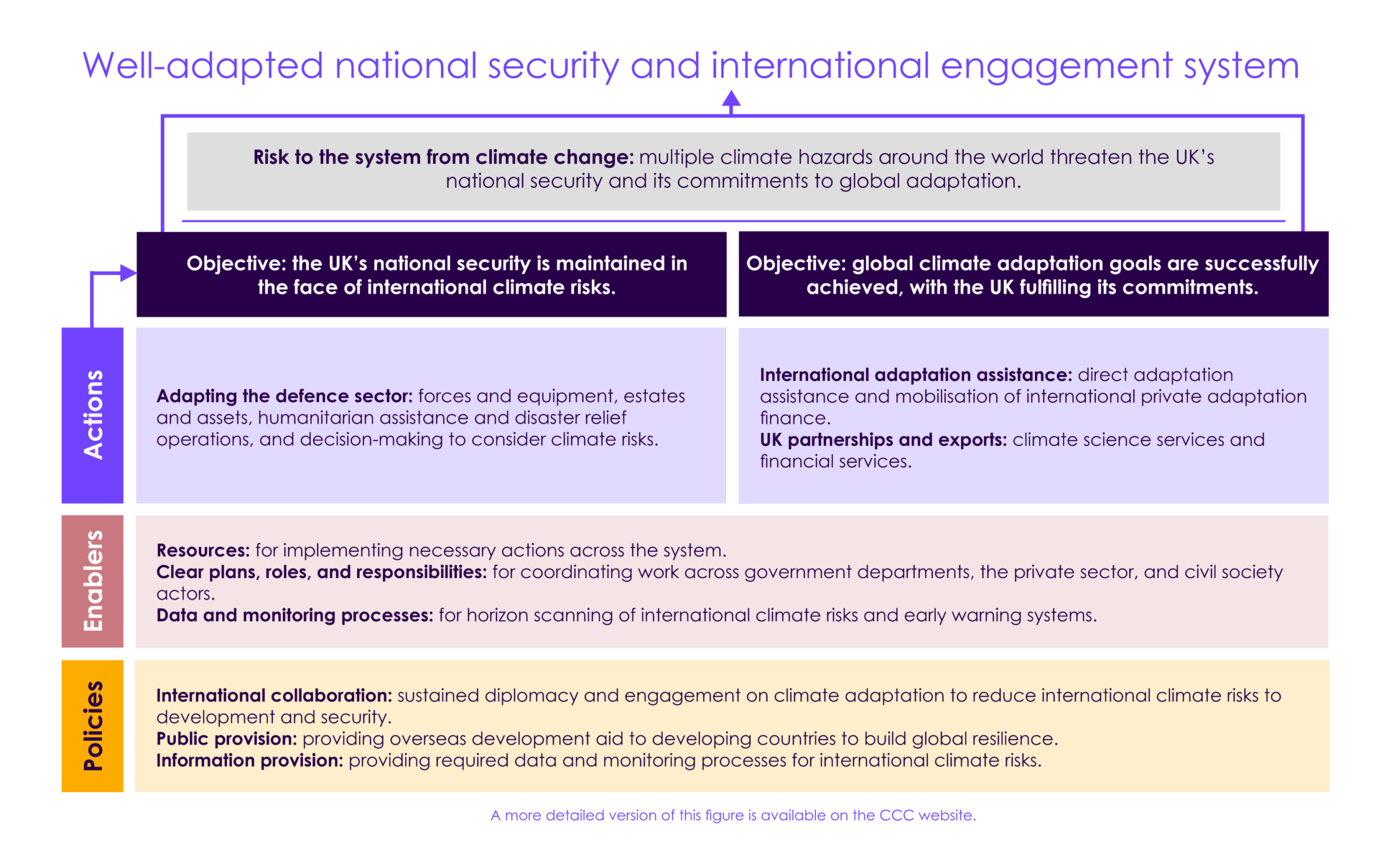 Notes: a more detailed, interactive version of this figure is available in the Climate Change Committee’s Adaptation Monitoring Framework. |
|
Box 17.1 |
The UK has international influence across several areas.[1544]
|
17.1 Set ambition
This section sets out the necessary ambition for adapting to the risks from climate change in the national security and international engagement system.
17.1.1 Climate risks to the national security and international engagement system
Climate change globally can contribute to increased conflict and geopolitical tensions, with implications for UK national security and humanitarian response objectives. Rising global climate risks, through changes in average conditions and more frequent extreme weather events, threaten global development. International agreements to which the UK is committed set global goals of enhancing adaptive capacity, strengthening resilience, and reducing vulnerability to climate change.
There are several pathways through which climate change can impact UK foreign policy, development, and national security interests within scope of the national security and international engagement system. Given the broad scope and complexity of risks to national security and development, there is limited quantitative evidence on impacts at different levels of global warming. Therefore, we discuss these risks in largely qualitative terms, rather than the 2ºC and 4ºC framing used for other systems.
- Climate change and global development: climate change impacts, weak economic development, and inequality exacerbate each other. Climate change intensifies existing vulnerabilities and inequalities and increases the threat of long- and short-term development challenges.[1553] Climate change impacts are felt unequally, with marginalised groups impacted most.[1554] Inequality, poverty, and marginalisation in turn amplify climate risks and reduce the capacity to adapt. Vulnerability is unevenly distributed – it is higher in places with poverty and weak governance and in places with violent conflict.[1555]
- Climate change and migration: climate hazards are a growing driver of involuntary migration, typically as one factor interacting with a series of other drivers.[1556];[1557] 60% of refugees and people displaced within countries live in countries that are among the most vulnerable to climate change.[1558]
- Most climate-related migration takes place within countries.[1559] Climate-related international migration is most often observed between neighbouring countries or between countries with established links, such as cultural ties.[1560] There are significant challenges in projecting future climate-related migration.[1561]
- The UK is unlikely to be a large receiver of climate-related migrants. It is geographically far from the most climate-vulnerable countries, though it does have strong links to some, for example through large diaspora populations.[1562];[1563] However, there is limited evidence on the role that climate change may play in migration to the UK.
- Reducing future risks of involuntary migration is possible through international cooperation, including dedicated relocation schemes.[1564];[1565]
- Climate change and security: there is limited evidence of a direct causal link between climate change and instability or conflict. Climate change may contribute to instability through indirect pathways, such as via food or water security, ecosystem collapse, resource scarcity, or migration.[1566];[1567];[1568];[1569] Climate change is a systemic problem that impacts the broad security agenda.[1570] Changing average climate conditions and extreme weather events will impact directly on defence sector demands and capabilities in a highly context-specific way.[1571];[1572];[1573]
- There may be increased demands on the UK’s armed forces, from both combat operations and humanitarian assistance and disaster relief (HADR) operations. The Council on Strategic Risks tracked 251 military deployments by all countries globally for climate-related disaster-response in 2024.[1574] Such demands are likely to increase, potentially straining readiness for core defence tasks.[1575]
- The UK Government has responsibilities to British Oversees Territories (BOTs), in the context of HADR demands, many of which are highly vulnerable to climate change.[1576];[1577];[1578]
- Climate change is placing pressures directly on the defence sector’s bases, equipment, personnel, and operations. This will continue both through changing average climate conditions, such as the impact of sea level rise on low-lying military bases, and changes in extreme weather. For example, heat stress is already a problem for militaries and is likely to increase. In the extreme-dry heat conditions of Iraq in 2003, there were 766 heat-implicated UK military casualties requiring hospital admission reported during the first six months of operational deployment.[1579] The average maximum temperature on the hottest days in the Middle East and North Africa region is projected to increase to 46ºC under 2ºC global warming by mid-century. This compares to 43ºC in the period 1986 to 2005.[1580]
- There are increasing military and geopolitical risks associated with the growing commercial interests in the Arctic, as melting sea ice opens trade routes, with Russia and China aiming to exert control in the region.[1581];[1582]
- International systemic, cascading, and compound risks: as climate change impacts and risks become more complex, there will be multiple cross-border impacts interacting with each other and with risks in systems other than the climate.[1583];[1584];[1585] Exposure to multi-sector risks of those living on less than $10 per day is projected to increase by 60–258% between 1.5°C and 2°C warming, and increase by another 57–185% with 3°C warming.[1586] Global biodiversity loss and damage to ecosystems also connect to, and amplify, climate impacts.[1587] Interacting climate risks can push sensitive ecosystems and connected communities towards tipping points.[1588] In turn, these can impact on development and security, leading to broad impacts spreading through societies and economies, potentially triggering major social changes.[1589];[1590];[1591] For example, research has documented connections between drought, water scarcity, deteriorating international relations and terrorism in the Lake Chad Basin.[1592] Early warning systems are an important adaptation which can help detect hazards early and prevent them from triggering knock-on impacts.[1593];[1594]
17.1.2 Objective for a well-adapted national security subsystem
Objective: the UK’s national security is maintained in the face of international climate risks under the current and future climate.[1595]
Achieving this objective means that the UK defence sector can continue to operate effectively as global average climate conditions change, and extreme weather events increase in frequency and magnitude. It also means that climate resilience is embedded into strategic and operational UK national security considerations. This requires acknowledging that climate resilience is an unavoidable part of national security.
To deliver on this objective, ambition is required to adapt the defence sector and account for international climate risks to national security. There is currently insufficient evidence to suggest measurable targets to complement this objective under these two areas, but targets should be considered as the evidence base develops further.
Adapting the defence sector
The UK’s defence sector faces specific challenges from climate change relating to the potential for increasing demand and changing operational challenges and must adapt to these (see Section 17.1.1). While we do not suggest quantified targets in this area at this time, greater data availability may make setting targets possible in future.
International examples offer a potential blueprint for the UK defence sector. These have, for example, set out the costs of extreme weather already being absorbed, where adaptation effort can be targeted, how climate data and tools can be used to support risk assessment, and how awareness of climate risk can be embedded across the defence sector.[1596]
There is no public evidence on the cost of ensuring the UK defence sector’s capabilities are made climate resilient. It is expected to increase costs in the short term but save money and avoid disruption further down the line.[1597] The Defence Science and Technology Laboratory has examined how to overcome affordability and incentivisation barriers affecting the uptake of solutions, including integrating resilience measures early in planning.[1598]
Accounting for international climate risks to UK national security
The national security sector needs to account for climate risks in its planning and operations. While we do not suggest quantified targets, there are important qualitative implications of this. It requires integrating climate change into national security policies, strategies, and operations, such as horizon-scanning for risks. It also includes joined-up consideration of systemic and cascading international risks, and their implications for national security.
There are international examples of good practice on which the UK can draw. These have included assessments by defence ministries and national security bodies. For example, they have set out judgements of how climate impacts are likely to affect geopolitical stability, and plans to incorporate such considerations into relevant strategy, planning, and processes.[1599];[1600] The UK Government has published an assessment of national security risks from global biodiversity loss and ecosystem collapse, with implications overlapping with climate change.[1601]
17.1.3 Objective for a well-adapted international climate adaptation subsystem
Objective: global climate adaptation goals are achieved under the current and future climate, with the UK fulfilling its international commitments.
Achieving this objective means that the UK plays a meaningful role in the successful delivery of global adaptation goals. The UK is committed to several international agreements which require countries to play their part in promoting greater climate resilience. The Paris Agreement established a headline aim to “increase the ability to adapt to the adverse impacts of climate change and foster climate resilience”. It also established a “global goal on adaptation of enhancing adaptive capacity, strengthening resilience and reducing vulnerability to climate change”.[1602] As well as the Paris Agreement, the UN Framework Convention on Climate Change (UNFCCC), the Convention to Combat Desertification, and the Convention on Biological Diversity, all commit developed countries to support developing countries with climate adaptation, or measures relevant to it.[1603];[1604];[1605];[1606]
Although there has been progress in global adaptation planning and implementation, adaptation gaps remain.[1607]
The UK is one of many developed countries with responsibilities to support developing countries to adapt to climate change. It is not expected to deliver global goals alone and will not individually be held to account for their delivery. Nonetheless, the UK also stands to gain from a more resilient world.
- By working to build countries’ resilience, the UK can support them to be better prepared for the risks that a changing climate brings. Economies will be more resilient, and the drivers of conflict and involuntary migration will be reduced. This means regions will be more stable, and the chance of climate risks producing knock-on impacts across sectors or borders will be lowered.[1608] This should help to minimise the need for disaster response support in future and reduce the risks to UK security interests.
- UK action and leadership on global climate adaptation can also foster collaborative relationships with international partners, building goodwill extending beyond the climate realm.
To deliver on this objective, we suggest targets on increasing adaptative capacity globally and providing UK financial support for global climate adaptation. In the national security and international engagement system, where much relies on political judgement, we recognise that targets will be directional trends rather than specific levels. The UK Government may choose to propose alternative targets where they have different priorities, trade-offs to consider, or further evidence (Box 3.11).
Increasing adaptive capacity globally
The Paris Agreement sets out the importance of increasing the ability to adapt to the adverse impacts of climate change.
Proposed target: from now through to 2050, the ability to adapt to climate change should be increased globally.
- Meeting this target will support a global reduction in the vulnerabilities of economies, societies, and ecosystems, and their exposure to climate hazards.
- The UK is not expected to deliver this target alone. Nonetheless, it relates to the ultimate goal of international agreements to which the UK is committed and is therefore important to track. The UK has specific responsibilities for the resilience of BOTs, in particular for providing disaster response. Many of them are highly vulnerable to climate change – the National Risk Register includes a specific risk for disaster response in the BOTs.[1609];[1610];[1611] As British citizens, the roughly 270,000 population of BOTs generally have the right to reside in the UK, representing a potential source of migration to the UK mainland.[1612]
- There are several characteristics that correlate with increasing capacity to adapt. Economic development facilitates adaptation by expanding the resources and capacity available to manage climate risks.[1613];[1614] Effective implementation of adaptation actions depends on good governance (formal and informal) and strong institutions.[1615];[1616] Access to finance is essential for implementation of adaptation actions, but has consistently been challenging, especially for least developed countries and small island developing states.[1617];[1618];[1619]
- Progress against this target can be measured using the Notre Dame Global Adaptation Initiative (ND-GAIN) Country Index as an available proxy for tracking vulnerability and adaptation readiness globally (Figure 17.2) (see Section 17.4).[1620] The vulnerability and adaptation readiness of the average country globally and across regions has increased since 1995. The highest ranked countries in 2023 score above 70, compared to the average country globally scoring 48. Internationally funded adaptation interventions have led to improvements in many of the metrics underpinning the ND-GAIN Country Index.[1621]
| Figure 17.2 Change in global adaptation readiness and climate change vulnerability |
 Description: There have been gradual improvements, globally and across regions, in readiness to adapt and in vulnerability to climate change since 1995. |
UK-provided finance supporting adaptation
As well as its global goals, the Paris Agreement requires developed countries to provide financial resources to assist developing countries to adapt to climate change, and to take the lead in mobilising climate finance.[1622] It also calls for cooperation to improve the effectiveness and durability of adaptation actions. The UK provides both public and private finance towards international climate adaptation.
Proposed target: from now through to 2050, UK-provided international finance should give sufficient weight to climate change adaptation and should be effective in building climate resilience.
- Meeting this target will ensure the UK is delivering on its commitments to support developing countries to adapt to climate change.
- The UK Government allocates a portion of its ODA to supporting developing countries to respond to the challenges and opportunities of climate change. This is known as UK international climate finance (ICF). To ensure that the impact of UK ICF is maximised, it is important that a sufficient amount supports adaptation and building resilience. The funding also needs to be used effectively, achieving its aims and ensuring good value for money. The UK Government will need to determine how ‘a sufficient amount’ should be defined for future ICF periods.
- Public finance alone will not meet the adaptation needs of developing countries. The UK’s finance sector is a global leader, offering the potential to mobilise larger amounts of capital than through public finance alone.
- Progress against this target can be, in part, measured using ICF key performance indicators (KPIs) relating to outcomes on adaptation and resilience (Figure 17.3) (see Section 17.4).
| Figure 17.3 Number of people supported to better adapt through UK International Climate Finance |
 Description: Since 2011, the number of people supported to adapt to climate change by UK International Climate Finance (ICF) has been steadily increasing. |
17.2 Identify actions
The following section sets out the priority adaption actions required to achieve the climate adaptation objectives for UK national security and international climate adaptation.
17.2.1 Actions in the national security subsystem
We focus proposed actions on the defence sector, as the area where concrete required steps are clearest. This does not imply that there are no actions for the wider national security sector to take, but these are explored through the enabling delivery section of this chapter (see Section 17.3).
Adapting the defence sector
To maintain national security in the face of international climate risks, the defence sector must adapt its capabilities, including to manage increased demand for HADR operations. This includes actions on several fronts.
- Forces and equipment: adaptation is required to be able to train and operate in more extreme weather conditions. Given the long lead times on most military equipment, in the near term this requires a focus on integrating climate considerations into procurement processes, including risks to supply chains themselves. See Section 16.2 for types of adaptation actions to improve supply chain climate resilience.
- Estates and assets: adaptation is needed to be able to withstand slow-onset climate impacts, such as sea-level rise, and sudden extreme climate events, such as flooding. See Section 5.2 and Section 10.2 for types of adaptation actions to improve asset resilience to climate change.
- Decision-making: adaptation requires embedding climate considerations, integrating relevant climate-related data, and evaluating the impact of potential climate hazards on plans and operations. See Section 6.2 for types of adaptation actions to improve decision-making in emergency response.
An additional consideration in adapting the defence sector is the intersection between national security and international development activities. In directly applying military capacity towards humanitarian response, HADR operations represent a clear intersection, but there are broader links which should also be considered. Strengthening resilience can support economic stability and improve development outcomes, which in turn can contribute to more stable and secure societies. As a result, international security pressures can be reduced.[1623];[1624];[1625];[1626]
17.2.2 Actions in the international climate adaptation subsystem
As a developed country party to the Paris Agreement, the UK has an obligation to support developing countries to adapt and build resilience to climate change and stands to gain from doing so. The Paris Agreement also calls for the integration of adaptation into broader policies and actions.[1627]
The following actions are required for the UK to play its full role in the delivery of global adaptation goals. They are grouped into actions for the UK Government and actions for the UK more broadly.
International adaptation assistance
The UK Government can provide support both through direct ODA finance, and through leveraging private finance.
- Direct adaptation assistance: provision of adaptation assistance is a direct route for the UK Government to support other countries and territories to adapt.
- The UK’s ICF funding is the primary vehicle for delivering on its international finance obligations under the Paris Agreement. To ensure it makes a material impact to global goals, it needs to be effective. Effective adaptation assistance is context-specific, giving consideration to the characteristics of the community where they take place, and community-led, to ensure integration with local priorities. It also includes a focus on capacity development to share knowledge and strengthen climate adaptation governance.[1628];[1629];[1630]
- The UK Government also has obligations to BOTs, some of which have expressed challenges in accessing financial support for adaptation.[1631];[1632] All but three of the 14 BOTs are ineligible for ODA. Therefore, alternative support mechanisms are required.[1633] The Conflict Stability and Security Fund has supported BOT’s climate resilience projects in the past, though its successor, the UK Integrated Security Fund, has not supported climate projects so far.[1634];[1635]
- There is a strong overlap between countries affected by conflict and fragility and those vulnerable to climate change.[1636] These states contain a disproportionate number of those living in extreme poverty – and so are important for global development goals – but receive proportionately less climate finance.[1637];[1638] They also account for a substantial share of the involuntarily displaced globally.[1639]
- Mobilising international private adaptation finance: while the UK Government’s provision of funding is the most direct tool it has to support adaptation in developing countries, there is the potential to leverage much greater sums through mobilising private sector finance.
- The gap between current adaptation finance and what’s needed in developing countries is estimated to range from $284–$339 billion per year until 2035. Public finance from developed countries only contributes $26 billion, as of 2023.[1640] Private finance is needed to help bridge the gap. However, in 2023 only $4 billion was invested privately in adaptation and several barriers have been identified to it scaling up.[1641] For example, there are often low perceived or actual returns on investment and a lack of country-level knowledge. There are also challenges in measuring impact and information mismatches between recipient countries and private investors have been identified.[1642];[1643];[1644];[1645]
- There are also potential solutions. A growing body of evidence suggests that in certain sectors good private returns to adaptation investments can be achieved.[1646] To help enable this, governments and multilateral institutions can collaborate to improve incentives and create innovative financial instruments.[1647] Approaches such as climate-resilient debt clauses (CRDCs) and blended finance, including guarantees and concessional debt, have been proposed and demonstrated to be effective in some cases.[1648];[1649];[1650] The UK Government is already engaged, including through UK Export Finance, the first export credit agency to offer CRDCs.[1651] British International Investment is also engaged, with their Climate Innovation Facility piloting tools to attract commercial investors into adaptation projects.[1652]
Supporting pre-emptive adaptation and resilience-building can also be prudent financially. Adaptation now can avert, minimise, and address future loss and damage, as the UK Government has recognised in the context of its ICF.[1653] More resilient countries and regions are likely to be more stable, and populations are less likely to be forcibly displaced, improving outcomes relevant to global development and UK national security.[1654]
UK climate science and services: partnerships and exports
The UK has world-leading capabilities in several sectors important to climate adaptation and resilience. In climate science, the UK hosts several of the world’s top institutions and is the country with the most authors appointed for the Intergovernmental Panel on Climate Change’s Seventh Assessment Report cycle.[1655] In insurance, the UK is the third largest market globally.[1656] Through international collaboration, these goods and services can be shared and exported, supporting others to build resilience internationally while offering opportunities for UK businesses.
- Climate science services: building on the UK’s existing climate services activities, organisations such as the Met Office can continue to work with international partners. These services can include weather forecasting, early warning systems, and building climate science capabilities.[1657];[1658] The Met Office has a track record of delivering impactful projects (Box 17.2). The Met Office’s existing Hadley Centre Climate Programme has been assessed as offering good value-for-money, with a benefit-cost ratio of 33:1.[1659]
- Financial services: the private finance sector, including the City of London and its insurance activities, can also play an important role, independently or collaboratively with the UK Government. Initiatives are already underway, such as Humanity Insured, a non-profit capitalised by seven global insurance companies, aiming to insure vulnerable communities.[1660] The Global Risk Modelling Alliance and the Oasis Loss Modelling Framework, two platforms seeking to improve risk analytics for vulnerable countries, were created out of the London insurance market.[1661];[1662] The Insurance Development Forum, a partnership with a mission to close insurance gaps in developing countries, was founded in London and has many British insurers as active members.[1663] Through the Room to Run scheme, the UK Government and three City of London insurance providers used a risk transfer mechanism to increase the African Development Bank’s lending headroom.[1664];[1665]
|
Box 17.2 |
From 2018 to 2022 the Met Office, the Foreign, Commonwealth and Development Office (FCDO), and the World Bank worked in partnership on the Asia Regional Resilience to a Changing Climate programme.[1666] Funded by UK ODA, it included several projects focused on strengthening resilience through improved weather and climate forecasting in several highly climate-vulnerable countries in South Asia. The programme produced several important outputs, for example:
In total, the programme supported the climate resilience of over two million people in South Asia.[1667] |
17.3 Enable delivery
This section sets out key enablers and policies to deliver the adaptation actions at the required scale and urgency for a well-adapted national security and international engagement system.
17.3.1 Enablers
Most adaptation needed in the national security and international engagement system will be delivered by the UK Government (Table 17.1). The most important enablers for these actions are appropriate resources, clear plans and responsibilities, and improved data and monitoring processes.
- Resources: sufficient resources are required to implement necessary actions across the system.
- For the UK to meet its international obligations, the Government will need to continue making funds available to provide meaningful international finance.
- The defence sector will also need sufficient funding to ensure climate resilience is embedded into its assets and equipment planning and investment. There is no public evidence on the cost that would entail, though the sector has recognised that delaying adaptation would likely increase costs overall.[1668]
- Clear plans, roles, and responsibilities: policy responsibility relating to national security and international development sits across several government departments, including the FCDO, the Home Office, the Ministry of Defence (MoD), and the Cabinet Office. It is important that there is an effective mechanism in place to collaborate between, and coordinate work across, these departments, as well as with private sector and civil society actors.
- Data and monitoring processes: effective adaptation to international risks requires good data and horizon scanning, covering both the risks themselves and potential adaptation actions required to reduce or avoid them. It is also important to monitor the effectiveness of actions taken.
- Multiple interacting climate risks can trigger tipping points in natural and social systems, with implications for global development and national security. Early warning systems can help detect and prevent these knock-on impacts (see Section 17.1.1).
- There are positive UK and international examples to build on. The UK and Canada’s joint CLARE programme is researching the effectiveness of interventions around climate-related migration in South Asia.[1673] Jordan is developing the world’s first national climate security intelligence assessment capability, with support from UK experts at the Climate Change and (In)Security Project.[1674] It intends to provide decision-makers with early warning systems and information to support planning, preparedness, and adaptation response.[1675] Similar proposals have been made for the UK.[1676]
- Many of the data and warning systems would be valuable across defence, security and development operations. Evidence that the armed forces need to ensure operations are safe and effective in changing weather conditions can also be useful for international development activities. Enabling the effective sharing of these would support the efficient use of resources.
17.3.2 Policies and plans
The key policy areas within the system for international development, defence policy, and national security are largely reserved. The Northern Ireland Executive, the Scottish Government, and the Welsh Government play a role in international development, to varying degrees, and the Scottish National Adaptation Plan includes a section on international action, noting their pledged funding for loss and damage, which now totals £7 million (2025 prices).[1677];[1678];[1679]
Existing policy action
Existing policy is largely carried out at the UK Government level. For the first time, the Third National Adaptation Programme had a dedicated section on addressing international risks. This noted actions being undertaken across several government departments (for example, the FCDO, the Home Office, and Cabinet Office).[1680] There is also recognition of international collaboration within devolved programmes.[1681]
The UK Government undertakes several roles in this area:
- Diplomacy: several government departments, including the FCDO, the Department for Energy Security and Net Zero (DESNZ) and the Department for Environment, Food and Rural Affairs (Defra), conduct international engagement on climate change across various forums, including the UNFCCC, G20, and G7.
- Horizon-scanning and recognition of risks: national security functions across government departments conduct or have committed to risk-scanning exercises.
- The Chronic Risks Analysis, which complements the National Risk Register, explores climate change vulnerabilities, risk-reducing measures, and interconnections of climate change with other chronic risks (Box 3.1).[1682]
- The 2025 National Security Strategy recognised climate change as a contributing factor in threats to UK national security.[1683] The UK Government has published an assessment of the national security implications of global biodiversity loss and ecosystem collapse, noting the interactions with climate change.[1684] International examples, such as from Germany, offer illustrations for how climate risks could be further integrated into national security assessments.[1685]
- The MoD has recognised the need to adapt to a changing climate, notably in its 2021 Climate Change and Sustainability Strategic Approach, and more recently in its Strategic Defence Review 2025.[1686];[1687] The Defence Science and Technology Laboratory, working with the Met Office, has conducted an assessment for the MoD of the impact climate change may have on future defence capability. This resulted in the publication of a climate change and defence ‘biscuit book’ in 2024.[1688];[1689]
- International assistance: the UK has historically been a relevant actor in the provision of international finance. The FCDO, DESNZ, and Defra deliver UK ICF, as well as some non-ODA international support. Between 2021/22 and 2025/26 the UK has committed to spending £11.6 billion of ICF, including a commitment to triple adaptation spending from £0.5 billion in 2019 to £1.5 billion in 2025.[1690] The UK is one of 27 partners voluntarily contributing to the UNFCCC loss and damage fund, as of November 2025.[1691]
Policy actions for a well-adapted system
To move towards a well-adapted international system, the UK Government will have to work through three key avenues: diplomacy, development assistance, and information provision.
- Sustained diplomacy and engagement on climate adaptation can help to reduce international climate risks to development and security. Key international forums include the UNFCCC, the G7, the G20, and NATO. The expected UK presidency of the G20 in 2027 offers an opportunity to prioritise international collaboration on climate adaptation.[1692]
- The UK has a strong track record of leadership in international climate negotiations, including through the hosting of COP26, and has been recognised as contributing constructively to facilitate strong outcomes.[1693];[1694] Under the negotiated requirements of the Paris Agreement, the formulation and implementation of national adaptation plans across developing countries has expanded.[1695]
- In the defence context, the ability of government to procure climate-adapted and resilient equipment relies on the engagement of the private defence industry. The UK Government is a relatively small buyer in an international context. Coordination with allies, particularly through NATO, can provide a stronger signal to manufacturers and allow for better-aligned climate-resilient capabilities and interoperability.[1696]
- The UK can build on previous multilateral collaboration in relation to climate change and security.[1697];[1698];[1699] Examples include the convening of a high-level dialogue on responding to climate change’s cascading security impacts at COP28, inclusion of the climate-security nexus in a 2025 UK-EU defence partnership, and participation in various forums focused on climate-related migration.[1700];[1701];[1702] Collaboration offers the opportunity for the UK to learn from others, as well as influence and share experience.
- Providing ODA to developing countries can continue to build global resilience. With the existing ICF commitment due to expire in 2026, the UK will need to set out a new contribution. This will sit in the context of the agreement at COP29 for developed countries to take the lead in mobilising at least $300 billion per year for developing countries, within the context of a wider goal involving all actors to scale up financing to developing countries to at least $1.3 trillion per year by 2035.[1703] It will also sit in the context of the call to triple adaptation finance by 2035 made at COP30.[1704]
- Robust information provision is central to adaptation to international climate risks. It will largely be the role of government to provide or enable the required data and monitoring processes.
- Through climate service programmes, government can facilitate the sharing of information from UK centres of expertise. There are positive examples to build on, such as the Advanced Research and Invention Agency’s £81 million (2025 prices) research programme developing an early warning system for tipping points, providing climate data around Greenland and the North Atlantic.[1705]
- A dedicated centre of excellence, designed to complement existing national security architecture, could play an important role developing and integrating climate data relevant to the future operating environment (including through early warning systems) and decision support into national security work.[1706];[1707] The proposed Defence Energy and Capability Resilience Centre of Excellence could play this role (amongst its other functions), with cross-government engagement needed to ensure the whole national security sector capitalises on the opportunity.[1708]
- Public adaptation plans can increase confidence that the defence sector is building resilience. The Climate Change and Sustainability Strategic Approach made several short and medium-term commitments.[1709] There has been little public information setting out progress since.
| Table 17.1 Responsibilities for delivering adaptation in the national security and international engagement system |
|
| UK Government |
|
| Private sector |
|
| National governments |
|
| Notes: National governments includes the role of the UK Government in England; and in Northern Ireland, Scotland, or Wales where powers sit with the UK Government for that nation but are devolved to other nations. | |
17.4 Evaluate progress
Effective adaptation requires monitoring and evaluation to assess whether delivery towards objectives and targets is contributing to reducing climate risk. This section sets out the current capability to track progress against the proposed targets in the national security and international engagement system, and priority gaps for monitoring and evaluating progress.
17.4.1 Tracking progress on adaptation
The existence of monitoring and evaluation processes is uneven across the national security and international engagement system.
- Adapting the defence sector: there are no material public data on the extent to which the defence sector is adapting to the potential of increased demand or changing operational conditions due to climate change.
- Accounting for international climate risks to UK national security: although the January 2026 nature security assessment covers overlapping issues, there is no material public information on the extent to which climate risks in the round are being factored into national security considerations.
- Increasing adaptive capacity globally: the ND-GAIN Country Index is a single metric which seeks to summarise, at country level, the vulnerability to climate change and readiness to adapt.[1710]
- Indicators under the Global Goal on Adaptation agreed at COP30 could provide additional metrics to track progress.[1711] Indicator 11(a) is the “status of having national adaptation plans, policy instruments, and planning processes and/or strategies in place”. Indicator 12(a) is the “extent of implementation of national adaptation plans, policies and strategies relative to planned implementation thereof”.
- UK-provided finance supporting adaptation: the UK Government reports through two relevant avenues.
- The UK Government publishes its ICF results annually, and two reported KPIs are directly relevant to tracking progress achieved by ODA funding. These are KPI 1 (number of people supported to better adapt to the effects of climate change) and KPI 4 (number of people whose resilience has been improved).
- Through its biennial reports to the UNFCCC, the UK Government reports the amount of UK ODA provided for adaptation.
17.4.2 Addressing monitoring and evaluation gaps
Due to the sensitive nature of actions in the national security sector, the UK Government is not expected to publish progress in full. However, greater transparency is possible whilst adhering to restrictions on publishing sensitive information.
We have identified three priority gaps to monitor and evaluate adaptation in a well-adapted national security and international engagement system.
- The MoD could publish information on the action it is taking to adapt its capabilities. In particular, it could publish progress on the actions it committed to taking through the Climate Change and Sustainability Strategic Approach.[1712] Such information could be sufficiently high-level to ensure no sensitivity risks, whilst giving a clear sense of progress.
- The Cabinet Office could publicly set out how climate risks are being embedded into national security planning and operations. It could publish its risks assessments and actions taken at a sufficiently high-level so as not to jeopardise national security in the process.
- Additional ICF metrics could support greater evaluation of progress and of value for money. These could build on existing annual results publications.
- There is currently no annual time series published for either public or private finance mobilised for adaptation. Such data would enable clearer tracking of the UK’s contributions towards enhancing international adaptation.
- Presenting KPIs both in terms of absolute values (for example, number of people supported) and in terms of value for money (for example, number of people supported per pound spent), would offer an additional layer of information on ICF effectiveness. Data challenges may make this impractical for some metrics.
Annex 1: Proposed objectives and targets for a well-adapted UK
The proposed objectives and targets set out across Chapter 4 to Chapter 17 in this report are listed below. Together, they set out a clear and measurable ambition for a well-adapted UK (Box 3.11).
A1.1 Health
- Objective: public health systems prevent, prepare for, and respond to climate-related health risks ensuring communities remain safe and healthy under the current and future climate.
- Proposed target: by 2050, excess heat-related mortality should be no greater, and ideally lower, than today’s annual average.
- Objective: health and social care services provide quality and accessible care that is maintained during extreme weather under the current and future climate.
- Proposed target: by 2035, all healthcare buildings and other essential assets should maintain safe and appropriate temperatures and should be at low risk (less than 1% chance for any given year) of flooding.
- Proposed target: by 2040, all residential care homes should be able to maintain indoor temperatures between 16°C–26ºC.
A1.2 Built environment and communities
- Objective: settlements, buildings, and communities are fit-for-purpose and durable places to live and work under the current and future climate.
- Proposed target: by 2050, the most vulnerable populations should be protected from overheating and most homes in the UK should not overheat.
- Proposed target: by 2050, the total number of residential properties impacted by flooding in the UK from all sources should remain no greater than today’s level. Levels of risk should be below today’s level in all parts of the UK where this is technically feasible and cost-effective.
A1.3 Public services
- Objective: services operate safely during extreme weather at levels at least as good, if not better, than today under the current and future climate.
- Proposed target: by 2050, internal temperatures of learning environments should remain between 16°C–25°C and school sites should be at low risk (less than 1% chance for any given year) of flooding.
- Proposed target: by 2050, internal temperatures of prison and justice facilities should remain between 16°C–26°C and sites should be at low risk (less than 1% chance for any given year) of flooding.
- Objective: emergency response services effectively anticipate, prepare for, and manage adverse weather-related impacts under the current and future climate.
- Proposed target: by 2030, all emergency services and incident responders should be equipped and resourced to meet emergency services’ target response times under all-weather events.
A1.4 Cultural heritage
- Objective: cultural heritage is managed and maintained to preserve value for current and future generations under the current and future climate.
- Proposed target: by 2035, all cultural heritage assets managed for public good that are deemed ‘at risk’ should have a long-term adaptation plan.
- Proposed target: by 2050, climate risks for all at-risk cultural heritage assets should be managed.
A1.5 Water and wastewater
- Objective: water service delivery is safe and reliable under current and future climate.
- Proposed target: by 2040, water supply should be resilient to a 1 in 500-year drought.
- Proposed target: by 2050, all water bodies should achieve sustainable abstraction criteria.
- Objective: wastewater management limits negative impacts on people and the environment under the current and future climate.
- Proposed target: by 2050, properties at risk of internal and external sewer flooding in a 1 in 50-year storm event should have decreased.
A1.6 Energy
- Objective: the energy system is reliable, minimising climate-related disruption, and maintaining current levels of service under the current and future climate.
- Proposed target: from now through to 2050, the electricity system should maintain service levels at current levels of resilience or higher.
- Proposed target: from now through to 2050, following a climate-related reduction or loss of electricity supply, the supply needs of priority customers should be met within a defined number of hours, with 100% of customers restored within a defined timeframe thereafter.
A1.7 Transport
- Objective: transport is safe and reliable, with disruption to critical parts of the network kept as low, or lower, than today’s level.
- Proposed target: from now through to 2050, trunk road accident rates should continue to decline on current trends, despite climate change.
- Proposed target: from now through to 2050, high risk rail accidents associated with extreme weather should be as low as reasonably practicable.
- Proposed target: from now through to 2050, disruption to high priority road and rail routes from climate hazards should be as low, or lower, than today’s level.
A1.8 Waste
- Objective: waste sites are managed safely and do not harm people or the environment under the current and future climate.
- Proposed target: by 2035, all mining tips should have been assessed and tips in the highest risk categories should be effectively adapted to ensure they are no longer a risk to public safety from landslides.
- Proposed target: by 2030, all sites should have been assessed and categorised by risk level to identify the sites where adaptation is most needed.
- Proposed target: by 2050, all sites classified as at high risk of harm from the release of hazardous waste into the environment due to flooding, waterlogging or coastal erosion, should be effectively adapted.
A1.9 Digital and telecoms
- Objective: data centres and telecoms maintain continuity of service for emergency services and critical infrastructure under the current and future climate.
- Proposed target: from now through to 2050, there should be no losses of service to CNI functions, including emergency calls, due to climate-related hazards.
A1.10 Land
- Objective: land is healthy, diverse, and managed for the future, whilst productivity is maintained without degrading the land under the current and future climate.
- Proposed target: by 2030, 30% of land should be protected for nature and by 2050 should be in good condition.
- Proposed target: by 2050, habitat connectivity should be increased through the creation of a defined level of good quality ecological corridors.
- Proposed target: from now through to 2050, domestic food production as a share of food consumed should be sustainably maintained at 60% at least.
- Proposed target: by 2030, all trees planted should be suitable for a future climate, and no more than 65% of an area of planting should be covered by a single species.
A1.11 Sea
- Objective: seas are healthy and diverse, with climate-responsive management practices for habitats and fisheries under the current and future climate.
- Proposed target: by 2030, marine protected areas should have adaptation management plans in place, and by 2050, should be in favourable condition.
- Proposed target: by 2050, commercial fish stocks should be sustainable under 2°C of global warming.
A1.12 Food security
- Objective: UK food security remains at current levels, with no prolonged food shortages and minimised impacts from climate-related food price inflation under the current and future climate.
- Proposed target: from now through to 2050, there should be no climate-related food shortages across entire nutritionally important groups in the UK.
- Proposed target: from now through to 2050, the impact of climate-related food price inflation on household budgets should be minimised.
A1.13 Economy and finance
- Objective: businesses can manage climate risks and have opportunities to prosper, deliver goods and services, and provide safe and productive workplaces under the current and future climate.
- Proposed target: by 2030, all businesses should have access to useful climate risk and adaptation information.
- Proposed target: by 2035, all large companies should have high-quality adaptation plans integrated into core business functions.
- Proposed target: from now through to 2050, rates of workplace illness and accidents due to heat should not rise.
- Objective: financial institutions manage climate-related financial risks and can continue to offer financial products without substantially raising prices under the current and future climate.
- Proposed target: by 2030, all Prudential Regulation Authority-regulated banks and insurers should be quantitatively assessing current and future physical climate risks and how adaptation interventions can reduce these risks.
- Proposed target: from now through to 2050, the UK insurance protection gap should not grow due to climate change.
- Objective: the macroeconomy swiftly recovers from climate impacts and maintains stability across key economic objectives under the current and future climate.
- Proposed target: from now through to 2050, public debt and deficits should meet fiscal rules when assessed in the presence of foreseeable but unpredictable climate impacts.
- Proposed target: from now through to 2050, inflation should be resilient to climate conditions and climate impacts should not prevent the Monetary Policy Committee from delivering on its remit over a multi-year horizon.
A1.14 National security and international engagement
- Objective: the UK’s national security is maintained in the face of international climate risks under the current and future climate.
- Objective: global climate adaptation goals are achieved under the current and future climate, with the UK fulfilling its international commitments.
- Proposed target: from now through to 2050, the ability to adapt to climate change should be increased globally.
- Proposed target: from now through to 2050, UK-provided international finance should give sufficient weight to climate change adaptation and should be effective in building climate resilience.
Annex 2: Summary of supporting research
The analysis for the Well-Adapted UK report was supported by a body of additional research projects:
- The CCRA4-IA Technical Report, produced by a consortium of academic authors, led by the Met Office.
- Five projects focused on understanding cost-effective adaptation.
- Eight projects supporting our cross-cutting and economics work.
This annex summarises the CCRA4-IA Technical Report, the cost-effective adaptation research method and projects, and the other supporting research. Full reports and datasets are available on the UK Climate Risk website.[1713]
A2.1 CCRA4-IA Technical Report
The risks and opportunities identified in the CCRA4-IA Technical Report underpin the context for what being well-adapted looks like across our systems.[1714] The Technical Report assesses the most up-to-date evidence and identifies 41 risks and two opportunities from climate change in the UK (Table A2.1, Box A2.1).
Evidence for each identified risk or opportunity is assessed for England, Northern Ireland, Scotland, and Wales, across both central and high climate scenarios. The urgency score is based on the magnitude of impact and confidence in the evidence base. The overall score is taken as the highest component score from either England, Northern Ireland, Scotland or Wales (Table A2.1).
| Table A2.1 Climate risks and opportunities identified in the CCRA4-IA Technical Report |
||||
| Critical action needed | ||||
| H1: Risks to people from heat. | BE1: Risks to buildings and communities from heat. | BE2: Risks to buildings and communities from flooding. | N10: Risks to food security. | I1: Risks to the delivery of infrastructure services from interdependencies with other infrastructure systems. |
| E1: Risks to UK macroeconomic performance and stability. | E2: Risks to domestic and overseas physical assets of UK businesses. | E5: Risks to financial institutions and the financial system. | ||
| Critical investigation | ||||
| H3: Risks to people from changes in air quality. | BE6: Risks to cultural heritage and landscapes. | BE8: Risks to local resilience planning and emergency service response capabilities. | N4: Risks to soil ecosystems. | I4: Risk to fuel supply systems. |
| I5: Risks to road transport systems. | I7: Risks to aviation and maritime transport systems. | I10: Risks to waste management systems, excluding wastewater systems. | E3: Risks to domestic and international supply chains and resource inputs of UK businesses. | E4: Risks to productivity and availability of labour in the UK. |
| E6: Risks to public finances. | E7: Risks to household finances. | E8: Opportunities to UK businesses and financial institutions from delivering adaptation goods and services. | ||
| More action needed | ||||
| H2: Risks to people from extreme weather, excluding heat. | H4: Risks to people from climate-sensitive infectious diseases. | H6: Risks to health and social care delivery. | BE3: Risks to buildings and communities from coastal change. | BE4: Risks to buildings and communities, excluding from heat, flooding, and coastal change. |
| BE5: Risks to indoor environmental quality. | BE7: Risks to facilities delivering public services, excluding health and social care. | BE9: Risks to households from changing energy demand. | N1: Risks to terrestrial and coastal ecosystems. | N2: Risks to freshwater ecosystems. |
| N3: Risks to marine ecosystems. | N5: Risks to natural carbon stores and sequestration. | N6: Risks to agriculture. | N7: Risks to fisheries and aquaculture. | N8: Risks to forestry. |
| I2: Risks to electricity generation. | I3: Risks to electricity transmission and distribution systems. | I6: Risks to rail transport systems. | I9: Risks to water supply and wastewater systems. | |
| Further investigation | ||||
| H5: Risks to food safety and nutrition. | N9: Opportunities for agriculture, forestry, fisheries, and aquaculture. | I8: Risks to digital and communications systems. | ||
|
Box A2.1 |
Opportunities to the UK from climate change, where benefits can be realised if appropriate adaptation interventions are taken, are few and far between. Opportunities require adaptation action to be realised and climate risks pose barriers to the feasibility of realising these opportunities. The CCRA4-IA Technical Report assesses the following opportunities:[1715]
|
A summary of the findings of the CCRA4-IA Technical Report for each of its five risk assessment areas is provided below.
A2.1.1 Health and wellbeing
The CCRA4-IA Technical Report finds that the most critical risk to health and wellbeing from climate change is from rising temperatures. Excess heat-related mortality during heatwaves is expected to rise from 1,400–3,000 per year currently to 3,800–10,000 per year by 2050 under a 2°C scenario, across the UK, not accounting for population growth or adaptation.[1716] Most of these deaths are projected to occur in England and Wales, but excess heat-related mortality in Northern Ireland and Scotland are also projected to increase. Where high exposure is combined with high vulnerability factors, such as age and health, there are hotspots of risk, often in urban areas. Heat is identified as a compounding hazard, impacting the health of individuals directly, as well as increasing pressures on health and social care systems.
There is increasing evidence linking climate change risks with adverse health outcomes compared with previous assessments. Risks of flooding-related disruption to health and social care are projected to rise, with the number of hospitals at risk of flooding from rivers, the sea, and surface water increasing from 26% currently to 32% in the 2050s.[1717]
Climate-sensitive disease vectors are already being recorded in Europe. Modelling suggests that parts of England are already suitable, or will become suitable by mid-century, for the mosquitos that can carry diseases such as dengue fever and chikungunya. These risks require more action. Air quality is also projected to result in very high mortality (over 30,000 deaths per year), but there is low confidence over how much of this can be attributed to climate change, meaning further research is needed.[1718]
A2.1.2 Built environment
The CCRA4-IA Technical Report identifies flooding and high temperatures as critical action risks, with risks from coastal erosion, storms, and wildfire also requiring more action. Flooding already has significant impacts, with total damages across Great Britain in 2023 estimated at £2.25 billion per year (2024 prices). By mid-century, rising sea levels, wetter winters, and increased heavy summer rainfall increase the number of properties at risk of flooding in the UK by around 27%, to approximately eight million. Millions of people are already exposed to overheating, living and working in dangerous and uncomfortable temperatures leading to impacts on health and productivity. Overheating risks are expected to be lower in Northern Ireland, Scotland, and Wales, but could still reach very high magnitudes by the end of the century.[1719]
Risks to buildings and communities from coastal erosion and storms are also significant but are more localised, with more uncertain projections than flooding and overheating. Over 4,600 properties are currently at risk of coastal erosion across the UK, but impacts can be very highly local. For example, parts of the Yorkshire, Norfolk and Suffolk coast are retreating at around 2–4 metres per year. By the 2080s, coastal locations will face significant challenges from sea level rise and erosion. Storm damage claims in the UK totalled £138 million (2024 prices) in 2023. More intense periods of heavy rainfall and wind-driven rain, as well as summer soil drying, are projected to have direct and indirect impacts on buildings through damages and increasing subsidence risk.[1720]
In some areas, risks require further research on the extent of impacts. For example, there is a high risk of future summers like 2022, when the fire and rescue service were placed under extreme pressure responding to wildfires in London.[1721] Whilst information on changing hazards is clear, there is a lack of data on the demand on emergency response services, including their buildings, operations, and equipment in the future. Similarly, inevitable damage to, and loss of, some cultural heritage sites is expected due to increasing flooding, heat, and coastal erosion. However, there is a lack of evidence on how much cultural heritage is at risk and where the priorities for action are, resulting in critical investigation scores.
A2.1.3 Land, nature, and food
The key risks within the land, nature, and food chapter of the CCRA4-IA Technical Report are driven by impacts from a range of climate hazards. These impacts are accelerating the decline of terrestrial, coastal, and soil ecosystems, and disrupting the production and supply of food both within the UK and abroad. The risks within the CCRA4-IA Technical Report chapter are highly interconnected, for example, impacts to ecosystems have knock-on effects for all other risks.
Risks to food security, from climate-related disruption to both domestic food production and international supply chains, require critical action. Climate impacts are projected to increase food prices, adding at least £1 billion annually to national food spending by 2060. Extreme weather events have already impacted agriculture. For example, extreme rainfall between October 2022 and March 2024 resulted in submerged fields and contributed to a 20% reduction in the 2024 UK wheat harvest compared to 2023. More action is needed to manage climate change risks to agriculture, whilst more evidence is needed to assess opportunities for agriculture (Box A2.1).[1722]
Climate change is accelerating ecosystem degradation and more action is needed to address risks to terrestrial, coastal, freshwater, and marine ecosystems. For example, coastal ecosystems such as salt-marshes are threatened by rapid sea level rise, with range expansion often limited by infrastructure or sand dunes. Annual minimum temperatures of UK rivers and lakes are warming at an average rate of 0.3°C per decade, disrupting species distribution and food web dynamics.[1723] Carbon stores are degraded by warming and wildfires, meaning climate change may exacerbate some natural carbon sources, with more carbon released than absorbed.
The CCRA4-IA Technical Report identifies priority evidence gaps for understanding risks to soil ecosystems. Increasing high temperatures, heavy winter rainfall, and summer drought are projected to worsen soil erosion, waterlogging, and degradation of soil ecosystems. Most research to date is site or hazard-specific, and priority investigation at larger spatial scales and for multiple climate hazards is needed.
A2.1.4 Infrastructure
The CCRA4-IA Technical Report finds that the most critical risks to infrastructure are driven by the interdependencies between different types of infrastructure. Their interconnected nature makes them particularly vulnerable to extreme weather events, with failure in one type of infrastructure triggering disruption to other types. By the 2050s, large and frequent damaging risk cascades across infrastructure sectors are expected to cost billions.[1724] Energy, and digital and communication are identified as high-risk sources of disruption.
Both the exposure and vulnerability of infrastructure are also changing. Some of the sectors, such as energy generation, will see significant change from decarbonisation. Other sectors, such as transport and wastewater, are characterised by long-lived existing assets that are already at significant risk. Weather-related rail delay compensation from wind, flooding, and subsidence across England, Scotland and Wales were £382.8 million, £316.2 million, and £144 million respectively between 2006 to 2024.[1725] This risk will increase in the future, with costs to rail estimated to be in the tens of millions per year for each nation by end of the century. Drought and summer flooding pose significant risks to water and wastewater, with hotspots in all nations, such as Northeast Scotland, Southwest Scotland, and Eastern England.
The CCRA4-IA Technical Report identified key evidence gaps and uncertainty. These include risks to fuel supply, where confidence is low due to a limited number of studies and there is uncertainty in future changes to fuel supply. They also include risks to road transport, aviation, and maritime transport, and risks to waste management, where limited studies and data are publicly available. These risks have potentially high magnitude impacts. For example, slope failure in coal spoil tips following heavy rain is a particular risk in Wales. Infrastructure sectors are largely regulated, and more openly available data would improve ability to assess risk and map interdependencies.
A2.1.5 Economy
The CCRA4-IA Technical Report shows key risks in the economy chapter are driven by a range of climate hazards, and impact all parts of the UK economy, including the macroeconomy, financial systems and institutions, and UK businesses. Risks and opportunities within the CCRA4-IA Technical Report economy chapter often integrate components from other chapters. For example, risk to domestic and international supply chains considers risk to food and pharmaceutical imports within the context of maritime transport, touching on components of health, food, and transport. This wider scope, whilst a real feature of the economy, means that the high and very high magnitude thresholds (annual damages or forgone opportunities of hundreds of millions of pounds, and billions of pounds) are reached more easily than in other chapters.
The CCRA4-IA Technical Report identifies impacts in the order of billions of pounds of damages, or for risks considering the macroeconomy, in the order of 4–8% of UK GDP or tens of billions of pounds of damages by the 2080s. While the magnitudes are high in the context of the whole report, they are comparatively low in the context of the UK’s macroeconomy and financial stability. Climate change will impact UK businesses and financial institutions. Flooding is the priority risk for UK businesses, with 40% of England’s business-critical infrastructure already exposed to flood-related disruption. Extreme heat is likely to impact health and productivity of both indoor and outdoor workers, with lost outputs projected to cost the UK over £1 billion by 2050. By 2050, impacts from climate change on UK banks and insurers may reach 1% of UK GDP. Further evidence is required to understand the opportunities to UK businesses from delivering adaptation (Box A2.1).[1726]
Several of the critical investigation risks identified within the CCRA4-IA Technical Report’s economy chapter are scored as more action needed in the present or 2030 time period, and critical action needed in the 2050s and 2080s. Economic risks require continuous monitoring, such as, improved tracking of globalised supply chains exposed to climate risk overseas and risks to public and household finances from costs of climate damages.
A2.2 Research on cost-effective adaptation
To improve the evidence base for adaptation we commissioned five research projects to explore cost-effective adaptation. The projects covered a range of topics: heat and health, future flood adaptation, urban heat, water scarcity, and farmed landscape. These research areas were prioritised from evidence gaps identified in the Third Independent Assessment of Climate Change Risk (CCRA3-IA), and the need for up-to-date evidence for the Fourth Independent Assessment of Climate Change Risk (CCRA4-IA).
We developed a common framing and economic methodology to aid comparability between projects, described below.
A2.2.1 Framing
The research projects used two scenarios: ‘central scenario’ and ‘high impact scenario’. Each scenario incorporates projections of future climatic conditions and socio-economic developments.[1727] To enhance comparability, projects used a consistent climate and socio-economic framing.
Climate framing
To ensure the ambition and actions identified in the projects are fit for a changing climate, we used two climate futures to characterise potential conditions in the UK and to reflect uncertainty in the speed and magnitude of warming (Table A2.2). The use of two climate futures balances the need for simplicity and the need to account for uncertainty in both risk assessment and adaptation planning.
- Central climate: middle of the road future where global temperatures and changes in UK climate and hazards are at the centre of the expected projection range.
- We assume 2°C of warming (above pre-industrial levels) by 2050.
This is consistent with a continuation of the current rate of global warming of around 0.25°C per decade.[1728]
It is consistent with climate outcomes based on up-to-date estimates of current global emissions reduction policy and median climate response (Figure A1).
- High climate: a high global warming future where global temperatures increase rapidly and changes to UK climate and hazards are at the top of the projected range.
- We assume 4°C warming by 2100 is a plausible long-term high-end scenario.
This is because high rates of warming are still possible, particularly if the climate response to greenhouse gas emissions is more sensitive than anticipated or if there is a global scale relaxation of emissions reduction ambition (Figure A2.1).
| Table A2.2 Global warming levels and sampling of UK climate hazards to be considered at each time period |
||||
| Central climate | High climate | |||
| Time period | 2030s | 2050s | 2030s | 2050s |
| Global warming level (above preindustrial levels) | 1.5°C | 2°C | 2°C | 2.5°C |
| UK climate hazards | Median of UKCP18 at 1.5°C | Median of UKCP18 at 2°C | Upper-end of UKCP18 at 2°C | Upper-end of UKCP18 at 2.5°C |
| Source: Rogelj, J. et al. (2023) Credibility gap in net-zero climate targets leaves world at high risk. | ||||
| Figure A2.1 Global warming under different emissions scenarios |
 Description: Global temperatures have risen since 1970. Under current emissions scenarios, temperatures are projected to increase further to around 2ºC of warming by 2050. It is possible that under current emissions warming could reach 4ºC by 2100. More ambitious policies to reduce emissions could limit warming to around 1.7ºC by 2100. |
Socio-economic framing
Socio-economic changes to the UK will affect the UK’s exposure and vulnerability to climate hazards. To account for future changes two socio-economic futures were used:
- Central socio-economic: a middle of the road future in which key aspects of UK socio-economic development align with central projections from widely used official bodies.
- High socio-economic: this represents a future in which exposure and vulnerability is higher than the central future.
Each project focused on the socio-economic variable(s) most relevant to the topic. Where possible, datasets and indicators were standardised across projects to aid comparability.
A2.2.2 Methodology
A common methodology was developed for the research projects to follow. Table A2.3 sets out the five-step approach developed for the projects.
| Table A2.3 Methodological steps to identify cost-effective adaptation |
|
| 1. Rapid evidence assessment | Review existing literature to inform assumptions and collect data to be used in the following stages. Determine the impact metrics which are used to measure the impact of the hazard on the impact pathway (such as mortality). Additionally, gather data and evidence through stakeholder consultation. |
| 2. Estimate impacts of climate change today and in the future | Model the impacts of the climate hazard using the central scenario at three time horizons: an indicative ‘present-day’ year, and indicative years in the 2030s and 2050s. Convert the modelled impacts into an economic cost using HM Treasury Green Book-aligned assumptions.[1729] |
| 3. Identify and evaluate adaptation actions | Collate a long list of relevant adaptation options identified in Step 1. Use multi-criteria analysis to evaluate and short-list options. Criteria include: costs, risk reduction and feasibility, scalability, co-benefits, and synergies with other actions. For each short-listed option, quantitatively assess the costs, benefits, and co-impacts where possible, qualitatively scoring the remaining criteria. |
| 4. Build and test a cost-effective adaptation package | Test different combinations of the short-listed adaptation options rollout across the UK, and timescales of deployment to identify a cost-effective package. The cost-effective package is the combination of variables at which the ratio of benefits to costs (BCR) is maximised. |
| 5. Conduct sensitivity analysis | Test the performance of the cost-effective package to the high impact scenario to evaluate its robustness to alternative climate and socio-economic futures. |
A2.2.3 Topics
The research projects covered: heat and health, future flood adaptation, urban heat, water scarcity, and farmed landscape.
Heat and health
The Climate Change Committee (CCC) commissioned Edge Health and Greencroft Economics to assess the present and future burden of extreme heat on health outcomes and healthcare services across the UK and how adaptation options could reduce these risks. The research aimed to understand cost-effective adaptation at a national scale, focusing on actions delivered across public health, and health and social care settings.[1730]
The results are discussed in Chapter 4.
Future flood adaptation
The CCC commissioned Sayers and Partners to update their Future Flood Explorer (FFE) model to include the most up-to-date flood hazard data and to align with the climate framing used in the other research projects on cost-effective adaptation. The project explored adaptation options to the changing risk from river, coastal, and surface water flooding in the UK. The analysis focused on the relationship between investment and different outcomes of future flood risk.[1731]
The results are discussed in Chapter 5.
Urban heat
The CCC commissioned Arup to assess the risks associated with overheating in the built environment and the effectiveness of adaptation actions in reducing these risks. The analysis focused on testing the cost-effectiveness of building-scale and urban-scale adaptation options for reducing the risk of extreme heat on mortality, productivity, and sleep. The research explored cost-effective adaptation at a national scale for reducing overheating in residential and office buildings.[1732]
The results are discussed in Chapter 5.
Water scarcity
The CCC commissioned WSP, Cambridge Econometrics, Cranfield University, and HR Wallingford to assess estimated economic losses from water scarcity in agriculture, industry, and power generation, and the cost-effectiveness of adaptation actions in reducing economic losses.[1733]
The results are discussed in Chapter 8.
Farmed landscapes
The CCC commissioned WSP to assess risks from extreme heat to four key agricultural products: cereals, dairy cattle, laying hens, and lambs. The project also included a qualitative assessment of risks from waterlogging to these products. This research aimed to improve understanding of heat-related climate risk to farmland across the UK, and how adaptation options could reduce this risk whilst supporting agricultural productivity, nature, and providing wider ecosystem benefits.[1734]
The results are discussed in Chapter 13.
A2.3 Other research projects
In addition to the research projects focusing on cost-effective adaptation, eight other research projects were undertaken to inform the analysis.
A2.3.1 Adaptation investment
The CCC conducted in-house analysis to estimate the investment required to deliver key sectoral adaptations. The analysis used data from the research projects on cost-effective adaptation and external literature to estimate of the scale of investment needed to deliver key actions out to 2050. The investment analysis does not cover all systems and actions in the Well-Adapted UK report due to data limitations but is intended to provide high-level evidence on the scale of investment required in adaptation.[1735]
The results are discussed in Chapter 2, and the relevant system chapters (Chapter 4, Chapter 5, Chapter 6, Chapter 8, Chapter 10, Chapter 13, and Chapter 16).
A2.3.2 Cascading risk
The CCC conducted in-house research into cross-sectoral risk. The project used a case study approach to analyse electrical disruption in the UK between 2003 to 2022 to understand why some events caused widespread impacts while others were contained. The project developed and applied a 50-question qualitative framework to systematically extract information across case studies. Data were synthesised at the event level and thematically analysed across events.
The results are discussed in Chapter 3 and Chapter 9.
A2.3.3 Citizens’ panel on public visions for climate change adaptation
The CCC, supported by Sciencewise, commissioned Ipsos to deliver a citizens’ panel to understand people’s concerns about climate change impacts in the UK and their priorities for adaptation. The panel consisted of 30 members of the public (reflective of the UK population) from Manchester and the surrounding area, as well as Northern Ireland, Scotland, and Wales. The panel covered the topics of overheating in homes, climate impacts on nature, climate impacts on transport, flooding of homes, and household utilities (energy and water).[1736]
The results are discussed in Chapter 2 and the relevant system chapters (Chapter 5, Chapter 8, Chapter 9, Chapter 10, and Chapter 13).
A2.3.4 Economics of systemic risk
The CCC commissioned CCRA4’s Economics Advisory Group to develop a pragmatic framework for how the CCC and government can use economics to understand and adapt to systemic climate change risk.[1737]
The results are discussed in Chapter 2.
A2.3.5 Local authorities and adaptation
The CCC commissioned CAG consultants to explore the role of UK local authorities in adapting to the impacts of climate change.
- The first report maps in detail the specific statutory duties local authorities in England, Northern Ireland, Scotland, and Wales must fulfil and the discretionary powers they can use in relation to climate adaptation. It also sets out the national policies that guide local climate adaptation.[1738]
- The second report expands on this mapping of current responsibilities and explores the role of local authorities and the practical actions they can take for each adaptation system. It further identifies the key drivers of, and barriers to, successful local climate adaptation.[1739]
The results are discussed in Chapter 3.
A2.3.6 Resilience of cold supply chains to future heat risk
The CCC commissioned Climate Sense and Dr. Tim Fox to assess the resilience of the UK’s cold supply chains for food and medical products to heat hazards. The work was conducted in two stages. Climate Sense identified key climate vulnerabilities in the UK’s cold chains and potential impacts on businesses and consumers.[1740] Dr. Tim Fox followed up with suggesting practical adaptation actions.[1741]
The results are discussed in Chapter 15.
A2.3.7 Review of adaptation targets and indicators
The CCC commissioned AtkinsRealis and Climate Sense to identify: existing targets related to adaptation across the CCC’s 14 systems, existing indicators to track adaptation progress, and key adaptation data gaps in the UK to provide actionable steps for how these could be addressed. The approach combined evidence reviews, expert input, and stakeholder engagement to build a comprehensive evidence base to inform the Well-Adapted UK report and to support ongoing monitoring and evaluation of adaptation progress.[1742]
The results are discussed in Chapter 3 and throughout the system chapters (Chapter 4 to Chapter 17).
A2.3.8 Spatial indicators of vulnerability
The CCC commissioned Sayers and Partners to compile a dataset of existing climate vulnerability spatial indicators and to develop further indices. The dataset includes vulnerability indicators such as health, age, mobility, access to green space, and housing type, sourced from the latest Census and UK datasets. Data are provided at neighbourhood spatial scales and cover the whole UK. The report also presents indices showing relative social vulnerability to flooding, relative social vulnerability to high temperatures, and an exploratory index of business vulnerability to climate shocks.[1743]
The results and further analysis are discussed in Chapter 1. The dataset was also used in our research projects on cost-effective adaptation (Section A2.2).
Annex 3: Impacts of adaptation on groups with protected characteristics
We assessed the potential impacts of climate change and climate adaptation measures on people with protected characteristics, as part of our advice for the Independent Assessment of the Fourth Climate Change Risk Assessment (CCRA4-IA). In line with the Public Sector Equality Duty (PSED), we assessed relevant protected characteristics: age, disability, gender reassignment, pregnancy and maternity, race, religion or belief, sex, and sexual orientation.[1744]
We reviewed published literature and conducted stakeholder engagement to produce a qualitative summary of key climate change risks and opportunities for people with protected characteristics across the UK, based on their relative exposure, vulnerability, and access to existing adaptation measures. We also reviewed how adaptation could better consider people with protected characteristics by addressing disproportionate impacts or improving access to measures.
- Exposure: whether people with protected characteristics disproportionately live, work or are present in settings that could be adversely affected by a climate-related hazard.
- Vulnerability: whether people with protected characteristics are disproportionately susceptible to experiencing negative impacts when exposed to climate hazards. This includes sensitivity or susceptibility to harm, as well as capacity to adapt to hazards.
- Impacts of adaptation measures: whether current or potential adaptation measures present additional risks or opportunities for people with protected characteristics.
Some people with protected characteristics also face heightened exposure and vulnerability to climate impacts as an indirect effect of their status as a member of a protected group. This is often related to their disproportionate concentration in certain areas, or socioeconomic groups. For example, people from minority ethnic backgrounds on average have lower incomes than the average UK household. As a result, they often live in areas with poorer housing conditions and are both more exposed and more vulnerable to extreme heat. Our assessment takes into account both direct and indirect effects, with further information on each of these laid out below.
Findings of the assessment are grouped into the five sectors of the CCRA4-IA Technical Report: health; built environment and communities; infrastructure; land, sea, and food; and economy.[1745] People with protected characteristics outside of the UK are beyond the scope of this assessment.
A3.1 Health
Disabled people, older people, people with existing health conditions, and people living in disadvantaged socio-economic contexts are expected to be disproportionately at risk of adverse health impacts from climate change impacts.
- Sensitivity to health-related climate impacts: climate impacts are likely to exacerbate the health conditions of older people and disabled people. Women and young children are more sensitive to health-related climate impacts, with risks increased during pregnancy. People from minority ethnic backgrounds face increased exposure and vulnerability to climate impacts due to socioeconomic and structural factors.[1746];[1747]
- Older people and disabled people are more susceptible to overheating which increases risks of dehydration, poor circulation, and infectious diseases, and can exacerbate pre-existing conditions such as respiratory, kidney, and cardiovascular diseases. Mobility limitations and reliance on fixed medical equipment can make it difficult to take protective measures, evacuate during emergencies, or adapt to changing conditions.[1748];[1749];[1750]
- Medical treatments can often increase sensitivity to climate impacts. For example, medication that is more likely to be taken by older and disabled people can increase health risks from overheating. In addition, climate-related disruption to access to healthcare, as well as extreme weather itself, can impact mental health and anxiety levels.[1751];[1752];[1753]
- During pregnancy, heat-related health risks are increased, as are health risks related to other hazards such as flooding.[1754];[1755] Indirect impacts of climate change may vary by sex. For example, women are more likely to suffer from hay fever than men (27% compared to 19% respectively), with climate change leading to increased pollen counts in the UK.[1756]
- Young children are more vulnerable to overheating and climate-sensitive infectious diseases.[1757];[1758] Rising temperatures and extreme weather events increase children’s exposure to allergens, mould, and air pollutants, increasing the risk of developing respiratory issues.[1759] Climate change is also likely to increase the spread of climate-sensitive infectious diseases (such as vector- and water-borne diseases), some of which have more complications in children.[1760];[1761];[1762];[1763]
- People from minority ethnic backgrounds are more likely to have poorer health – in particular people from Black Caribbean, Bangladeshi, Pakistani, White Gypsy or Irish Traveller communities. This increases vulnerability to overheating, flooding, and other climate impacts. The infrastructure and built environment and communities sections of this annex outline how these groups have higher levels of exposure to these impacts, which can affect health, too.[1764];[1765];[1766]
- Impacts on healthcare services: climate-related disruption to healthcare services can disproportionately impact those who rely on or are employed in healthcare services.
- Older people, disabled people, and young children are likely to disproportionately use outpatient healthcare services, and healthcare use is also increased during pregnancy. Women and people from minority ethnic backgrounds are also disproportionately represented in employment in health and social care sectors.[1767];[1768];[1769];[1770];[1771];[1772]
- These groups are therefore at increased risk of exposure to climate hazards in healthcare settings (for example, overheating in hospitals), and from disruption to service provision (for example, lack of access to hospitals or medication due to floods).
Some countries have implemented proactive measures to provide targeted support to groups who are most vulnerable to climate-related health impacts, as well as to ensure continuity of healthcare services during extreme weather events. For example:
- Emergency response considering protected groups: the Heatwave Action Plan in Italy strengthens the role of GPs during periods of extreme heat. In some locations, GPs monitor vulnerable patients such as older and disabled people through phone calls or visits, adjust medications if needed, and provide advice on hydration, cooling, and early warning signs of heat-related illness.[1773];[1774]
- Healthcare continuity plans: in order to limit impacts from disruption of healthcare services during extreme weather events, New Zealand’s National Health Emergency Plan includes guidance on evacuation of healthcare facilities, continued provision of healthcare services, and medication to vulnerable people during extreme weather. It includes support for people who are pregnant, have a disability, or are older.[1775]
A3.2 Built environment and communities
People with protected characteristics face disproportionate impacts from different climate risks in the built environment depending on where they live, work, and spend time, as well as the condition of their homes and surrounding infrastructure.
- Impacts on homes: people who live in densely populated areas, flood-prone properties, or who face barriers to adapting their homes, face increased risks from climate change.
- Densely populated urban areas are more exposed to climate hazards such as overheating and surface water flooding, and to poor air quality. As a result, groups who disproportionately live in densely populated urban areas such as people from minority ethnic backgrounds; people who are undergoing or have undergone gender reassignment; and gay, lesbian or bisexual people, face increased exposure to climate hazards (Box A3.1).[1776];[1777]
- Some minority ethnic groups also face barriers to investing in and installing property-level adaptation measures such as flood doors and window shutters, as they have less access to capital on average and are more likely to live in rented properties.[1778];[1779];[1780];[1781]
- Older and disabled people may be more likely to live in flood-prone properties such as ground-floor or basement flats. They are also more vulnerable to home flooding as they often do not have access to evacuation measures due to reduced mobility.[1782];[1783];[1784]
- Impacts on public buildings: some people face additional risks when exposed to climate hazards in poorly adapted public buildings.
- A lack of adaptation in public buildings, such as schools and prisons, would lead to increased exposure for those who live and work in them. For example, young children and women (as teachers) are overrepresented in education settings, while minority ethnic groups and men are disproportionately represented in prisons.[1785];[1786]
- Some historic or listed buildings are harder to adapt due to their protected status, leading to increased exposure to climate hazards. For example, religious groups are more exposed to climate hazards such as overheating in some older or hard-to-adapt religious buildings.[1787];[1788];[1789]
- Accessibility of adaptation measures: poorly installed adaptation measures can reduce accessibility of homes and public spaces. For example, flood barriers can obstruct pathways for wheelchair users, and heavy flood doors may not be accessible for some older people.
Some countries and cities have implemented physical and behavioural measures that consider these risks when addressing overheating and flooding in the built environment. For example:
- Promote inclusive municipal design: Barcelona has implemented a network of climate shelters, including parks and public spaces, to protect residents from extreme heat. These shelters are strategically located to ensure accessibility for vulnerable groups, such as the elderly and low-income families, offering them refuge during heatwaves.[1790]
- Support home upgrades: the Resilient Homes Program in New South Wales provides assistance to homeowners affected by flooding, grants for resilience measures such as raising homes, and voluntary home buybacks. The program recognises the increased vulnerability of older people, disabled people, parents and carers, and socioeconomically disadvantaged households, and prioritises their homes in provision of support.[1791]
- Safeguard healthcare workers, schools, and prison populations: some countries introduce additional legislation or support to address the increased vulnerability or exposure of workers and residents in these public buildings. For example, in Ontario, care homes are mandated to have a written plan for responding to extreme heat, including cooling and welfare checks, and these are triggered above certain temperature thresholds.[1792] In Paris, programmes have been introduced to increase passive cooling measures (for example, green spaces) in schools and public buildings.[1793]
|
Box A3.1 |
| In general, densely populated urban areas are more exposed to extreme heat than other areas. Combined with other factors, this means that certain groups with protected characteristics, who are more likely to live in these areas, are disproportionately exposed to extreme heat.[1794] We compared heat exposure data with the spatial distribution of people with protected characteristics such as ethnicity, disability, age, and sex. Our analysis finds that people from minority ethnic backgrounds are more likely to live in areas that are more exposed to overheating. Generally, neighbourhoods with higher proportions of people from minority ethnic backgrounds are more exposed to extreme heat (Figure A3.1). In our analysis, other characteristics such as religion have also been identified as factors associated with disproportionate exposure to heat. In particular, neighbourhoods with higher proportions of Muslim residents are more exposed to extreme heat. There are also some groups who are more vulnerable to climate impacts, but generally live in areas, mainly rural and coastal, that are not significantly more exposed to extreme heat, on average. However, this captures general patterns only.
|
| Figure A3.1 Exposure to overheating by characteristic |
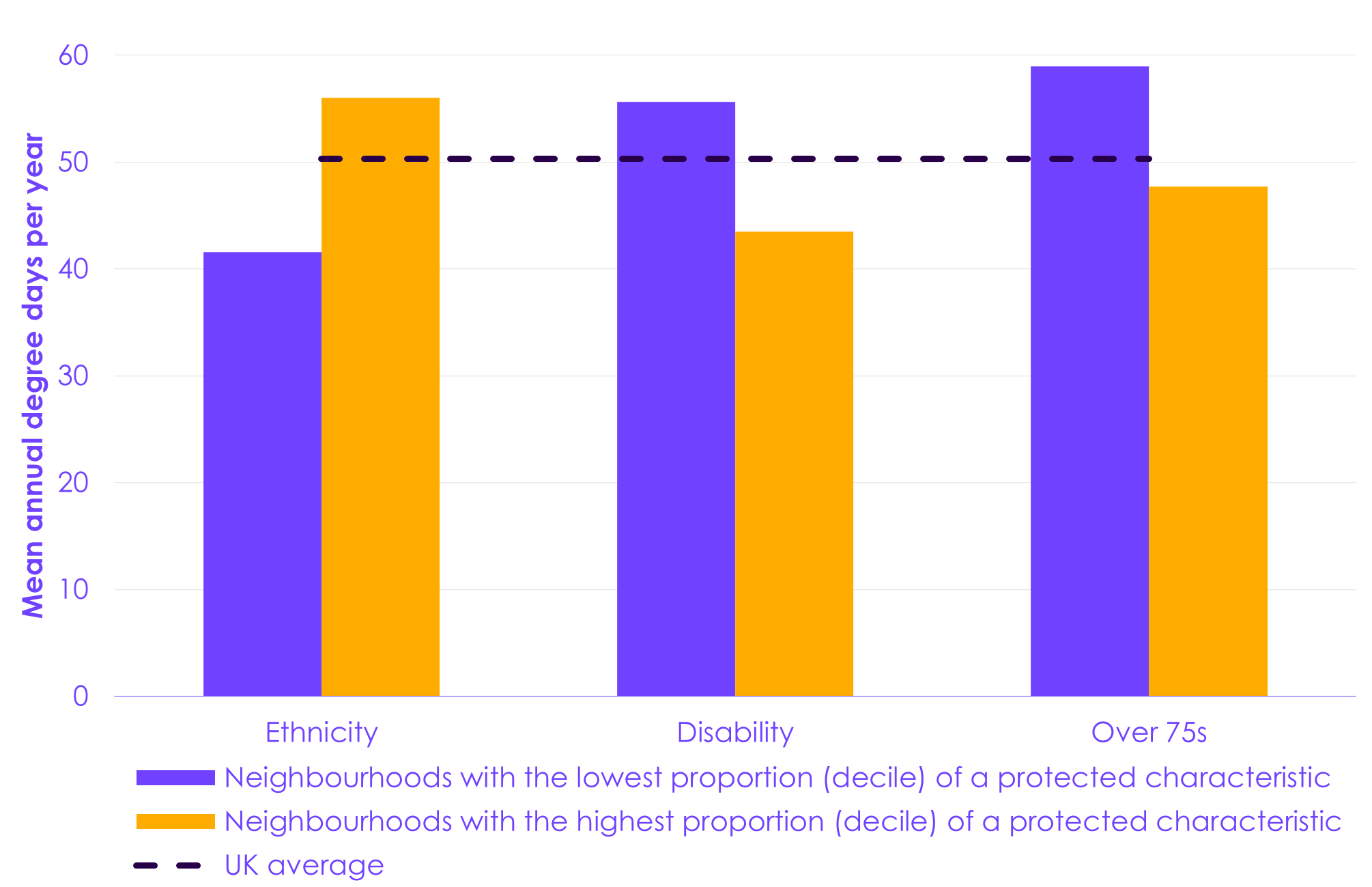 Description: Neighbourhoods with the highest proportion of people from minority ethnic backgrounds are likely to be more exposed to overheating compared to the UK average. The trend is the reverse for disability and age. However, this is a general pattern only, and there may still be a number of neighbourhoods with high concentrations of these groups in more exposed areas. |
A3.3 Infrastructure
Older people, disabled people, and young children have less capacity to adapt to transport disruption. They are more vulnerable to disruption of energy and water supply and are included in the Priority Services Register for support during outages.
- Impacts on connectivity: older people, disabled people, young children, and people from minority ethnic backgrounds are likely to be more impacted by disruptions to certain forms of transport and telecommunications.
- Older people and disabled people are more vulnerable to loss of connectivity (both digital/telecoms and transport) for health and social reasons, and require accessible emergency warnings. Older people are also more likely to rely on traditional telecoms such as telephones and radio, rather than the internet, making them more impacted by outages in these telecoms.[1795];[1796];[1797];[1798];[1799]
- People from minority ethnic backgrounds are more reliant on public transport, and therefore more impacted by climate impacts on public transport availability or pricing.[1800];[1801]
- Impacts on mobility: mobility and access to transport in cases of disruption or extreme weather events can be affected during pregnancy and for young children, older people and disabled people. These difficulties are particularly evident during flooding or extreme heat, where physical demands and infrastructural limitations can restrict safe and timely movement.[1802]
- Impacts on utilities: older people, young children, and disabled people are disproportionately impacted by disruption of services such as energy, water, and waste.
- Disabled people are more likely to use electricity and water for medical purposes, such as for equipment like oxygen concentrators, ventilators, electric wheelchairs or infusion pumps. These can require continuous access and increased consumption of energy and water, increasing vulnerability to climate impacts on the availability and price of utilities.[1803]
- Young children and older people are more vulnerable to water supply disruption, as they are more prone to dehydration due to reduced thirst response and water storage capacity. Water supply disruption also impacts baby formula provision as guidance recommends that parents do not use bottled water when mixing baby formula.[1804];[1805];[1806];[1807]
- Climate change risks to the municipal waste system are low relative to other parts of the sector (for example, historical waste sites). However, some people may be disproportionately impacted by disruption of services or access to waste disposal. For example, some disabled people are more likely to produce medical waste that requires routine disposal.[1808] Extreme weather events can delay medical waste pickups or mean that people are unable to travel to safe drop-off points, leading to unsafe accumulation at home.
The Priority Services Register provides targeted early warning and support for vulnerable households during water or energy outages.[1809] However, not everyone who is vulnerable may be on the register, and some older people still face barriers to accessing adaptation measures due to digital exclusion or living in remote areas.
Some countries have implemented proactive measures to address some of these limitations, and to ensure access to key infrastructure such as public transport. For example:
- Targeted local registers and outreach. In Italy and France, national registers are complemented by local registers of vulnerable people and active in-person contact. Local health service and GP data is integrated with priority registers, and local authorities are required to provide welfare checks, in person where needed, when alerts are triggered.[1810];[1811]
- Accessible public transport. Many cities, in countries such as Germany, Denmark, Slovenia, and the Netherlands, have implemented measures to maintain accessible use of public transport during heatwaves and extreme weather. This includes active and/or passive cooling inside vehicles and at bus stops, and flood-proofing public transport access points.[1812];[1813];[1814];[1815]
A3.4 Land, sea, and food security
Disabled people, women, and people from minority ethnic backgrounds, are disproportionately impacted by food price shocks and low food availability. People from minority ethnic backgrounds and disabled people also have reduced access to nature, which can reduce capacity to adapt to some climate impacts. Famers, who are usually older, and other people who work outside, are also likely to be more exposed to climate hazards.
- Vulnerability to food price changes: disabled people, people from some minority ethnic backgrounds, and women (including single mothers and carers) are more likely to experience food insecurity and have lower incomes. This means they face disproportionate impacts from climate-related price increases or food supply chain disruption.[1816];[1817];[1818];[1819]
- Vulnerability to specific food availability: young children are more likely to be affected by changes in nutrition due to their developmental status, while disabled people can have dietary restrictions.[1820];[1821] They are therefore more vulnerable to climate impacts on specific food items with limited substitutions, such as baby formula.
- Outdoor workforce age: farmers and outdoor workers face increased exposure to climate hazards such as heatwaves and flooding, and workers in the agriculture sector are also disproportionately older, potentially leading to increased vulnerability.[1822];[1823];[1824];[1825];[1826]
- Unequal access to nature: people from minority ethnic backgrounds and disabled people have less access to nature and green spaces, increasing exposure and reducing capacity to adapt to climate impacts such as overheating.[1827];[1828];[1829];[1830]
Some countries have introduced targeted measures to secure access and affordability of key food items during supply shocks, as well as to protect outdoor workers and increase access to nature, with targeted support for people with protected characteristics. For example:
- Strategic food reserves: countries such as Norway, Switzerland, and Japan maintain strategic food reserves to ensure food price stabilisation and availability of key goods during supply shocks or emergencies.[1831] These can be distributed to targeted vulnerable households where needed and can include specific food items for vulnerable groups.
- Targeted support or shock payments: some countries provide targeted support during price shocks. For example, in response to rapid food and energy price inflation in 2022, the French Government provided one-off support payments to vulnerable households such as older and disabled households, with additional payments for each child.[1832]
- Outdoor workforce regulations for older workers: many countries have regulations in place to protect outdoor workers from extreme heat, and some countries have sector-specific protections for sectors which account for worker demographics. For example, Japan’s climate adaptation plan has targeted measures and guidance for workers in agriculture, forestry and fisheries, and relates this to the average workforce age in those sectors.[1833]
- Increased access to nature: the European project URBiNAT has funded the development of urban nature-based solutions, such as restored parks, green roofs, and urban forests, in social housing neighbourhoods in the cities of Porto, Nates, and Sofia. These often have high proportions of people from minority ethnic backgrounds. These interventions seek to improve residents’ physical, mental and social well-being, strengthen social cohesion, and enhance climate resilience.[1834]
A3.5 Economy
Some groups with protected characteristics are more vulnerable to climate impacts on bills because they are likely to have lower incomes and reduced access to capital.
- Impacts on household bills: climate change impacts such as floods, drought, and wildfires are likely to increase costs of energy, water, food and other household purchases. People from minority ethnic backgrounds are more likely to be in poverty and disabled people have lower average incomes, and are therefore disproportionately impacted by price increases.[1835] Women are also more likely to experience economic uncertainty and be heads of single-parent households than men, making them disproportionately vulnerable to the costs of climate change.[1836];[1837];[1838]
- Access to capital: similarly, many adaptation measures at a household and business level require upfront capital investment. People from minority ethnic backgrounds have reduced access to capital in the UK and therefore face higher barriers to adapting.[1839]
Some countries have implemented proactive measures to address lack of access to capital amongst certain groups, and targeted support to limit impacts of price shocks. For example:
- Support for vulnerable households: as outlined in the built environment and land, nature, and food sections of this annex, some governments provide targeted support for households who are more vulnerable to changes in price shocks, or who have limited access to capital to adapt their homes. This includes targeted one-off support payments for low-income, older, or disabled people and carers during periods of rapid price inflation in France, and targeted support to implement flood resilience measures in Australia.[1840];[1841]
Footnotes and endnotes
- This proposed adaptation target serves as a proxy for the set of infrastructure system targets proposed across Chapter 8 to Chapter 12 of this report. ↑
- Assumes a rollout of these measures at a UK-national scale to 30% highest risk regions and demographics. ↑
- Met Office (2025) How changing weather is affecting UK wildlife. https://www.metoffice.gov.uk/blog/2025/how-changing-weather-is-affecting-uk-wildlife. (Accessed: 27 February 2026). ↑
- National Oceanic and Atmospheric Administration Global Monitoring Laboratory (2024) Trends in CO2, CH4, N2O, SF6. https://gml.noaa.gov/ccgg/trends/global.html. (Accessed: 25 October 2025). ↑
- Copernicus (2025) Copernicus: 2025 was the third hottest year on record. https://climate.copernicus.eu/copernicus-2025-was-third-hottest-year-record. (Accessed: 27 January 2025). ↑
- Forster, P. M. et al (2025) Indicators of Global Climate Change 2024: annual update of key indicators of the state of the climate system and human influence. Earth System Science Data. https://doi.org/10.5194/essd-17-2641-2025. ↑
- World Meteorological Organisation (2025) WMO confirms 2024 as warmest year on record at about 1.55°C above pre-industrial level. https://wmo.int/news/media-centre/wmo-confirms-2024-warmest-year-record-about-155degc-above-pre-industrial-level. (Accessed: 25 October 2025). ↑
- Philip, S. Y. et al (2022) Rapid attribution analysis of the extraordinary heat wave on the Pacific coast of the US and Canada in June 2021. Earth System Dynamics. https://doi.org/10.5194/esd-13-1689-2022. ↑
- Fischer, E. M. et al (2021) Increasing probability of record‑shattering climate extremes. Nature Climate Change. https://doi.org/10.1038/s41558-021-01092-9. ↑
- NASA (2024) Global Mean Sea Level Key Indicators – NASA Sea Level Change Portal. https://sealevel.nasa.gov/understanding-sea-level/key-indicators/global-mean-sea-level. (Accessed: 3 March 2025). ↑
- World Glacier Monitoring Service (2024) Latest glacier mass balance data. https://wgms.ch/latest-glacier-mass-balance-data/. (Accessed: 12 February 2026). ↑
- BBC News (2025) Swiss glacier collapse buries most of village of Blatten. https://www.bbc.co.uk/news/articles/cnv1evn2p2vo. (Accessed: 3 March 2025). ↑
- Intergovernmental Panel on Climate Change (IPCC) (2018) Summary for Policymakers In: Global Warming of 1.5°C. An IPCC Special Report on the impacts of global warming of 1.5°C above pre‑industrial levels and related global greenhouse gas emission pathways, in the context of strengthening the global response to the threat of climate change, sustainable development, and efforts to eradicate poverty. https://www.cambridge.org/core/books/global-warming-of-15c/summary-for-policymakers/31C38E590392F74C7341928B681FF668. ↑
- Jones, C. D. et al (2019) The Zero Emissions Commitment Model Intercomparison Project (ZECMIP) contribution to C4MIP: quantifying committed climate changes following zero carbon emissions. Geoscience Model Development. https://doi.org/10.5194/gmd-12-4375-2019. ↑
- Expected global emissions are estimated based on the anticipated effects of climate policies already in place around the world today. ↑
- Armstrong McKay, D. I. et al (2022) Exceeding 1.5°C global warming could trigger multiple climate tipping points. Science. https://doi.org/10.1126/science.abn7950. ↑
- Fischer, E. M. et al (2021) Increasing probability of record‑shattering climate extremes. Nature Climate Change. https://doi.org/10.1038/s41558-021-01092-9. ↑
- Kimutai, J. et al (2023) Human-induced climate change increased drought severity in Horn of Africa. https://doi.org/10.25561/103482. ↑
- Ballester, J. et al (2023) Heat-related mortality in Europe during the summer of 2022. Nature Medicine. https://doi.org/10.1038/s41591-023-02419-z. ↑
- Frauke, F. et al (2024) The Summer Heatwave 2022 over Western Europe: An Attribution to Anthropogenic Climate Change. Bulletin of the American Meteorological Society. https://doi.org/10.1175/BAMS-D-24-0017.1. ↑
- World Weather Attribution (2022) High temperatures exacerbated by climate change made 2022 Northern Hemisphere soil moisture droughts more likely. https://www.worldweatherattribution.org/wp-content/uploads/WCE-NH-drought-scientific-report.pdf. (Accessed: 27 February 2026). ↑
- Comunicación Poder Judicial (2024) La cifra de víctimas mortales por la Dana de Valencia aumenta a 222. https://www.poderjudicial.es/cgpj/es/Poder-Judicial/Tribunales-Superiores-de-Justicia/TSJ-Comunidad-Valenciana/Oficina-de-Comunicacion/Notas-de-prensa/La-cifra-de-victimas-mortales-por-la-Dana-de-Valencia-aumenta-a-222–todas-con-autopsia-y-una-de-ellas-pendiente-de-identificar. (Accessed: 27 February 2026). ↑
- World Weather Attribution (2024) Extreme downpours increasing in southeastern Spain as fossil fuel emissions heat the climate. https://www.worldweatherattribution.org/extreme-downpours-increasing-in-southern-spain-as-fossil-fuel-emissions-heat-the-climate/. (Accessed: 27 February 2026). ↑
- CAL FIRE (2025) 2025 Incident Archive. https://web.archive.org/web/20250130064355/https://www.fire.ca.gov/incidents. (Accessed: 12 February 2026). ↑
- Paglino, E. et al (2025) Excess Deaths Attributable to the Los Angeles Wildfires From January 5 to February 1, 2025. JAMA. https://jamanetwork.com/journals/jama/fullarticle/2837351. ↑
- Munich RE (2025) Wildfires around Los Angeles, severe thunderstorms: US natural catastrophes dominate global losses in the first half of 2025. https://www.munichre.com/en/company/media-relations/media-information-and-corporate-news/media-information/2025/natural-disaster-figures-first-half-2025.html. (Accessed: 27 February 2026). ↑
- Barnes, C. et al (2024) Climate change increased the likelihood of wildfire disaster in highly exposed Los Angeles area. World Weather Attribution. https://www.worldweatherattribution.org/wp-content/uploads/WWA-scientific-report-LA-wildfires-1.pdf. (Accessed: 12 February 2026). ↑
- European Forest Fire Information System (EFFIS) (2025). Seasonal Trend for European Union. https://forest-fire.emergency.copernicus.eu/apps/effis.statistics/seasonaltrend. (Accessed: 5 February 2026). ↑
- World Weather Attribution (WWA) (2023) Extreme fire-weather conditions in Spain and Portugal now common due to climate change. https://www.worldweatherattribution.org/extreme-fire-weather-conditions-in-spain-and-portugal-now-common-due-to-climate-change/. (Accessed: 5 February 2026). ↑
- Kendon, M. et al (2025) State of the UK Climate 2024. International Journal of Climatology. https://doi.org/10.1002/joc.70010. ↑
- Mudhar, R. et al (2023) (2023) Reviewing climate change attribution in UK natural hazards and their impacts. https://www.ukclimaterisk.org/publications/reviewing-climate-change-attribution-in-uk-natural-hazards-and-their-impacts/. ↑
- The UK is warming at a rate similar to global average land temperatures, and faster than global average temperatures (which combine land and sea). ↑
- Kay, G. et al (2025) Rapidly increasing chance of record UK summer temperatures. Weather. https://doi.org/10.1002/wea.7741. ↑
- Barnes, C. et al (2024) Climate change increased the likelihood of wildfire disaster in highly exposed Los Angeles area. World Weather Attribution. https://www.worldweatherattribution.org/wp-content/uploads/WWA-scientific-report-LA-wildfires-1.pdf. (Accessed: 12 February 2026). ↑
- Carruthers, J. et al (2025) Climate Models Tend to Underestimate Scaling of UK Mean Winter Precipitation With Temperature. Geophysical Research Letters. https://agupubs.onlinelibrary.wiley.com/doi/full/10.1029/2025GL118201. ↑
- Hawkins, E. et al (2020) Observed Emergence of the Climate Change Signal: From the Familiar to the Unknown. Geophysical Research Letters. https://agupubs.onlinelibrary.wiley.com/doi/10.1029/2019GL086259. ↑
- Greater London Authority (2022) Surface Water Flooding in London: Roundtable Progress Report. https://www.london.gov.uk/sites/default/files/flooding_progress_report_final_1.pdf. (Accessed: 5 February 2026). ↑
- Across the Well-Adapted UK report, bespoke analysis and external literature on costs are represented in 2025 prices to allow comparability across different sources. This analysis has been conducted using the latest GDP deflators published by the Office for National Statistics (ONS), as of December 2025. Future GDP is forecast using the Office for Budget Responsibility’s (OBR) long-term GDP forecast (OBR, 2025). ↑
- Cotterill, D. F. et al (2024) Using UNSEEN approach to attribute regional UK winter rainfall extremes. International Journal of Climatology. https://doi.org/10.1002/joc.8460. ↑
- Office for National Statistics (ONS) (2022) Excess mortality during heat-periods: 1 June to 31 August 2022. https://www.ons.gov.uk/peoplepopulationandcommunity/birthsdeathsandmarriages/deaths/articles/excessmortalityduringheatperiods/englandandwales1juneto31august2022. (Accessed: 27 February 2026). ↑
- Kay, G. et al (2025) Rapidly increasing chance of record UK summer temperatures. Weather. https://doi.org/10.1002/wea.7741. ↑
- National Fire Chiefs Council (2023) Wildfires position statement. https://nfcc.org.uk/our-services/position-statements/wildfires-position-statement/?action=history. (Accessed: 27 February 2026). ↑
- Barker, L. et al (2024) An appraisal of the severity of the 2022 drought and its impacts. Weather. https://rmets.onlinelibrary.wiley.com/doi/10.1002/wea.4531. ↑
- UK Centre for Ecology and Hydrology (2024) Summer 2022 drought provides warning for future years. https://www.ceh.ac.uk/press/summer-2022-drought-provides-warning-future-years. (Accessed 27 February 2026). ↑
- Environment Agency (2025) Water situation: March 2024 summary. https://www.gov.uk/government/publications/water-situation-national-monthly-reports-for-england-2024/water-situation-march-2024-summary. (Accessed: 3 March 2026). ↑
- Kendon, M. et al (2025) State of the UK Climate 2024. International Journal of Climatology. https://doi.org/10.1002/joc.70010. ↑
- Department for Environment, Food, and Rural Affairs (Defra) (2025) Cereal and oilseed rape production in the United Kingdom 2024. https://www.gov.uk/government/statistics/cereal-and-oilseed-rape-production/cereal-and-oilseed-production-in-the-united-kingdom-2024. (Accessed: 3 March 2026). ↑
- World Weather Attribution (2024) Autumn and winter storm rainfall in the UK and Ireland was made about 20% heavier by human-caused climate change. https://www.worldweatherattribution.org/autumn-and-winter-storms-over-uk-and-ireland-are-becoming-wetter-due-to-climate-change/. (Accessed: 27 February 2026). ↑
- Global Wildfire Information System (2025) Statistics portal: seasonal trend for United Kingdom. https://gwis.jrc.ec.europa.eu/apps/gwis.statistics/seasonaltrend. (Accessed: 2 March 2026). ↑
- National Fire Chiefs Council (2025) New wildfire sparks urgent call for fire service investment. https://nfcc.org.uk/new-wildfire-record-sparks-urgent-call-for-fire-service-investment/. (Accessed: 27 February 2026). ↑
- Burton, C. et al (2025) Very high fire danger in UK in 2022 at least 6 times more likely due to human-caused climate change. Environmental Research Letters. https://iopscience.iop.org/article/10.1088/1748-9326/adb764. ↑
- Department for Environment, Food, and Rural Affairs (Defra) (2026) Cereal and oilseed rape production in the United Kingdom 2025: Cereal and rape production dataset. https://www.gov.uk/government/statistics/cereal-and-oilseed-rape-production. (Accessed: 2 March 2026). ↑
- Met Office (2026) How much rain have we had so far? https://www.metoffice.gov.uk/blog/2026/how-much-rain-have-we-had-in-february-and-winter. (Accessed: 27 February 2026). ↑
- Met Office (2018) UKCP18 Factsheet: Derived Projections. https://www.metoffice.gov.uk/binaries/content/assets/metofficegovuk/pdf/research/ukcp/ukcp18-fact-sheet-derived-projections.pdf. (Accessed: 2 March 2026). ↑
- Doger de Speville, C. et al (2023) Predicting future UK nighttime urban heat islands using observed short-term variability and regional climate projections. Environmental Research Letters. https://iopscience.iop.org/article/10.1088/1748-9326/acf94c. ↑
- Data are sourced from the FUTURE‑DRAINAGE project, providing rainfall uplift values for the one‑hour, one1‑in‑100‑year event. The dataset covers the UK using 5 km grid cells for the 2050s and 2070s, based on UKCP18 local projections data. According to the UKCP18 global climate model ensemble, global warming is projected to reach approximately 3°C by the 2050s and around 4°C by the 2070s, so slightly lower changes might be expected at a 2°C global warming level in the 2050s. ↑
- Chan, S. C. et al (2023) New extreme rainfall projections for improved climate resilience of urban drainage systems. Climate Services. https://doi.org/10.1016/j.cliser.2023.100375. ↑
- Kay, A. L. et al (2021) Climate change impacts on peak river flows: combining national-scale hydrological modelling and probabilistic projections. Climate Risk Management. https://doi.org/10.1016/j.crm.2020.100263. ↑
- Tanguy, M. et al (2023) CS-N0W-D2 Task 5: Analysis of future scenarios. https://assets.publishing.service.gov.uk/media/672b4fbbabb279b2de1e8c34/cs-now-d2-future-water-resources-output-analysis.pdf. ↑
- Szczykulska, M. et al (2024) Future increases in soil moisture drought frequency at UK monitoring sites: merging the JULES land model with observations and convection-permitting UK climate projections. Environmental Research Letters. https://iopscience.iop.org/article/10.1088/1748-9326/ad7045. ↑
- Perry, M. C. et al (2022) Past and future trends in fire weather for the UK. Natural Hazards and Earth System Science. https://nhess.copernicus.org/articles/22/559/2022/. ↑
- Manning, C. et al (2023) Projected increase in windstorm severity and contribution from sting jets over the UK and Ireland. Weather and Climate Extremes. https://www.sciencedirect.com/science/article/pii/S2212094723000154. ↑
- Manning, C. et al (2021) Extreme windstorms and sting jets in convection – permitting climate simulations over Europe. Climate Dynamics. https://link.springer.com/article/10.1007/s00382-021-06011-4. ↑
- Ermis, S. et al (2024) Event attribution of a midlatitude windstorm using ensemble weather forecasts. Environmental Research Climate. https://iopscience.iop.org/article/10.1088/2752-5295/ad4200. ↑
- Kornhuber, K. et al (2024) Global emergence of regional heatwave hotspots outpaces climate model simulations. PNAS. https://www.pnas.org/doi/10.1073/pnas.2411258121. ↑
- Schumacher, D. L. et al (2024) Exacerbated summer European warming not captured by climate models neglecting long-term aerosol changes. Communications Earth and Environment. https://doi.org/10.1038/s43247-024-01332-8. ↑
- Carruthers, J. et al (2025) Dynamical adjustment reveals spatial patterns of wetting and drying in European winter precipitation. Environmental Research Letters. https://iopscience.iop.org/article/10.1088/1748-9326/ae198b. ↑
- Arnell, N. et al (2021) Indicators of climate risk in the UK at different levels of warming. Environmental Research Communications. https://nora.nerc.ac.uk/id/eprint/531082/1/N531082JA.pdf. ↑
- Christidis, N. et al (2020) The increasing likelihood of temperatures above 30 to 40°C in the United Kingdom. Nature Communications. https://www.nature.com/articles/s41467-020-16834-0. ↑
- Data are sourced from the FUTURE‑DRAINAGE project, providing rainfall uplift values for the one hour, 1‑in‑100‑year event. The dataset covers the UK using 5 km grid cells for the 2050s and 2070s, based on UKCP18 local projections data. According to the UKCP18 global climate model ensemble, global warming is projected to reach approximately 3°C by the 2050s and around 4°C by the 2070s. ↑
- Kendon, E. J. et al (2023) Variability conceals emerging trend in 100‑year projections of UK local hourly rainfall extremes. Nature Communications. https://doi.org/10.1038/s41467-023-36499-9. ↑
- Kay, A. L. et al (2021) Climate change impacts on peak river flows: Combining national-scale hydrological modelling and probabilistic projections. ScienceDirect. https://www.sciencedirect.com/science/article/pii/S221209632030053X#s0095. ↑
- Weeks, J. H. et al (2025) A New Framework to Explore High-End Sea Level Rise for the UK: Updating H++. Earth’s Future. https://doi.org/10.1029/2025EF006086. ↑
- Vousdoukas, M. I. et al (2018) Global probabilistic projections of extreme sea levels show intensification of coastal flood hazard. Nature Communications. https://www.nature.com/articles/s41467-018-04692-w. ↑
- Manning, C. et al (2023) Projected increase in windstorm severity and contribution from sting jets over the UK and Ireland. Weather and Climate Extremes. https://www.sciencedirect.com/science/article/pii/S2212094723000154. ↑
- Manning, C. et al (2021) Extreme windstorms and sting jets in convection – permitting climate simulations over Europe. Climate Dynamics. https://link.springer.com/article/10.1007/s00382-021-06011-4. ↑
- Arnell, N. W. et al (2025) High-Impact Low-Likelihood Climate Scenarios for Risk Assessment in the UK. Advancing Earther and Space Sciences. https://agupubs.onlinelibrary.wiley.com/doi/full/10.1029/2025EF006946. ↑
- British Red Cross (2024) Vulnerability and Resilience. https://assets.redcross.org.uk/82b1e254-5524-0172-0612-9ce813c7824c/d3ea670d-733a-416b-a928-b9eed2138ec1/Vulnerability-and-Resilience-Public-awareness-and-perceptions-of-flood-risk-in-the-UK.pdf. ↑
- Sayers and Partners (2025) Spatial indicators of vulnerability to climate related hazards in the UK. https://www.ukclimaterisk.org/publications/spatial-indicators-of-vulnerability-to-climate-related-hazards-sayers-2025/. ↑
- Lowe, J. A., Harrison, M. and Perks, R. J. (2026) CCRA4-IA Technical Report. https://www.ukclimaterisk.org/publications/technical-report-ccra4-ia/ ↑
- Lowe, J. A., Harrison, M. and Perks, R. J. (2026) CCRA4-IA Technical Report. https://www.ukclimaterisk.org/publications/technical-report-ccra4-ia/executive-summary/. ↑
- Lowe, J. A., Harrison, M. and Perks, R. J. (2026) Executive Summary In: CCRA4-IA Technical Report. https://www.ukclimaterisk.org/publications/technical-report-ccra4-ia/executive-summary/. ↑
- Mitchell, D. and Newton, J. (2026) Health and Wellbeing In: CCRA4-IA Technical Report. https://www.ukclimaterisk.org/publications/technical-report-ccra4-ia/chapter-3/#section-5-3-2-1-risks-to-people-from-heat-%e2%80%93-h1. ↑
- Mumovic, D. et al (2026) Built Environment In: CCRA4-IA Technical Report. https://www.ukclimaterisk.org/publications/technical-report-ccra4-ia/chapter-4/#section-12-4-2-2-risks-to-buildings-and-communities-from-flooding-%e2%80%93-be2. ↑
- While a real feature of the system, the wide scope of the economy and finance system means that high and very high magnitude thresholds are reached more easily for these risks (Box 1.6). ↑
- Cole, M. A. and Elliott, R. J. R. (2026) Economy In: CCRA4-IA Technical Report. https://www.ukclimaterisk.org/publications/technical-report-ccra4-ia/chapter-7/#section-5-7-2-1-risks-to-uk-macroeconomic-performance-and-stability-%e2%80%93-e1. ↑
- Lowe, J. A., Harrison, M. and Perks, R. J. (2026) Executive Summary In: CCRA4-IA Technical Report. https://www.ukclimaterisk.org/publications/technical-report-ccra4-ia/executive-summary/. ↑
- Department for Science, Innovation, and Technology (DSIT) (2025) Policy Paper, Data centres. https://www.gov.uk/government/publications/cyber-security-and-resilience-network-and-information-systems-bill-factsheets/data-centres. (Accessed. 25 February 2026). ↑
- Bullock, J. M. et al (2026) Land, Nature, and Food In: CCRA4-IA Technical Report. https://www.ukclimaterisk.org/publications/technical-report-ccra4-ia/chapter-5/#section-67-5-2-10-risks-to-food-security-%e2%80%93-n10. ↑
- Cole, M. A. and Elliott, R. J. R. (2026) Economy In: CCRA4-IA Technical Report. https://www.ukclimaterisk.org/publications/technical-report-ccra4-ia/chapter-7/#section-19-7-2-3-risks-to-domestic-andinternational-supply-chains-and-resource-inputs-of-uk-businesses-%e2%80%93-e3. ↑
- Lowe, J. A., Harrison, M. and Perks, R. J. (2026) CCRA4-IA Technical Report. https://www.ukclimaterisk.org/publications/technical-report-ccra4-ia/executive-summary/. ↑
- Jaroszweski, D. and Dawson, D. (2026) Methods In: CCRA4-IA Technical Report. https://www.ukclimaterisk.org/publications/technical-report-ccra4-ia/chapter-1/#section-4-1-3-urgency-scoring-framework. ↑
- Lowe, J. A., Harrison, M. and Perks, R. J. (2026) Executive Summary In: CCRA4-IA Technical Report. https://www.ukclimaterisk.org/publications/technical-report-ccra4-ia/executive-summary/. ↑
- Mitchell, D. and Newton, J. (2026) Health and Wellbeing In: CCRA4-IA Technical Report. https://www.ukclimaterisk.org/publications/technical-report-ccra4-ia/chapter-3/#section-5-3-2-1-risks-to-people-from-heat-%e2%80%93-h1. ↑
- Mumovic, D. et al (2026) Built Environment In: CCRA4-IA Technical Report. https://www.ukclimaterisk.org/publications/technical-report-ccra4-ia/chapter-4/#section-12-4-2-2-risks-to-buildings-and-communities-from-flooding-%e2%80%93-be2. ↑
- Sayers, P. et al (2026) Well-Adapted UK – Future Flood Risk. A report by Sayers and Partners for the Climate Change Committee Fourth Climate Change Risk Assessment. https://www.ukclimaterisk.org/publications/cost-effective-adaptation-research-flooding/. ↑
- Sayers, P. et al (2026) Well-Adapted UK – Future Flood Risk. A report by Sayers and Partners for the Climate Change Committee Fourth Climate Change Risk Assessment. https://www.ukclimaterisk.org/publications/cost-effective-adaptation-research-flooding/. ↑
- Scottish Environmental Protection Agency (SEPA) (2025) April water situation update. https://beta.sepa.scot/water-scarcity/previous-reports/25-april-2025/. (Accessed: 2 March 2026). ↑
- Environment Agency (2025). National Framework for water resources 2025. https://www.gov.uk/government/publications/national-framework-for-water-resources-2025-water-for-growth-nature-and-a-resilient-future. (Accessed: 2 March 2026). ↑
- Department for Environment, Food, and Rural Affairs (Defra) (2026) Cereal and oilseed rape production in the United Kingdom 2025: Cereal and rape production dataset. https://www.gov.uk/government/statistics/cereal-and-oilseed-rape-production. (Accessed: 2 March 2026). ↑
- Kotz et al. (2023) The impact of global warming on inflation: averages, seasonality and extremes. https://www.ecb.europa.eu/pub/pdf/scpwps/ecb.wp2821~f008e5cb9c.en.pdf. (Accessed: 2 March 2026). ↑
- ABI (2025) More action needed to protect properties as adverse weather takes record toll on insurance claims in 2024. https://www.abi.org.uk/news/news-articles/2025/2/more-action-needed-to-protect-properties-as-adverse-weather-takes-record-toll-on-insurance-claims-in-2024/.(Accessed: 2 March 2026). ↑
- Guy’s and St Thomas’ NHS Foundation Trust (2023) Review of the Guy’s and St Thomas’ IT critical incident final report from the Deputy Chief Executive Officer. https://www.guysandstthomas.nhs.uk/sites/default/files/2023-01/IT-critical-incident-review.pdf. (Accessed: 2 March 2026). ↑
- The costs of climate change referred to in this report include both financial/monetary damages (such as damage to properties, salaries, revenues) and non-monetary damages, which can be valued in monetary terms (such as loss of life and lost productivity). ↑
- Across the Well-Adapted UK report, bespoke analysis and external literature on costs are presented in 2025 prices to allow comparability across different sources. This analysis has been conducted using the latest GDP deflators published by the Office for National Statistics (ONS) as of December 2025. Future GDP is forecast using the Office for Budget Responsibility’s (OBR) long term GDP forecast (OBR, 2025). ↑
- This is calculated based on a GDP forecast of £4.8 trillion in 2050, using OBR’s long term central GDP growth projections on fourth quarter GDP from 2025 (£3 trillion). This uses OBR (2025) Supplementary forecast information on Long-term economic determinants and personal independence payment policy costing and ONS (2025) GDP – data tables. ↑
- Office for Budget Responsibility (OBR) (2025) Supplementary forecast information on Long-term economic determinants and personal independence payment policy costing. https://obr.uk/supplementary-forecast-information-on-long-term-economic-determinants-and-personal-independence-payment-policy-costing/. ↑
- Office for National Statistics (ONS) (2025). GDP – data tables. https://www.ons.gov.uk/economy/grossdomesticproductgdp/datasets/uksecondestimateofgdpdatatables (Accessed: 2 March 2026). ↑
- Current modelling estimates can generally be distinguished by two categories: top-down models which simulate systems within the economy, and bottom-up meta-analyses which aggregate sector-specific impact pathways. ↑
- Rising, J. et al (2026) suggests missing and catastrophic risk could lead to economic damages of around 3% as a share of GDP in 2041 to 2060, under a low mitigation baseline scenario which is considered in our ‘above 3°C by 2100’ scenario range. ↑
- Robinson, E. (2026) Economics of systemic risk. https://www.ukclimaterisk.org/publications/economics-of-systemic-risk/. ↑
- Bank of England (BoE) (2016) The Financial Policy Committee’s framework for the systemic risk buffer. https://www.bankofengland.co.uk/-/media/boe/files/paper/2025/fpc-framework-for-srb-july-2025.pdf. (Accessed: 2 March 2026). ↑
- Arup (2026) Heat Risk and Adaptation in the Urban Built Environment. https://www.ukclimaterisk.org/publications/cost-effective-adaptation-urban-heat/. ↑
- Benefit-cost ratios are a measure to evaluate the effectiveness or value of an adaptation action per pound (£) invested. They are presented in the format [X:1], where X represents the monetised value of the benefits (in £) per £1 of cost. ↑
- Watkiss, P. (2022) The costs of adaptation and the economic costs and benefits of adaptation in the UK. https://www.theccc.org.uk/wp-content/uploads/2023/01/The-Costs-of-Adaptation-and-the-Economic-Costs-and-Benefits-of-Adaptation-in-the-UK-Paul-Watkiss.pdf. ↑
- European Investment Bank (2022) Climate change adaptation and economics and investment decision making in the cities. https://advisory.eib.org/files/publications/attachments/climate-change-adaptation-and-economics-and-investment-decision-making-in-the-cities.pdf. ↑
- European Environment Agency (2025) Assessing the costs and benefits of climate change adaptation. https://www.eea.europa.eu/en/analysis/publications/assessing-the-costs-and-benefits-of-climate-change-adaptation. ↑
- Organisation for Economic Co-operation and Development (OECD) (2024) Climate Adaptation Investment Framework. https://doi.org/10.1787/8686fc27-en. ↑
- Rising, J. et al (2026) The Macroeconomic Case for Adaptation Investment. Grantham Research Institute on Climate Change and the Environment, London School of Economics and Political Science. https://www.lse.ac.uk/granthaminstitute/publication/the-macroeconomic-case-for-investing-in-climate-adaptation/. ↑
- Sayers, P. B. et al (2025) A national assessment of natural flood management and its contribution to fluvial flood risk reduction. Journal of Flood Risk Management. https://doi.org/10.1111/jfr3.70151. ↑
- Bonfield, P. (2016) The property flood resilience action plan. Department for Environment Food and Rural Affairs. https://assets.publishing.service.gov.uk/media/5a81a13040f0b62305b8ffcd/flood-resilience-bonfield-action-plan-2016.pdf. (Accessed: 2 March 2026). ↑
- Environment Agency (2014) Flood and coastal erosion risk management, Long-term investment scenarios. https://assets.publishing.service.gov.uk/media/5a750e6840f0b6360e472ff1/FCRM_Long_term_investment_scenarios.pdf. (Accessed: 2 March 2026). ↑
- Assumes a rollout of these measures at a UK-national scale to 30% highest risk regions and demographics. ↑
- Arup (2026) Heat Risk and Adaptation in the Urban Built Environment. https://www.ukclimaterisk.org/publications/cost-effective-adaptation-urban-heat/. ↑
- Climate Change Committee (2019) Heat and preventable deaths in the health and social care system. https://www.theccc.org.uk/wp-content/uploads/2019/07/Outcomes-Heat-preventable-deaths-case-study.pdf. ↑
- Ofwat (2024) Cost benefit analysis of the water efficiency fund. https://www.ofwat.gov.uk/wp-content/uploads/2024/05/Cost-Benefit-Analysis-of-the-WEF.pdf. ↑
- Gough, D. et al (2024) Least cost compilation of water efficiency measures. https://www.ofwat.gov.uk/wp-content/uploads/2024/05/Artesia-compiled-costs-of-water-efficiency-measures.pdf. (Accessed: 2 March 2026). ↑
- Water UK (2016) Water Resources Long Term Planning Framework: Final Report. Water UK. https://www.water.org.uk/sites/default/files/wp/2018/11/WaterUK-WRLTPF_Final-Report_FINAL-PUBLISHED-min.pdf. ↑
- National Engineering Policy Centre (2025) Reviving our ageing infrastructure. https://nepc.raeng.org.uk/media/fh0plphp/nepc-reviving-ageing-infrastructure-report.pdf. ↑
- National Fire Chiefs Council (2022) The economic and social value of UK Fire and Rescue Services. https://irep.ntu.ac.uk/id/eprint/45952/1/1531657_a2344_Hewitt.pdf. ↑
- Global Commission on Adaptation (2019) ADAPT NOW: A GLOBAL CALL FOR LEADERSHIP ON CLIMATE RESILIENCE. https://files.wri.org/s3fs-public/uploads/GlobalCommission_Report_FINAL.pdf. ↑
- WSP (2025) UK projections of climate risks and effectiveness of adaptation measures for water scarcity. https://www.ukclimaterisk.org/publications/cost-effective-adaptation-water-scarcity/. ↑
- WSP (2026) Modelling heat-related climate risks and nature-focussed adaptation measures for selected farm outputs. https://www.ukclimaterisk.org/publications/cost-effective-adaptation-research-farmed-landscapes/. ↑
- Edge Health and Greencroft Economics for the CCC (2026) Risks to health and health services from extreme heat. https://www.ukclimaterisk.org/publications/cost-effective-adaptation-research-heat-and-health/. ↑
- Arup (2026) Heat Risk and Adaptation in the Urban Built Environment. https://www.ukclimaterisk.org/publications/cost-effective-adaptation-urban-heat/. ↑
- Referred to as the ‘central scenario’ and ‘high-impact scenario’ respectively. ↑
- The ‘economic cost’ refers to the sum of the financial costs from climate change (for example, damages to properties) and monetised losses of non-monetary impacts (for example, loss of life or loss of work hours). ↑
- The farmed landscapes project is not included in this overall figure due to data limitations. Details on the limitations of this project can be found in the supporting research report. ↑
- The high BCR of the water scarcity project is primarily due a modelling assumption, according to which water shortages cannot be offset by other resources. Therefore, even small water deficits cause significant economic impacts across a sector, as they result in temporary closures and production losses. This builds off previous work by the Environment Agency and was aligned with feedback from the stakeholder steering group. In addition, in the modelling these small deficits can be filled with relatively inexpensive water supply options, such as rainwater collection. This results in high benefits for relatively low-cost measures, yielding a high BCR. ↑
- WSP (2025) UK projections of climate risks and effectiveness of adaptation measures for water scarcity. https://www.ukclimaterisk.org/publications/cost-effective-adaptation-water-scarcity/. ↑
- WSP (2026) Modelling heat-related climate risks and nature-focussed adaptation measures for selected farm outputs. https://www.ukclimaterisk.org/publications/cost-effective-adaptation-research-farmed-landscapes/. ↑
- Edge Health and Greencroft Economics for the CCC (2026) Risks to health and health services from extreme heat. https://www.ukclimaterisk.org/publications/cost-effective-adaptation-research-heat-and-health/. ↑
- Arup (2026) Heat Risk and Adaptation in the Urban Built Environment. https://www.ukclimaterisk.org/publications/cost-effective-adaptation-urban-heat/. ↑
- Brandon, C. et al (2025) Strengthening the Investment Case for Climate Adaptation: A Triple Dividend Approach. World Resources Institute. https://www.wri.org/research/climate-adaptation-investment-case. (Accessed: 2 March 2026). ↑
- Greater London Authority (2017) Natural capital accounts for public green space in London. https://www.london.gov.uk/sites/default/files/11015viv_natural_capital_account_for_london_v7_full_vis.pdf. ↑
- Leeds City Council (2024) Construction of groundbreaking £200 million scheme to protect Leeds from extreme flood risk is complete. https://news.leeds.gov.uk/news/construction-of-groundbreaking-gbp-200million-scheme-to-protect-leeds-from-extreme-flood-risk-is-complete. (Accessed: 2 March 2026). ↑
- Leeds City Council (no date) Section A: Scheme Summary. https://westyorkshire.moderngov.co.uk/documents/s13113/item%207%20-%20Appendix%2006%20-%20BC%20Summary%20-%20Leeds%20Flood%20Alleviation%20Scheme%202.pdf. (Accessed: 2 March 2026). ↑
- Leeds City Council (2024) Construction of groundbreaking £200 million scheme to protect Leeds from extreme flood risk is complete. https://news.leeds.gov.uk/news/construction-of-groundbreaking-gbp-200million-scheme-to-protect-leeds-from-extreme-flood-risk-is-complete. (Accessed: 2 March 2026). ↑
- Leeds City Council (2024) Construction of groundbreaking £200 million scheme to protect Leeds from extreme flood risk is complete. https://news.leeds.gov.uk/news/construction-of-groundbreaking-gbp-200million-scheme-to-protect-leeds-from-extreme-flood-risk-is-complete. (Accessed: 2 March 2026). ↑
- Gross value added (GVA) in this example refers to the direct and indirect value created by the flood scheme to the wider economy, such as through real-estate developments or economic growth. ↑
- Department for Environment, Food, and Rural Affairs (Defra) (2024) 2 September 2021: Leeds Flood Alleviation Scheme Phase 2 accounting officer assessment. https://www.gov.uk/government/publications/defra-accounting-officer-assessments/leeds-flood-alleviation-scheme-phase-2-accounting-officer-assessment. (Accessed: 2 March 2026). ↑
- Climate Change Committee (CCC) (2026). CCRA4-IA Adaptation Investment Analysis. https://www.theccc.org.uk/publication/ccra4-ia-adaptation-investment-analysis. ↑
- The approach to this analysis and more detailed insights can be found in the supplementary CCRA4-IA Adaptation Investment Analysis report. This builds on the 2023 Investment for a Well-Adapted UK report which highlighted existing estimates for investment needs in five key areas, indicating a roughly aligned order of magnitude of £5–10 billion per year in the 2030s in total additional investment need for adaptation. This work uses the actions identified in each system in the Well-Adapted UK report to establish investment needs across the economy and draws on both literature and bespoke analysis for CCRA4-IA. Investment needs are profiled along the 2025 to 2059 period, to align with the climate and economic framing set out in Annex 2. ↑
- Climate Change Committee (CCC) (2023). Investment for a well-adapted UK. https://www.theccc.org.uk/publication/investment-for-a-well-adapted-uk/. ↑
- This figure represents the total investment needed in adaptation for a well-adapted UK, which includes current and planned spending, and additional spend estimated through a costing of the actions set out in Chapter 4 to Chapter 17 of this report. ↑
- As measured by Total Gross Fixed Capital Formation (GCFC), which was estimated at £547 billion in 2025 (seasonally adjusted chained volume measures, identifier NPQT). ↑
- Office for National Statistics (2026) Gross fixed capital formation – by sector and asset. https://www.ons.gov.uk/economy/grossdomesticproductgdp/datasets/grossfixedcapitalformationbysectorandasset. (Accessed: 2 March 2026). ↑
- Arup (2026) Heat Risk and Adaptation in the Urban Built Environment. https://www.ukclimaterisk.org/publications/cost-effective-adaptation-urban-heat/. ↑
- Environment Agency (2014) Flood and coastal erosion risk management, Long-term investment scenarios. https://assets.publishing.service.gov.uk/media/5a750e6840f0b6360e472ff1/FCRM_Long_term_investment_scenarios.pdf. ↑
- Ofwat (2024) Cost benefit analysis of the water efficiency fund. https://www.ofwat.gov.uk/wp-content/uploads/2024/05/Cost-Benefit-Analysis-of-the-WEF.pdf. ↑
- Ofwat (2024) Least cost compilation of water efficiency measures. https://www.ofwat.gov.uk/wp-content/uploads/2024/05/Artesia-compiled-costs-of-water-efficiency-measures.pdf. (Accessed: 2 March 2026). ↑
- Water UK (2016) Water Resources Long Term Planning Framework: Final Report. https://www.water.org.uk/sites/default/files/wp/2018/11/WaterUK-WRLTPF_Final-Report_FINAL-PUBLISHED-min.pdf. ↑
- Department for Energy, Security, and Net Zero (DESNZ) (2025) DESNZ Public Attitudes Tracker: Summer 2025. https://www.gov.uk/government/statistics/desnz-public-attitudes-tracker-summer-2025. (Accessed: 2 March 2026). ↑
- Ipsos (2025) People and Climate Change: Public attitudes to the Climate Crisis and the transition to Net Zero. https://www.ipsos.com/sites/default/files/ct/news/documents/2025-04/People%26amp%3BClimateChange2025.pdf. ↑
- Ipsos (2024) Citizens’ Panel for an accessible and affordable household vision of Net Zero. https://www.theccc.org.uk/wp-content/uploads/2025/02/Citizens-Panel-for-an-accessible-and-affordable-household-vision-of-Net-Zero-IPSOS-1.pdf. ↑
- Ipsos (2023) Public Dialogue on Climate Adaptation. https://sciencewise.org.uk/wp-content/uploads/2023/07/Climate-Adaptation-Dialogue-Report.pdf. ↑
- YouGov (no date) The most important issues facing the country. https://yougov.co.uk/topics/society/trackers/the-most-important-issues-facing-the-country. (Accessed: 2 March 2026). ↑
- Ipsos (2025) The economy, NHS and immigration remain the big three issues facing Britain. https://www.ipsos.com/en-uk/economy-nhs-and-immigration-remain-big-three-issues-facing-britain. (Accessed: 2 March 2026). ↑
- Climate Barometer (no date) Opinion trackers. https://climatebarometer.org/climate-barometer-trackers/. (Accessed: 2 March 2026). ↑
- Sambrook, K. et al (2024) New evidence of a strong public mandate for climate change adaptation in the UK. Priestley Centre for Climate Futures. https://eprints.whiterose.ac.uk/id/eprint/218509/1/Public%20mandate%20for%20adaptation_Climate%20Evidence%20Unit%202024%20%281%29.pdf. ↑
- Public First (2023) National Trust Adaptation Survey. https://www.publicfirst.co.uk/wp-content/uploads/2023/06/PF_NatTrust.pdf. ↑
- Office for National Statistics (2024) Public and business attitudes to the environment and climate change, Great Britain: 2024. https://www.ons.gov.uk/economy/environmentalaccounts/articles/publicandbusinessattitudestotheenvironmentandclimatechangegreatbritain/2024#climate-change-is-an-important-issue-for-people-and-businesses. (Accessed: 2 March 2026). ↑
- Public First (2025) Public First Poll for EFF + QCF – Flood Resilience Nat Rep. https://view.officeapps.live.com/op/view.aspx?src=https%3A%2F%2Fwww.publicfirst.co.uk%2Fwp-content%2Fuploads%2F2025%2F03%2FPublic-First-Poll-for-EFF-QCF-Flood-Resilience-Nat-Rep.xlsx&wdOrigin=BROWSELINK. (Accessed: 2 March 2026). ↑
- British Red Cross (2024) Vulnerability and Resilience: Public awareness and perceptions of flood risk in the UK. https://www.redcross.org.uk/about-us/what-we-do/we-speak-up-for-change/public-awareness-and-perceptions-of-flood-risk-in-the-uk. (Accessed: 2 March 2026). ↑
- Hopkins Van Mil (2023) What matters when we think about environmental science? https://www.ukri.org/wp-content/uploads/2024/05/NERC-160524-WhatMattersInEnvironmentalScience-SummaryReport.pdf. ↑
- Ipsos (2023) Public Dialogue on Climate Adaptation. https://sciencewise.org.uk/wp-content/uploads/2023/07/Climate-Adaptation-Dialogue-Report.pdf. ↑
- Alvis, S. and Jenkinson, S. (2026) Adapt or Die: Why Progressives Need to Deal with Extreme Weather. https://www.ippr.org/articles/adapt-or-die. ↑
- Climate Barometer (2025) Majority think UK is not prepared for climate impacts. https://climatebarometer.org/topic/climate-impacts#module-4764. (Accessed: 2 March 2026). ↑
- Public First (2025) Public First Poll for EFF + QCF – Flood Resilience Nat Rep. https://view.officeapps.live.com/op/view.aspx?src=https%3A%2F%2Fwww.publicfirst.co.uk%2Fwp-content%2Fuploads%2F2025%2F03%2FPublic-First-Poll-for-EFF-QCF-Flood-Resilience-Nat-Rep.xlsx&wdOrigin=BROWSELINK. (Accessed: 2 March 2026). ↑
- Public First (2023) National Trust Adaptation Survey. https://www.publicfirst.co.uk/wp-content/uploads/2023/06/PF_NatTrust.pdf. ↑
- Ipsos (2023) Public Dialogue on Climate Adaptation. https://sciencewise.org.uk/wp-content/uploads/2023/07/Climate-Adaptation-Dialogue-Report.pdf. ↑
- Sambrook, K. et al (2024) New evidence of a strong public mandate for climate change adaptation in the UK. Priestly Centre for Climate Futures. https://eprints.whiterose.ac.uk/id/eprint/218509/1/Public%20mandate%20for%20adaptation_Climate%20Evidence%20Unit%202024%20%281%29.pdf. ↑
- Harcourt, R. et al (no date) What do UK residents think should be prioritised by climate change adaptation? Findings from a national survey. Unpublished. ↑
- Public First (2023) National Trust Adaptation Survey. https://www.publicfirst.co.uk/wp-content/uploads/2023/06/PF_NatTrust.pdf. ↑
- Ipsos (2023) Public Dialogue on Climate Adaptation. https://sciencewise.org.uk/wp-content/uploads/2023/07/Climate-Adaptation-Dialogue-Report.pdf. ↑
- Findings from the citizens’ panel for each of the topic sessions are discussed in the relevant system chapters of Part 2 of this report. ↑
- Ipsos (2026) Citizens’ Panel on climate adaptation in the UK. https://www.ukclimaterisk.org/publications/citizens-panel-on-public-visions-for-climate-change-adaptation/. ↑
- Ipsos (2026) Citizens’ Panel on climate adaptation in the UK. https://www.ukclimaterisk.org/publications/citizens-panel-on-public-visions-for-climate-change-adaptation/. ↑
- Ipsos (2026) Citizens’ Panel on climate adaptation in the UK. https://www.ukclimaterisk.org/publications/citizens-panel-on-public-visions-for-climate-change-adaptation/. ↑
- Ipsos (2023) Public dialogue on climate adaptation. https://sciencewise.org.uk/wp-content/uploads/2023/07/Climate-Adaptation-Dialogue-Report.pdf. ↑
- Hewlett et al (2026) Hopeful futures: Londoners’ visions for a city that is well adapted to climate change. https://doi.org/10.18742/pub01-228. ↑
- Alvis, S. and Jenkinson, S. (2026) Adapt or Die: Why Progressives Need to Deal with Extreme Weather. https://www.ippr.org/articles/adapt-or-die. ↑
- National Centre for Social Research (2025) BSA 42. Britain’s democracy: A health check. https://natcen.ac.uk/sites/default/files/2025-06/bsa-42-%7C-britain%26%23039%3Bs-democracy-1661.pdf. ↑
- Edelman Trust Institute (2026) 2026 Edelman Trust Barometer. Trust Amid Insularity. UK Report. https://www.edelman.com/sites/g/files/aatuss191/files/uk/2026-01/2026%20Edelman%20Trust%20Barometer_UK%20Report%20%281%29.pdf. ↑
- Holmes, C. et al (2023) The Citizens’ Economic Council on the Cost of Living. https://citizensecon.org.uk/media/pages/project-report/b3c2678650-1715281098/citizens-econ-full-report-oct2023.pdf. ↑
- Ipsos (2023) Public dialogue on climate adaptation. https://sciencewise.org.uk/wp-content/uploads/2023/07/Climate-Adaptation-Dialogue-Report.pdf. ↑
- Consumer Council for Water (2025) Environment Matters 2025: Insights from Water Matters 2025. https://www.ccw.org.uk/publication/environment-matters-2025/. (Accessed: 2 March 2026). ↑
- Alvis, S. and Jenkinson, S. (2026) Adapt or Die: Why Progressives Need to Deal with Extreme Weather. https://www.ippr.org/articles/adapt-or-die. ↑
- Climate Barometer (2025) Majority think UK is not prepared for climate impacts. https://climatebarometer.org/topic/climate-impacts#module-4764. (Accessed: 2 March 2026). ↑
- Howarth et al (2024) Gaps in public perceptions of extreme heat highlight UK’s lack of preparedness. https://www.lse.ac.uk/granthaminstitute/wp-content/uploads/2024/12/working-paper-416-Howarth-et-al.pdf. ↑
- HM Treasury (2003) The Green Book – Appraisal and Evaluation in Central Government. http://www.hm-treasury.gov.uk/d/green_book_complete.pdf. (Accessed: 2 March 2026). ↑
- Ministry for Housing, Communities, and Local Government (MHCLG) (2022) Overheating: Approved Document O. https://www.gov.uk/government/publications/overheating-approved-document-o. (Accessed: 2 March 2026). ↑
- Flood Re (2025) Build back better. https://www.floodre.co.uk/buildbackbetter. (Accessed: 2 March 2026). ↑
- Met Office (2025) UK Climate Projections (UKCP18). https://www.metoffice.gov.uk/research/approach/collaboration/ukcp. (Accessed: 2 March 2026). ↑
- Climate Change Committee (2019) Water stress and resilience. https://www.theccc.org.uk/wp-content/uploads/2019/07/Outcomes-Water-stress-case-study.pdf. ↑
- HM Treasury (2020) Government as insurer of last resort: managing contingent liabilities in the public sector. https://assets.publishing.service.gov.uk/media/5e67c54e86650c727b2f46d6/06022020_Government_as_Insurer_of_Last_Resort_report__Final_clean_.pdf. (Accessed: 2 March 2026). ↑
- Office of Budget Responsibility (OBR) (2023) The cost of the government’s energy support policies. https://obr.uk/box/the-cost-of-the-governments-energy-support-policies/. (Accessed: 2 March 2026). ↑
- Climate Change Act 2008. https://www.legislation.gov.uk/ukpga/2008/27/contents. (Accessed: 24 February 2026). ↑
- Met Office (2018) UK Climate Projections (UKCP18). https://www.metoffice.gov.uk/research/approach/collaboration/ukcp. (Accessed: 20 January 2025). ↑
- Met Office (2018) UK Climate Projections (UKCP18) guidance and reports. https://www.metoffice.gov.uk/research/approach/collaboration/ukcp/using-ukcp/guidance. (Accessed: 20 January 2025). ↑
- Met Office (2024) Local Authority Climate Service. https://climatedataportal.metoffice.gov.uk/pages/lacs. (Accessed: 20 January 2026). ↑
- Environment Agency (2023). Adapting to climate change: industry sector examples for your risk assessment. https://www.gov.uk/government/publications/adapting-to-climate-change-industry-sector-examples-for-your-risk-assessment. (Accessed: 3 March 2026). ↑
- Cabinet Office (2025) National Risk Register 2025. https://www.gov.uk/government/publications/national-risk-register-2025. ↑
- Climate Change Committee (CCC) (2025) CCC letter to Emma Hardy MP Parliamentary Under-Secretary of State (Department for Environment, Food, and Rural Affairs), October 15. https://www.theccc.org.uk/publication/letter-ccc-letter-to-minister-hardy-advice-on-the-uks-adaptation-objectives/. ↑
- Department for Environment, Food, and Rural Affairs (Defra) (2023) Third National Adaptation Programme (NAP3). https://www.gov.uk/government/publications/third-national-adaptation-programme-nap3. ↑
- Welsh Government (2024) Climate Adaptation Strategy for Wales 2024. https://www.gov.wales/climate-adaptation-strategy-wales-2024. ↑
- Department of Agriculture, Environment, and Rural Affairs (DAERA) (2019) Northern Ireland Climate Change Adaptation Programme 2019-2024. https://www.daera-ni.gov.uk/publications/northern-ireland-climate-change-adaptation-programme-2019-2024. ↑
- Scottish Government (2024) Scottish National Adaptation Plan 2024-2029. https://www.gov.scot/publications/scottish-national-adaptation-plan-2024-2029-2/documents/. ↑
- AtkinsRealis and ClimateSense (2026) Adaptation targets and indicators: review of existing practices and key insights to fill monitoring gaps. https://www.ukclimaterisk.org/publications/review-of-adaptation-targets-and-indicators/. ↑
- Department for Environment, Food, and Rural Affairs (Defra) (2024) Protected Landscapes Targets and Outcomes Framework. https://www.gov.uk/government/publications/protected-landscapes-targets-and-outcomes-framework/protected-landscapes-targets-and-outcomes-framework. ↑
- AtkinsRealis and Climate Sense (2026) Adaptation targets and indicators: review of existing practices and key insights to fill monitoring gaps. https://www.ukclimaterisk.org/publications/review-of-adaptation-targets-and-indicators/. ↑
- United Nation Environment Programme (UNEP) (2023) Global Goal on Adaptation. https://www.unep.org/gan/what-we-do/global-goal-adaptation. (Accessed: 20 January 2026). ↑
- United Nations Framework Convention on Climate Change (UNFCCC) (2025) Matters relating to adaptation. https://unfccc.int/sites/default/files/resource/cma2025_L25_adv.pdf. ↑
- Government of Canada (2022) Government of Canada adaptation action plan. https://publications.gc.ca/site/eng/9.938780/publication.html. ↑
- Federal Ministry for the Environment, Nature Conservation, Nuclear Safety, and Consumer Protection (2024) 2024 German Strategy for Adaptation to Climate Change. https://www.bundesumweltministerium.de/fileadmin/Daten_BMU/Download_PDF/Klimaanpassung/german_strategy_for_adaption_to_climate_change_bf.pdf. ↑
- Federal Government of Germany (2024). The Federal Climate Adaptation Act 2024. https://www.recht.bund.de/bgbl/1/2023/393/VO. (Accessed: 26 February 2026). ↑
- National Grid (no date) History of the supergrid. https://www.nationalgrid.com/supergrid-history. (Accessed: 23 December 2026). ↑
- Department for Environment, Food, and Rural Affairs (Defra) and Environment Agency (2023) Managing future flood risk and Thames Barrier: Thames Estuary 2100. https://www.gov.uk/guidance/managing-future-flood-risk-and-thames-barrier-thames-estuary-2100. (Accessed: 26 February 2026). ↑
- Under the supplementary guidance, policies with a lifetime up to 2040 should assess risks using the 2ºC global warming scenario. Policies with lifetimes beyond 2040 should assess risks at both the 2ºC and 4ºC global warming scenarios. ↑
- HM Treasury (HMT) (2026) The Green Book, UK government guidance on appraisal. https://assets.publishing.service.gov.uk/media/698dbcd17da91680ad7f4308/The_Green_Book_2026.pdf. ↑
- Department for Environment, Food, and Rural Affairs (Defra) (2025) Accounting for the effects of climate change – supplementary Green Book guidance. https://assets.publishing.service.gov.uk/media/6830434ce9440506ee953a33/Accounting_for_the_effects_of_climate_change_Green_Book_supplementary_guidance.pdf. ↑
- Department for Environment, Food, and Rural Affairs (Defra) (2025) Government’s response to the Climate Change Committee 2025 adaptation progress report. https://www.gov.uk/government/publications/government-response-to-the-climate-change-committee-2025-adaptation-progress-report/government-response-to-the-climate-change-committee-2025-adaptation-progress-report. ↑
- Lowe, J. et al (2025) Realising co-benefits of climate action. White Rose. https://doi.org/10.48785/100/346. ↑
- Chausson, A. et al (2020) Mapping the effectiveness of nature-based solutions for climate change adaptation. Global Change Biology. https://doi.org/10.1111/gcb.15310. ↑
- NISTA oversees independent assurance reviews of major, high-risk government projects each year. The Gate 5 Review has included a test for Net Zero and climate adaptation. This is included in every stage of the Gate Review process (risk management, deliverability and strategic alignment) as it is one of the former National Infrastructure Commission’s four recommended design principles. ↑
- HM Treasury (HMT) (2022) The Green Book. https://www.gov.uk/government/publications/the-green-book-appraisal-and-evaluation-in-central-government/the-green-book-2020. ↑
- Department for Business and Trade (DBT) (2023) Better Regulation Framework. https://www.gov.uk/government/publications/better-regulation-framework. ↑
- Infrastructure and Projects Authority (2021) Gate review process. https://assets.publishing.service.gov.uk/media/60f01860e90e0764cb10bd8a/1174-APS-0-CCS0521656666-001_IPA_Gateway_Web.pdf. ↑
- Department for Environment, Food, and Rural Affairs (Defra) (2023) Enabling a Natural Capital Approach (ENCA). https://www.gov.uk/guidance/enabling-a-natural-capital-approach-enca. ↑
- International Union for Conservation of Nature (IUCN) (2020) Guidance for using the IUCN Global Standard for Nature-based Solutions. https://portals.iucn.org/library/sites/library/files/documents/2020-021-En.pdf. ↑
- Hewlett, K. et al (2026) Hopeful futures: Londoners’ visions for a city that is well adapted to climate change. https://doi.org/10.18742/pub01-228. ↑
- Ipsos (2023) Public dialogue on climate adaptation. https://sciencewise.org.uk/wp-content/uploads/2023/07/Climate-Adaptation-Dialogue-Report.pdf. ↑
- Nesta (2025) Using digital deliberation to build consensus for climate adaptation. https://www.nesta.org.uk/project-updates/using-digital-deliberation-to-build-consensus-for-climate-adaptation/. (Accessed: 3 February 2026). ↑
- Vicarelli, M. et al (2024). On the cost-effectiveness of Nature-based Solutions for reducing disaster risk. Science of the Total Environment. https://doi.org/10.1016/j.scitotenv.2024.174524. ↑
- The River Restoration Centre (2025) Eddleston Water Restoration – 2025 UK River Prize Finalist. https://www.therrc.co.uk/eddleston-water-restoration-2025-uk-river-prize-finalist. (Accessed: 12 December 2025). ↑
- Greater London Authority (GLA) (2023) London Plan Guidance: Urban Greening Factor. https://www.london.gov.uk/sites/default/files/2023-02/London Plan Guidance – Urban Greening Factor.pdf. ↑
- Vivid Economics (2021) Greening Streets within London. https://www.london.gov.uk/sites/default/files/210903_summary_report_-_finalwdisclaimer_v2.pdf. ↑
- Vulnerability of people with protected characteristics such as age and disability are discussed in Annex 3. ↑
- Civil Contingencies Act 2004. https://www.legislation.gov.uk/ukpga/2004/36/data.pdf. (Accessed: 24 February 2026). ↑
- Ministry of Justice (MOJ) (2011) Public sector equality duty. https://www.gov.uk/government/publications/public-sector-equality-duty. ↑
- Natural England (2020) National Biodiversity Climate Change Vulnerability Assessment (England). https://environment.data.gov.uk/dataset/7cc9c641-d276-4117-8cd0-23729993c472. (Accessed: 21 January 2026). ↑
- British Trust for Ornithology (BTO) (2021) Climate Change and the UK’s Birds. https://www.bto.org/sites/default/files/publications/bto_climate_change_and_uk_birds_-_james_pearce-higgins_bto_web-compressed.pdf. ↑
- Sayers and Partners (2025) Spatial indicators of vulnerability to climate related hazards in the UK. https://www.ukclimaterisk.org/publications/spatial-indicators-of-vulnerability-to-climate-related-hazards-sayers-2025/. ↑
- Rochdale Borough Council (2024) Rochdale Flood Poverty Report. https://nationalfloodforum.org.uk/wp-content/uploads/2024/08/Rochdale_Flood_Poverty_Report.pdf. ↑
- CIWEM (2025) Building climate resilience in flood-prone communities: the Resilient Roch approach. https://www.ciwem.org/news/building-climate-resilience-in-flood-prone-communities-the-resilient-roch-approach. (Accessed: 27 February 2026). ↑
- Clyde Climate Forest (2024) CCF 3-Year Review. https://issuu.com/gcvgreennetworkpartnership/docs/6pp_a4_ccf_3yr_review_web_sp. (Accessed: 27 February 2026). ↑
- Verture (no date) Creative Climate Futures. https://verture.org.uk/project/creative-climate-futures/. (Accessed 27 February 2026) ↑
- The Adaptation Reporting Power is the power of the Secretary of State to require some authorities (bodies with ‘functions of a public nature’ and ‘statutory undertakers’) to report on their climate change adaptation actions. This power is provided under the Climate Change Act (2008). ↑
- There are 13 CNI sectors. These include: chemicals, civil nuclear, communications, defence, emergency services, energy, finance, food, government, health, space, transport, and water. ↑
- National Energy System Operator (2025) North Hyde Review Final Report. https://www.neso.energy/document/363891/download. ↑
- Ofgem (2020) 9 August 2019 power outage report. https://www.ofgem.gov.uk/sites/default/files/docs/9_august_2019_power_outage_report.pdf. ↑
- Ofgem (2022) Final report on the review into the networks’ response to Storm Arwen. https://www.ofgem.gov.uk/sites/default/files/2022-06/Final%20report%20on%20the%20review%20into%20the%20networks%27%20response%20to%20Storm%20Arwen.pdf. ↑
- Department for Business, Energy, and Industrial Strategy (2022) Energy Emergencies Executive Committee Storm Arwen Review Final Report. https://assets.publishing.service.gov.uk/media/629fa8b1d3bf7f0371a9b0ca/storm-arwen-review-final-report.pdf. ↑
- Ofgem (2020) 9 August 2019 power outage report. https://www.ofgem.gov.uk/sites/default/files/docs/9_august_2019_power_outage_report.pdf. ↑
- Guy’s and St Thomas’ NHS Foundation Trust (2023) Review of the Guy’s and St Thomas’ IT Critical Incident Final Report from the Deputy Chief Executive Officer. https://www.guysandstthomas.nhs.uk/sites/default/files/2023-01/IT-critical-incident-review.pdf. ↑
- Such as emergency services, mountain rescue, ferry companies, and the Scottish Government. ↑
- House of Commons Scottish Affairs Committee (2014) Power outages and extreme weather conditions in the west of Scotland. https://publications.parliament.uk/pa/cm201314/cmselect/cmscotaf/484/484.pdf. ↑
- South East Water (2022) Case for Excluding Supply Interruptions Minutes Resulting From Civil Emergency in February 2022. https://www.ofwat.gov.uk/wp-content/uploads/2022/10/Appendix1_-SEW_representation_for_exclusion_to_supply_interruptions_relating_February_2022_storms.pdf. ↑
- Arup (2022) Addressing overheating risk in existing UK homes. https://www.theccc.org.uk/publication/addressing-overheating-risk-in-existing-uk-homes-arup/. ↑
- HM Government (2021) Overheating: Approved Document O. https://assets.publishing.service.gov.uk/media/6218c5aad3bf7f4f0b29b624/ADO.pdf. ↑
- Infrastructure and Cities for Economic Development (2018) Climate Resilient Infrastructure: Getting the economics of infrastructure resilience right. https://ukgreencitiesandinfrastructure.org/wp-content/uploads/2018/01/ICED-CRI-Briefing-Note-2-Economics.pdf. ↑
- Climate Change Committee (CCC) (2019) Ensuring all policies, programmes and investment decisions take account of climate change (with a focus on new infrastructure investment). https://www.theccc.org.uk/wp-content/uploads/2019/07/Outcomes-Infrastructure-Investment-case-study.pdf. ↑
- Flood and Water Management Act 2010. https://www.legislation.gov.uk/ukpga/2010/29/data.pdf. (Accessed: 24 February 2026). ↑
- Ofwat (2026) Our duties. https://www.ofwat.gov.uk/about-us/our-duties/. (Accessed: 21 January 2026). ↑
- CAG Consultants (2025) Duties and Powers for Local Authorities in the UK to Adapt to Climate Change. https://www.ukclimaterisk.org/wp-content/uploads/2025/07/Duties-and-Powers-of-Local-Authorities-for-Climate-Change-Adaptation.pdf. ↑
- CAG Consultants (2026) The role of UK local authorities in adapting to climate change. https://www.ukclimaterisk.org/publications/the-role-of-uk-local-authorities-in-adapting-to-climate-change/. ↑
- These themes reflect the views of the local authority officers/officials that took part in the engagement and do not represent the views of the CCC. ↑
- CAG Consultants (2026) The role of UK local authorities in adapting to climate change. https://www.ukclimaterisk.org/publications/the-role-of-uk-local-authorities-in-adapting-to-climate-change/. ↑
- Environment Agency (2025) National assessment of flood and coastal erosion risk in England 2024. https://www.gov.uk/government/publications/national-assessment-of-flood-and-coastal-erosion-risk-in-england-2024/national-assessment-of-flood-and-coastal-erosion-risk-in-england-2024. ↑
- Ofwat (2025) Ofwat’s 4th Climate Adaptation Report. https://www.ofwat.gov.uk/wp-content/uploads/2025/02/Ofwats-4th-Climate-Adaptation-Report.pdf. ↑
- Green Finance Institute (2022) The Wyre Catchment Natural Flood Management Project. https://www.greenfinanceinstitute.com/hive/revenues-for-nature/case-studies/the-wyre-catchment-natural-flood-management-project/. (Accessed: 21 January 2026). ↑
- Thames21 (2021) Salmons Brook Natural Flood Management Pilot: results and lessons. https://www.thames21.org.uk/wp-content/uploads/2021/08/Salmons-Brook-NFM-Pilot-report.pdf. ↑
- Thames21 (2016) Salmons Brook Health River Challenge: The start-up performance of three constructed wetlands at improving water quality. https://www.thames21.org.uk/wp-content/uploads/2013/11/Salmons-Brook-constructed-wetlands-impact-assessment-FINAL.pdf. ↑
- Scottish Government (2024) Scottish National Adaptation Plan 2024-2029: Monitoring and Evaluation Framework. https://www.gov.scot/publications/scottish-national-adaptation-plan-2024-2029-monitoring-evaluation-framework/documents/. ↑
- Welsh Government (2020) Prosperity for All: A Climate Conscious Wales – Monitoring and Evaluation Framework. https://www.gov.wales/sites/default/files/publications/2020-07/prosperity-for-all-a-climate-conscious-wales-monitoring-and-evaluation-framework.pdf. ↑
- Department for Environment, Food, and Rural Affairs (Defra) (2025) The National Adaptation Programme Monitoring, Evaluation and Learning Framework. https://sciencesearch.defra.gov.uk/ProjectDetails?ProjectId=21878. ↑
- Scottish Government (2024) Scottish National Adaptation Plan 2024-2029: Monitoring and Evaluation Framework. https://www.gov.scot/publications/scottish-national-adaptation-plan-2024-2029-monitoring-evaluation-framework/documents/. ↑
- HM Treasury (2020) Magenta Book: Central Government guidance on evaluation. https://assets.publishing.service.gov.uk/media/5e96cab9d3bf7f412b2264b1/HMT_Magenta_Book.pdf. ↑
- Lowe, J. A., Harrison, M. and Perks, R. J. (2026) CCRA4-IA Technical Report. https://www.ukclimaterisk.org/publications/technical-report-ccra4-ia/. ↑
- Lowe, J. A., Harrison, M. and Perks, R. J. (2026) CCRA4-IA Technical Report. https://www.ukclimaterisk.org/publications/technical-report-ccra4-ia/.
↑ - Public health refers to all organised measures (whether public or private) to prevent disease, promote health, and prolong life among the population as a whole. ↑
- Those at higher risk from the impacts of heat include older people, young children, those who are socioeconomically deprived, and those with underlying health conditions or who are pregnant. People in urban areas who live alone, are homeless, have alcohol or drug dependence, or work or spend extended time in hot environments are also at higher risk. ↑
- UK Health Security Agency (UKHSA) (2024) Research exploring the experience of social care practitioners in relation to extreme temperatures. www.gov.uk/government/publications/hot-weather-and-health-exploring-extreme-heat-in-adult-social-care/research-exploring-the-experience-of-social-care-practitioners-in-relation-to-extreme-temperatures. (Accessed: 3 March 2026). ↑
- Mitchell, D. and Newton, J. (2026) Health and Wellbeing In: CCRA4-IA Technical Report. https://www.ukclimaterisk.org/publications/technical-report-ccra4-ia/chapter-3/. ↑
- Davies, I., and Thompson, R. (2025) It’s not all about the extremes: monitoring heat-associated mortality in England in 2024. European Journal of Public Health. https://academic.oup.com/eurpub/article/35/Supplement_4/ckaf161.314/8301491. ↑
- Excess heat-related mortality is the extra deaths occurring during hot periods above the expected baseline, calculated by comparing actual deaths during a heatwave to the average deaths in non-heat periods. ↑
- Mitchell, D. and Newton, J. (2026) Health and Wellbeing In: CCRA4-IA Technical Report. https://www.ukclimaterisk.org/publications/technical-report-ccra4-ia/chapter-3/#section-5-3-2-1-risks-to-people-from-heat-%e2%80%93-h1. ↑
- UK Health Security Agency (UKHSA) (2025) Heat mortality monitoring report, England: 2024. https://www.gov.uk/government/statistics/heat-mortality-monitoring-report-england-2024. ↑
- Public Health Scotland (PHS) (2025) Heat impacts on health in Scotland: Deaths 2005-2024. https://publichealthscotland.scot/media/35610/20251017-health-impacts-from-heat-in-scotland_final.pdf. ↑
- Public Health Wales (PHW) (2025) Heat Mortality Monitoring in Wales Annual Surveillance Report 2024. https://phw.nhs.wales/publications/publications1/heat-mortality-monitoring-in-wales/. ↑
- UK Health Security Agency (UKHSA) (2025) Heat mortality monitoring report, England: 2024. https://www.gov.uk/government/statistics/heat-mortality-monitoring-report-england-2024. ↑
- Fahr, P. et al (2025) Quantifying the health-care burden of temperature in the National Health Service in England: an economic analysis of resource use and costs. The Lancet Planetary Health. www.thelancet.com/journals/lanplh/article/PIIS2542-5196(25)00251-7/fulltext. ↑
- Estimates based on Climate Change Committee (CCC) analysis using statistics from NHS England, Department of Health Northern Ireland, Public Health Scotland, NHS Wales and Edge Health and Greencroft Economics for the CCC (2026). ↑
- Edge Health and Greencroft Economics for the CCC (2026) Risks to health and health services from extreme heat. https://www.ukclimaterisk.org/publications/cost-effective-adaptation-research-heat-and-health/. ↑
- UK Health Security Agency (UKHSA) (2024) Research exploring the experience of social care practitioners in relation to extreme temperatures. https://www.gov.uk/government/publications/hot-weather-and-health-exploring-extreme-heat-in-adult-social-care/research-exploring-the-experience-of-social-care-practitioners-in-relation-to-extreme-temperatures#main-findings. ↑
- UK Health Alliance (no date) Flooding and health. https://ukhealthalliance.org/flooding/. (Accessed: 9 January 2026). ↑
- European Centre for Disease Prevention and Control (ECDC) (no date) Chikungunya virus disease: seasonal surveillance and updates. https://www.ecdc.europa.eu/en/chikungunya-virus-disease/surveillance-and-updates/seasonal-surveillance. (Accessed: 9 January 2026). ↑
- European Centre for Disease Prevention and Control (ECDC) (no date) Dengue: seasonal surveillance updates. https://www.ecdc.europa.eu/en/dengue/surveillance-and-updates/seasonal-surveillance-dengue-eueea-weekly. (Accessed: 9 January 2026). ↑
- Mitchell, D. and Newton, J. (2026) Health and Wellbeing In: CCRA4-IA Technical Report. https://www.ukclimaterisk.org/publications/technical-report-ccra4-ia/chapter-3/#section-26-3-2-4-risks-to-people-from-climate-sensitive-infectious-diseases-%e2%80%93-h4. ↑
- Mitchell, D. and Newton, J. (2026) Health and Wellbeing In: CCRA4-IA Technical Report. https://www.ukclimaterisk.org/publications/technical-report-ccra4-ia/chapter-3/#section-5-3-2-1-risks-to-people-from-heat-%e2%80%93-h1. ↑
- Although absolute heat-related mortality rates are lower in Northern Ireland and Scotland, the population is more sensitive to the effects of warming on mortality at lower temperatures than in England. These historically cooler areas could face large adaptation challenges as they encounter increasing extreme heat levels. ↑
- Edge Health and Greencroft Economics for the CCC (2026) Risks to health and health services from extreme heat. https://www.ukclimaterisk.org/publications/cost-effective-adaptation-research-heat-and-health/. ↑
- Mitchell, D. and Newton, J. (2026) Health and Wellbeing. In: CCRA4-IA Technical Report. https://www.ukclimaterisk.org/publications/technical-report-ccra4-ia/chapter-3/#section-40-3-2-6-risks-to-health-and-social-care-delivery-%e2%80%93-h6. ↑
- Mitchell, D. and Newton, J. (2026) Health and Wellbeing In: CCRA4-IA Technical Report. https://www.ukclimaterisk.org/publications/technical-report-ccra4-ia/chapter-3/#section-12-3-2-2-risks-to-people-from-extreme-weather-excluding-heat-%e2%80%93-h2. ↑
- Mitchell, D. and Newton, J. (2026) Health and Wellbeing In: CCRA4-IA Technical Report. https://www.ukclimaterisk.org/publications/technical-report-ccra4-ia/chapter-3/#section-33-3-2-5-risks-to-food-safety-and-nutrition-%e2%80%93-h5. ↑
- Mitchell, D. and Newton, J. (2026) Health and Wellbeing In: CCRA4-IA Technical Report. https://www.ukclimaterisk.org/publications/technical-report-ccra4-ia/chapter-3/#section-5-3-2-1-risks-to-people-from-heat-%e2%80%93-h1. ↑
- Mitchell, D. and Newton, J. (2026) Health and Wellbeing In: CCRA4-IA Technical Report. https://www.ukclimaterisk.org/publications/technical-report-ccra4-ia/chapter-3/#section-26-3-2-4-risks-to-people-from-climate-sensitive-infectious-diseases-%e2%80%93-h4. ↑
- Mitchell, D. and Newton, J. (2026) Health and Wellbeing In: CCRA4-IA Technical Report. https://www.ukclimaterisk.org/publications/technical-report-ccra4-ia/chapter-3/#section-26-3-2-4-risks-to-people-from-climate-sensitive-infectious-diseases-%e2%80%93-h4. ↑
- Mitchell, D. and Newton, J. (2026) Health and Wellbeing In: CCRA4-IA Technical Report. https://www.ukclimaterisk.org/publications/technical-report-ccra4-ia/chapter-3/#section-26-3-2-4-risks-to-people-from-climate-sensitive-infectious-diseases-%e2%80%93-h4. ↑
- Mitchell, D. and Newton, J. (2026) Health and Wellbeing In: CCRA4-IA Technical Report. https://www.ukclimaterisk.org/publications/technical-report-ccra4-ia/chapter-3/#section-26-3-2-4-risks-to-people-from-climate-sensitive-infectious-diseases-%e2%80%93-h4. ↑
- Mitchell, D. and Newton, J. (2026) Health and Wellbeing In: CCRA4-IA Technical Report. https://www.ukclimaterisk.org/publications/technical-report-ccra4-ia/chapter-3/#section-12-3-2-2-risks-to-people-from-extreme-weather-excluding-heat-%e2%80%93-h2. ↑
- Mitchell, D. and Newton, J. (2026) Health and Wellbeing In: CCRA4-IA Technical Report. https://www.ukclimaterisk.org/publications/technical-report-ccra4-ia/chapter-3/#section-12-3-2-2-risks-to-people-from-extreme-weather-excluding-heat-%e2%80%93-h2. ↑
- Arup (2026) Heat Risk and Adaptation in the Urban Built Environment. https://www.ukclimaterisk.org/publications/cost-effective-adaptation-urban-heat/. ↑
- Edge Health and Greencroft Economics for the CCC (2026) Risks to health and health services from extreme heat. https://www.ukclimaterisk.org/publications/cost-effective-adaptation-research-heat-and-health/. ↑
- Brisley, R. et al (2023) Climate adaptation dialogue report. https://sciencewise.org.uk/wp-content/uploads/2023/07/Climate-Adaptation-Dialogue-Report.pdf. ↑
- Ipsos (2026) Citizens’ Panel on climate adaptation in the UK. https://www.ukclimaterisk.org/publications/citizens-panel-on-public-visions-for-climate-change-adaptation/. ↑
- By quality, we mean safe, effective, caring, responsive and well-led as defined by the Care Quality Commission Assessment Framework. ↑
- UK Health Security Agency (UKHSA) (2024) Adverse Weather and Health Plan: supporting evidence. https://assets.publishing.service.gov.uk/media/65fdb71af1d3a0001d32ae74/Adverse_Weather_and_Health_Plan_supporting_evidence__1_.pdf. ↑
- UK Health Security Agency (UKHSA) (2024) Research exploring the experience of social care practitioners in relation to extreme temperatures. https://www.gov.uk/government/publications/hot-weather-and-health-exploring-extreme-heat-in-adult-social-care/research-exploring-the-experience-of-social-care-practitioners-in-relation-to-extreme-temperatures#main-findings. ↑
- UK Health Security Agency (UKHSA) (2025) Heat-Health Alert Action card for health and social care providers. www.gov.uk/guidance/heat-health-alert-action-card-for-health-and-social-care-providers. (Accessed: 3 March 2026). ↑
- Climate Change Committee (CCC) (2026). CCRA4-IA Adaptation Investment Analysis. https://www.theccc.org.uk/publication/ccra4-ia-adaptation-investment-analysis. ↑
- AECOM for the CCC (2020) Understanding how behaviours can influence climate change risks: main report. https://www.ukclimaterisk.org/wp-content/uploads/2020/07/Understanding-how-behaviours-can-influence-climate-change-risks-Main-Report_AECOM.pdf. ↑
- Edge Health and Greencroft Economics for the CCC (2026) Risks to health and health services from extreme heat. https://www.ukclimaterisk.org/publications/cost-effective-adaptation-research-heat-and-health/. ↑
- UK Health Security Agency (UKHSA) (2025) How we protect the UK from vector-borne diseases. https://ukhsa.blog.gov.uk/2025/05/21/how-we-protect-the-uk-from-vector-borne-diseases/. (Accessed: 9 January 2026). ↑
- Edge Health and Greencroft Economics for the CCC (2026) Risks to health and health services from extreme heat. https://www.ukclimaterisk.org/publications/cost-effective-adaptation-research-heat-and-health/. ↑
- Ipsos (2026) Citizens’ Panel on climate adaptation in the UK. https://www.ukclimaterisk.org/publications/citizens-panel-on-public-visions-for-climate-change-adaptation/. ↑
- Heat sensitive medications include those to treat heart failure and high blood pressure. Patients who may require additional support include those with cardiovascular, respiratory, mental health, and cognitive function conditions. ↑
- UK Health Security Agency (UKHSA) (2025) Climate change and mental health: thematic assessment report. https://assets.publishing.service.gov.uk/media/69146cc3db01ecfcf96fc825/climate-change-and-mental-health-full-report.pdf. ↑
- Cobham, VE., and McDermott, B. (2025) ‘School-based screen-and-treat’: an effective blueprint for expediating access to care in children experiencing PTSD following disasters. British Journal of Clinical Psychology. www.bpspsychub.onlinelibrary.wiley.com/doi/epdf/10.1111/bjc.12475. ↑
- UK Health Security Agency (UKHSA) (2025) UKHSA Advisory Board: Preparedness for Environmental Hazards. www.gov.uk/government/publications/ukhsa-advisory-board-meeting-papers-for-july-2025/ukhsa-advisory-board-preparedness-for-environmental-hazards. ↑
- Malaria Elimination Initiative (MEI) (no date) Maintaining zero: Sri Lanka. https://www.shrinkingthemalariamap.org/sites/default/files/resources/mei-maintaining-zero-sri-lanka.pdf. (Accessed: 9 January 2026). ↑
- UK Health Security Agency (UKHSA) (2025) UKHSA Advisory Board: Preparedness for Environmental Hazards. https://www.gov.uk/government/publications/ukhsa-advisory-board-meeting-papers-for-july-2025/ukhsa-advisory-board-preparedness-for-environmental-hazards. ↑
- Mitchell, D. and Newton, J. (2026) Health and Wellbeing In: CCRA4-IA Technical Report. https://www.ukclimaterisk.org/publications/technical-report-ccra4-ia/chapter-3/#section-26-3-2-4-risks-to-people-from-climate-sensitive-infectious-diseases-%e2%80%93-h4. ↑
- Mitchell, D. and Newton, J. (2026) Health and Wellbeing In: CCRA4-IA Technical Report. https://www.ukclimaterisk.org/publications/technical-report-ccra4-ia/chapter-3/#section-26-3-2-4-risks-to-people-from-climate-sensitive-infectious-diseases-%e2%80%93-h4. ↑
- Fearnley, C., and Kelman, I. (2021) Enhancing warnings. www.nationalpreparednesscommission.uk/publications/enhancing-warnings. ↑
- Office for National Statistics (ONS) (2024) UK natural capital accounts: 2024. https://www.ons.gov.uk/economy/environmentalaccounts/bulletins/uknaturalcapitalaccounts/2024. (Accessed: 3 March 2026). ↑
- Kirby, M., and Scott, A.J. (2023). Green Blue Infrastructure Impacts on Health and Wellbeing: A Rapid Evidence Assessment. CAPE, University College London. www.cape.ac.uk/wp-content/uploads/2023/05/GBI-Rapid-Evidence-Assessment.pdf. ↑
- Aquatic plants that are rooted in waterlogged soil but have stems, leaves, and flowers that emerge above the water’s surface. ↑
- Lohmus, M. et al (2015) Making green infrastructure healthier infrastructure. National Library of Medicine. https://www.ncbi.nlm.nih.gov/pmc/articles/PMC4663195/. ↑
- Edge Health and Greencroft Economics for the CCC (2026) Risks to health and health services from extreme heat. https://www.ukclimaterisk.org/publications/cost-effective-adaptation-research-heat-and-health/. ↑
- Edge Health and Greencroft Economics for the CCC (2026) Risks to health and health services from extreme heat. https://www.ukclimaterisk.org/publications/cost-effective-adaptation-research-heat-and-health/. ↑
- Arup (2022) Addressing overheating risk in existing UK homes. www.theccc.org.uk/wp-content/uploads/2022/10/Addressing-overheating-risk-in-existing-UK-homes-Arup.pdf. ↑
- Edge Health and Greencroft Economics for the CCC (2026) Risks to health and health services from extreme heat. https://www.ukclimaterisk.org/publications/cost-effective-adaptation-research-heat-and-health/. ↑
- Ibbetson, A., et al (2025) Cost-effective analysis of interventions to protect care homes residents in England against heat risks. Environmental Research. https://iopscience.iop.org/article/10.1088/2752-5309/ae25c8. ↑
- Arup (2022) Addressing overheating risk in existing UK homes. www.theccc.org.uk/wp-content/uploads/2022/10/Addressing-overheating-risk-in-existing-UK-homes-Arup.pdf. ↑
- Edge Health and Greencroft Economics for the CCC (2026) Risks to health and health services from extreme heat. https://www.ukclimaterisk.org/publications/cost-effective-adaptation-research-heat-and-health/. ↑
- Air conditioning can raise issues such as increasing the demand for electricity and the urban heat island effect. These are discussed in Chapter 5. ↑
- Ibbetson, A., et al (2025) Cost-effective analysis of interventions to protect care homes residents in England against heat risks. Environmental Research. https://iopscience.iop.org/article/10.1088/2752-5309/ae25c8. ↑
- Edge Health and Greencroft Economics for the CCC (2026) Risks to health and health services from extreme heat. https://www.ukclimaterisk.org/publications/cost-effective-adaptation-research-heat-and-health/. ↑
- NHS England (2025) 4th Health and climate adaptation report. www.england.nhs.uk/long-read/4th-health-and-climate-adaptation-report/. ↑
- European Environment Agency (2025) New Førde Hospital: measures for flood protection. https://climate-adapt.eea.europa.eu/en/metadata/case-studies/new-forde-hospital-measures-for-flood-protection. (Accessed: 9 January 2026). ↑
- UK Health Security Agency (UKHSA) (2024) Research exploring the experience of social care practitioners in relation to extreme temperatures. https://www.gov.uk/government/publications/hot-weather-and-health-exploring-extreme-heat-in-adult-social-care/research-exploring-the-experience-of-social-care-practitioners-in-relation-to-extreme-temperatures#main-findings. ↑
- UK Health Alliance on Climate Change (no date) Health workforce and service delivery. https://ukhealthalliance.org/health-workforce-and-service-delivery/. (Accessed: 9 January 2026). ↑
- Edge Health and Greencroft Economics for the CCC (2026) Risks to health and health services from extreme heat. https://www.ukclimaterisk.org/publications/cost-effective-adaptation-research-heat-and-health/. ↑
- UK Health Alliance on Climate Change (2025) Building a Climate-Resilient Health System in the UK. https://ukhealthalliance.org/sustainable-healthcare/building-a-climate-resilient-health-system-in-the-uk/. ↑
- Edge Health and Greencroft Economics for the CCC (2026) Risks to health and health services from extreme heat. https://www.ukclimaterisk.org/publications/cost-effective-adaptation-research-heat-and-health/. ↑
- Office for National Statistics (ONS) (2023) Care homes and estimating the self-funding population, England: 2022 to 2023. https://www.ons.gov.uk/peoplepopulationandcommunity/healthandsocialcare/socialcare/articles/carehomesandestimatingtheselffundingpopulationengland/2022to2023. (Accessed: 3 March 2026). ↑
- Social Care Institute for Excellence (no date) Care homes as a model for housing with care and support. www.scie.org.uk/housing/role-of-housing/promising-practice/models/care-home. (Accessed: 3 March 2026). ↑
- NHS England (2025) 4th Health and climate adaptation report. www.england.nhs.uk/long-read/4th-health-and-climate-adaptation-report/. ↑
- UK Health Alliance on Climate Change (no date) Health workforce and service delivery. https://ukhealthalliance.org/health-workforce-and-service-delivery/. (Accessed: 9 January 2026). ↑
- Department of Agriculture, Environment and Rural Affairs (DAERA) (2025) Third Northern Ireland Climate Change Adaptation Programme (NICCAP3) Consultation Annex I. www.daera-ni.gov.uk/sites/default/files/2025-06/Annex%20I%20-%20Draft%20Third%20Northern%20Ireland%20Climate%20Change%20Adaptation%20Programme%20%28NICCAP3%29_1.pdf. ↑
- NHS National Services Scotland (2025) NHS Scotland Climate change Risk Assessments and Adaptation Plans: A Summary Report. https://www.nss.nhs.scot/media/5784/asr500-002-report-of-ccras-and-ap-v1-jan-25.pdf. ↑
- UK Health Alliance (no date) Leadership and Governance. https://ukhealthalliance.org/leadership-and-governance/. (Accessed: 3 March 2026). ↑
- British Red Cross (2021) Heatwaves perception gap putting UK lives at risk. https://www.redcross.org.uk/about-us/news-and-media/media-centre/press-releases/heatwaves-perception-gap-putting-uk-lives-at-risk. (Accessed: 9 January 2026). ↑
- British Red Cross (2023) Cultural shift needed on heatwave action warns British Red Cross. https://www.redcross.org.uk/about-us/news-and-media/media-centre/press-releases/cultural-shift-needed-on-heatwave-action-warns-british-red-cross. (Accessed: 3 March 2026). ↑
- For example, analysis for CCRA3-IA found a benefit-cost ratio of over 10:1 for heat alert and heat event. ↑
- Edge Health and Greencroft Economics for the CCC (2026) Risks to health and health services from extreme heat. https://www.ukclimaterisk.org/publications/cost-effective-adaptation-research-heat-and-health/. ↑
- Watkiss, P. et al (2021) Monetary Valuation of Risks and Opportunities in CCRA3. https://www.ukclimaterisk.org/wp-content/uploads/2021/06/Monetary-Valuation-of-Risks-and-Opportunities-in-CCRA3.pdf. ↑
- UK Health Security Agency (UKHSA) (2024) Supporting vulnerable people before and during hot weather: healthcare professionals. https://www.gov.uk/guidance/supporting-vulnerable-people-before-and-during-hot-weather-healthcare-professionals. ↑
- UK Health Security Agency (UKHSA) (2025) Heat-Health Alert action card for health and social care providers. https://www.gov.uk/guidance/heat-health-alert-action-card-for-health-and-social-care-providers. (Accessed: 3 March 2026). ↑
- Brooks, K. et al (2023) Heatwaves, hospitals and health system resilience in England: a qualitative assessment of frontline perspectives from the hot summer of 2019. BMJ Open. https://pmc.ncbi.nlm.nih.gov/articles/PMC9990610/. ↑
- UK Health Security Agency (UKHSA) (2024) Research exploring the experience of social care practitioners in relation to extreme temperatures. https://www.gov.uk/government/publications/hot-weather-and-health-exploring-extreme-heat-in-adult-social-care/research-exploring-the-experience-of-social-care-practitioners-in-relation-to-extreme-temperatures#main-findings. ↑
- Davies, M. et al (2024) Governing the Climate Adaptation of Care Settings: Participatory Workshop Transcripts, 2022-2024. https://reshare.ukdataservice.ac.uk/856899/. ↑
- Health and Care Act 2022. https://www.legislation.gov.uk/ukpga/2022/31/data.pdf. (Accessed: 26 February 2026). ↑
- Department for Environment Food and Rural Affairs (Defra) (2023) Third National Adaptation Programme (NAP3). www.gov.uk/government/publications/third-national-adaptation-programme-nap3. ↑
- Scottish Government (2024) Climate change: Scottish National Adaptation Plan 2024-2029. www.gov.scot/publications/scottish-national-adaptation-plan-2024-2029-2/. ↑
- Welsh Government (2024) Climate Adaptation Strategy for Wales 2024. www.gov.wales/climate-adaptation-strategy-wales-2024. ↑
- Department of Agriculture, Environment and Rural Affairs (DAERA) (2019) Northern Ireland Climate Change Adaptation Programme 2019-2024. www.daera-ni.gov.uk/publications/northern-ireland-climate-change-adaptation-programme-2019-2024. ↑
- National Assembly for Wales (2015) Well-being of Future Generations (Wales) Act 2015. www.legislation.gov.uk/anaw/2015/2/contents. ↑
- NHS England (2025) A climate adaptation framework for NHS organisations in England. www.england.nhs.uk/long-read/a-climate-adaptation-framework-for-nhs-organisations-in-england/. ↑
- NHS Scotland (2022) NHS Scotland climate emergency and sustainability strategy: 2022-2026. www.gov.scot/publications/nhs-scotland-climate-emergency-sustainability-strategy-2022-2026/. ↑
- Welsh Government (2024) Health and social care climate emergency national programme. www.gov.wales/health-and-social-care-climate-emergency-national-programme. ↑
- Ministry of Housing, Communities and Local Government (MHCLG) (2021) Statutory guidance Overheating: Approved Document O. www.gov.uk/government/publications/overheating-approved-document-o. ↑
- Welsh Government (2022) The Building Regulations 2020. Approved Document O, 2022 edition. www.gov.wales/sites/default/files/publications/2022-05/approved-document-o.pdf. ↑
- Scottish Government (2022) Building standards technical handbooks 2022: summary of changes for 1 June 2022 and 1 December 2022. www.gov.scot/publications/building-standards-technical-handbooks-2022-summary-of-changes-for-1-june-2022-and-1-december-2022/. (Accessed: 3 March 2026). ↑
- UK Health Security Agency (UKHSA) (2023) Adverse Weather and Health Plan. www.gov.uk/government/publications/adverse-weather-and-health-plan. ↑
- Public Health Scotland (PHS) (2024) PHS adverse weather and health plan 2024-2027. https://publichealthscotland.scot/publications/phs-adverse-weather-and-health-plan-2024-2027/phs-adverse-weather-and-health-plan-2024-2027/. ↑
- Scottish Government (2025) Scotland’s Population Health Framework. www.gov.scot/publications/scotlands-population-health-framework/. ↑
- These include the UK Government Resilience Framework (2022) and action plans; Preparing Scotland Framework, Welsh Government Emergency Planning (Wales) Guidance; Northern Ireland Civil Contingencies Framework. ↑
- Civil Contingencies Act 2004. https://www.legislation.gov.uk/ukpga/2004/36/data.pdf. (Accessed: 3 March 2026). ↑
- Edge Health and Greencroft Economics for the CCC (2026) Risks to health and health services from extreme heat. https://www.ukclimaterisk.org/publications/cost-effective-adaptation-research-heat-and-health/. ↑
- British Red Cross (2021) Heatwaves perception gap putting UK lives at risk. https://www.redcross.org.uk/about-us/news-and-media/media-centre/press-releases/heatwaves-perception-gap-putting-uk-lives-at-risk. (Accessed: 9 January 2026). ↑
- UK Health Alliance on Climate Change (no date) Health workforce and service delivery. https://ukhealthalliance.org/health-workforce-and-service-delivery/. (Accessed: 9 January 2026). ↑
- Social Care Institute for Excellence (no date) Care homes as a model for housing with care and support. https://www.scie.org.uk/housing/role-of-housing/promising-practice/models/care-home/. (Accessed: 9 January 2026). ↑
- Social Care Institute for Excellence (no date) Care homes as a model for housing with care and support. https://www.scie.org.uk/housing/role-of-housing/promising-practice/models/care-home/. (Accessed: 9 January 2026). ↑
- Ipsos (2026) Citizens’ Panel on climate adaptation in the UK. https://www.ukclimaterisk.org/publications/citizens-panel-on-public-visions-for-climate-change-adaptation/. ↑
- UK Health Security Agency (UKHSA) (2022) Heat mortality monitoring reports. www.gov.uk/government/publications/heat-mortality-monitoring-reports. ↑
- Public Health Scotland (PHS) (2025) Heat impacts on health in Scotland. www.publichealthscotland.scot/publications/heat-impacts-on-health-in-scotland/heat-impacts-on-health-in-scotland-28-october-2025/. ↑
- Public Health Wales (PHW) (2025) Heat Mortality Monitoring in Wales Annual Surveillance Report 2024. www.phw.nhs.wales/publications/publications1/heat-mortality-monitoring-in-wales/. ↑
- A reduction in mortality from that expected could therefore be indicative of effective adaptation, although attribution of the effect to implemented interventions is not possible using this method. ↑
- Edge Health and Greencroft Economics for the CCC (2026) Risks to health and health services from extreme heat. https://www.ukclimaterisk.org/publications/cost-effective-adaptation-research-heat-and-health/. ↑
- Public Health Wales (PHW) (2025) Heat Morbidity Monitoring in Wales Annual Surveillance Report 2024. www.phw.nhs.wales/publications/publications1/heat-morbidity-monitoring-in-wales/. ↑
- Via Estates Returns Information Collection: NHS Digital (no date) Estates Returns Information Collection. www.digital.nhs.uk/data-and-information/publications/statistical/estates-returns-information-collection. (Accessed: 3 March 2026). ↑
- AtkinsRealis and Climate Sense (2026) Adaptation targets and indicators: review of existing practices and key insights to fill monitoring gaps. https://www.ukclimaterisk.org/publications/review-of-adaptation-targets-and-indicators/. ↑
- Mitchell, D. and Newton, J. (2026) Health and Wellbeing In: CCRA4-IA Technical Report. https://www.ukclimaterisk.org/publications/technical-report-ccra4-ia/chapter-3/#section-12-3-2-2-risks-to-people-from-extreme-weather-excluding-heat-%e2%80%93-h2. ↑
- A zoonosis is an infectious disease that has jumped from a non-human animal to humans. ↑
- UK Health Security Agency (UKHSA) (2017) Zoonoses: UK annual reports. www.gov.uk/government/publications/zoonoses-uk-annual-reports. (Accessed: 22 January 2026). ↑
- European Centre for Disease Control (no date) Disease vectors. www.ecdc.europa.eu/en/disease-vectors. (Accessed: 22 January 2026). ↑
- Mitchell, D. and Newton, J. (2026) Health and Wellbeing In: CCRA4-IA Technical Report. https://www.ukclimaterisk.org/publications/technical-report-ccra4-ia/chapter-3/#section-33-3-2-5-risks-to-food-safety-and-nutrition-%e2%80%93-h5. ↑
- Mumovic, D. et al (2026) Built Environment In: CCRA4-IA Technical Report. https://www.ukclimaterisk.org/publications/technical-report-ccra4-ia/chapter-4/. ↑
- Arup (2022) Addressing overheating risk in existing UK homes. https://www.theccc.org.uk/wp-content/uploads/2022/10/Addressing-overheating-risk-in-existing-UK-homes-Arup.pdf. ↑
- Mumovic, D. et al (2026) Built Environment In: CCRA4-IA Technical Report. https://www.ukclimaterisk.org/publications/technical-report-ccra4-ia/chapter-4/#section-12-4-2-2-risks-to-buildings-and-communities-from-flooding-%e2%80%93-be2. ↑
- Sayers, P. et al 2026) Well-Adapted UK – Future Flood Risk. A report by Sayers and Partners for the Climate Change Committee Fourth Climate Change Risk Assessment. https://www.ukclimaterisk.org/publications/cost-effective-adaptation-research-flooding/. ↑
- Mumovic, D. et al (2026) Built Environment In: CCRA4-IA Technical Report. https://www.ukclimaterisk.org/publications/technical-report-ccra4-ia/chapter-4/#section-26-4-2-4-risks-to-buildings-and-communities-excluding-from-heat-flooding-andcoastal-change-%e2%80%93-be4. ↑
- Arup (2026) Heat Risk and Adaptation in the Urban Built Environment. https://www.ukclimaterisk.org/publications/cost-effective-adaptation-urban-heat/. ↑
- Arup (2022) Addressing overheating risk in existing UK homes. https://www.theccc.org.uk/wp-content/uploads/2022/10/Addressing-overheating-risk-in-existing-UK-homes-Arup.pdf. ↑
- Mumovic, D. et al (2026) Built Environment In: CCRA4-IA Technical Report. https://www.ukclimaterisk.org/publications/technical-report-ccra4-ia/chapter-4/#section-12-4-2-2-risks-to-buildings-and-communities-from-flooding-%e2%80%93-be2. ↑
- Sayers, P. et al (2026) Well-Adapted UK – Future Flood Risk. A report by Sayers and Partners for the Climate Change Committee Fourth Climate Change Risk Assessment. https://www.ukclimaterisk.org/publications/cost-effective-adaptation-research-flooding/. ↑
- Mumovic, D. et al (2026) Built Environment In: CCRA4-IA Technical Report. https://www.ukclimaterisk.org/publications/technical-report-ccra4-ia/chapter-4/#section-19-4-2-3-risks-to-buildings-and-communities-from-coastal-change-%e2%80%93-be3. ↑
- Sayers, P. et al (2022) Responding to climate change around England’s coast – The scale of the transformational challenge. Ocean and Coastal Management. https://www.sciencedirect.com/science/article/pii/S0964569122001624. ↑
- British Geological Survey (2021) Maps show the real threat of climate-related subsidence to British homes and properties. https://www.bgs.ac.uk/news/maps-show-the-real-threat-of-climate-related-subsidence-to-british-homes-and-properties/. (Accessed: 27 February 2026). ↑
- Mumovic, D. et al (2026) Built Environment In: CCRA4-IA Technical Report. https://www.ukclimaterisk.org/publications/technical-report-ccra4-ia/chapter-4/#section-26-4-2-4-risks-to-buildings-and-communities-excluding-from-heat-flooding-andcoastal-change-%e2%80%93-be4. ↑
- Arup (2022) Addressing overheating risk in existing UK homes. https://www.theccc.org.uk/wp-content/uploads/2022/10/Addressing-overheating-risk-in-existing-UK-homes-Arup.pdf. ↑
- Sayers, P. et al (2026) Well-Adapted UK – Future Flood Risk. A report by Sayers and Partners for the Climate Change Committee Fourth Climate Change Risk Assessment. https://www.ukclimaterisk.org/publications/cost-effective-adaptation-research-flooding/. ↑
- Ministry of Housing, Communities and Local Government (MHCLG) (2021) National Design Guide. https://www.gov.uk/government/publications/national-design-guide. ↑
- Arup (2022) Addressing overheating risk in existing UK homes. https://www.theccc.org.uk/wp-content/uploads/2022/10/Addressing-overheating-risk-in-existing-UK-homes-Arup.pdf. ↑
- Arup (2026) Heat Risk and Adaptation in the Urban Built Environment. https://www.ukclimaterisk.org/publications/cost-effective-adaptation-urban-heat/. ↑
- Ipsos (2026) Citizens’ Panel on climate adaptation in the UK. https://www.ukclimaterisk.org/publications/citizens-panel-on-public-visions-for-climate-change-adaptation/. ↑
- Ipsos (2026) Citizens’ Panel on climate adaptation in the UK. https://www.ukclimaterisk.org/publications/citizens-panel-on-public-visions-for-climate-change-adaptation/. ↑
- Climate Barometer (2025) Majority think UK is not prepared for climate impacts. https://climatebarometer.org/topic/climate-impacts#module-4764. (Accessed: 27 February 2026). ↑
- Climate Change Committee (CCC) (2026). CCRA4-IA Adaptation Investment Analysis. https://www.theccc.org.uk/publication/ccra4-ia-adaptation-investment-analysis. ↑
- Department for Environment, Food and Rural Affairs (Defra) (2025) Reforming our approach to floods funding: Including a call for evidence on alternative sources of funding; and English devolution and flood risk management. https://consult.defra.gov.uk/floods-and-water/reforming-our-approach-to-floods-funding/supporting_documents/Reforming%20our%20approach%20to%20floods%20funding%20June%202025.pdf. ↑
- Sayers, P. et al (2025) A national assessment of natural flood management and its contribution to fluvial flood risk reduction. Journal of Flood Risk Management. https://onlinelibrary.wiley.com/doi/10.1111/jfr3.70151. ↑
- The Flood Hub (2025) New research finds that Wildlife Trust natural flood management schemes deliver £10 of benefits for every £1 invested. https://thefloodhub.co.uk/news/new-research-finds-that-wildlife-trust-natural-flood-management-schemes-deliver-10-of-benefits-for-every-1-invested/. (Accessed: 27 February 2026). ↑
- Aviva (2025) Analysis shows natural flood management helping to reduce flood risk in Norfolk. https://www.aviva.com/newsroom/news-releases/2025/06/analysis-shows-natural-flood-management-helping-to-reduce-flood-risk-in-norfolk/. (Accessed: 27 February 2026). ↑
- Kumar, P. et al (2024) Urban heat mitigation by green and blue infrastructure. The Innovation. https://www.cell.com/the-innovation/fulltext/S2666-6758%2824%2900026-2. ↑
- Greater London Authority (2017) Natural capital accounts for public green space in London. https://www.london.gov.uk/sites/default/files/11015viv_natural_capital_account_for_london_v7_full_vis.pdf. ↑
- Office for National Statistics (ONS) (2023) Urban natural capital accounts, UK: 2023. https://www.ons.gov.uk/economy/environmentalaccounts/bulletins/urbannaturalcapitalaccountsuk/2023. (Accessed: 3 March 2026). ↑
- Environmental Policy Consulting Ltd. (2017) SuDS on new developments: Analysis of evidence including costs and benefits of SuDS construction and adoption. https://www.susdrain.org/files/resources/evidence/analysis_of_evidence_including_costs_and_benefits_of_suds_wg_2017_.pdf. ↑
- Mumovic, D. et al (2026) Built Environment In: CCRA4-IA Technical Report. https://www.ukclimaterisk.org/publications/technical-report-ccra4-ia/chapter-4/#section-19-4-2-3-risks-to-buildings-and-communities-from-coastal-change-%e2%80%93-be3. ↑
- Coastal Partners (2025) Hayling Island Coastal Management Strategy. https://issuu.com/coastalpartners/docs/strategy_summary_2025_new?fr=sMWZmNzg2OTUzMjk. ↑
- Rempel, A. et al (2022) Improving the passive survivability of residential buildings during extreme heat events in the Pacific Northwest. Applied Energy. https://doi.org/10.1016/j.apenergy.2022.119323. ↑
- Arup (2022) Addressing overheating risk in existing UK homes. https://www.theccc.org.uk/wp-content/uploads/2022/10/Addressing-overheating-risk-in-existing-UK-homes-Arup.pdf. ↑
- Sera, F. et al (2020) Air conditioning and heat-related mortality: a multi-country longitudinal study. Epidemiology. https://pubmed.ncbi.nlm.nih.gov/33003149/. ↑
- UK Energy Research Centre (2020) Domestic Air Conditioning in 2050. https://ukerc.ac.uk/publications/domestic-air-conditioning-in-2050/. ↑
- Salamanca, F. et al (2014) Anthropogenic heating of the urban environment due to air conditioning. JGR Atmospheres. https://doi.org/10.1002/2013JD021225. ↑
- Mussetti, G. (2022) Do Electric Vehicles Mitigate Urban Heat? The Case of a Tropical City. Frontiers in Environmental Science. https://doi.org/10.3389/fenvs.2022.810342. ↑
- Li, C. et al (2015) Hidden Benefits of Electric Vehicles for Addressing Climate Change. Scientific Reports. https://doi.org/10.1038/srep09213. ↑
- Environment Agency (2019) Flood and coastal risk management in England: Long-term investment scenarios (LTIS) 2019. https://www.gov.uk/government/publications/flood-and-coastal-risk-management-in-england-long-term-investment/long-term-investment-scenarios-ltis-2019. (Accessed: 3 March 2026). ↑
- Flood Re (2025) Reducing flood risk: Which homes are most suitable for PFR? Phase 1: National-Level Analysis. https://www.floodre.co.uk/wp-content/uploads/JBA-Flood-Re-Phase-1-Report.pdf. ↑
- Flood Re (no date) Research brief: Insurance affordability – before and after Flood Re. https://www.floodre.co.uk/wp-content/uploads/Blog-Post-Affordability-and-prices-before-and-after-Flood-Re.pdf. ↑
- Arup (2026) Heat Risk and Adaptation in the Urban Built Environment. https://www.ukclimaterisk.org/publications/cost-effective-adaptation-urban-heat/. ↑
- UK Health Security Agency (UKHSA) (2025) Heat mortality monitoring report: 2022. https://www.gov.uk/government/publications/heat-mortality-monitoring-reports/heat-mortality-monitoring-report-2022. ↑
- Sayers, P. et al (2026) Well-Adapted UK – Future Flood Risk. A report by Sayers and Partners for theClimate Change Committee Fourth Climate Change Risk Assessment. https://www.ukclimaterisk.org/publications/cost-effective-adaptation-research-flooding/. ↑
- The number of homes flooded, and the damages, are both measured as annual expected values. Expected annual exposure is an estimate of the number of properties actually flooded in a given year, taking into account the number of properties at different levels of risk. ↑
- Environment Agency and Department for Environment, Food and Rural Affairs (Defra) (2025) FloodReady – an action plan to build the resilience of people and properties. https://www.gov.uk/government/publications/floodproof-an-action-plan-to-build-resilience/floodready-an-action-plan-to-build-the-resilience-of-people-and-properties. ↑
- Jenkins, D. (2020) Report of a review of the arrangements for determining responsibility for surface water and drainage assets. https://assets.publishing.service.gov.uk/media/5f450822e90e0752a83a7aa2/surface-water-drainage-review.pdf. ↑
- Audit Scotland (2025) Flooding in Communities. https://audit.scot/uploads/2025-08/nr_250828_flooding_in_communities.pdf. ↑
- Scottish Government (2023) National Planning Framework 4. https://www.gov.scot/binaries/content/documents/govscot/publications/strategy-plan/2023/02/national-planning-framework-4/documents/national-planning-framework-4-revised-draft/national-planning-framework-4-revised-draft/govscot%3Adocument/national-planning-framework-4.pdf. ↑
- Welsh Government (2025) Technical advice note (TAN) 15: development, flooding and coastal erosion. https://www.gov.wales/technical-advice-note-tan-15-development-flooding-and-coastal-erosion. ↑
- Ministry of Housing, Communities and Local Government (2024) National Planning Policy Framework. https://assets.publishing.service.gov.uk/media/67aafe8f3b41f783cca46251/NPPF_December_2024.pdf. ↑
- Jenkins, D. (2020) Report of a review of the arrangements for determining responsibility for surface water and drainage assets. https://assets.publishing.service.gov.uk/media/5f450822e90e0752a83a7aa2/surface-water-drainage-review.pdf. ↑
- Welsh Government (2025) Technical advice note (TAN) 15: development, flooding and coastal erosion. https://www.gov.wales/technical-advice-note-tan-15-development-flooding-and-coastal-erosion. ↑
- Department for Environment, Food and Rural Affairs (Defra) (2023) Flood and coastal erosion risk management funding policy. https://assets.publishing.service.gov.uk/media/68ed0b4582670806f9d5dfe1/Flood_and_coastal_erosion_risk_management_funding_policy.pdf. ↑
- Scottish Environment Protection Agency (SEPA) (no date) Frequently asked questions – Flood Risk Management Plans. https://www2.sepa.org.uk/frmplans/frequently-asked-questions.html. (Accessed: 27 February 2026). ↑
- Audit Scotland (2025) Flooding in communities: Moving towards flood resilience. https://audit.scot/uploads/2025-08/nr_250828_flooding_in_communities.pdf. ↑
- Welsh Government (2024) Flood and coastal erosion risk management programme 2024–2025. https://www.gov.wales/flood-and-coastal-erosion-risk-management-programme-2024-2025-html. ↑
- Department for Infrastructure (DfI) (2022) Second Cycle Northern Ireland Flood Risk Management Plan 2021‑2027. https://www.infrastructure-ni.gov.uk/sites/default/files/publications/infrastructure/second-cycle-ni-flood-risk-management-plan-may-2022.pdf. ↑
- Scottish Government (2025) Scotland’s Draft Climate Change Plan: 2026-2040 Annex 2 – Sectoral Annexes. https://www.gov.scot/binaries/content/documents/govscot/publications/strategy-plan/2025/11/scotlands-climate-change-plan-2026-2040/documents/scotlands-draft-climate-change-plan-20262040-annex-2-sectoral-annexes/scotlands-draft-climate-change-plan-20262040-annex-2-sectoral-annexes/govscot%3Adocument/scotlands-draft-climate-change-plan-20262040-annex-2-sectoral-annexes.pdf. ↑
- JBA Risk Management Ltd. (2025) Reducing flood risk: Which homes are most suitable for PFR? Phase 2: Area-Specific Analysis. https://www.floodre.co.uk/wp-content/uploads/JBA-Flood-Re-Phase-2-Report.pdf. ↑
- Aviva (2025) Building Future Communities 2025. https://static.aviva.io/content/dam/aviva-corporate/documents/newsroom/pdfs/reports/building_future_communities_report_2025.pdf. ↑
- Aviva (2025) Building Future Communities 2025. https://static.aviva.io/content/dam/aviva-corporate/documents/newsroom/pdfs/reports/building_future_communities_report_2025.pdf. ↑
- Aviva (2026) Proportion of new homes built in flood areas rises to one in nine. https://www.aviva.com/newsroom/news-releases/2026/02/proportion-of-new-homes-built-in-flood-areas-rises-to-one-in-nine. (Accessed: 27 February 2026). ↑
- UK Parliament (2025) Written evidence submitted by the Town and Country Planning Association: Flood resilience in England. https://committees.parliament.uk/writtenevidence/134070/pdf/. ↑
- Environment Agency (2024) Helping Kent communities become more flood-resilient. https://www.gov.uk/government/news/helping-kent-communities-become-more-flood-resilient. (Accessed: 27 February 2026). ↑
- Environment Agency (2019) Flood and coastal risk management in England: Long‑term investment scenarios (LTIS) 2019 — Main findings. https://www.gov.uk/government/publications/flood-and-coastal-risk-management-in-england-long-term-investment/long-term-investment-scenarios-ltis-2019#main-findings. (Accessed: 27 February 2026). ↑
- UK Parliament (2025) Written evidence submitted by the Department for Environment, Food and Rural Affairs (CWR0063). https://committees.parliament.uk/writtenevidence/150071/default/. ↑
- Natural Resources Wales (2024) Long‑term investment requirements for flood defences in Wales. https://naturalresources.wales/evidence-and-data/research-and-reports/flooding-reports-evidence-and-data/long-term-investment-requirements-for-flood-defences-in-wales/?lang=en. ↑
- UK Government and Climate Services for a Net Zero Resilient World (CS-N0W) (2025) Adapting Homes to Heat in Greater Manchester. https://assets.publishing.service.gov.uk/media/68821bbdf47abf78ca1d361a/Adapting_homes_to_heat_in_Greater_Manchester.pdf. ↑
- UK Government and Climate Services for a Net Zero Resilient World (CS-N0W) (2025) Assessing the future heating and cooling needs of the UK housing stock. https://assets.publishing.service.gov.uk/media/67a08e731d14e76535afb6b2/CS-N0W_Assessing_future_heating_and_cooling_needs_of_UK_housing.pdf. ↑
- Department for Business, Energy and Industrial Strategy (2021) Cooling in the UK: research study. https://assets.publishing.service.gov.uk/media/614c1c75e90e077a34ed9fb7/cooling-in-uk.pdf. ↑
- AtkinsRealis and Climate Sense (2026) Adaptation targets and indicators: review of existing practices and key insights to fill monitoring gaps. https://www.ukclimaterisk.org/publications/review-of-adaptation-targets-and-indicators/. ↑
- AtkinsRealis and Climate Sense (2026) Adaptation targets and indicators: review of existing practices and key insights to fill monitoring gaps. https://www.ukclimaterisk.org/publications/review-of-adaptation-targets-and-indicators/. ↑
- AtkinsRealis and Climate Sense (2026) Adaptation targets and indicators: review of existing practices and key insights to fill monitoring gaps. https://www.ukclimaterisk.org/publications/review-of-adaptation-targets-and-indicators/. ↑
- AtkinsRealis and Climate Sense (2026) Adaptation targets and indicators: review of existing practices and key insights to fill monitoring gaps. https://www.ukclimaterisk.org/publications/review-of-adaptation-targets-and-indicators/. ↑
- Mumovic, D. et al (2026) Built Environment In: CCRA4-IA Technical Report. https://www.ukclimaterisk.org/publications/technical-report-ccra4-ia/chapter-4/. ↑
- Mumovic, D. et al (2026) Built Environment In: CCRA4-IA Technical Report. https://www.ukclimaterisk.org/publications/technical-report-ccra4-ia/chapter-4/#section-47-4-2-7-risks-to-facilities-delivering-public-services-excluding-health-andsocial-care-%e2%80%93-be7. ↑
- Department of Education (DfE) (2025) Schools close due to Storm Éowyn. www.education-ni.gov.uk/news/schools-close-due-storm-eowyn. (Accessed 26 February 2026). ↑
- Independent (2025) Storm Eowyn school closures: Find out which are shut near you amid rare red weather warning. www.independent.co.uk/weather/storm-eowyn-school-closure-today-where-weather-warning. (Accessed 26 February 2026). ↑
- Such as the Environment Agency (EA), Northern Ireland Environment Agency (NIEA), Scottish Environmental Protection Agency (SEPA), and National Resources Wales (NRW). ↑
- European Forest Fire Information System (EFFIS) (2026) Annual Statistics for United Kingdom. https://forest-fire.emergency.copernicus.eu/apps/effis.statistics/estimates/GBR. (Accessed 16 February 2026). ↑
- Department for Levelling Up, Housing and Communities (DLUHC) (2025) Detailed analysis of non-fire incidents: England, April 2025 to March 2025. www.gov.uk/government/statistics/detailed-analysis-of-non-fire-incidents-year-ending-march-2025/detailed-analysis-of-non-fire-incidents-england-april-2024-to-march-2025#flooding-and-rescue-or-evacuation-from-water. ↑
- This is based on estimated number of extreme heat days per year in England rising from 1.7 to 2.9. Equivalent statistics for Northern Ireland, Scotland, and Wales are not available. ↑
- Department for Education (DfE) (2025) Summary of findings in relation to 3 climate risks: overheating, flooding and water scarcity. www.gov.uk/government/publications/impact-of-uk-climate-change-risk-on-the-delivery-of-education/summary-of-findings-in-relation-to-3-climate-risks-overheating-flooding-and-water-scarcity. ↑
- This is estimated to be when classrooms reach or exceed 35ºC. ↑
- Department for Education (DfE) (2025) Summary of findings in relation to 3 climate risks: overheating, flooding and water scarcity. www.gov.uk/government/publications/impact-of-uk-climate-change-risk-on-the-delivery-of-education/summary-of-findings-in-relation-to-3-climate-risks-overheating-flooding-and-water-scarcity. ↑
- Climate Change Committee (2022) Risks to health, wellbeing and productivity from overheating in buildings. www.theccc.org.uk/wp-content/uploads/2022/07/Risks-to-health-wellbeing-and-productivity-from-overheating-in-buildings.pdf. ↑
- Department for Education (DfE) (2025) The impact of school absence on lifetime earnings. www.gov.uk/government/publications/the-impact-of-school-absence-on-lifetime-earnings. ↑
- Environment Agency (2024) National assessment of flood and coastal erosion risk in England 2024. www.gov.uk/government/publications/national-assessment-of-flood-and-coastal-erosion-risk-in-england-2024/national-assessment-of-flood-and-coastal-erosion-risk-in-england-2024. ↑
- Ministry of Justice (MoJ) (2025) Annual report and accounts 2024–25. https://www.gov.uk/government/publications/ministry-of-justice-annual-report-and-accounts-2024-to-2025. ↑
- Mumovic, D. et al (2026) Built Environment In: CCRA4-IA Technical Report. https://www.ukclimaterisk.org/publications/technical-report-ccra4-ia/chapter-4/#section-54-4-2-8-risks-to-local-resilience-planning-and-emergency-service-responsecapabilities-%e2%80%93-be8 ↑
- Mumovic, D. et al (2026) Built Environment In: CCRA4-IA Technical Report. https://www.ukclimaterisk.org/publications/technical-report-ccra4-ia/chapter-4/#section-54-4-2-8-risks-to-local-resilience-planning-and-emergency-service-responsecapabilities-%e2%80%93-be8. ↑
- Mumovic, D. et al (2026) Built Environment In: CCRA4-IA Technical Report. https://www.ukclimaterisk.org/publications/technical-report-ccra4-ia/chapter-4/#section-26-4-2-4-risks-to-buildings-and-communities-excluding-from-heat-flooding-andcoastal-change-%e2%80%93-be4 . ↑
- Mitchell, D. and Newton, J. (2026) Health and Wellbeing In: CCRA4-IA Technical Report. https://www.ukclimaterisk.org/publications/technical-report-ccra4-ia/chapter-3/#section-19-3-2-3-risks-to-people-from-changes-in-air-quality-%e2%80%93-h3. ↑
- A severe loss was defined in the study as when hourly cognitive performance loss is above 20%. ↑
- Mumovic, D. et al (2026) Built Environment In: CCRA4-IA Technical Report. https://www.ukclimaterisk.org/publications/technical-report-ccra4-ia/chapter-4/#section-47-4-2-7-risks-to-facilities-delivering-public-services-excluding-health-andsocial-care-%e2%80%93-be7. ↑
- Ministry of Justice (MoJ) (2025) Annual report and accounts 2024–25. https://www.gov.uk/government/publications/ministry-of-justice-annual-report-and-accounts-2024-to-2025. ↑
- Mumovic, D. et al (2026) Built Environment In: CCRA4-IA Technical Report. https://www.ukclimaterisk.org/publications/technical-report-ccra4-ia/chapter-4/#section-47-4-2-7-risks-to-facilities-delivering-public-services-excluding-health-andsocial-care-%e2%80%93-be7. ↑
- Mumovic, D. et al (2026) Built Environment In: CCRA4-IA Technical Report. https://www.ukclimaterisk.org/publications/technical-report-ccra4-ia/chapter-4/#section-47-4-2-7-risks-to-facilities-delivering-public-services-excluding-health-andsocial-care-%e2%80%93-be7. ↑
- There may be some spaces, for example those with less than normal levels of activity, that may require higher temperatures. Temperatures may also need to be adjusted for pupils with Special Educational Needs and Disabilities (SEND), depending on needs. ↑
- Dawkins, L. et al (2024) Quantifying overheating risk in English schools: A spatially coherent climate risk assessment. Climate Risk Management. www.sciencedirect.com/science/article/pii/S2212096324000196/. ↑
- Health and Safety Executive (HSE) (no date) Temperature in the workplace. www.hse.gov.uk/temperature/employer/index.htm. (Accessed 26 February 2026). ↑
- Health and Safety Executive (HSE) (no date) Temperature in the workplace. www.hse.gov.uk/temperature/employer/index.htm. (Accessed 26 February 2026). ↑
- HM Prison and Probation Service (2023) Heatwave guidance for prisons England and Wales. www.prisonreformtrust.org.uk/wp-content/uploads/2025/09/Heatwave-Guidance-for-Prisons-May-2023.pdf. ↑
- Ipsos (2026) Citizens’ Panel on climate adaptation in the UK. https://www.ukclimaterisk.org/publications/citizens-panel-on-public-visions-for-climate-change-adaptation/. ↑
- National Fire Chiefs Council (NFCC) (2025) UK not fully prepared for impacts of climate change, say fire chiefs. www.nfcc.org.uk/uk-not-fully-prepared-for-impacts-of-climate-change-say-fire-chiefs/. (Accessed 8 January 2026). ↑
- London Fire Brigade (2023) Major Incident Review Extreme Weather Period 2022. www.london-fire.gov.uk/media/7882/lfc-23-014a-mirt2200024reviewdraftv70002_redacted.pdf. ↑
- The review was based on 38 expert interviews and four focus groups with key decision-makers and stakeholders working on the frontline of the 2022 UK heatwaves. ↑
- Howarth, C. et al (2025) England’s response to the 2022 heatwaves and future preparedness for extreme heat. Environmental Research Letters. https://doi.org/10.1088/1748-9326/add94c. ↑
- Yu, D. et al (2020) Disruption of emergency response to vulnerable populations during floods. Nature Sustainability. https://doi.org/10.1038/s41893-020-0516-7. ↑
- Climate Change Committee (CCC) (2026). CCRA4-IA Adaptation Investment Analysis. https://www.theccc.org.uk/publication/ccra4-ia-adaptation-investment-analysis. ↑
- Greater London Authority (2023) Climate Adaptation Plans for Schools. www.london.gov.uk/sites/default/files/2023-06/CAPS_OR_finalissue_09June2023.pdf. ↑
- Department for Business, Energy and Industrial Strategy (BEIS) (2021) Cooling in the UK: research study. www.gov.uk/government/publications/cooling-in-the-uk. ↑
- Dong, J. et al (2024) Unintended consequences of English school stock energy efficient retrofit on cognitive performance of children under climate change. Building and Environment. www.sciencedirect.com/science/article/pii/S0360132323011344?via%3Dihub. ↑
- Air conditioning can impact the demand for electricity and the urban heat island effect (see Chapter 5). ↑
- Ghosh, S. et al (2024) Retrofitting sustainable urban drainage systems (SuDS): A cost-benefit analysis appraisal. MDPI. www.mdpi.com/2073-4441/14/16/2521. ↑
- Trees for Cities (no date) SuDS feasibility study: Cardiff. www.treesforcities.org/downloads/files/Trees-for-Cities-SuDS-Feasibility-Study-Cardiff.pdf. (Accessed: 8 January 2026). ↑
- HM Prison and Probation Service (2023) Heatwave guidance for prisons England and Wales. www.prisonreformtrust.org.uk/wp-content/uploads/2025/09/Heatwave-Guidance-for-Prisons-May-2023.pdf. ↑
- Mumovic, D. et al (2026) Built Environment In: CCRA4-IA Technical Report. https://www.ukclimaterisk.org/publications/technical-report-ccra4-ia/chapter-4/#section-54-4-2-8-risks-to-local-resilience-planning-and-emergency-service-responsecapabilities-%e2%80%93-be8. ↑
- Greater London Authority (2024) “Operation Helios” to test London’s response to extreme heat. www.london.gov.uk/‘Operation%20Helios’%20to%20test%20London’s%20response%20to%20extreme%20heat. (Accessed: 8 January 2026). ↑
- London Fire Brigade (2024) London Fire Brigade pilots new wildfire response vehicles. www.london-fire.gov.uk/news/2024-news/july/london-fire-brigade-pilots-new-wildfire-response-vehicles. (Accessed: 8 January 2026). ↑
- Fearnley, C. and Kelman, I. (2021) Enhancing warnings. www.nationalpreparednesscommission.uk/publications/enhancing-warnings. ↑
- Mumovic, D. et al (2026) Built Environment In: CCRA4-IA Technical Report. https://www.ukclimaterisk.org/publications/technical-report-ccra4-ia/chapter-4/#section-54-4-2-8-risks-to-local-resilience-planning-and-emergency-service-responsecapabilities-%e2%80%93-be8. ↑
- National Fire Chiefs Council (NFCC) (2026) Fire chiefs call for government action on flooding as Storm Chandra hits UK. https://nfcc.org.uk/fire-chiefs-call-for-government-action-on-flooding-as-storm-chandra-hits-uk/. (Accessed 16 February 2026). ↑
- Department for Environment, Food and Rural Affairs (Defra) (2020) Prepare for flooding to reduce impacts on mental health. www.gov.uk/government/news/prepare-for-flooding-to-reduce-impacts-on-mental-health. ↑
- Environment Agency (2024) Public flood survey dataset. Unpublished. ↑
- UK Parliament (2024) Government resilience: extreme weather. www.publications.parliament.uk/pa/cm5804/cmselect/cmpubacc/454/report.html. ↑
- Ipsos (2026) Citizens’ Panel on climate adaptation in the UK. https://www.ukclimaterisk.org/publications/citizens-panel-on-public-visions-for-climate-change-adaptation/. ↑
- Mumovic, D. et al (2026) Built Environment In: CCRA4-IA Technical Report. https://www.ukclimaterisk.org/publications/technical-report-ccra4-ia/chapter-4/#section-47-4-2-7-risks-to-facilities-delivering-public-services-excluding-health-andsocial-care-%e2%80%93-be7. ↑
- The Adaptation Reporting Power is the power of the Secretary of State to require some authorities (bodies with ‘functions of a public nature’ and ‘statutory undertakers’) to report on their climate change adaptation actions. This power is provided under the Climate Change Act (2008). ↑
- Department of Agriculture, Environment and Rural Affairs (DAERA) (2024) The Climate Change (Reporting Bodies) Regulations (Northern Ireland) 2024. www.daera-ni.gov.uk/sites/default/files/publications/daera/The%20Climate%20Change%20%28Reporting%20Bodies%29%20Regulations%20%28NI%29%202024.pdf. ↑
- Category 1 responders are organisations at the core of the response to most emergencies. ↑
- Civil Contingencies Act 2004. www.legislation.gov.uk/ukpga/2004/36/contents. (Accessed 26 February 2026). ↑
- HM Government (2025) National Risk Register 2025 edition. https://assets.publishing.service.gov.uk/media/67b5f85732b2aab18314bbe4/National_Risk_Register_2025.pdf ↑
- Cabinet Office (2024) The UK Government Resilience Framework. www.gov.uk/government/publications/the-uk-government-resilience-framework. ↑
- Welsh Government (2025) Wales Resilience Framework 2025. www.gov.wales/sites/default/files/publications/2025-05/wales-resilience-framework-2025.pdf. ↑
- The resilience forums aim to plan and prepare for localised incidents and catastrophic emergencies. They work to identify potential risks and produce emergency plans to either prevent or mitigate the impact of any incident on their local community. ↑
- Public Service Boards are statutory, locally-led partnerships between different public services, focused on delivering local Wellbeing Plans, which must address a range of issues including climate risks. ↑
- Mumovic, D. et al (2026) Built Environment In: CCRA4-IA Technical Report. https://www.ukclimaterisk.org/publications/technical-report-ccra4-ia/chapter-4/#section-54-4-2-8-risks-to-local-resilience-planning-and-emergency-service-responsecapabilities-%e2%80%93-be8. ↑
- Mumovic, D. et al (2026) Built Environment In: CCRA4-IA Technical Report. https://www.ukclimaterisk.org/publications/technical-report-ccra4-ia/chapter-4/#section-54-4-2-8-risks-to-local-resilience-planning-and-emergency-service-responsecapabilities-%e2%80%93-be8. ↑
- National Fire Chiefs Council (NFCC) (no date) Wildfires position statement. www.nfcc.org.uk/our-services/position-statements/wildfires-position-statement. (Accessed: 8 January 2026). ↑
- National Fire Chiefs Council (NFCC) (2026) Fire chiefs call for government action on flooding as Storm Chandra hits UK. https://nfcc.org.uk/fire-chiefs-call-for-government-action-on-flooding-as-storm-chandra-hits-uk/. (Accessed 16 February 2026). ↑
- Mumovic, D. et al (2026) Built Environment In: CCRA4-IA Technical Report. https://www.ukclimaterisk.org/publications/technical-report-ccra4-ia/chapter-4/#section-54-4-2-8-risks-to-local-resilience-planning-and-emergency-service-responsecapabilities-%e2%80%93-be8. ↑
- Mumovic, D. et al (2026) Built Environment In: CCRA4-IA Technical Report. https://www.ukclimaterisk.org/publications/technical-report-ccra4-ia/chapter-4/#section-54-4-2-8-risks-to-local-resilience-planning-and-emergency-service-responsecapabilities-%e2%80%93-be8. ↑
- Atkins Realis and Climate Sense (2026) Adaptation targets and indicators: review of existing practices and key insights to fill monitoring gaps. https://www.ukclimaterisk.org/publications/review-of-adaptation-targets-and-indicators/. ↑
- Mumovic, D. et al (2026) Built Environment In: CCRA4-IA Technical Report. https://www.ukclimaterisk.org/publications/technical-report-ccra4-ia/chapter-4/#section-54-4-2-8-risks-to-local-resilience-planning-and-emergency-service-responsecapabilities-%e2%80%93-be8. ↑
- Mumovic, D. et al (2026) Built Environment In: CCRA4-IA Technical Report. https://www.ukclimaterisk.org/publications/technical-report-ccra4-ia/chapter-4/#section-54-4-2-8-risks-to-local-resilience-planning-and-emergency-service-responsecapabilities-%e2%80%93-be8. ↑
- UK Music (2020) Written evidence submitted by UK Music: The Future of UK Music Festivals. https://committees.parliament.uk/writtenevidence/18840/html/. ↑
- Department for Culture, Media and Sport (DCMS) (2025) DCMS Economic Estimates: Annual GVA 2023 (provisional). https://www.gov.uk/government/statistics/dcms-economic-estimates-gva-2023-provisional/dcms-economic-estimates-annual-gva-2023-provisional. (Accessed: 3 March 2026). ↑
- Department for Culture, Media and Sport (DCMS) (2025) DCMS Economic Estimates: Annual GVA 2023 (provisional). https://www.gov.uk/government/statistics/dcms-economic-estimates-gva-2023-provisional/dcms-economic-estimates-annual-gva-2023-provisional. (Accessed: 3 March 2026). ↑
- Edinburgh Tattoo (2025) The Heroes Who Made Us Show on Monday, 4th August, is cancelled. https://www.edintattoo.co.uk/news/the-heroes-who-made-us-show-on-monday-4th-august-is-cancelled. (Accessed: 3 March 2026). ↑
- Bell, G. (2025) All Points East festival-goers hit out at ‘insane’ amount of dust at bone-dry Victoria Park. Evening Standard. https://www.standard.co.uk/news/london/all-points-east-festival-dust-victoria-park-dry-b1244285.html. (Accessed: 3 March 2026). ↑
- Cancer Research UK London Winter Run Team (2020) Event Cancellation FAQ. https://www.londonwinterrun.co.uk/event-cancellation-faq/. (Accessed: 3 March 2026). ↑
- BBC (2024) Premiership programme wiped out by Storm Darragh. https://www.bbc.co.uk/sport/articles/cn4xxz2m9v3o. (Accessed: 3 March 2026). ↑
- Sky Sports (2024) Storm Darragh: Live updates, sport postponements and cancellations as football, rugby union, horse racing and more affected. https://www.skysports.com/football/live-blog/11095/13268175/storm-darragh-live-updates-sport-postponements-and-cancellations-as-football-rugby-union-horse-racing-and-more-affected. (Accessed: 3 March 2026). ↑
- Sport England (no date) Major investment to help sports battle climate change. https://www.sportengland.org/news-and-inspiration/major-investment-help-sports-battle-climate-change. ↑
- Department for Culture, Media and Sport (DCMS) (2025). Exploring the financial implications of climate change on grassroots sport. https://www.gov.uk/government/publications/exploring-the-financial-implications-of-climate-change-on-grassroots-sport/exploring-the-financial-implications-of-climate-change-on-grassroots-sport. ↑
- Buschschlüter, V. (2023) Taylor Swift fan died of heat exhaustion at Rio concert, tests show. BBC News. https://www.bbc.co.uk/news/world-latin-america-67826945. (Accessed: 3 March 2026). ↑
- Premier League (2025) How Premier League match postponements are decided. https://www.premierleague.com/en/news/299988. (Accessed: 3 March 2026). ↑
- Mumovic, D. et al (2026) Built Environment In: CCRA4-IA Technical Report. https://www.ukclimaterisk.org/publications/technical-report-ccra4-ia/chapter-4/. ↑
- Historic England (2025) Heritage at Risk Register Indicator Data. https://historicengland.org.uk/research/heritage-counts/indicator-data/har/. (Accessed: 3 March 2026). ↑
- National Trust (no date) How we’re adapting to climate change. https://www.nationaltrust.org.uk/our-cause/nature-climate/adapting-for-climate-change. (Accessed: 3 March 2026). ↑
- Historic England (2025) Written Evidence submitted by Historic England. https://committees.parliament.uk/writtenevidence/136507/pdf/. ↑
- Historic England and Harlow Consulting (2024) Skills Needs Analysis For the Repair, Maintenance and Retrofit of Traditional (pre-1919) Buildings in England. https://historicengland.org.uk/images-books/publications/skills-needs-analysis-2024-repair-maintenance-retrofit-traditional-pre1919-buildings/skills-needs-analysis-2024-report/. ↑
- National Trust (no date) How we’re adapting to climate change. https://www.nationaltrust.org.uk/our-cause/nature-climate/adapting-for-climate-change. (Accessed: 3 March 2026). ↑
- Mumovic, D. et al (2026) Built Environment In: CCRA4-IA Technical Report. https://www.ukclimaterisk.org/publications/technical-report-ccra4-ia/chapter-4/#section-40-4-2-6-risks-to-cultural-heritage-and-landscapes-%e2%80%93-be6. ↑
- Mumovic, D. et al (2026) Built Environment In: CCRA4-IA Technical Report. https://www.ukclimaterisk.org/publications/technical-report-ccra4-ia/chapter-4/#section-40-4-2-6-risks-to-cultural-heritage-and-landscapes-%e2%80%93-be6. ↑
- Historic England (2024) Climate Change Adaptation Report 2024. https://historicengland.org.uk/research/results/reports/9057/ClimateChangeAdaptationReport2024. ↑
- Historic England (2016) Discovered by Disaster: 6 Astounding Archaeological Finds from Environmental Change. https://heritagecalling.com/2016/07/18/discovered-by-disaster-6-astounding-archaeological-finds-from-environmental-change/. (Accessed: 3 March 2026). ↑
- Once risk assessments have been completed and adaptation plans developed for at-risk assets, it may be possible to develop more outcome focused objectives for cultural heritage, aggregating across key at-risk heritage assets. ↑
- Warwickshire County Council (2025) Historic bridge maintenance programme. https://www.warwickshire.gov.uk/major-transport-construction-projects/historic-bridge-maintenance-programme/1. (Accessed: 3 March 2026). ↑
- Hewitt, R. (2025) Mourne Wall repairs to cost £650k after Storm Éowyn. BBC News NI. https://www.bbc.co.uk/news/articles/c7vngm88pn0o. (Accessed: 3 March 2026). ↑
- National Trust (2023) A Climate for Change: Adaptation and the National Trust. https://nt.global.ssl.fastly.net/binaries/content/assets/website/national/pdf/a-climate-for-change-adaptation-and-the-national-trust-report-full.pdf. ↑
- National Trust (2023) A Climate for Change: Adaptation and the National Trust. https://nt.global.ssl.fastly.net/binaries/content/assets/website/national/pdf/a-climate-for-change-adaptation-and-the-national-trust-report-full.pdf. ↑
- Historic England (2024) Climate Change Adaptation Report 2024. https://historicengland.org.uk/research/results/reports/9057/ClimateChangeAdaptationReport2024. ↑
- National Trust (2023) A Climate for Change: Adaptation and the National Trust. https://nt.global.ssl.fastly.net/binaries/content/assets/website/national/pdf/a-climate-for-change-adaptation-and-the-national-trust-report-full.pdf. ↑
- Rennell, R. et al (2025) Uist Unearthed: 5000 Years of Prehistory and History Told through the Interactive Exploration of Five Archaeological Sites. https://pure.uhi.ac.uk/en/publications/uist-unearthed-5000-years-of-prehistory-and-history-told-through-/. ↑
- Visit Outer Hebrides (2025) Uist Unearthed. https://www.visitouterhebrides.co.uk/see-and-do/history/uist-unearthed. (Accessed: 3 March 2026). ↑
- Cornwall and Isles of Scilly Maritime Archaeology Society (CISMAS) (2024) HMS Colossus Dive Trail. Commissioned by Historic England. https://cismas.org.uk/wp-content/uploads/2024/10/Colossus_2024_FINAL_V5.pdf. ↑
- Historic England (2025) Annual Report and Accounts 2024–25. https://historicengland.org.uk/images-books/publications/he-ann-rep-accounts-24-25/he-ann-rep-accounts-2024-25. ↑
- Department for Culture, Media and Sport (DCMS) (2025) Major investment to boost growth and cement Britain’s place as cultural powerhouse. https://www.gov.uk/government/news/major-investment-to-boost-growth-and-cement-britains-place-as-cultural-powerhouse. (Accessed: 3 March 2026). ↑
- Historic England (2022) Mapping Climate-Related Hazards to Historic Sites. https://historicengland.org.uk/research/results/reports/8678/MappingClimate-RelatedHazardstoHistoricSites. ↑
- Department for Culture, Media and Sport (DCMS) (2007) The Costs and Benefits of World Heritage Site Status in the UK. https://assets.publishing.service.gov.uk/media/5a75864b40f0b6360e474c73/PwC_fullreport.pdf. ↑
- United Nations Educational, Scientific and Cultural Organisation (UNESCO) (2023) Updated Policy Document on climate action for World Heritage. https://whc.unesco.org/en/documents/203725. ↑
- The Adaptation Reporting Power is the power of the Secretary of State to require some authorities (bodies with ‘functions of a public nature’ and ‘statutory undertakers’) to report on their climate change adaptation actions. This power is provided under the Climate Change Act (2008). ↑
- Natural England, Historic England, and the National Lottery Heritage Fund (2024) Integrating the management of the natural and historic environment. Joint Statement between Natural England, Historic England, and the National Lottery Heritage Fund. https://historicengland.org.uk/content/docs/advice/joint-statement-naturalengland-historicengland-nlhf. ↑
- AtkinsRealis and Climate Sense (2026) Adaptation targets and indicators: review of existing practices and key insights to fill monitoring gaps. https://www.ukclimaterisk.org/publications/review-of-adaptation-targets-and-indicators/. ↑
- AtkinsRealis and Climate Sense (2026) Adaptation targets and indicators: review of existing practices and key insights to fill monitoring gaps. https://www.ukclimaterisk.org/publications/review-of-adaptation-targets-and-indicators/. ↑
- Historic England (2025) Heritage at Risk Register Indicator Data. https://historicengland.org.uk/research/heritage-counts/indicator-data/har/. ↑
- Historic Environment Scotland (2025) Climate change – Scottish National Adaptation Plan: annual progress report 2024-2025. https://www.gov.scot/publications/scottish-national-adaptation-plan-annual-progress-report-2024-2025/. ↑
- Mumovic, D. et al (2026) Built Environment In: CCRA4-IA Technical Report. https://www.ukclimaterisk.org/publications/technical-report-ccra4-ia/chapter-4/#section-40-4-2-6-risks-to-cultural-heritage-and-landscapes-%e2%80%93-be6. ↑
- Historic England (2022) Climate change adaptation report. https://historicengland.org.uk/research/results/reports/8614/ClimateChangeAdaptationReport. ↑
- United Nations Framework Convention on Climate Change (UNFCCC) (2025) Final list of potential indicators, UAE–Belém work programme on indicators. https://unfccc.int/documents/649629. ↑
- Ferranti, E. et al (2026) Infrastructure In: CCRA4-IA Technical Report. https://www.ukclimaterisk.org/publications/technical-report-ccra4-ia/chapter-6/. ↑
- Ferranti, E. et al (2026) Infrastructure In: CCRA4-IA Technical Report. https://www.ukclimaterisk.org/publications/technical-report-ccra4-ia/chapter-6/#section-61-6-2-9-risks-to-water-supply-and-wastewatersystems%e2%80%93-i9. ↑
- Northern Ireland Water (2023) Climate Change Strategy. https://www.niwater.com/media/zeci0tbj/climatechangestrategy.pdf. ↑
- Scottish Environment Protection Agency (SEPA) (2025) Water scarcity report – 25 April 2025. https://beta.sepa.scot/water-scarcity/previous-reports/25-april-2025/. ↑
- Environment Agency (2026) Dry weather and drought in England: 19 December 2025 to 8 January 2026. https://www.gov.uk/government/publications/dry-weather-and-drought-in-england-summary-reports/dry-weather-and-drought-in-england-19-december-2025-to-8-january-2026. (Accessed: 3 March 2026). ↑
- Harmful Algal Blooms (HABs) are outbreaks of aquatic toxic microalgae driven by nutrient enrichment, global climate, and invasive species. They are a significant environmental and public health risk. ↑
- Reid, N. et al (2024) Unprecedented Harmful algal bloom in the UK and Ireland’s largest lake associated with gastrointestinal bacteria, microcystins and anabaenopeptins presenting an environmental and public health risk. Environment International. https://doi.org/10.1016/j.envint.2024.108934. ↑
- Institute of Civil Engineers (2023) Civil engineering insights into combined sewer overflows (CSOs). https://www.ice.org.uk/news-views-insights/policy-and-advocacy/policy-insights/insights-into-combined-sewer-overflows. (Accessed: 3 March 2026). ↑
- Ferranti, E. et al (2026) Infrastructure In: CCRA4-IA Technical Report. https://www.ukclimaterisk.org/publications/technical-report-ccra4-ia/chapter-6/#section-61-6-2-9-risks-to-water-supply-and-wastewatersystems%e2%80%93-i9. ↑
- WSP (2025) UK projections of climate risks and effectiveness of adaptation measures for water scarcity. https://www.ukclimaterisk.org/publications/cost-effective-adaptation-water-scarcity/. ↑
- Drinking Water Quality Regulator for Scotland (2025) Private Water Supplies Annual Report 2024. https://dwqr.scot/information/annual-report/2024-annual-reports/. ↑
- Drinking Water Inspectorate (no date) Private Water Supplies. https://www.dwi.gov.uk/consumers/learn-more-about-your-water/private-water-supplies/. (Accessed: 27 January 2026). ↑
- Department of Agriculture, Environment and Rural Affairs (DAERA) (no date) Private Water Supplies. https://www.daera-ni.gov.uk/articles/private-water-supplies. (Accessed: 27 January 2026). ↑
- Ferranti, E. et al (2026) Infrastructure In: CCRA4-IA Technical Report. https://www.ukclimaterisk.org/publications/technical-report-ccra4-ia/chapter-6/#section-61-6-2-9-risks-to-water-supply-and-wastewatersystems%e2%80%93-i9. ↑
- Ferranti, E. et al (2026) Infrastructure In: CCRA4-IA Technical Report. https://www.ukclimaterisk.org/publications/technical-report-ccra4-ia/chapter-6/#section-61-6-2-9-risks-to-water-supply-and-wastewatersystems%e2%80%93-i9. ↑
- Ferranti, E. et al (2026) Infrastructure In: CCRA4-IA Technical Report. https://www.ukclimaterisk.org/publications/technical-report-ccra4-ia/chapter-6/#section-61-6-2-9-risks-to-water-supply-and-wastewatersystems%e2%80%93-i9. ↑
- Environment Agency (2025) National Framework for Water Resources 2025: water for growth, nature and a resilient future. https://www.gov.uk/government/publications/national-framework-for-water-resources-2025-water-for-growth-nature-and-a-resilient-future. ↑
- This could rise to 657 million litre average annual shortfall under the modelled high vulnerability scenario. ↑
- Reid, N. et al (2024) Unprecedented Harmful algal bloom in the UK and Ireland’s largest lake associated with gastrointestinal bacteria, microcystins and anabaenopeptins presenting an environmental and public health risk. Environment International. https://doi.org/10.1016/j.envint.2024.108934. ↑
- Environment Agency (2024) National assessment of flood and coastal erosion risk in England 2024. https://assets.publishing.service.gov.uk/media/6797a4e6e0edc3fbb060633c/E03253099_EA_Flood_Coastal_Erosion_Risk_Assessment_accessible_v2.pdf. ↑
- Ferranti, E. et al (2026) Infrastructure In: CCRA4-IA Technical Report. https://www.ukclimaterisk.org/publications/technical-report-ccra4-ia/chapter-6/#section-61-6-2-9-risks-to-water-supply-and-wastewatersystems%e2%80%93-i9. ↑
- Consumer Council for Water (CCW) (2025) Essential water use. https://www.ccw.org.uk/publication/essential-water-use/. (Accessed: 3 March 2026). ↑
- Ipsos (2026) Citizens’ Panel on climate adaptation in the UK. https://www.ukclimaterisk.org/publications/citizens-panel-on-public-visions-for-climate-change-adaptation/. ↑
- Ipsos (2026) Citizens’ Panel on climate adaptation in the UK. https://www.ukclimaterisk.org/publications/citizens-panel-on-public-visions-for-climate-change-adaptation/. ↑
- UK Health Security Agency (UKHSA) (2023) Health Effects of Climate Change (HECC) in the UK: Chapter 11. The direct and indirect effects of drought on human health in the UK. https://assets.publishing.service.gov.uk/media/65705cf4746930000d4888d0/HECC-report-2023-chapter-11-drought.pdf. ↑
- Department for Environment, Food and Rural Affairs (Defra) (2025) Water saving plans to reduce bills and unblock new homes. https://www.gov.uk/government/news/water-saving-plans-to-reduce-bills-and-unblock-new-homes. (Accessed: 3 March 2026). ↑
- Standpipes are pipes connected to a water main, like a hydrant, to provide temporary communal supply when household supplies are cut off. ↑
- Environment Agency, Natural Resources Wales, and Ofwat (2023) Water resources planning guideline. https://www.gov.uk/government/publications/water-resources-planning-guideline/water-resources-planning-guideline. ↑
- Environment Agency (2025) Review of stochastic and other approaches in water resources planning. https://www.gov.uk/government/publications/review-of-stochastic-and-other-approaches-in-water-resources-planning. ↑
- Demand for water from the public water systems varies by time of day and week. Water that has already been treated is stored in service reservoirs for use when needed to respond to this changing demand. During prolonged hot and dry periods, like summer 2022, demand can exceed readily dispatchable treated supply in service reservoirs. ↑
- Northern Ireland Water (2023). Climate Change Strategy. https://www.niwater.com/media/zeci0tbj/climatechangestrategy.pdf. ↑
- Met Office (2025) Impacts of extreme heat events on industries. https://www.metoffice.gov.uk/blog/2025/impact-of-extreme-heat-events-on-industries. (Accessed: 27 January 2026). ↑
- National Infrastructure Commission (2018) Preparing for a drier future: England’s water infrastructure needs. https://webarchive.nationalarchives.gov.uk/ukgwa/20250327100616/https://nic.org.uk/studies-reports/national-infrastructure-assessment/national-infrastructure-assessment-1/preparing-for-a-drier-future/. ↑
- Northern Ireland Department for Infrastructure (2021) Technical Guidance: Water Resource and Supply Resilience Plan. Unpublished. ↑
- Scottish Water (2026) Business Plan 2027-2033: Data Tables. https://www.scottishwater.co.uk/-/media/scottishwater/document-hub/key-publications/delivery-and-business-plans/business-plan-sr27/040326businessplan2027-2033-datatables.xlsx. ↑
- Department for Environment, Food and Rural Affairs (Defra) (2026) Environmental Indicator Framework Theme B (Water): B5: Water bodies achieving sustainable abstraction criteria. https://www.gov.uk/government/publications/environmental-indicator-framework-theme-b-water/environmental-indicator-framework-theme-b-water#b5-water-bodies-achieving-sustainable-abstraction-criteria. (Accessed: 3 March 2026). ↑
- Department for Environment, Food and Rural Affairs (Defra) (2026) Environmental indicator framework Theme B (Water): B5: Water bodies achieving sustainable abstraction criteria. https://www.gov.uk/government/publications/environmental-indicator-framework-theme-b-water/environmental-indicator-framework-theme-b-water#b5-water-bodies-achieving-sustainable-abstraction-criteria. (Accessed: 3 March 2026). ↑
- Scottish Environment Protection Agency (SEPA) (2021) The River Basin Management Plan for Scotland 2021 – 2027. https://www.sepa.org.uk/media/594088/211222-final-rbmp3-scotland.pdf. ↑
- Northern Ireland Environment Agency (2025) River Basin Management Plan for Northern Ireland 2021 – 2027. https://www.daera-ni.gov.uk/sites/default/files/2025-06/NIEA%20-%20WMU%20-%20ICP%20%20Third%20cycle%20River%20Basin%20Management%20Plan%202021%20-%202027.PDF. ↑
- UK Government (2017) The Water Environment (Water Framework Directive) (England and Wales) Regulations 2017. https://www.legislation.gov.uk/uksi/2017/407/contents. (Accessed: 24 February 2026). ↑
- Department for Environment, Food and Rural Affairs (Defra) (2023) Storm overflows discharge reduction plan. https://www.gov.uk/government/publications/storm-overflows-discharge-reduction-plan. ↑
- Natural Resources Wales (2023) Storm Overflows. https://naturalresources.wales/about-us/what-we-do/our-roles-and-responsibilities/water/storm-overflows/?lang=en. (Accessed: 24 February 2026). ↑
- Ofwat (2025) PR24 Common performance commitments: Internal sewer flooding. https://www.ofwat.gov.uk/wp-content/uploads/2025/03/Internal-sewer-flooding-FD-PC-definition-1.pdf. ↑
- Ofwat (2025) PR24 Common performance commitments: External sewer flooding. https://www.ofwat.gov.uk/wp-content/uploads/2025/03/External-sewer-flooding-PC-definition-1.pdf. ↑
- National Infrastructure Commission (2024) Developing resilience standards in UK infrastructure. https://webarchive.nationalarchives.gov.uk/ukgwa/20250327100222/https://nic.org.uk/studies-reports/developing-resilience-standards/. ↑
- Ofwat (2019) Reporting guidance – Risk of sewer flooding in a storm. https://www.ofwat.gov.uk/wp-content/uploads/2019/04/Reporting-guidance-Risk-of-sewer-flooding-in-a-storm_final_290319.pdf. ↑
- Thames Water (2023) Our Drainage and Wastewater Management Plan 2025-2050. https://www.thameswater.co.uk/media-library/home/about-us/regulation/drainage-and-wastewater/the-plan.pdf. ↑
- Utility Regulator (2024) Price Control for Northern Ireland Water 2021-2027: Mid-Term Review Final Determination. https://www.uregni.gov.uk/files/uregni/documents/2024-09/UR%20PC21%20MTR%20Final%20Determination%2001.00%20Final.pdf. ↑
- Kim, Y. et al. (2022) Leveraging SETS resilience capabilities for safe-to-fail infrastructure under climate change. Current Opinion in Environmental Sustainability. https://doi.org/10.1016/j.cosust.2022.101153. ↑
- Department for Environment, Food and Rural Affairs (Defra) (2025) National standards for sustainable drainage systems (SuDS). https://www.gov.uk/government/publications/national-standards-for-sustainable-drainage-systems/national-standards-for-sustainable-drainage-systems-suds. ↑
- Department for Environment, Food and Rural Affairs (Defra) (2025) Climate adaption reporting fourth round: water. https://www.gov.uk/government/publications/climate-adaption-reporting-fourth-round-water. (Accessed: 3 March 2026). ↑
- Climate Change Committee (CCC) (2026). CCRA4-IA Adaptation Investment Analysis. https://www.theccc.org.uk/publication/ccra4-ia-adaptation-investment-analysis. ↑
- Environment Agency (2025) National Framework for Water Resources 2025: water for growth, nature and a resilient future. https://www.gov.uk/government/publications/national-framework-for-water-resources-2025-water-for-growth-nature-and-a-resilient-future. ↑
- The Chartered Institution of Water and Environmental Management (CIWEM) (2013). A Blueprint for Carbon Emissions Reduction in the UK Water Industry. https://www.ciwem.org/assets/pdf/Policy/Reports/A-Blueprint-for-carbon-emissions-reductions-in-the-water-industry.pdf. ↑
- Sowby, R. B., and Capener, A. (2022) Reducing carbon emissions through water conservation: An analysis of 10 major U.S. cities. Energy Nexus. https://doi.org/10.1016/j.nexus.2022.100094. ↑
- Smart irrigation brings benefits for water users as drip or trickle irrigation is generally permitted during temporary use or hosepipe bans. ↑
- Scottish Water (2024) Scottish Water Climate Change Adaptation Plan 2024. https://www.scottishwater.co.uk/-/media/scottishwater/document-hub/key-publications/climate-change/290224scottishwateradaptationplan.pdf. ↑
- UK Government (2010) Flood and Water Management Act 2010, c.29, s.36. https://www.legislation.gov.uk/ukpga/2010/29/section/36?view=extent. (Accessed: 24 February 2026). ↑
- Southern Water (no date) Hosepipe ban exemptions. https://www.southernwater.co.uk/help-and-support/hosepipe-ban-exemptions/. (Accessed: 24 February 2026). ↑
- Climate Change Committee (2021) Independent Assessment of UK Climate Risk (CCRA3). https://www.theccc.org.uk/wp-content/uploads/2021/07/Independent-Assessment-of-UK-Climate-Risk-Advice-to-Govt-for-CCRA3-CCC.pdf. ↑
- 50L Home Coalition (2024) A Roadmap to Operationalize the Water-Energy-Carbon Nexus for Homes. https://50lhome.org/resources/a-roadmap-to-operationalize-the-water-energy-carbon-nexus-for-homes/. ↑
- Anglian Water (2025) Re-using water for non-potable purposes: a review of opportunities. https://www.anglianwater.co.uk/globalassets/non-potable-reuse-summary-report_april-2025.pdf. ↑
- Drinking Water Inspectorate (no date) Water recycling. https://www.dwi.gov.uk/water-recycling/. (Accessed: 19 February 2026). ↑
- Environment Agency (2025) Water recycling for public water supply: Environment Agency position statement. https://www.gov.uk/government/publications/water-recycling-for-public-water-supply-environment-agency-position-statement. ↑
- British Standards Institution (2013) BS 8595:2013 – Code of practice for the selection of water reuse systems. https://knowledge.bsigroup.com/products/code-of-practice-for-the-selection-of-water-reuse-systems. ↑
- British Standards Institution (2025) BS ISO 20760-1:2025 – TC Water reuse in urban areas — Guidelines for centralized water reuse system – Design principle of a centralized water reuse system. https://knowledge.bsigroup.com/products/water-reuse-in-urban-areas-guidelines-for-centralized-water-reuse-system-design-principle-of-a-centralized-water-reuse-system-1. ↑
- British Standards Institution (2025) BS ISO 20760-2:2025 – TC Water reuse in urban areas — Guidelines for centralized water reuse system – Management of a centralized water reuse system. https://knowledge.bsigroup.com/products/water-reuse-in-urban-areas-guidelines-for-centralized-water-reuse-system-management-of-a-centralized-water-reuse-system-1. ↑
- British Standards Institution (2024) BS EN 16941-1:2024 On-site non-potable water systems – Systems for the use of rainwater and Part 2: Systems for the use of treated greywater. https://knowledge.bsigroup.com/products/on-site-non-potable-water-systems-systems-for-the-use-of-rainwater-2. ↑
- British Standards Institution (2024) BS EN 16941-2:2021 On-site non-potable water systems – Systems for the use of treated greywater. https://knowledge.bsigroup.com/products/on-site-non-potable-water-systems-systems-for-the-use-of-treated-greywater. ↑
- Ofwat (2024) Water Efficiency Campaign Development. https://www.ofwat.gov.uk/wp-content/uploads/2025/02/THINKS-Ofwat_Water-Efficiency-Campaign_REA_Full-Report_060924.pdf. ↑
- Duke, C. and Suter, J. (2022) Hosepipe bans across England and Wales: time to turn to behavioural insights for managing water use. Behavioural Economics in Focus. https://londoneconomics.co.uk/wp-content/uploads/2022/08/Issue-3-Water-demand-Behavioural-insights_UPLOAD_v2.pdf. ↑
- Environment Agency (2024) Water resources 2023-2024: analysis of the water industry’s annual water resources performance. https://www.gov.uk/government/publications/water-resources-2023-2024-analysis-of-the-water-industrys-annual-water-resources-performance. (Accessed: 3 March 2026). ↑
- Water UK (2022) A Leakage Routemap to 2050. https://www.water.org.uk/sites/default/files/wp/2022/03/Water_UK_A-LEAKAGE-ROUTEMAP-TO-2050_Low-Res_V3.pdf. ↑
- Waterwise (2022) UK Water Efficiency Strategy to 2030. https://database.waterwise.org.uk/wp-content/uploads/2022/09/J37880-Waterwise_Water_Efficiency_Strategy_Inners_Landscape_WEB.pdf. ↑
- Water UK (2022) A Leakage Routemap to 2050. https://www.water.org.uk/sites/default/files/wp/2022/03/Water_UK_A-LEAKAGE-ROUTEMAP-TO-2050_Low-Res_V3.pdf. ↑
- Yorkshire Water (2024) South Yorkshire pressure management programme to reduce leaks. https://www.yorkshirewater.com/news-media/news-articles/2024/south-yorkshire-pressure-management-programme-to-reduce-leaks/. (Accessed: 25 February 2026). ↑
- Scottish Water (2024) Scottish Water Climate Change Adaptation Plan 2024. https://www.scottishwater.co.uk/-/media/scottishwater/document-hub/key-publications/climate-change/290224scottishwateradaptationplan.pdf. ↑
- National Infrastructure Commission (2024) Developing resilience standards in UK infrastructure. https://webarchive.nationalarchives.gov.uk/ukgwa/20250327100222/https://nic.org.uk/studies-reports/developing-resilience-standards/. (Accessed: 3 March 2026). ↑
- Severn Trent Water (2021) Climate Change Adaptation Report 2021. https://www.stwater.co.uk/content/dam/stw/about_us/documents/stw-climate-change-adaptation-report-2021.pdf. ↑
- McAliden, Ben. (2015) What are water transfers and interconnections? Institution of Civil Engineers. https://www.ice.org.uk/areas-of-interest/water/what-are-water-transfers-and-interconnections. (Accessed: 3 March 2026). ↑
- Pashby, T. (2025) Water industry proposes ‘National Water Grid’ as means of distribution to meet demand. New Civil Engineer. https://www.newcivilengineer.com/latest/water-industry-proposes-national-water-grid-as-means-of-distribution-to-meet-demand-25-04-2025/. (Accessed: 25 February 2026). ↑
- Parliamentary Office of Science and Technology (2021) POSTbrief 40, Water supply resilience and climate change. https://researchbriefings.files.parliament.uk/documents/POST-PB-0040/POST-PB-0040.pdf. ↑
- Department for Environment, Food and Rural Affairs (Defra) (2025) National standards for sustainable drainage systems (SuDS). https://www.gov.uk/government/publications/national-standards-for-sustainable-drainage-systems/national-standards-for-sustainable-drainage-systems-suds. ↑
- Scottish Water (2026) Business Plan 2027-2033 Technical Appendices. https://www.scottishwater.co.uk/-/media/scottishwater/document-hub/key-publications/delivery-and-business-plans/business-plan-sr27/040327businessplan2027-2033-technicalappendices.pdf. ↑
- James, D. (2024) Water companies offer premiums to Wildfarmed wheat growers. Farmers Weekly. https://www.fwi.co.uk/news/environment/air-and-water/water-companies-offer-premiums-to-wildfarmed-wheat-growers. (Accessed: 25 February 2026). ↑
- Scottish Water (2024) Scottish Water Climate Change Adaptation Plan 2024. https://www.scottishwater.co.uk/-/media/scottishwater/document-hub/key-publications/climate-change/290224scottishwateradaptationplan.pdf. ↑
- WSP (2025) UK projections of climate risks and effectiveness of adaptation measures for water scarcity. https://www.ukclimaterisk.org/publications/cost-effective-adaptation-water-scarcity/. ↑
- Scottish Water (2024) Scottish Water Climate Change Adaptation Plan 2024. https://www.scottishwater.co.uk/-/media/scottishwater/document-hub/key-publications/climate-change/290224scottishwateradaptationplan.pdf. ↑
- National Engineering Policy Centre (2024) Testing the waters: priorities for mitigating health risks from wastewater pollution. https://raeng.org.uk/media/qi2eyivp/testing-the-waters-priorities-for-mitigating-health-risks-from-wastewater-pollution.pdf. ↑
- House of Commons Library (2025) Sewage discharges. https://commonslibrary.parliament.uk/research-briefings/cbp-10027/. ↑
- McKinsey Global Institute (2025) Advancing adaptation: Mapping costs from cooling to coastal defenses. Library of adaptation measures: Swales. https://www.mckinsey.com/mgi/our-research/advancing-adaptation-mapping-costs-from-cooling-to-coastal-defenses. (Accessed: 25 February 2026). ↑
- McKinsey Global Institute (2025) Advancing adaptation: Mapping costs from cooling to coastal defenses. Library of adaptation measures: Detention basins. https://www.mckinsey.com/mgi/our-research/advancing-adaptation-mapping-costs-from-cooling-to-coastal-defenses. (Accessed: 25 February 2026). ↑
- Behaviour Change (no date) Northumbrian Water Group: Reducing sewer blockages. https://behaviourchange.org.uk/case-studies/reducing-sewer-blockages. (Accessed: 9 January 2026). ↑
- Scottish Water (2024) Scottish Water Climate Change Adaptation Plan 2024. https://www.scottishwater.co.uk/-/media/scottishwater/document-hub/key-publications/climate-change/290224scottishwateradaptationplan.pdf. ↑
- The Water Report (2022) Scottish Water heralds smart asset monitoring plan with promises for customers and environment. https://www.thewaterreport.co.uk/single-post/scottish-water-heralds-smart-asset-monitoring-plan-with-promises-for-customers-and-environment. (Accessed: 25 February 2026). ↑
- National Engineering Policy Centre (2024) Testing the waters: priorities for mitigating health risks from wastewater pollution. https://raeng.org.uk/media/qi2eyivp/testing-the-waters-priorities-for-mitigating-health-risks-from-wastewater-pollution.pdf. ↑
- Thames Water (no date) Thames Tideway Tunnel. https://www.thameswater.co.uk/about-us/projects/thames-tideway-tunnel. (Accessed: 10 February 2026). ↑
- National Engineering Policy Centre (2024) Testing the waters: priorities for mitigating health risks from wastewater pollution. https://raeng.org.uk/media/qi2eyivp/testing-the-waters-priorities-for-mitigating-health-risks-from-wastewater-pollution.pdf. ↑
- World Economic Forum (2022) How tackling wastewater can help corporations achieve climate goals. https://www.weforum.org/stories/2022/10/wastewater-corporations-climate-goals/. (Accessed: 25 February 2026). ↑
- Department for Environment, Food and Rural Affairs (Defra) and Natural England (2024) Housebuilding supported as government tackles water pollution at source. https://www.gov.uk/government/news/housebuilding-supported-as-government-tackles-water-pollution-at-source. ↑
- The Chartered Institution of Water and Environmental Management (CIWEM) (2023) Surface water management: A review of the opportunities and challenges. https://www.ciwem.org/assets/pdf/Policy/Reports/SWM%20-%20full%20report_compressed.pdf. ↑
- This could include current Adaptation Reporting Power (ARP) reporting in England, public body climate change reporting (existing in Scotland, and beginning in 2026 in Northern Ireland), and any future reporting implemented in Wales. ↑
- Ipsos (2026) Citizens’ Panel on climate adaptation in the UK. https://www.ukclimaterisk.org/publications/citizens-panel-on-public-visions-for-climate-change-adaptation/. ↑
- Duke, C. and Suter, J. (2022) Hosepipe bans across England and Wales: time to turn to behavioural insights for managing water use. Behavioural Economics in Focus. https://londoneconomics.co.uk/wp-content/uploads/2022/08/Issue-3-Water-demand-Behavioural-insights_UPLOAD_v2.pdf. ↑
- Garrido-Momparler, V. and Peris, M. (2022) Smart sensors in environmental/water quality monitoring using IoT and cloud services. Trends in Environmental Analytical Chemistry. https://doi.org/10.1016/j.teac.2022.e00173. ↑
- Holloway, T. G. et al (2022) Exploring the use of water resource recovery facility instrument data to visualise dynamic resilience to emerging environmental stressors. Water Researchhttps://doi.org/10.1016/j.watres.2022.118711. https://doi.org/10.1016/j.watres.2022.118711. ↑
- Isle Utilities (2026) Does Regulation Promote Resilience? https://isleutilities.com/resilience/. (Accessed: 2 March 2026). ↑
- DeOreo, W.B. (2020) The Truth About Water Efficiency in the United States. American Water Works Association. https://doi.org/10.1002/awwa.1537. ↑
- Allen + Clarke Consulting (2021) 2020 Independent Review of the Water Efficiency Labelling and Standards Scheme and Intergovernmental Agreement. https://www.waterrating.gov.au/sites/default/files/documents/2020-independent-review-wels-scheme-intergovernmental-agreement.pdf. ↑
- Australian Department of Climate Change, Energy, the Environment and Water (2025) Water efficiency scheme marks 20 years of big water savings. https://www.dcceew.gov.au/about/news/water-efficiency-scheme-marks-20-years-big-water-savings. (Accessed: 25 February 2026). ↑
- Fisher, J. (2025) So long, plastic wet wipes – but should we be flushing the new ones? BBC News. https://www.bbc.co.uk/news/articles/cdjr4gk7v38o. (Accessed: 25 February 2026). ↑
- Department for Environment, Food and Rural Affairs (Defra) (2026) A new vision for water: white paper. https://www.gov.uk/government/publications/a-new-vision-for-water-white-paper. ↑
- Welsh Government (2026) Green Paper: Shaping the Future of Water Governance in Wales. https://www.gov.wales/green-paper-shaping-future-water-governance-wales. ↑
- Department for Environment, Food and Rural Affairs (Defra) (2025) Water Efficiency Standards: a review of Building Regulations 2010 Part G2. https://www.gov.uk/government/consultations/water-efficiency-standards-a-review-of-building-regulations-2010-part-g2. ↑
- Environment Agency (2025) Reserving water abstraction rights. https://consult.environment-agency.gov.uk/environment-and-business/reserving-water-abstraction-rights/. (Accessed: 3 March 2026). ↑
- CAG Consultants (2026) The role of UK local authorities in adapting to climate change. https://www.ukclimaterisk.org/publications/the-role-of-uk-local-authorities-in-adapting-to-climate-change/. ↑
- The PSR is currently open to customers who are of pensionable age, are disabled, have an illness which affects their day-to-day life, are pregnant or live with children aged five and under, have a mental health problem, have a hearing or sight condition, have a poor sense of taste or smell, are unable to or have difficulties in communicating in English or Welsh, have a cognitive impairment, learning disability, developmental conditions or dementia, require additional showering or bathing due to a health condition, have physical impairments, or are going through a disruptive life event, such as bereavement. ↑
- AtkinsRealis and Climate Sense (2026) Adaptation targets and indicators: review of existing practices and key insights to fill monitoring gaps. https://www.ukclimaterisk.org/publications/review-of-adaptation-targets-and-indicators/. ↑
- Scottish Water (2026) Business Plan 2027-2033: Data Tables. https://www.scottishwater.co.uk/-/media/scottishwater/document-hub/key-publications/delivery-and-business-plans/business-plan-sr27/040326businessplan2027-2033-datatables.xlsx. ↑
- Scottish Environment Protection Agency (SEPA) (2021) The River Basin Management Plan for Scotland 2021 – 2027. https://www.sepa.org.uk/media/594088/211222-final-rbmp3-scotland.pdf. ↑
- Northern Ireland Environment Agency (2025) River Basin Management Plan for Northern Ireland 2021 – 2027. https://www.daera-ni.gov.uk/sites/default/files/2025-06/NIEA%20-%20WMU%20-%20ICP%20%20Third%20cycle%20River%20Basin%20Management%20Plan%202021%20-%202027.PDF. ↑
- UK Government (2017) The Water Environment (Water Framework Directive) (England and Wales) Regulations 2017. https://www.legislation.gov.uk/uksi/2017/407/contents. (Accessed: 24 February 2026). ↑
- Department for Environment, Food and Rural Affairs (Defra) (2026) Environmental Indicator Framework Theme B (Water): B5: Water bodies achieving sustainable abstraction criteria. https://www.gov.uk/government/publications/environmental-indicator-framework-theme-b-water/environmental-indicator-framework-theme-b-water#b5-water-bodies-achieving-sustainable-abstraction-criteria. ↑
- Utility Regulator (2024) Price Control for Northern Ireland Water 2021-2027: Mid-Term Review Final Determination. https://www.uregni.gov.uk/files/uregni/documents/2024-09/UR%20PC21%20MTR%20Final%20Determination%2001.00%20Final.pdf. ↑
- Scottish Water (2026) Business Plan 2027-2033: Data Tables. https://www.scottishwater.co.uk/-/media/scottishwater/document-hub/key-publications/delivery-and-business-plans/business-plan-sr27/040326businessplan2027-2033-datatables.xlsx. ↑
- Department for Environment, Food and Rural Affairs (Defra) (2024) Water abstraction data sets. https://www.data.gov.uk/dataset/7619198a-1bbf-4cbc-8014-f6a46edb230e/water-abstraction-data-sets. ↑
- Natural Resources Wales (2026) Licenced Water Abstractions. https://datamap.gov.wales/layers/geonode:nrw_water_resource_permits. (Accessed: 5 February 2026). ↑
- South Ayrshire Council (2024) Private Water Supply – Abstraction 1km risk impact zone (all other abstraction types except borewells). https://maps-southayrshire.opendata.arcgis.com/datasets/54d6887d5bbb4d9cbd46f14f555341e8_50/explore. (Accessed: 25 February 2026). ↑
- Department of Agriculture, Environment and Rural Affairs (DAERA) (2023) Abstraction Licensing. https://opendata-daerani.hub.arcgis.com/datasets/DAERANI::abstraction-licensing/about. (Accessed: 3 March 2026). ↑
- Department for Environment, Food and Rural Affairs (Defra) and Environment Agency (2023) Storm overflows monitoring hits 100% target. https://www.gov.uk/government/news/storm-overflows-monitoring-hits-100-target. ↑
- Natural Resources Wales (2024) Storm overflow spill data report. https://cdn.cyfoethnaturiol.cymru/pv2krr3s/storm-overflow-spill-data-report-2024.pdf. ↑
- Environmental Standards Scotland (2024) Storm overflows – an assessment of spills, their impact on the water environment and the effectiveness of legislation and policy. https://environmentalstandards.scot/wp-content/uploads/2024/09/Storm-overflows-an-assessment-of-spills-their-impact-on-the-water-environment-and-the-effectiveness-of-legislation-and-policy-September-2024.pdf. ↑
- Northern Ireland Water (2024) Northern Ireland’s Wastewater System. https://www.niwater.com/media/b45br0kt/northernirelandswastewatersystemmay2024.pdf. ↑
- National Energy System Operator (NESO) (2025) Energy Sector Digitalisation Plan. The digitalisation actions needed for Clean Power 2030. https://www.neso.energy/document/367551/download. (Accessed: 3 March 2026). ↑
- Ferranti, E. et al (2026) Infrastructure In: CCRA4-IA Technical Report. https://www.ukclimaterisk.org/publications/technical-report-ccra4-ia/chapter-6/. ↑
- Windstorms are a key hazard to the electricity system today. How these will be affected by climate change remains uncertain, but emerging evidence suggests increased severity and frequency of windstorms is probable (see Chapter 1). ↑
- Ferranti, E. et al (2026) Infrastructure In: CCRA4-IA Technical Report. https://www.ukclimaterisk.org/publications/technical-report-ccra4-ia/chapter-6/#section-12-6-2-2-risks-to-electricity-generation-%e2%80%93-i2. ↑
- Climate Services for a Net Zero Resilient World (CS-N0W) (2024) Enhancing Resilience in UK Energy Networks. https://assets.publishing.service.gov.uk/media/6825b81485c0250741b014a3/enhancing-resilience-in-UK-energy-networks.pdf. ↑
- National Grid (2021) Transmission Planning Code. https://www.nationalgas.com/sites/default/files/documents/TPC%202021%20v0.4.pdf. ↑
- Energy UK (2024) Fuelling the future: Prioritising the gas transition for Net Zero. The role of gas in generating electricity. https://www.energy-uk.org.uk/fuelling-the-future/the-role-of-gas-in-generating-electricity/. (Accessed: 3 March 2026). ↑
- Met Office (2026) Storm Goretti: Key stats from the multi-hazard event. https://www.metoffice.gov.uk/blog/2026/storm-goretti-key-stats-from-the-multi-hazard-event. (Accessed: 3 March 2026). ↑
- BBC (2026) Thousands without power after Storm Goretti snow. https://www.bbc.co.uk/news/articles/c4gr0y5002wo. (Accessed: 26 February 2026). ↑
- Energy Networks Association (ENA) (2026) Storm Goretti power cut information. https://www.energynetworks.org/newsroom/storm-goretti-power-cut-information. (Accessed: 3 March 2026). ↑
- Met Office (2023) Storm Babet, 18 to 21 October 2023. https://www.metoffice.gov.uk/binaries/content/assets/metofficegovuk/pdf/weather/learn-about/uk-past-events/interesting/2023/2023_08_storm_babet.pdf. ↑
- Ofgem (2022) Final report on the review into the networks’ response to Storm Arwen. https://www.ofgem.gov.uk/sites/default/files/2022-06/Final%20report%20on%20the%20review%20into%20the%20networks%27%20response%20to%20Storm%20Arwen.pdf. ↑
- Energy Networks Association (ENA) (2025) Storm Éowyn power cut information. https://www.energynetworks.org/newsroom/storm-eowyn-power-cut-information. (Accessed: 26 February 2026). ↑
- Offshore Energy (2025) North Sea FPSO production restart on the cards next month following storm-induced damage. https://www.offshore-energy.biz/north-sea-fpso-production-restart-on-the-cards-next-month-following-storm-induced-damage/. (Accessed: 21 January 2026). ↑
- Financial Times (2026) Rapid UK coastal erosion throws spotlight on £40bn nuclear plant. https://www.ft.com/content/7f093296-41cd-498c-ba81-f3707204eca9. (Accessed: 26 February 2026). ↑
- Met Office (2025) Impacts of extreme heat events on industries. https://www.metoffice.gov.uk/blog/2025/impact-of-extreme-heat-events-on-industries. (Accessed: 27 January 2026). ↑
- Ferranti, E. et al (2026) Infrastructure In: CCRA4-IA Technical Report. https://www.ukclimaterisk.org/publications/technical-report-ccra4-ia/chapter-6/#section-5-6-2-1-risks-to-thedelivery-of-infrastructure-services-frominterdependencies-with-other-infrastructure-systems-%e2%80%93-i1. ↑
- UK Energy Research Centre (2021). Resilience of the Future Energy System: Impacts of Energy Disruption on Society. https://d2e1qxpsswcpgz.cloudfront.net/uploads/2021/01/UKERC_WP_Resilience-Energy-System_Impacts-of-Disruptions-on-Society.pdf. ↑
- Ferranti, E. et al (2026) Infrastructure In: CCRA4-IA Technical Report. https://www.ukclimaterisk.org/publications/technical-report-ccra4-ia/chapter-6/#section-12-6-2-2-risks-to-electricity-generation-%e2%80%93-i2. ↑
- Sayers, P. et al (2020) Third UK Climate Change Risk Assessment (CCRA3) Future flood risk. Main Report. Final Report prepared for the Committee on Climate Change, UK. https://www.ukclimaterisk.org/wp-content/uploads/2020/07/Future-Flooding-Main-Report-Sayers-1.pdf. ↑
- Environment Agency (2024) National assessment of flood and coastal erosion risk in England 2024. https://assets.publishing.service.gov.uk/media/6797a4e6e0edc3fbb060633c/E03253099_EA_Flood_Coastal_Erosion_Risk_Assessment_accessible_v2.pdf. ↑
- Ferranti, E. et al (2026) Infrastructure In: CCRA4-IA Technical Report. https://www.ukclimaterisk.org/publications/technical-report-ccra4-ia/chapter-6/#section-26-6-2-4-risks-to-fuel-supply-systems-%e2%80%93-i4. ↑
- Climate Services for a Net Zero Resilient World (CS-N0W) (2024) Enhancing Resilience in UK Energy Networks. https://assets.publishing.service.gov.uk/media/6825b81485c0250741b014a3/enhancing-resilience-in-UK-energy-networks.pdf. ↑
- Ferranti, E. et al (2026) Infrastructure In: CCRA4-IA Technical Report. https://www.ukclimaterisk.org/publications/technical-report-ccra4-ia/chapter-6/#section-26-6-2-4-risks-to-fuel-supply-systems-%e2%80%93-i4. ↑
- Environment Agency (2025) Environmental Capacity in Industrial Clusters Project. Executive Summary. https://assets.publishing.service.gov.uk/media/6877674fcfc3756455bb6aa3/environmental-capacity-in-industrial-clusters-summary.pdf. ↑
- Manning, C. et al (2025) Antecedent rainfall, wind direction and seasonal effects may amplify the risk of wind-driven power outages in the UK. Communications Earth and Environment. https://doi.org/10.1038/s43247-025-02176-6. ↑
- Ferranti, E. et al (2026) Infrastructure In: CCRA4-IA Technical Report. https://www.ukclimaterisk.org/publications/technical-report-ccra4-ia/chapter-6/#section-26-6-2-4-risks-to-fuel-supply-systems-%e2%80%93-i4. ↑
- Ferranti, E. et al (2026) Infrastructure In: CCRA4-IA Technical Report. https://www.ukclimaterisk.org/publications/technical-report-ccra4-ia/chapter-6/#section-19-6-2-3-risks-to-electricity-transmission-anddistribution-systems-%e2%80%93-i3. ↑
- Climate Services for a Net Zero Resilient World (CS-N0W) (2025) Impacts on energy assets from extreme heat and heatwaves. https://assets.publishing.service.gov.uk/media/680b9d79521c5b6f2883cca1/impacts-on-energy-assets-from-extreme-heat-and-heatwaves.pdf. ↑
- Ferranti, E. et al (2026) Infrastructure In: CCRA4-IA Technical Report. https://www.ukclimaterisk.org/publications/technical-report-ccra4-ia/chapter-6/#section-19-6-2-3-risks-to-electricity-transmission-anddistribution-systems-%e2%80%93-i3. ↑
- Ferranti, E. et al (2026) Infrastructure In: CCRA4-IA Technical Report. https://www.ukclimaterisk.org/publications/technical-report-ccra4-ia/chapter-6/#section-26-6-2-4-risks-to-fuel-supply-systems-%e2%80%93-i4. ↑
- Leckebusch, G. C. and McCarthy M. (2026) State of the Climate In: CCRA4-IA Technical Report. https://www.ukclimaterisk.org/publications/technical-report-ccra4-ia/chapter-2/#section-7-2-3-1-temperature-dominated-hazards. ↑
- Leckebusch, G. C. and McCarthy M. (2026) State of the Climate In: CCRA4-IA Technical Report. https://www.ukclimaterisk.org/publications/technical-report-ccra4-ia/chapter-2/#section-51-2-3-5-compound-hazards. ↑
- Watkiss, P. (2022) The costs of adaptation, and the economic costs and benefits of adaptation in the UK. https://www.theccc.org.uk/wp-content/uploads/2023/01/The-Costs-of-Adaptation-and-the-Economic-Costs-and-Benefits-of-Adaptation-in-the-UK-Paul-Watkiss.pdf. ↑
- Ferranti, E. et al (2026) Infrastructure In: CCRA4-IA Technical Report. https://www.ukclimaterisk.org/publications/technical-report-ccra4-ia/chapter-6/. ↑
- Ferranti, E. et al (2026) Infrastructure In: CCRA4-IA Technical Report. https://www.ukclimaterisk.org/publications/technical-report-ccra4-ia/chapter-6/#section-26-6-2-4-risks-to-fuel-supply-systems-%e2%80%93-i4 ↑
- Additional protections would be expected to vary by customer group. Priority customers would include those on the Priority Services Register (PSR), but also other groups with additional resilience needs, such as CNI. ↑
- Department for Energy Security and Net Zero (DESNZ) (2025). New Energy Resilience Strategy to better protect infrastructure. https://www.gov.uk/government/news/new-energy-resilience-strategy-to-better-protect-infrastructure. ↑
- Ofgem (2025) Climate resilience report – fourth round reporting (ARP4). https://www.ofgem.gov.uk/sites/default/files/2025-04/Ofgem-climate-resilience-report-ARP4.pdf. ↑
- RIIO-ED3 is Ofgem’s upcoming price control for companies that operate the electricity distribution networks in Great Britain. It covers the five-year period from April 2028 to March 2033. ↑
- Ofgem (2025) ED3 Framework Decision. https://www.ofgem.gov.uk/sites/default/files/2025-04/ED3-Framework-Decision.pdf. ↑
- Ofgem (2025) ED3 Sector Specific Methodology Consultation – Climate Resilience Metrics and Indicators (CRMI) Annex. https://www.ofgem.gov.uk/sites/default/files/2025-10/ED3%20SSMC%20Climate%20Resilience%20Metrics%20and%20Indicators%20Annex%20FINAL2_clean.pdf. ↑
- From 2026 to 2031 for electricity transmission and from 2028 to 2033 for electricity distribution. ↑
- Ofgem (no date) Energy network price controls. https://www.ofgem.gov.uk/energy-regulation/how-we-regulate/energy-network-price-controls. (Accessed: 27 January 2026). ↑
- Weather-corrected data removes the impact of changes in weather from a dataset. This helps us understand, for example, whether a decrease in disruptions is due to milder weather or due to effective adaptation actions that have better prepared the energy system for changing weather. ↑
- University of Birmingham (2025) Informing standards for electricity distribution network resilience. Insight from IEEE Distribution Resiliency Guide and Metrics. https://epapers.bham.ac.uk/id/eprint/4399/1/DistributionResiliencyBriefingDonaldson2025.pdf. ↑
- Ipsos (2026) Citizens’ Panel on climate adaptation in the UK. https://www.ukclimaterisk.org/publications/citizens-panel-on-public-visions-for-climate-change-adaptation/. ↑
- National Energy System Operator (NESO) (no date) Electricity System Restoration Standard. https://www.neso.energy/industry-information/balancing-services/electricity-system-restoration-standard. (Accessed: 21 January 2026). ↑
- Category one storms are those causing between eight to 12 times the daily average number of faults in a 24-hour period. Category two storms are those causing more than twelve times the daily average number of faults in a 24-hour period. ↑
- Ofgem (2023) Ofgem announces rise in storm compensation cap from £700 to £2,000. https://www.ofgem.gov.uk/press-release/ofgem-announces-rise-storm-compensation-cap-ps700-ps2000. (Accessed: 3 February 2026). ↑
- Ofgem (no date) Compensation for energy supply issues. https://www.ofgem.gov.uk/information-consumers/energy-advice-households/check-compensation-rules-power-cut-or-supply-problem. (Accessed: 21 January 2026). ↑
- The PSR is currently open to customers who are of pensionable age, are pregnant or have young children, struggle with speaking or reading English, need to use medical equipment that requires power supply, have a physical disability or mental health condition. ↑
- Ofgem (no date) Join your supplier’s Priority Services Register. https://www.ofgem.gov.uk/information-consumers/energy-advice-households/join-your-suppliers-priority-services-register. (Accessed: 3 February 2026). ↑
- Priority Services Register (no date) The benefits of signing up for priority services. https://www.thepsr.co.uk/#the-benefits. (Accessed: 22 January 2026). ↑
- Ofgem (2023) Ofgem announces rise in storm compensation cap from £700 to £2,000. https://www.ofgem.gov.uk/press-release/ofgem-announces-rise-storm-compensation-cap-ps700-ps2000. (Accessed: 10 February 2026). ↑
- UK Defence and Security Exports (2023) Securing Critical National Infrastructure: an introduction to UK capability. https://assets.publishing.service.gov.uk/media/67c712c868a61757838d229f/ukdse-securing-critical-national-infrastructure-an-introduction-to-uk-capability-accessible-version.pdf. ↑
- Climate Services for a Net Zero Resilient World (CS-N0W) (2024) Enhancing Resilience in UK Energy Networks. https://assets.publishing.service.gov.uk/media/6825b81485c0250741b014a3/enhancing-resilience-in-UK-energy-networks.pdf. ↑
- Climate Services for a Net Zero Resilient World (CS-N0W) (2024) Review of the Climate Resilience of the Net Zero Innovation Portfolio. https://assets.publishing.service.gov.uk/media/688216e3901d5f8d471205d8/Review_of_the_Climate_Resilience_of_the_Net_Zero_Innovation_Portfolio.pdf. ↑
- International Energy Agency (2022) Climate Resilience for Energy Security. https://www.oecd.org/content/dam/oecd/en/publications/reports/2022/11/climate-resilience-for-energy-security_ca981e74/2a931f53-en.pdf. ↑
- International Renewables Energy Agency (2022) Enhancing resilience: climate-proofing power infrastructure. https://www.irena.org/-/media/Files/IRENA/Agency/Publication/2025/Dec/IRENA_TEC_Enhancing_resilience_power_infrastructure_2025.pdf. ↑
- Infrastructure and Cities for Economic Development (2018) Climate Resilient Infrastructure: Getting the economics of infrastructure resilience right. https://ukgreencitiesandinfrastructure.org/wp-content/uploads/2018/01/ICED-CRI-Briefing-Note-2-Economics.pdf. ↑
- Climate Change Committee (2019) Ensuring all policies, programmes and investment decisions take account of climate change (with a focus on new infrastructure investment). https://www.theccc.org.uk/wp-content/uploads/2019/07/Outcomes-Infrastructure-Investment-case-study.pdf. ↑
- WSP (2025) UK projections of climate risks and effectiveness of adaptation measures for water scarcity. https://www.ukclimaterisk.org/publications/cost-effective-adaptation-water-scarcity/. ↑
- Ministry of Housing, Communities and Local Government (MHCLG) (2024) National Planning Policy Framework. https://assets.publishing.service.gov.uk/media/67aafe8f3b41f783cca46251/NPPF_December_2024.pdf. ↑
- Carbon Trust (no date) Briefing: Flexible energy systems. https://www.carbontrust.com/our-work-and-impact/guides-reports-and-tools/briefing-flexible-energy-systems. (Accessed: 22 January 2026). ↑
- National Energy System Operator (NESO) (2025) North Hyde Review Final Report. https://www.neso.energy/document/363891/download. ↑
- Climate Services for a Net Zero Resilient World (CS-N0W) (2025) Impacts on energy assets from extreme heat and heatwaves. https://assets.publishing.service.gov.uk/media/680b9d79521c5b6f2883cca1/impacts-on-energy-assets-from-extreme-heat-and-heatwaves.pdf. ↑
- National Energy System Operator (NESO) (2025) North Hyde Review Final Report. https://www.neso.energy/document/363891/download. ↑
- Bloomfield, H. (2025) Reasonable worst-case stress-test scenarios for the UK energy sector in the context of the changing climate. https://www.theccc.org.uk/wp-content/uploads/2025/02/Reasonable-worst-case-stress-test-scenarios-for-the-UK-energy-sector-in-the-context-of-the-changing-climate-Bloomfield.pdf. ↑
- Climate Services for a Net Zero Resilient World (CS-N0W) (2024) Review of the Climate Resilience of the Net Zero Innovation Portfolio. https://assets.publishing.service.gov.uk/media/688216e3901d5f8d471205d8/Review_of_the_Climate_Resilience_of_the_Net_Zero_Innovation_Portfolio.pdf. ↑
- Climate Services for a Net Zero Resilient World (CS-N0W) (2024) Review of the Climate Resilience of the Net Zero Innovation Portfolio. https://assets.publishing.service.gov.uk/media/688216e3901d5f8d471205d8/Review_of_the_Climate_Resilience_of_the_Net_Zero_Innovation_Portfolio.pdf. ↑
- Climate Services for a Net Zero Resilient World (CS-N0W) (2024) Enhancing Resilience in UK Energy Networks. https://assets.publishing.service.gov.uk/media/6825b81485c0250741b014a3/enhancing-resilience-in-UK-energy-networks.pdf. ↑
- National Energy System Operator (NESO) Energy Sector Digitalisation Plan. The digitalisation actions needed for Clean Power 2030. https://www.neso.energy/document/367551/download. ↑
- Environment Agency (2024) National assessment of flood and coastal erosion risk in England 2024. https://www.gov.uk/government/publications/national-assessment-of-flood-and-coastal-erosion-risk-in-england-2024. ↑
- Climate Services for a Net Zero Resilient World (CS-N0W) (2024) Enhancing Resilience in UK Energy Networks. https://assets.publishing.service.gov.uk/media/6825b81485c0250741b014a3/enhancing-resilience-in-UK-energy-networks.pdf. ↑
- Climate Services for a Net Zero Resilient World (CS-N0W) (2024) Enhancing Resilience in UK Energy Networks. https://assets.publishing.service.gov.uk/media/6825b81485c0250741b014a3/enhancing-resilience-in-UK-energy-networks.pdf. ↑
- Climate Services for a Net Zero Resilient World (CS-N0W) (2024) Review of the Climate Resilience of the Net Zero Innovation Portfolio. https://assets.publishing.service.gov.uk/media/688216e3901d5f8d471205d8/Review_of_the_Climate_Resilience_of_the_Net_Zero_Innovation_Portfolio.pdf. ↑
- Climate Services for a Net Zero Resilient World (CS-N0W) (2025) Impacts on energy assets from extreme heat and heatwaves. https://assets.publishing.service.gov.uk/media/680b9d79521c5b6f2883cca1/impacts-on-energy-assets-from-extreme-heat-and-heatwaves.pdf. ↑
- Climate ADAPT (2018) Adapting overhead lines in response to increasing temperatures in UK. https://climate-adapt.eea.europa.eu/en/metadata/case-studies/adapting-overhead-lines-in-response-to-increasing-temperatures-in-uk. (Accessed: 3 March 2026). ↑
- According to BS EN 60076 for transformers, the external ambient temperature must not exceed 40ºC at any time, a monthly average of 30ºC, or a yearly average of 20ºC. ↑
- International Electrotechnical Commission (2011) IEC 60076 Part 2. https://cdn.standards.iteh.ai/samples/15221/c6a77584aa9145539aadd9eb505ea4c1/IEC-60076-2-2011.pdf ↑
- Department for Energy Security and Net Zero (DESNZ) (2025) Statutory security of supply report: 2025. https://www.gov.uk/government/publications/statutory-security-of-supply-report-2025/statutory-security-of-supply-report-2025. ↑
- Climate Services for a Net Zero Resilient World (CS-N0W) (2024) Enhancing Resilience in UK Energy Networks. https://assets.publishing.service.gov.uk/media/6825b81485c0250741b014a3/enhancing-resilience-in-UK-energy-networks.pdf. ↑
- Environment Agency (2025) Environmental Capacity in Industrial Clusters Project. https://assets.publishing.service.gov.uk/media/6877674fcfc3756455bb6aa3/environmental-capacity-in-industrial-clusters-summary.pdf. ↑
- Climate Services for a Net Zero Resilient World (CS-N0W) (2024) Review of the Climate Resilience of the Net Zero Innovation Portfolio. https://assets.publishing.service.gov.uk/media/688216e3901d5f8d471205d8/Review_of_the_Climate_Resilience_of_the_Net_Zero_Innovation_Portfolio.pdf. ↑
- Scottish Environment Protection Agency (SEPA) (no date) Hydrogen: water abstraction and discharge. https://beta.sepa.scot/topics/energy/hydrogen. (Accessed: 20 February 2026). ↑
- WSP (2025) UK projections of climate risks and effectiveness of adaptation measures for water scarcity. https://www.ukclimaterisk.org/publications/cost-effective-adaptation-water-scarcity/. ↑
- Ofgem (2025) Climate resilience report – fourth round reporting (ARP4). https://www.ofgem.gov.uk/sites/default/files/2025-04/Ofgem-climate-resilience-report-ARP4.pdf. ↑
- Climate Services for a Net Zero Resilient World (CS-N0W) (2025) Impacts on energy assets from extreme heat and heatwaves. https://assets.publishing.service.gov.uk/media/680b9d79521c5b6f2883cca1/impacts-on-energy-assets-from-extreme-heat-and-heatwaves.pdf. ↑
- Climate Services for a Net Zero Resilient World (CS-N0W) (2025) Impacts on energy assets from extreme heat and heatwaves. https://assets.publishing.service.gov.uk/media/680b9d79521c5b6f2883cca1/impacts-on-energy-assets-from-extreme-heat-and-heatwaves.pdf. ↑
- Met Office (2025) Impacts of extreme heat events on industries. https://www.metoffice.gov.uk/blog/2025/impact-of-extreme-heat-events-on-industries. (Accessed: 27 January 2026). ↑
- Climate Services for a Net Zero Resilient World (CS-N0W) (2025) Impacts on energy assets from extreme heat and heatwaves. https://assets.publishing.service.gov.uk/media/680b9d79521c5b6f2883cca1/impacts-on-energy-assets-from-extreme-heat-and-heatwaves.pdf. ↑
- National Grid Electricity System Operator (2022) ESO Operational Transparency Forum. https://www.neso.energy/document/266956/download. ↑
- National Grid Electricity System Operator (2022) Summer Outlook. Helping to inform the electricity industry and support preparations for the summer ahead. https://www.neso.energy/document/248821/download. ↑
- BBC (2022) London narrowly avoided post-heatwave blackout. https://www.bbc.co.uk/news/uk-england-london-62296443. (Accessed: 3 March 2026). ↑
- Climate Services for a Net Zero Resilient World (CS-N0W) (2025) Impacts on energy assets from extreme heat and heatwaves. https://assets.publishing.service.gov.uk/media/680b9d79521c5b6f2883cca1/impacts-on-energy-assets-from-extreme-heat-and-heatwaves.pdf. ↑
- CCC analysis based on SP Electricity North West (2024) CoolDown discovery project. ↑
- SP Electricity North West (2024) CoolDown discovery project. https://www.enwl.co.uk/future-energy/innovation/strategic-innovation-fund/cooldown/. (Accessed: 3 March 2026). ↑
- SP Electricity North West (2025) SIF CoolDown Alpha, Work Package 3 Network Impact of SC, Work Package 7 CBA report. https://www.enwl.co.uk/globalassets/innovation/strategic-innovation-fund/cooldown/cooldown-alpha/wp3-wp7-network-impact-and-cost-benefit-analysis-summary.pdf. ↑
- Range reflects variation by DNO area. In contrast, less correlation (13–38%) was found between poor pole condition and damage during the storm. ↑
- Ofgem (2022) Final report on the review into the network’ response to Storm Arwen. https://www.ofgem.gov.uk/sites/default/files/2022-06/Final%20report%20on%20the%20review%20into%20the%20networks%27%20response%20to%20Storm%20Arwen.pdf. ↑
- Climate Services for a Net Zero Resilient World (CS-N0W) (2024) Enhancing Resilience in UK Energy Networks. https://assets.publishing.service.gov.uk/media/6825b81485c0250741b014a3/enhancing-resilience-in-UK-energy-networks.pdf. ↑
- Cadent Gas (2024) Climate Change Adaptation Report (ARP4). https://documents.cadentgas.com/view/186582564/10/. ↑
- Northern Gas Network (2024) Appendix A8: Climate resilience strategy. https://www.northerngasnetworks.co.uk/wp-content/uploads/2024/12/A8-Climate-Resilience-Strategy.pdf. ↑
- Scotia Gas Networks Limited (SGN) (2024) Climate Change Adaptation Report: 4th Round (ARP4). https://sgn.co.uk/sites/default/files/media-entities/documents/2024-12/SGN-CCAR4-SGN_Dec-2024-FINAL.pdf. ↑
- Brown, T. (2025) Wildfires: Reducing the risks and mitigating the effects. House of Lord Library. https://lordslibrary.parliament.uk/wildfires-reducing-the-risks-and-mitigating-the-effects/. (Accessed: 27 February 2026). ↑
- Climate Services for a Net Zero Resilient World (CS-N0W) (2024) Enhancing Resilience in UK Energy Networks. https://assets.publishing.service.gov.uk/media/6825b81485c0250741b014a3/enhancing-resilience-in-UK-energy-networks.pdf. ↑
- Department for Business, Energy and Industrial Strategy (BEIS) (2022) Energy Emergencies Executive Committee Storm Arwen Review. https://assets.publishing.service.gov.uk/media/629fa8b1d3bf7f0371a9b0ca/storm-arwen-review-final-report.pdf. ↑
- This estimate uses HadCET and UKCP18 data to project changes in length of growing season in a warming climate, assuming a linear relationship. Average tree cutting costs from electricity distribution price control 2023 to 2028 (ED2). Range reflects modelling under RCP2.6 to RCP8.5 scenarios. These estimates do not account for the influence of other hazards such as rainfall or drought. In practice, increases in vegetation management costs may also be driven by declining tree health, pests and diseases, wildfire risk, and higher volumes of hazardous or dead trees. ↑
- Met Office (2025) Hadley Centre Central England Temperature (HadCET). HadCET Data: Download. https://www.metoffice.gov.uk/hadobs/hadcet/data/download.html. (Accessed: 27 February 2026). ↑
- Met Office (2022) UKCP summaries and headline findings. https://www.metoffice.gov.uk/research/approach/collaboration/ukcp/summaries-headline-findings. (Accessed: 27 February 2026). ↑
- Ofgem (no date) RIIO-2 data. Unpublished. (Accessed: 12 September 2025). ↑
- Climate Services for a Net Zero Resilient World (CS-N0W) (2024) Review of the Climate Resilience of the Net Zero Innovation Portfolio. https://assets.publishing.service.gov.uk/media/688216e3901d5f8d471205d8/Review_of_the_Climate_Resilience_of_the_Net_Zero_Innovation_Portfolio.pdf. ↑
- Ofgem (2022). Final report on the review into the networks’ response to Storm Arwen. https://www.ofgem.gov.uk/sites/default/files/2022-06/Final%20report%20on%20the%20review%20into%20the%20networks%27%20response%20to%20Storm%20Arwen.pdf. ↑
- Department for Business, Energy and Industrial Strategy (BEIS) (2022). Energy Emergencies Executive Committee Storm Arwen Review: Final Report. https://assets.publishing.service.gov.uk/media/629fa8b1d3bf7f0371a9b0ca/storm-arwen-review-final-report.pdf. ↑
- National Energy System Operator (NESO) (2025) North Hyde Review Final Report. https://www.neso.energy/document/363891/download. ↑
- Climate Services for a Net Zero Resilient World (CS-N0W) (2024) Enhancing Resilience in UK Energy Networks. https://assets.publishing.service.gov.uk/media/6825b81485c0250741b014a3/enhancing-resilience-in-UK-energy-networks.pdf. ↑
- Health and Safety Executive (HSE) (no date) Reliability of utilities. https://www.hse.gov.uk/comah/sragtech/techmeasutilitie.htm. (Accessed: 2 February 2026). ↑
- Department for Energy Security and Net Zero (DESNZ) (2024) V2X Innovation Programme: Phase 2 projects. https://www.gov.uk/government/publications/v2x-innovation-programme-successful-projects/v2x-innovation-programme-phase-2-successful-projects. ↑
- National Energy System Operator (NESO) (2024) Clean Power 2030. Advice on achieving clean power for Great Britain by 2030. https://www.neso.energy/document/346651/download. ↑
- National Preparedness Commission (2025) Assessing Energy System Resilience in the UK 2050. https://nationalpreparednesscommission.uk/wp-content/uploads/2025/06/NPC-Baringa-UK-Energy-System-Resilience-to-2050.pdf. ↑
- Department for Energy Security and Net Zero (DESNZ) (2025) Clean Power 2030 Action Plan: A new era of clean electricity – main report. https://www.gov.uk/government/publications/clean-power-2030-action-plan/clean-power-2030-action-plan-a-new-era-of-clean-electricity-main-report. ↑
- Infrastructure and Cities for Economic Development (2018) Climate Resilient Infrastructure: Getting the economics of infrastructure resilience right. https://ukgreencitiesandinfrastructure.org/wp-content/uploads/2018/01/ICED-CRI-Briefing-Note-2-Economics.pdf. ↑
- Climate Change Committee (2019) Ensuring all policies, programmes and investment decisions take account of climate change (with a focus on new infrastructure investment). https://www.theccc.org.uk/wp-content/uploads/2019/07/Outcomes-Infrastructure-Investment-case-study.pdf. ↑
- UK Government (2025) Government Response to NESO’s North Hyde Report. Developing an Energy Resilience Strategy and setting the North Hyde Implementation Plan. https://assets.publishing.service.gov.uk/media/691b47e25a253e2c40d7062c/neso-north-hyde-report-government-response.pdf. ↑
- Ofgem (2025) Ofgem climate resilience report – fourth round reporting. https://www.ofgem.gov.uk/sites/default/files/2025-04/Ofgem-climate-resilience-report-ARP4.pdf. ↑
- Critical customers are defined as connected customers that provide a vital service to the community, where the loss of supply to these sites is likely to lead to mass evacuation. ↑
- Climate Change Committee (2025) Progress in adapting to climate change. https://www.theccc.org.uk/wp-content/uploads/2025/04/Progress-in-adapting-to-climate-change-2025-1.pdf ↑
- Bennett, J. et al. (2015) Rainfall intensity for sewer design. Technical report. https://ukwir.org/eng/reports/15-CL-10-16-1/129641/Rainfall-Intensity-for-Sewer-Design–Technical-Guide. ↑
- SP Energy Networks (2021) We’re using drones to inspect our transmission network. https://www.spenergynetworks.co.uk/news/pages/drones_transmission_network.aspx. (Accessed: 17 February 2026). ↑
- National Grid (2025) Beyond the horizon: how Drones are revolutionising National Grid’s inspections. https://www.nationalgrid.com/stories/grid-work-stories/national-grids-drones. (Accessed: 17 February 2026). ↑
- House of Lords (2022) Energy Bill [HL]. https://committees.parliament.uk/publications/28492/documents/171916/default/. ↑
- National Energy System Operator (NESO) (2024) Introducing NESO. Our strategic priorities. https://www.neso.energy/document/318356/download. ↑
- Utility Regulator (no date) SEM: What is the SEM? https://www.uregni.gov.uk/sem. (Accessed: 17 February 2026). ↑
- Crown Estate (no date) Offshore wind. https://www.thecrownestate.co.uk/our-business/marine/offshore-wind. (Accessed: 18 February 2026). ↑
- Crown Estate Scotland (no date) ScotWind leasing round. https://www.crownestatescotland.com/scotlands-property/offshore-wind/scotwind-leasing-round. (Accessed: 18 February 2026). ↑
- Utility Regulator (2022) NIE Networks RP7 Price Control: Our approach. https://www.uregni.gov.uk/files/uregni/documents/2022-07/2022-07-06%20RP7%20final%20Approach%20Document%20final.pdf. ↑
- National Energy System Operator (NESO) (2024) Centralised Strategic Network Plan (CSNP): High-level methodology principles. https://www.neso.energy/document/349136/download. ↑
- System Operator of Northern Ireland (SONI) (2021) Transmission Development Plan for Northern Ireland 2021-2030. https://www.soni.ltd.uk/media/documents/Transmission-Development-Plan-Northern-Ireland-2021-2030.pdf. ↑
- Environment Agency (2025) Environmental Capacity in Industrial Clusters. https://www.gov.uk/government/collections/environmental-capacity-for-industrial-clusters. (Accessed: 3 March 2026). ↑
- The Adaptation Reporting Power is the power of the Secretary of State to require some authorities (bodies with ‘functions of a public nature’ and ‘statutory undertakers’) to report on their climate change adaptation actions. This power is provided under the Climate Change Act (2008). This reporting applies to Great Britain for reserved powers, including energy. Similar reporting in Northern Ireland for public bodies only will begin in 2026. ↑
- HM Treasury (2025) Task Force on Climate-related Financial Disclosure (TCFD)-aligned disclosure application guidance. https://www.gov.uk/government/publications/tcfd-aligned-disclosure-application-guidance/task-force-on-climate-related-financial-disclosure-tcfd-aligned-disclosure-application-guidance–2. ↑
- Ofgem (2025) Climate resilience report – fourth round reporting (ARP4). https://www.ofgem.gov.uk/sites/default/files/2025-04/Ofgem-climate-resilience-report-ARP4.pdf. ↑
- Ofgem (2025) Sector specific methodology consultation: electricity distribution price control (ED3). https://www.ofgem.gov.uk/consultation/sector-specific-methodology-consultation-electricity-distribution-price-control-ed3. (Accessed: 3 March 2026). ↑
- UK Government (2025) Government Response to NESO’s North Hyde Report. Developing an Energy Resilience Strategy and setting the North Hyde Implementation Plan. https://assets.publishing.service.gov.uk/media/691b47e25a253e2c40d7062c/neso-north-hyde-report-government-response.pdf. ↑
- Department for Energy Security and Net Zero (DESNZ) (2025) New Energy Resilience Strategy to better protect infrastructure. https://www.gov.uk/government/news/new-energy-resilience-strategy-to-better-protect-infrastructure. ↑
- HM Treasury and National Infrastructure and Service Transformation Authority (NISTA) (2025) UK Infrastructure: A 10 year strategy. https://assets.publishing.service.gov.uk/media/6853c5db99b009dcdcb73649/UK_Infrastructure_A_10_Year_Strategy_Web_Accessible.pdf. ↑
- National Energy System Operator (NESO) (2025) North Hyde Review Final Report. https://www.neso.energy/document/363891/download. ↑
- National Energy System Operator (NESO) (2025) North Hyde Review Final Report. https://www.neso.energy/document/363891/download. ↑
- UK Government (2025) Government Response to NESO’s North Hyde Report. Developing an Energy Resilience Strategy and setting the North Hyde Implementation Plan. https://assets.publishing.service.gov.uk/media/691b47e25a253e2c40d7062c/neso-north-hyde-report-government-response.pdf. ↑
- UK Government (2025) Government Response to NESO’s North Hyde Report. Developing an Energy Resilience Strategy and setting the North Hyde Implementation Plan. https://assets.publishing.service.gov.uk/media/691b47e25a253e2c40d7062c/neso-north-hyde-report-government-response.pdf. ↑
- Cabinet Office (2026) Guidance. Local resilience forums: contact details. https://www.gov.uk/guidance/local-resilience-forums-contact-details. (Accessed: 3 March 2026). ↑
- CAG Consultants (2026) The role of UK local authorities in adapting to climate change. https://www.ukclimaterisk.org/publications/the-role-of-uk-local-authorities-in-adapting-to-climate-change/. ↑
- AtkinsRealis and Climate Sense (2026) Adaptation targets and indicators: review of existing practices and key insights to fill monitoring gaps. https://www.ukclimaterisk.org/publications/review-of-adaptation-targets-and-indicators/. ↑
- Department for Energy Security and Net Zero (DESNZ) (2024) Statutory Security of Supply Report 2024. https://www.gov.uk/government/publications/statutory-security-of-supply-report-2024/statutory-security-of-supply-report-2024. ↑
- UK Government (2025) Statutory Security of Supply Report 2025. https://assets.publishing.service.gov.uk/media/693bddf4c72b0f8ccf33d68d/statutory-security-of-supply-report-2025.pdf. ↑
- Ofgem (2025) Climate resilience report – fourth round reporting (ARP4). https://www.ofgem.gov.uk/sites/default/files/2025-04/Ofgem-climate-resilience-report-ARP4.pdf ↑
- Ferranti, E. et al (2026) Infrastructure In: CCRA4-IA Technical Report. https://www.ukclimaterisk.org/publications/technical-report-ccra4-ia/chapter-6/. ↑
- ARP reporting applies to reporting authorities in Great Britain for reserved powers. Similar reporting for public bodies in Northern Ireland will commence in 2026. ↑
- Ferranti, E. et al (2026) Infrastructure In: CCRA4-IA Technical Report. https://www.ukclimaterisk.org/publications/technical-report-ccra4-ia/chapter-6/. ↑
- Ferranti, E. et al (2026) Infrastructure In: CCRA4-IA Technical Report. https://www.ukclimaterisk.org/publications/technical-report-ccra4-ia/chapter-6/. ↑
- Ferranti, E. et al (2026) Infrastructure In: CCRA4-IA Technical Report. https://www.ukclimaterisk.org/publications/technical-report-ccra4-ia/chapter-6/. ↑
- Ofgem (2025) ED3 Sector Specific Methodology Consultation – Climate Resilience Metrics and Indicators (CRMI)Annex. https://www.ofgem.gov.uk/sites/default/files/2025-10/ED3%20SSMC%20Climate%20Resilience%20Metrics%20and%20Indicators%20Annex%20FINAL2_clean.pdf. ↑
- Ofgem (2025) ED3 Sector Specific Methodology Consultation – Climate Resilience Metrics and Indicators (CRMI). https://www.ofgem.gov.uk/sites/default/files/2025-10/ED3%20SSMC%20Climate%20Resilience%20Metrics%20and%20Indicators%20Annex%20FINAL2_clean.pdf. ↑
- Roads includes trunk roads (the Strategic Road Network in England), local roads, buses, and active travel. Rail includes passenger, freight, metro, and light rail. Maritime includes ports, inland waterways, ferries, and shipping. Aviation includes airports and air-travel operations. ↑
- NatCen Social Research (2022) Climate Change Adaptation and Transport Infrastructure: A Rapid Evidence Assessment. https://assets.publishing.service.gov.uk/media/6569b274cd4dda000d082fa3/climate-change-and-transport-infrastructure-rapid-evidence-assessment.pdf. ↑
- Ferranti, E. et al (2026) Infrastructure In: CCRA4-IA Technical Report. https://www.ukclimaterisk.org/publications/technical-report-ccra4-ia/chapter-6/. ↑
- Ferranti, E. et al (2026) Infrastructure In: CCRA4-IA Technical Report. https://www.ukclimaterisk.org/publications/technical-report-ccra4-ia/chapter-6/. ↑
- BMG Research (2016) Cumbria Business Survey 2015/16 – Flood Impact Report. https://www.cumbria.gov.uk/eLibrary/Content/Internet/536/675/4356/42635113446.pdf. ↑
- The actual impact of disruption on the railway due to weather is likely to be higher because of statistical limitations in attributing root causes of asset failures and planned disruptions (such as to reduce services in dangerous weather, or for extended repairs of damaged assets). ↑
- Network Rail (2026) Unpublished. ↑
- Network Rail (2026) Unpublished. ↑
- Network Rail (2023) England and Wales Strategic Business Plan Control Period 7. https://www.networkrail.co.uk/wp-content/uploads/2023/05/England-and-Wales-CP7-Strategic-Business-Plan.pdf. ↑
- Network Rail (2024) Network Rail Fourth Adaptation Report. https://www.networkrail.co.uk/wp-content/uploads/2024/12/Network-Rail-4th-Adaptation-Report-Dec-2024.pdf. ↑
- Network Rail (2025) Network Rail partners with ESP to improve planning for – and response to – flooding and coastal erosion. https://www.networkrailmediacentre.co.uk/news/network-rail-partners-with-wsp-to-improve-planning-for-and-response-to-flooding-and-coastal-erosion. (Accessed: 27 February 2026). ↑
- Translink (no date) Adapting Infrastructure Today for Tomorrow. https://www.translink.co.uk/getmedia/ffe9e895-2fc5-4ff5-b168-8745fde8c8ca/44093-Translink-Climate-Change-28pp-brochure-v17.pdf. ↑
- Rail Accident Investigation Branch (2022) Derailment of a passenger train at Carmont, Aberdeenshire. https://www.gov.uk/raib-reports/report-02-slash-2022-derailment-of-a-passenger-train-at-carmont. (Accessed: 4 March 2026). ↑
- Severe weather delay is counted in ‘other’ in Highways England reporting. The 2015/16 National Road Users satisfaction study reported proportion of delay due to bad weather in 2014 to 2015 to be 2–3%. ↑
- Highways England (2021) Managing delay on the strategic road network. https://nationalhighways.co.uk/media/nixpb1ed/managing-delay-on-the-strategic-road-network.pdf. ↑
- Department for Transport (2025) RAS0701: Road safety statistics: data tables. https://www.gov.uk/government/statistical-data-sets/reported-road-accidents-vehicles-and-casualties-tables-for-great-britain. (Accessed: 4 March 2026). ↑
- Police Service of Northern Ireland (2025) Police recorded injury road traffic collisions and casualties. https://www.psni.police.uk/sites/default/files/2025-06/2024%20Detailed%20Trends%20Report.pdf. (Accessed: 27 February 2026). ↑
- Transport Scotland (2025) Severe weather now an all year round challenge. https://www.transport.gov.scot/news/severe-weather-now-an-all-year-round-challenge/. (Accessed: 27 February 2026). ↑
- Climate Change Committee (CCC) (2025) Progress in adapting to climate change: 2025 report to Parliament. https://www.theccc.org.uk/publication/progress-in-adapting-to-climate-change-2025/. ↑
- EUROCONTROL (2025) CODA Digest: all-causes delays to air transport in Europe annual 2024. https://www.eurocontrol.int/sites/default/files/2025-07/eurocontrol-coda-digest-annual-report-2024.pdf. ↑
- Supply Chain Digital (2025) DP world: the hidden value of perishables logistics. https://supplychaindigital.com/news/dp-world-hidden-value-perishables-logistics. (Accessed: 27 February 2026). ↑
- Met Office (2025) Met Office deep dive: warnings still in place as storm Bram’s impacts felt. https://www.metoffice.gov.uk/syndication/syndicated-articles/daily-weather/2025/december/met-office-deep-dive-warnings-still-in-place-as-storm-brams-impacts-felt. (Accessed: 27 February 2026). ↑
- Department for Transport (DfT) (2025) Storms: transport hazard summary series. https://assets.publishing.service.gov.uk/media/68bab60dcc8356c3c882ab3a/dft-transport-hazard-summary-storms.pdf. ↑
- Brahde, R. (2025) Family tell of ‘terrifying’ stormy ferry crossing. BBC News. https://www.bbc.co.uk/news/articles/c74jdk0ke47o. (Accessed: 27 February 2026). ↑
- Orban, A. (2026) AAIB: Airbus A380 turbulence injuries over North Atlantic highlight value of real-time weather tools. Aviation24.be. https://www.aviation24.be/airlines/international-airlines-group-iag/british-airways/aaib-airbus-a380-turbulence-injuries-over-north-atlantic-highlight-value-of-real-time-weather-tools/. (Accessed: 27 February 2026). ↑
- UK Parliament (2016) Written evidence by Kent County Council to support the Oral Evidence Session of the House of Commons Transport Select Committee Inquiry: Operation Stack. https://committees.parliament.uk/writtenevidence/66834/pdf/. ↑
- Environment Agency (2016) The costs and impacts of the winter 2013 to 2014 floods. https://assets.publishing.service.gov.uk/media/60354990e90e0740b7caac90/The_costs_and_impacts_of_the_winter_2013_to_2014_floods_-_non_technical_report.pdf. ↑
- Environment Agency (2016) The costs and impacts of the winter 2013 to 2014 floods. https://assets.publishing.service.gov.uk/media/60354990e90e0740b7caac90/The_costs_and_impacts_of_the_winter_2013_to_2014_floods_-_non_technical_report.pdf. ↑
- Devon Maritime Forum (no date) Holding the line? Reviewing the impacts, responses, and resilience of people and places in Devon to the winter storms of 2013/2014. https://www.devonmaritimeforum.org.uk/library/. (Accessed: 4 March 2026). ↑
- Environment Agency (2018) Estimating the economic costs of the 2015 to 2016 winter floods. https://assets.publishing.service.gov.uk/media/5a755ce8ed915d7314959615/Estimating_the_economic_costs_of_the_winter_floods_2015_to_2016.pdf. ↑
- BBC News (2016) £4.5m repairs for Farnham and Alton railway line after landslide. https://www.bbc.co.uk/news/uk-england-37222861. (Accessed: 4 March 2026). ↑
- Transport for London (2023) Climate change adaptation plan 2023. https://content.tfl.gov.uk/tfl-climate-change-adaptation-plan.pdf. ↑
- Transport for London (2023) Climate change adaptation plan 2023. https://content.tfl.gov.uk/tfl-climate-change-adaptation-plan.pdf. ↑
- Based on EUROCONTROL’s standard estimated cost per flight for a low-cost carrier. ↑
- EUROCONTROL (no date) Table 14.1: Cancellation cost: EUROCONTROL recommended values. https://ansperformance.eu/economics/cba/standard-inputs/latest/chapters/cancellation_cost.html. (Accessed: 27 February 2026). ↑
- London Luton Airport (2024) Climate change adaptation report (CCAR.) https://eu-assets.contentstack.com/v3/assets/blt4d5e17844b60f82b/blt045c73f700a9c6eb/67658c73f995794a6b0075ab/LONDON_LUTON_AIRPORT_OPERATIONS_LIMITED_-_Climate_Change_Adaptation_Report_-_2024_Revision_-_V1.pdf. ↑
- Argyll and Bute Council (2025) Storm Eowyn Weather Event January 2025: Infrastructure Damage and Recovery.
https://www.argyll-bute.gov.uk/moderngov/documents/s218157/STORM%20EOWYN%20WEATHER%20EVENT%20JANUARY%202025%20INFRASTRUCTURE%20DAMAGE%20AND%20RECOVERY.pdf. ↑ - Northern Ireland Assembly (2025) Minutes of Evidence: Committee session (12 February 2025; Agenda ID 35125; Event ID 17652). https://aims.niassembly.gov.uk/officialreport/minutesofevidencereport.aspx?AgendaId=35125&eveID=17652 ↑
- Chartered Institution of Highways and Transportation (CIHT) (2024) Delivering a resilient transport network: Maintaining and future proofing highway infrastructure from extreme weather events. https://www.ciht.org.uk/media/up2dv2em/delivering-a-resilient-transport-network-full-report.pdf. ↑
- Environment Agency (2025) National assessment of flood and coastal erosion risk in England 2024. https://www.gov.uk/government/publications/national-assessment-of-flood-and-coastal-erosion-risk-in-england-2024/national-assessment-of-flood-and-coastal-erosion-risk-in-england-2024. (Accessed: 3 March 2026). ↑
- Environment Agency (2025) National assessment of flood and coastal erosion risk in England 2024. https://www.gov.uk/government/publications/national-assessment-of-flood-and-coastal-erosion-risk-in-england-2024/national-assessment-of-flood-and-coastal-erosion-risk-in-england-2024. (Accessed: 3 March 2026). ↑
- Tett, S. F. B., Long, C., and Brown, S. (2025) Attribution of extreme precipitation related to a fatal derailment near Carmont, Scotland. IOP Science. https://doi.org/10.1088/2752-5295/adeeb7. ↑
- Ochsner, M. et al (2023) Transportation Research Procedia: The effects of flooding on railway infrastructure: al literature review. Transportation Research Procedia. https://doi.org/10.1016/j.trpro.2023.11.654. ↑
- Port of London Authority (2024) Climate Change Adaptation Report 2024. https://pla.co.uk/sites/default/files/2024-12/Climate-Change-Adaptation-Report-2024.pdf. ↑
- Ferranti, E. et al (2026) Infrastructure In: CCRA4-IA Technical Report. https://www.ukclimaterisk.org/publications/technical-report-ccra4-ia/chapter-6/. ↑
- Nawarat, K. et al (2026) Impacts of global warming on coastal flood risk to European surface transport infrastructure. Nature climate change. https://doi.org/10.1038/s41558-025-02510-y. ↑
- Vousdoukas, M.I. et al (2018) Global probabilistic projections of extreme sea levels show intensification of coastal flood hazard. Nature communications. https://doi.org/10.1038/s41467-018-04692-w. ↑
- HR Wallingford (2021) Climate change and ports: Impacts and adaptation strategies. https://www.britishports.org.uk/content/uploads/2021/10/BPA_HR_Wallingford_Climate_Change_Adaptation1.pdf. ↑
- Mulholland, E. and Feyen, L. (2021) Climate Risk Management: Increased risk of extreme heat to European roads and railways with global warming. Climate Risk Management. https://doi.org/10.1016/j.crm.2021.100365. ↑
- Arnell, N.W. et al (2021) Indicators of climate risk in the UK at different levels of warming. IOP Science. https://doi.org/10.1088/2515-7620/ac24c0. ↑
- Ferranti, E. et al (2026) Infrastructure In: CCRA4-IA Technical Report. https://www.ukclimaterisk.org/publications/technical-report-ccra4-ia/chapter-6/. ↑
- NatCen Social Research (2022) Climate Change Adaptation and Transport Infrastructure: A Rapid Evidence Assessment. https://assets.publishing.service.gov.uk/media/6569b274cd4dda000d082fa3/climate-change-and-transport-infrastructure-rapid-evidence-assessment.pdf. ↑
- Ipsos (2026) Citizens’ Panel on climate adaptation in the UK. https://www.ukclimaterisk.org/publications/citizens-panel-on-public-visions-for-climate-change-adaptation/. ↑
- Serious accidents defined as the number of people killed or seriously injured on the road network. ↑
- Department for Transport (DfT) (2026) Road safety strategy. https://www.gov.uk/government/publications/road-safety-strategy. ↑
- Transport Scotland (2024) Reported Road Casualties Scotland 2024. https://www.transport.gov.scot/publication/reported-road-casualties-scotland-2024/casualty-reduction-targets-scotland-s-road-safety-framework-to-2030/. (Accessed: 27 February 2026). ↑
- Department for Transport (DfT) (2025) Reported road casualties Great Britain: annual report 2024. https://www.gov.uk/government/statistics/reported-road-casualties-great-britain-annual-report-2024/reported-road-casualties-great-britain-annual-report-2024#headline-figures. (Accessed: 27 February 2026). ↑
- The Office for Road and Rail reports potentially high-risk train accidents (PHRTAs), which are accidents with the greatest risk of causing physical injuries. ↑
- Office of Rail and Road (2025) Rail safety: April 2024 to March 2025. https://dataportal.orr.gov.uk/media/fmlorhmw/rail-safety-2024-25.pdf. ↑
- Climate Change Committee (CCC) (2026). CCRA4-IA Adaptation Investment Analysis. https://www.theccc.org.uk/publication/ccra4-ia-adaptation-investment-analysis. ↑
- National Highways (2024) Climate change and the strategic road network: Fourth round adaptation reporting power. https://nationalhighways.co.uk/media/4vlbyhgm/national-highways-arp4.pdf. ↑
- Environmental Audit Committee (2025) Oral evidence: National Highways and environmental sustainability, HC 1284. https://committees.parliament.uk/oralevidence/16411/pdf/. ↑
- Network Rail (2025) A Review of Earthworks Management. https://www.networkrail.co.uk/wp-content/uploads/2025/04/Network-Rail-Earthworks-Review-Final-Report.pdf. ↑
- SGC Civil Engineering (2021) Drainage upgrade on M6 smart motorway. https://sgc.ltd/our-work/m66-drainage-upgrade. (Accessed: 27 February 2026). ↑
- Network Rail (2024) CP7 WRCCA Plans National Summary. https://www.networkrail.co.uk/wp-content/uploads/2024/04/CP7-WRCCA-Plans-combined-summary-of-all-regions-April-2024.pdf. ↑
- Associated British Ports (2021) Climate Change Adaptation Report: 2021 Update. https://www.abports.co.uk/media/q3lpq4mp/associated-british-ports-climate-change-adaptation-report-update-2021.pdf. ↑
- Edinburgh Airport (2024) Climate Change Adaptation Report: Fourth Round Progress Report 2024. https://downloads.ctfassets.net/2hwzhse7szu0/1G2Af8LMEmfyF3zJm19cHH/6ee8bd0c65633e37d494f92a1c449dbf/Climate_Change_Adaptation_report.pdf. ↑
- Network Rail (no date) Flooding: how flooding on the railway causes delays – and what we’re doing to reduce it. https://www.networkrail.co.uk/rail-travel/delays-explained/flooding/. (Accessed: 27 February 2026). ↑
- Transport Scotland (2024) Trunk Road Adaptation Plan: Preparing Scotland’s Roads for a Changing Climate.
https://www.transport.gov.scot/media/ogjl4rq0/trunk-road-adaption-plan-final-version.pdf. ↑ - Network Rail (2024) Flood resilience work: Conwy Valley Line.
https://www.networkrail.co.uk/stories/flood-resilience-work-conwy-valley-line/. (Accessed: 27 February 2026). ↑ - BBC News (2017) Port of Immingham £7.4m flood defence scheme works approved.
https://www.bbc.com/news/uk-england-humber-39141063.amp. (Accessed: 27 February 2026). ↑ - Network Rail (2014) West of Exeter Route Resilience Study.
https://www.networkrail.co.uk/wp-content/uploads/2016/11/West-of-Exeter-Route-Resilience-Study.pdf. ↑ - Network Rail (2024) Ten years since Dawlish’s railway washed away. https://www.networkrail.co.uk/stories/ten-years-since-dawlishs-railway-washed-away/. (Accessed: 27 February 2026). ↑
- Network Rail (no date) Dawlish sea wall – section two.
https://www.networkrail.co.uk/wp-content/uploads/2020/06/Dawlish-Sea-Wall-section-2-FAQs.pdf. ↑ - Network Rail (2025) A Review of Earthworks Management. https://www.networkrail.co.uk/wp-content/uploads/2025/04/Network-Rail-Earthworks-Review-Final-Report.pdf. ↑
- Network Rail (2024) CP7 WRCCA Plans: National Summary. https://www.networkrail.co.uk/wp-content/uploads/2024/04/CP7-WRCCA-Plans-combined-summary-of-all-regions-April-2024.pdf. ↑
- HM Treasury and National Infrastructure and Service Transformation Authority (NISTA) (2025) UK Infrastructure: A 10 Year Strategy.
https://assets.publishing.service.gov.uk/media/6853c5db99b009dcdcb73649/UK_Infrastructure_A_10_Year_Strategy_Web_Accessible.pdf. ↑ - Thermal Road Repairs (2024) National Highways’ trial of GiPave with 40% RAP.
https://www.thermalroadrepairs.com/national-highways-trial-of-gipave-with-40-rap. (Accessed: 27 February 2026). ↑ - London Luton Airport Operations Limited (2024) Climate Change Adaptation Report – 2024 Revision.
https://eu-assets.contentstack.com/v3/assets/blt4d5e17844b60f82b/blt045c73f700a9c6eb/67658c73f995794a6b0075ab/LONDON_LUTON_AIRPORT_OPERATIONS_LIMITED_-_Climate_Change_Adaptation_Report_-_2024_Revision_-_V1.pdf. ↑ - Network Rail (no date) Hot weather and the railway.
https://www.networkrail.co.uk/campaigns/hot-weather-and-the-railway/. (Accessed 27 February 2026). ↑ - Network Rail (2015) Media briefing: How Network Rail “battles the buckle” during hot weather.
https://www.networkrailmediacentre.co.uk/news/media-briefing-network-rail-battles-the-buckle-during-hot-weather. (Accessed: 27 February 2026). ↑ - Bristol Airport (2023) Filmcote Ltd revolutionises passenger experience at Bristol airport with solar control window films. https://www.bristolairport.co.uk/corporate/news-and-media/news-and-media-centre/2023/11/filmcote-ltd-revolutionises-passenger-experience-at-bristol-airport-with-solar-control-window-films/. (Accessed: 4 March 2026). ↑
- Department for Transport (DfT) (2014) Transport Resilience Review: A review of the resilience of the transport network to extreme weather events.
https://assets.publishing.service.gov.uk/media/5a7e42f840f0b62305b81d99/transport-resilience-review-web.pdf. ↑ - National Audit Office (NAO) (2024) The condition and maintenance of local roads in England.
https://www.nao.org.uk/wp-content/uploads/2024/07/condition-and-maintenance-of-local-roads-in-england-summary.pdf. ↑ - Chartered Institution of Highways and Transportation (CIHT) (2024) Delivering a resilient transport network: Maintaining and future‑proofing highway infrastructure from extreme weather events.
https://www.ciht.org.uk/media/up2dv2em/delivering-a-resilient-transport-network-full-report.pdf. ↑ - Department for Transport (DfT) (2014) Transport Resilience Review: A review of the resilience of the transport network to extreme weather events.
https://assets.publishing.service.gov.uk/media/5a7e42f840f0b62305b81d99/transport-resilience-review-web.pdf. ↑ - Chartered Institution of Highways & Transportation (CIHT) (2024) Delivering a resilient transport network: Maintaining and future‑proofing highway infrastructure from extreme weather events.
https://www.ciht.org.uk/media/up2dv2em/delivering-a-resilient-transport-network-full-report.pdf. ↑ - Network Rail (2025) A Review of Earthworks Management. https://www.networkrail.co.uk/wp-content/uploads/2025/04/Network-Rail-Earthworks-Review-Final-Report.pdf. ↑
- Office of Rail and Road (2021) Earthworks Renewals Cost and Volume Transparency: Targeted Assurance Review.
https://www.orr.gov.uk/sites/default/files/2021-06/earthworks-cost-and-volume-tar-may-2021.pdf. ↑ - Associated British Ports (2021) Climate Change Adaptation Report: 2021 Update. https://www.abports.co.uk/media/q3lpq4mp/associated-british-ports-climate-change-adaptation-report-update-2021.pdf. ↑
- Royal Aeronautical Society (2025) Enhancing resilience in the UK Air Traffic Management system: Briefing Note No. 4.
https://www.aerosociety.com/media/26948/atmsg-briefing-paper-resilience-final.pdf. ↑ - Network Rail (2025) Our updated GB delivery plan for Control Period 7 (CP7). https://www.networkrail.co.uk/wp-content/uploads/2025/07/GB-CP7-Delivery-Plan-Year-2-update.pdf. ↑
- Network Rail (2024) Our delivery plan for Control Period 7.
https://www.networkrail.co.uk/wp-content/uploads/2024/03/Network-Rail-CP7-GB-Delivery-Plan.pdf. ↑ - Network Rail (2025) Our updated GB delivery plan for Control Period 7 (CP7).
https://www.networkrail.co.uk/wp-content/uploads/2025/07/GB-CP7-Delivery-Plan-Year-2-update.pdf. ↑ - This allocated budget is dedicated to standalone adaptation projects. As TfL is aiming to mainstream adaptation into all project costs, the actual spend on resilience to climate change is higher than these numbers suggest. ↑
- London Assembly (2023) Climate Change Adaptation Plan 2023: Question to the Mayor (Reference 2023/1935).
https://www.london.gov.uk/who-we-are/what-london-assembly-does/questions-mayor/find-an-answer/climate-change-adaptation-plan-2023. (Accessed 27 February 2026). ↑ - Transport for London (2024) TfL Adaptation Reporting Power submission 2024: non-technical summary.
https://content.tfl.gov.uk/tfl-adaptation-reporting-power-2024-non-technical-summary.pdf. ↑ - House of Commons Library (2025) Potholes and local road maintenance funding.
https://researchbriefings.files.parliament.uk/documents/CBP-9975/CBP-9975.pdf. ↑ - Chartered Institution of Highways and Transportation (CIHT) (2025) Unlocking the benefits of long term‑ funding for local roads: key messages for policy makers.
https://www.ciht.org.uk/media/kskovnxo/policy_briefing_ltfpb110625.pdf. ↑ - National Audit Office (NAO) (2024) The condition and maintenance of local roads in England.
https://www.nao.org.uk/wp-content/uploads/2024/07/condition-and-maintenance-of-local-roads-in-england-summary.pdf. ↑ - Department for Transport (DfT) (2024) RDC0310: Maintenance expenditure on local roads and the strategic road network, by road class in England. https://www.gov.uk/government/statistical-data-sets/road-condition-statistics-data-tables-rdc. (Accessed: 4 March 2026). ↑
- Department for Transport (DfT) (2025) Highways maintenance block: formula allocations 2025 to 2026.
https://www.gov.uk/government/publications/highways-maintenance-funding-allocations/highways-maintenance-block-formula-allocations-2025-to-2026. ↑ - Department for Transport (DfT) (2014) Transport Resilience Review: A review of the resilience of the transport network to extreme weather events.
https://assets.publishing.service.gov.uk/media/5a7e42f840f0b62305b81d99/transport-resilience-review-web.pdf. ↑ - Network Rail (2026) Unpublished. ↑
- Climate Sense and Birmingham Centre for Railway Research and Education (BCRRE) (2021) Review of Network Rail’s weather resilience and climate change adaptation plans.
https://www.orr.gov.uk/sites/default/files/2021-07/review-of-network-rails-weather-resilience-and-climate-change-adaptation-plans_0.pdf. ↑ - Department for Transport (DfT) (2025) Climate adaptation strategy for transport.
https://www.gov.uk/government/publications/climate-adaptation-strategy-for-transport/climate-adaptation-strategy-for-transport. ↑ - Network Rail (2025) A Review of Earthworks Management. https://www.networkrail.co.uk/wp-content/uploads/2025/04/Network-Rail-Earthworks-Review-Final-Report.pdf. ↑
- Transport Scotland (2016) Road Asset Management Plan for Scottish Trunk Roads.
https://www.transport.gov.scot/publication/road-asset-management-plan-for-scottish-trunk-roads-january-2016/j408891-07/. ↑ - Department for Environment, Food and Rural Affairs (Defra) (2025) Climate change adaptation reporting: fourth round reports. https://www.gov.uk/government/collections/climate-change-adaptation-reporting-fourth-round-reports. (Accessed 27 February 2026). ↑
- Transport Scotland (2024) Trunk Road Adaptation Plan: Preparing Scotland’s Roads for a Changing Climate.
https://www.transport.gov.scot/media/ogjl4rq0/trunk-road-adaption-plan-final-version.pdf. ↑ - National Highways (2024) Climate change and the strategic road network: Fourth round adaptation reporting power. https://nationalhighways.co.uk/media/4vlbyhgm/national-highways-arp4.pdf. ↑
- Translink (no date) Adapting Infrastructure Today for Tomorrow: Leading a resilient climate-related transformation of transport in Northern Ireland. https://www.translink.co.uk/getmedia/ffe9e895-2fc5-4ff5-b168-8745fde8c8ca/44093-Translink-Climate-Change-28pp-brochure-v17.pdf. ↑
- National Highways (no date) Delivery Plan Update 2024–25.
https://nationalhighways.co.uk/media/hxfa55uk/delivery-plan-update-2024-25-final.pdf. ↑ - Network Rail (2025) A Review of Earthworks Management. https://www.networkrail.co.uk/wp-content/uploads/2025/04/Network-Rail-Earthworks-Review-Final-Report.pdf. ↑
- Department for Transport (DfT) (2025) Letter to local authorities about local highway maintenance funding in 2025 to 2026. https://www.gov.uk/government/publications/highway-maintenance-funding-guidance-for-local-authorities/letter-to-local-authorities-about-local-highway-maintenance-funding-in-2025-to-2026. (Accessed: 27 February 2026). ↑
- Network Rail (2025) Smart sensors, fewer delays: tackling heat on the tracks. https://www.networkrail.co.uk/stories/smart-sensors-fewer-delays-tackling-heat-on-the-tracks/. (Accessed: 27 February 2026). ↑
- NatCen Social Research (2022) Climate Change Adaptation and Transport Infrastructure: A Rapid Evidence Assessment. https://assets.publishing.service.gov.uk/media/6569b274cd4dda000d082fa3/climate-change-and-transport-infrastructure-rapid-evidence-assessment.pdf. ↑
- Network Rail (2025) A Review of Earthworks Management. https://www.networkrail.co.uk/wp-content/uploads/2025/04/Network-Rail-Earthworks-Review-Final-Report.pdf. ↑
- National Highways (2023) Finding pioneering ways to take care of bridges. https://nationalhighways.co.uk/press/hunt-is-on-to-find-pioneering-new-ways-to-take-care-of-national-highways-bridges/. (Accessed: 27 February 2026). ↑
- Within London, the Strategic Road Network is managed by TfL. ↑
- CAG Consultants (2026) The role of UK local authorities in adapting to climate change. https://www.ukclimaterisk.org/publications/the-role-of-uk-local-authorities-in-adapting-to-climate-change/. ↑
- Network Rail own the significant majority of the railway, excluding smaller networks such as Cardiff Valleys, Central London’s Elizabeth Line and Metropolitan Line, and High Speed (HS) One and Two. ↑
- Department for Transport (DfT) (2025) Railways Bill factsheet: introducing and designing Great British Railways. https://www.gov.uk/government/publications/railways-bill/railways-bill-introducing-and-designing-great-british-railways. (Accessed: 3 March 2026). ↑
- Department for Transport (DfT) (2025) Draft Road Investment Strategy 3. https://assets.publishing.service.gov.uk/media/68ca9c35995dfd01bff0bfec/draft-ris-3.pdf. ↑
- Department for Transport (DfT) (2022) Railways Act 2005 statement: high level output specification.
https://assets.publishing.service.gov.uk/media/638783d28fa8f5370714e94d/railways-act-2005-statement-high-level-output-specification-2022-web-version.pdf. ↑ - Transport Scotland (2023) Scottish Ministers’ High Level Output Specification (HLOS): Control Period 7 2024–2029.
https://www.transport.gov.scot/media/52916/scottish-ministers-high-level-output-specification-hlos-control-period-7-2024-2029.pdf. ↑ - House of Commons Library (2025) Potholes and local road maintenance funding.
https://researchbriefings.files.parliament.uk/documents/CBP-9975/CBP-9975.pdf. ↑ - Department for Transport (DfT) (2026) Road safety strategy. https://www.gov.uk/government/publications/road-safety-strategy. ↑
- National Highways (2024) Climate change and the strategic road network: Fourth round adaptation reporting power.
https://nationalhighways.co.uk/media/4vlbyhgm/national-highways-arp4.pdf. ↑ - Network Rail (2022) Catalogue of Network Rail Standards: NR/CAT/STP/001 Issue 123.
https://www.networkrail.co.uk/wp-content/uploads/2022/03/Catalogue-of-NR-Standards-Issue-123.pdf. ↑ - Network Rail (2024) Network Rail Fourth Adaptation Report December 2024. https://www.networkrail.co.uk/wp-content/uploads/2024/12/Network-Rail-4th-Adaptation-Report-Dec-2024.pdf. ↑
- Institution of Civil Engineers (2023) How can the UK’s infrastructure system be made more climate resilient?
https://www.ice.org.uk/media/i0bbkeia/ice-policy-position-statement-uk-infrastructure-system-climate-resilience.pdf. ↑ - Planning Inspectorate (2025) Nationally Significant Infrastructure Projects: National Policy Statements.
https://www.gov.uk/guidance/nationally-significant-infrastructure-projects-national-policy-statements. (Accessed: 4 March 2026). ↑ - HM Treasury and National Infrastructure and Service Transformation Authority (NISTA) (2025) UK Infrastructure: A 10 Year Strategy.
https://assets.publishing.service.gov.uk/media/6853c5db99b009dcdcb73649/UK_Infrastructure_A_10_Year_Strategy_Web_Accessible.pdf. ↑ - Department for Transport (DfT) (2025) Climate adaptation strategy for transport.
https://www.gov.uk/government/publications/climate-adaptation-strategy-for-transport/climate-adaptation-strategy-for-transport. (Accessed: 4 March 2026). ↑ - The Adaptation Reporting Power is the power of the Secretary of State to require some authorities (bodies with ‘functions of a public nature’ and ‘statutory undertakers’) to report on their climate change adaptation actions. This power is provided under the Climate Change Act (2008). ↑
- A small number of local authorities reported in this round of ARP as part of a pilot – the first time that local authorities have been invited to report. ARP applies to England only for devolved transport modes, although some transport operators reported on their operations throughout Great Britain. The dispersed nature of local roads, airports, and ports compared to rail and trunk roads necessitates more distributed risk reporting. ↑
- Department for Environment, Food and Rural Affairs (Defra) (2025) Climate change adaptation reporting: fourth round reports. https://www.gov.uk/government/collections/climate-change-adaptation-reporting-fourth-round-reports. (Accessed 27 February 2026). ↑
- Transport Scotland (2023) Transport Scotland’s Approach to Climate Change Adaptation and Resilience.
https://www.transport.gov.scot/publication/transport-scotland-s-approach-to-climate-change-adaptation-and-resilience/. ↑ - HM Treasury and National Infrastructure and Service Transformation Authority (NISTA) (2025) UK Infrastructure: A 10 Year Strategy.
https://assets.publishing.service.gov.uk/media/6853c5db99b009dcdcb73649/UK_Infrastructure_A_10_Year_Strategy_Web_Accessible.pdf. ↑ - NatCen Social Research (2022) Climate Change Adaptation and Transport Infrastructure: A Rapid Evidence Assessment. https://assets.publishing.service.gov.uk/media/6569b274cd4dda000d082fa3/climate-change-and-transport-infrastructure-rapid-evidence-assessment.pdf. ↑
- AtkinsRealis and Climate Sense (2026) Adaptation targets and indicators: review of existing practices and key insights to fill monitoring gaps. https://www.ukclimaterisk.org/publications/review-of-adaptation-targets-and-indicators/. ↑
- Ferranti, E. et al (2026) Infrastructure In: CCRA4-IA Technical Report. https://www.ukclimaterisk.org/publications/technical-report-ccra4-ia/chapter-6/#section-68-6-2-10-risks-to-waste-management-systemsexcluding-wastewater-systems-%e2%80%93-i10. ↑
- Chan, A., Russell, A. and Wentworth, J. (2026) Management of legacy landfill. POST note 759. https://researchbriefings.files.parliament.uk/documents/POST-PN-0759/POST-PN-0759.pdf. ↑
- Welsh Government (2025) Coal tip safety. https://www.gov.wales/coal-tip-safety#72283. (Accessed: 3 March 2026). ↑
- Saner, E. (2024) ‘A noise like thunder – then my classroom went black’: how I lost my brother, sister and stability to the Aberfan disaster. The Guardian. https://www.theguardian.com/lifeandstyle/article/2024/jul/10/a-noise-like-thunder-then-my-classroom-went-black-how-i-lost-my-brother-sister-and-stability-to-the-aberfan-disaster. (Accessed: 3 March 2026). ↑
- British Geological Survey (no date) Hatfield Colliery, South Yorkshire landslide case study. https://www.bgs.ac.uk/case-studies/hatfield-colliery-south-yorkshire-landslide-case-study/. (Accessed: 27 February 2026). ↑
- Matthews, A., Pigott, P., and Bird, N. (2024) River of boulders and trees from collapsed tip. BBC News. https://www.bbc.co.uk/news/articles/c3wqjen1veqo. (Accessed: 3 March 2026). ↑
- BBC News (2020) Storm Dennis: Tylorstown landslide site clear-up to begin. https://www.bbc.co.uk/news/uk-wales-53185569. (Accessed: 3 March 2026). ↑
- This calculation uses the Environment Agency’s National Coastal Erosion Risk Map 1 (NCERM). Subsequent calculations use the National Coastal Erosion Risk Map 2 (NCERM2), published in 2024. ↑
- Brand, J. and Spencer, K. (2023) Potential pollution risks of historic landfills on low-lying coasts and estuaries. Wiley Interdisciplinary Reviews: Water. https://wires.onlinelibrary.wiley.com/doi/epdf/10.1002/wat2.1264. ↑
- Department for Environment, Food, and Rural Affairs (Defra) (2024) National Coastal Erosion Risk Mapping. https://environment.data.gov.uk/dataset/9fede91f-5acd-4fd2-9bd8-98153fa3c2ff. (Accessed: 3 March 2026). ↑
- Nuclear Decommissioning Authority (2016) NDA Strategy: Integrated Impact Assessment Report. https://assets.publishing.service.gov.uk/media/5a80c02940f0b62305b8cf0e/NDA_Strategy_-_Integrated_Impact_Assessment_Report_Volume_3_Baseline_Report_and_Policy_and_Legislative_Context_Review.pdf. ↑
- Department for Environment, Food, and Rural Affairs (Defra) (2024) National Coastal Erosion Risk Mapping. https://environment.data.gov.uk/dataset/9fede91f-5acd-4fd2-9bd8-98153fa3c2ff. (Accessed: 3 March 2026). ↑
- Each tip’s categorisation is agreed by technical experts. The highest risk Category D tips are inspected at least twice a year, and Category C tips once a year. Category B and Category A tips are classed as unlikely to impact public safety. ↑
- Welsh Government (2023) Explanatory Memorandum to the Disused Mine and Quarry Tips (Wales) Bill. https://business.senedd.wales/documents/s156293/Explanatory+Memorandum+to+the+Disused+Mine+and+Quarry+Tips+Wales+Bill.pdf. ↑
- Brand, J. and Spencer, K. (2019) Potential contamination of the coastal zone by eroding historic landfills. Marine Pollution Bulletin. https://www.sciencedirect.com/science/article/pii/S0025326X19304631?dgcid=author. ↑
- Brand, J. and Spencer, K. (2018) Risk screening assessment for ranking historic coastal landfills by pollution risk. Anthropocene Coasts. https://link.springer.com/article/10.1139/anc-2018-0001. ↑
- The SCOPAC Coastal Landfills Study references a cost of £1.8 million for the project from 2005 to 2008. This was assumed to be 2008 prices and was converted to 2025 prices. The paper cites CIRIA (2013) for the £16 million in economic benefits, which was converted from 2013 prices to 2025 prices. ↑
- Southern Coastal Group (SCOPAC) (2019) Coastal landfills study: flooding, erosion and funding assessment. https://southerncoastalgroup-scopac.org.uk/wp-content/uploads/2019/06/2019-06-19_SCOPAC-LANDFILLS-REPORT-FINAL.pdf. ↑
- Doyle, A. (2024) Erosion fears prompt £816,000 repairs at coal tip. BBC News. https://www.bbc.co.uk/news/articles/cg4xgk6yk2go. (Accessed: 3 March 2026). ↑
- Horgan, R. (2022) Welsh coal tip to be reprofiled to prevent landslides. New Civil Engineer. https://www.newcivilengineer.com/latest/welsh-coal-tip-to-be-reprofiled-to-prevent-landslides-24-10-2022/. (Accessed: 3 March 2026). ↑
- Rhondda Cynon Taf County Borough Council (2023) Upcoming planned maintenance works at Wattstown National Tip. https://www.rctcbc.gov.uk/EN/Newsroom/PressReleases/2023/January/UpcomingplannedmaintenanceworksatWattstownNationalTip.aspx. (Accessed: 3 March 2026). ↑
- Geoengineer (2024) Coal tip safety in South Wales: Engineering solutions for the future. https://www.geoengineer.org/news/coal-tip-safety-in-south-wales-engineering-solutions-for-the-future. (Accessed: 3 March 2026). ↑
- Rhondda Cynon Taf County Borough Council (2022) Coal tip inspection report. https://rctcbc.moderngov.co.uk/documents/s50818/Report.pdf?LLL=0. ↑
- Welsh Government (2025) ATISN 23212: Details of coal tip remediation costs. https://www.gov.wales/sites/default/files/publications/2025-01/atisn23212.pdf. ↑
- Rhondda Cynon Taf County Borough Council (2024) Management of tip safety in RCTCBC. https://rctcbc.moderngov.co.uk/documents/s45630/Report.pdf?LLL=0. ↑
- Southern Coastal Group (SCOPAC) (2019) Coastal landfills study: flooding, erosion and funding assessment. https://southerncoastalgroup-scopac.org.uk/wp-content/uploads/2019/06/2019-06-19_SCOPAC-LANDFILLS-REPORT-FINAL.pdf. ↑
- Robbins, K. et al. (2023) Investigating the impact of landfill sites at the coast on Marine Protected Area features in Wales. Natural Resources Wales. https://cdn.cyfoethnaturiol.cymru/696908/nrw-evidence-report-673-investigating-the-impact-of-landfill-sites-at-the-coast-on-marine-protected-area-features-in-wales.pdf. ↑
- Nicholls, R. et al. (2021) Coastal landfills and rising sea levels: a challenge for the 21st century. Frontiers in Marine Science. https://eprints.soton.ac.uk/451308/1/COASTAL_LANDFILLS_AND_RISING_SEA_LEVELS_A_CHALLENGE_FOR_THE_21ST_CENTURY_resubmission_Final_clean.pdf. ↑
- UK Government (2025) Coastal historic landfills. https://www.gov.uk/government/case-studies/coastal-historic-landfills. (Accessed: 3 March 2026). ↑
- BAM UK & Ireland (2025) Lynemouth coastline safe to enjoy again after 70 years of historic waste. https://ukandireland.bam.com/media-centre/news/2025/4/lynemouth-coastline-safe-to-enjoy-again-after-70-years-of-historic-waste. (Accessed: 3 March 2026). ↑
- Northumberland County Council (2020) Lynemouth coastal landfill feasibility study. https://www.northumberland.gov.uk/NorthumberlandCountyCouncil/media/Roads-streets-and-transport/coastal%20erosion%20and%20flooding/Coastal%20Schemes/PB9153-RHD-00-XX-RP-Z-0001_Lynemouth-Coastal-Landfill_Feasibility-Study_FINAL.pdf. ↑
- BBC News (2023) Pollution warning over old landfill sites on North East coast. https://www.bbc.co.uk/news/uk-england-tyne-64625755. (Accessed: 3 March 2026). ↑
- UK Government (2021) Work starts on £15 million Lower Otter Restoration Project. https://www.gov.uk/government/news/work-starts-on-15-million-lower-otter-restoration-project. ↑
- Fouqué, B. (2023) Promoting Adaptation to Changing Coasts – Lower Otter restoration project – case study of the disused tip. https://www.pacco-interreg.com/content/uploads/2023/03/PACCo-Tip-Case-Study_V5_FINAL.pdf. ↑
- Local Government Association Coastal Special Interest Group (2022) Coastal landfill survey report. https://lgacoastalsig.com/wp-content/uploads/2022/11/lga-coastal-sig_cgn_coastal-landfill-survey-report_final.pdf. ↑
- Chan, A., Russell, A. and Wentworth, J. (2026) Management of legacy landfill. POST note 759. https://researchbriefings.files.parliament.uk/documents/POST-PN-0759/POST-PN-0759.pdf. ↑
- UK Government (2024) Colliery tips owned and inspected by the Mining Remediation Authority. https://www.gov.uk/government/publications/disused-colliery-tips-owned-and-inspected-by-the-coal-authority. (Accessed: 3 March 2026). ↑
- Northern Ireland Environment Agency (2019) Assessment to ascertain the financial, environmental and health risks associated with not having a specific Contaminated Land regulatory regime in Northern Ireland. https://www.daera-ni.gov.uk/sites/default/files/publications/daera/Part%20III%20Final%20Report%20March%202019.PDF. ↑
- Local Government Association Coastal Special Interest Group (2022) Coastal landfill survey report. https://lgacoastalsig.com/wp-content/uploads/2022/11/lga-coastal-sig_cgn_coastal-landfill-survey-report_final.pdf. ↑
- Southern Coastal Group (SCOPAC) (2019) Coastal landfills study: flooding, erosion and funding assessment. https://southerncoastalgroup-scopac.org.uk/wp-content/uploads/2019/06/2019-06-19_SCOPAC-LANDFILLS-REPORT-FINAL.pdf. ↑
- Northern Ireland Audit Office (2025) Waste Crime in Northern Ireland. https://www.niauditoffice.gov.uk/files/niauditoffice/documents/2025-07/NI%20Audit%20Office%20Report%20-%20Waste%20Crime%20in%20NI.pdf. ↑
- Southern Coastal Group (SCOPAC) (2019) Coastal landfills study: flooding, erosion and funding assessment. https://southerncoastalgroup-scopac.org.uk/wp-content/uploads/2019/06/2019-06-19_SCOPAC-LANDFILLS-REPORT-FINAL.pdf. ↑
- Chan, A., Russell, A. and Wentworth, J. (2026) Management of legacy landfill. POST note 759. https://researchbriefings.files.parliament.uk/documents/POST-PN-0759/POST-PN-0759.pdf. ↑
- Natural Resources Wales (2016) The State of Contaminated Land in Wales. https://cdn.cyfoethnaturiol.cymru/nu3dn2e5/nrw26759-contaminated-land-in-wales-pdf_english-1.pdf. ↑
- Hannah, B. (2018) Written Statement – Statement on contaminated land. https://www.gov.wales/written-statement-statement-contaminated-land. ↑
- UK Government (2024) Colliery tips owned and inspected by the Mining Remediation Authority. https://www.gov.uk/government/publications/disused-colliery-tips-owned-and-inspected-by-the-coal-authority. ↑
- CAG Consultants (2026) The role of UK local authorities in adapting to climate change. https://www.ukclimaterisk.org/publications/the-role-of-uk-local-authorities-in-adapting-to-climate-change/. ↑
- Saner, E. (2024) ‘A noise like thunder – then my classroom went black’: how I lost my brother, sister and stability to the Aberfan disaster. The Guardian. https://www.theguardian.com/lifeandstyle/article/2024/jul/10/a-noise-like-thunder-then-my-classroom-went-black-how-i-lost-my-brother-sister-and-stability-to-the-aberfan-disaster. (Accessed: 3 March 2026). ↑
- BBC News (2020) Storm Dennis: Tylorstown landslide site clear-up to begin. https://www.bbc.co.uk/news/uk-wales-53185569. (Accessed: 3 March 2026). ↑
- Matthews, A., Pigott, P., and Bird, N. (2024) River of boulders and trees from collapsed tip. BBC News. https://www.bbc.co.uk/news/articles/c3wqjen1veqo. (Accessed: 3 March 2026). ↑
- Welsh Government (2025) Disused Mine and Quarry Tips (Wales) Bill. https://senedd.wales/media/gsfjbtmz/pri-ld16848-e.pdf. ↑
- UK Government (2022) £143 million funding to secure over 130 disused coal tips. https://www.gov.uk/government/news/143-million-funding-to-secure-over-130-disused-coal-tips. (Accessed: 3 March 2026). ↑
- AtkinsRealis and Climate Sense (2026) Adaptation targets and indicators: review of existing practices and key insights to fill monitoring gaps. https://www.ukclimaterisk.org/publications/review-of-adaptation-targets-and-indicators/. ↑
- Brand, J. and Spencer, K. (2019) Potential contamination of the coastal zone by eroding historic landfills. Marine Pollution Bulletin. https://www.sciencedirect.com/science/article/pii/S0025326X19304631. ↑
- AtkinsRealis and Climate Sense (2026) Adaptation targets and indicators: review of existing practices and key insights to fill monitoring gaps. https://www.ukclimaterisk.org/publications/review-of-adaptation-targets-and-indicators/. ↑
- Types of data centres include: co-location (facilities operated by specialist data centre providers), enterprise (dedicated in-house facilities), hyperscale data centres (very large facilities mainly built and run by major cloud providers), AI data centres (specialised sites set up for artificial intelligence), and edge data centres (smaller sites located close to users). These types of data centres are not mutually exclusive. Electronic communications networks include fixed (broadband and landline), mobile, and satellite networks and services. ↑
- House of Commons (2025) Data centres: planning, policy, sustainability, and resilience. https://researchbriefings.files.parliament.uk/documents/CBP-10315/CBP-10315.pdf. ↑
- White, C. et al (2025) Assessing the cascading impacts of natural hazards on Critical National Infrastructure (CNI) using Scotland as a case study. npj Natural Hazards. https://doi.org/10.1038/s44304-025-00161-9. ↑
- Internet Service Providers’ Association (ISPA) and Independent Networks Cooperative Association (INCA) (2024) Climate adaptation in the telecommunications sector. Fourth Adaptation Reporting Power (ARP4) report. https://www.ispa.org.uk/wp-content/uploads/ARP4_telecoms-sectoral-overview-response.pdf. ↑
- US Department of Homeland Security (2024) Implications of Extreme Weather Events on U.S Telecommunications Infrastructure. https://www.dhs.gov/sites/default/files/2024-09/2024aepphasellimpactsofextremeweatherevents.pdf. ↑
- Internet Service Providers’ Association (ISPA) and Independent Networks Cooperative Association (INCA) (2024) Climate adaptation in the telecommunications sector. Fourth Adaptation Reporting Power (ARP4) report. https://www.ispa.org.uk/wp-content/uploads/ARP4_telecoms-sectoral-overview-response.pdf. ↑
- Ferranti, E. et al (2026) Infrastructure In: CCRA4-IA Technical Report. https://www.ukclimaterisk.org/publications/technical-report-ccra4-ia/chapter-6/. ↑
- Ferranti, E. et al (2026) Infrastructure In: CCRA4-IA Technical Report. https://www.ukclimaterisk.org/publications/technical-report-ccra4-ia/chapter-6/#section-54-6-2-8-risks-to-digital-and-communicationssystems-%e2%80%93-i8. ↑
- Ofcom (2024) Connected Nations. UK Report 2024. https://www.ofcom.org.uk/siteassets/resources/documents/research-and-data/multi-sector/infrastructure-research/connected-nations-2024/connected-nations-uk-report-2024.pdf?v=386497. ↑
- Ofcom (2025) Connected Nations: UK Report 2025. https://www.ofcom.org.uk/siteassets/resources/documents/research-and-data/multi-sector/infrastructure-research/connected-nations-2025/connected-nations-uk-report-2025.pdf?v=407947. ↑
- Frontier Economics (2022) Climate change and its effect on network resilience. https://www.comreg.ie/media/2022/12/ComReg-22100a.pdf. ↑
- Uptime Institute (2024) Uptime Institute Global Data Center Survey 2024. https://datacenter.uptimeinstitute.com/rs/711-RIA-145/images/2024.GlobalDataCenterSurvey.Report.pdf?version=0&. ↑
- Ferranti, E. et al (2026) Infrastructure In: CCRA4-IA Technical Report. https://www.ukclimaterisk.org/publications/technical-report-ccra4-ia/chapter-6/#section-54-6-2-8-risks-to-digital-and-communicationssystems-%e2%80%93-i8. ↑
- Ofcom (2024) Resilience to climate change in the telecoms sector. Ofcom report to Defra. https://www.ofcom.org.uk/siteassets/resources/documents/phones-telecoms-and-internet/information-for-industry/resilience-to-climate-change-in-the-telecoms-sector/climate-adaptation-report-2024.pdf?v=389727. ↑
- Ferranti, E. et al (2026) Infrastructure In: CCRA4-IA Technical Report. https://www.ukclimaterisk.org/publications/technical-report-ccra4-ia/chapter-6/#section-54-6-2-8-risks-to-digital-and-communicationssystems-%e2%80%93-i8. ↑
- Uptime Institute (2024) Uptime Institute Global Data Center Survey 2024. https://datacenter.uptimeinstitute.com/rs/711-RIA-145/images/2024.GlobalDataCenterSurvey.Report.pdf. ↑
- Government Digital Sustainability Alliance (GDSA) (2025) Water use in AI and Data Centres. https://assets.publishing.service.gov.uk/media/688cb407dc6688ed50878367/Water_use_in_data_centre_and_AI_report.pdf. ↑
- Latency is the delay caused by the time it takes for data to travel from one point to another. ↑
- TechUK (2024) Future-Proofing Digital Infrastructure: Climate Resilience in the Data Centre Sector. https://www.techuk.org/resource/future-proofing-digital-infrastructure-climate-resilience-in-the-data-centre-sector.html#:~:text=Policy%20recommendations,the%20UK%20Government%2C%20which%20include%3A&text=Mandate%20industry%2Dwide%20standards%20to,sector%20as%20climate%20risks%20increase. ↑
- Datum (2023) Data centres and colocation – why location matters. https://www.datum.co.uk/insights/blog/why-location-matters/. (Accessed: 19 January 2026). ↑
- Ferranti, E. et al (2026) Infrastructure In: CCRA4-IA Technical Report. https://www.ukclimaterisk.org/publications/technical-report-ccra4-ia/chapter-6/#section-54-6-2-8-risks-to-digital-and-communicationssystems-%e2%80%93-i8. ↑
- Fowler, J. (2024) Fibrus: Storm-damaged broadband repairs may take a week. BBC News. https://www.bbc.co.uk/news/uk-northern-ireland-68087534. (Accessed: 20 January 2026). ↑
- Electronic Communications Resilience & Response Group (EC-RRG) (2022) 2021/2022 Severe Storms Post-Incident Report. https://assets.publishing.service.gov.uk/media/62828be08fa8f556165a1dec/GOV.UK_ECRRG_Post_Incident_Report_-_2021_2022_Severe_Storms.pdf. ↑
- Waterfield, S. (2022) Small businesses out of pocket after UK heatwave outages at Google and Oracle. Tech Monitor. https://www.techmonitor.ai/hardware/data-centres/uk-heatwave-oracle-google-outages-data-centres?cf-view. (Accessed: 19 January 2026). ↑
- Ferranti, E. et al (2026) Infrastructure In: CCRA4-IA Technical Report. https://www.ukclimaterisk.org/publications/technical-report-ccra4-ia/chapter-6/#section-54-6-2-8-risks-to-digital-and-communicationssystems-%e2%80%93-i8. ↑
- Leckebusch, G. C. and McCarthy M. (2026) State of the Climate In: CCRA4-IA Technical Report. https://www.ukclimaterisk.org/publications/technical-report-ccra4-ia/chapter-2/. ↑
- Ofcom (2025) Connected Nations: UK Report 2025. https://www.ofcom.org.uk/siteassets/resources/documents/research-and-data/multi-sector/infrastructure-research/connected-nations-2025/connected-nations-uk-report-2025.pdf?v=407947. ↑
- National Protective Security Authority (NPSA) (2025) Critical National Infrastructure. https://www.npsa.gov.uk/about-npsa/critical-national-infrastructure. (Accessed: 19 January 2026) ↑
- Electronic Communications Resilience & Response Group (EC-RRG) (2011) Telecommunications Networks – a vital part of the Critical National Infrastructure. https://assets.publishing.service.gov.uk/media/5a78f214e5274a277e690b1a/telecommunications_sector_intro.pdf. ↑
- Department for Science, Innovation and Technology (DSIT) (2024) Data centres to be given massive boost and protections from cyber criminals and IT blackouts. https://www.gov.uk/government/news/data-centres-to-be-given-massive-boost-and-protections-from-cyber-criminals-and-it-blackouts. (Accessed: 19 January 2026). ↑
- National Protective Security Authority (NPSA) (2025) Critical National Infrastructure. https://www.npsa.gov.uk/about-npsa/critical-national-infrastructure. (Accessed: 19 January 2026) ↑
- Ofcom (2018) Protecting access to emergency organisation when there is a power cut at the customer’s premises. https://www.ofcom.org.uk/siteassets/resources/documents/consultations/category-2-6-weeks/114208-emergency-access-during-power-cuts/associated-documents/guidance-emergency-access-power-cut.pdf?v=323489. ↑
- Department for Science, Innovation and Technology (DSIT) (2025) Communication providers: ensuring telecom services are resilient. https://www.gov.uk/government/publications/communication-providers-how-to-ensure-networks-are-resilient/communication-providers-ensuring-telecom-services-are-resilient. (Accessed: 19 January 2026). ↑
- Home Office (2024) August 2024: Emergency Services Mobile Communications Programme (ESMCP) Accounting Officer Memorandum. https://www.gov.uk/government/publications/home-office-major-programmes-accounting-officer-assessments/accounting-officer-memorandum-emergency-services-mobile-communications-programme-esmcp. (Accessed: 19 January 2026). ↑
- Home Office (2025) Emergency Services Network: overview. https://www.gov.uk/government/publications/the-emergency-services-mobile-communications-programme/emergency-services-network. (Accessed: 19 January 2026). ↑
- Uptime Institute (no date) Tier Classification System. https://uptimeinstitute.com/tiers. (Accessed: 19 January 2026). ↑
- UK Government (2003) Communications Act 2003. https://www.legislation.gov.uk/ukpga/2003/21/section/151. ↑
- Department for Science, Innovation and Technology (DSIT) (2023) Call for Information on the uses and security of Private Telecommunications Networks within the UK: government response. https://www.gov.uk/government/consultations/private-telecommunications-networks-call-for-information/outcome/call-for-information-on-the-uses-and-security-of-private-telecommunications-networks-within-the-uk-government-response#fn:1. (Accessed: 19 January 2026). ↑
- Network Rail (no date) GSM-R: the railway’s mobile communication system. https://www.networkrail.co.uk/industry-and-commercial/gsm-r-communicating-on-the-railway/. (Accessed: 19 January 2026). ↑
- Fujikura (2025) What’s replacing GSM-R in the rail industry? https://www.europe.fujikura.com/insights/whats-replacing-gsm-r-in-the-rail-industry/. (Accessed: 27 February 2026). ↑
- Department for Science, Innovation and Technology (DSIT) (2025) Communication providers: ensuring telecom services are resilient. https://www.gov.uk/government/publications/communication-providers-how-to-ensure-networks-are-resilient/communication-providers-ensuring-telecom-services-are-resilient. (Accessed: 19 January 2026). ↑
- National Protective Security Authority (NPSA) (2025) Critical National Infrastructure. https://www.npsa.gov.uk/about-npsa/critical-national-infrastructure. (Accessed: 19 January 2026). ↑
- Department for Science, Innovation and Technology (DSIT) (2025) Communication providers: ensuring telecom services are resilient. https://www.gov.uk/government/publications/communication-providers-how-to-ensure-networks-are-resilient/communication-providers-ensuring-telecom-services-are-resilient. (Accessed: 19 January 2026). ↑
- Department for Science, Innovation and Technology (DSIT) (2025) Communication providers: ensuring telecom services are resilient. https://www.gov.uk/government/publications/communication-providers-how-to-ensure-networks-are-resilient/communication-providers-ensuring-telecom-services-are-resilient. (Accessed: 19 January 2026). ↑
- Uptime Institute (2001) Industry Standard Tier Classifications Define Site Infrastructure Performance. https://critical-eng.com/wp-content/uploads/2020/09/Uptime-Industry-Standard-Tier-Classifications.pdf. ↑
- Uptime Institute (no date) Tier Classification System https://uptimeinstitute.com/tiers. (Accessed: 19 January 2026). ↑
- Ofcom (2025) Connected Nations: UK Report 2025. https://www.ofcom.org.uk/siteassets/resources/documents/research-and-data/multi-sector/infrastructure-research/connected-nations-2025/connected-nations-uk-report-2025.pdf?v=407947. ↑
- The Internet Services Providers’ Association (ISPA) and Independent Networks Cooperative Association (INCA) (2024) Climate adaptation in the telecommunications sector. Fourth Adaptation Reporting Power (ARP4) report. https://www.ispa.org.uk/wp-content/uploads/ARP4_telecoms-sectoral-overview-response.pdf. ↑
- TechUK (2024) Future-Proofing Digital Infrastructure: Climate Resilience in the Data Centre Sector. https://www.techuk.org/resource/future-proofing-digital-infrastructure-climate-resilience-in-the-data-centre-sector.html#:~:text=Policy%20recommendations,the%20UK%20Government%2C%20which%20include%3A&text=Mandate%20industry%2Dwide%20standards%20to,sector%20as%20climate%20risks%20increase. ↑
- Openreach (no date) Extreme weather and storms, what we’re doing and how you can help. https://www.openreach.com/help-and-support/damage-health-and-safety/extreme-weather#accordion-85cbc6b2fe-item-93d1fdecb5. (Accessed: 19 January 2026). ↑
- Department for Science, Innovation and Technology (DSIT) and Department of Health and Social care (2025). Public Switch Telephone Network (PSTN). https://www.gov.uk/government/collections/public-switch-telephone-network-pstn. (Accessed: 10 February 2026). ↑
- The Internet Services Providers’ Association (ISPA) and Independent Networks Cooperative Association (INCA) (2024) Climate adaptation in the telecommunications sector. Fourth Adaptation Reporting Power (ARP4) report. https://www.ispa.org.uk/wp-content/uploads/ARP4_telecoms-sectoral-overview-response.pdf. ↑
- Ofcom (2025) Connected Nations: UK Report 2025. https://www.ofcom.org.uk/siteassets/resources/documents/research-and-data/multi-sector/infrastructure-research/connected-nations-2025/connected-nations-uk-report-2025.pdf?v=407947. ↑
- Ofcom (2024) Connected Nations: Planned Network Deployments 2024. https://www.ofcom.org.uk/phones-and-broadband/coverage-and-speeds/connected-nations-planned-network-deployment/connected-nations-2024. ↑
- Ofcom (2025) Communications Market Report 2025. https://www.ofcom.org.uk/siteassets/resources/documents/research-and-data/multi-sector/cmr/cmr2025/communications-market-report-2025_pdf.pdf?v=400305. ↑
- National Audit Office (NAO) (2023) Government resilience: extreme weather. https://www.nao.org.uk/wp-content/uploads/2023/12/government-resilience-extreme-weather.pdf. ↑
- TechUK (2018) Adapting to Climate Change Environmental Audit Committee Inquiry on Heatwaves: techUK Response: Core Digital Infrastructure (data centres). https://data.parliament.uk/writtenevidence/committeeevidence.svc/evidencedocument/environmental-audit-committee/heatwaves-adapting-to-climate-change/written/80288.pdf. ↑
- TechUK (2024) Future-Proofing Digital Infrastructure: Climate Resilience in the Data Centre Sector. https://www.techuk.org/resource/future-proofing-digital-infrastructure-climate-resilience-in-the-data-centre-sector.html. ↑
- House of Commons (2025) Data centres: planning, policy, sustainability, and resilience. https://researchbriefings.files.parliament.uk/documents/CBP-10315/CBP-10315.pdf. ↑
- House of Commons (2025) Data centres: planning, policy, sustainability, and resilience. https://researchbriefings.files.parliament.uk/documents/CBP-10315/CBP-10315.pdf. ↑
- TechUK (2025) Understanding data centre water use in England. https://www.techuk.org/resource/techuk-report-understanding-data-centre-water-use-in-england.html. ↑
- TechUk (2025) Understanding data centre water use in England. https://www.techuk.org/resource/techuk-report-understanding-data-centre-water-use-in-england.html. ↑
- Uptime Institute (no date) Tier Classification System. https://uptimeinstitute.com/tiers. (Accessed: 19 January 2026). ↑
- While the switchover from PSTN to full fibre reduces vulnerability to power cuts between the exchange and premises, it increases the vulnerability to power cuts at the premises. Fibre requires power from each end, whereas the PTSN delivered power via the copper cables from the exchange. ↑
- Ofcom (2018) Protecting access to emergency organisation when there is a power cut at the customer’s premises. Guidance on General Condition A3.4(b). https://www.ofcom.org.uk/siteassets/resources/documents/consultations/category-2-6-weeks/114208-emergency-access-during-power-cuts/associated-documents/guidance-emergency-access-power-cut.pdf?v=323489. ↑
- Department for Science, Innovation and Technology (DSIT) (2023) UK transition from analogue to digital landlines. https://www.gov.uk/guidance/uk-transition-from-analogue-to-digital-landlines. ↑
- Ofcom (2018) Protecting access to emergency organisations when there is a power cut at the customer’s premises. https://www.ofcom.org.uk/siteassets/resources/documents/consultations/category-2-6-weeks/114208-emergency-access-during-power-cuts/associated-documents/guidance-emergency-access-power-cut.pdf?v=323489. ↑
- Ofcom (2023) Protecting customers during the migration to digital landlines. https://www.ofcom.org.uk/phones-and-broadband/landline-phones/protecting-customers-during-the-migration-to-digital-landlines. (Accessed: 19 January 2026). ↑
- Ofcom (2025) Mobile RAN power resilience. Technical Report and CFI Update. https://www.ofcom.org.uk/siteassets/resources/documents/consultations/category-1-10-weeks/272921-resilience-guidance-and-mobile-ran-power-back-up/associated-documents/mobile-ran-power-resilience-technical-report-cfi-update.pdf?v=403602. ↑
- BT Group (2024) Resilience Guidance Consultation and Call for Input on Mobile RAN Power Back up. https://www.ofcom.org.uk/siteassets/resources/documents/consultations/category-1-10-weeks/272921-resilience-guidance-and-mobile-ran-power-back-up/responses/bt-ee.pdf?v=373398. ↑
- TechUK (2018) Adapting to Climate Change Environmental Audit Committee Inquiry on Heatwaves: techUK Response: Core Digital Infrastructure (data centres). https://data.parliament.uk/writtenevidence/committeeevidence.svc/evidencedocument/environmental-audit-committee/heatwaves-adapting-to-climate-change/written/80288.pdf. ↑
- Ofcom (2024) Network and Service Resilience Guidance for Communications Providers. https://www.ofcom.org.uk/siteassets/resources/documents/consultations/category-1-10-weeks/272921-resilience-guidance-and-mobile-ran-power-back-up/associated-documents/network-and-service-resilience-guidance-for-communication-providers.pdf?v=385029&. ↑
- Ofcom (2024) Connected Nations, UK Report 2024. https://www.ofcom.org.uk/siteassets/resources/documents/phones-telecoms-and-internet/information-for-industry/resilience-to-climate-change-in-the-telecoms-sector/climate-adaptation-report-2024.pdf?v=389727. ↑
- Ofcom (2024) Connected Nations, UK Report 2024. https://www.ofcom.org.uk/siteassets/resources/documents/phones-telecoms-and-internet/information-for-industry/resilience-to-climate-change-in-the-telecoms-sector/climate-adaptation-report-2024.pdf?v=389727. ↑
- Ofcom (2025) Connected Nations: UK Report 2025. https://www.ofcom.org.uk/siteassets/resources/documents/research-and-data/multi-sector/infrastructure-research/connected-nations-2025/connected-nations-uk-report-2025.pdf?v=407947. ↑
- Ofcom (2025) Enabling satellite Direct to Device services in Mobile spectrum bands. Final Statement. https://www.ofcom.org.uk/siteassets/resources/documents/consultations/category-1-10-weeks/consultation-enabling-satellite-direct-to-device-services-in-mobile-spectrum-bands/main-documents/dec2025/statement—enabling-satellite-direct-to-device-connectivity-in-mobile-spectrum-bands.pdf?v=408872. ↑
- BT Group (2024) Resilience Guidance Consultation and Call for Input on Mobile RAN Power Back up. https://www.ofcom.org.uk/siteassets/resources/documents/consultations/category-1-10-weeks/272921-resilience-guidance-and-mobile-ran-power-back-up/responses/bt-ee.pdf?v=373398. ↑
- UK Government (2025) Government Response to NESO’s North Hyde Report. Developing an Energy Resilience Strategy and setting the North Hyde Implementation Plan. https://assets.publishing.service.gov.uk/media/691b47e25a253e2c40d7062c/neso-north-hyde-report-government-response.pdf. ↑
- Ferranti, E. et al (2026) Infrastructure In: CCRA4-IA Technical Report. https://www.ukclimaterisk.org/publications/technical-report-ccra4-ia/chapter-6/#section-54-6-2-8-risks-to-digital-and-communicationssystems-%e2%80%93-i8. ↑
- Tongue, B. and Robinson, C. (2025) In a world with more extreme weather, how can we avoid digital blackouts in healthcare? A Systems Thinking Approach. https://www.transformuk.com/media/2cuhghov/climate_risk_article_2025.pdf?utm_source=ccc&utm_medium=report&utm_campaign=resilience. ↑
- Guy’s and St Thomas’ NHS Foundation Trust (2023) Review of the Guy’s and St Thomas’ IT Critical Incident Final Report from the Deputy Chief Executive Officer. https://www.guysandstthomas.nhs.uk/sites/default/files/2023-01/IT-critical-incident-review.pdf. ↑
- Ofcom (2024) Network and Service Resilience Guidance for Communications Providers. Guidance for communications providers on resilience related security duties under the Communications Act 2003. https://www.ofcom.org.uk/siteassets/resources/documents/consultations/category-1-10-weeks/272921-resilience-guidance-and-mobile-ran-power-back-up/associated-documents/network-and-service-resilience-guidance-for-communication-providers.pdf?v=385029. ↑
- Department for Science, Innovation and Technology (DSIT) (2025) Communication providers: ensuring telecom services are resilient. https://www.gov.uk/government/publications/communication-providers-how-to-ensure-networks-are-resilient/communication-providers-ensuring-telecom-services-are-resilient. (Accessed: 25 November 2025). ↑
- Department for Science, Innovation and Technology (DSIT) (2025) Communication providers: ensuring telecom services are resilient. https://www.gov.uk/government/publications/communication-providers-how-to-ensure-networks-are-resilient/communication-providers-ensuring-telecom-services-are-resilient. (Accessed: 25 November 2025). ↑
- Department for Science, Innovation and Technology (DSIT) (2025) Summary of the Bill. https://www.gov.uk/government/publications/cyber-security-and-resilience-network-and-information-systems-bill-factsheets/summary-of-the-bill. ↑
- Building Digital UK (2022) Project Gigabit. https://www.gov.uk/guidance/project-gigabit-uk-gigabit-programme. (Accessed: 19 January 2026). ↑
- Ofcom (2024) Network and Service Resilience Guidance for Communications Providers. https://www.ofcom.org.uk/siteassets/resources/documents/consultations/category-1-10-weeks/272921-resilience-guidance-and-mobile-ran-power-back-up/associated-documents/network-and-service-resilience-guidance-for-communication-providers.pdf?v=385029&. ↑
- Cabinet Office (2026) Guidance. Local resilience forums: contact details. https://www.gov.uk/guidance/local-resilience-forums-contact-details. (Accessed: 3 March 2026). ↑
- CAG Consultants (2026) The role of UK local authorities in adapting to climate change. https://www.ukclimaterisk.org/publications/the-role-of-uk-local-authorities-in-adapting-to-climate-change/. ↑
- AtkinsRealis and Climate Sense (2026) Adaptation targets and indicators: review of existing practices and key insights to fill monitoring gaps. https://www.ukclimaterisk.org/publications/review-of-adaptation-targets-and-indicators/. ↑
- Ofcom (2024) Connected Nations, UK Report 2024. https://www.ofcom.org.uk/siteassets/resources/documents/phones-telecoms-and-internet/information-for-industry/resilience-to-climate-change-in-the-telecoms-sector/climate-adaptation-report-2024.pdf?v=389727. ↑
- Ofcom (2024) Network and Service Resilience Guidance for Communications Providers. https://www.ofcom.org.uk/siteassets/resources/documents/consultations/category-1-10-weeks/272921-resilience-guidance-and-mobile-ran-power-back-up/associated-documents/network-and-service-resilience-guidance-for-communication-providers.pdf?v=385029&. ↑
- Ofcom (2024) Connected Nations, UK Report 2024. https://www.ofcom.org.uk/siteassets/resources/documents/phones-telecoms-and-internet/information-for-industry/resilience-to-climate-change-in-the-telecoms-sector/climate-adaptation-report-2024.pdf?v=389727. ↑
- AtkinsRealis and Climate Sense (2026) Adaptation targets and indicators: review of existing practices and key insights to fill monitoring gaps. https://www.ukclimaterisk.org/publications/review-of-adaptation-targets-and-indicators/. ↑
- UK National Ecosystem Assessment (2011) The UK National Ecosystem Assessment: Synthesis of the Key Findings. https://catalog.ipbes.net/assessments/1. ↑
- Bullock, J. M. et al (2026) Land, Nature, and Food In: CCRA4-IA Technical Report. https://www.ukclimaterisk.org/publications/technical-report-ccra4-ia/chapter-5/. ↑
- Burns, F. et al (2023). State of Nature 2023. https://www.stateofnature.org.uk. ↑
- Energy and Climate Intelligence Unit (ECIU) (2025). Estimated financial losses faced by UK farmers due dry weather impacts on key arable crops. https://eciu.net/analysis/reports/2025/estimated-financial-losses-faced-by-uk-farmers-due-dry-weather-impacts-on-key-arable-crops. ↑
- Washaya, P. et al (2024) Patterns and impacts of an unprecedented outbreak of bark beetles in Central Europe: A glimpse into the future? Forest Ecosystems. https://doi.org/10.1016/j.fecs.2024.100243. ↑
- Department for Environment, Food and Rural Affairs (Defra) (2015) SP1104: The Impact of climate change on the capability of soils for agriculture as defined by the Agricultural Land Classification – Policy brief. https://naturalengland.contentdm.oclc.org/digital/api/collection/p21006coll3/id/19951/download. ↑
- Panagos, P. et al (2021) Projections of soil loss by water erosion in Europe by 2050. Environmental Science and Policy. https://doi.org/10.1016/j.envsci.2021.07.012. ↑
- Bullock, J. M. et al (2026) Land, Nature, and Food In: CCRA4-IA Technical Report. https://www.ukclimaterisk.org/publications/technical-report-ccra4-ia/chapter-5/#section-40-5-2-6risks-to-agriculture-%e2%80%93-n6. ↑
- Hacket-Pain, A. et al (2025) Growth decline in European beech associated with temperature-driven increase in reproductive allocation. PNAS. https://doi.org/10.1073/pnas.2423181122. ↑
- Natural England (2023) Amberley Wild Brooks SSSI climate change vulnerability assessment and adaptation planning report. (NECR504). https://publications.naturalengland.org.uk/publication/5011263307120640. ↑
- Natural England (2020). The causes and prevention of wildfire on heathlands and peatlands in England (NEER014). https://publications.naturalengland.org.uk/publication/4741162353295360. ↑
- UK Climate Risk (2021) Wildfire briefing: findings from the third UK Climate Change Risk Assessment (CCRA3) evidence report 2021. https://www.ukclimaterisk.org/wp-content/uploads/2021/06/CCRA3-Briefing-Wildfire.pdf. ↑
- Jenkins, K. et al (2024) The UK Fens Climate Change Risk Assessment: Big challenges and strategic solutions. University of East Anglia. https://awinnovationhub.co.uk/wp-content/uploads/2024/11/Fens-Climate-Change-Risk-Assessment-Final-4.pdf. ↑
- Perry, M. et al (2022) Past and future trends in fire weather for the UK. Natural Hazards and Earth System Sciences. https://doi.org/10.5194/nhess-22-559-2022. ↑
- UK Government and Climate Services for a Net Zero Resilient World (CS-N0W) (2023) CS-N0W-D2 Task 5: Analysis of future scenarios. https://assets.publishing.service.gov.uk/media/672b4fbbabb279b2de1e8c34/cs-now-d2-future-water-resources-output-analysis.pdf. ↑
- Ipsos (2026) Citizens’ Panel on climate adaptation in the UK. https://www.ukclimaterisk.org/publications/citizens-panel-on-public-visions-for-climate-change-adaptation/. ↑
- Joint Nature Conservation Committee (JNCC) (2025) Extent and condition of protected areas. https://jncc.gov.uk/our-work/ukbi-protected-areas/. ↑
- Department for Environment, Food and Rural Affairs (Defra) (2024) 30by30 on land in England: confirmed criteria and next steps. https://www.gov.uk/government/publications/criteria-for-30by30-on-land-in-england/30by30-on-land-in-england-confirmed-criteria-and-next-steps. ↑
- Scottish Government (2024) A framework for 30 by 30 on land in Scotland. https://www.nature.scot/sites/default/files/2024-12/1-30×30-framework-november-2024-accessible-corrections.pdf. ↑
- NatureScot (2025) The Proportion of Scotland’s Protected Sites in Favourable Condition 2025. https://www.nature.scot/doc/proportion-scotlands-protected-sites-favourable-condition-2025. ↑
- Welsh Government (2025) A 30by30 framework for Wales: Protecting 30% land, freshwater, and sea for people and nature by 2030. https://www.gov.wales/30by30-framework-wales-html. ↑
- Watkiss, P. (2026) The Costs of Adaptation for UK Transport and Land Systems. https://www.ukclimaterisk.org/publications/the-costs-of-adaptation-for-uk-transport-and-land-systems/. ↑
- Watkiss, P. (2026) The Costs of Adaptation for UK Transport and Land Systems. https://www.ukclimaterisk.org/publications/the-costs-of-adaptation-for-uk-transport-and-land-systems/. ↑
- Department for Environment, Food and Rural Affairs (Defra) (2022) Government Food Strategy. https://assets.publishing.service.gov.uk/media/62a6eb418fa8f5039a1bd7b5/government-food-strategy.pdf. ↑
- Watkiss, P. (2026) The Costs of Adaptation for UK Transport and Land Systems. https://www.ukclimaterisk.org/publications/the-costs-of-adaptation-for-uk-transport-and-land-systems/. ↑
- Watkiss, P. (2026) The Costs of Adaptation for UK Transport and Land Systems. https://www.ukclimaterisk.org/publications/the-costs-of-adaptation-for-uk-transport-and-land-systems/. ↑
- Raveloaritiana, E. and Wagner, T. C. (2024) Decades matter: Agricultural diversification increases financial profitability, biodiversity, and ecosystem services over time. Cornell University. https://doi.org/10.48550/arXiv.2403.05599. ↑
- Pretzsch, H. et al (2013) Productivity of mixed versus pure stands of oak (Quercus petraea (Matt.) Liebl. and Quercus robur L.) and European beech (Fagus sylvatica L.) along an ecological gradient. European Journal of Forest Research. https://doi.org/10.1007/s10342-012-0673-y. ↑
- UK Parliament POST (2022) Post Note Number 673: Invasive non-native species. https://researchbriefings.files.parliament.uk/documents/POST-PN-0673/POST-PN-0673.pdf. ↑
- WSP (2026) Modelling heat-related climate risks and nature-focussed adaptation measures for selected farm outputs. https://www.ukclimaterisk.org/publications/cost-effective-adaptation-research-farmed-landscapes/. ↑
- Natural Resources Wales (2025) Indicators that rewetted peatland stalled wildfire spread. https://naturalresourceswales.gov.uk/about-us/news-and-blogs/news/indicators-that-rewetted-peatland-stalled-wildfire-spread/?lang=en. (Accessed: 3 March 2026). ↑
- Watkiss, P. (2026) The Costs of Adaptation for UK Transport and Land Systems. https://www.ukclimaterisk.org/publications/the-costs-of-adaptation-for-uk-transport-and-land-systems/. ↑
- Actions focus on farmland and do not cover off-farm food production in controlled environments, such as vertical farming and hydroponics. ↑
- WSP (2026) UK projections of climate risks and effectiveness of adaptation measures for water scarcity. https://www.ukclimaterisk.org/publications/cost-effective-adaptation-water-scarcity/. ↑
- Graves, A. et al (2015) The total costs of soil degradation in England and Wales. Ecological Economics. https://doi.org/10.1016/j.ecolecon.2015.07.026. ↑
- Green Finance Institute (2021) The Finance Gap for UK Nature: Assessing the finance gap for nature-related outcomes across the UK and the devolved administrations. https://legacy.greenfinanceinstitute.com/wp-content/uploads/2021/10/The-Finance-Gap-for-UK-Nature-13102021.pdf. ↑
- Redhead, J. et al (2025) National Horizon Scanning for Future Crops Under a Changing UK Climate. Climate Resilience and Sustainability. https://doi.org/10.1002/cli2.70007. ↑
- Woodcock, B. A. et al (2025) Agroecological farming promotes yield and biodiversity but may require subsidy to be profitable. Journal of Applied Ecology. https://doi.org/10.1111/1365-2664.70079. ↑
- WSP (2026) Modelling heat-related climate risks and nature-focussed adaptation measures for selected farm outputs. https://www.ukclimaterisk.org/publications/cost-effective-adaptation-research-farmed-landscapes/. ↑
- WSP (2026) Modelling heat-related climate risks and nature-focussed adaptation measures for selected farm outputs. https://www.ukclimaterisk.org/publications/cost-effective-adaptation-research-farmed-landscapes/. ↑
- Natural England (2023) Re-evaluating the sensitivity of habitats to climate change (NECR478). https://publications.naturalengland.org.uk/publication/6095916432621568. ↑
- Watkiss, P. (2026) The Costs of Adaptation for UK Transport and Land Systems. https://www.ukclimaterisk.org/publications/the-costs-of-adaptation-for-uk-transport-and-land-systems/. ↑
- Gardner, C. and Bullock, J. (2025) Revisiting the case for assisted colonisation under rapid climate change. Journal of Applied Ecology. https://doi.org/10.1111/1365-2664.70027. ↑
- Forestry England (no date) Planning for future forests. https://www.forestryengland.uk/nature-wildlife/species-for-the-future. (Accessed: 26 February 2026). ↑
- Forest Research (no date) Climate change hub: Using natural regeneration. https://www.forestresearch.gov.uk/climate-change/adaptation-measures/using-natural-regeneration/. (Accessed: 26 February 2026). ↑
- Broughton, R. et al (2021) Long-term woodland restoration on lowland farmland through passive rewilding. PLOS One. https://doi.org/10.1371/journal.pone.025246. ↑
- Forest Research (2023) The UK Forestry Standard 5th edition. https://www.forestresearch.gov.uk/tools-and-resources/fthr/uk-forestry-standard/. ↑
- Environment Agency (2025) Water temperature projections for England’s rivers: summary. https://www.gov.uk/government/publications/water-temperature-projections-for-englands-rivers/water-temperature-projections-for-englands-rivers-summary. ↑
- Bowler, D. et al (2012) What are the effects of wooded riparian zones on stream temperature? Environmental Evidence. https://doi.org/10.1186/2047-2382-1-3. ↑
- Broadmeadow, S. et al (2010) The influence of riparian shade on lowland stream water temperatures in southern England and their viability for brown trout. River Research and Applications. https://doi.org/10.1002/rra.1354. ↑
- Institution of Civil Engineers (2025) Case study: Managed realignment at Medmerry, Sussex. https://www.ice.org.uk/areas-of-interest/coastal-maritime-and-offshore-engineering/managed-realignment-at-medmerry-sussex. (Accessed: 20 November 2025) ↑
- Natural England (2023) Re-evaluating the sensitivity of habitats to climate change (NECR478). https://publications.naturalengland.org.uk/publication/6095916432621568. ↑
- AtkinsRealis and Climate Sense (2026) Adaptation targets and indicators: review of existing practices and key insights to fill monitoring gaps. https://www.ukclimaterisk.org/publications/review-of-adaptation-targets-and-indicators/. ↑
- AtkinsRealis and Climate Sense (2026) Adaptation targets and indicators: review of existing practices and key insights to fill monitoring gaps. https://www.ukclimaterisk.org/publications/review-of-adaptation-targets-and-indicators/. ↑
- Bullock, J. M. et al (2026) Land, Nature, and Food In: CCRA4-IA Technical Report. https://www.ukclimaterisk.org/publications/technical-report-ccra4-ia/chapter-5/. ↑
- Office for Environmental Protection (OEP) (2025) Progress in improving the natural environment in England 2023 to 2024. https://www.theoep.org.uk/report/government-has-chance-get-track-meet-legal-environmental-commitments-window-opportunity. ↑
- A marine heatwave is defined as prolonged periods (days to months) of unusually high sea surface temperatures relative to the expected variability for the time of year. ↑
- Martin, E., Banga, R., and Taylor, N.L. (2023) Climate change impacts on marine mammals around the UK and Ireland. Marine Climate Change Impacts Partnership (MCCIP) Science review. https://www.mccip.org.uk/marine-mammals. ↑
- Intergovernmental Pannel on Climate Change (IPCC) (2021) Climate change 2021: The physical science basis. Summary for policy makers. https://www.ipcc.ch/report/ar6/wg1/downloads/report/IPCC_AR6_WGI_SPM.pdf. ↑
- Met Office (2025) Waters surrounding UK experiencing significant marine heatwave. https://www.metoffice.gov.uk/blog/2025/waters-surrounding-uk-experiencing-marine-heatwave. (Accessed: 23 September 2025). ↑
- Albini, D. et al (2025) Warming alters plankton body-size distributions in a large field experiment. Communications Biology. https://doi.org/10.1038/s42003-024-07380-2. ↑
- Berthou, S. et al (2024) Exceptional atmospheric conditions in June 2023 generated a northwest European marine heatwave which contributed to breaking land temperature records. Commun Earth Environ. https://doi.org/10.1038/s43247-024-01413-8. ↑
- Davies, J. et al (2021) Seabird abundances projected to decline in response to climate change in Britain and Ireland. Marine Ecology Progress Series. https://www.researchgate.net/publication/374803904_Seabird_abundances_projected_to_decline_in_response_to_climate_change_in_Britain_and_Ireland. ↑
- Jeffreys, R.M., Robson, L.M., and Narayanaswamy, B.E. (2020) Impacts of climate change on deep-sea habitats relevant to the coastal and marine environment around the UK. Climate Change Impacts Partnership (MCCIP). Science Review. https://www.mccip.org.uk/deep-sea-habitats. ↑
- Martin, E., Banga, R., and Taylor, N.L. (2023) Climate change impacts on marine mammals around the UK and Ireland. Marine Climate Change Impacts Partnership (MCCIP) Science review. https://www.mccip.org.uk/marine-mammals. ↑
- Townhill, B. et al (2023) Climate change projections of commercial fish distribution and suitable habitat around north western Europe. Fish and Fisheries. https://doi.org/10.1111/faf.12773. ↑
- Bullock, J. M. et al (2026) Land, Nature, and Food In: CCRA4-IA Technical Report. https://www.ukclimaterisk.org/publications/technical-report-ccra4-ia/chapter-5/#section-47-5-2-7risks-to-fisheries-and-aquaculture-%e2%80%93-n7. ↑
- Marine Climate Change Impacts Partnership (MCCIP) (2020) Report Card; plankton. https://www.mccip.org.uk/plankton. ↑
- Tittensor, D. et al (2021) Next-generation ensemble projections reveal higher climate risks for marine ecosystems. Nature Climate Change. https://www.nature.com/articles/s41558-021-01173-9. ↑
- Sailley, S. et al (2025) Multiple Models of European Marine Fish Stocks: Regional Winners and Losers in a Future Climate. Global Change Biology. https://onlinelibrary.wiley.com/doi/10.1111/gcb.70149. ↑
- Fernandes, J. et al (2017) Estimating the ecological, economic and social impacts of ocean acidification and warming on UK fisheries. Fish and Fisheries. https://doi.org/10.1111/faf.12183. ↑
- Fernandes, J. et al (2017) Estimating the ecological, economic and social impacts of ocean acidification and warming on UK fisheries. Fish and Fisheries. https://doi.org/10.1111/faf.12183. ↑
- Murray, A.G. et al (2025) Climate change impacts on marine aquaculture relevant to the UK. Marine Climate Change Impacts Partnership (MCCIP). Science Review. https://www.mccip.org.uk/aquaculture. ↑
- Berthou, S. et al (2024) Exceptional atmospheric conditions in June 2023 generated a northwest European marine heatwave which contributed to breaking land temperature records. Commun Earth Environ. https://doi.org/10.1038/s43247-024-01413-8. ↑
- Sailley, S. et al (2025) Multiple Models of European Marine Fish Stocks: Regional Winners and Losers in a Future Climate. Global Change Biology. https://onlinelibrary.wiley.com/doi/10.1111/gcb.70149. ↑
- Gazeau, F. et al (2007) Impact of elevated CO2 on shellfish calcification. Geophysical research letters. https://agupubs.onlinelibrary.wiley.com/doi/full/10.1029/2006GL028554. ↑
- Mangi, S. et al (2018) The economic impacts of ocean acidification on shellfish fisheries and aquaculture in the United Kingdom. Environmental Science and Policy. https://www.sciencedirect.com/science/article/abs/pii/S1462901117311528. ↑
- OSPAR assessment (2023) Quality Status Report 2023. https://oap.ospar.org/en/ospar-assessments/quality-status-reports/qsr-2023/synthesis-report/key-messages/#the-effects-of-climate-change-are-clearly-measurable. ↑
- The condition of an MPA is measured through the condition of its protected features (a specific, nationally or internationally important habitat or species that the MPA is legally designated to conserve). ↑
- Green Finance Institute (2021) The finance gap for UK nature. https://legacy.greenfinanceinstitute.com/wp-content/uploads/2021/10/The-Finance-Gap-for-UK-Nature-13102021.pdf. ↑
- Joint Nature Conservation Committee (JNCC) (2023) UK Marine Protected Area network statistics. https://jncc.gov.uk/our-work/uk-marine-protected-area-network-statistics. ↑
- Office for Environmental Protection (OEP) (2026) Progress in improving the natural environment in England 2024/2025. https://www.theoep.org.uk/report/progress-improving-natural-environment-england-20242025. ↑
- Northern Ireland Statistics and Research Agency (2024) Northern Ireland Environmental Statistics Report. https://www.daera-ni.gov.uk/publications/northern-ireland-environmental-statistics-report-2024. ↑
- Marine Online Assessment Tool (no date) Fishing pressure. https://moat.cefas.co.uk/pressures-from-human-activities/commercial-fish-and-shellfish/fishing-pressure/ (Accessed: 18 December 2025) ↑
- Roberts, C. et al (2017) Marine reserves can mitigate and promote adaptation to climate change. PNAS. https://www.pnas.org/doi/epdf/10.1073/pnas.1701262114. ↑
- Climate Change Committee (CCC) (2019) Impacts of climate change on meeting Government outcomes in England (Paul Watkiss Associates). Fisheries case study. https://www.theccc.org.uk/wp-content/uploads/2019/07/Outcomes-Fisheries-case-study.pdf. ↑
- Economics for the environment (eftec) and ABPmer (2022) A Natural Capital Account for the Industrial Sandeel Fishery; Final report for Natural England. https://randd.defra.gov.uk/ProjectDetails?ProjectId=21126. ↑
- Arafeh-Dalmau, N. et al (2023) Integrating climate adaptation and transboundary management: Guidelines for designing climate-smart marine protected areas. One Earth. https://www.sciencedirect.com/science/article/pii/S2590332223004529. ↑
- Arafeh-Dalmau, N. et al (2023) Integrating climate adaptation and transboundary management: Guidelines for designing climate-smart marine protected areas. One Earth. https://www.sciencedirect.com/science/article/pii/S2590332223004529. ↑
- Thorstad, E. B. et al (2021) Atlantic salmon in a rapidly changing environment – Facing the challenges of reduced marine survival and climate change. Aquatic conservation: Marine and Freshwater Ecosystems. https://onlinelibrary.wiley.com/doi/full/10.1002/aqc.3624. ↑
- Murray, A. et al (2022) Climate change impacts on marine aquaculture relevant to the UK and Ireland. MCCIP Science Review 2022. https://www.mccip.org.uk/aquaculture. ↑
- Seafish (2024) Tuna factsheet 2024. https://www.seafish.org/media/lzzfdmcc/2024-march-tuna-factsheet.pdf. ↑
- Scottish Government (2025) Scottish sea fisheries statistics 2024. https://www.gov.scot/publications/scottish-sea-fisheries-statistics-2024/pages/2-landings-by-scottish-vessels/. ↑
- Bricheno, L.M. et al (2025) Climate Change Impacts on Storms and Waves Relevant to the UK and Ireland. Marine Climate Change Impacts Partnership (MCCIP) science review. https://www.mccip.org.uk/storms-and-waves. ↑
- Perry, W. (2025) Almost 75,000 farmed salmon in Scotland escape after storm Amy. Cardiff University News. https://www.cardiff.ac.uk/news/view/2973410-almost-75,000-farmed-salmon-in-scotland-escape-after-storm-amy. (Accessed: 18 December 2025) ↑
- Department for Environment, Food, and Rural Affairs (Defra) (2023) The Alien and Locally Absent Species in Aquaculture (England and Wales) Regulations 2011. Post Implementation Review. https://www.legislation.gov.uk/uksi/2011/2292/pdfs/uksiod_20112292_en_002.pdf. ↑
- Relevant UK MPAs that are part of the Convention for the Protection of the Marine Environment of the North-East Atlantic (OSPAR). ↑
- Office for Environmental Protection (OEP) (2025) Progress in improving the natural environment in England 2023/2024. https://www.theoep.org.uk/report/government-has-chance-get-track-meet-legal-environmental-commitments-window-opportunity. ↑
- Sala, E. et al (2018) Assessing real progress towards effective ocean protection. Marine Policy. https://doi.org/10.1016/j.marpol.2018.02.004. ↑
- Seafish (2021) Climate change adaptation in UK seafood: understanding and responding to climate change in aquaculture sourced seafood. https://www.seafish.org/media/e2dbwi2t/climate-change-adaptation-in-uk-seafood_understanding-and-responding-to-climate-change-in-aquaculture-sourced-seafood.pdf. ↑
- Fernandes, J. et al (2017) Estimating the ecological, economic and social impacts of ocean acidification and warming on UK fisheries. Fish and Fisheries. https://doi.org/10.1111/faf.12183. ↑
- Wenzel, L. et al (2025). Establishing Marine Protected Areas in a Changing Climate. IUCN WCPA Technical Report Series No. 9. https://portals.iucn.org/library/node/52545. ↑
- AtkinsRealis and Climate Sense (2026) Adaptation targets and indicators: review of existing practices and key insights to fill monitoring gaps. https://www.ukclimaterisk.org/publications/review-of-adaptation-targets-and-indicators/. ↑
- AtkinsRealis and Climate Sense (2026) Adaptation targets and indicators: review of existing practices and key insights to fill monitoring gaps. https://www.ukclimaterisk.org/publications/review-of-adaptation-targets-and-indicators/. ↑
- Bullock, J. M. et al (2026) Land, Nature, and Food In: CCRA4-IA Technical Report. https://www.ukclimaterisk.org/publications/technical-report-ccra4-ia/chapter-5/. ↑
- Department for Environment, Food and Rural Affairs (Defra) (2024) United Kingdom Food Security Report 2024: Theme 2: UK Food Supply Sources. https://www.gov.uk/government/statistics/united-kingdom-food-security-report-2024/united-kingdom-food-security-report-2024-theme-2-uk-food-supply-sources. ↑
- Bullock, J. M. et al (2026) Land, Nature, and Food In: CCRA4-IA Technical Report. https://www.ukclimaterisk.org/publications/technical-report-ccra4-ia/chapter-5/#section-67-5-2-10-risks-to-food-security-%e2%80%93-n10. ↑
- Dwyer, O. and Prater, T. (2025). Mapped: How extreme weather is destroying crops around the world. https://interactive.carbonbrief.org/crops-extreme-weather/index.html. (Accessed: 3 March 2026). ↑
- World Meteorological Organisation (2023) Significant weather and climate events in 2023. https://wmo.int/sites/default/files/2023-12/Supplement.pdf. ↑
- Maize and soybean are primarily used in animal feed and as ingredients for processed foods. ↑
- Li, C. et al (2025) Predicting changes in agricultural yields under climate change scenarios and their implications for global food security. Scientific Reports. https://www.nature.com/articles/s41598-025-87047-y. ↑
- Zhang, T. et al. (2022) Increased wheat price spikes and larger economic inequality with 2°C global warming. One Earth. https://www.sciencedirect.com/science/article/pii/S2590332222003712. ↑
- Webber, H. et al. (2018) Diverging importance of drought stress for maize and winter wheat in Europe. Nature Communications. https://www.nature.com/articles/s41467-018-06525-2. ↑
- UK Health Security Agency (UKHSA) (2023) Health Effects of Climate Change (HECC) in the UK: 2023 report. https://assets.publishing.service.gov.uk/media/659ff76ee96df5000df844c3/HECC-report-2023-chapter-9-food-supply.pdf. ↑
- Food and Agriculture Organisation (FAO) (2022) The future of food and agriculture – Drivers and triggers for transformation. https://openknowledge.fao.org/items/66a787f4-af91-4f6e-b436-560010ab72d4. ↑
- Wiebe, K. et al (2015) Climate change impacts on agriculture in 2050 under a range of plausible socioeconomic and emissions scenarios. Environmental Research Letters. https://iopscience.iop.org/article/10.1088/1748-9326/10/8/085010. ↑
- Hasegawa, T., Wakatsuki, H., and Nelson, G.C. (2022) Evidence for and projection of multi-breadbasket failure caused by climate change. Current Opinion in Environmental Sustainability. https://www.sciencedirect.com/science/article/abs/pii/S1877343522000690?via%3Dihub. ↑
- Climate vulnerability in this context refers to more volatile agricultural output due to climate impacts. ↑
- Scheelbeek, P. et al. (2020) United Kingdom’s fruit and vegetable supply is increasingly dependent on imports from climate-vulnerable producing countries. https://pmc.ncbi.nlm.nih.gov/articles/PMC7116398/. ↑
- Bullock, J. M. et al (2026) Land, Nature, and Food In: CCRA4-IA Technical Report. https://www.ukclimaterisk.org/publications/technical-report-ccra4-ia/chapter-5/#section-67-5-2-10-risks-to-food-security-%e2%80%93-n10. ↑
- Dwyer, O. and Prater, T. (2025). Mapped: How extreme weather is destroying crops around the world. https://interactive.carbonbrief.org/crops-extreme-weather/index.html. ↑
- Jägermeyr, J. et al (2021) Climate impacts on global agriculture emerge earlier in new generation of climate and crop models. Nature Food. https://www.nature.com/articles/s43016-021-00400-y. ↑
- Caparas, M. et al. (2021) Increasing risks of crop failure and water scarcity in global breadbaskets by 2030. Environmental Research Letters. https://iopscience.iop.org/article/10.1088/1748-9326/ac22c1. ↑
- Department for Environment, Food and Rural Affairs (Defra) (2025) A UK government food strategy for England, considering the wider UK food system. https://www.gov.uk/government/publications/a-uk-government-food-strategy-for-england/a-uk-government-food-strategy-for-england-considering-the-wider-uk-food-system. ↑
- Examples of nutritionally important groups are whole foods, fruit and vegetables, or food that contain macro and micronutrients. ↑
- Fruit and vegetables, starchy foods, protein foods, dairy and alternatives, and oils and spreads. ↑
- Public Health England in association with the Welsh Government, Food Standards Scotland and the Food Standards Agency in Northern Ireland (2018) The Eatwell Guide. https://assets.publishing.service.gov.uk/media/5ba8a50540f0b605084c9501/Eatwell_Guide_booklet_2018v4.pdf. ↑
- Do, Q.N. et al (2021) Supply chain agility responding to unprecedented changes: empirical evidence from the UK food supply chain during COVID-19 crisis. Supply Chain Management. https://www.emerald.com/scm/article-abstract/26/6/737/343740/Supply-chain-agility-responding-to-unprecedented?redirectedFrom=fulltext. ↑
- Moran, D. et al (2020) UK food system resilience tested by COVID-19. Nature Food https://www.nature.com/articles/s43016-020-0082-1. ↑
- Suali A.S., Srai J.S., and Tsolakis, N. (2024) The role of digital platforms in e-commerce food supply chain resilience under exogenous disruptions. Supply Chain Management. https://doi.org/10.1108/SCM-02-2023-0064. ↑
- Aethr Associates (2025) Climate Change and Fresh Food Security. https://www.aethr.co.uk/strategic-papers/climate-change-and-fresh-food-security. ↑
- Cold Chain Federation (2025). Written evidence submitted by the Cold Chain Federation (APH0075). UK Parliament. https://committees.parliament.uk/writtenevidence/135689/pdf/. ↑
- Pyatt, N. et al (2025) Synthesis Report – CCC Part 1: Scoping study to assess the resilience of the UK’s cold supply chain to rising and extreme temperatures. https://www.ukclimaterisk.org/publications/resilience-of-cold-supply-chains-to-future-heat-risk/. ↑
- Department for Environment, Food and Rural Affairs (Defra) (2024) United Kingdom Food Security Report 2021: Theme 3: Food Supply Chain Resilience. https://www.gov.uk/government/statistics/united-kingdom-food-security-report-2021/united-kingdom-food-security-report-2021-theme-3-food-supply-chain-resilience. ↑
- Dietary energy supply measures the calories available per capita per day. Both FAO Food Balance Sheets and Defra Family Food have a time lag for reporting. ↑
- Food and Agriculture Organisation (FAO) (2024) Food balance sheets 2010–2022. https://openknowledge.fao.org/items/26b57a5f-6411-455c-aba1-e368088111b8. ↑
- Food Standards Agency (FSA) (2025) Consumer Insights Tracker. https://www.food.gov.uk/research/consumer-interests-aka-wider-consumer-interests/consumer-insights-tracker. (Accessed: 3 March 2026). ↑
- Department for Environment, Food and Rural Affairs (Defra) (2025) Family Food FYE 2024. https://www.gov.uk/government/statistics/family-food-fye-2024. ↑
- In particular, low-income and disabled groups who are more sensitive to food price volatility as outlined in the 2024 UK Food Security Report. ↑
- Department for Environment, Food and Rural Affairs (Defra) (2024) United Kingdom Food Security Report 2024: Theme 4: Food Security at Household Level. https://www.gov.uk/government/statistics/united-kingdom-food-security-report-2024/united-kingdom-food-security-report-2024-theme-4-food-security-at-household-level. ↑
- Office for National Statistics (ONS) (2025) Consumer price inflation, updating weights. https://www.ons.gov.uk/economy/inflationandpriceindices/articles/consumerpriceinflationupdatingweights/2025. ↑
- Bullock, J. M. et al (2026) Land, Nature, and Food In: CCRA4-IA Technical Report. https://www.ukclimaterisk.org/publications/technical-report-ccra4-ia/chapter-5/#section-67-5-2-10-risks-to-food-security-%e2%80%93-n10. ↑
- Kotz, M. et al. (2024) Global warming and heat extremes to enhance inflationary pressures. Communications Earth and Environment. https://www.nature.com/articles/s43247-023-01173-x. ↑
- Kotz, M. et al (2025) Climate extremes, food price spikes, and their wider societal risks. Environmental Research Letters. https://doi.org/10.1088/1748-9326/ade45f. ↑
- Department for Environment, Food and Rural Affairs (Defra) (2024) United Kingdom Food Security Report 2024: Theme 4: Food Security at Household Level. https://www.gov.uk/government/statistics/united-kingdom-food-security-report-2024/united-kingdom-food-security-report-2024-theme-4-food-security-at-household-level#household-food-security-status. ↑
- Alvis, S. and Jenkinson, S. (2026) Adapt or Die: Why Progressives Need to Deal with Extreme Weather. https://www.ippr.org/articles/adapt-or-die. ↑
- Department for Environment, Food and Rural Affairs (Defra) (2025) Food statistics in your pocket. Food statistics in your pocket – GOV.UK https://www.gov.uk/government/statistics/food-statistics-pocketbook/food-statistics-in-your-pocket. ↑
- Department for Environment, Food and Rural Affairs (Defra) (2024) United Kingdom Food Security Report 2024: Theme 4: Food Security at Household Level. https://www.gov.uk/government/statistics/united-kingdom-food-security-report-2024/united-kingdom-food-security-report-2024-theme-4-food-security-at-household-level. ↑
- Marks and Spencer (M&S) (2025) Marks and Spencer Group plc ESG Report 2025. https://corporate.marksandspencer.com/sites/marksandspencer/files/2025-05/Marks-and-Spencer-Group-plc-ESG-Report-2025.pdf. ↑
- Diversification can be across crop varieties and sourcing regions, trade routes and new physical assets. ↑
- Chatham House (2017) Chokepoints and Vulnerabilities in Global Food Trade. https://www.chathamhouse.org/2017/06/chokepoints-and-vulnerabilities-global-food-trade. ↑
- Department for Environment, Food and Rural Affairs (Defra) (2024) United Kingdom Food Security Report 2021: Theme 1: Global Food Availability. https://www.gov.uk/government/statistics/united-kingdom-food-security-report-2024/united-kingdom-food-security-report-2024-theme-1-global-food-availability. ↑
- Olarewaju, T. et al. (2024) The Impact of Climate Action on the Financial Performance of Food, Grocery, and Supermarket Retailers in the UK. Sustainability. https://doi.org/10.3390/su16051785. ↑
- Department for Environment, Food and Rural Affairs (Defra) (2024) United Kingdom Food Security Report 2021: Theme 3: Food Supply Chain Resilience. https://www.gov.uk/government/statistics/united-kingdom-food-security-report-2021/united-kingdom-food-security-report-2021-theme-3-food-supply-chain-resilience. ↑
- Nestle (2022) Climate risk and impact report. https://www.nestle.com/sites/default/files/2023-03/2022-tcfd-report.pdf. ↑
- The Waste and Resources Action Programme (WRAP) (2025) UK Food Waste & Food Surplus – Key Facts. https://www.wrap.ngo/resources/report/uk-food-waste-food-surplus-key-facts. ↑
- Voicu-Dorobanțu, R. (2025) Crisis-Proofing the Fresh: A Multi-Risk Management Approach for Sustainable Produce Trade Flows. Sustainability. https://doi.org/10.3390/su17104466. ↑
- UN Environment Programme (2025) Food Loss and Waste. https://www.unep.org/topics/food-systems/food-loss-and-waste. (Accessed: 20 December 2025). ↑
- Cold chain federation (2024) The Cold Chain Report. https://www.coldchainfederation.org.uk/cold-chain-report-2024/. ↑
- Ciaian, P. (2025) Literature review on stress tests in food supply chains. Publications Office of the European Union. https://data.europa.eu/doi/10.2760/5774366. ↑
- Godfray, H.C.J., Mason-D’Croz, D., Robinson, S. (2016) Food system consequences of a fungal disease epidemic in a major crop. Philosophical Transactions B. https://royalsocietypublishing.org/rstb/article/371/1709/20150467/23127/Food-system-consequences-of-a-fungal-disease. ↑
- Nes, K., Schaefer, K.A., and Yu, J. (2025) Economic impacts of the Indian ban on non-Basmati rice exports. Food Policy https://www.sciencedirect.com/science/article/abs/pii/S0306919225000983#aep-article-footnote-id1. ↑
- Critical food supplies are essential food commodities required to maintain food security and nutrition during emergencies. Specific criteria and lists are determined by national policies and risk assessments. ↑
- Lassa, A. (2019) Revisiting Emergency Food Reserve Policy and Practice under Disaster and Extreme Climate Events. International Journal of Disaster Risk Science. https://doi.org/10.1007/s13753-018-0200-y. ↑
- National stockpiling is generally used for non-fresh produce (whereas the most acute UK food risks sit with fresh produce supply due to their shorter shelf life and more complex logistics), although it is possible to store tinned or frozen fruit and vegetables which can have the same nutritional value as fresh produce. ↑
- Wesseler, J. (2020) Storage Policies: Stockpiling Versus Immediate Release. Journal of Agricultural & Food Industrial Organization. https://doi.org/10.1515/jafio-2019-0055. ↑
- Eberhardt, K. et al. (2024) Comparative Analysis of Strategies for National Food Stockpiling: A Case Study of Germany and Switzerland. Proceedings of the International ISCRAM Conference. https://doi.org/10.59297/d3kgg415 ↑
- UK Government (no date) Get prepared for emergencies. https://prepare.campaign.gov.uk/get-prepared-for-emergencies/ (Accessed: 20 December 2025). ↑
- Federal Office for Civil Protection and Disaster Assistance (2025) Stockpiling. https://www.bbk.bund.de/EN/Prepare-for-disasters/Personal-Preparedness/Stockpiling/stockpiling_node.html. (Accessed: 4 February 2026). ↑
- Pyatt, N. et al (2025) Synthesis Report – CCC Part 1: Scoping study to assess the resilience of the UK’s cold supply chain to rising and extreme temperatures. https://www.ukclimaterisk.org/publications/resilience-of-cold-supply-chains-to-future-heat-risk/. ↑
- Fox, T. (2025) Phase 2 of the Resilience of UK Cold Chains Project: Advisory Group Chair’s Report. https://www.ukclimaterisk.org/publications/resilience-of-cold-supply-chains-to-future-heat-risk/. ↑
- Institute of Grocery Distribution (2025) A climate risk assessment of the UK food system. https://www.igd.com/social-impact/resilience/reports/a-climate-risk-assessment-of-the-uk-food-system/71694. ↑
- Loopstra, R. (2018) Interventions to address household food insecurity in high-income countries. The Proceedings of the Nutrition Society. https://pubmed.ncbi.nlm.nih.gov/29580316/. ↑
- UK Health Security Agency (UKHSA) (2023) Health Effects of Climate Change (HECC) in the UK: 2023 report. https://assets.publishing.service.gov.uk/media/659ff76ee96df5000df844c3/HECC-report-2023-chapter-9-food-supply.pdf. ↑
- Department for Environment, Food and Rural Affairs (Defra) (2024) United Kingdom Food Security Report 2024: Theme 1: Global Food Availability. https://www.gov.uk/government/statistics/united-kingdom-food-security-report-2024/united-kingdom-food-security-report-2024-theme-1-global-food-availability. ↑
- Global Agricultural Productivity Initiative (2022) Global Agricultural Productivity Report 2022. https://globalagriculturalproductivity.org/2022-gap-report/system-shocks/. ↑
- United Nations Framework Convention on Climate Change (UNFCCC)(2025) Final list of potential indicators, UAE–Belém work programme on indicators. https://unfccc.int/documents/649629. ↑
- AtkinsRealis and Climate Sense (2026) Adaptation targets and indicators: review of existing practices and key insights to fill monitoring gaps. https://www.ukclimaterisk.org/publications/review-of-adaptation-targets-and-indicators/. ↑
- AtkinsRealis and Climate Sense (2026) Adaptation targets and indicators: review of existing practices and key insights to fill monitoring gaps. https://www.ukclimaterisk.org/publications/review-of-adaptation-targets-and-indicators/. ↑
- In our advice on the Seventh Carbon Budget, healthier, lower-carbon diets are a key demand-led measure for reducing emissions across agriculture and land use. ↑
- GDP measures the total value of all goods and services produced in the UK in a year. ↑
- Cole, M. A. and, Elliott, R. J. R. (2026). Economy In: CCRA4-IA Technical Report. https://www.ukclimaterisk.org/publications/technical-report-ccra4-ia/chapter-7/. ↑
- Office for Budget Responsibility (OBR) (2025) Fiscal risks and sustainability – July 2025. https://obr.uk/frs/fiscal-risks-and-sustainability-july-2025/. ↑
- PRA (2025) PRA Climate Change Adaptation Report 2025. https://www.bankofengland.co.uk/prudential-regulation/publication/2025/january/pra-climate-change-adaptation-report-2025. ↑
- Sayers, P.B. et al (2020) Third UK Climate Change Risk Assessment, CCRA3 Future flood risk: Main Report. https://www.ukclimaterisk.org/wp-content/uploads/2020/07/Future-Flooding-Main-Report-Sayers35361.pdf. ↑
- Deloitte (2026) UK property insurance claims expected to hit record high for 2025. https://www.deloitte.com/uk/en/about/press-room/uk-property-insurance-claims-expected-to-hit-record-high-for-2025.html. (Accessed: 3 March 2026). ↑
- Arthur J. Gallagher & Co (2023) Half of UK businesses already impacted by climate change. https://www.ajg.com/uk/news-and-insights/half-of-uk-businesses-already-impacted-by-climate-change/. (Accessed: 3 March 2026). ↑
- De Winne, J. and Peersman, G. (2021) The adverse consequences of global harvest and weather disruptions on economic activity. Nature Climate Change. https://www.nature.com/articles/s41558-021-01102-w. ↑
- Watkiss, P. et al (2021) Monetary Valuation of Risks and Opportunities in CCRA3 (report prepared for the CCC). https://www.ukclimaterisk.org/publications/monetary-valuation-of-risks-and-opportunities-in-ccra3/. ↑
- Sun, Y. et al (2024) Global supply chains amplify economy costs of future extreme heat risk. Nature. https://www.nature.com/articles/s41586-024-07147-z. ↑
- Robinson, E. et al (2025) Improving the resilience of the UK labour force in a 1.5°C world. https://www.lse.ac.uk/granthaminstitute/wp-content/uploads/2025/04/working-paper-423-Robinson-et-al.pdf. ↑
- Office for National Statistics (ONS) (2021) Impact of hot days on productivity in Great Britain methodology. https://www.ons.gov.uk/methodology/methodologicalpublications/generalmethodology/onsworkingpaperseries/impactofhotdaysonproductivityingreatbritainmethodology. (Accessed: 3 March 2026). ↑
- Bank of England (2022) Results of the 2021 Climate Biennial Exploratory Scenario (CBES). https://www.bankofengland.co.uk/stress-testing/2022/results-of-the-2021-climate-biennial-exploratory-scenario. ↑
- We use the OBR’s ‘below 3°C scenario’, which has around 2°C warming by 2050 and aligns with our central scenario. We use the 2024 analysis, based on the Network for Greening the Financial System (NGFS) Phase IV damage function. The 2025 update uses a since-redacted damage function. ↑
- Office for Budget Responsibility (OBR) (2024) Fiscal risks and sustainability – September 2024. https://obr.uk/frs/fiscal-risks-and-sustainability-september-2024. ↑
- Range based on estimates of similar scenarios from: OBR (2024); Rising, J. et al (2026); Rising, J. et al (2022); Kahn, ME. et al (2021). ↑
- S&P Global (2023) Quantifying the financial costs of climate change physical risks for companies. https://www.spglobal.com/sustainable1/en/insights/special-editorial/quantifying-the-financial-costs-of-climate-change-physical-risks. (Accessed: 3 March 2026). ↑
- Cole, M. A. and, Elliott, R. J. R. (2026). Economy In: CCRA4-IA Technical Report. https://www.ukclimaterisk.org/publications/technical-report-ccra4-ia/chapter-7/. ↑
- Institute and Faculty of Actuaries (2024) Climate scorpion – the sting is in the tail. https://actuaries.org.uk/media/g1qevrfa/climate-scorpion.pdf. ↑
- Carbon Tracker (2026) Recalibrating climate risk. https://carbontracker.org/reports/recalibrating-climate-risk/. (Accessed: 3 March 2026). ↑
- Department for Business and Trade (DBT) (2025) Backing your business: Our plan for small and medium sized businesses. https://assets.publishing.service.gov.uk/media/688b1f6f1affbf4bedb7b11d/our-plan-for-small-and-medium-sized-businesses.pdf. ↑
- Industries excluded from the sample include those in agriculture, oil and gas extraction, or energy generation and supply. ↑
- Office for National Statistics (ONS) (2025) Public opinions and social trends, Great Britain: October 2025. https://www.ons.gov.uk/peoplepopulationandcommunity/wellbeing/bulletins/publicopinionsandsocialtrendsgreatbritain/october2025. ↑
- Thomas, G., Ovens, M., and Stace, N. (2025) The Willow Review. https://willowreview.com/report. ↑
- Climate Change Committee (CCC) (2026). CCRA4-IA Adaptation Investment Analysis. https://www.theccc.org.uk/publication/ccra4-ia-adaptation-investment-analysis. ↑
- Office for National Statistics (ONS) (2025) Public opinions and social trends, Great Britain: October 2025. https://www.ons.gov.uk/peoplepopulationandcommunity/wellbeing/bulletins/publicopinionsandsocialtrendsgreatbritain/latest#effects-of-environmental-issues-on-people-and-businesses. ↑
- Transition Plan Taskforce (2023) Disclosure framework. https://www.ifrs.org/content/dam/ifrs/knowledge-hub/resources/tpt/disclosure-framework-oct-2023.pdf. ↑
- Transition Plan Taskforce (2024) Building climate-ready transition plans. https://itpn.global/wp-content/uploads/2024/11/Adaptation-1.pdf. ↑
- Climate Financial Risk Forum (CFRF) (2025) From risk to resilience: Integrating adaptation into finance. https://www.fca.org.uk/publication/corporate/from-risk-resilience-integrating-adaptation-finance.pdf. ↑
- Department for Energy Security and Net Zero (DESNZ) (2025) Climate-related transition plan requirements (consultation). https://www.gov.uk/government/consultations/climate-related-transition-plan-requirements. (Accessed: 3 March 2026). ↑
- Climate Financial Risk Forum (CFRF) (2024) Mobilising adaptation finance to build resilience. https://www.fca.org.uk/publication/corporate/cfrf-mobilising-adaptation-finance-build-resilience-2024.pdf. ↑
- Costs are based on the Financial Conduct Authority’s (FCA) 2021 assessment of climate-related disclosure regulation for listed companies. We exclude costs associated with emissions reporting. For unlisted large companies, which are covered in the scope of the proposed target but not by disclosure regulation, we use FCA’s estimated scenario analysis costs. These costs cover the types of activities required for adaptation planning. ↑
- Financial Conduct Authority (FCA) (2021) Enhancing climate-related disclosures by standard listed companies and seeking views on ESG topics in capital markets. https://www.fca.org.uk/publication/consultation/cp21-18.pdf. ↑
- Climate Change Committee (CCC) (2026). CCRA4-IA Adaptation Investment Analysis. https://www.theccc.org.uk/publication/ccra4-ia-adaptation-investment-analysis. ↑
- Extreme cold can also cause harm. However, extreme heat is likely to be more common under future climate conditions. ↑
- Health and Safety Executive (HSE) (no date) Heat stress. https://www.hse.gov.uk/temperature/employer/heat-stress.htm. (Accessed: 19 February 2026). ↑
- International Labour Organisation (ILO) (2024) Ensuring safety and health at work in a changing climate. https://www.ilo.org/sites/default/files/2024-07/ILO_SafeDay24_Report_r11.pdf. ↑
- Health and Safety Executive (HSE) (no date) What the law says. https://www.hse.gov.uk/temperature/employer/the-law.htm. (Accessed: 19 February 2026). ↑
- Prudential Regulatory Authority (PRA) (2025) PRA Climate Change Adaptation Report 2025. https://www.bankofengland.co.uk/prudential-regulation/publication/2025/january/pra-climate-change-adaptation-report-2025. ↑
- Prudential Regulatory Authority (PRA) (2025) PS25/25 – Enhancing banks’ and insurers’ approaches to managing climate-related risks – Update to SS3/19. https://www.bankofengland.co.uk/prudential-regulation/publication/2025/december/enhancing-banks-and-insurers-approaches-to-managing-climate-related-risks-policy-statement. ↑
- Climate Financial Risk Forum CFRF (2025) Quantitative Climate Scenario Analysis in Financial Decisions: Case Studies. https://www.fca.org.uk/publication/corporate/quantitative-climate-scenario-analysis-financial-decisions-case-studies.pdf. ↑
- Climate Change Committee (CCC) (2026). CCRA4-IA Adaptation Investment Analysis. https://www.theccc.org.uk/publication/ccra4-ia-adaptation-investment-analysis. ↑
- World Wide Fund for Nature (WWF) (2026) Tackling the insurance protection gap. https://wwfint.awsassets.panda.org/downloads/wwf-protection-gap-report-.pdf. ↑
- Swiss Re (2025) How big is the protection gap from natural catastrophes where you are? https://www.swissre.com/risk-knowledge/mitigating-climate-risk/natcat-protection-gap-infographic.html#/. (Accessed: 5 January 2026). ↑
- Flood Re (2025) Annual Report and Financial Statements, Year ended 31 March 2025. https://www.floodre.co.uk/wp-content/uploads/Flood-Re-Limited-ARA-2025-FINAL-EY-signed.pdf. ↑
- European Central Bank (2023) Policy options to reduce the insurance protection gap. https://www.ecb.europa.eu/pub/pdf/other/ecb.policyoptions_EIOPA~c0adae58b7.en.pdf. ↑
- Swiss Re (2025) How big is the protection gap from natural catastrophes where you are? https://www.swissre.com/risk-knowledge/mitigating-climate-risk/natcat-protection-gap-infographic.html#/. (Accessed: 5 January 2026). ↑
- European Commission (2025) Assessing the Macro-Fiscal Risks from Climate Change. https://economy-finance.ec.europa.eu/publications/assessing-macro-fiscal-risks-climate-change-concepts-methodological-approaches-and-insights-country_en. ↑
- We use the OBR’s ‘below 3°C scenario’, which has around 2°C warming by 2050. This aligns with our central scenario. ↑
- Office for Budget Responsibility (OBR) (2024) Fiscal risks and sustainability – September 2024. https://obr.uk/frs/fiscal-risks-and-sustainability-september-2024. ↑
- Office for Budget Responsibility (OBR) (2025) Economic and fiscal outlook – November 2025. https://obr.uk/efo/economic-and-fiscal-outlook-november-2025/. ↑
- HM Treasury (2024) A strong fiscal framework. https://www.gov.uk/government/publications/a-strong-fiscal-framework. ↑
- Schuler, P. et al (2019) Managing the fiscal risks associated with natural disasters (Chapter 4). https://documents1.worldbank.org/curated/en/340601545406276579/pdf/133156-REPLACEMNET-PUBLIC.pdf. ↑
- Coalition of Finance Ministers for Climate Action (2025) How ministries of finance can assess and manage physical climate risks and adaptation. https://www.financeministersforclimate.org/sites/default/files/2025-10/Coalition%20Capabilities%20report_Final.pdf. ↑
- Talbot, J. (2025) The heat is on: why monetary policy makers are increasingly focusing on the impact of climate risks. https://www.bankofengland.co.uk/speech/2025/may/james-talbot-speech-at-university-of-oxford-on-climate. ↑
- Breeden, S. (2025) Weathering the storm: stability in a changing climate – speech by Sarah Breeden. https://www.bankofengland.co.uk/speech/2025/july/sarah-breeden-speech-at-the-annual-chapman-barrigan-lecture-series. ↑
- Ficarra, M. and Mari, R. (2025) Weathering the storm: sectoral economic and inflationary effects of floods and the role of adaptation. Bank of England. https://www.bankofengland.co.uk/-/media/boe/files/working-paper/2025/weathering-the-storm-sectoral-economic-and-inflationary-effects-of-floods-and-the-role-of-adaptation.pdf. ↑
- Ficarra, M. and Mari, R. (2025) Weathering the storm: sectoral economic and inflationary effects of floods and the role of adaptation. Bank of England. https://www.bankofengland.co.uk/-/media/boe/files/working-paper/2025/weathering-the-storm-sectoral-economic-and-inflationary-effects-of-floods-and-the-role-of-adaptation.pdf. ↑
- Network for Greening the Financial System (NGFS) (2025) Integrating adaptation and resilience into transition plans. https://www.ngfs.net/en/publications-and-statistics/publications/ngfs-input-paper-integrating-adaptation-and-resilience-transition-plans. ↑
- MarshMcLennan (2024) Adapting to climate risks. https://www.marshmclennan.com/insights/publications/2024/september/adapting-to-climate-risks.html. ↑
- Health and Safety Executive (HSE) (no date) Temperature in the workplace. https://www.hse.gov.uk/temperature/employer/managing.htm. (Accessed: 19 February 2026). ↑
- Robinson, E. et al (2025) Improving the resilience of the UK labour force in a 1.5°C world. https://www.lse.ac.uk/granthaminstitute/publication/improving-the-resilience-of-the-uk-labour-force-in-a-1-5c-world/. ↑
- Morabito, M. et al (2020) Heat-related productivity loss: benefits derived from working in the shade or work-time shifting. International Journal of Productivity and Performance Management. https://www.emerald.com/ijppm/article-pdf/70/3/507/1129526/ijppm-10-2019-0500.pdf. ↑
- Climate Change Committee (CCC) (2022) Resilient supply chains. https://www.theccc.org.uk/wp-content/uploads/2022/10/Resilient-Supply-Chains-.pdf. ↑
- Department for Business and Trade (DBT) and Department for International Trade (DIT) (2022) DBT supply chains resilience framework. https://www.gov.uk/government/publications/supply-chain-resilience/dit-supply-chains-resilience-framework. ↑
- HM Government (2025) Climate adaptation research and innovation framework. https://assets.publishing.service.gov.uk/media/67ee394e98b3bac1ec299bf7/climate-adaptation-research-innovation-framework.pdf. ↑
- Polaris Market Research (2024) Climate Adaptation Market Size, Growth and Opportunities, 2025-2034. https://www.polarismarketresearch.com/industry-analysis/climate-adaption-market. ↑
- Imperial Grantham Institute (2025) Growth in a changing climate: workshop report. https://www.imperial.ac.uk/grantham/publications/all-publications/growth-in-a-changing-climate-workshop-report.php. ↑
- CETEx (2026) Catalysing climate resilience: current strengths and future innovations. Unpublished. ↑
- Environment Analyst (2024) Future of Environmental & Sustainability Consulting Report: UK Edition. https://www.home.environment-analyst.com/uk-future-consulting-report-2024. ↑
- Industry Research (2026) Climate risk analytics market overview. https://www.industryresearch.co/market-reports/climate-risk-analytics-market-300048. ↑
- PwC (2024) UK climate tech investment surges almost 25%, with AI-powered solutions an attractive investment opportunity (press release). https://www.pwc.co.uk/press-room/press-releases/research-commentary/2024/uk-climate-tech-investment-surges-almost-25—with-ai-powered-so.html. (Accessed: 3 March 2026). ↑
- Robinson, E. and Dasgupta, S. (2025) Workers’ health and the economy are suffering due to climate change. https://blogs.lse.ac.uk/politicsandpolicy/workers-health-and-the-economy-are-suffering-due-to-climate-change/. (Accessed: 3 March 2026). ↑
- Fatima, S. et al (2021) Extreme heat and occupational injuries in different climate zones: A systematic review and meta-analysis of epidemiological evidence. Environment International. https://www.sciencedirect.com/science/article/pii/S0160412021000088. ↑
- Health and Safety Executive (HSE) (no date) Heat stress. https://www.hse.gov.uk/temperature/employer/heat-stress.htm. (Accessed: 19 February 2026). ↑
- Wilde, M. (2023) HMA v Network Rail Infrastructure Ltd. https://blogs.city.ac.uk/railwaysandlaw/2023/12/04/hma-v-network-rail-infrastructure-ltd. (Accessed: 3 March 2026). ↑
- Judiciary of Scotland (2023) HMA v Network Rail Infrastructure Ltd. https://judiciary.scot/home/sentences-judgments/sentences-and-opinions/2023/09/08/hma-v-network-rail-infrastructure-ltd. ↑
- Eurofund (2024) Job quality side of climate change. https://www.eurofound.europa.eu/en/publications/all/job-quality-side-climate-change. ↑
- Robinson, E. and Dasgupta, S. (2025) Workers’ health and the economy are suffering due to climate change. https://blogs.lse.ac.uk/politicsandpolicy/workers-health-and-the-economy-are-suffering-due-to-climate-change/. (Accessed: 3 March 2026). ↑
- Horton, H. (2021) National Trust to give staff siestas in summer. The Guardian. https://www.theguardian.com/uk-news/2021/aug/25/national-trust-to-give-staff-siestas-in-summer. (Accessed: 3 March 2026). ↑
- Radboudmc (2021) Cooling vests alleviate perceptual heat strain perceived by COVID-19 nurses. https://www.radboudumc.nl/en/news/2021/cooling-vests-alleviate-perceptual-heat-strain-perceived-by-covid19-nurses. (Accessed: 3 March 2026). ↑
- Citizens Advice Bureau Spain (2018) Work temperature – minimum and maximum. https://www.citizensadvice.org.es/faq/work-temperature-minimum-and-maximum. (Accessed: 3 March 2026). ↑
- Eurogip (2023) Working in extreme heat and heatwaves: what legislation and preventive measures at international level? https://eurogip.fr/wp-content/uploads/2023/08/EUROGIP_Working-in-extreme-heat-and-heatwaves-legislation-and-preventive-measures-at-international-level.pdf. ↑
- C40 (2024) How cities can support workers in extreme heat. https://www.c40knowledgehub.org/s/article/How-cities-can-support-workers-in-extreme-heat?language=en_US. (Accessed: 3 March 2026). ↑
- Eurogip (2023) Working in extreme heat and heatwaves: what legislation and preventive measure at international level? https://eurogip.fr/wp-content/uploads/2023/08/EUROGIP_Working-in-extreme-heat-and-heatwaves-legislation-and-preventive-measures-at-international-level.pdf. ↑
- Lovdata (2025) Act relating to the working environment, working hours and employment protection, etc. (Working Environment Act). https://lovdata.no/dokument/NLE/lov/2005-06-17-62/KAPITTEL_7#%C2%A76-5. ↑
- Swedish Work Environment Authority (2025) Suspension of work by safety representatives. https://www.av.se/en/work-environment-work-and-inspections/safety-representatives/suspension-of-work-by-safety-representatives6-kap-7. ↑
- Canadian Centre for Occupational Health and Safety (2021) Health and Safety Legislation in Canada. https://www.ccohs.ca/oshanswers/legisl/legislation/right_to_refuse.html. ↑
- WorkSafe Tasmania (2024) Resolving issues. https://worksafe.tas.gov.au/topics/Health-and-Safety/managing-safety/health-and-safety-representatives-hsr/resolving-issues. (Accessed: 3 March 2026). ↑
- Employment Rights Act 1996. https://www.legislation.gov.uk/ukpga/1996/18/section/44. (Accessed: 3 March 2026). ↑
- National Fire Chiefs Council (2023) Flooding response position statement. https://nfcc.org.uk/our-services/position-statements/flooding-response-position-statement/, ↑
- Worksafe (2026) Severe weather prompts WorkSafe warning for outdoor workers. https://www.worksafe.govt.nz/about-us/news-and-media/severe-weather-prompts-worksafe-warning-for-outdoor-workers. (Accessed: 3 March 2026). ↑
- Prudential Regulatory Authority (PRA) (2025) PRA Climate Change Adaptation Report 2025. https://www.bankofengland.co.uk/prudential-regulation/publication/2025/january/pra-climate-change-adaptation-report-2025. ↑
- Climate Financial Risk Forum (CFRF) (2025) From risk to resilience: Integrating adaptation into finance. https://www.fca.org.uk/publication/corporate/from-risk-resilience-integrating-adaptation-finance.pdf. ↑
- Prudential Regulatory Authority (PRA) (2025) PS25/25 – Enhancing banks’ and insurers’ approaches to managing climate-related risks – Update to SS3/19. https://www.bankofengland.co.uk/prudential-regulation/publication/2025/december/enhancing-banks-and-insurers-approaches-to-managing-climate-related-risks-policy-statement. ↑
- Green Finance Institute (2023) Mission climate ready. https://www.smithschool.ox.ac.uk/sites/default/files/2023-06/Mission-Climate-Ready-Unleashing-finance-and-investment-REPORT.pdf. ↑
- Chataigné, A. (2025) What is Adaptation and Resilience (A&R), why it matters, and how to bridge the gap. Institutional Investors Group on Climate Change (IIGCC). https://www.iigcc.org/insights/adaptation-resilience-why-it-matters-how. (Accessed: 3 March 2026). ↑
- Capital holdings are comprised of regulatory capital, the minimum requirements to meet depositors and maintain confidence in the financial system, and capital buffers, for additional resilience and flexibility. ↑
- de Bandt, O. et al (2023) The effect of climate-related risks on banks: a literate review. Basel Committee on Banking Supervision working paper. https://www.bis.org/bcbs/publ/wp40.pdf. ↑
- European Systemic Risk Board (2022) The macroprudential challenge of climate change. https://www.esrb.europa.eu/pub/pdf/reports/esrb.ecb.climate_report202207~622b791878.en.pdf. ↑
- Climate Financial Risk Forum (CFRF) (2025) From risk to resilience: Integrating adaptation into finance. https://www.fca.org.uk/publication/corporate/from-risk-resilience-integrating-adaptation-finance.pdf. ↑
- Prudential Regulatory Authority (PRA) (2025) PS25/25 – Enhancing banks’ and insurers’ approaches to managing climate-related risks – Update to SS3/19. https://www.bankofengland.co.uk/prudential-regulation/publication/2025/december/enhancing-banks-and-insurers-approaches-to-managing-climate-related-risks-policy-statement. ↑
- Mohr, C., Yong, J., and Zweimueller, M. (2025) Mind the climate-related protection gap – reinsurance pricing and underwriting considerations. https://www.bis.org/fsi/publ/insights65.pdf. ↑
- Aoun Angueira, G. (2025) Alabama Study Shows Fortified Homes Paying Off for Insurers, Homeowners. Insurance Journal. https://www.insurancejournal.com/news/southeast/2025/05/28/825141.htm. (Accessed: 3 March 2026). ↑
- Flood Re (2025) Annual Report and Financial Statements, Year ended 31 March 2025. https://www.floodre.co.uk/wp-content/uploads/Flood-Re-Limited-ARA-2025-FINAL-EY-signed.pdf. ↑
- Flood Re (2025) Annual Report and Financial Statements, Year ended 31 March 2025. https://www.floodre.co.uk/wp-content/uploads/Flood-Re-Limited-ARA-2025-FINAL-EY-signed.pdf. ↑
- Association of British Insurers (2025) More action needed to protect properties as adverse weather takes record toll on insurance claims in 2024. https://www.abi.org.uk/news/news-articles/2025/2/more-action-needed-to-protect-properties-as-adverse-weather-takes-record-toll-on-insurance-claims-in-2024/. (Accessed: 3 March 2026). ↑
- HM Treasury (2020) Government as insurer of last resort: managing contingent liabilities in the public sector. https://assets.publishing.service.gov.uk/media/5e67c54e86650c727b2f46d6/06022020_Government_as_Insurer_of_Last_Resort_report__Final_clean_.pdf. ↑
- Asian Development Bank (2024) Climate-resilient fiscal management. https://www.adb.org/sites/default/files/publication/1009781/climate-resilient-fiscal-management-southeast-asia.pdf. ↑
- European Commission (2025) Assessing the Macro-Fiscal Risks from Climate Change. https://economy-finance.ec.europa.eu/publications/assessing-macro-fiscal-risks-climate-change-concepts-methodological-approaches-and-insights-country_en. ↑
- Schuler, P. et al (2019) Managing the fiscal risks associated with natural disasters (Chapter 4). https://documents1.worldbank.org/curated/en/340601545406276579/pdf/133156-REPLACEMNET-PUBLIC.pdf. ↑
- CETEx (2024) Designing a UK fiscal framework fit for the climate challenge. https://cetex.org/publications/designing-a-uk-fiscal-framework-fit-for-the-climate-challenge/. ↑
- Catalano, M., Forni, L., and Pezzolla, E. (2019) Climate-change adaptation: The role of fiscal policy. https://fsr.eui.eu/wp-content/uploads/2020/04/Pezzola-paper-TEMP-FSR-Climate.pdf. ↑
- Volz, U. et al (2020) Climate Change and Sovereign Risk. https://legacy-assets.eenews.net/open_files/assets/2020/10/13/document_cw_01.pdf. ↑
- Chronic climate damages are longer term gradual shifts in climate patterns, such as temperature increases and sea-level rise. Acute climate damages are event-driven hazards such as floods, wildfires, and heatwaves. ↑
- Network for Greening the Financial System (NGFS) (2024) Acute physical impacts from climate change and monetary policy. https://www.ngfs.net/en/publications-and-statistics/publications/acute-physical-impacts-climate-change-and-monetary-policy. ↑
- Network for Greening the Financial System (NGFS) (2024) Climate change, the macroeconomy and monetary policy. https://www.ngfs.net/en/publications-and-statistics/publications/climate-change-macroeconomy-and-monetary-policy/. ↑
- Talbot, J. (2026) Measure, Model, Tackle, Tailor: The Bank of England’s approach to assessing and managing climate impacts across its core objectives – speech by James Talbot. https://www.bankofengland.co.uk/speech/2026/february/james-talbot-speech-at-the-london-school-of-economics. ↑
- Talbot, J. (2025) The heat is on: why monetary policy makers are increasingly focusing on the impact of climate risks. https://www.bankofengland.co.uk/speech/2025/may/james-talbot-speech-at-university-of-oxford-on-climate. ↑
- Van’t Klooster, J. and Weber, I. (2024) Closing the EU’s inflation governance gap: The limits of monetary policy and the case for a new policy framework for shockflation. https://www.europarl.europa.eu/RegData/etudes/STUD/2024/755727/IPOL_STU(2024)755727_EN.pdf. ↑
- Department for Business and Trade (DBT) (2024) Critical imports and supply chains strategy. https://www.gov.uk/government/publications/uk-critical-imports-and-supply-chains-strategy. ↑
- Environmental Change Institute (2025) Towards UK Systemic Resilience to International Cascading Climate Risks: The Role of Infrastructure and Supply Chains. https://www.eci.ox.ac.uk/sites/default/files/2025-05/UK_Systemic_Resilience_Report_2025%5BWeb%5D.pdf. ↑
- Verschuur, J., Lumma, J., and Hall, J. (2025) Systemic impacts of disruptions at maritime chokepoints. Nature Communications. https://www.nature.com/articles/s41467-025-65403-w. ↑
- Adaptation Without Borders (2023) White paper on European climate risk and trade in Europe. https://adaptationwithoutborders.org/wp-content/uploads/2024/01/AWB-white-paper.pdf. ↑
- Environmental Change Institute (2025) Towards UK Systemic Resilience to International Cascading Climate Risks: The Role of Infrastructure and Supply Chains. https://www.eci.ox.ac.uk/sites/default/files/2025-05/UK_Systemic_Resilience_Report_2025%5BWeb%5D.pdf. ↑
- U.S. Department of Commerce (2024) Fact sheet: Department of Commerce announces new actions on supply chain resilience. https://www.commerce.gov/news/fact-sheets/2024/09/fact-sheet-department-commerce-announces-new-actions-supply-chain. ↑
- Prudential Regulatory Authority (PRA) (2025) PRA Climate Change Adaptation Report 2025. https://www.bankofengland.co.uk/prudential-regulation/publication/2025/january/pra-climate-change-adaptation-report-2025. ↑
- MarshMcLennan (2025) Climate adaptation 2025 report. https://www.marsh.com/en/risks/climate-change-sustainability/insights/climate-adaptation-report.html. ↑
- Thomas, G., Ovens, M. and Stace, N. (2025) The Willow Review. https://willowreview.com/report. ↑
- Imperial Grantham Institute (2025) Growth in a changing climate: workshop report. https://www.imperial.ac.uk/grantham/publications/all-publications/growth-in-a-changing-climate-workshop-report.php. ↑
- Adaptation Scotland (2024) SME resilience checklist. https://adaptation.scot/take-action/sme-resilience-checklist/. (Accessed: 3 March 2026). ↑
- Corporate Leaders Group (2023) UK policy: Climate adaptation and resilience advocacy toolkit. https://www.corporateleadersgroup.com/files/climate_adaptation_and_resilience_advocacy_toolkit_final_v2.pdf. ↑
- Bank of England (2022) Results of the 2021 Climate Biennial Exploratory Scenario (CBES). https://www.bankofengland.co.uk/stress-testing/2022/results-of-the-2021-climate-biennial-exploratory-scenario. ↑
- Joint Committee on the National Security Strategy (2022) Readiness for storms ahead? Critical national infrastructure in an age of climate change. https://committees.parliament.uk/publications/30507/documents/175976/default/. ↑
- Environmental Change Institute (2025) Towards UK Systemic Resilience to International Cascading Climate Risks: The Role of Infrastructure and Supply Chains. https://www.eci.ox.ac.uk/sites/default/files/2025-05/UK_Systemic_Resilience_Report_2025%5BWeb%5D.pdf. ↑
- Climate Financial Risk Forum (CFRF) (2025) A risk professional’s guide to physical risk assessments. https://www.fca.org.uk/publication/corporate/risk-professionals-guide-physical-risk-assessments-garp-benchmarking-study-13-vendors.pdf. ↑
- Office for National Statistics (ONS) (2025) Public opinions and social trends, Great Britain: 2025. https://www.ons.gov.uk/peoplepopulationandcommunity/wellbeing/bulletins/publicopinionsandsocialtrendsgreatbritain/latest. ↑
- Cambridge Institute for Sustainability Leadership (CISL) (2025) The business case for integrated retrofit. https://www.cisl.cam.ac.uk/files/cisl_retrofit_report.pdf. ↑
- Ministry of Housing, Communities and Local Government (2024) English Housing Survey 2023 to 2024, Chapter 3: Housing history and future housing. https://www.gov.uk/government/statistics/chapters-for-english-housing-survey-2023-to-2024-headline-findings-on-demographics-and-household-resilience/chapter-3-housing-history-and-future-housing. ↑
- Bonfield, P. (2025) FloodReady: An action plan to build the resilience of people and properties. https://www.gov.uk/government/publications/floodproof-an-action-plan-to-build-resilience/floodready-an-action-plan-to-build-the-resilience-of-people-and-properties. ↑
- European Central Bank (2023) Policy options to reduce the insurance protection gap. https://www.ecb.europa.eu/pub/pdf/other/ecb.policyoptions_EIOPA~c0adae58b7.en.pdf. ↑
- Climate Financial Risk Forum (CFRF) (2024) Mobilising adaptation finance to build resilience. https://www.fca.org.uk/publication/corporate/cfrf-mobilising-adaptation-finance-build-resilience-2024.pdf. ↑
- Transition Plan Taskforce (2024) Building Climate-ready Transition Plans: Including adaptation and resilience for comprehensive Transition Planning approaches. A primer for preparers. https://itpn.global/wp-content/uploads/2024/11/Adaptation-1.pdf. ↑
- Prudential Regulatory Authority (PRA) (2025) Supervisory statement 25/25 – Enhancing banks’ and insurers’ approaches to managing climate-related risks. https://www.bankofengland.co.uk/prudential-regulation/publication/2025/december/enhancing-banks-and-insurers-approaches-to-managing-climate-related-risks-ss. ↑
- Cambridge Institute for Sustainability Leadership (CISL) (2025) The business case for integrated retrofit. https://www.cisl.cam.ac.uk/files/cisl_retrofit_report.pdf. ↑
- Thomas, G., Ovens, M., and Stace, N. (2025) The Willow Review. https://willowreview.com/report. ↑
- Environmental Change Institute (2025) Towards UK Systemic Resilience to International Cascading Climate Risks: The Role of Infrastructure and Supply Chains. https://www.eci.ox.ac.uk/sites/default/files/2025-05/UK_Systemic_Resilience_Report_2025%5BWeb%5D.pdf. ↑
- Department for Business and Trade (DBT) (2024) Critical imports and supply chains strategy. https://www.gov.uk/government/publications/uk-critical-imports-and-supply-chains-strategy/critical-imports-and-supply-chains-strategy-html-version. ↑
- Adaptation Without Borders (2023) White paper on European climate risk and trade in Europe. https://adaptationwithoutborders.org/wp-content/uploads/2024/01/AWB-white-paper.pdf. ↑
- Environmental Change Institute (2025) Towards UK Systemic Resilience to International Cascading Climate Risks: The Role of Infrastructure and Supply Chains. https://www.eci.ox.ac.uk/sites/default/files/2025-05/UK_Systemic_Resilience_Report_2025%5BWeb%5D.pdf. ↑
- Coalition of Finance Ministers for Climate Action (2025) How ministries of finance can assess and manage physical climate risks and adaptation. https://www.financeministersforclimate.org/sites/default/files/2025-10/Coalition%20Capabilities%20report_Final.pdf. ↑
- Government Actuary’s Department (2025) Getting started with climate scenario analysis. https://www.gov.uk/government/publications/getting-started-with-climate-scenario-analysis/getting-started-with-climate-scenario-analysis. ↑
- Talbot, J. (2026) Measure, Model, Tackle, Tailor: The Bank of England’s approach to assessing and managing climate impacts across its core objectives – speech by James Talbot. https://www.bankofengland.co.uk/speech/2026/february/james-talbot-speech-at-the-london-school-of-economics ↑
- Network for Greening the Financial System (NGFS) (2024) Climate change, the macroeconomy and monetary policy. https://www.ngfs.net/en/publications-and-statistics/publications/climate-change-macroeconomy-and-monetary-policy/. ↑
- CETEx (2024) The case for adaptive inflation targeting. https://cetex.org/wp-content/uploads/2024/12/The-case-for-adaptive-inflation-targeting.pdf. ↑
- Macklem, T. (2025) Flexible inflation targeting in a shock-prone world. https://www.bankofcanada.ca/2025/08/flexible-inflation-targeting-in-a-shock-prone-world/. (Accessed: 3 March 2026). ↑
- AtkinsRealis and Climate Sense (2026) Adaptation targets and indicators: review of existing practices and key insights to fill monitoring gaps. https://www.ukclimaterisk.org/publications/review-of-adaptation-targets-and-indicators/. ↑
- Office for National Statistics (ONS) (2025) Public opinions and social trends, Great Britain: October 2025. https://www.ons.gov.uk/peoplepopulationandcommunity/wellbeing/bulletins/publicopinionsandsocialtrendsgreatbritain/latest#effects-of-environmental-issues-on-people-and-businesses. ↑
- Association of British Insurers (2025) More action needed to protect properties as adverse weather takes record toll on insurance claims in 2024. https://www.abi.org.uk/news/news-articles/2025/2/more-action-needed-to-protect-properties-as-adverse-weather-takes-record-toll-on-insurance-claims-in-2024/. (Accessed: 3 March 2026). ↑
- Swiss Re (2025) How big is the protection gap from natural catastrophes where you are? https://www.swissre.com/risk-knowledge/mitigating-climate-risk/natcat-protection-gap-infographic.html#/. (Accessed: 5 January 2026). ↑
- The scope of this chapter relates to global risks as they affect the UK and its residents. Risks to British Overseas Territories (BOTs) and their citizens are considered in line with other global risks. Direct climate risks from local climate and weather for BOTs are not included. ↑
- The armed forces are also regularly called upon to support domestic climate-related disaster response, known as military aid to the civil authority. Relating to UK climate risks, such action sits in scope of the public services system (Chapter 6). ↑
- House of Lords Library (2025) UK global position: Defence, international partnerships and influence. https://lordslibrary.parliament.uk/uk-global-position-defence-international-partnerships-and-influence/. ↑
- United Nations (no date) Security Council. https://main.un.org/securitycouncil/en. https://main.un.org/securitycouncil/en/content/current-members(Accessed: 21 January 2026). ↑
- Security Council Report (2018) The Penholder System. https://www.securitycouncilreport.org/atf/cf/%7B65BFCF9B-6D27-4E9C-8CD3-CF6E4FF96FF9%7D/Penholders.pdf. ↑
- House of Lords Library (2025) UK global position: Defence, international partnerships and influence. https://lordslibrary.parliament.uk/uk-global-position-defence-international-partnerships-and-influence/. ↑
- UK Government (2025) Growth and opportunity set to be at the heart of UK-hosted G20. https://www.gov.uk/government/news/growth-and-opportunity-set-to-be-at-the-heart-of-uk-hosted-g20. (Accessed: 3 March 2026). ↑
- North Atlantic Treaty Organisation (NATO) (2025) Defence Expenditure of NATO Countries (2014-2025). https://www.nato.int/content/dam/nato/webready/documents/finance/def-exp-2025-en.pdf. ↑
- Organisation for Economic Co-operation and Development (OECD) (2025) Preliminary official development assistance levels in 2024. https://one.oecd.org/document/DCD(2025)6/en/pdf. ↑
- Center For Global Development (2019) How effective is UK aid? Assessing the last 8 years of spending. https://www.cgdev.org/blog/how-effective-uk-aid-assessing-last-8-years-spending. (Accessed: 3 March 2026). ↑
- Organisation for Economic Co-operation and Development (OECD) (2025). Cuts in official development assistance: OECD projections for 2025 and the near term. https://doi.org/10.1787/8c530629-en. ↑
- Birkmann, J. et al (2022) Poverty, Livelihoods and Sustainable Development In: Climate Change 2022: Impacts, Adaptation and Vulnerability. Contribution of Working Group II to the Sixth Assessment Report of the Intergovernmental Panel on Climate Change. https://www.ipcc.ch/report/ar6/wg2/chapter/chapter-8/. ↑
- Birkmann, J. et al (2022) Poverty, Livelihoods and Sustainable Development In: Climate Change 2022: Impacts, Adaptation and Vulnerability. Contribution of Working Group II to the Sixth Assessment Report of the Intergovernmental Panel on Climate Change. https://www.ipcc.ch/report/ar6/wg2/chapter/chapter-8/. ↑
- Intergovernmental Panel on Climate Change (IPCC) (2022) Summary for Policymakers In: Climate Change 2022: Impacts, Adaptation, and Vulnerability. Contribution of Working Group II to the Sixth Assessment Report of the Intergovernmental Panel on Climate Change. https://www.ipcc.ch/report/ar6/wg2/chapter/summary-for-policymakers/. ↑
- Cissé, G. et al (2022) Health, Wellbeing, and the Changing Structure of Communities In: Climate Change 2022: Impacts, Adaptation and Vulnerability. Contribution of Working Group II to the Sixth Assessment Report of the Intergovernmental Panel on Climate Change. https://www.ipcc.ch/report/ar6/wg2/chapter/chapter-7/. ↑
- United Kingdom for the United Nations High Commissioner for Refugees (UNHCR) (no date) Climate change and disaster-related displacement. https://unrefugees.org.uk/where-help-is-needed/climate-change-and-disaster-related-displacement/. (Accessed: 8 January 2026). ↑
- United Nations High Commissioner for Refugees (UNHCR) (2023) Climate change and displacement: the myths and the facts. https://www.unhcr.org/uk/news/stories/climate-change-and-displacement-myths-and-facts. (Accessed: 3 March 2026). ↑
- Cissé, G. et al (2022) Health, Wellbeing, and the Changing Structure of Communities In: Climate Change 2022: Impacts, Adaptation and Vulnerability. Contribution of Working Group II to the Sixth Assessment Report of the Intergovernmental Panel on Climate Change. https://www.ipcc.ch/report/ar6/wg2/chapter/chapter-7/. ↑
- Cissé, G. et al (2022) Health, Wellbeing, and the Changing Structure of Communities In: Climate Change 2022: Impacts, Adaptation and Vulnerability. Contribution of Working Group II to the Sixth Assessment Report of the Intergovernmental Panel on Climate Change. https://www.ipcc.ch/report/ar6/wg2/chapter/chapter-7/. ↑
- Cissé, G. et al (2022) Health, Wellbeing, and the Changing Structure of Communities In: Climate Change 2022: Impacts, Adaptation and Vulnerability. Contribution of Working Group II to the Sixth Assessment Report of the Intergovernmental Panel on Climate Change. https://www.ipcc.ch/report/ar6/wg2/chapter/chapter-7/. ↑
- Royal Society (2025) Adapting to international climate risks. https://royalsociety.org/news-resources/publications/2025/adapting-to-international-climate-risks/. ↑
- Cundill, G. et al (2021) Toward a climate mobilities research agenda: Intersectionality, immobility, and policy responses. Global Environmental Change. https://doi.org/10.1016/j.gloenvcha.2021.102315. ↑
- Cissé, G. et al (2022) Health, Wellbeing, and the Changing Structure of Communities In: Climate Change 2022: Impacts, Adaptation and Vulnerability. Contribution of Working Group II to the Sixth Assessment Report of the Intergovernmental Panel on Climate Change. https://www.ipcc.ch/report/ar6/wg2/chapter/chapter-7/. ↑
- Fleury, S. (2023) Policy briefing: protecting environmental migrants through human rights-based relocation schemes. https://hull-repository.worktribe.com/output/4662431. ↑
- Caretta, M. A. et al (2022) Water In: Climate Change 2022: Impacts, Adaptation and Vulnerability. Contribution of Working Group II to the Sixth Assessment Report of the Intergovernmental Panel on Climate Change. https://www.ipcc.ch/report/ar6/wg2/chapter/chapter-4/. ↑
- Office of the Director of National Intelligence (2023) Annual threat assessment of the United States intelligence community. https://www.dni.gov/index.php/newsroom/reports-publications/reports-publications-2023/3676-2023-annual-threat-assessment-of-the-u-s-intelligence-community. ↑
- RAND (2023) Planning for an Uncertain Future: What Climate-Related Conflict Could Mean for U.S. Central Command. https://www.rand.org/pubs/research_briefs/RBA2338-1.html. ↑
- UK Government (2026) Nature security assessment on global biodiversity loss, ecosystem collapse and national security. https://www.gov.uk/government/publications/nature-security-assessment-on-global-biodiversity-loss-ecosystem-collapse-and-national-security. ↑
- NATO Science and Technology Organization (2026) The Effects of Climate Change on Security. https://www.sto.nato.int/document/the-effects-of-climate-change-on-security/. ↑
- Maimunah, O. (2023) Climate change and its impact towards military. The Journal of Defence and Security. https://www.proquest.com/openview/cbeb3b65a9532e17dae6a557f431dd6f/1. ↑
- Ioniţă, C.-C. (2024) Climate Changes and the Military. How Recent Environmental Major Issues Could Affect the National Defence Strategy. https://www.ceeol.com/search/article-detail?id=1296973. (Accessed: 3 March 2026). ↑
- NATO Science and Technology Organization (2026) The Effects of Climate Change on Security. https://www.sto.nato.int/document/the-effects-of-climate-change-on-security/. ↑
- The Council on Strategic Risks (2025) Military Responses to Climate Hazards Tracker. https://councilonstrategicrisks.org/ccs/mirch/. (Accessed: 17 November 2025). ↑
- RAND (2021) Crisis Response in a Changing Climate. https://www.rand.org/pubs/research_reports/RRA1024-1.html. ↑
- UK Government (2012) The Overseas Territories. https://www.gov.uk/government/publications/the-overseas-territories. ↑
- House of Commons Library (2021) The UK Overseas Territories: Climate change and biodiversity. https://commonslibrary.parliament.uk/research-briefings/cbp-9290/. ↑
- Lincke, D. and Hinkel, J. (2021) Coastal Migration due to 21st Century Sea‐Level Rise. Earth’s Future. https://doi.org/10.1029/2020EF001965. ↑
- Parsons, I. T., Stacey, M. J., and Woods, D. R. (2019) Heat Adaptation in Military Personnel: Mitigating Risk, Maximizing Performance. Frontiers in Physiology. https://doi.org/10.3389/fphys.2019.01485. ↑
- Lelieveld, J. et al (2016) Strongly increasing heat extremes in the Middle East and North Africa in the 21st century. Climatic Change. https://doi.org/10.1007/s10584-016-1665-6. ↑
- Challinor, A. and Benton, T. G. (2021) International dimensions In: The Third UK Climate Change Risk Assessment Technical Report. https://www.ukclimaterisk.org/publications/technical-report-ccra3-ia/chapter-7/. ↑
- Ustymenko, B. (2025) Putin’s Arctic ambitions: Russia eyes natural resources and shipping routes. https://www.atlanticcouncil.org/blogs/ukrainealert/putins-arctic-ambitions-russia-eyes-natural-resources-and-shipping-routes/. (Accessed: 3 March 2026). ↑
- These three types of risk are closely related. Systemic risks are those which are locally triggered and then amplified, often at the interconnections between systems (Box 2.1). Compound risks involve multiple climate hazards or stressors occurring at the same time that interact and intensify overall impact. Cascading risks involve an initial disruption triggering subsequent impacts that spread across sectors and regions. ↑
- Intergovernmental Panel on Climate Change (IPCC) (2022) Summary for Policymakers In: Climate Change 2022: Impacts, Adaptation, and Vulnerability. Contribution of Working Group II to the Sixth Assessment Report of the Intergovernmental Panel on Climate Change. https://www.ipcc.ch/report/ar6/wg2/chapter/summary-for-policymakers/. ↑
- Bowen, K. J. et al (2022) The risk of cascading climate change shocks and stressors. Science for Adaptation Policy Brief 5. The World Adaptation Science Programme. https://wasp-adaptation.org/wasp-publications/wasp-brief-5-the-risk-of-cascading-climate-change-shocks-and-stressors. ↑
- Byers, E. et al (2018) Global exposure and vulnerability to multi-sector development and climate change hotspots. Environmental Research Letters. https://doi.org/10.1088/1748-9326/aabf45. ↑
- UK Government (2026) Nature security assessment on global biodiversity loss, ecosystem collapse and national security. https://www.gov.uk/government/publications/nature-security-assessment-on-global-biodiversity-loss-ecosystem-collapse-and-national-security. ↑
- Intergovernmental Panel on Climate Change (IPCC) (2022) Summary for Policymakers In: Climate Change 2022: Impacts, Adaptation, and Vulnerability. Contribution of Working Group II to the Sixth Assessment Report of the Intergovernmental Panel on Climate Change. https://www.ipcc.ch/report/ar6/wg2/chapter/summary-for-policymakers/. ↑
- Birkmann, J. et al (2022) Poverty, Livelihoods and Sustainable Development In: Climate Change 2022: Impacts, Adaptation and Vulnerability. Contribution of Working Group II to the Sixth Assessment Report of the Intergovernmental Panel on Climate Change. https://www.ipcc.ch/report/ar6/wg2/chapter/chapter-8/. ↑
- Pörtner, H.-O. et al (2022) Technical Summary In: Climate Change 2022: Impacts, Adaptation and Vulnerability. Contribution of Working Group II to the Sixth Assessment Report of the Intergovernmental Panel on Climate Change. https://www.ipcc.ch/report/ar6/wg2/chapter/technical-summary/. ↑
- Pörtner, H.-O. et al (2022) Technical Summary In: Climate Change 2022: Impacts, Adaptation and Vulnerability. Contribution of Working Group II to the Sixth Assessment Report of the Intergovernmental Panel on Climate Change. https://www.ipcc.ch/report/ar6/wg2/chapter/technical-summary/. ↑
- Franzke, C. L. E. et al (2022) Perspectives on tipping points in integrated models of the natural and human Earth system: cascading effects and telecoupling. Environmental Research Letters. https://doi.org/10.1088/1748-9326/ac42fd. ↑
- New, M. et al (2022) Decision-Making Options for Managing Risk In: Climate Change 2022: Impacts, Adaptation and Vulnerability. Contribution of Working Group II to the Sixth Assessment Report of the Intergovernmental Panel on Climate Change. https://www.ipcc.ch/report/ar6/wg2/chapter/chapter-17/. ↑
- World Adaptation Science Programme (2021) Early Warning Systems for Adaptation. https://wasp-adaptation.org/wasp-publications/wasp-brief-4-early-warning-systems-for-adaptation. ↑
- The term ‘national security’ can be used in a broad sense, encompassing food security, health security, and cyber-security, amongst others. The UK Government uses this framing. To avoid overlap with other systems, in the national security and international engagement system we refer to the national security sector in relatively narrow terms, relating to the activities of the armed forces, intelligence agencies, and associated government departments. As well as the national security sector in the round, according to this formulation, in what follows we also isolate the defence sector, including the Ministry of Defence (MoD), the armed forces and private sector defence industry. ↑
- United States Department of Defense (2024) Department of Defense 2024-2027 Climate Adaptation Plan. https://www.sustainability.gov/pdfs/dod-2024-cap.pdf. ↑
- RAND (2023) How Can DoD Compare Damage Costs Against Resilience Investment Costs for Climate-Driven Natural Hazards? Overview of an Analytic Approach, Its Advantages, and Its Limitations. https://www.rand.org/pubs/research_reports/RRA1860-1.html. ↑
- Defence Science and Technology Laboratory (DSTL) (2024) Defence: sustainability as a competitive advantage. https://www.gov.uk/government/publications/defence-sustainability-as-a-competitive-advantage/defence-sustainability-as-a-competitive-advantage. ↑
- Department of Defense (2021) Department of Defense Climate Risk Analysis. https://apps.dtic.mil/sti/html/trecms/AD1172160/index.html. ↑
- National Intelligence Council (2021) National Intelligence Estimate | Climate Change and International Responses Increasing Challenges to US National Security Through 2040. https://www.dni.gov/files/ODNI/documents/assessments/NIE_Climate_Change_and_National_Security.pdf. ↑
- UK Government (2026) Nature security assessment on global biodiversity loss, ecosystem collapse and national security. https://www.gov.uk/government/publications/nature-security-assessment-on-global-biodiversity-loss-ecosystem-collapse-and-national-security. ↑
- United Nations Framework Convention on Climate Change (UNFCCC) (2015) The Paris Agreement. https://unfccc.int/sites/default/files/english_paris_agreement.pdf. ↑
- United Nations Framework Convention on Climate Change (UNFCCC) (2015) The Paris Agreement. https://unfccc.int/sites/default/files/english_paris_agreement.pdf. ↑
- United Nations (1992) United Nations Framework Convention on Climate Change. https://unfccc.int/resource/docs/convkp/conveng.pdf. ↑
- United Nations (1994) United Nations Convention to Combat Desertification. https://www.unccd.int/sites/default/files/2022-02/UNCCD_Convention_ENG_0_0.pdf. ↑
- United Nations (1992) United Nations Convention on Biological Diversity. https://www.cbd.int/convention/text. ↑
- United Nations Environment Programme (UNEP) (2025) Adaptation Gap Report 2025. https://www.unep.org/resources/adaptation-gap-report-2025. ↑
- Ranger, N. et al (2025) Towards UK Systemic Resilience to International Cascading Climate Risks: The Role of Infrastructure and Supply Chains. https://www.oxfordmartin.ox.ac.uk/publications/uk-systemic-resilience-report. ↑
- Cabinet Office (2025) National Risk Register 2025. https://www.gov.uk/government/publications/national-risk-register-2025. ↑
- House of Commons Library (2021) The UK Overseas Territories: Climate change and biodiversity. https://commonslibrary.parliament.uk/research-briefings/cbp-9290/. ↑
- Lincke, D. and Hinkel, J. (2021) Coastal Migration due to 21st Century Sea‐Level Rise. Earth’s Future. https://doi.org/10.1029/2020EF001965. ↑
- House of Commons Library (2024) Representing the Overseas Territories in the UK Parliament and Government. https://commonslibrary.parliament.uk/research-briefings/cbp-9708/. ↑
- Ara Begum, R. et al (2022) Point of Departure and Key Concepts In: Climate Change 2022: Impacts, Adaptation and Vulnerability. Contribution of Working Group II to the Sixth Assessment Report of the Intergovernmental Panel on Climate Change. https://www.ipcc.ch/report/ar6/wg2/chapter/chapter-1/. ↑
- Birkmann, J. et al (2022) Poverty, Livelihoods and Sustainable Development In: Climate Change 2022: Impacts, Adaptation and Vulnerability. Contribution of Working Group II to the Sixth Assessment Report of the Intergovernmental Panel on Climate Change. https://www.ipcc.ch/report/ar6/wg2/chapter/chapter-8/. ↑
- Intergovernmental Panel on Climate Change (IPCC) (2022) Summary for Policymakers In: Climate Change 2022: Impacts, Adaptation, and Vulnerability. Contribution of Working Group II to the Sixth Assessment Report of the Intergovernmental Panel on Climate Change. https://www.ipcc.ch/report/ar6/wg2/chapter/summary-for-policymakers/. ↑
- Intergovernmental Panel on Climate Change (IPCC) (2022) Summary for Policymakers In: Climate Change 2022: Impacts, Adaptation, and Vulnerability. Contribution of Working Group II to the Sixth Assessment Report of the Intergovernmental Panel on Climate Change. https://www.ipcc.ch/report/ar6/wg2/chapter/summary-for-policymakers/. ↑
- Intergovernmental Panel on Climate Change (IPCC) (2022) Summary for Policymakers In: Climate Change 2022: Impacts, Adaptation, and Vulnerability. Contribution of Working Group II to the Sixth Assessment Report of the Intergovernmental Panel on Climate Change. https://www.ipcc.ch/report/ar6/wg2/chapter/summary-for-policymakers/. ↑
- Least Developed Countries Expert Group (2025) The National Adaptation Plans Technical Guidelines. https://unfccc.int/sites/default/files/resource/250828_UCC_LEG_NAP_NEW_NAP_TG.pdf. ↑
- Organisation for Economic Co-operation and Development (OECD) (2023) Capacity Development for Climate Change in Small Island Developing States. https://www.oecd.org/content/dam/oecd/en/publications/reports/2023/11/capacity-development-for-climate-change-in-small-island-developing-states_58d9c5c7/888c870a-en.pdf. ↑
- University of Notre Dame (2026) Notre Dame Global Adaptation Initiative Country Index (ND-GAIN). https://gain.nd.edu/our-work/country-index/. (Accessed: 22 January 2026). ↑
- University of Notre Dame (2026) Notre Dame Global Adaptation Initiative Country Index (ND-GAIN) Adaptation Briefs. https://gain.nd.edu/our-work/adaptation-briefs/. (Accessed: 2 February 2026). ↑
- United Nations Framework Convention on Climate Change (UNFCCC) (2015) The Paris Agreement. https://unfccc.int/sites/default/files/english_paris_agreement.pdf. ↑
- Cissé, G. et al (2022) Health, Wellbeing, and the Changing Structure of Communities In: Climate Change 2022: Impacts, Adaptation and Vulnerability. Contribution of Working Group II to the Sixth Assessment Report of the Intergovernmental Panel on Climate Change. https://www.ipcc.ch/report/ar6/wg2/chapter/chapter-7/. ↑
- United Nations (no date) The True Cost of Peace: Rebalancing world military spending for a sustainable and peaceful future. https://www.un.org/en/peace-and-security/the-true-cost-of-peace. (Accessed: 21 January 2026). ↑
- United Nations University (2023) Development Aid Cuts Will Hit Fragile Countries Hard, Could Fuel Violent Conflict. https://unu.edu/article/development-aid-cuts-will-hit-fragile-countries-hard-could-fuel-violent-conflict. ↑
- The Borgen Project (2014) The Relationship Between Aid and Security. https://borgenproject.org/relationship-aid-security/. ↑
- United Nations Framework Convention on Climate Change (UNFCCC) (2015) The Paris Agreement. https://unfccc.int/sites/default/files/english_paris_agreement.pdf. ↑
- Owen, G. (2020) What makes climate change adaptation effective? A systematic review of the literature. Global Environmental Change. https://www.sciencedirect.com/science/article/abs/pii/S0959378019312026. ↑
- Hallegatte, S. et al (2020) The Adaptation Principles: A Guide for Designing Strategies for Climate Change Adaptation and Resilience. World Bank Group. http://documents.worldbank.org/curated/en/546611605298449211. ↑
- Puig, D. et al (2025) Improving the effectiveness of climate change adaptation measures. Climatic Change. https://link.springer.com/article/10.1007/s10584-024-03838-8. ↑
- House of Commons (2019) Global Britain and the British Overseas Territories: Resetting the relationship. https://publications.parliament.uk/pa/cm201719/cmselect/cmfaff/1464/146402.htm. ↑
- Friends of the British Overseas Territories (2024) Overseas Territories confront climate challenges at COP29. https://fotbot.org/overseas-territories-confront-climate-challenges-at-cop29. ↑
- Foreign, Commonwealth and Development Office (FCDO) (2022) Overseas Territories Project Summary. https://www.gov.uk/government/publications/official-development-assistance-oda-fcdo-international-programme-spend-objectives-2021-to-2022/overseas-territories-project-summary. ↑
- Joint Nature Conservation Committee (JNCC) (2023) Environmental resilience and security in the Overseas Territories. https://hub.jncc.gov.uk/our-work/environmental-resilience-and-security-in-the-overseas-territories/. ↑
- UK Government (2025) Integrated Security Fund annual report 2024 to 2025. https://www.gov.uk/government/publications/integrated-security-fund-annual-report-2024-to-2025/integrated-security-fund-annual-report-2024-to-2025. ↑
- Gulati, M. et al (2024) Climate change, conflict and fragility: a recipe for disasters. ODI Global. https://odi.org/en/insights/climate-change-conflict-fragility-recipe-for-disasters/. ↑
- World Bank Group (2025) Fragility, Conflict and Violence: Overview. https://www.worldbank.org/en/topic/fragilityconflictviolence/overview. (Accessed: 4 November 2025). ↑
- Gulati, M. et al (2024) Climate change, conflict and fragility: a recipe for disasters. ODI Global. https://odi.org/en/insights/climate-change-conflict-fragility-recipe-for-disasters/. ↑
- United Nations High Commissioner for Refugees (UNHCR) (2025) No Escape II: The Way Forward. https://www.unhcr.org/media/no-escape-ii-way-forward. ↑
- United Nations Environment Programme (UNEP) (2025) Adaptation Gap Report 2025. https://www.unep.org/resources/adaptation-gap-report-2025. ↑
- United Nations Environment Programme (UNEP) (2025) Adaptation Gap Report 2025. https://www.unep.org/resources/adaptation-gap-report-2025. ↑
- Intergovernmental Panel on Climate Change (IPCC) (2022) Summary for Policymakers In: Climate Change 2022: Impacts, Adaptation, and Vulnerability. Contribution of Working Group II to the Sixth Assessment Report of the Intergovernmental Panel on Climate Change. https://www.ipcc.ch/report/ar6/wg2/chapter/summary-for-policymakers/. ↑
- Tall, A. et al (2021) Enabling Private Investment in Climate Adaptation and Resilience: Current Status, Barriers to Investment and Blueprint for Action. World Bank Group. http://documents.worldbank.org/curated/en/566041614722486484. ↑
- Choi, E., Jang, E., and Laxton, V. (2023) How to Attract Private Finance for Climate Adaptation. World Resources Institute. https://www.wri.org/insights/private-sector-climate-adaptation-finance. ↑
- British International Investment (2025) Strengthening climate adaptation and resilience using blended finance. https://www.bii.co.uk/en/news-insight/insight/articles/how-can-blended-finance-drive-climate-adaptation-and-resilience/. (Accessed: 3 March 2026). ↑
- Systemiq (2025) Returns on Resilience: Investing in Adaptation to Drive Prosperity, Growth and Competitiveness. https://www.systemiq.earth/the-returns-on-resilience/. ↑
- Adhikari, B. and Safaee Chalkasra, L. (2023) Mobilizing private sector investment for climate action: enhancing ambition and scaling up implementation. Journal of Sustainable Finance and Investment. https://doi.org/10.1080/20430795.2021.1917929. ↑
- Intergovernmental Panel on Climate Change (IPCC) (2022) Summary for Policymakers In: Climate Change 2022: Impacts, Adaptation, and Vulnerability. Contribution of Working Group II to the Sixth Assessment Report of the Intergovernmental Panel on Climate Change. https://www.ipcc.ch/report/ar6/wg2/chapter/summary-for-policymakers/. ↑
- Cravero, M., Gonzalez Esquinca, K. D., and Peres, T. (2025) Climate-resilient debt clauses: a primer for FiCS members. Climate Policy Initiative. https://www.climatepolicyinitiative.org/publication/climate-resilient-debt-clauses-a-primer-for-fics-members/. ↑
- United Nations Industrial Development Organization (2025) Blended Finance for Adaptation and Resilience. https://www.unido.org/news/blended-finance-adaptation-and-resilience. (Accessed: 3 March 2026). ↑
- Cravero, M. et al (2025) Climate-resilient debt clauses: a primer for FiCS members. Climate Policy Initiative. https://www.climatepolicyinitiative.org/publication/climate-resilient-debt-clauses-a-primer-for-fics-members/. ↑
- British International Investment (2025) Strengthening climate adaptation and resilience using blended finance. https://www.bii.co.uk/en/news-insight/insight/articles/how-can-blended-finance-drive-climate-adaptation-and-resilience/. ↑
- UK Government (2024) United Kingdom Biennial Finance Communication to the United Nations Framework Convention on Climate Change. https://www4.unfccc.int/sites/SubmissionsStaging/Documents/202501021215—United%20Kingdom%20Biennial%20Finance%20Communication%202024.pdf. ↑
- Cissé, G. et al (2022) Health, Wellbeing, and the Changing Structure of Communities In: Climate Change 2022: Impacts, Adaptation and Vulnerability. Contribution of Working Group II to the Sixth Assessment Report of the Intergovernmental Panel on Climate Change. https://www.ipcc.ch/report/ar6/wg2/chapter/chapter-7/. ↑
- Tandon, A. (2025) Analysis: IPCC’s seventh assessment has record-high representation from global south. Carbon Brief. https://www.carbonbrief.org/analysis-ipccs-seventh-assessment-has-record-high-representation-from-global-south/. (Accessed: 3 March 2026). ↑
- Parashchak, O. (2026) Top Ranking the World’s Largest Insurance Markets 2026. https://beinsure.com/top-ranking-the-worlds-largest-insurance-markets/. (Accessed: 22 January 2026). ↑
- Met Office (no date) International. https://www.metoffice.gov.uk/services/government/international-development. (Accessed: 22 January 2026). ↑
- Department of Energy and Climate Change and Foreign and Commonwealth Office (2015) UK Climate Services. https://www.gov.uk/government/publications/uk-climate-services. ↑
- Department for Energy Security and Net Zero (DESNZ) (2025) Economic benefit realisation and evaluation of the Met Office Hadley Centre Climate Programme. https://www.gov.uk/government/publications/economic-benefit-realisation-and-evaluation-of-the-met-office-hadley-centre-climate-programme. ↑
- Tokio Marine Kiln (2024) Humanity Insured, an international non-profit, launches to bring insurance-led climate resilience to 3.6 billion people. https://www.tmkiln.com/news-insights/news/humanity-insured-an-international-non-profit-launches-to-bring-insurance-led-climate-resilience-to-3-6-billion-people/. (Accessed: 3 March 2026). ↑
- Tokio Marine Kiln (2024) Humanity Insured, an international non-profit, launches to bring insurance-led climate resilience to 3.6 billion people. https://www.tmkiln.com/news-insights/news/humanity-insured-an-international-non-profit-launches-to-bring-insurance-led-climate-resilience-to-3-6-billion-people/. (Accessed: 3 March 2026). ↑
- Oasis Loss Modelling Framework (no date) Oasis Loss Modelling Framework. https://oasislmf.org/. (Accessed: 3 February 2026). ↑
- Insurance Development Forum (no date) Governance and Members. https://www.insdevforum.org/governance-members/. (Accessed: 3 February 2026). ↑
- African Development Bank (2022) African Development Bank, United Kingdom and London Market Insurers enter new risk transfer partnership for climate action. https://www.afdb.org/en/news-and-events/press-releases/african-development-bank-united-kingdom-and-london-market-insurers-enter-new-risk-transfer-partnership-climate-action-55664. ↑
- Humphrey, C. (2022) AfDB’s new Room2Run highlights opportunities and questions about MDB risk transfer. ODI Global. https://odi.org/en/insights/afdbs-new-room2run-highlights-opportunities-and-questions-about-mdb-risk-transfer/. (Accessed: 3 March 2026). ↑
- Met Office (no date) Asia Regional Resilience to a Changing Climate. https://www.metoffice.gov.uk/services/government/international-development/arrcc. (Accessed: 22 January 2026). ↑
- Met Office (2022) Asia Regional Resilience to a Changing Climate Met Office Partnership newsletter. https://www.metoffice.gov.uk/binaries/content/assets/metofficegovuk/pdf/business/international/arrcc-oct2022-newsletter.pdf. ↑
- Defence Science and Technology Laboratory (DSTL) (2024) Defence: sustainability as a competitive advantage. https://www.gov.uk/government/publications/defence-sustainability-as-a-competitive-advantage. ↑
- Royal Society (2025) Adapting to international climate risks. https://royalsociety.org/news-resources/publications/2025/adapting-to-international-climate-risks/. ↑
- Benzie, M., Biesbroek, R., and Gupta, A. (2025) Strategic resilience: outlining a new government approach to climate change adaptation. Stockholm Environment Institute. https://doi.org/10.51414/sei2048. ↑
- United Nations (2025) The Security We Need: Rebalancing Military Spending for a Sustainable and Peaceful Future. https://front.un-arm.org/Milex-SDG-Study/SG_Report_TheSecurityWeNeed.pdf. ↑
- Mueller, H. et al (2024) The Urgency of Conflict Prevention – A Macroeconomic Perspective. IMF Working Papers 2024. https://doi.org/10.5089/9798400293832.001. ↑
- Clare Programme (no date) Successful intervention pathways for migration as adaptation (SUCCESS). https://clareprogramme.org/project/successful-intervention-pathways-for-migration-as-adaptation-success/. (Accessed: 22 January 2026). ↑
- Clack, T., and Raine, S. (2025) Counterterrorism Lessons for Climate Security: A Trade in Tradecraft. The RUSI Journal. https://doi.org/10.1080/03071847.2025.2476526. ↑
- Clack, T., and Raine, S. (2025) Counterterrorism Lessons for Climate Security: A Trade in Tradecraft. The RUSI Journal. https://doi.org/10.1080/03071847.2025.2476526. ↑
- Selisny, L., Clack, T., and Nugee, Lt Gen (retd) R. (2025) Red Hot Risk, Ice Cold Response: UK Climate Security Intelligence Blind Spots. https://static1.squarespace.com/static/60800d20f65a1555173d7f03/t/68247fce358adc1ca49ffc59/1747222517139/*+Final+Blind+Spots.pdf. ↑
- Scottish Government (2024) Climate change: Scottish National Adaptation Plan 2024-2029. https://www.gov.scot/publications/scottish-national-adaptation-plan-2024-2029-2/. ↑
- Scottish Government (2022) Funding pledge for loss and damage. https://www.gov.scot/news/funding-pledge-for-loss-and-damage/. ↑
- Welsh Government (2018) Wales and Africa. https://www.gov.wales/wales-and-africa. (Accessed: 3 March 2026). ↑
- Department for Environment, Food and Rural Affairs (Defra) (2023) Third National Adaptation Programme (NAP3). https://www.gov.uk/government/publications/third-national-adaptation-programme-nap3. ↑
- The Scottish National Adaptation Plan also sets out an “international role [supporting] climate justice and enhanced global action on climate adaptation”. The Welsh Government’s Wales and Africa Grant Scheme supports climate adaptation projects. ↑
- Cabinet Office and Government Office for Science (2025) Chronic risks analysis. https://www.gov.uk/government/publications/chronic-risks-analysis. ↑
- Cabinet Office (2025) National Security Strategy 2025: Security for the British People in a Dangerous World. https://www.gov.uk/government/publications/national-security-strategy-2025-security-for-the-british-people-in-a-dangerous-world/national-security-strategy-2025-security-for-the-british-people-in-a-dangerous-world-html. ↑
- UK Government (2026) Nature security assessment on global biodiversity loss, ecosystem collapse and national security. https://www.gov.uk/government/publications/nature-security-assessment-on-global-biodiversity-loss-ecosystem-collapse-and-national-security. ↑
- German Federal Foreign Office (2025) Climate action as security policy: First publication of the National Interdisciplinary Climate Risk Assessment. https://www.auswaertiges-amt.de/en/newsroom/news/2700056-2700056. ↑
- Ministry of Defence (2021) Ministry of Defence Climate Change and Sustainability Strategic Approach. https://www.gov.uk/government/publications/ministry-of-defence-climate-change-and-sustainability-strategic-approach. ↑
- Ministry of Defence (2025) The Strategic Defence Review 2025 – Making Britain Safer: secure at home, strong abroad. https://www.gov.uk/government/publications/the-strategic-defence-review-2025-making-britain-safer-secure-at-home-strong-abroad/the-strategic-defence-review-2025-making-britain-safer-secure-at-home-strong-abroad. ↑
- Met Office (no date) How climate science is protecting military capability. https://www.metoffice.gov.uk/services/insights/how-climate-science-is-protecting-military-capability. (Accessed: 22 January 2026). ↑
- Defence Science and Technology Laboratory (DSTL) (2024) Climate change and defence: a Dstl biscuit book. https://www.gov.uk/guidance/climate. (Accessed: 22 January 2026). ↑
- UK Government (2025) International Climate Finance. https://www.gov.uk/guidance/international-climate-finance. (Accessed: 22 January 2026). ↑
- The Fund for responding to Loss and Damage (no date) Funding. https://www.frld.org/pledges. (Accessed: 22 January 2026). ↑
- UK Government (2025) Growth and opportunity set to be at the heart of UK-hosted G20. https://www.gov.uk/government/news/growth-and-opportunity-set-to-be-at-the-heart-of-uk-hosted-g20. (Accessed: 3 March 2026). ↑
- United Nations Framework Convention on Climate Change (UNFCCC) (no date) The Glasgow Climate Pact – Key Outcomes from COP26. https://unfccc.int/process-and-meetings/the-paris-agreement/the-glasgow-climate-pact-key-outcomes-from-cop26. (Accessed: 22 January 2026). ↑
- Climate Change Committee (CCC) (2024) COP29 Key outcomes and next steps for the UK. https://www.theccc.org.uk/publication/cop29-key-outcomes-and-next-steps-for-the-uk/. ↑
- United Nations Framework Convention on Climate Change (UNFCCC) (2025) Progress in the process to formulate and implement national adaptation plans. https://unfccc.int/sites/default/files/resource/sbi2025_17.pdf. ↑
- North Atlantic Treaty Organization (NATO) (2025) NATO’s role in defence industry production. https://www.nato.int/en/what-we-do/deterrence-and-defence/natos-role-in-defence-industry-production. ↑
- A Plus for Peace (2023) Statement of Joint Pledges Related to Climate, Peace and Security. https://www.aplusforpeace.ch/sites/default/files/2023-08/230831-Joint_Pledges.pdf. ↑
- Foreign, Commonwealth and Development Office (FCDO) and Ministry of Defence (2025) Security and defence partnership between the European Union and the United Kingdom of Great Britain and Northern Ireland. https://www.gov.uk/government/publications/uk-eu-security-and-defence-partnership/security-and-defence-partnership-between-the-european-union-and-the-united-kingdom-of-great-britain-and-northern-ireland. ↑
- House of Lords Library (2023) Climate change-induced migration: UK collaboration with international partners. https://lordslibrary.parliament.uk/climate-change-induced-migration-uk-collaboration-with-international-partners/. ↑
- UK Government (2023) UK Government at COP28. https://web.archive.org/web/20231123090752/https:/eu.eventscloud.com/website/11841/uk-pavilion-programme/. ↑
- Foreign, Commonwealth and Development Office (FCDO) and Ministry of Defence (2025) Security and defence partnership between the European Union and the United Kingdom of Great Britain and Northern Ireland. https://www.gov.uk/government/publications/uk-eu-security-and-defence-partnership/security-and-defence-partnership-between-the-european-union-and-the-united-kingdom-of-great-britain-and-northern-ireland. ↑
- House of Lords Library (2023) Climate change-induced migration: UK collaboration with international partners. https://lordslibrary.parliament.uk/climate-change-induced-migration-uk-collaboration-with-international-partners/. ↑
- United Nations Framework Convention on Climate Change (2025) Report of the Conference of the Parties serving as the meeting of the Parties to the Paris Agreement on its sixth session, held in Baku from 11 to 24 November 2024. https://unfccc.int/sites/default/files/resource/cma2024_17a01_adv.pdf. ↑
- United Nations Framework Convention on Climate Change (UNFCCC) (2025) Global Mutirão: Uniting humanity in a global mobilization against climate change. https://unfccc.int/sites/default/files/resource/cma2025_L24_adv.pdf. ↑
- Advanced Research and Innovation Agency (ARIA) (no date) Forecasting Tipping Points. https://www.aria.org.uk/opportunity-spaces/scoping-our-planet/forecasting-tipping-points/. (Accessed: 4 November 2025). ↑
- Selisny, L., Clack, T., and Nugee, Lt Gen (retd) R. (2025) Red Hot Risk, Ice Cold Response: UK Climate Security Intelligence Blind Spots. https://static1.squarespace.com/static/60800d20f65a1555173d7f03/t/68247fce358adc1ca49ffc59/1747222517139/*+Final+Blind+Spots.pdf. ↑
- Laybourn, L. et al (2024) The security blind spot. Institute for Public Policy Research. https://www.ippr.org/articles/security-blind-spot. ↑
- Ministry of Defence (2025) Defence Industrial Strategy 2025: Making Defence an Engine for Growth. https://www.gov.uk/government/publications/defence-industrial-strategy-2025-making-defence-an-engine-for-growth. ↑
- Ministry of Defence (2021) Ministry of Defence Climate Change and Sustainability Strategic Approach. https://www.gov.uk/government/publications/ministry-of-defence-climate-change-and-sustainability-strategic-approach. ↑
- University of Notre Dame (2026) Notre Dame Global Adaptation Initiative Country Index (ND-GAIN). https://gain.nd.edu/our-work/country-index/. (Accessed: 22 January 2026). ↑
- United Nations Framework Convention on Climate Change (UNFCCC) (2025) Matters relating to adaptation. https://unfccc.int/sites/default/files/resource/cma2025_L25E.pdf. ↑
- Ministry of Defence (2021) Ministry of Defence Climate Change and Sustainability Strategic Approach. https://www.gov.uk/government/publications/ministry-of-defence-climate-change-and-sustainability-strategic-approach. ↑
- UK Climate Risk (no date). Research and supporting analysis. https://www.ukclimaterisk.org/publications/type/research-supporting-analysis/. (Accessed: 27 February 2026). ↑
- The CCRA4-IA Technical Report does not cover risks addressed in the National security and international engagement system. ↑
- Lowe, J. A., Harrison, M. and Perks, R. J. (2026) Executive Summary In: CCRA4-IA Technical Report. https://www.ukclimaterisk.org/publications/technical-report-ccra4-ia/executive-summary/. ↑
- Mitchell, D. and Newton, J. (2026) Health and Wellbeing In: CCRA4-IA Technical Report. https://www.ukclimaterisk.org/publications/technical-report-ccra4-ia/chapter-3/. ↑
- Mitchell, D. and Newton, J. (2026) Health and Wellbeing In: CCRA4-IA Technical Report. https://www.ukclimaterisk.org/publications/technical-report-ccra4-ia/chapter-3/. ↑
- Mitchell, D. and Newton, J. (2026) Health and Wellbeing In: CCRA4-IA Technical Report. https://www.ukclimaterisk.org/publications/technical-report-ccra4-ia/chapter-3/. ↑
- Mumovic, D. et al (2026) Built Environment In: CCRA4-IA Technical Report. https://www.ukclimaterisk.org/publications/technical-report-ccra4-ia/chapter-4/. ↑
- Mumovic, D. et al (2026) Built Environment In: CCRA4-IA Technical Report. https://www.ukclimaterisk.org/publications/technical-report-ccra4-ia/chapter-4/. ↑
- Mumovic, D. et al (2026) Built Environment In: CCRA4-IA Technical Report. https://www.ukclimaterisk.org/publications/technical-report-ccra4-ia/chapter-4/. ↑
- Bullock, J. M. et al (2026) Land, Nature, and Food In: CCRA4-IA Technical Report. https://www.ukclimaterisk.org/publications/technical-report-ccra4-ia/chapter-5/. ↑
- Bullock, J. M. et al (2026) Land, Nature, and Food In: CCRA4-IA Technical Report. https://www.ukclimaterisk.org/publications/technical-report-ccra4-ia/chapter-5/. ↑
- Ferranti, E. et al (2026) Infrastructure In: CCRA4-IA Technical Report. https://www.ukclimaterisk.org/publications/technical-report-ccra4-ia/chapter-6/. ↑
- Ferranti, E. et al (2026) Infrastructure In: CCRA4-IA Technical Report. https://www.ukclimaterisk.org/publications/technical-report-ccra4-ia/chapter-6/. ↑
- Cole, M. A. and Elliott, R. J. R. (2026) Economy In: CCRA4-IA Technical Report. https://www.ukclimaterisk.org/publications/technical-report-ccra4-ia/chapter-7/. ↑
- The central scenario includes both central climate and central socio-economic futures. The high impact scenario includes the high climate and high socio-economic futures. ↑
- Forster, P. et al (2025) Indicators of Global Climate Change 2024: annual update of key indicators of the state of the climate system and human influence. Earth System Science Data. https://doi.org/10.5194/essd-16- 2625-2024. ↑
- HM Treasury (2013) The Green Book. https://www.gov.uk/government/publications/the-green-book-appraisal-and-evaluation-in-central-government. ↑
- Edge Health and Greencroft Economics for the CCC (2026) Risks to health and health services from extreme heat. https://www.ukclimaterisk.org/publications/cost-effective-adaptation-research-heat-and-health/. ↑
- Sayers, P. et al (2026) Well-Adapted UK – Future Flood Risk. A report by Sayers and Partners for the Climate Change Committee Fourth Climate Change Risk Assessment. https://www.ukclimaterisk.org/publications/cost-effective-adaptation-research-flooding/. ↑
- Arup (2026) Heat Risk and Adaptation in the Urban Built Environment. https://www.ukclimaterisk.org/publications/cost-effective-adaptation-urban-heat/. ↑
- WSP (2025) UK projections of climate risks and effectiveness of adaptation measures for water scarcity. https://www.ukclimaterisk.org/publications/cost-effective-adaptation-water-scarcity/. ↑
- WSP (2026) Modelling heat-related climate risks and nature-focussed adaptation measures for selected farm outputs. https://www.ukclimaterisk.org/publications/cost-effective-adaptation-research-farmed-landscapes/. ↑
- Climate Change Committee (CCC) (2026). CCRA4-IA Adaptation Investment Analysis. https://www.theccc.org.uk/publication/ccra4-ia-adaptation-investment-analysis. ↑
- Ipsos (2026) Citizens’ Panel on climate adaptation in the UK. https://www.ukclimaterisk.org/publications/citizens-panel-on-public-visions-for-climate-change-adaptation/. ↑
- Robinson, E. (2026) Economics of systemic risk. https://www.ukclimaterisk.org/publications/economics-of-systemic-risk/. ↑
- CAG Consultants (2025) Duties and powers of local authorities in the UK to adapt to climate change. https://www.ukclimaterisk.org/publications/duties-and-powers-of-local-authorites-to-adapt-to-climate-change/. ↑
- CAG Consultants (2026) The role of UK local authorities in adapting to climate change. https://www.ukclimaterisk.org/publications/the-role-of-uk-local-authorities-in-adapting-to-climate-change/. ↑
- Pyatt, N. et al (2025) Synthesis Report – CCC Part 1: Scoping study to assess the resilience of the UK’s cold supply chain to rising and extreme temperatures. https://www.ukclimaterisk.org/publications/resilience-of-cold-supply-chains-to-future-heat-risk/. ↑
- Fox, T. (2025) Phase 2 of the Resilience of UK Cold Chains Project: Advisory Group Chair’s Report. https://www.ukclimaterisk.org/publications/resilience-of-cold-supply-chains-to-future-heat-risk/. ↑
- AtkinsRealis and Climate Sense (2026) Adaptation targets and indicators: review of existing practices and key insights to fill monitoring gaps. https://www.ukclimaterisk.org/publications/review-of-adaptation-targets-and-indicators/. ↑
- Sayers and Partners (2025) Spatial indicators of vulnerability to climate related hazards in the UK. https://www.ukclimaterisk.org/publications/spatial-indicators-of-vulnerability-to-climate-related-hazards-sayers-2025/. ↑
- PSED obligations apply to the CCC because it is a formally recognised non-departmental government body which is exercising public functions assigned to it by the Climate Change Act (2008). ↑
- Lowe, J. A. et al (2026) CCRA4-IA Technical Report. https://www.ukclimaterisk.org/publications/technical-report-ccra4-ia/. ↑
- UK Health Security Agency (2023) Health Effects of Climate Change (HECC) in the UK – State of the evidence 2023. https://assets.publishing.service.gov.uk/media/659ff6a93308d200131fbe78/HECC-report-2023-overview.pdf. ↑
- Stieb et al. (2012) Ambient air pollution, birth weight and preterm birth: a systematic review and meta-analysis. Environmental Research. https://www.sciencedirect.com/science/article/abs/pii/S0013935112001764?via%3Dihub. ↑
- World Economic Forum (2023) Why are older adults more susceptible to heat-related illness, and what can be done about it? https://www.weforum.org/stories/2023/07/older-adults-more-susceptible-heat-illnesses/. (Accessed: 3 March 2026). ↑
- Stein et al (2022) Climate change and the right to health of people with disabilities. The Lancet Global Health. https://www.thelancet.com/journals/langlo/article/PIIS2214-109X(21)00542-8/fulltext. ↑
- Roy, S., et al. (2025) Aging and climate change-induced heat stress synergistically increase susceptibility to Vibrio vulnificus infection via an altered gut microbiome-immune axis. https://www.news-medical.net/news/20250625/Aging-and-extreme-heat-combine-to-raise-risk-of-deadly-infections.aspx. (Accessed: 3 March 2026). ↑
- Pathak, N. (2022) Common medications may increase the dangers of heat waves. https://yaleclimateconnections.org/2022/07/common-medications-may-increase-the-dangers-of-heat-waves/. (Accessed: 3 March 2026). ↑
- Mazzone, A. (2024) Thermal comfort and gender affirmation: A virtual ethnography of extreme heat among trans women in Rio de Janeiro. Social Science and Medicine. https://www.sciencedirect.com/science/article/pii/S0277953624009353. ↑
- UK Health Security Agency (2025) New report highlights impact of climate change on mental health in the UK. https://www.gov.uk/government/news/new-report-highlights-impact-of-climate-change-on-mental-health-in-the-uk. (Accessed: 3 March 2026). ↑
- University of Bristol (no date) Heat stress and women’s health over the reproductive life course. https://www.bristol.ac.uk/cabot/what-we-do/women-heat/. (Accessed 18 December 2025) ↑
- Yang, Z. et al (2024) The association of adverse birth outcomes with flood exposure before and during pregnancy in Australia: a cohort study. The Lancet Planetary Health. https://www.thelancet.com/journals/lanplh/article/PIIS2542-5196(24)00142-6/fulltext. ↑
- Chemist4u (2025) Key Hay Fever Statistics. www.chemist-4-u.com/guides/advice/hayfever/hay-fever-statistics-uk/. (Accessed: 3 March 2026). ↑
- Helleden, D. et al (2021) Climate change and child health: a scoping review and an expanded conceptual framework. The Lancet Planetary Health. https://www.thelancet.com/journals/lanplh/article/PIIS2542-5196(20)30274-6/fulltext. ↑
- Climate-ADAPT (2024) Children’s health. https://climate-adapt.eea.europa.eu/en/observatory/topics/health-impacts/childrens-health.(Accessed: 3 March 2026). ↑
- Bignier et al (2025) Climate change and children’s respiratory health. Paediatric Respiratory Reviews. https://www.sciencedirect.com/science/article/pii/S1526054224000563. ↑
- Sheffield et al (2010) Global climate change and children’s health: threats and strategies for prevention. Environmental Health Perspectives. https://pmc.ncbi.nlm.nih.gov/articles/PMC3059989/#:~:text=Changing%20rates%20of%20infectious%20disease,(Patz%20and%20Reisen%202001). ↑
- Hellden et al (2021) Climate change and child health: a scoping review and an expanded conceptual framework. The Lancet Planetary Health. https://www.thelancet.com/journals/lanplh%20/article/PIIS2542-5196(20)30274-6/fulltext. ↑
- Semenza et al (2022) Climate change and cascading risks from infectious disease. Infectious Diseases and Therapy. https://pmc.ncbi.nlm.nih.gov/articles/PMC9334478/. ↑
- European Environment Agency (2022) Heatwaves, spread of infectious diseases due to climate change growing health threats to Europeans. https://www.eea.europa.eu/en/newsroom/news/heatwaves-spread-infectious-diseases#:~:text=The%20report%20focuses%20on%20the%20impact%20of,transmission%20to%20previously%20unaffected%20areas%20of%20Europe. (Accessed: 3 March 2026). ↑
- Office for National Statistics (2021) Ethnic group differences in health, employment, education and housing shown in England and Wales’ Census 2021. https://www.ons.gov.uk/peoplepopulationandcommunity/culturalidentity/ethnicity/articles/ethnicgroupdifferencesinhealthemploymenteducationandhousingshowninenglandandwalescensus2021/2023-03-15. ↑
- The King’s Fund (2023) The health of people from ethnic minority groups in England. https://www.kingsfund.org.uk/insight-and-analysis/long-reads/health-people-ethnic-minority-groups-england. (Accessed: 3 March 2026). ↑
- The Health Foundation (2025) How racism affects health. https://cdn.prod.website-files.com/61488f992b58e687f1108c7c/67cf1f2d1788822bd74ab601_Health%20Foundation_Runnymede%20Report_Final_single%20pages%20(1).pdf. ↑
- National Health Service (2025) Hospital Outpatient Activity 2024-25. https://digital.nhs.uk/data-and-information/publications/statistical/hospital-outpatient-activity/2024-25/summary-reports#outpatient-attendances-by-age-and-gender-incl-maternity-specific-attendances-2024-25. ↑
- UK Government (2023) School teacher workforce. https://www.ethnicity-facts-figures.service.gov.uk/workforce-and-business/workforce-diversity/school-teacher-workforce/latest. (Accessed: 3 March 2026). ↑
- Public Health Scotland (2025) Accident and emergency. https://publichealthscotland.scot/healthcare-system/urgent-and-unscheduled-care/accident-and-emergency/interactive-charts/who-attends/. (Accessed: 3 March 2026). ↑
- Welsh Government (2025) Number of attendances in NHS Wales emergency departments by age band, sex and site. https://statswales.gov.wales/Catalogue/Health-and-Social-Care/NHS-Hospital-Waiting-Times/emergency-department/emergencyattendances-by-age-sex-site. ↑
- NHS Digital (2023) NHS Workforce. https://www.ethnicity-facts-figures.service.gov.uk/workforce-and-business/workforce-diversity/nhs-workforce/latest/. (Accessed: 3 March 2026). ↑
- General Medical Council (2025) More female than male doctors for first time ever in the UK. https://www.gmc-uk.org/news/news-archive/more-female-than-male-doctors-for-first-time-ever-in-the-uk. (Accessed: 3 March 2026). ↑
- Ministero della Salute (2025) Guidelines and recommendations. https://www.salute.gov.it/new/it/tema/ondate-di-calore/linee-guida-e-raccomandazioni/. (Accessed: 3 March 2026). ↑
- Municipality of Rimini (2023) Heat Plan: 3,200 people contacted by telephone by the Elderly Frailty Unit service to check on their physical and psychological health. https://www.comune.rimini.it/novita/notizie/piano-caldo-3200-le-persone-contattate-telefono-dal-servizio-nucleo-fragilita. (Accessed: 3 March 2026). ↑
- Ministry of Health (2015) National Health Emergency Plan: A framework for the health and disability sector. https://www.health.govt.nz/system/files/2015-10/national-health-emergency-plan-oct15-v2.pdf. ↑
- Office for National Statistics (2023) Gender identity, England and Wales, Census 2021. https://www.ons.gov.uk/peoplepopulationandcommunity/culturalidentity/genderidentity/bulletins/genderidentityenglandandwales/census2021. ↑
- Carbon Brief (2025) Analysis: England’s most ethnically diverse areas are 15 times more likely to face extreme heat. https://www.carbonbrief.org/analysis-englands-most-ethnically-diverse-areas-are-15-times-more-likely-to-face-extreme-heat/. (Accessed: 3 March 2026). ↑
- Sayers, P et al (2020) Flood disadvantage – Socially vulnerable and ethnic minorities. https://www.floodre.co.uk/wp-content/uploads/Sayers-Flood-disadvantage-Socially-vulnerable-and-ethnic-minorities.pdf. ↑
- Department for Levelling Up, Housing and Communities (2023) Profile of households and dwellings. https://www.gov.uk/government/statistics/chapters-for-english-housing-survey-2022-to-2023-headline-report/chapter-1-profile-of-households-and-dwellings#housing-stock-profile. ↑
- Centre for Climate Change and Social Transformations (2024) Ethnicity and UK climate perceptions: why we need greater diversity in engagement and research. https://cast.ac.uk/wp-content/uploads/2025/03/CAST-the-centre-for-climate-change-and-social-transformations-report-ethnicity-and-uk-climate-perceptions-why-we-need-greater-diversity-in-engagement-and-research.pdf. ↑
- Race Equality Foundation (2023) How will the climate and nature crises impact people from Black, Asian and Ethnic Minority Communities? https://raceequalityfoundation.org.uk/wp-content/uploads/2023/05/How-will-the-climate-and-nature-crises-impact-people-from-Black-Asian-and-Ethnic-Minority-Communities.pdf. ↑
- Environment Agency (2006) Addressing Environmental Inequalities: Flood Risk. https://assets.publishing.service.gov.uk/media/5a7c365ced915d76e2ebbd58/scho0905bjok-e-e.pdf?utm. ↑
- Levelling Up, Housing and Communities Committee (2024) Disabled people in the housing sector – Report Summary. https://publications.parliament.uk/pa/cm5804/cmselect/cmcomloc/63/summary.html. ↑
- Climate Just (no date) Older people. https://www.climatejust.org.uk/messages/older-people#:~:text=Floods%20affect%20the%20health%20and,and%20cope%20during%20flood%20events. (Accessed 21 November 2025). ↑
- Ministry of Justice (2021) Ethnicity and the criminal justice system statistics 2020. https://www.gov.uk/government/statistics/ethnicity-and-the-criminal-justice-system-statistics-2020. ↑
- Department for Education (2025) School workforce in England. https://explore-education-statistics.service.gov.uk/find-statistics/school-workforce-in-england/2024. ↑
- Historic England (no date) Responding to Climate Change. https://historicengland.org.uk/advice/caring-for-heritage/places-of-worship/places-of-worship-at-risk/climate-change/?utm. (Accessed: 3 March 2026). ↑
- Church Times (2025) How is climate change affecting church buildings? https://www.churchtimes.co.uk/articles/2025/21-february/features/features/how-is-climate-change-affecting-church-buildings?utm. (Accessed: 3 March 2026). ↑
- Hyphen (2025) Mosques in southern England face five-figure bills to heatproof themselves. https://hyphenonline.com/2025/08/06/mosques-heatwaves-air-conditioning-bill-cost-climate-change/?utm. (Accessed: 3 March 2026). ↑
- BCNUEJ (2023) Policy brief: What does the ideal climate shelter look like? https://www.bcnuej.org/2023/09/27/policy-brief-what-does-the-ideal-climate-shelter-look-like/. ↑
- New South Wales Reconstruction Authority (2024) Individual and Exceptional Circumstances Policy. https://www.nsw.gov.au/sites/default/files/2024-10/RHP-Individual-and-Exceptional-Circumstances-Policy_0.pdf. ↑
- Government of Ontario (2021) O. Reg. 246/21: GENERAL. https://www.ontario.ca/laws/regulation/r21246. ↑
- Climate-ADAPT (2022) Paris Oasis schoolyard programme, France – case study. https://climate-adapt.eea.europa.eu/en/metadata/case-studies/paris-oasis-schoolyard-programme-france. (Accessed: 3 March 2026). ↑
- Carbon Brief (2025) Analysis: England’s most ethnically diverse areas are 15 times more likely to face extreme heat. https://www.carbonbrief.org/analysis-englands-most-ethnically-diverse-areas-are-15-times-more-likely-to-face-extreme-heat/. (Accessed: 3 March 2026). ↑
- Climate Just (no date) Where do older people tend to be located? https://www.climatejust.org.uk/where-do-older-people-tend-be-located. (Accessed 19 August 2025). ↑
- Age UK (2024) Facts and figures about digital inclusion and older people. https://www.ageuk.org.uk/siteassets/documents/reports-and-publications/reports-and-briefings/active-communities/internet-use-statistics-june-2024.pdf. ↑
- Department for Environment, Food and Rural Affairs (2021) Rural population and migration. https://www.gov.uk/government/statistics/rural-population-and-migration/rural-population-and-migration#population-by-age. ↑
- Urban Institute (2024) To protect disabled people during climate disasters, we need to invest more in rural connectivity. https://www.urban.org/urban-wire/protect-disabled-people-during-climate-disasters-we-need-invest-more-rural-connectivity. (Accessed: 3 March 2026). ↑
- Office for National Statistics (2019) Exploring the UK’s digital divide. https://www.ons.gov.uk/peoplepopulationandcommunity/householdcharacteristics/homeinternetandsocialmediausage/articles/exploringtheuksdigitaldivide/2019-03-04. (Accessed: 3 March 2026). ↑
- Nie, Y. and Suel, E. (2023) Disparities in London’s Public Transport Accessibility over a Decade: Impact of Race, Ethnicity, and Socioeconomic Status. Proceedings of the Equitable Accessibility and Sustainable Mobility Workshop 2023. https://discovery.ucl.ac.uk/id/eprint/10182703/1/EASM2023_5979.pdf. ↑
- Department for Transport (2023) Travel – ethnicity facts and figures. https://www.ethnicity-facts-figures.service.gov.uk/culture-and-community/transport/travel/latest/. (Accessed: 3 March 2026). ↑
- Ha, S. (2022) The changing climate and pregnancy health. Curr Environ Health Rep. https://pmc.ncbi.nlm.nih.gov/articles/PMC9090695/. ↑
- Cueto (2022) Extreme temperatures pose special risk to people with chronic illness. https://www.statnews.com/2022/07/19/heat-waves-risk-to-people-with-chronic-illness/?ref=disabilitydebrief.org. (Accessed: 3 March 2026). ↑
- Li et al. (2023) Hydration Status in Older Adults: Current Knowledge and Future Challenges. Nutrients. https://pmc.ncbi.nlm.nih.gov/articles/PMC10255140/. ↑
- British Nutrition Foundation (no date) Hydration. https://www.nutrition.org.uk/nutritional-information/hydration/. (Accessed 21 November 2025). ↑
- Buzalaf et al (2004) Risk of fluorosis associated with infant formulas prepared with bottled water. Journal of Dentistry for Children. https://www.ingentaconnect.com/content/aapd/jodc/2004/00000071/00000002/art00005. ↑
- National Health Service (2026) Formula milk: common questions. https://www.nhs.uk/baby/breastfeeding-and-bottle-feeding/bottle-feeding/formula-milk-questions/.(Accessed: 3 March 2026). ↑
- Department for Environment, Food and Rural Affairs (2021) Waste collection services: guidance for local authorities. https://www.gov.uk/government/publications/waste-collection-services-guidance-for-local-authorities/waste-collection-services-guidance-for-local-authorities. (Accessed: 3 March 2026). ↑
- Priority Services Register (no date) Priority Services Register. https://www.thepsr.co.uk/. (Accessed: 3 March 2026). ↑
- République française (2025) Se protéger et protéger ses proches en cas de forte chaleur. https://www.service-public.gouv.fr/particuliers/actualites/A14978. ↑
- Engage (2023) Awareness and response to heatwaves. https://www.project-engage.eu/awareness-and-response-to-heat-waves. (Accessed: 3 March 2026). ↑
- European Commission (no date) Preparing Maribor for hotter days ahead through heat action planning. https://eu-mayors.ec.europa.eu/en/Preparing-Maribo-for-hotter-days-ahead-through-heat-action-planning. (Accessed 26 September 2025). ↑
- Climate Adaptation Platform Netherlands (2023) Green roof for Utrecht bus shelters. https://klimaatadaptatienederland.nl/en/%40297584/green-roof-utrecht-bus-shelters. (Accessed: 3 March 2026). ↑
- Climate Adapt (2020) Integrating adaptation in the design of the metro of Copenhagen. https://climate-adapt.eea.europa.eu/en/metadata/case-studies/integrating-adaptation-in-the-design-of-the-metro-of-copenhagen. (Accessed: 3 March 2026). ↑
- Ministry of Infrastructure and Water Management (2023) National Climate Adaptation Implementation Programme. https://unfccc.int/sites/default/files/resource/2025_NAP_Netherlands.pdf. ↑
- House of Commons (2024) Who is experiencing food insecurity in the UK? https://commonslibrary.parliament.uk/who-is-experiencing-food-insecurity-in-the-uk/. ↑
- FAO (no date) Gender. https://www.fao.org/gender/learning-center/thematic-areas/gender-and-food-security-and-nutrition/18/en?utm. (Accessed 24 February 2026) ↑
- The Food Foundation (2024) Food insecurity among single parent families. https://foodfoundation.org.uk/sites/default/files/2024-03/Single%20Parents%20briefing_FINAL.pdf. ↑
- IPPR (2025) Women in Scotland: the gendered impact of care on financial stability and well-being. https://www.ippr.org/articles/women-in-scotland-the-gendered-impact-of-care-on-financial-stability-and-well-being. (Accessed: 3 March 2026). ↑
- Agostoni et al (2023) Interlinkages between climate change and food systems: the impact on child malnutrition – narrative review. Nutrients. https://www.mdpi.com/2072-6643/15/2/416. ↑
- The Food Foundation (2023) Food insecurity and inequalities experienced by disabled people. https://foodfoundation.org.uk/sites/default/files/2023-12/Disabilities%20briefing_FINAL.pdf. ↑
- El Khayat et al (2022) Impacts of Climate Change and Heat Stress on Farmworkers’ Health: A Scoping Review. Frontiers in Public Health. https://pmc.ncbi.nlm.nih.gov/articles/PMC8861180/. ↑
- Department for Environment, Food and Rural Affairs (2025) Farming evidence – key statistics. https://www.gov.uk/government/publications/farming-evidence-pack-a-high-level-overview-of-the-uk-agricultural-industry/farming-evidence-key-statistics-accessible-version. ↑
- Scottish Government (2022) New Entrants and Young Farmers Start-Up Grant Schemes: evaluation. https://www.gov.scot/publications/new-entrants-young-farmers-start-up-grant-schemes-evaluation/pages/3/. ↑
- Farmers’ Union of Wales (2023) Written evidence submitted by the Farmers’ Union of Wales. https://committees.parliament.uk/writtenevidence/125155/pdf/. ↑
- Department of Agriculture, Environment and Rural Affairs (2016) EU Farm Structure Survey 2016 Northern Ireland. https://www.daera-ni.gov.uk/sites/default/files/publications/daera/17.18.088%20EU%20Farm%20Structure%20Survey%202016%20V2.pdf. ↑
- Campaign to Protect Rural England (2021) Access to nature in the English countryside. https://www.cpre.org.uk/wp-content/uploads/2021/08/August-2021_Access-to-nature-in-the-English-countryside_research-overview.pdf. ↑
- Welsh Government (2024) Anti-racist Wales evidence report: ethnicity and access to green space. https://www.gov.wales/sites/default/files/pdf-versions/2024/8/2/1724159277/anti-racist-wales-evidence-report-ethnicity-and-access-greenspace.pdf. ↑
- National Centre for Atmospheric Science (2025) Air pollution disparity in the UK: Minoritised ethnic groups face higher emissions. https://ncas.ac.uk/air-pollution-disparity-in-the-uk-minoritised-ethnic-groups-face-higher-emissions/. (Accessed: 3 March 2026). ↑
- Natural England (2022) Included outside: Engaging people living with disabilities in nature. https://publications.naturalengland.org.uk/publication/6250437023105024. ↑
- World Bank (2025) Strengthening strategic grain reserves to enhance food security. https://documents1.worldbank.org/curated/en/099042625211562573/pdf/P504545-488431b2-0565-40f9-852c-e8db32d22559.pdf. ↑
- République Française (2022) Décret no 2022-1234 du 14 septembre 2022 portant attribution d’une aide financière exceptionnelle pour les ménages les plus modestes. https://www.legifrance.gouv.fr/jorf/id/JORFTEXT000046289935. ↑
- Ministry of Agriculture, Forestry and Fisheries (2015) Climate Change Adaptation Plan of Ministry of Agriculture, Forestry and Fisheries. https://www.maff.go.jp/j/kanbo/kankyo/seisaku/pdf/pdf/tekiou_eng.pdf. ↑
- URBiNAT (no date) Urban innovative and inclusive nature (2018-2024). https://urbinat.ces.uc.pt/. (Accessed 11 February 2026). ↑
- University of Manchester (no date) New research uncovers the unequal impact of the cost-of-living crisis on BAME citizens. https://www.policy.manchester.ac.uk/about-us/news/cost-of-living-article/. (Accessed 21 November 2025). ↑
- Women’s Budget Group (no date) Environment and climate change https://www.wbg.org.uk/research-analysis/topics/environment-and-climate-change/. (Accessed 18 December 2025). ↑
- Livingstone (2023) Women’s economic empowerment and climate change. https://assets.publishing.service.gov.uk/media/65b2416af2718c000dfb1d37/WOW_Helpdesk_Query_81_Update_to_Targeted_Guidance_3_WEE_Primer.pdf. ↑
- Office for National Statistics (2024) Disability pay gaps in the UK: 2014 to 2023. https://www.ons.gov.uk/peoplepopulationandcommunity/healthandsocialcare/disability/articles/disabilitypaygapsintheuk/2014to2023. (Accessed: 3 March 2026). ↑
- Fair4AllFinance (2024) Levelling the playing field. https://fair4allfinance.org.uk/wpcontent/uploads/2024/10/Levelling-the-playing-field-Building-inclusive-access-to-finance.pdf. ↑
- New South Wales Reconstruction Authority (2024) Individual and Exceptional Circumstances Policy. https://www.nsw.gov.au/sites/default/files/2024-10/RHP-Individual-and-Exceptional-Circumstances-Policy_0.pdf. ↑
- République Française (2022) Décret n° 2022-1234 du 14 septembre 2022 portant attribution d’une aide financière exceptionnelle pour les ménages les plus modestes. https://www.legifrance.gouv.fr/jorf/id/JORFTEXT000046289935. ↑
Topics
Back to top