

Contents
1. An initial assessment of NAP3
1.1 Context and background to NAP3
The Third National Adaptation Programme (NAP3) was published in July 2023. NAP3 sets out the UK Government’s plan to ensure that the country is prepared for the effects of climate change. It covers adaptation policy for England (as adaptation is largely a devolved policy area with separate programmes in place in Scotland, Wales and Northern Ireland) and for policy areas for the whole UK reserved to the UK Government. It spans the 2023 to 2028 period and will be replaced by NAP4 in 2028.[1]
The production of a NAP every five years is required under the Climate Change Act (2008). Progress in implementing the NAP and preparing for climate change more broadly, is assessed by the Climate Change Committee every two years.
- The Act mandates the government to produce a plan to respond to the risks from climate change highlighted in the most recent Climate Change Risk Assessment – the third iteration (CCRA3) was published in 2021.[2]
- CCRA3 highlighted 61 risks and opportunities from climate change to the UK, around half of which were assessed as ‘urgent: needing more action’ in the next five years.
- In March 2023, the Committee published its most recent biennial progress report of adaptation in the UK. It concluded that the UK remains insufficiently prepared for climate risks that are already having an impact on lives and livelihoods, despite some improvement in the consideration of adaptation in planning.[3]
Our 2023 Progress Report was clear that a step-change was needed in NAP3 to address the large adaptation gaps highlighted. We identified six requirements that a high-ambition NAP would need to address to deliver this step-change.
- Vision: clear and specific outcomes are needed to make adaptation tangible both inside and outside of government. A clear vision of what being well-adapted means is needed from central government. Making the vision operational requires clear outcomes supported by a delivery programme with measurable goals, and a demonstration of how the outcomes link to the activities in the programme.
- Ambition: adaptation is an urgent issue that must be tackled now. Compilations of existing policy and initiatives are insufficient; additional high-ambition commitments are needed to reduce the UK’s vulnerability to climate change. Increased public funding for adaptation should be a cornerstone of an effective adaptation response – as well as helping to remove barriers to private investment. Without sufficient ambition in the current NAP cycle, there is a risk another five years will be lost to inaction.
- Delivery: an effective programme must have a clear focus on delivery. This includes delivering improved resilience directly through the public sector, as well as putting in place the enabling conditions needed for others to deliver adaptation. Effective cross-government governance structures are needed to ensure that all relevant departments are engaged and collectively own and deliver on interlinked adaptation challenges across multiple sectors.
- Scope: a comprehensive response is needed across all the risks identified in the most recent CCRA. Risks from climate change outside of the UK are one of the most significant ways in which climate change can impact our economy and must be included in the programme.
- Monitoring: a functioning monitoring and evaluation system is vital to drive delivery. This framework must be built around a measurable vision for the NAP to enable appropriate key performance indicators to be identified and improved over time. A strong plan for the next round of the Adaptation Reporting Power (ARP) must be provided. ARP is a key mechanism available to the government under the Climate Change Act (2008) to require the production of climate risk assessments from key bodies such as infrastructure operators. The next round of ARP should extend the requirement to report on climate risk and adaptation to additional organisations with key societal functions.
- Development: the next NAP must continue to be implemented and improved across the five-year period, with a mechanism to strengthen areas and close gaps as they are identified. A long term and stable resource within government is required to support this.
The following two sub-sections undertake an initial assessment of how NAP3 addresses the challenge of preparing the UK for climate change, at the level of the programme as a whole and in addressing specific actions highlighted within CCRA3 that could be taken over the next five years to close the nation’s adaptation gaps.
1.2 A programme-level evaluation of NAP3
We have conducted an initial evaluation of the published NAP3 programme against the Committee’s six requirements from our 2023 Progress Report (Table 1). Most of our requirements for the programme have not been delivered at sufficient scale and ambition. The programme, as with its predecessors, remains focused on bringing together existing initiatives across government and offers little in terms of significant new commitments to support the large-scale delivery of adaptation actions.
Despite this, NAP3 improves upon previous NAPs in several important areas:
- Acknowledging all risks: unlike in NAP2, NAP3 acknowledges all the risks identified in CCRA3, with a specific annex for each. This includes the risks from climate change overseas which were not addressed in NAP2.
- Adaptation reporting power: the proposals for the fourth round of the ARP have taken on many of the Committee’s recommendations from its assessment of the third reporting round – published in 2022. This is welcome and will enable a richer picture of climate risk to be produced by the next ARP, on timescales which will allow this information to feed into the next Climate Change Risk Assessment.[4]
- Cross-government governance structures: NAP3 commits to the creation of a new cross-government Climate Resilience Board (CRB) of senior officials. The challenge of adequate integration of adaptation into government activities has long been acknowledged, so this initiative to help tackle that challenge is welcome. However, success will be determined by how it works. It is vital it is not simply another forum unable to drive ambition and delivery. The Committee will assess the effectiveness of the CRB in future progress reports.
Table 1Programme-level evaluation of NAP3 against the high-level requirements from the Climate Change Committee’s 2023 Progress Report |
|
| Requirement for high-ambition NAP3 | Evaluation of the extent to which this has been met in NAP3 |
| Vision: coherent, specific, and measurable goals and outcomes under a unifying vision for being well-adapted. | Not met. NAP3 only contains a very high-level vision statement that is not operational, with no measurable goals or specific outcomes for any sector. |
| Ambition: new commitments not just restating of existing policy. Significant new funding commitments. | Not met. NAP3 is largely based on existing policy commitments or mechanisms. |
| Delivery: effective cross-government governance structures to engage all departments. Integration with other top-level policy objectives. | Partially met. A new cross-government Climate Resilience Board (CRB) of senior officials is planned to oversee strategic, cross-cutting adaptation and resilience issues. Integration of adaptation with other government objectives is recognised in several places in the NAP. |
| Scope: comprehensive response covering all of the risks identified in the Climate Change Risk Assessment (CCRA). | Met. NAP3 acknowledges all 61 climate risks and opportunities from CCRA3, including international risks. |
| Monitoring: monitoring and evaluation framework built around a high-level vision, with appropriate key performance indicators. | Partially met. NAP3 contains a commitment to a forthcoming monitoring and evaluation framework to inform the Committee’s next progress report in 2025. A strengthened proposal for the next Adaptation Reporting Power (ARP) round is included in NAP3, aligned to many of the Committee’s recommendations from its evaluation of round three reporting, including resetting the timing relative to CCRA, NAP and progress reports. |
| Development: continue to be implemented and improved across programme lifetime. | Partially met. NAP3 has a stated commitment to be a continually evolving programme but provides no detail of what this entails. |
It is clear that many areas of NAP3 still need key improvements for the required step-change in the government’s planning for climate change. The commitment in NAP3 for the programme to be continually evolving over its lifetime is therefore essential. It is vital that adaptation policy is sufficiently resourced by government over the lifetime of NAP3 to make this a meaningful commitment and ensure that the country does not have to wait another five years for an improved plan.
1.3 An action-based evaluation of NAP3
CCRA3 highlighted many actions that could be taken over the next five years to close the nation’s adaptation gaps. However, an initial rapid evaluation finds that only around one-third of these actions have significant commitments associated with them in NAP3 (Box 1). This rises only slightly to around 40%, when considering actions to address only the most urgent risks (as assessed by CCRA3). Underpinning this is a variable picture of the extent to which identified actions are committed to across risk areas (Figure 1).[*] This analysis suggests that the current NAP is only making limited progress in undertaking actions identified as important to help mitigate climate risk.
Box 1An initial assessment of the extent to which NAP3 addressed suggested adaptation actions in CCRA3 |
| We commissioned ADAS to undertake a rapid initial assessment of the published NAP3 documents. This assessment aimed to provide an initial evaluation of the extent to which NAP3 commits to actions highlighted in the CCRA3 assessment that could close identified adaptation gaps across the 61 named risks and opportunities.
The tasks for this commission were:
A significant level of judgement is required to interpret to what extent any action highlighted in the CCRA is addressed by the NAP commitments. Commitments to actions in the NAP also do not necessarily mean that they will be delivered or delivered effectively. This exercise should therefore be treated as an overview of how well the NAP brings forward actions proposed in the CCRA as a whole. The findings of this assessment are published as an independent report alongside this briefing. Source: ADAS (2024) Rapid evaluation of the extent to which NAP3 addressed suggested adaptation actions in CCRA3. |
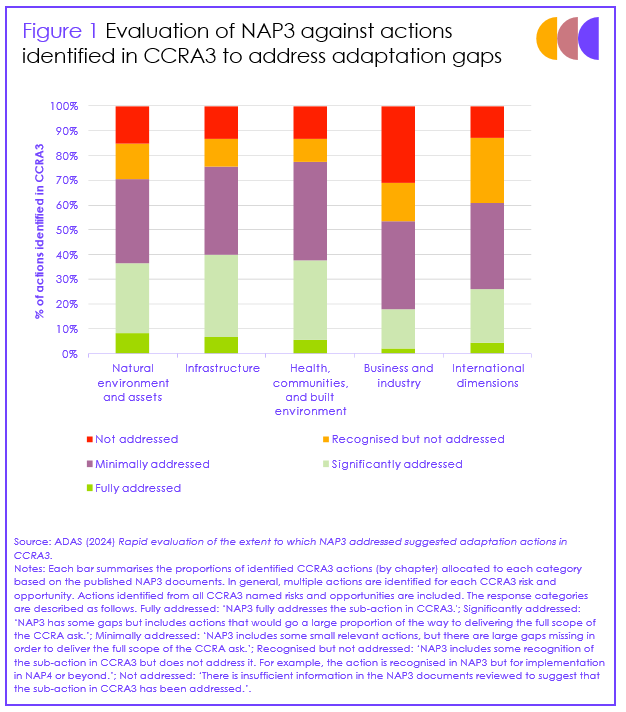
[*] A smaller proportion of the necessary actions in the business and industry, and international sectors are found to be substantially addressed by NAP3 when compared to risk to the natural environment, infrastructure and built environment, communities, and health. Risks that scored in the highest urgency category in CCRA3 (‘more action needed’) generally see a higher proportion of the CCRA actions significantly addressed by NAP3 than for risk and opportunities with lower urgency scores. CCRA3 used a typology to classify adaptation actions. No/low regrets actions and actions corresponding to climate-smart design made up the large majority of identified actions, but no significant difference in how actions are addressed by NAP is seen across the action typology in this evaluation.