

Footnotes have been removed from the online version of this report. Please download the PDF for the footnoted version of this report.
Executive summary
Scotland has newly legislated emissions targets consistent with achieving Net Zero by 2045. The targets are achievable, provided the Scottish Government urgently utilises policy powers within its gift. Now it is time to deliver, with an opportunity to demonstrate commitment to this ambition.
Greenhouse gas emissions in Scotland fell 2.6% between 2021 and 2023. They are now less than half the levels seen in 1990. This good progress was mainly driven by a rapid scale-up of wind and solar electricity generation, supporting the GB-wide grid, while coal generation was phased out and gas generation declined. To achieve Scotland’s targets, action must now broaden to more sectors.
The Climate Change (Scotland) Act 2009 was amended in 2024 to repeal the previous interim targets. The Scottish Government and Parliament have since made rapid progress to legislate five-yearly carbon budgets, covering the period 2026 to 2045. These have been set at levels in line with the Committee’s advice and with achieving Net Zero by 2045. This is a positive step forward.
Following this, the Scottish Government published its draft Climate Change Plan (CCP), including a set of quantified policies and proposals for achieving the first three carbon budgets. While most of the required emissions savings to achieve the First Carbon Budget (2026 to 2030) have credible plans or plans with only some risks, there are significant risks to achieving much of the Second (2031 to 2035) and Third (2036 to 2040) Carbon Budgets. Time is tight, with long lead times between policy action and emissions reductions in many cases. More detail is needed on the expected roll-out of key technologies and measures to ensure effective monitoring is possible.
Most of the required emissions reductions will come from sectors with policy powers devolved to the Scottish Government. This includes a transition to modern, efficient, electrified technologies for transport and heat in buildings, as well as reducing emissions in agriculture and land use.
- Electric vehicles: with prices of new electric vehicles (EVs) falling, public charge points being rapidly rolled out, and strong policy in the UK’s zero-emission vehicle (ZEV) mandate, there is potential for sales to grow quickly. This should be supported by continued pace in the charge point roll-out and strong supportive messaging.
- Low-carbon heat: the draft CCP lacks sufficient plans for buildings. Very little emissions reduction is projected to occur over the next ten years, compensated for by a rapid acceleration in the late 2030s. It is not clear what will drive this acceleration, which will be challenging for supply chains to deliver. This ‘delay and catch-up’ approach therefore carries significant risk. A more plausible approach would be to implement policy to build on, and accelerate, the recent steady increase in heat pump installations seen in Scotland.
- Woodland and peatland: a significant and sustained increase in tree planting and peatland restoration is needed. While both have seen recent increases, tree planting rates have not been sustained, and low historical planting rates have led to a decline in the forestry sink. Stop-start funding leads to uncertainty and damages supply chains. A joined-up approach with agriculture will be needed to understand the scale and type of land required.
While the majority of the required emissions reduction is in sectors with policy powers in the Scottish Government’s hands, it is vital that the Scottish and UK Governments work together effectively to achieve their shared objectives. This is particularly important given the Scottish Government has chosen a pathway with a heavy reliance on negative emissions technologies (NETs), an area with significant risk and with policy powers largely reserved to the UK Government. A co-ordinated approach with plans for UK-wide NETs will be needed to ensure successful delivery, with the Scottish Government ensuring Scotland is an attractive location for NETs.
Climate change in Scotland
The people of Scotland are already feeling the effects of climate change today. According to the Summer 2025 Public Attitudes Tracker, 82% of Scottish respondents were very or fairly concerned about climate change. Winters are getting wetter, raising flood risk. Summers are getting warmer, with more intense and more frequent heatwaves impacting people’s health. Sea levels are rising around the coasts of Scotland and its islands. Scotland is also experiencing more instances of new climate impacts such as wildfires and drought in East Scotland, impacting rural parts of the country. Scotland must continue to reduce its greenhouse gas emissions while simultaneously becoming more resilient and preparing for the rapidly increasing severity of future risks. A failure to prepare for the effects of climate change in Scotland will increasingly create risks to the delivery of the pathway to Net Zero – this must be addressed alongside reducing greenhouse gas emissions.
Scotland’s carbon budgets and the draft Climate Change Plan
Under the Climate Change (Scotland) Act 2009 (the Act), Scotland has a target to reach Net Zero greenhouse gas emissions by 2045. In 2024, the Act was amended to replace the old interim decadal and annual targets with a framework of five-yearly carbon budgets (a carbon budget is a cap on greenhouse gases emitted in Scotland over a five-year period). Since then, the Scottish Government and Scottish Parliament have made rapid progress in legislating the levels of the four carbon budgets, covering the period 2026 to 2045. The carbon budgets are set such that the average annual level of emissions will be:
- 57% lower than 1990 levels for the First Carbon Budget (2026 to 2030), implying a 12% reduction from levels in 2023.
- 69% lower than 1990 levels for the Second Carbon Budget (2031 to 2035), implying a 36% reduction from levels in 2023.
- 80% lower than 1990 levels for the Third Carbon Budget (2036 to 2040), implying a 59% reduction from levels in 2023.
- 94% lower than 1990 levels for the Fourth Carbon Budget (2041 to 2045), implying an 88% reduction from levels in 2023.
These targets are in line with our advice and with reaching Net Zero by 2045. Achieving them will require rapid decarbonisation action and will represent a fair contribution for Scotland to UK-wide and global efforts to mitigate climate change.
In November 2025, the Scottish Government published its draft CCP for the first three carbon budgets (2026 to 2040), setting out – for the first time – policies and plans with quantified emissions reductions attached to policy outcomes across all sectors of the economy and providing an emissions pathway that achieves the carbon budgets (Figure 1). We welcome this new draft plan, and it is positive to see it contain plans for a monitoring and evaluation framework, which includes just transition indicators for the first time. However, the draft CCP does not include deployment pathways for each key indicator. Nor does it include annual sectoral emissions pathways, with only carbon budget averages given. Due to the lag in reported emissions data, this makes it very difficult to monitor progress until a given carbon budget is almost over, when it will likely be too late to make adjustments to the pathway. The framework in the final CCP should include indicative annual sectoral emissions and indicator pathways, so that progress can be effectively monitored.
| Figure 1 Greenhouse gas emissions in Scotland and the Scottish Government’s targets and pathway |
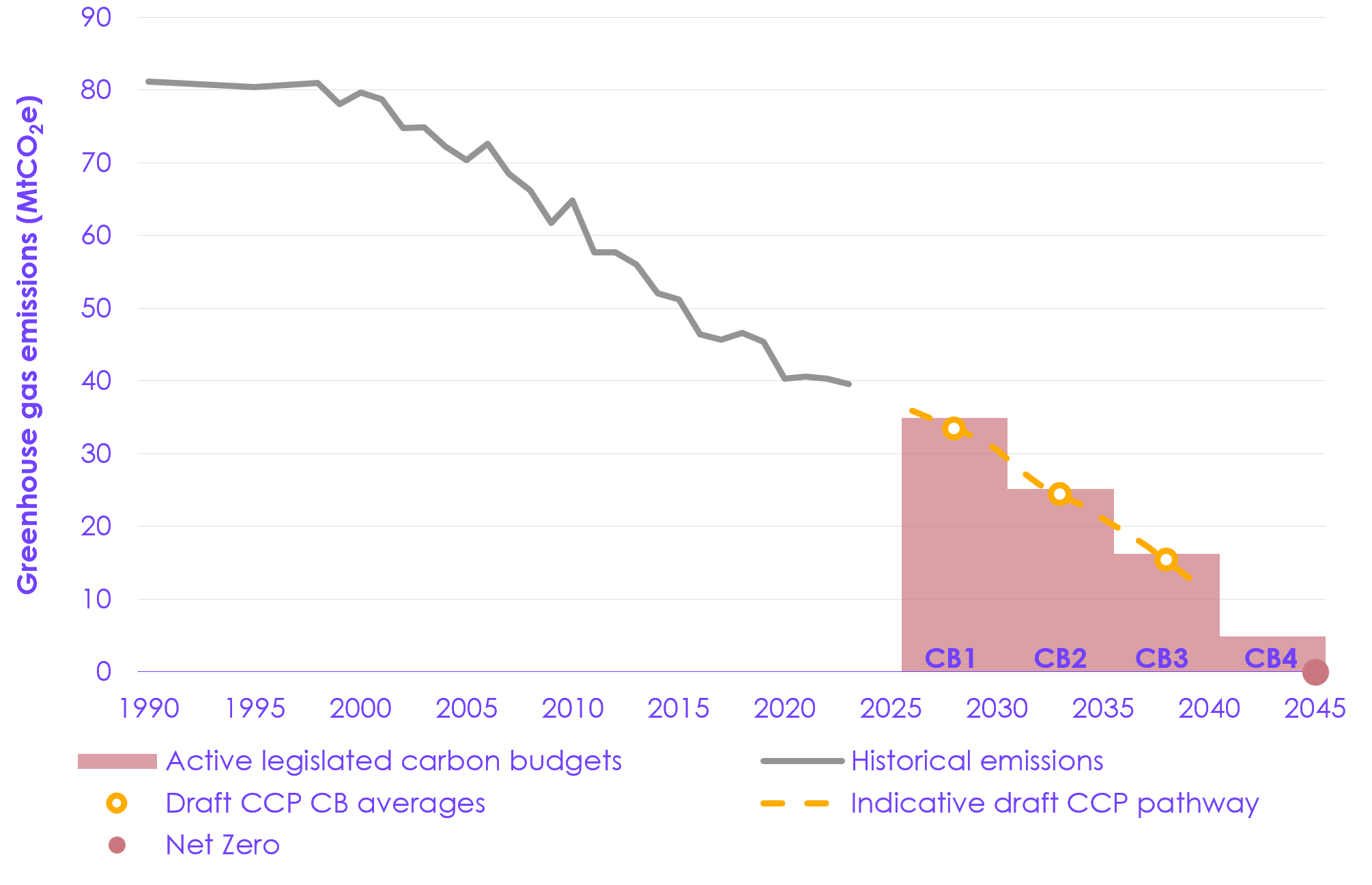 Description: Scotland is more than halfway to Net Zero emissions. Scotland’s carbon budgets and draft Climate Change Plan (CCP) pathway are in line with Net Zero by 2045. |
Historical emissions in Scotland
Greenhouse gas emissions in Scotland were 39.6 MtCO2e in 2023, 51.3% lower than 1990 levels. This is significant progress, with emissions steadily falling since the start of the century (Figure 1).
- The primary driver of emissions reductions so far has been electricity supply. A significant ramp-up of wind and solar generation has enabled the phase-out of coal generation in 2016 and a steady decline in gas generation, which in 2023 contributed only 7% of the electricity generated in Scotland. The remaining 93% was low-carbon generation, primarily from wind power.
- There have also been substantial reductions in the business and industrial process; land use, land use change and forestry (land use); and waste management sectors.
Between 2021 and 2023, emissions fell by 2.6%, falling year-on-year in both 2022 and 2023, following a slight increase in 2021.
- Emissions reductions over these two years were largely driven by the residential and public buildings (buildings) and energy supply sectors.
- For buildings, around half of the overall reduction was due to milder-than-average winter months in 2022 and 2023 contrasting the colder winter months in 2021, and a likely behavioural response to record-high gas prices, rather than sustained changes in how buildings in Scotland are heated.
- Emissions from buildings vary considerably year-to-year due to annual variations in temperature and are likely to increase in colder winters. Additionally, it is highly uncertain whether behavioural responses will be maintained following reductions in gas prices.
- These reductions in emissions were partially offset by an increase in emissions in transport, as flying levels increased following the pandemic. There was also an increase in land use emissions, in part due to a legacy of lower tree planting rates over the previous two decades. This has led to a declining forestry carbon sink in Scotland. The land use sector has consequently recently transitioned from a net sink to a net source of emissions.
Emissions from imports from outside the UK, which are not included in the climate targets in the Act, have been relatively steady since 2009, following a drop after the financial crisis. This has happened despite territorial emissions falling considerably during this period, showing that this decrease is not being offset by increased emissions elsewhere.
Assessment of delivery and policy progress
The draft CCP shows that emissions reductions will need to broaden to more sectors, with significant contributions from sectors with policy powers in the Scottish Government’s hands (Figure 2). We have assessed the policies and plans in the draft CCP, determining if they are credible for delivering the required emissions savings in each carbon budget period, whether they carry some or significant risk, or whether plans are currently insufficient (see Annex 3 for our assessment criteria).
We assess that there are credible plans and plans with only some risks in place for the majority of the emissions reduction needed to achieve Scotland’s First Carbon Budget, with the draft CCP pathway going beyond the level of the budget. This is a prudent approach, allowing for some contingency. However, there are significant risks and gaps in policy for the Second and Third Carbon Budgets (Figure 3). And while the pathway goes slightly beyond the level of these two carbon budgets, the scale of this overperformance is less than the quantified impact of areas in which we have concerns about the assumptions and modelling methodologies employed:
- First Carbon Budget (2026 to 2030): 91% of the emissions reduction required to meet the First Carbon Budget is covered by credible plans or plans which carry only some risk.
- The majority of the required emissions reduction over this period comes from the transport, energy supply, and business and industrial process sectors (Figure 2).
- There are credible plans or only some risks for nearly all the emissions reductions in transport due to strong policy in the ZEV mandate and recent good progress in the roll-out of EVs and charging infrastructure. There are also credible plans for near-term peatland restoration, which has increased significantly in recent years.
- There remain significant risks for 9% of the required emissions savings, mostly related to the assumption that recent energy-saving practices in buildings following high gas prices will be maintained. While some (for example, reducing boiler flow temperatures) could be maintained following reductions in gas prices, others (such as underheating of homes due to affordability concerns) would not be desirable to continue.
- Second and Third Carbon Budgets (2031 to 2040): The proportion of required emissions reductions covered by credible plans, or carrying only some risk, reduces over time to 64% for the Second Carbon Budget and 58% for the Third Carbon Budget. The Scottish Government is therefore relying on areas with significant risks or insufficient plans in place, and highly uncertain wider factors that are not supported by policy levers, to deliver 36% of the required emissions savings for the Second Carbon Budget and 42% for the Third Carbon Budget.
- Emissions reductions need to broaden even further over this period, with buildings, agriculture and land use, and NETs becoming increasingly important (Figure 2). However, many aspects of the emissions reductions required in these sectors carry significant risk or in some cases have insufficient plans.
- The areas with credible plans in place are largely the same as those assessed as credible for the First Carbon Budget.
- Significant risks or insufficient plans are mostly related to decarbonising buildings, a large portion of industrial emissions, and NETs, with important contributions from agriculture.
- There are also some areas where we are concerned that the modelling methodologies employed leave aspects of the draft CCP pathway reliant on emissions savings that depend on highly uncertain wider factors:
- More than half of the expected emissions savings in land use are due to a peatland area inventory change that is assumed to be applied from the start of the Second Carbon Budget. This is based on emerging research indicating that the area of grasslands on peat soils and associated emissions could be substantially lower than currently estimated. It is unclear whether this correction will be incorporated into future emissions accounting and its impact is currently uncertain. Furthermore, the correction may affect the 1990 baseline emissions with respect to which the carbon budgets are defined, which has not been factored into the draft CCP projections.
- Energy demand in buildings is assumed to stay at the low levels seen in 2023 – when winter months were milder than average. While it is reasonable to account for the underlying trend of increasing temperatures lowering heating demand, there are year-to-year fluctuations either side of this trend. It is unlikely that temperatures would remain milder than the average underlying trend, and hence that heating demand would remain low, over a full five-year carbon budget period.
While some level of uncertainty and risk is inevitable for the later carbon budgets, the Second Carbon Budget begins in only five years. Given the significant risks associated with uncertain assumptions, a lack of supporting policy, and heavy reliance on NETs, the Scottish Government should ensure that the proposed monitoring framework is robust. If assumptions are shown to be invalid, adjustments must be made to the pathway to compensate. To enable this, indicative annual emissions and indicator pathways should be included in the final CCP. Effective monitoring and evaluation will be essential to ensure delivery remains on track, together with robust contingency planning to allow the plan to adapt to evolving circumstances.
| Figure 2 Distribution of emissions reduction by sector in the draft Climate Change Plan |
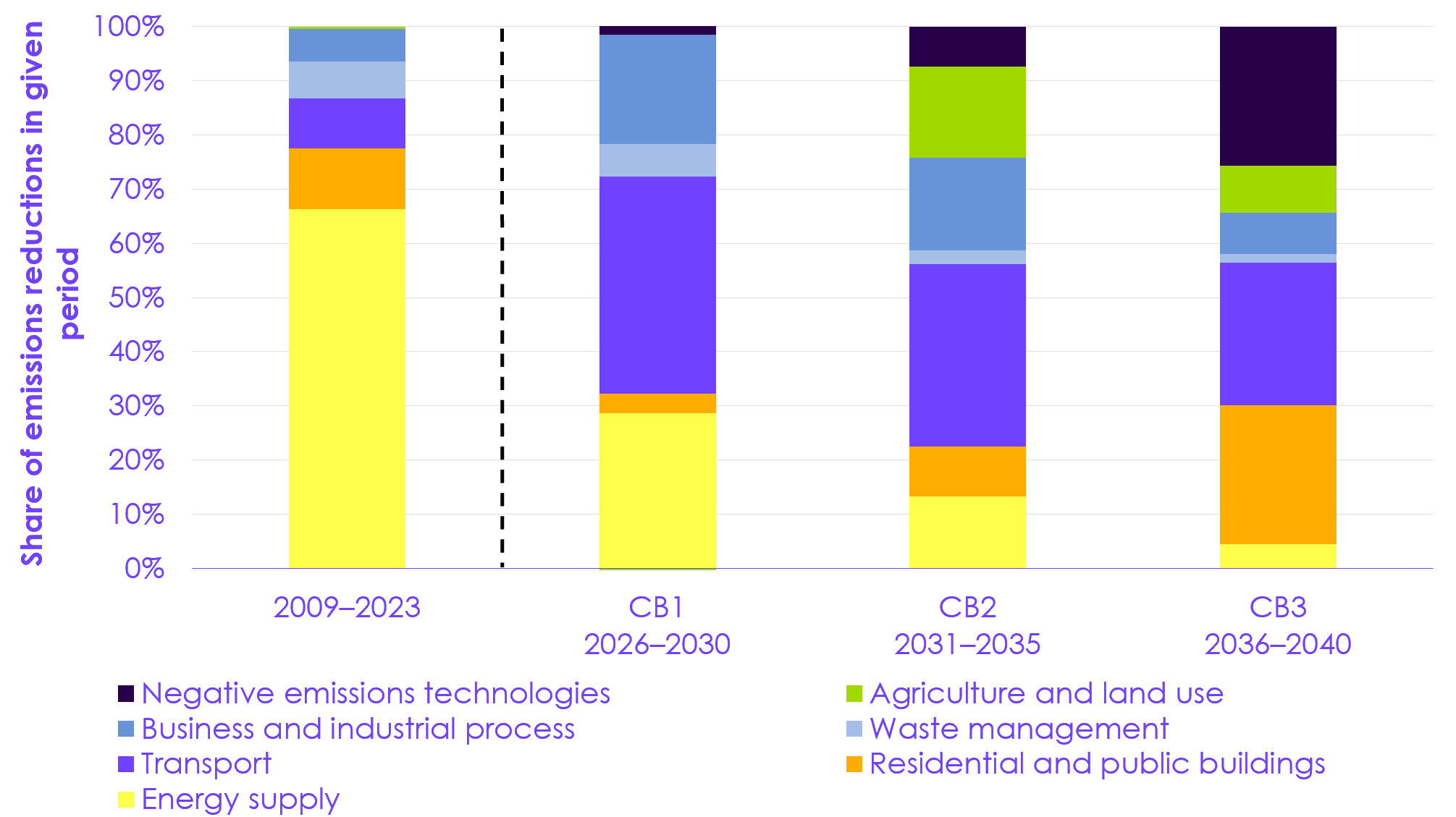 Description: The majority of the emissions reductions seen in Scotland to date have been in the mostly reserved energy supply sector. Emissions savings need to broaden, particularly into the mostly devolved transport, buildings, and agriculture and land use sectors. Source: National Atmospheric Emissions Inventory (2025) Greenhouse Gas Inventories for England, Scotland, Wales and Northern Ireland: 1990-2023; Scottish Government (2025) Scotland’s Draft Climate Change Plan: 2026-2040; CCC analysis. Notes: See Chapter 3. |
| Figure 3 Assessment of policies and plans |
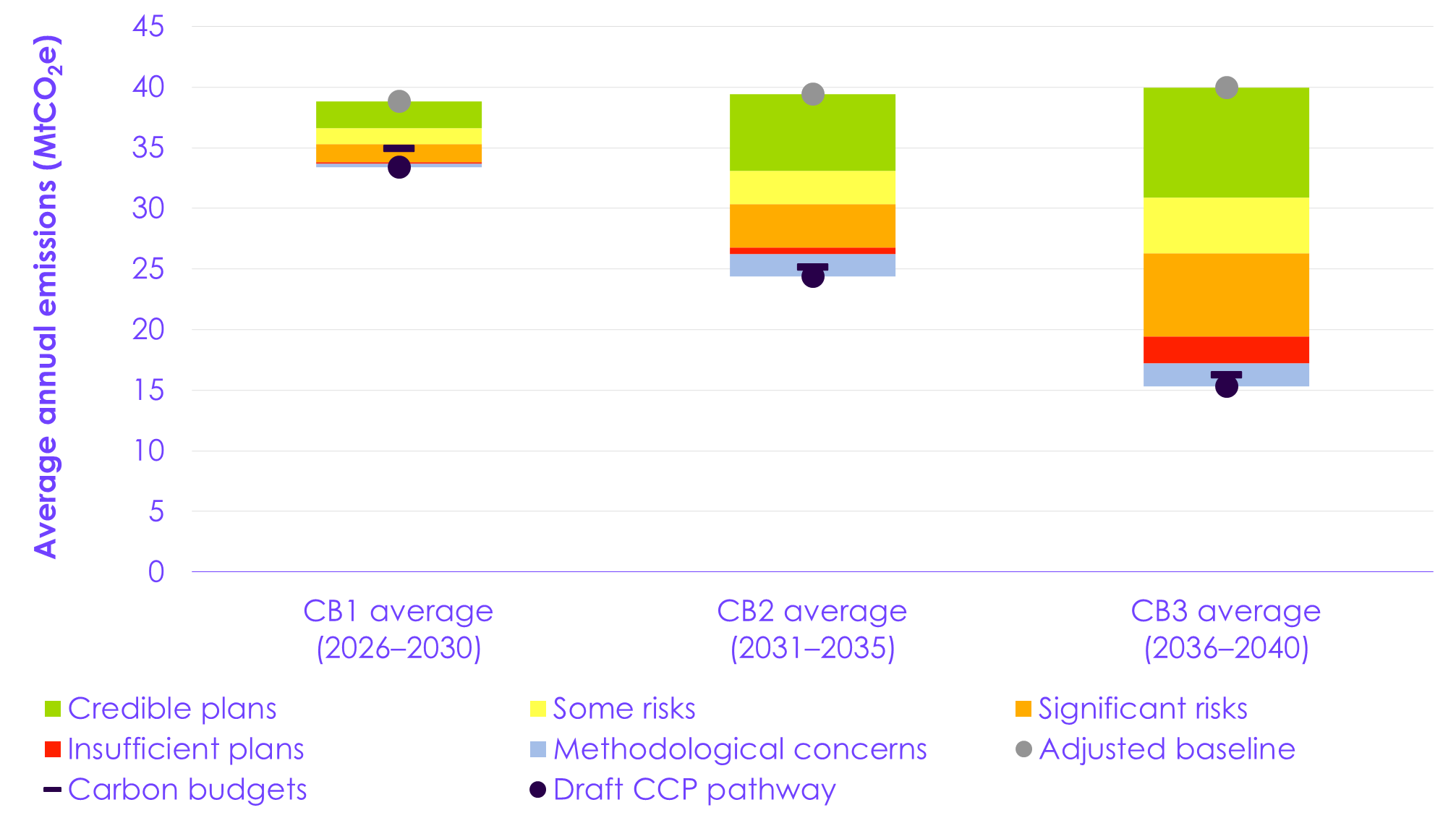 Description: Plans that are either credible or have only some risks attached are in place covering the majority of emissions reductions required to meet the First Carbon Budget. However, the Scottish Government is relying on emissions reductions where there are significant risks or insufficient plans in place, and on areas in which we have identified methodological concerns, to meet the Second and Third Carbon Budgets. Description: Plans that are either credible or have only some risks attached are in place covering the majority of emissions reductions required to meet the First Carbon Budget. However, the Scottish Government is relying on emissions reductions where there are significant risks or insufficient plans in place, and on areas in which we have identified methodological concerns, to meet the Second and Third Carbon Budgets.Source: Scottish Government (2025) Scotland’s Draft Climate Change Plan: 2026-2040; CCC analysis. Notes: See Chapter 5. |
Progress by sector
Transport
Transport is currently Scotland’s highest-emitting sector, responsible for around a third of emissions in 2023. In the First Carbon Budget period, 40% of the required emissions reductions are projected to come from transport.
- The number of battery-electric cars on roads in Scotland increased by 38% in the year to September 2025, supported by strong policy in the ZEV mandate and targeted funding. The draft CCP pathway requires EV sales to continue growing rapidly, in line with the Climate Change Committee’s (CCC) Balanced Pathway in our 2025 Scotland’s Carbon Budgets advice. Sales go beyond the mandate, driven by a rapid fall in EV prices together with the already lower running costs. The price premium of a new EV compared to a new petrol car dropped to 19% as of September 2025, from 24% in 2024.
- Public charge points across Scotland are showing impressive growth and increased by approximately 34% to over 6,000 in 2024, meeting the Scottish Government’s target two years early, although the distribution across Scotland varies and satisfaction could be substantially improved. A cross-pavement charging grant pilot worth up to £3,500 per household is available to enable access to the lower costs of home charging.
- Aviation emissions abatement in the draft CCP is heavily reliant on the success of the UK-wide sustainable aviation fuel (SAF) mandate and assumed efficiency improvements. No new aviation policy is committed to in the draft CCP. Significant policy gaps remain UK-wide to ensure the aviation sector takes responsibility for mitigating its emissions and ultimately achieving Net Zero for the sector by 2050. This includes paying for permanent engineered removals to balance out all remaining emissions.
Agriculture and land use
Progress in agriculture and land use has been mixed. While there have been increases in peatland restoration and tree planting, tree planting rates have not been sustained. There are significant risks for agriculture due to the lack of detail in the Agricultural Reform Programme and there is a lack of any policy to decarbonise non-road mobile machinery.[1]
- There has been a significant increase in peatland restoration recently, with rates almost doubling over two years to 14,900 hectares in 2024/25 – the highest rates seen to date. A five-year Peatland ACTION Partnership Plan was published in December 2025 setting out details on the peatland sector’s capacity, skills, and finance in support of reaching future restoration targets.
- The trend in tree planting rates has been less sustained. In 2023/24, woodland creation rates in Scotland reached 15,000 hectares – the highest levels seen since 1990 (Figure 4), demonstrating that rapid increases are possible. However, cuts to the Forestry Grant Scheme meant rates almost halved in 2024/25 to 8,500 hectares. With a target to reach, and crucially to maintain, 18,000 hectares of new woodland creation by the end of this decade, consistent progress is urgently needed. Funding has been increased in the 2025/26 and 2026/27 budgets, but remains at levels lower than 2023/24. Stop-start funding leads to uncertainty and damages supply chains.
- Livestock numbers have been steadily declining in Scotland, as has UK-wide meat consumption, which is the biggest market for Scottish meat. The draft CCP includes no proactive measures to reduce livestock numbers beyond projections based on these existing long-term trends.
- Scotland’s land use sector will play an important role in reaching both Scotland’s and the UK’s Net Zero ambitions through its high potential for woodland creation and peatland restoration. The draft CCP does not currently set out how this will be delivered, in terms of the scale and type of land required to transition from agriculture.
| Figure 4 Tree planting rates in Scotland and the UK |
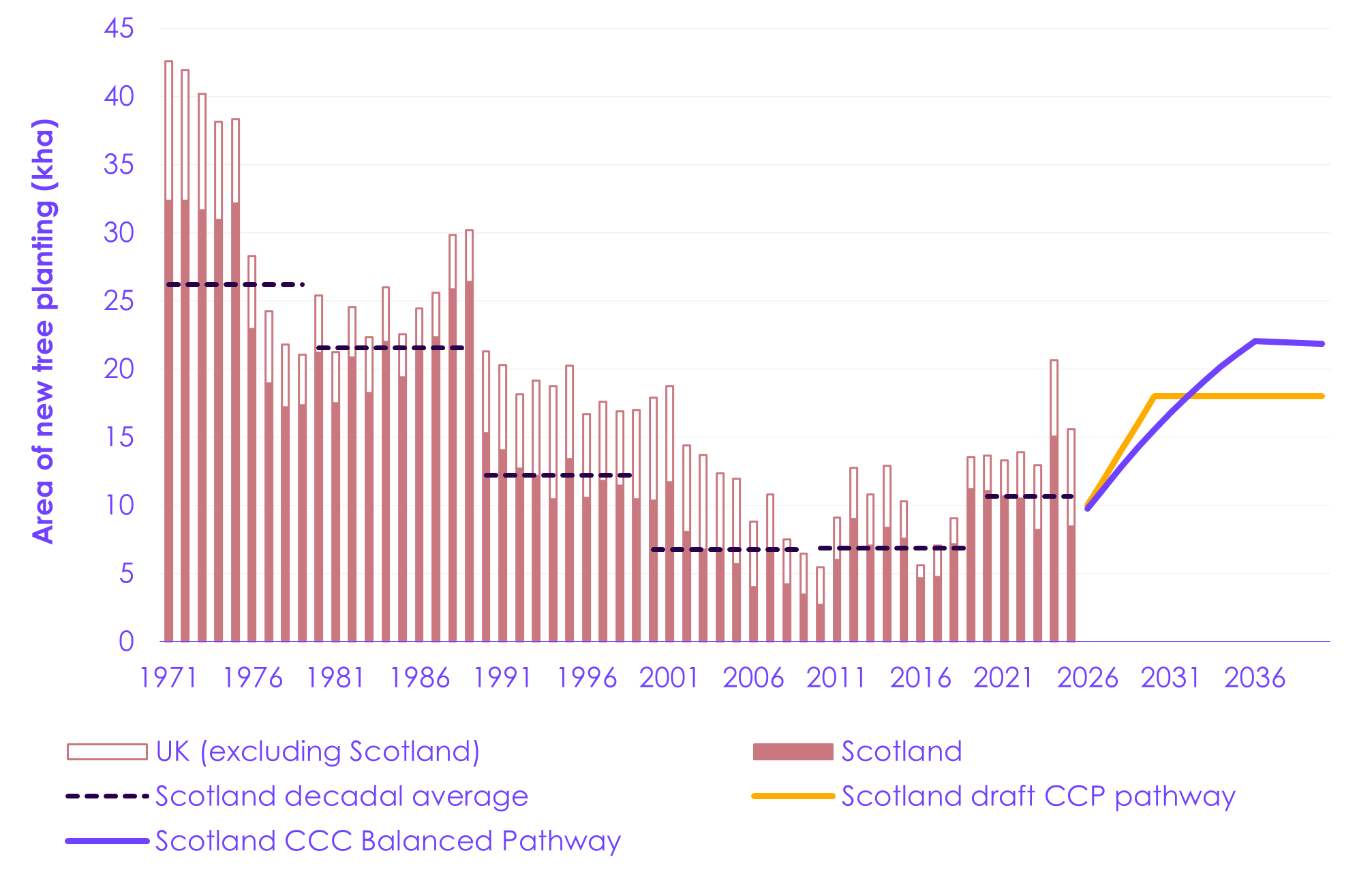 Description: Scotland has consistently delivered the highest planting rates in the UK. Though woodland creation rates have started to rise in the 2020s, they remain far below the rates achieved in the 1970s and 1980s. Description: Scotland has consistently delivered the highest planting rates in the UK. Though woodland creation rates have started to rise in the 2020s, they remain far below the rates achieved in the 1970s and 1980s.Source: Forest Research (2025) Time Series; CCC analysis. Notes: See Chapter 4. |
Buildings
The Scottish Government has a target to decarbonise heating systems in all buildings where ‘reasonable and practicable to do so’ by 2045. However, policies and plans to deliver the scale-up in low-carbon heating installations required to meet this target are currently missing.
Emissions reductions proposed over the next decade are unambitious – with emissions falling by an average of only 0.1 MtCO2e per year over the first two carbon budgets, then accelerating extremely rapidly to 0.4 MtCO2e per year in the late 2030s, over the third carbon budget period. This ‘delay and catch-up’ approach carries significant risk. A more credible approach would be to build on, and accelerate, the recent steady increase in heat pump installations, allowing supply chains to grow and costs to reduce.
- Heat pump installations in Scotland have been steadily growing over the 2020s, with an 18% increase between 2023 and 2024, driven by an increase in installations under the Home Energy Scotland and Warmer Homes Scotland schemes (Figure 5). A higher proportion of Scottish homes have a heat pump compared to the UK as a whole.
- The CCC Balanced Pathway sees a rapid increase in heat pump installation rates, in line with those seen in similar European countries like the Netherlands and Ireland, reaching a maximum growth rate of 42% by 2028.
- The expected roll-out of heat pumps is not given in the draft CCP and should be included in the final CCP to ensure progress can be effectively tracked in the monitoring and evaluation framework.
- The Scottish Government offers generous grants and interest-free loans, providing a good incentive for households. However, they are currently only committed until the end of this financial year. The Scottish Budget 2026-27 confirmed £335 million of funding to extend support for low-carbon heating and energy efficiency into the coming financial year. However, the Scottish Government has yet to confirm that this will be used to continue existing grant schemes and has not yet set out plans for continued funding beyond this. Longer-term certainty is needed.
- It has been two years since the Scottish Government initially consulted on the Heat in Buildings Bill, which the Committee described in our 2023 Progress in reducing emissions in Scotland report as a potential template for other parts of the UK. It is therefore disappointing that there are still no alternative measures to the initial proposals for regulations to upgrade properties at the point of sale.
- The Scottish Government sees a significant role for heat networks in buildings, potentially delivered by requiring certain buildings to connect. However, further plans are needed on how this will be implemented.
- Scotland currently has regulations requiring minimum energy efficiency standards in the social-rented sector, but not in other existing buildings.
- There has been progress in new buildings, with the New Build Heat Standard requiring that new buildings with warrant applications made from April 2024 be built with a low-carbon heating system. In 2024, around one-third of new homes in Scotland were constructed with a low-carbon heating system, this is expected to increase over the coming years. The majority of these (62%) were heat pumps, with 22% being less efficient direct electric technologies. The rest were communal heating systems.
- On 21 January 2026, the UK Government published its Warm Homes Plan. This includes steps announced at the Budget to remove some levies from energy bills. This is a positive step forward. However the ratio of electricity to gas prices remains high, meaning that many properties will not yet be able to see the benefits of reduced running costs from heat pumps, which are a highly efficient technology.
| Figure 5 Historic heat pump deployment in existing homes compared to the CCC’s Balanced Pathway |
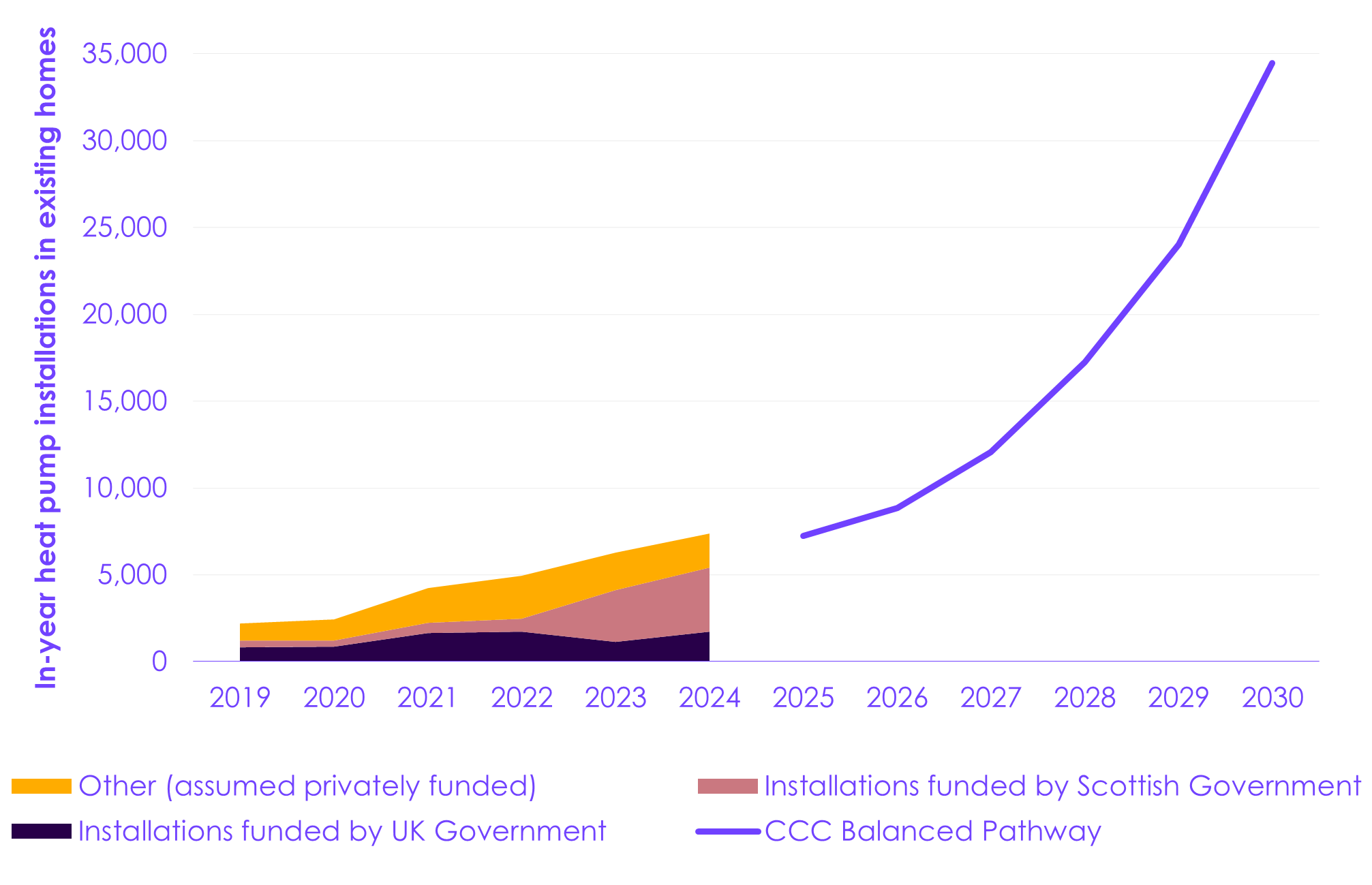 Description: Heat pump installations have grown steadily over the last five years in Scotland but need to accelerate rapidly in order to reach rates required for Net Zero. Description: Heat pump installations have grown steadily over the last five years in Scotland but need to accelerate rapidly in order to reach rates required for Net Zero.Source: Energy Savings Trust (2025) Scotland Energy Performance Certificate database; Scottish Government (2025) Heat in Buildings Progress Report 2025; Microgeneration Certification Scheme (2025) Data Dashboard; CCC analysis. Notes: See Chapter 4. |
Waste management
There has been little progress in reducing emissions from waste over the past decade. Although there have been small reductions in the total volume of waste produced by households, household recycling rates have not improved notably for many years, which risks the delivery of emissions reduction without further action. While Scotland has significantly reduced the volumes of waste sent to landfill in recent years, there has been a corresponding growth in emissions from waste incinerated via energy from waste.[2]
Sectors with most policy powers reserved to the UK Government
To date the majority of emissions reductions have been achieved in energy supply via action led by the UK Government. Going forwards this will need to broaden to sectors with many policy powers devolved to the Scottish Government. However, there are also important contributions from sectors with significant powers reserved to the UK Government. In particular, the Scottish Government has chosen a pathway that has significant dependencies on NETs, which are responsible for around a quarter of the required emissions reduction in the Third Carbon Budget (Figure 2). A co-ordinated approach will be essential.
- Business and industrial process: the draft CCP relies on three main policies: the UK Emissions Trading Scheme (ETS); the proposed industrial decarbonisation programme; and industrial carbon capture and storage (CCS). There are significant risks to achieving the required emissions reductions in the latter two.
- We welcome the proposed launch of the industrial decarbonisation programme in 2026. Where electrification is the economically rational choice, the Scottish and UK Governments should work together to ensure that businesses and industries are incentivised to adopt electric technologies.
- Following the end of operations of some potential industrial CCS customers, the Scottish Government will need to work with the UK Government to ensure that the Acorn project is financially viable. The UK Government should provide greater clarity on timelines for the Scottish cluster.
- Energy supply: deployment of variable renewable electricity generation is continuing to increase in Scotland, with 1.1 GW of offshore and 1.3 GW of onshore wind capacity deployed in 2024.
- Remaining emissions in electricity generation come predominantly from the Peterhead gas-fired power station. Reducing emissions further relies on the continued roll-out of wind and solar generation and of network capacity to accommodate it. The draft CCP sets out plans to replace Peterhead with a CCS-enabled gas plant.
- For the oil and gas sector, the plan sets out an intention to manage the transition via skills programmes and targeted investment, including in Grangemouth and North East Scotland. However, further detail is needed on how these measures translate into secure, high-quality employment opportunities in affected regions, particularly where the pace of job creation in growing sectors remains uncertain.
- NETs: the Scottish Government has chosen a pathway with a high dependence on NETs, but it is not clear how the Scottish Government’s plans for a significant ramp up in NETs in the late 2030s, over the Third Carbon Budget period, align with UK-wide plans for where they will be geographically placed. What is more, UK-wide plans currently lack certainty and funding. This is an area of significant risk for achieving the Third Carbon Budget.
Priority actions
As set out in the Act, the Scottish Government must now produce a final Climate Change Plan, which will set out how Scotland will meet its emissions targets over the next 15 years. Beyond this, the Scottish Government will publish important new strategies and plans in a number of crucial areas over the coming months, including the Heat in Buildings Strategy and Delivery Plan and the Fourth Land Use Strategy. These new documents should be used to move forward with implementing the key measures set out in the plan at pace.
We have 18 priority recommendations for the Scottish Government to achieve this – within these, there are six core themes which require particular focus over the coming year:
- Produce an effective and credible final Climate Change Plan: the Committee’s assessment of the draft CCP, set out in this report, has identified a number of improvements that should be included in the final CCP. These include addressing the risk from the methodological concerns around the assumed inventory change for peatlands and the underlying temperature assumptions for buildings. The final CCP should also make clear how energy-saving practices seen when gas prices were high will be maintained without adverse effects such as underheating of homes. Further key actions to reduce delivery risk in achieving the carbon budgets are given in the following core themes. As part of the final CCP, the Scottish Government should also set out its finalised monitoring and evaluation framework, including indicative annual pathways for sectoral emissions and all key indicators of progress. An explicit inclusion of contingency options should also be included to make up for any potential shortfalls in the pathway (R2026-001, R2026-002, and R2026-003).
- Implement a clear delivery plan for decarbonising home heating: the Scottish Government has an opportunity to lead the way in the UK for buildings decarbonisation, with significant policy powers within its gift. However, the draft CCP lacks policy to deliver this (R2025-100, R2025-101, and R2026-006).
- The Scottish Government should confirm that funding announced in the Scottish Budget 2026-27 will be used to continue existing grants and top-up loans to support households with heat pump installations. Furthermore, it should set out plans for the continuation of funding beyond the next financial year.
- The upcoming Heat in Buildings Strategy and Delivery Plan should be published as soon as possible this year and ensure conditions are in place to deliver the required scale-up in low-carbon heat and energy efficiency measures. This could be via a combination of continued financial support, regulation, support for skills, public engagement on the benefit of heat pumps, and leading by example and helping to build supply chains in public sector buildings.
- There are homes that would already benefit from lower heating bills by installing a heat pump. The UK Government’s Warm Homes Plan includes steps announced at the Budget to remove some levies from energy bills and provide funding for fuel poor homes across the UK, following the forthcoming closure of the Energy Company Obligation scheme. The Scottish Government should develop plans accordingly, considering the homes that will see reduced running costs, to ensure that progress in heat pump deployment continues. Delays to decision-making are postponing opportunities for emissions reductions and putting targets for decarbonisation of buildings at risk.
- In addition, the delivery plan should include details of plans to ensure buildings connect to heat networks where appropriate.
- The delivery plan should also include proposals for improving energy efficiency in existing buildings, including a commitment to implement minimum energy efficiency standards for privately rented homes, and revised standards for social housing.
- Around 25% of homes in Scotland are within tenement buildings, with nearly a third of these built pre-1919. Meeting the Scottish Government’s targets will require an effective approach to decarbonising these buildings, which can be challenging due to traditional construction and the need to coordinate works with multiple owners. The delivery plan needs to address these challenges, including through developing appropriate governance frameworks to enable the installation of communal low-carbon heating systems where appropriate.
- Produce a clear strategy for delivering the required land use changes: Scotland leads the UK on planting new woodlands and restoring peatlands. These two actions will contribute significantly to both Scotland’s and the UK’s emissions targets. The upcoming Fourth Land Use Strategy needs to be clear on the types and locations of land that will be needed for each action, taking a joined-up approach with agriculture. Regulation and long-term public funding should also ensure that farmers are able to take up low-regret measures to reduce emissions from managing crops and livestock. Funding for woodland creation and peatland restoration should be sustained and sufficient to ensure delivery in line with the Government’s ambition (R2025-095, R2025-096, and R2025-097).
- Enable the rapid transition to electric transport: the draft CCP pathway sees a rapid acceleration in EV sales. We expect this to be possible, driven by falling prices and a stable UK-wide policy landscape, but the Scottish Government will need to continue to support the roll-out of public charge points across Scotland in all regions and through positive public engagement on the benefit of EVs to help grow demand. This should be complemented by improvements to public transport across Scotland (R2025-093 and R2025-094).
- Enhance confidence in the delivery of negative emissions technologies: the Scottish Government has chosen a draft CCP pathway that includes a significant level of reliance on NETs. The Scottish Government should publish a delivery plan setting out the expected role of each technology and the actions required to deliver them. A co-ordinated approach with the UK Government and plans for UK-wide NETs will be needed to ensure successful delivery, and the Scottish Government should set out how they intend to make Scotland an attractive location for NETs, such as through efficient planning, permitting, and consenting processes (R2026-004).
- Continue to strengthen public and business engagement with a focus on impactful low-carbon choices and proactive transition plans: the draft CCP reiterates the Scottish Government’s strong commitment to public engagement. However, current approaches need to have an increased emphasis on the most impactful low-carbon household choices. In addition, the Scottish Government needs to build upon positive steps in the draft CCP and the Green Industrial Strategy to ensure that proactive transition plans are agreed with communities, workers, and businesses likely to be affected by the Net Zero transition and the reduced production and use of fossil fuels (R2025-091 and R2025-092).
The Scottish Government has devolved powers to deliver in each of these key areas. But it is also vital that the Scottish and UK Governments work together effectively to achieve progress on areas critical to their shared objectives. To deliver its contribution to UK-wide targets, including the 2030 Nationally Determined Contribution, Scotland will need to continue its strong progress in rolling out renewable electricity generation and ensure development of electricity networks can keep pace. The Scottish Government should act to accelerate planning and consenting for transmission infrastructure to achieve this (R2026-005). Significantly ramping up rates of tree planting and peatland restoration in Scotland will also represent a strong contribution to UK-wide decarbonisation. Rapid and effective action to make electricity cheaper – building on the positive steps taken in the Budget 2025 – and a final investment decision for the Acorn project are two critical enabling actions that the UK Government can take to support decarbonisation in Scotland.
Now that the Scottish Government has adopted its new system of carbon budgets and has developed a draft plan to deliver them, it is essential to make strong progress on delivery. The key lesson from the previous system of annual targets was that ambition alone is not enough – this needs to be backed up by timely, effective policy and implementation. Effective monitoring and evaluation will also be essential to ensure delivery remains on track, together with robust contingency planning to allow the plan to adapt to evolving circumstances. The coming year presents a critical opportunity for the Scottish Government to demonstrate commitment to its ambition by ensuring that policy is well set up to support markets to continue to grow, costs to continue to fall, and emissions to continue to reduce.
Chapter 1: Scotland’s emissions reduction targets
This chapter summarises the legislative framework in place to reduce greenhouse gas (GHG) emissions in Scotland.
Our key messages are:
- Under the Climate Change (Scotland) Act 2009 (the Act), Scotland has a target to reach Net Zero emissions by 2045. In 2024, the Act was amended to replace interim decadal and annual emissions reduction targets with a framework of carbon budgets.
- The Scottish Government has since made rapid progress in legislating the level of the carbon budgets.
- Now that the new framework is in place and the Scottish Government has published Scotland’s Draft Climate Change Plan: 2026-2040 (the draft CCP) for consultation, the Scottish Government should move fast to deliver on its ambitious targets.[3]
1.1 The Climate Change (Scotland) Act
The Act sets the framework for the Scottish Government to address climate change.[4] Emissions in Scotland are covered by both Scotland’s targets, set under the Act, and UK-wide targets, set under the UK Climate Change Act (2008) and as part of the United Nations Framework Convention on Climate Change (UNFCCC) process.[5]
- Scotland’s Act was amended in 2019 to include a target to reach Net Zero GHG emissions by 2045 and interim decadal emissions targets for 2020, 2030, and 2040.[6]
- Scotland’s target to achieve Net Zero by 2045 represents a fair contribution towards UK and global efforts under the Paris Agreement to limit global average temperatures. It is appropriate that Scotland’s target is earlier than the UK-wide target to reach Net Zero by 2050, because Scotland has proportionally more land suitable for tree planting and strong potential for engineered GHG removals.
- The Act was amended in 2024 to repeal the interim targets and introduce five-yearly carbon budgets aligned with the 2045 Net Zero target.[7] This is our first progress report since the Committee offered advice to the Scottish Government on a carbon budget system, and since new targets were legislated.
- Emissions from international aviation and shipping are included in Scotland’s carbon budgets and Net Zero target.
1.2 Scotland’s carbon budgets
In June 2025, the Scottish Government laid the Climate Change (Scotland) Act 2009 (Scottish Carbon Budgets) Amendment Regulations 2025 in the Scottish Parliament.[8]
- The regulations proposed setting Scotland’s carbon budgets, including Scotland’s share of international aviation and shipping emissions, at annual average levels of emissions that will be:
- 57% lower than 1990 levels for the First Carbon Budget (2026 to 2030), implying a 12% reduction from levels in 2023.
- 69% lower than 1990 levels for the Second Carbon Budget (2031 to 2035), implying a 36% reduction from levels in 2023.
- 80% lower than 1990 levels for the Third Carbon Budget (2036 to 2040), implying a 59% reduction from levels in 2023.
- 94% lower than 1990 levels for the Fourth Carbon Budget (2041 to 2045), implying an 88% reduction from levels in 2023.
- These carbon budgets are given as five-year average percentage reductions from the 1990 baseline.[9] They are consistent with the Committee’s 2025 Scotland’s Carbon Budgets advice and with reaching Net Zero by 2045.
- In October 2025, the Scottish Parliament approved the proposed regulations, voting to set Scotland’s carbon budgets in line with the Committee’s recommendations.
It is positive that the Scottish Government has taken swift action to set the levels of the carbon budgets. This provides a firm basis for timely development of policy to deliver the carbon budgets and will, in turn, give confidence to businesses and households on the emissions reduction actions that will be required. Now that the new framework is in place, the Scottish Government needs to deliver against its ambitious targets.
1.3 Progress towards Scotland’s emissions reduction targets
In the following chapters, we assess Scotland’s progress in reducing emissions since our last progress report:
- In Chapter 2, we consider progress in the emissions data for Scotland that has been published since our last progress report, covering emissions in 2022 and 2023.
- In Chapter 3, we review the draft CCP published in November 2025, considering the overall approach and discussing the Scottish Government’s intended emissions reduction pathway as set out in the plan.
- In Chapter 4, we assess progress on a range of delivery indicators, based on the latest robust data available (which varies between 2022 and 2025 depending on the indicator), and compare these against the changes that are needed to meet the draft CCP pathway.
- In Chapter 5, we provide our assessment of policy developments over the period since our last progress report, between March 2024 and 21 January 2026, that are relevant to meeting Scotland’s emissions targets. This includes our assessment of the credibility of the policies and plans set out to meet Scotland’s carbon budgets in the draft CCP.
Chapter 2: Progress in reducing Scotland’s emissions
In this chapter, we review trends in the latest emissions data in total and by sector, with a focus on changes since our last progress report.[10] This covers the period 2021 to 2023, with 2023 being the latest available data. We focus on territorial emissions, that is, emissions within Scotland’s territorial borders and including Scotland’s share of international aviation and shipping (IAS). This is the basis on which Scotland’s legally binding targets are set. However, we also track imported emissions.
Our key messages are:
- Scotland’s territorial greenhouse gas emissions were 39.6 MtCO2e in 2023.[11]
- Emissions were 51.3% lower than in 1990. Relative to emissions in 1990, Scotland is now more than halfway to Net Zero emissions. This milestone was achieved in Scotland two years earlier than the UK as a whole, which provisionally halved its emissions against the 1990 baseline in 2024.
- Reductions since 1990 have been mainly driven by the energy supply sector, with smaller contributions from the business and industrial process; land use, land use change and forestry (land use); and waste management sectors.
- Between 2021 and 2023, emissions fell by 1.1 MtCO2e (2.6%), with emissions falling year-on-year in both 2022 and 2023 following a slight increase in emissions in 2021.
- The emissions reduction between 2021 and 2023 was largely driven by the residential and public buildings (buildings) and energy supply sectors. Emissions from transport and land use increased over this period.
- The pace of emissions reductions will need to slightly increase to meet Scotland’s carbon budgets. This will increasingly require focus on the mostly devolved transport, buildings, and agriculture and land use sectors.
- Emissions from imports outside the UK have been relatively steady since 2009, following a drop after the financial crisis.
2.1 Scotland’s territorial emissions
2.1.1 Overall Scottish emissions
Scotland is now more than halfway to Net Zero emissions by 2045, with emissions having steadily fallen since the start of the century (Figure 2.1). Including its share of emissions from IAS, Scotland has achieved a 51.3% reduction in emissions when compared to 1990 levels (Table 2.1). This milestone was achieved in Scotland two years earlier than the UK as a whole, which provisionally halved its emissions against the 1990 baseline in 2024. This is because electricity supply emissions have decreased faster than in the UK as a whole.
- More than half of total reductions against the 1990 baseline have been achieved since the introduction of the Climate Change (Scotland) Act 2009 (the Act).
- Emissions fell in both 2022 and 2023. The pace of emissions reduction will need to slightly increase to meet Scotland’s carbon budgets.
- The average annual emissions reduction between the introduction of the Act in 2009 and 2023 was 1.6 MtCO2e per year. This will need to increase to an average annual reduction of 1.8 MtCO2e per year between 2023 and 2045 to meet Scotland’s emissions targets.
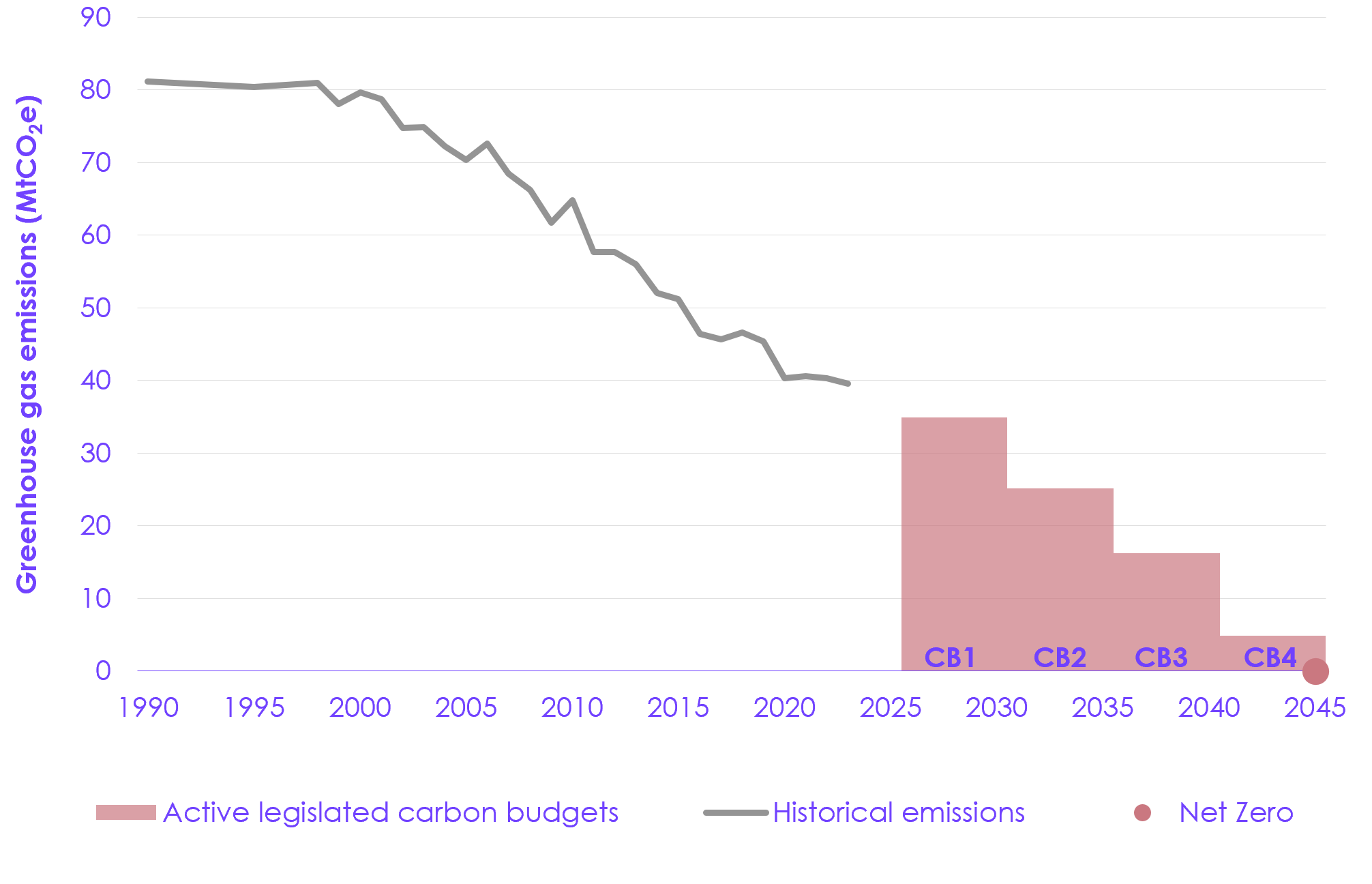 Description: Scotland is more than halfway to Net Zero emissions.
| Table 2.1 Scotland’s territorial emissions and emissions changes for selected periods |
||
| Period | Value | |
| Emissions (MtCO2e) | 1990 | 81.2 |
| 2009 | 61.7 | |
| 2021 | 40.6 | |
| 2022 | 40.3 | |
| 2023 | 39.6 | |
| % change in emissions | 1990–2022 | -50.3% |
| 1990–2023 | -51.3% | |
| 2021–2022 | -0.7% | |
| 2022–2023 | -1.9% | |
| Annual average change (MtCO2e) | 1990–2023 | -1.3 |
| 2009–2023 | -1.6 | |
| Source: National Atmospheric Emissions Inventory (2025) Greenhouse Gas Inventories for England, Scotland, Wales and Northern Ireland: 1990-2023; CCC analysis. Notes: 1990 numbers refer to the 1990 baseline. The baseline year is 1990 for CO2, methane, and nitrous oxide, and 1995 for F-gases. |
||
Emissions changes between 2021 and 2023
Between 2021 and 2023, emissions fell by 1.1 MtCO2e (2.6%), with emissions falling year-on-year in both 2022 and 2023 following a slight increase in 2021 as emissions rebounded from the COVID-19 pandemic.
- 2022 emissions were 40.3 MtCO2e, which is 50.3% below 1990 levels. This is a 0.3 MtCO2e (0.7%) reduction from 2021.
- 2023 emissions were 39.6 MtCO2e, which is 51.3% below 1990 levels. This is a 0.8 MtCO2e (1.9%) reduction from 2022.
The emissions reductions between 2021 and 2023 were largely driven by the buildings and energy supply sectors. Emissions from transport and land use increased over this period (Figure 2.2).
- Emissions from buildings showed the largest sectoral decrease, falling by 1.3 MtCO2e, which is an 18% reduction for the sector. Emissions in this sector fell by 1.3 MtCO2e in 2022 and 0.1 MtCO2e in 2023.[12]
- Around half of the overall reduction was due to milder-than-average winter months in 2022 and 2023. Emissions vary considerably year-to-year due to annual variations in temperature. After adjusting for the effect of these short-term fluctuations in temperature on heating requirements, emissions in this sector fell by 0.7 MtCO2e, a 10% reduction.[13] This is likely to be driven by a behavioural response to record-high gas prices.
- Energy supply emissions fell by 0.9 MtCO2e between 2021 and 2023. Emissions in this sector increased by 0.3 MtCO2e in 2022 before falling by 1.2 MtCO2e in 2023.
- Around two-thirds of the overall reduction relates to a reduction in unabated gas generation in power stations. Around one-third of the reduction is due to reductions in emissions from oil refining and fuel use in oil and gas extraction.
- Transport emissions increased by 1.1 MtCO2e (9%) between 2021 and 2023. In 2022, emissions increased by 1.0 MtCO2e, with a further increase of 0.1 MtCO2e in 2023.
- This increase is largely due to aviation emissions continuing to rebound following the COVID-19 pandemic.
- Emissions from the land use sector increased by 0.7 MtCO2e between 2021 and 2023. Emissions increased by 0.1 MtCO2e in 2022 and 0.6 MtCO2e in 2023.
- This was largely due to a legacy of lower tree planting rates during the previous two decades, leading to a decline in the forestry carbon sink, as well as the removal of trees from peatlands under restoration management, leading to a net loss of carbon sequestration in the near-term.
The driving factors behind these sectoral changes are discussed further in Section 2.1.2 below.
| Figure 2.2 Change in Scotland’s emissions by sector (2021–2023) |
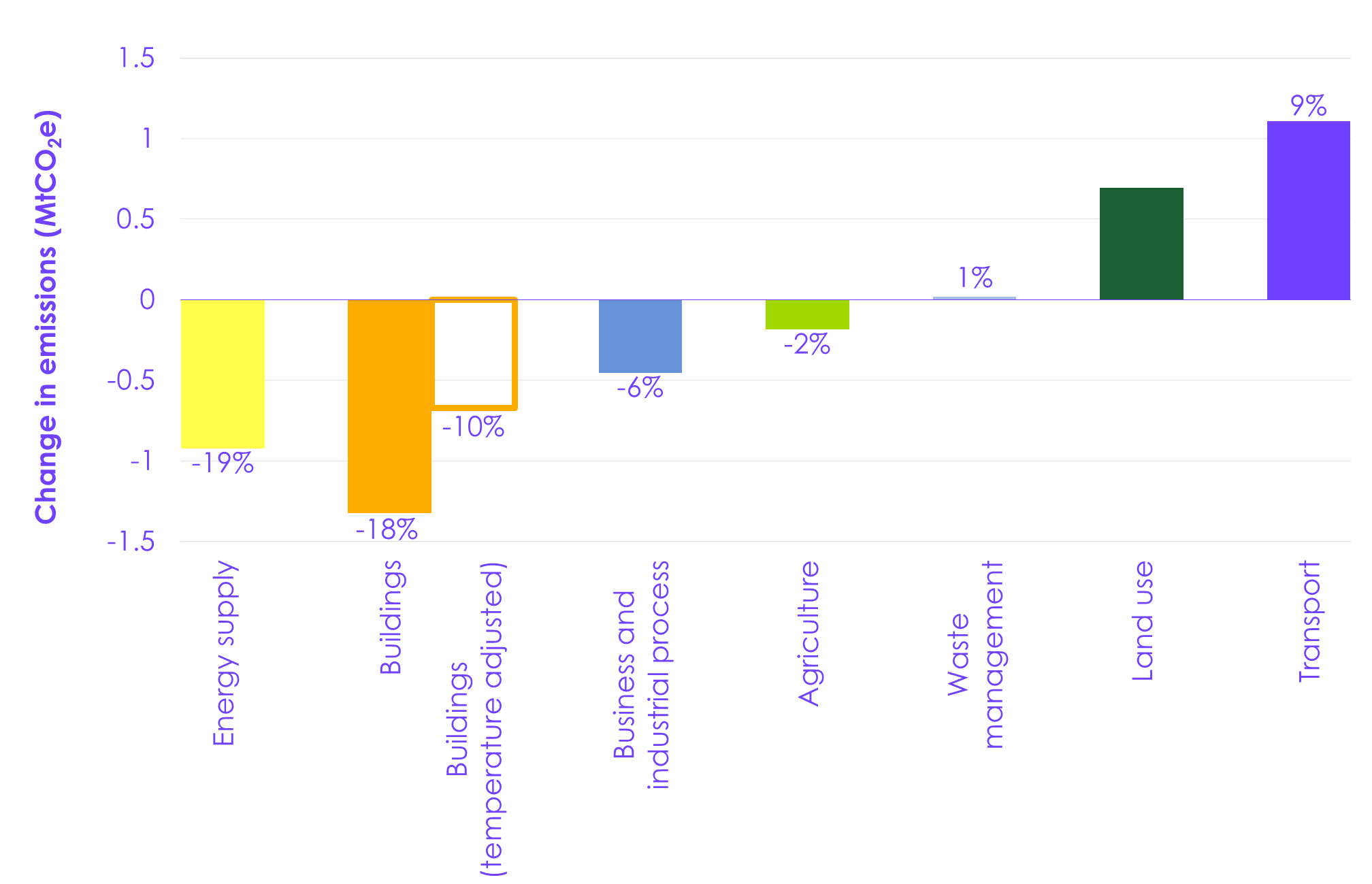 Description: The main reductions in emissions in between 2021 and 2023 were in energy supply (by 19%) and buildings (by 18%), while emissions from transport increased by 9%. Description: The main reductions in emissions in between 2021 and 2023 were in energy supply (by 19%) and buildings (by 18%), while emissions from transport increased by 9%.Source: National Atmospheric Emissions Inventory (2025) Greenhouse Gas Inventories for England, Scotland, Wales and Northern Ireland: 1990-2023; CCC analysis. Notes: (1) Temperature-adjusted emissions are displayed to better represent the change in activities without the interannual fluctuations in temperature. (2) The year-on-year percentage change for land use has not been displayed due to this sector being comprised of a mixture of sources and sinks, making relative changes appear very dramatic. |
2.1.2 Emissions trends by sector
In this section, we discuss recent and longer-term trends in emissions, and the main factors driving these, within each sector.
- Transport (comprising road, rail, aviation, and maritime transport) is currently Scotland’s largest source of emissions, followed by agriculture and business and industrial process (Table 2.2).
- The biggest driver of emissions reduction since 1990 has been energy supply. There have also been substantial reductions in the business and industrial process, waste management, and land use sectors (Figure 2.3).
| Table 2.2 Emissions by sector in 2023 |
|||
| Sector | Emissions (MtCO2e) | Sector | Emissions (MtCO2e) |
| Transport | 13.0 | Energy supply | 3.9 |
| Agriculture | 7.5 | Waste management | 1.7 |
| Business and industrial process | 7.0 | Land use | 0.5 |
| Buildings actual (temperature adjusted) | 6.0 (6.2) | ||
| Source: National Atmospheric Emissions Inventory (2025) Greenhouse Gas Inventories for England, Scotland, Wales and Northern Ireland: 1990-2023; CCC analysis. Notes: Temperature-adjusted buildings emissions are displayed to better represent emissions without the interannual fluctuations in temperature. |
|||
| Figure 2.3 Scottish emissions by sector (1990–2023) |
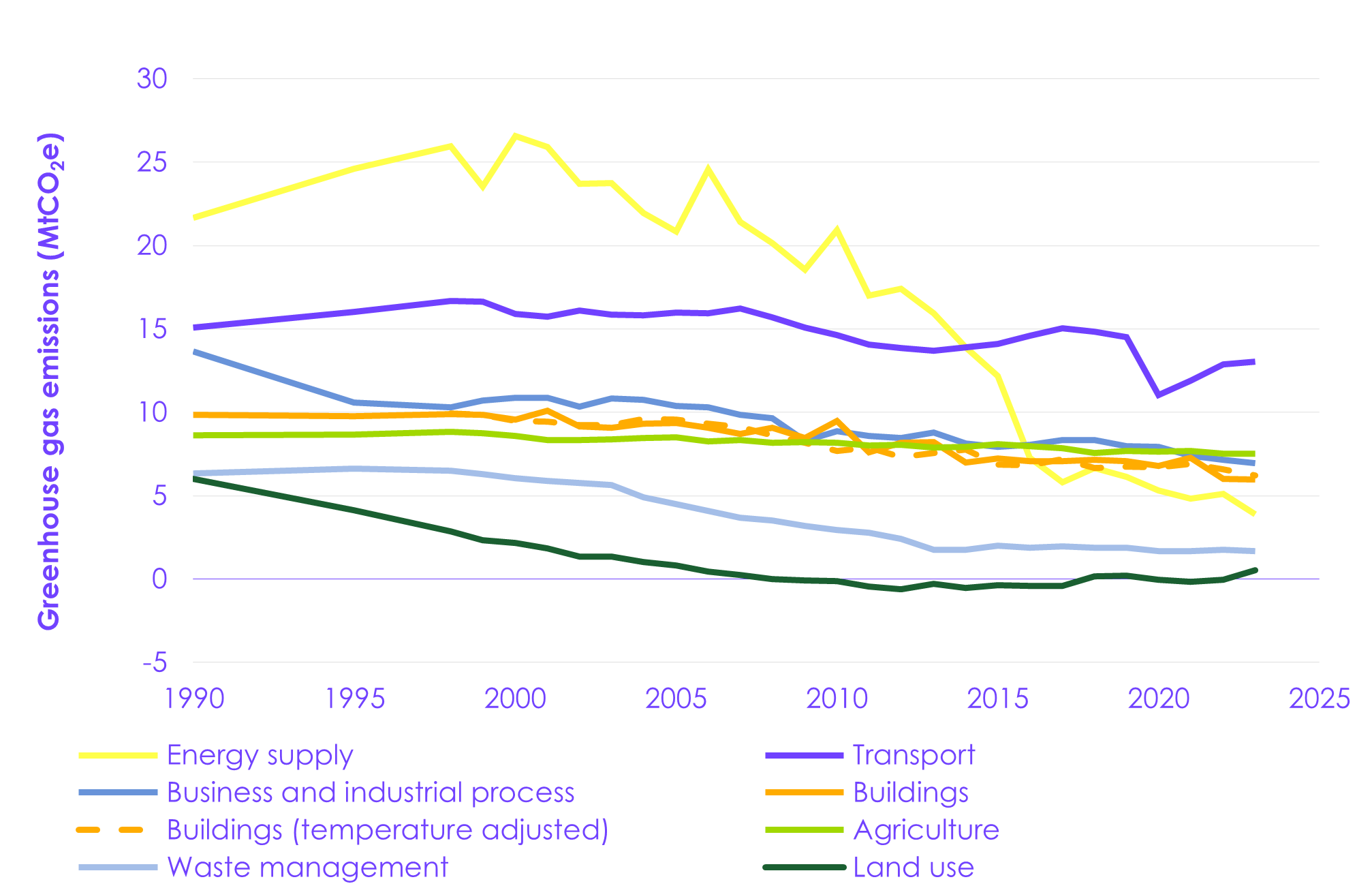 Description: Large reductions in emissions have been observed since 1990 in the energy supply, business and industrial process, waste, and land use sectors (dominated by energy supply), with smaller changes across other activities. Description: Large reductions in emissions have been observed since 1990 in the energy supply, business and industrial process, waste, and land use sectors (dominated by energy supply), with smaller changes across other activities.Source: National Atmospheric Emissions Inventory (2025) Greenhouse Gas Inventories for England, Scotland, Wales and Northern Ireland: 1990-2023; CCC analysis. Notes: (1) Temperature-adjustment is performed for buildings sectors where the impact of interannual variability in temperature has a noticeable impact on emissions. (2) The land use sector is a combination of positive sources of emissions and negative sinks of emissions. (3) ‘Buildings’ refers to residential and public buildings. |
Transport
Transport has been the highest-emitting sector in Scotland since 2014. Emissions have fallen by 14% since 1990, but most of this reduction has been the result of structural shifts in transport patterns following the pandemic.
- Surface transport: emissions from surface transport were 9.2 MtCO2e in 2023, 0.1 MtCO2e (1%) higher than in 2021. Emissions are now 3% lower than 1990 levels.
- In 2019, before the COVID-19 pandemic, emissions from surface transport were 6% higher than in 1990.[14] This was due to a 38% rise in vehicle-kilometres, driven in part by a 6% population increase since 1990 and an additional one million cars on the roads since 1994.[15];[16];[17] There has also been a shift towards larger petrol vehicles. These changes have partially offset efficiency improvements that reduce emissions.
- The pandemic caused a 19% drop in emissions during 2020, which rebounded to 9.3 MtCO2e in 2022 (7% below 2019 pre-pandemic levels). In 2023, year-on-year emissions reduced slightly to 9.2 MtCO2e. The sustained reduction compared to 2019 reflects a structural shift in transport patterns following the pandemic.
- Progress in this area is key to delivering economy-wide emissions reductions over the next decade. We expect that the transition to electric vehicles (EVs) will follow an
‘S-shaped’ adoption curve, starting slowly but accelerating rapidly, with purchase price parity being a key tipping point in the next few years (see Figure 4.1b). Despite overall car-kilometres increasing by 14% between 2021 and 2023, car emissions have increased by only 4%.[18] This could provide early evidence of EVs beginning to have a measurable impact on emissions in Scotland as well as continued improvements in efficiencies for petrol cars.
- Aviation: emissions from aviation were 2.0 MtCO2e in 2023, 1.2 MtCO2e (157%) higher than in 2021. Emissions are now 41% higher than 1990 levels.
- Aviation emissions increased by 48% between 1990 and 2019 (pre-COVID-19 levels).
- In 2023, emissions almost rebounded to pre-COVID-19 levels at 4% below 2019 levels, which has been a key factor in the increase in overall transport sector emissions in the past two years.
- Shipping: emissions from shipping were 1.8 MtCO2e in 2023, 0.2 MtCO2e (8%) lower than in 2021. Emissions are now 56% lower than 1990 levels.
- Shipping emissions have fallen every year since 2019 and are now 23% below 2019 pre-pandemic levels. Most of the absolute emissions reductions are in domestic shipping, particularly coastal domestic shipping, but international shipping emissions have fallen by a proportionally greater amount.
Agriculture and land use
Agriculture
Agriculture is currently the second highest-emitting sector in Scotland. Emissions fell by 0.2 MtCO2e (2%) to 7.5 MtCO2e between 2021 and 2023 and are now 13% lower than in 1990.
- Livestock emissions from enteric fermentation (the digestive process of cattle and sheep) and waste and manure management have declined by 19% since 1990 to 5.2 MtCO2e in 2023. This is due to a decline in cattle and sheep numbers.
- Soil emissions have decreased by 16% since 1990 to 1.6 MtCO2e in 2023. Soil emissions associated with nitrogen fertilisers have fallen by 57% due to increased efficiency in application and the amount used on agricultural land.[19] This decrease is offset by increases in emissions from other soil activities such as liming (an action to improve soil pH). Emissions from agriculture will receive increasing focus as other sectors continue to decarbonise. Agriculture is expected to become the highest-emitting sector in Scotland during the Third Carbon Budget period in Scotland’s Draft Climate Change Plan: 2026-2040 (the draft CCP).[20]
Land use
Emissions from land use have fallen by 5.5 MtCO2e since 1990. Between 1990 and the late 2000s, land use emissions steadily declined, with the sector becoming a small net sink of emissions between 2009 and 2017. In the last two years emissions have risen, due to a smaller forest sink and the removal of trees on peat soils undergoing restoration, and land use is now a net source of emissions, at 0.5 MtCO2e in 2023.
- The shift from source to sink is largely driven by the forestry sector, which is currently a sink of -8.6 MtCO2e. The forestry sink in Scotland has decreased from a peak of around -10 MtCO2e, which was maintained over the late 1990s through to 2013.
- This is the result of lower planting rates since the 1990s (see Chapter 4).
- Grasslands on mineral soils are also a significant sink in Scotland, at -3.6 MtCO2e in 2023. This sink has increased since 1990 by around 1.0 MtCO2e and is attributed to existing, established grasslands sequestering CO2.
- The largest source of land use emissions is peatlands, at 6.1 MtCO2e in 2023. However, this has decreased by 2.3 MtCO2e since 1990, driven by the expansion of peat restoration activity.
- Drainage of peatland and its management as grassland remains a key driver of emissions from peatland in Scotland at 1.9 MtCO2e in 2023, contributing 31% of the total emissions from peat.
- Croplands on mineral soils are also a significant source of emissions at 4.8 MtCO2e in 2023. However, this has fallen by 1.7 MtCO2e since 1990, indicating a decrease in the transition of grasslands to cropland systems, as well as a decrease in soil carbon emissions over time following the initial land use transition.
- Restoring and growing the land use sink will be critical to meeting Scotland’s carbon budgets and especially for reaching Net Zero by 2045. The reduction in the forestry sink in recent years, because of lower planting rates over recent decades, demonstrates the long-term effects of tree planting on land use emissions – planting rates will need to increase quickly over the coming years to deliver the contribution required to Net Zero (see Chapters 4 and 5).
Business and industrial process
Business and industrial process (which covers industry and commercial buildings) is the third highest-emitting sector in Scotland. Emissions were 7.0 MtCO2e in 2023, 0.5 MtCO2e (6%) lower than in 2021. These have fallen substantially over time and are now 49% lower than 1990 levels.
- Industry: emissions from industry were 5.0 MtCO2e in 2023, 0.3 MtCO2e (6%) lower than in 2021.
- There has been a structural shift since the 1990s towards less energy-intensive, higher-value industrial output. The gross value added (GVA) of Scottish manufacturing increased by 55% between 1998 and 2023 (Figure 2.4). Over 40% of this growth came from the drinks industry.[21] The emissions intensity (tCO2e/£GVA) of Scottish industry has improved dramatically, falling by more than half since 1998.[22]
- Emissions from industry fell rapidly between 1990 and 1995, mostly driven by the closure of the Ravenscraig steelworks in 1992, but have been falling more slowly since then. Since 2009, industrial emissions have fallen by around 0.1 MtCO2e per year on average.
- By moving to higher value, low carbon production, Scotland’s industries can attract investment and carve out a more competitive footing. Achieving this requires policy to create a viable investment case and a carbon border adjustment mechanism to level the playing field.
- Commercial buildings: emissions from commercial buildings were 1.3 MtCO2e in 2023, 0.1 MtCO2e (4%) lower than in 2021.
- In the longer term, growth in the commercial sector has more than offset decarbonisation actions.[23] Emissions from commercial buildings are now 11% higher than 1990 levels.
| Figure 2.4 Change in emissions and gross value added (GVA) in Scotland’s industry sector since 1998 |
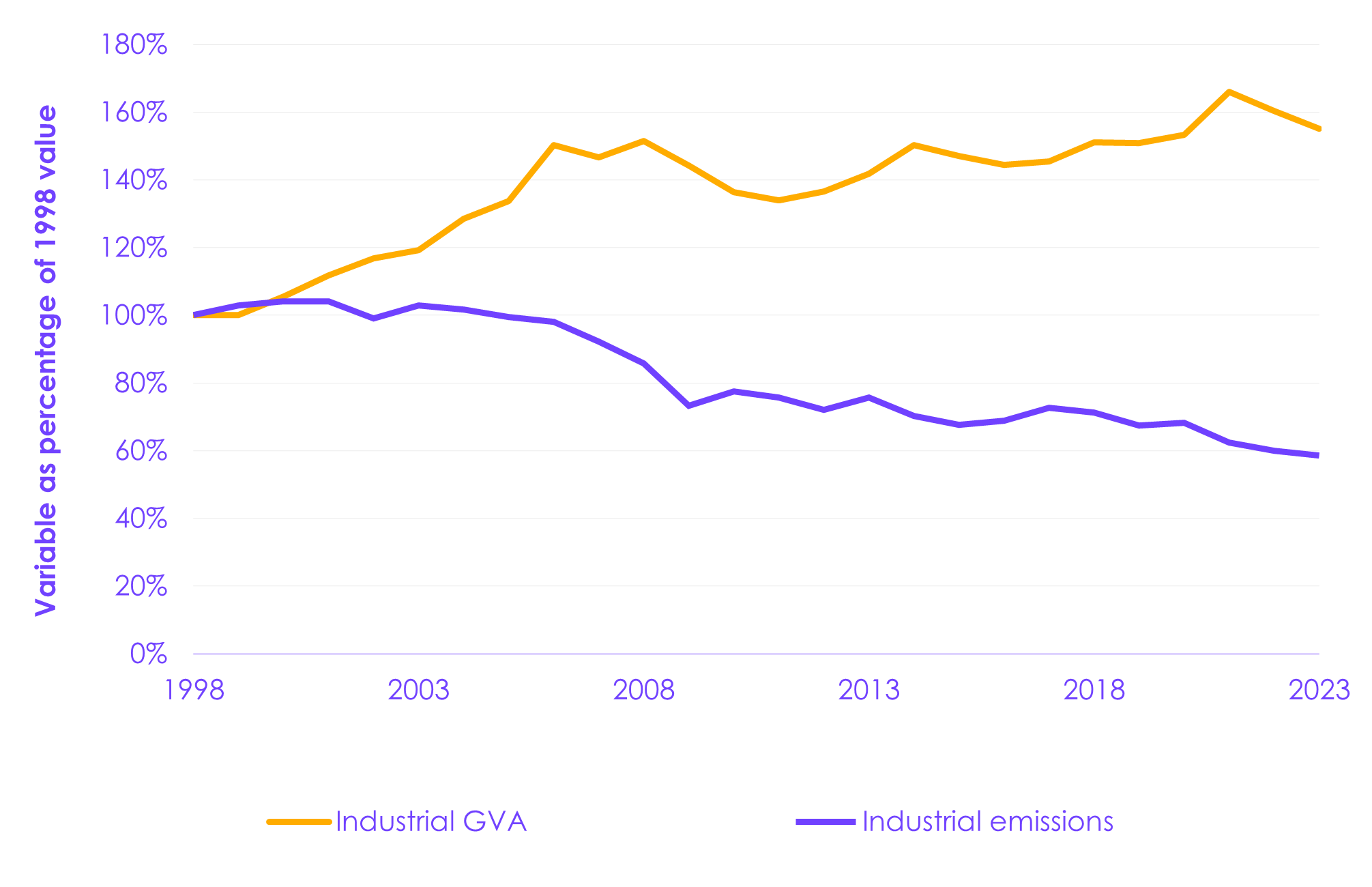 Description: Emissions in the industry sector have declined since 1998, despite an increase in sectoral GVA over the same period. Description: Emissions in the industry sector have declined since 1998, despite an increase in sectoral GVA over the same period.Source: National Atmospheric Emissions Inventory (2025) Greenhouse Gas Inventories for England, Scotland, Wales and Northern Ireland: 1990-2023; Office for National Statistics (2025) Regional gross value added (balanced) by industry: all ITL regions (April 2025); CCC analysis. Notes: (1) Emissions are shown using the CCC’s industry sector classification (see Annex 1). (3) GVA is calculated in real 2022 prices for the ‘Manufacturing’ sector under Standard Industrial Classifications in chained volume measures. |
Buildings
The buildings sector is currently the fourth highest-emitting sector in Scotland. Emissions have fallen by 1.3 MtCO2e (18%) between 2021 and 2023 to 6.0 MtCO2e, which is 40% below 1990 levels.
- Residential buildings: emissions from residential buildings were 5.0 MtCO2e in 2023, 1.2 MtCO2e (19%) lower than in 2021. Emissions are now 38% lower than 1990 levels.
- Most of the emissions reductions have been delivered since 2009. Policies have helped to improve the efficiency of heating technologies and deliver investments in building fabric efficiency.[24];[25] Prior to the COVID-19 pandemic and recent gas price spike, from 1990 to 2019, emissions in residential buildings in Scotland had fallen by slightly more than across the UK as a whole.
- 2023 was warmer than 2021, reducing energy demand for heating homes. After applying a temperature adjustment to account for this effect, the reduction in emissions from 2021 to 2023 was 0.6 MtCO2e (10%). This suggests that half the fall in emissions was weather-related and half was driven by other factors, likely including behavioural responses to high energy prices.
- Public buildings: emissions from public buildings were 1.0 MtCO2e in 2023, 0.1 MtCO2e (13%) lower than in 2021. Emissions are now 50% lower than 1990 levels.
- Most of the emissions reductions in public buildings occurred between 1990 and 2009. Significant emissions reductions have been made across a range of public bodies including the NHS, Scottish Government core estate, and local authorities.
- Although Scotland’s public bodies have had a duty under the Climate Change (Scotland) Act 2009 to act in the way best calculated to contribute to the delivery of emissions reduction targets while exercising their functions since 2011, emissions in 2023 were only 6% below 2011 levels.[26]
- Residential, public, and commercial buildings are expected to be central to delivering emissions reductions throughout the 2030s. This means that falling behind on buildings decarbonisation would have severe implications for longer-term decarbonisation.
Energy supply
The energy supply sector has been the key driver of Scotland’s emissions reductions. It was Scotland’s highest-emitting sector until 2013 but has since dropped to fifth. Emissions have fallen by 0.9 MtCO2e (19%) between 2021 and 2023 to 3.9 MtCO2e, 82% lower than in 1990.
- Electricity supply (excluding energy from waste): electricity generation in Scotland is almost completely decarbonised. Electricity supply emissions were 0.7 MtCO2e in 2023, 0.6 MtCO2e lower than in 2021. Emissions are now 95% lower than 1990 levels.
- Emissions fell rapidly between 2010 and 2017 as coal was phased out of the generation mix and largely replaced with wind and solar (Figure 2.5). The last remaining coal-fired power station in Scotland, Longannet, closed in 2016, leaving unabated gas generation, which also declined significantly in this period, as the main source of emissions.
- Between 2017 and 2023, emissions reduced at a slower rate as continued deployment of wind and solar largely displaced retiring nuclear capacity. During this period, the share of generation from unabated gas remained around 10% up to 2022, until a fall to 7% in 2023. Remaining emissions are dominated by Peterhead power station, which in 2023 accounted for more than 90% of electricity supply emissions.
- Demand for electricity in Scotland has been falling by an average of 2% per year since 2005, but this is expected to grow again as a result of the roll-out of low-carbon electric technologies.
- For the GB-wide electricity market, the continued roll-out of renewable generation capacity should continue to displace fossil generation, leading to further reductions in electricity supply emissions.
- Fuel supply: emissions from fuel supply were 2.9 MtCO2e in 2023, 0.3 MtCO2e (10%) lower than in 2021. Emissions are now 56% lower than 1990 levels.
- Oil refineries: oil refining contributed 40% of fuel supply emissions, emitting 1.2 MtCO2e in 2023. These emissions have fallen by 59% since 1990, as output from Grangemouth, Scotland’s main oil refinery, has reduced.
- The Grangemouth oil refinery, part of the wider industrial complex, ranked as Scotland’s largest point source of emissions. In November 2023, the owner, Petroineos, announced that it would close the refinery, and the company completed the closure in 2025. Reported fuel supply emissions are therefore expected to fall substantially because of the closure.
- Oil and gas processing terminals: emissions from oil and gas processing terminals together contributed around 33% of fuel supply emissions, emitting 1.0 MtCO2e in 2023. These emissions have fallen by 35% since 1990.
- Gas distribution: gas distribution contributed around 14% of fuel supply emissions (0.4 MtCO2e) in 2023. These emissions have fallen by 59% since 1990.
- Energy from waste (EfW): emissions from EfW increased rapidly between 2013 and 2019. Since 2019, EfW emissions have been reported at around 0.3 MtCO2e, although emissions in 2022 and 2023 are underestimated as one EfW site was missed from the emissions data. Between 2019 and 2023, the amount of household waste incinerated in Scotland increased by 64%.[27]
- In 2024, Scotland had eight operating EfW sites with a total permit capacity of 1.4 Mt of waste per year. No new energy from waste sites have been granted planning permissions since 2023, when new restrictions were introduced. However, four additional sites are in the commissioning or construction phase, which, if fully delivered, would provide an additional 0.9 Mt of permitted capacity per year, significantly increasing Scotland’s EfW capacity and emissions.[28]
| Figure 2.5 Electricity generation from wind and solar, coal, gas, and nuclear (2009–2024) |
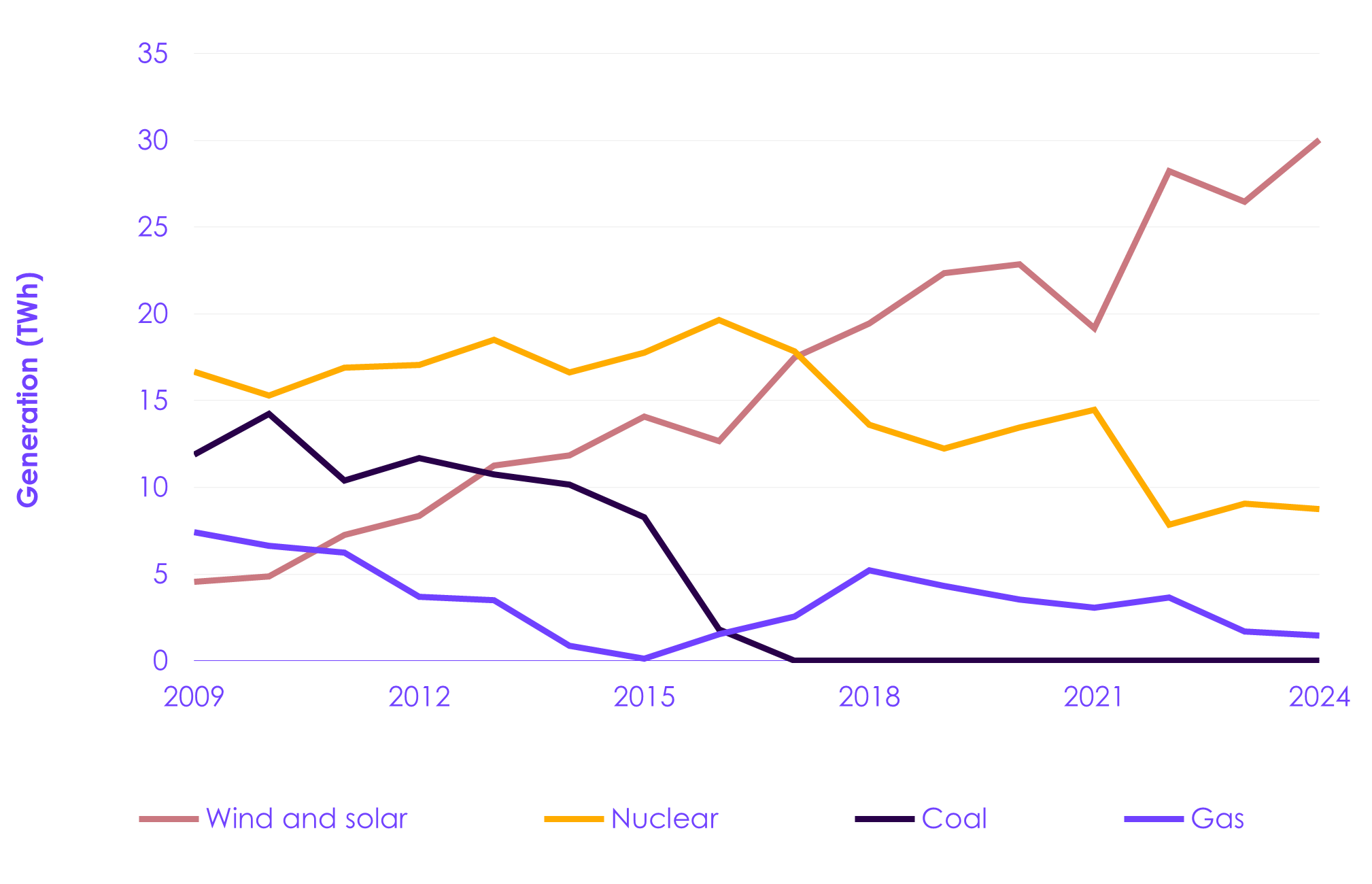 Description: Coal was phased out of the electricity generation mix in Scotland by 2017, while wind and solar have been providing a growing share of the generation mix. Description: Coal was phased out of the electricity generation mix in Scotland by 2017, while wind and solar have been providing a growing share of the generation mix.Source: Department for Energy Security and Net Zero (2025) Electricity generation and supply in Scotland, Wales, Northern Ireland and England, 2019 to 2024; CCC analysis. Notes: Generation for coal, gas, and nuclear refers to generation by ‘Major Power Producers’, which excludes autogeneration where electricity is produced as part of industrial or commercial activities as a by-product. |
Waste management
Emissions from waste management, excluding energy from waste, fell by 0.02 MtCO2e (1%) between 2021 and 2023 to 1.7 MtCO2e. Emissions are now 73% lower than 1990 levels, but have not changed significantly since 2013.
- The main cause of the fall in emissions since 1990 has been a decrease in waste sent to landfill, driven by the Landfill Tax, which helped drive a reduction in waste generated and an increase in recycling rates.
- Waste emissions have fallen by only 0.1 MtCO2e since 2013. Emissions reductions from reducing waste sent to landfill have slowed, while recycling rates have plateaued.
2.2 Emissions from imports
Scotland’s legally binding targets are set on the basis of territorial emissions (that is, emissions within Scotland’s territorial borders). However, it is important to also consider emissions associated with Scottish imports. The latest published imported emissions data are for 2021.
Emissions from imports have been relatively steady since 2009, even as territorial emissions have fallen considerably over the same period (Figure 2.6).
- Between 1998 (the first year of available data) and 2021, imported emissions increased by 15% from 27.4 MtCO2e to 31.6 MtCO2e. Imported emissions peaked in 2007 before falling sharply in 2008 following the global financial crisis.
- Year-on-year, imported emissions decreased by 3% in 2020 and increased by 22% in 2021. This increase is due to greater imports from non-EU countries following the end of the Brexit transition period in 2021, as indicated by Office for Budget Responsibility trade analysis.[29] However, the imported emissions data are highly variable, and subject to revisions.
- In the equivalent publication for the UK, a similar 2021 peak was subsequently revised down to below 2019 levels, but imported emissions increased further in 2022. This downward revision was due to methodological changes in the statistics from the University of Leeds.[30]
Minimising potential future carbon leakage, through addressing emissions from imports and ensuring the competitiveness of Scottish industry, would prevent reductions in Scotland’s territorial emissions from being undermined by slower progress elsewhere.
- In our UK-wide Seventh Carbon Budget advice (2025), we highlighted that the risk of carbon leakage, though limited, remains, particularly in energy-intensive sectors and in agriculture.
- The report also set out a hierarchy of available policy levers and proposed that the UK Government set a non-legally binding benchmark against which to track imported emissions.
| Figure 2.6 Comparison of imported and territorial emissions |
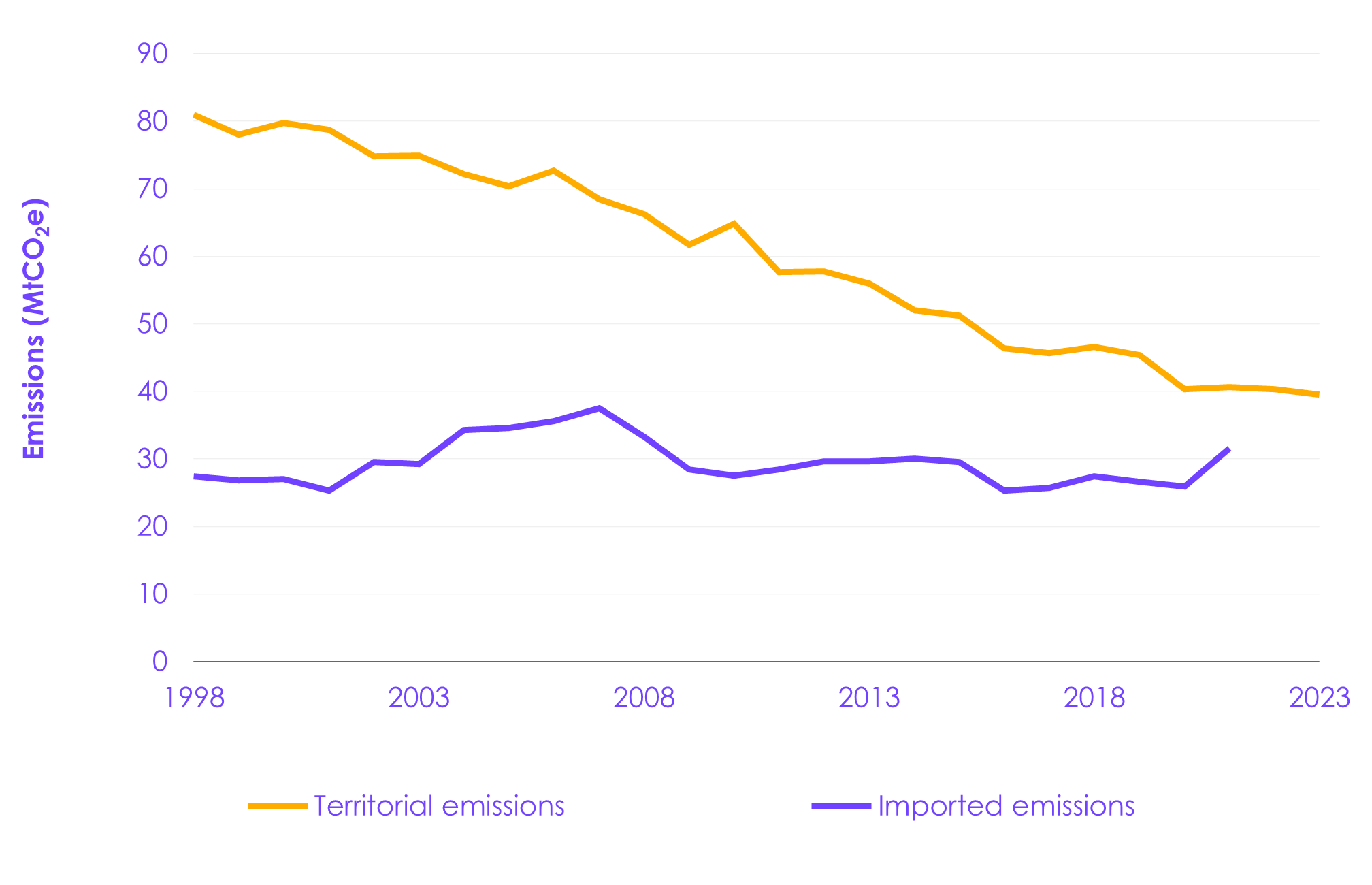 Description: Scottish territorial emissions have fallen since 1990 while emissions from imports outside the UK have been relatively steady since 2009, following a drop after the financial crisis. Description: Scottish territorial emissions have fallen since 1990 while emissions from imports outside the UK have been relatively steady since 2009, following a drop after the financial crisis.Source: National Atmospheric Emissions Inventory (2025) Greenhouse Gas Inventories for England, Scotland, Wales and Northern Ireland: 1990-2023; Scottish Government (2025) Scotland’s Carbon Footprint 1998-2021; CCC analysis. Notes: Imported emissions refer to emissions associated with imports from outside the UK. The latest available data point is 2021 due to the lag in producing the statistics. The next release is expected in the first half of 2026. |
Chapter 3: The draft Climate Change Plan
In November 2025, the Scottish Government published Scotland’s Draft Climate Change Plan: 2026-2040 (the draft CCP). This sets out an emissions reduction pathway to meet the first three carbon budgets, including emissions savings from specific policies and proposals.[31] In this chapter, we consider the overall approach taken in the draft CCP and discuss this pathway. Our assessment of the policies and plans required to deliver it can be found in Chapter 5.
Our key messages are:
- We welcome the quantification of abatement associated with specified policy outcomes. This makes clear what needs to be delivered to meet Scotland’s carbon budgets.
- Urgent work is now needed to develop delivery plans and implement policies to achieve these outcomes.
- It is positive to see the planned approach to monitoring and evaluation (M&E), which includes just transition indicators for the first time. The final CCP should include a finalised M&E framework, including annual pathways for sectoral emissions and key indicators of progress.
- The pathway set out in the draft CCP sees emissions fall across all sectors.
- To deliver the pathway, emissions reductions will need to broaden, particularly into the transport; residential and public buildings (buildings); agriculture; and land use, land use change and forestry (land use) sectors. The Scottish Government has substantial powers to reduce emissions in these areas.
- In the First Carbon Budget, mostly devolved sectors provide 48% of the required emissions reductions. This increases to 62% for the Second and Third Carbon Budgets.
- Some of the choices in the draft CCP pathway could increase delivery risk. The final CCP should consider appropriate contingencies or methodological changes to address this.
- The modelling methodologies and assumptions used for some aspects of the buildings and land use pathways rely on emissions savings that depend on highly uncertain wider factors.
- In some key areas, including low-carbon heating, policies are either missing or carry significant risks. We discuss these concerns in Chapter 5.
- The draft CCP pathway has significant dependence on negative emissions technologies (NETs), an area with significant risk and with policy powers largely reserved to the UK Government.
3.1 Overall approach taken in the draft Climate Change Plan
In our 2025 Scotland’s Carbon Budgets advice, we set out key considerations for the draft CCP to address, including:
- Quantification of emissions reductions. Publishing details on the assumptions underpinning the pathway and how the abatement will be achieved by planned policies.
- Roles and responsibilities. Setting out clear roles, responsibilities, and accountability mechanisms for delivering aspects of emissions reduction and climate change adaptation, as well as details of how these will be coordinated.
- Monitoring and evaluation. Developing a monitoring and evaluation plan, including the latest emissions data and underlying indicators of progress, that can be used to identify where there are risks of delivery falling behind the pace of change that is required.
- Contingency planning. A range of credible contingency plans that can be activated if necessary.
In April 2025, the Convenor of the Scottish Parliament’s Net Zero, Energy and Transport Committee wrote to the Acting Cabinet Secretary for Net Zero and Energy to summarise input gathered by his Committee on what would make a good Climate Change Plan.[32] We provided input into this process, as did Audit Scotland, Environmental Standards Scotland, and the Scottish Fiscal Commission. The Convenor’s letter identifies a range of themes that should be addressed within an effective plan. We welcome the Scottish Government’s approach to the draft CCP, which aims to address these considerations.
3.1.1 Quantification of emissions reductions
This is the first comprehensive plan from the Scottish Government that quantifies the policies and proposals that will be needed to achieve Scotland’s emissions reduction targets. This makes clear how the Scottish Government plans to deliver the carbon budgets, as well as the outcomes it will need to achieve to do this. The Scottish Government should now develop detailed delivery plans and implement the required policies to ensure that these outcomes can be achieved. This work needs to be progressed with urgency.
- In a number of areas, the policies that will be needed to achieve these outcomes are not yet in place or carry significant risks. This is particularly the case in the buildings, agriculture, business and industrial processes, and NETs sectors. Our full assessment of policies and plans is set out in Chapter 5.
- We also have concerns about the modelling approach taken to quantify aspects of the emissions reduction pathways for buildings and land use. These are discussed in Section 3.2.
3.1.2 Roles and responsibilities
The draft CCP includes both quantified emissions savings by sector and detailed sectoral annexes setting out the changes that will be needed to achieve these. The annexes include a vision for each sector, which should help clarify the role that each sector will play.
In many cases, the details in the draft CCP (including route map diagrams) set out who will be responsible for delivering key aspects of this vision. However, there is little detail on the actual governance processes to deliver the vision or on the role of local authorities and other bodies.
The Scottish Government should expand on these sectoral visions and implement delivery plans which give clear roles and responsibilities to different levels of government and wider organisations to enable reliable delivery.
3.1.3 Monitoring and evaluation
The draft CCP sets out the Scottish Government’s proposed approach to monitoring emissions reductions, including the use of the latest emissions data and underlying indicators of progress. We welcome the intention to track emissions progress at subsector level and to develop a set of early-warning indicators to allow earlier identification of areas of progress or risk.
- As part of the M&E framework proposed in the draft CCP, the Scottish Government plans to report annual emissions at subsector level and track progress against the subsectoral pathways set out in the final CCP. However, the draft CCP does not include annual emissions pathways at a sectoral, or subsectoral level. This makes it very difficult to monitor progress until the last year in a given carbon budget. Emissions data are published on an 18-month lag (for example, 2024 emissions for Scotland will be available in June 2026) so emissions for the mid-point of a given carbon budget (which are not the same as but are likely to be similar to the annual average) will not be published until the final year of that carbon budget period. At that point it will likely be too late to make adjustments to the pathway. The framework in the final CCP should include indicative annual sectoral emissions so that progress can be effectively monitored.
- The M&E plans also set out an intention to build on the indicator set used in the existing monitoring report.[33] This includes key indicators that we would expect to be included, such as the market share of electric vehicles, low-carbon heating system installations, and woodland creation rates.
- A good M&E framework will enable the identification of risks of delivery falling behind the pace of change that is required, allowing action to be taken to mitigate the risks and get back on track. To enable this, the finalised framework should include annual deployment pathways for each key indicator. These pathways should be aligned with the pace of change required to deliver each sector’s contribution to the final CCP pathway, so that outturn data can be judged against these pathways.
- In many cases, the Scottish Government’s assumed deployment pathways are set out in the sectoral annexes of the draft CCP. However, these are not provided as annual pathways and are missing for some key indicators, including the deployment of low-carbon heating, livestock numbers, air passenger-kilometres, and recycling rates.
The introduction of indicators tracking progress against the aims of the just transition principles is a welcome step that demonstrates the Scottish Government’s commitment to embedding these principles across the CCP policy framework.
- In our advice on Scotland’s Carbon Budgets, we recommended that the Scottish Government should ‘work with communities, workers, and businesses to develop proactive transition plans that enable access to secure employment and business opportunities that come with the Net Zero transition’. Proposed indicators monitoring green jobs, access to training for offshore oil and gas workers, socio-economic impact on oil and gas communities, and impact on household finances in oil and gas communities can support monitoring of progress towards this recommendation.
- Delivering a just transition goes beyond consideration of the oil and gas sector and the employment opportunities created by the transition to Net Zero. More broadly, it means ensuring that the costs and benefits of emissions reduction and climate adaptation are shared fairly across society. Other indicators such as transport affordability, fuel poverty, and impact of energy prices on small businesses, can also support monitoring of action to make low-carbon choices for businesses and households easy, attractive, and affordable.
The final CCP should include a finalised M&E framework, including annual pathways for sectoral emissions and all key indicators of progress.
3.1.4 Contingency planning
While the draft CCP does not explicitly set out contingency plans, we welcome the approach taken by the Scottish Government to include policies and proposals, which, taken together, outperform Scotland’s emissions targets (see Section 3.2).
This acknowledges the uncertainty in quantifying the emissions impacts of individual policies and proposals and provides a level of contingency for meeting the targets. Alongside this, the Scottish Government should assess what options could be available to go further or address delivery shortfalls if needed, as part of its work on the governance structures around its M&E plans.
However, as discussed in Section 3.2 and Chapter 5, for the Second and Third Carbon Budgets the overperformance in the draft CCP pathway is significantly less than the quantified impact of some major uncertainties on which the pathway depends.
3.1.5 Other considerations
A robust understanding of the timescales associated with the required policies is critical to ensure that the draft CCP pathway can be delivered. The sectoral annexes in the draft CCP include route map diagrams that set out some of these timescales, although more specifics are needed.
- It is welcome that many of these route maps include details of the actions needed during 2026. The Scottish Government must work at pace to ensure these are delivered on time.
- The route maps recognise the need for full delivery plans in key areas including buildings and NETs. These plans must be developed urgently and should set out the specific, measurable, achievable, relevant, and time-bound steps that will be taken to enact the policy outcomes required to deliver these sectors’ contributions to the final CCP pathway.
The draft CCP attempts to quantify the costs and benefits associated with delivering the policies that are set out in the plan. Consistent with our advice on Scotland’s Carbon Budgets and analysis undertaken by the Scottish Fiscal Commission, this assessment finds that investment is required to deliver the transition, but that this investment unlocks direct financial savings that grow over time.[34] By the Third Carbon Budget period, the draft CCP pathway is expected to result in savings for the Scottish economy.
- The lower running costs of electric vehicles (EVs) compared to petrol and diesel vehicles mean that transport is the main driver of these savings. Given that some proportion of EV uptake is included in the draft CCP baseline, the full extent of these savings will not be quantified. By contrast, there are net costs associated with the decarbonisation of businesses and industrial processes and residential and public buildings.
- In some areas, we note that the quantification of costs and benefits is incomplete. This includes buildings, where the costs and savings from low-carbon heating systems have not been quantified for the Second and Third Carbon Budget periods, and negative emissions technologies (NETs), where costs are not provided as they are ‘highly uncertain’.
- For NETs, the draft CCP anticipates that these costs will fall on the Scottish Government. However, in our Scotland’s Carbon Budgets advice, we noted that while who pays for removals is a policy choice, we assume that these costs will be predominantly borne UK-wide, rather than by Scotland specifically, on a ‘polluter pays’ basis by industries such as aviation that have residual CO2 emissions.
The draft CCP also includes easy-read and children’s versions, increasing the accessibility of the plan. This reflects the Scottish Government’s strong commitment to public engagement, which is discussed further in Section 5.3.2.
3.2 Performance of the draft Climate Change Plan pathway against Scotland’s emissions reduction targets
3.2.1 Performance against Scotland’s targets
The draft CCP emissions reduction pathway meets and outperforms Scotland’s first three carbon budgets (Figure 3.1 and Table 3.1), with the highest level of overperformance against the First Carbon Budget (2026 to 2030).
If delivered, meeting these budgets will give high confidence that Scotland’s 2045 Net Zero target can be achieved and will represent a fair contribution for Scotland to meeting the UK-wide Nationally Determined Contributions, carbon budgets, and 2050 Net Zero target.
- The draft CCP pathway requires emissions to fall at a similar overall rate to what has been achieved in Scotland since the introduction of the Act in 2009.
- The draft CCP pathway has a similar shape to the CCC’s Balanced Pathway from our advice on Scotland’s Carbon Budgets, but the balance of actions to deliver the emissions reductions across sectors is different (see Section 3.3).
| Figure 3.1 Greenhouse gas emissions in Scotland and the Scottish Government’s targets and pathway |
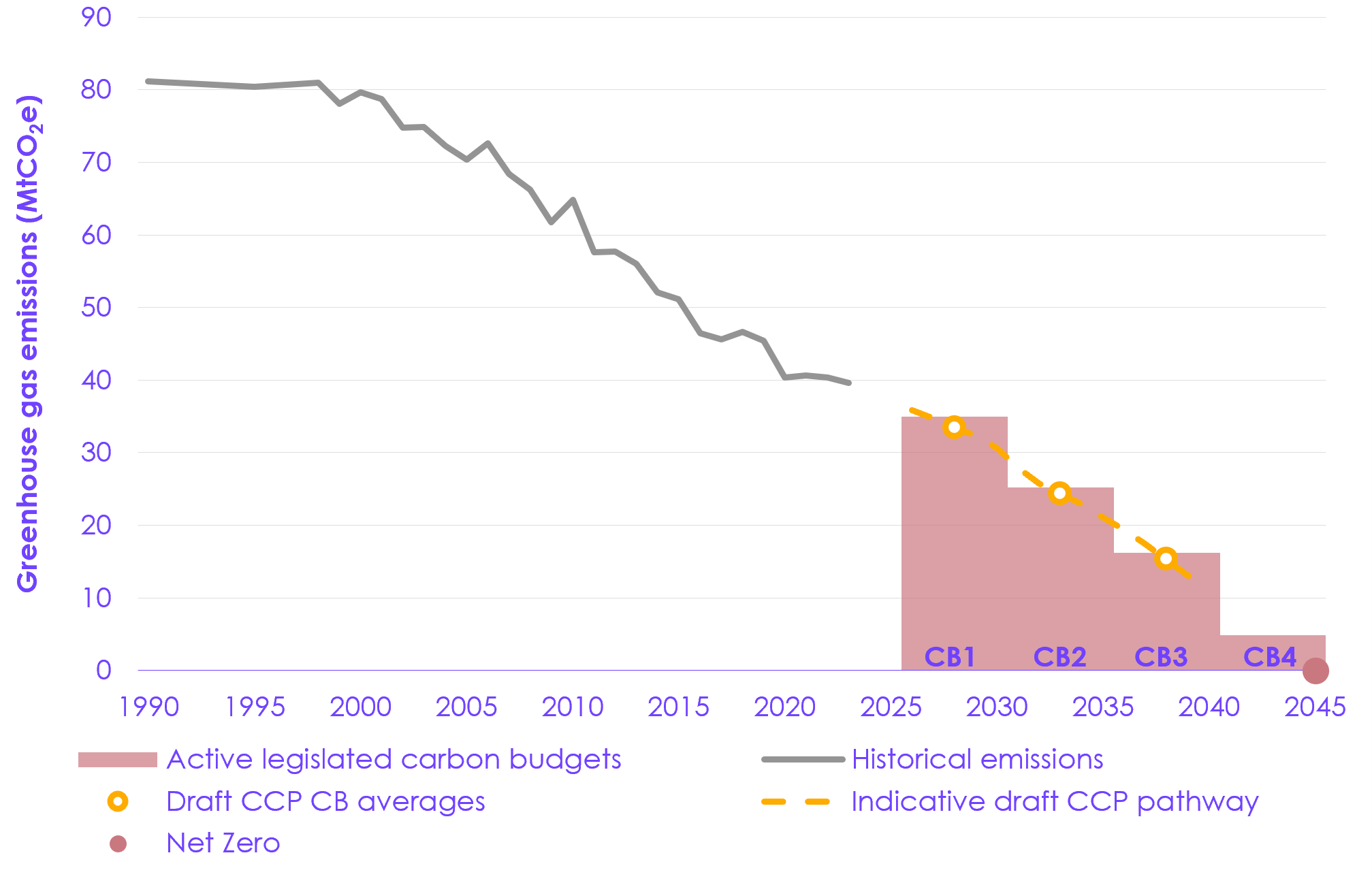 Description: Scotland is more than halfway to Net Zero emissions. Scotland’s carbon budgets and draft Climate Change Plan pathway are in line with Net Zero by 2045. Description: Scotland is more than halfway to Net Zero emissions. Scotland’s carbon budgets and draft Climate Change Plan pathway are in line with Net Zero by 2045.Source: National Atmospheric Emissions Inventory (2025) Greenhouse Gas Inventories for England, Scotland, Wales and Northern Ireland: 1990-2023; Scottish Government (2025) Scotland’s Climate Change Plan: 2026-2040; CCC analysis. Notes: (1) ‘CB’ refers to Scottish carbon budgets: ‘CB1’ refers to the First Carbon Budget; subsequent numbers refer to subsequent carbon budgets. (2) The indicative draft CCP pathway is an indication of emissions reduction. Scotland does not have annual targets but the five-year carbon budgets must be achieved. |
| Table 3.1 Performance of the draft Climate Change Plan pathway against Scotland’s emissions targets |
|||
| Current legislated level (reduction in average annual emissions on 1990 levels) | Draft Climate Change Plan pathway (reduction in average annual emissions on 1990 levels) | Level of overperformance against the target | |
| First Carbon Budget (2026–2030) | 57% | 58.9% | 7.7 MtCO2e (1.9 percentage points) |
| Second Carbon Budget (2031–2035) | 69% | 70.3% | 5.4 MtCO2e (1.3 percentage points) |
| Third Carbon Budget (2036–2040) | 80% | 81.5% | 6.1 MtCO2e (1.5 percentage points) |
| Source: Scottish Government (2025) Scotland’s Climate Change Plan – 2026-2040; National Atmospheric Emissions Inventory (NAEI) (2025) Greenhouse Gas Inventories for England, Scotland, Wales and Northern Ireland: 1990-2023; CCC analysis. Notes: The levels of absolute emissions (in MtCO2e) required to meet Scottish targets calculated in this advice are based on 1990 baseline emissions in the NAEI (2025) Greenhouse Gas Inventories for England, Scotland, Wales and Northern Ireland: 1990-2023. |
|||
3.2.2 Uncertainties and methodological concerns in the draft Climate Change Plan pathway
Key sources of uncertainty
The draft CCP acknowledges that there are a range of significant uncertainties that could affect Scotland’s pathway to Net Zero.
- Population and GDP growth, emissions accounting methodologies, and fuel costs are key sources of uncertainties. There are also uncertainties in how key technology costs will evolve, as well as year-to-year weather fluctuations and general trends in weather, including from climate change. Uncertainties vary across sectors.
- There is also a risk that policies and proposals could fail to deliver the expected level of emissions reductions. The risks associated with each policy or proposal will vary, but could include bottlenecks in scaling up supply chains, changing technology costs, evolving consumer preferences, and delays to infrastructure roll-out.
- In either case, it is important to monitor both the emissions trajectory (see Chapter 2) and underlying indicators of progress (see Chapter 4), as well as factors such as GDP, population, the greenhouse gas (GHG) inventory methodology, costs, and any wider factors that are assumed to play a key role in delivering the pathway. This will enable early identification of a long-term risk of underperforming on emissions reductions.
Methodological concerns
In addition to key underlying sources of uncertainty, there are some areas where we are concerned that the modelling methodologies and assumptions employed leave aspects of the draft CCP pathway reliant on emissions savings that depend on highly uncertain wider factors. In these areas – within the land use and buildings sectors – we assess that policy levers would not be able to realise these emissions savings if these uncertain factors do not develop favourably.
- Assumed inventory change for peatlands. The draft CCP pathway includes a peatland area correction from 2031 which delivers more than half of the expected emissions savings from land use. This is based on emerging research from the James Hutton Institute that indicates that the area of peat soils managed as intensive and extensive grassland could be substantially lower than estimated in the current GHG inventory.[35] We have concerns around both the appropriateness of including this adjustment in the draft CCP pathway, without appropriate contingency plans in place, and the methodology with which this has been done.
- As yet, it is uncertain whether this area correction will be incorporated into the GHG inventory. While it is good that the Scottish Government is supporting research to improve our knowledge of this important area, the inventory for the land use sector is highly uncertain, and future inventory changes may include both upward and downward adjustments. Therefore, this adjustment may be better treated as a potential positive source of uncertainty, rather than within the pathway. If it is included in the pathway, appropriate contingency actions should be included in case the adjustment is not made to the inventory by the time and at the level assumed. See Box 3.1 for details of how the Scottish Government could introduce this adjustment to the GHG inventory.
- Even if this adjustment does occur, its impact is not yet certain. The research paper notes that this land area would need to be reclassified into another inventory category, and would hence likely attract a different, positive emissions factor. This could reduce the emissions savings that have been quantified, but further research would be needed to ascertain the impact of this change.
- In addition, we expect that the adjustment would also apply to the 1990 baseline, changing the implied emissions levels of the carbon budgets (which are set relative to this 1990 baseline). The research identifies that the identified inaccuracy of the current inventory estimates could be due to a combination of factors, two of which would affect 1990 levels too. However, it does not quantify the contribution from each factor, meaning that further research may be needed to do this.
- Underlying temperature assumptions for buildings. For residential and public buildings, the draft CCP baseline is estimated using historical 2023 emissions as the starting point, without adjusting to account for the effect of the warmer-than-average temperatures seen in that year on emissions. We are concerned that the draft CCP is therefore assuming a lower baseline trajectory for emissions than is likely to occur, before the impact of policies and proposals.
- While it is reasonable to account for the underlying trend of increasing temperatures lowering heating demand, there are year-to-year fluctuations either side of this trend. 2023 was a warmer than average year, so heating demand and hence emissions were lower than would typically be expected.
- Over a five-year carbon budget period, this is unlikely to be replicated every year, meaning that a better analytical methodology would be to start the pathway from a value that adjusts 2023 buildings emissions to account for these annual temperature fluctuations (see the temperature-adjusted values in Chapter 2).
- In addition, buildings emissions in 2023 were lowered by households adopting energy-saving practices in response to high gas prices. While some of these (for example, reducing boiler flow temperatures) are likely to be maintained in the long term following reductions in gas prices, others (such as underheating of homes due to affordability concerns) would not be desirable to continue.[36] Therefore, the Scottish Government will need to implement policies to ensure that these emissions savings can be delivered without prolonging undesirable practices for reducing energy demand.
Contingency planning
While we welcome the Scottish Government’s decision to include policies and proposals that are expected to deliver more than the required emissions reductions to meet Scotland’s carbon budget targets, we assess that the combined effect of the peatland inventory adjustment and the lack of temperature adjustment of the buildings baseline would exceed this quantified overperformance for the Second and Third Carbon Budgets. Therefore, the pathway set out in the draft CCP carries significant risk of falling short of meeting these targets, even if the Scottish Government’s policies and proposals deliver their expected levels of emissions reduction.
We therefore encourage the Scottish Government to reflect on its methodological approaches in these areas in the final CCP to mitigate the potential impact of these emissions changes not happening. This could be achieved through revising the modelling approach or by implementing sufficient contingency plans to mitigate these risks.
The final CCP should set out the Scottish Government’s proposed approach to contingency planning, to ensure a robust and adaptive approach to achieving Net Zero. This should include an explicit assessment of contingency options that can be implemented to deliver additional emissions reductions to make up for any potential shortfalls in the pathway.
- The contingency actions that could have the largest impact in Scotland are expected to change in different carbon budget periods. A credible contingency framework should include contingency options that can address risks across different timescales and should include a mix of measures with longer lead times and those that could be implemented quickly if needed.
- Our Scotland’s Carbon Budgets advice set out a number of potential contingency options over each carbon budget period that could be considered. These include:
- For the first two carbon budgets: measures to further incentivise people to choose public transport or active travel over private car travel; incentives and effective public engagement to grow the EV and heat pump markets more quickly than modelled.
- For the Third and Fourth Carbon Budgets: scrappage schemes to incentivise owners of older, less efficient fossil fuel cars and boilers to replace these before end-of-life; further use of methane-suppressing livestock feed additives beyond those additives considered in our pathway; additional deployment of NETs beyond the levels modelled.
3.3 Sectoral contributions to the draft Climate Change Plan pathway
3.3.1 The draft Climate Change Plan pathway by sector
The pathway set out in the draft CCP sees emissions fall across all sectors, with the biggest reductions coming in the transport, business and industrial process, energy supply, and residential and public buildings sectors (Table 3.2 and Figure 3.2).[37]
- Transport: emissions in transport fall from 13.0 MtCO2e in 2023 to an annual average of 11.1 MtCO2e in the First Carbon Budget (2026 to 2030), 7.8 MtCO2e in the Second Carbon Budget (2031 to 2035), and 5.0 MtCO2e in the Third Carbon Budget (2036 to 2040). Transport remains the highest-emitting sector in the draft CCP pathway throughout the first two carbon budgets.
- This emissions reduction is achieved largely through the electrification of road transport vehicles. Modal shift away from car use also plays a smaller role. The draft CCP assumes average annual aviation emissions in the Second Carbon Budget are similar to 2023 levels.
- Agriculture: emissions in agriculture fall from 7.5 MtCO2e in 2023 to an annual average of 7.2 MtCO2e in the First Carbon Budget, 6.5 MtCO2e in the Second Carbon Budget, and 5.6 MtCO2e in the Third Carbon Budget. Agriculture is expected to become the highest-emitting sector in Scotland during the Third Carbon Budget period in the draft CCP pathway.
- Agricultural emissions reduction is heavily dependent on new farming approaches and technologies being taken up by farmers and land managers, with no proactive measures to reduce livestock numbers beyond existing long-term trends.
- Business and industrial process: emissions in business and industrial process fall from 7.0 MtCO2e in 2023 to an annual average of 5.5 MtCO2e in the First Carbon Budget, 4.1 MtCO2e in the Second Carbon Budget, and 2.7 MtCO2e in the Third Carbon Budget.
- This is achieved through a combination of deploying carbon capture and storage (CCS) and hydrogen, as well as existing policies such as the UK Emissions Trading Scheme (ETS), and proposed policies such as an industrial decarbonisation programme. Commercial buildings are assumed to use low-carbon heating by 2045 ‘where it is reasonable and practicable to do so’.
- Residential and public buildings: emissions in buildings fall from 6.0 MtCO2e in 2023 to an annual average of 5.7 MtCO2e in the First Carbon Budget, 5.3 MtCO2e in the Second Carbon Budget, and 3.3 MtCO2e in the Third Carbon Budget. Emissions reductions proposed over the next decade are unambitious – with emissions falling an average of only 0.1 MtCO2e per year over the first two carbon budgets, then accelerating extremely rapidly to 0.4 MtCO2e per year in the late 2030s, over the Third Carbon Budget period.
- This is assumed to be driven by a roll-out of low-carbon technologies including heat pumps and heat networks to reach the Scottish Government’s target of all buildings having a low-carbon heating system by 2045, where this is reasonable and practicable.
- However, the modelled ‘delay and catch-up’ approach introduces significant risk, given the sharp market acceleration required following an assumed period of little growth. A more credible approach would be to build on, and accelerate, the recent steady increase in heat pump installations (see Section 4.2.3). As discussed further in Chapter 5, a clear delivery plan is urgently needed to set out how the Scottish Government plans to deliver the transition to low-carbon heating.
- As set out in Section 3.2.2, the baseline has not been adjusted for annual temperature variations, meaning emissions may exceed the modelled pathway even if all policies and proposals deliver their expected levels of emissions reduction (see Figure 3.2d). The baseline also assumes that reductions in emissions due to energy-saving practices as a result of recent high gas prices are maintained (see Section 3.2.2).
- Energy supply: emissions in energy supply fall from 3.9 MtCO2e in 2023 to an annual average of 2.0 MtCO2e in the First Carbon Budget, 0.4 MtCO2e in the Second Carbon Budget, and 0.2 MtCO2e in the Third Carbon Budget. Emissions fall steeply during the Second Carbon Budget as Peterhead power station and some energy from waste (EfW) sites are assumed to install CCS and connect to the Acorn project in 2032.
- Electricity supply: power sector emissions fall due to the proposed replacement of the existing Peterhead gas-fired power station with a CCS-enabled gas power station in 2032, as well as smaller reductions from the removal of unabated diesel generators on islands.
- Fuel supply: emissions from fossil fuel supply are expected to fall, due to the expected decline in Scotland’s demand for oil and gas and in Scotland’s oil and gas production over the plan period, reflecting the maturity of the North Sea basin.
- Energy from waste: the UK ETS and CCS adoption are key measures for energy from waste. Emissions reductions from EfW include some CO2 removals from 2032 as the draft CCP pathway assumes 50% of waste incinerated is from biogenic sources.
- Waste management: emissions in waste management fall from 1.7 MtCO2e to an annual average of 1.2 MtCO2e in the First Carbon Budget, 0.9 MtCO2e in the Second Carbon Budget, and 0.7 MtCO2e in the Third Carbon Budget.
- The principal drivers of emissions reduction are banning biodegradable waste from going to landfill and measures to reduce waste more broadly.
- The draft CCP pathway for waste management assumes that a ban on sending biodegradable waste to landfill was implemented from the beginning of 2025. However, the full enforcement of the ban has been delayed until 2028 (see Chapter 5).
- Land use, land use change and forestry: emissions in land use increase from 0.5 MtCO2e in 2023 to an annual average of 0.7 MtCO2e in the First Carbon Budget. Average annual emissions then fall to -0.2 MtCO2e in the Second Carbon Budget, before increasing to 0.0 MtCO2e in the Third Carbon Budget.
- Emissions increase in the near-term due to a legacy of lower tree planting rates during the 1990s and 2000s, leading to an ongoing decrease in the forestry sink before new woodland creation reverses this trend and the sink begins to increase.
- As set out in Section 3.2.2, the drop in land use emissions in the Second Carbon Budget is due to an uncertain future change to the area of peatland that the draft CCP assumes will be implemented in the GHG inventory from then on. If this does not occur (or if the final methodology used in the inventory differs from what has been assumed), then emissions could exceed those modelled (see Figure 3.2g).
- Most of the remaining emissions reduction is delivered by peatland restoration. Planting of new woodlands only contributes to emissions reductions in the Third Carbon Budget, due to the time lag between planting a tree and it delivering meaningful sequestration.
- NETs: contributions begin at low levels in the First Carbon Budget and scale up to reach an annual average of -0.6 MtCO2e in the Second Carbon Budget and -2.4 MtCO2e in the Third Carbon Budget. The draft CCP provides no information on individual technology contributions or policy drivers.
| Table 3.2 Emissions in Scotland in 2023 and average annual emissions in each carbon budget period in the draft Climate Change Plan pathway by sector |
||||
| Sector | 2023 emissions (MtCO2e) | Average annual emissions in the draft Climate Change Plan pathway (MtCO2e) | ||
| First Carbon Budget (2026–2030) |
Second Carbon Budget (2031–2035) |
Third Carbon Budget (2036–2040) |
||
| Transport | 13.0 | 11.1 | 7.8 | 5.0 |
| Agriculture | 7.5 | 7.2 | 6.5 | 5.6 |
| Business and industrial process | 7.0 | 5.5 | 4.1 | 2.7 |
| Residential and public buildings | 6.0 | 5.7 | 5.3 | 3.3 |
| Energy supply | 3.9 | 2.0 | 0.4 | 0.2 |
| Waste management | 1.7 | 1.2 | 0.9 | 0.7 |
| Land use, land use change and forestry | 0.5 | 0.7 | -0.2 | 0.0 |
| Negative emissions technologies | 0.0 | 0.0 | -0.6 | -2.4 |
| Source: National Atmospheric Emissions Inventory (2025) Greenhouse Gas Inventories for England, Scotland, Wales and Northern Ireland: 1990-2023; Scottish Government (2025) Scotland’s Climate Change Plan – 2026-2040; CCC analysis. Notes: We have adjusted the published draft Climate Change Plan pathway to move the emissions reductions associated with non-road mobile machinery (NRMM) from energy supply to the agriculture, business and industrial process, transport, and buildings sectors, based on the share of NRMM abatement in each of these sectors in our Balanced Pathway for Scotland, as set out in our 2025 Scotland’s Carbon Budgets advice. |
||||
| Figure 3.2 The Scottish Government’s draft Climate Change Plan pathway and the CCC’s Balanced Pathway by sector |
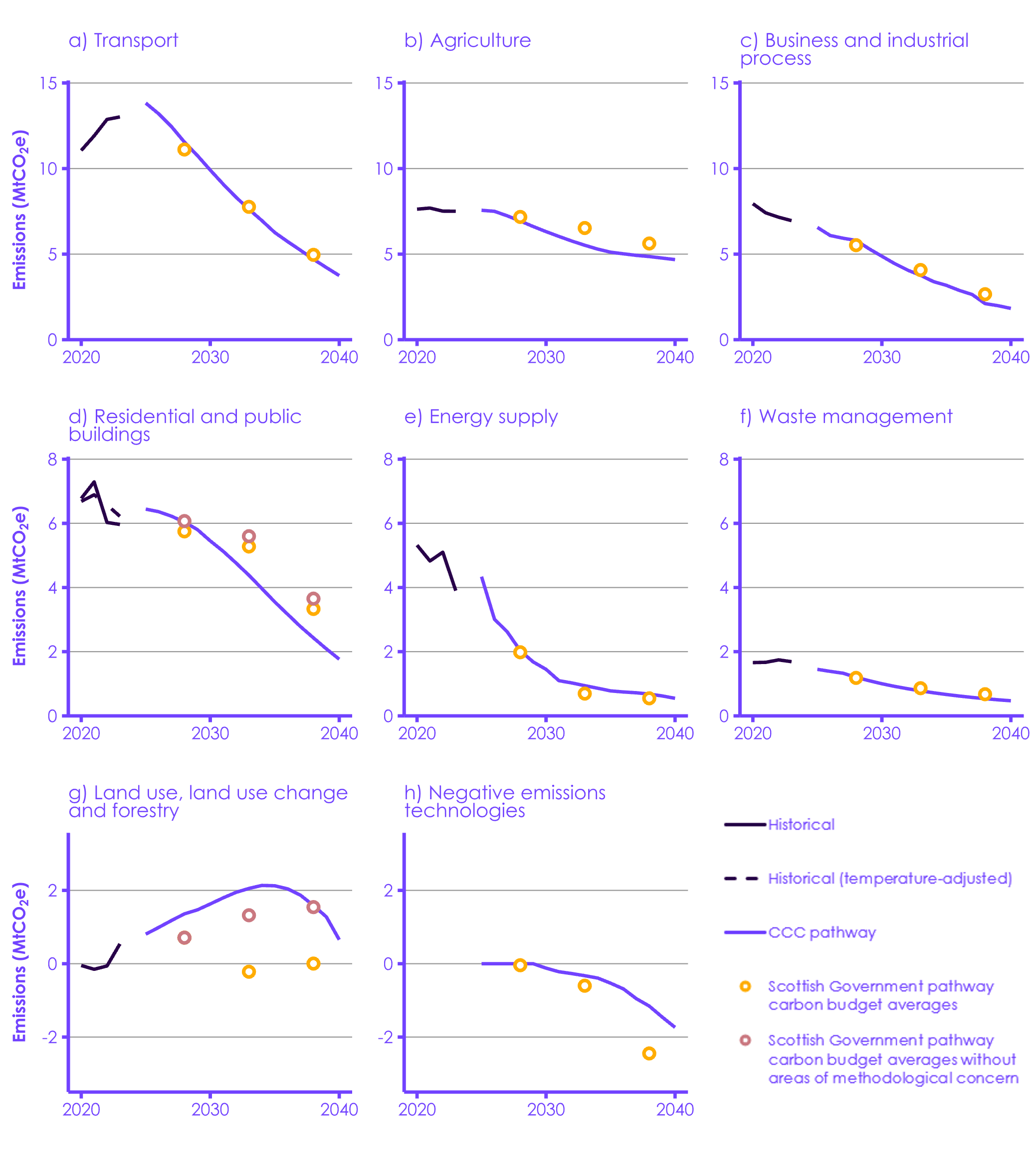 Description: The main differences between the draft Climate Change Plan (CCP) pathway and the CCC’s Balanced Pathway are in agriculture; residential and public buildings; land use, land use change and forestry; and negative emissions technologies. Description: The main differences between the draft Climate Change Plan (CCP) pathway and the CCC’s Balanced Pathway are in agriculture; residential and public buildings; land use, land use change and forestry; and negative emissions technologies.Source: National Atmospheric Emissions Inventory (2025) Greenhouse Gas Inventories for England, Scotland, Wales and Northern Ireland: 1990-2023; Scottish Government (2025) Scotland’s Draft Climate Change Plan: 2026-2040; CCC analysis. Notes: (1) The CCC pathway data uses the 2022 greenhouse gas (GHG) inventory. The historical data and the Scottish Government pathway use the 2023 inventory. (2) We have adjusted the published draft CCP pathway to move the emissions reductions associated with non-road mobile machinery (NRMM) from energy supply to the agriculture, business and industrial process, transport, and buildings sectors based on the share of NRMM abatement in each of these sectors in our Balanced Pathway for Scotland. (3) Areas of methodological concern refer to aspects of the draft CCP pathway where we are concerned that the modelling methodologies and assumptions are reliant on emissions savings that depend on highly uncertain wider factors. In these areas, we assess that policy levers would not be able to realise these emissions savings if these uncertain factors do not develop favourably. (4) In chart a), the CCC pathway for transport has a higher starting point than the Scottish Government pathway as we used the UK Department for Transport’s emissions model as the starting point for the majority of emissions in shipping. This was based on potential future changes to the inventory. (5) In chart e), negative emissions from biogenic waste in energy from waste are included in the Scottish Government pathway for this sector. (6) In chart g), the large drop in emissions between the First Carbon Budget and the Second Carbon Budget is largely due to an uncertain future change to the area of peatland that the draft CCP assumes will be implemented in the GHG inventory from then on. |
3.3.2 Comparison to the CCC’s Balanced Pathway
It is for the Scottish Government and the Scottish Parliament to decide on the exact pathway and policies within devolved powers to meet the emissions reductions targets. The CCC’s Balanced Pathway is not the only possible route to meeting the targets. In many cases there is scope to go faster, possibly at higher cost or through policy that is more challenging to deliver.
Where the Scottish Government chooses to go slower in one area, there will need to be accelerated progress somewhere else in the economy.
The main differences between the draft CCP pathway and the CCC’s Balanced Pathway are in residential and public buildings; agriculture and land use; and NETs.
- Residential and public buildings: the key difference is the slow pace of decarbonisation assumed in the draft CCP between now and the Second Carbon Budget. During the Third Carbon Budget period, the rapid uptake of low-carbon heat assumed in the draft CCP means that emissions start to catch up to our Balanced Pathway.
- The rapid pace of decarbonisation in the draft CCP during the Third Carbon Budget will require replacements of residential heating systems ahead of end of life. Earlier growth in heat pump deployment would reduce the need for replacing heating systems before end of life.
- For public buildings, emissions in the draft CCP are more than three times higher than in the CCC’s Balanced Pathway during the Third Carbon Budget. The draft CCP pathway has little public sector decarbonisation to this point, while the public sector leads the way in the CCC’s Balanced Pathway.
- In addition, the draft CCP pathway starts from a lower level of emissions than the CCC’s Balanced Pathway. This is due to the lack of temperature adjustment to the draft CCP baseline and the fact that emissions savings equivalent to the full level of energy-saving practices seen during the energy crisis are assumed to be maintained.
- Agriculture and land use: differences between the draft CCP pathway and the CCC’s Balanced Pathway are driven by the modelling approach taken and consideration of livestock numbers.
- Agriculture: the draft CCP pathway includes emission reductions associated with only a decline in Scottish livestock numbers in line with existing long-term trends, without any proactive measures to further reduce numbers. Under the CCC’s Balanced Pathway, lower livestock numbers deliver 46% of emissions reduction in the agriculture sector by 2040. The Scottish Government’s decision limits the options available to reduce emissions from agriculture in the draft CCP.
- Land use, land use change and forestry: woodland creation targets in the draft CCP exceed those set out in the CCC’s Balanced Pathway in the early years of the pathway (see Section 4.2.2). However, in the 2030s, the draft CCP woodland creation rate plateaus and falls below the level of ambition set out in the CCC’s Balanced Pathway. Peatland restoration rates are less ambitious than in the CCC’s Balanced Pathway after 2026/27. The assumed peatland inventory adjustment leads to a substantial reduction in the draft CCP pathway which is not present in the CCC’s Balanced Pathway. See Box 3.1 for details of how the Scottish Government could ensure this adjustment is made to the GHG inventory.
- NETs: the draft CCP pathway has a greater reliance on NETs than the CCC’s Balanced Pathway, reaching an annual average of -2.4 MtCO2e in the Third Carbon Budget, compared to -1.2 MtCO2e in the CCC’s Balanced Pathway. This reflects steeper growth in NETs deployment over the Third Carbon Budget.
- NETs is an area with significant risk and with policy powers largely reserved to the UK Government (see Chapter 5). A co-ordinated approach with the UK Government and plans for UK-wide NETs will be needed to ensure successful delivery, with the Scottish Government ensuring Scotland is an attractive location for NETs.
- As noted in Section 3.3.1, CO2 removals from the combustion of biogenic waste in energy from waste (EfW) facilities with CCS installed are included in the energy sector in the draft CCP. This means that the draft CCP pathway’s dependence on negative emissions is actually slightly larger than it appears from the NETs sectoral pathway alone.
| Box 3.1 Adjustments to the GHG inventory |
|
The UK Government decides each year which adjustments to the GHG inventory to fund and implement. There are a few ways that the Scottish Government could influence the prioritisation of improvements:
The emissions inventory for each year is first published around one and half years after that year ends, so for an inventory adjustment to be considered in the reporting of whether a carbon budget target is met, it would need to be implemented by that point. Depending on the complexity and when in the year any given adjustment is available, it could take between a few months and three years to be implemented. |
3.3.3 Distribution of future emissions reductions
The majority of the emissions reductions seen in Scotland to date have been in the mostly reserved energy supply and business and industrial process sectors. Action needs to broaden across a wider range of sectors to deliver the emissions reductions that are required in the draft CCP pathway to meet Scotland’s carbon budgets (Figure 3.3).
- Around two-thirds of the emissions reductions seen since the introduction of the Act in 2009 have been in the energy supply sector. Electricity supply in Scotland is now almost fully decarbonised, so there is limited scope for further reduction in the energy supply sector beyond the First Carbon Budget.
- Further expanding low-carbon generation and supporting transmission network infrastructure in Scotland remains critical to enable decarbonisation of other sectors and to supply low-carbon electricity to the rest of the UK.
- Further reductions in energy supply will come predominantly in fuel supply, through reduced oil and gas processing (as both production and demand for these fuels across the economy decreases) and through measures to decarbonise remaining production.
- Therefore, emissions savings need to broaden, particularly into the mostly devolved transport, residential and public buildings, and agriculture and land use sectors. The Scottish Government has substantial powers to reduce emissions in these areas. In the First Carbon Budget, mostly devolved sectors provide 48% of the required emissions reductions. This increases to 62% in the Second and Third Carbon Budgets.
- In the Second Carbon Budget, 67% of the savings required in the draft CCP pathway are projected to come from sectors other than energy supply and business and industrial process, which have dominated emissions reductions to date. This increases to 88% in the Third Carbon Budget.
- Emissions reductions from transport are the largest contribution to meeting the First and Second Carbon Budgets, providing 40% of emissions reductions in the First Carbon Budget and 34% of reductions in the Second Carbon Budget.
- In the Second Carbon Budget, a further 34% of emissions reductions come from agriculture and land use, residential and public buildings, and NETs together, with the rest coming from energy supply and business and industrial process.
- In the Third Carbon Budget, transport, residential and public buildings, and NETs each provide 26% of the required emissions reductions.
- As described in Section 3.3.1, the pace of decarbonisation assumed in the draft CCP pathway for buildings is slow in the first two carbon budget periods before accelerating rapidly. A more credible trajectory would likely see this sector contribute a greater share of emissions reductions than shown to meeting the First and Second Carbon Budgets.
- The large contribution from agriculture and land use in the Second Carbon Budget period is largely driven by the peatland area correction described in Section 3.2.2. If this does not happen, the contribution from these sectors would be smaller than shown.
| Figure 3.3 Distribution of emissions reduction by sector in the draft Climate Change Plan |
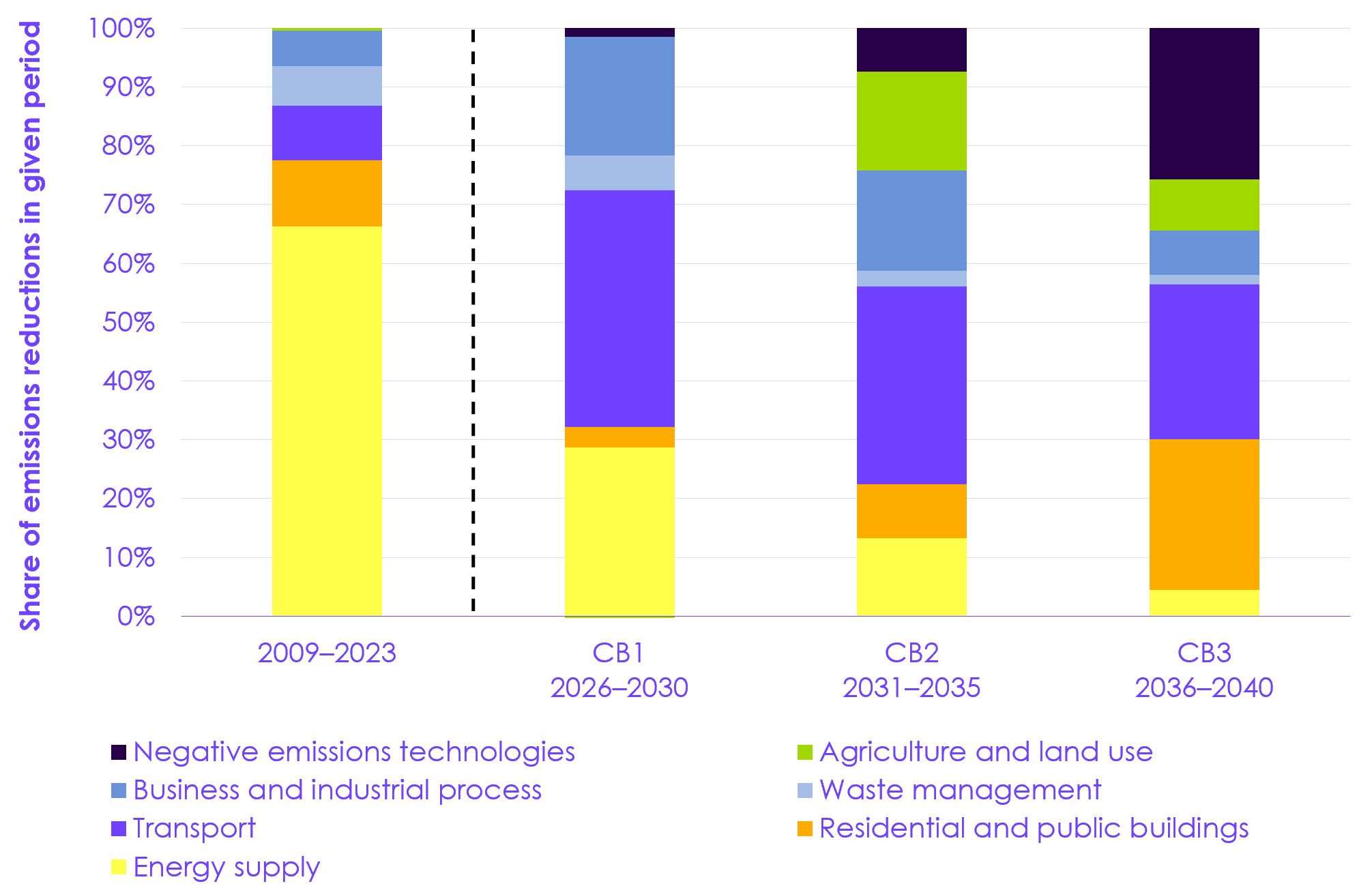 Description: The majority of the emissions reductions seen in Scotland to date have been in the mostly reserved energy supply sector. Emissions savings need to broaden, particularly into the mostly devolved transport, buildings, and agriculture and land use sectors. Description: The majority of the emissions reductions seen in Scotland to date have been in the mostly reserved energy supply sector. Emissions savings need to broaden, particularly into the mostly devolved transport, buildings, and agriculture and land use sectors.Source: National Atmospheric Emissions Inventory (2025) Greenhouse Gas Inventories for England, Scotland, Wales and Northern Ireland: 1990-2023; Scottish Government (2025) Scotland’s Draft Climate Change Plan – 2026-2040; CCC analysis. Notes: (1) ‘CB’ refers to Scottish carbon budgets: ‘CB1’ refers to the First Carbon Budget; subsequent numbers refer to subsequent carbon budgets. (2) We have combined the agriculture and land use, land use change and forestry sectors in this chart. Agriculture and land use does not make a contribution to emissions reductions during the First Carbon Budget as net emissions increase in the near-term due to a legacy of lower tree planting rates during the 1990s and 2000s, leading to an ongoing decrease in the forestry sink before new woodland creation begins to contribute net sequestration. |
Chapter 4: Indicators of current delivery progress
In this chapter, we assess progress in delivering the changes required to meet Scotland’s emissions targets. This includes monitoring the pace at which low-carbon technology markets are growing, their prices are falling, and low-carbon choices by households and businesses are developing.
Our key messages are as follows:
- Electric vehicles: with prices continuing to fall, the number of electric cars on Scottish roads increased by 38% in the year to September 2025. Scotland has more public charge points per capita than the UK average and deployment is increasing fast, but satisfaction with charging infrastructure could be substantially improved.
- Between 2023 and 2024, the number of public charge points across Scotland increased by approximately 34% to over 6,000, meeting the Scottish Government’s target two years ahead of schedule.
- The distribution of charging infrastructure across Scotland is uneven. Urban town and fringe areas show higher satisfaction in the number of charge points (51%) than rural or island areas (38%).
- Tree planting: in 2023/24, woodland creation rates almost doubled, reaching their highest levels since 1990 and demonstrating significant potential for the sector. However, planting rates fell significantly in 2024/25 due to funding cuts. Sustained funding is needed to deliver at the scale required.
- Peatland restoration: peatland restoration rates almost doubled over two years, reaching almost 15,000 hectares in 2024/25, the highest reported rate to date.
- The Scottish Government has reported the restoration of around 90,000 hectares of degraded peatland to date.
- Scotland’s Draft Climate Change Plan: 2026-2040 (the draft CCP) introduced a new, later target of restoring 400,000 hectares of degraded peat by 2040.[38] Restoration rates will have to continue to increase rapidly if this is going to be achieved.
- Heat pumps: sales are steadily increasing but a rapid scale up is needed to meet the Scottish Government’s target to decarbonise homes and to achieve Net Zero by 2045 overall.
- Heat pump deployment grew by 18% between 2023 and 2024, and a higher proportion of Scottish homes have heat pumps compared to the UK as a whole.
- Scotland implemented their New Build Heat Standard in 2024, requiring new buildings with warrants issued after 1 April 2024 to be built with zero emissions heating systems. This is ahead of the rest of the UK, which is yet to implement the equivalent Future Homes Standard.
- Renewables and electricity transmission infrastructure: deployment of variable renewable electricity generation is increasing in Scotland and will need to accelerate further, together with an increase in transmission network capacity. This will enable wider electrification across the UK.
4.1 Principles of progress monitoring
Effective mechanisms to monitor progress are essential to allow barriers and risks to delivery of Scotland’s emission targets to be identified and addressed. In this chapter, we do this by tracking progress on a range of key delivery indicators. Tracking these indicators allows us to identify at an early stage whether progress is on or off track for the pace of change required, providing an early signal for areas at risk. Further details on our approach to progress monitoring can be found in the Climate Change Committee’s (CCC) Mitigation Monitoring Framework (2025).
In Section 4.2, we assess progress on key indicators.
- We have selected these indicators in order to allow us to focus our assessment on the actions and changes leading to the most significant emissions reductions, subject to data availability. For the targets up to the 2030s, this is mostly the roll-out of electric technologies and renewable electricity generation, the latter of which is critical both to direct emissions reductions in the energy supply sector and electrification in other sectors. For the Net Zero target, this also includes action in agriculture and land use.
- Where available, we assess progress against the pace of change required to meet the Scottish Government’s targets. If there is no government target, we assess how trends compare to the CCC’s Balanced Pathway from our 2025 Scotland’s Carbon Budgets advice where possible.
In Section 4.3, we discuss trends in a range of cross-cutting impacts on jobs, concern about climate change, and air quality. While we do not have benchmarks against which to judge progress on these, they provide a useful insight into the wider impacts of the Net Zero transition.
4.2 Assessment of progress on key indicators
In this section we look at key indicators by sector. We do not score our indicators because, in many areas, the Scottish Government’s targets have been updated in the draft CCP based on the latest data, so it is too early to judge whether progress to deliver these is on track. Also, in some key areas, the draft CCP does not provide indicator trajectories against which to judge progress.
4.2.1 Transport
The market share for new electric cars increased in 2024, following a stall in 2023, while the share for new electric vans declined. The number of electric cars on the road increased by 38% in the year to September 2025, while prices in the UK are falling quickly.[39] Public charge point deployment is growing well, although with uneven distribution across Scotland.
- Electric cars: according to official statistics, electric vehicles (EVs) made up 12% of new car sales in Scotland in 2024, an increase from 10% in 2023 (Box 4.1 and Figure 4.1a).[40];[41] This upward trend continued into 2025, reaching 14% in the first three quarters of the year. While this is still below the headline targets of the UK’s zero-emission vehicle (ZEV) mandate (22% for 2024; 28% for 2025), there is uncertainty regarding the number of cars on Scottish roads, which could be underreported (Box 4.1).[42];[43] The draft CCP assumes the same EV uptake as the CCC’s Balanced Pathway, which projects that sales of electric cars surpass the ZEV mandate to reach 90% of new sales by 2030 (compared to the ZEV mandate target of 80%). While hybrids could continue to be sold until 2035, they do not have a major role in our pathway because we expect most consumers to choose EVs once they are the cheapest option.
- In September 2025, there were around 97,000 electric cars registered on Scotland’s roads, accounting for 3.7% of the total fleet – up from 2.7% the previous year.[44] However, Scotland’s electric car uptake may be being underreported in official statistics (Box 4.1).
- While, on average, new EVs remain more expensive to buy than a comparable petrol vehicle, the price has declined steadily in recent years and is in line with our expectations of price parity being met between 2026 and 2028. The premium fell from 37% in 2023 to 24% in 2024 (Figure 4.1b) and has since dropped to 19% as of September 2025.[45]
- The increasing availability of lower-cost models and competitiveness of the second-hand market means EVs are increasingly affordable to people on lower incomes. In many cases, EVs are now cheaper to own and run than petrol and diesel equivalents. This is expected to broadly remain the case for those with access to home charging once the three pence per mile electric Vehicle Excise Duty (eVED) is introduced in 2028.[46] However, for those without access to home charging, eVED will compound with higher charging costs.
- Electric vans: electric van sales declined from 4% of new registrations in 2023 to 3% in 2024 but are still higher than 2022 levels (Figure 4.1c).[47] Early 2025 data show modest growth to 4% of the market but levels remain significantly below the UK ZEV mandate headline target (10% for 2024; 16% for 2025). Similarly to cars, Scotland’s electric van uptake is uncertain and may be underreported (see Box 4.1). In the draft CCP, the Scottish Government assumes the same uptake as the CCC’s Balanced Pathway, and assumes that, by 2030, electric vans reach 100% of new sales, compared to the 70% ZEV mandate target.
- Public charge points: the number of public charge points across Scotland has increased by approximately 34% since 2023 to over 6,000 in 2024, meeting the Scottish Government’s target two years ahead of schedule (Figure 4.1d). Scotland has more public charge points per capita than the rest of the UK, with 135 per 100,000 population compared to the UK average of 127 (as of early October 2025).[48]
- The distribution of charging infrastructure across Scotland is uneven. Despite lower per capita provision, urban chargers typically serve higher numbers of vehicles per device. While satisfaction rates regarding the number of public charge points are higher in urban/town and fringe areas (51%) compared to rural or island areas (38%), both rates could be substantially improved, with satisfaction across all locations averaging only 47%.[49] When measured against traffic volume, East Renfrewshire and West Lothian have the lowest provision at 129 and 131 charge points per billion vehicle miles respectively. East Lothian performs best with 891 charge points per billion miles.[50];[51] Orkney, Shetland, and Na h-Eileanan Siar also perform well, offering the highest per capita concentration of rapid or ultra-rapid charge points.
- Around 60% of households in Scotland have access to off-street parking, slightly below the 65% average for Great Britain.[52];[53] Across the UK, public charging is generally significantly more expensive than charging at home (costing between two to nine times more per kWh), though rates vary across different types of public charge point.[54]
- Vehicle-kilometres: car-kilometres per capita increased by 1% between 2023 and 2024, having also increased from 2022 to 2023.[55];[56] This metric remains 4% below pre-pandemic 2019 levels (Figure 4.1e). Van-kilometres per capita remain the same as 2023 but are 13% above 2019 levels (Figure 4.1f).
- The draft CCP includes a draft target to reduce car-kilometres by 4% in 2030 compared to a ‘business as usual’ forecast baseline, replacing the Scottish Government’s previous target to reduce car mileage levels by 20% (from a 2019 baseline). This revised target aligns with the level of ambition in the CCC’s Balanced Pathway, which is based on evidence of successful modal shift interventions across the UK and Europe, and therefore, while still ambitious, is more achievable.
- Aviation emissions and demand: 2023 aviation emissions were 2.0 MtCO2e, 4% below pre-COVID-19 levels (2.1 MtCO2e in 2019) (Figure 4.1g). Similarly, 2023 passenger-kms were 5% below 2019 levels (Figure 4.1h). There are no 2024 emissions data available yet, however, it is likely that aviation emissions will exceed 2019 levels, as passenger-kilometres reached 20.3 billion in 2024, an overall 6% increase compared to 2019 levels. The draft CCP assumes average annual aviation emissions in the Second Carbon Budget are similar to 2023 levels. However, if demand growth rates do not stabilise and aviation emissions abatement does not increase, Scottish aviation emissions are at risk of exceeding the draft CCP pathway.
- The 6% increase in overall Scottish passenger-kilometres from 2019 to 2024 was driven by international passenger-kilometres, which increased by 10% between 2019 to 2024; in contrast, domestic passenger-kilometres decreased by 14%.
| Box 4.1 Uncertainty in EV registration statistics in Scotland |
|
Scotland’s officially reported electric car market share was 12% in 2024, compared to 19% across the UK.[57] For vans, this is a 3.1% share, compared to a 6.2% share across the UK. However, there is uncertainty about whether these gaps reflect genuine differences in EV uptake or underreporting in official statistics. Scotland’s EV uptake may be underreported because company vehicles are often registered at corporate headquarters (predominantly in England) rather than where they are used. Company cars accounted for 82% of new EV sales across the UK in 2024 – largely driven by favourable tax incentives. By comparison, only 61% of new EVs in Scotland were registered as company cars. This registration practice could be disproportionately affecting Scotland’s EV figures.
It may also be the case that EV sales in Scotland are genuinely lower than the UK average. The Scottish Government is undertaking further analysis to better understand this uncertainty. |
| Figure 4.1 Transport indicators |
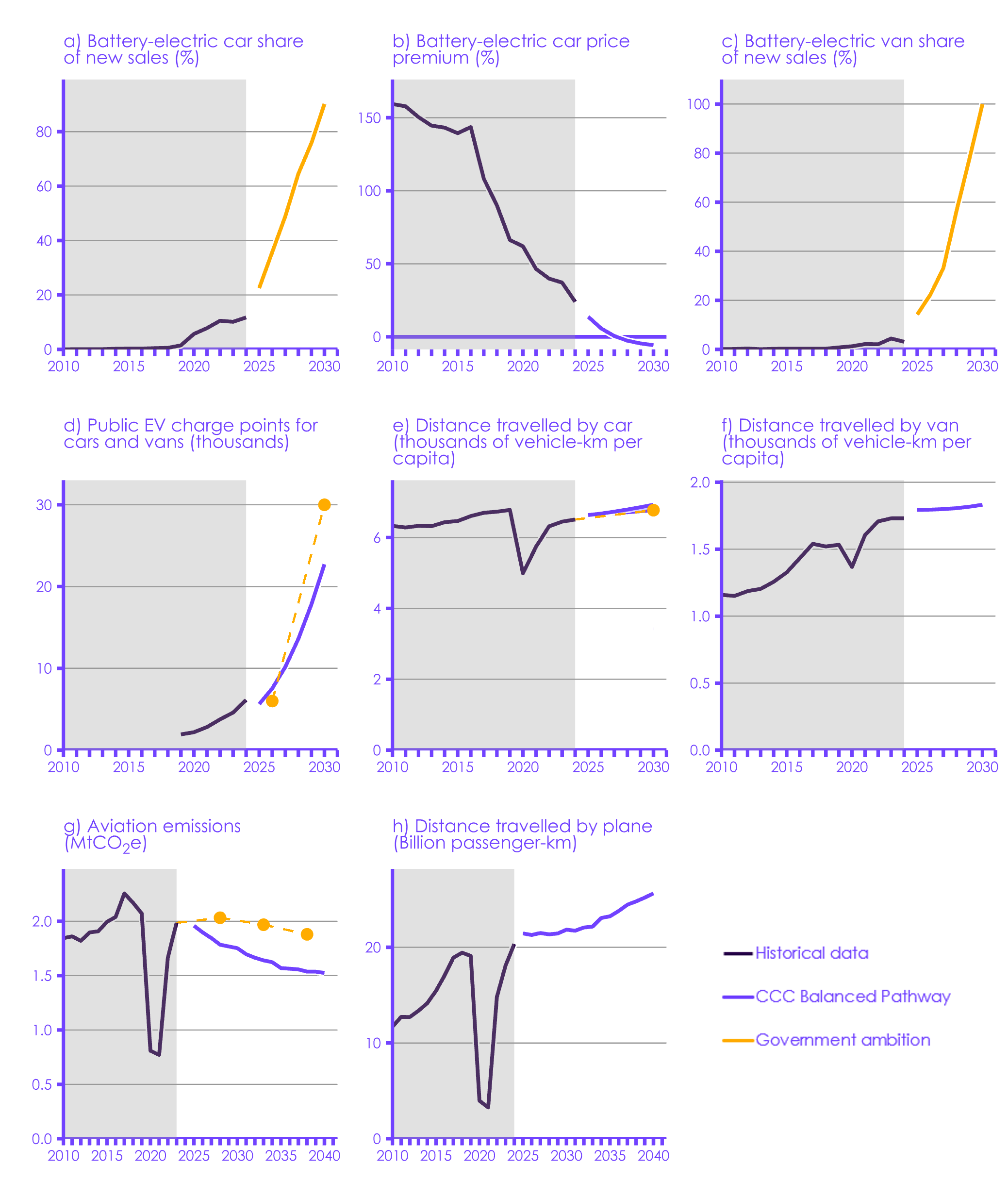 Description: Battery-electric car sales increased last year, having stalled the previous year, but remain below the zero-emission vehicle (ZEV) mandate. Battery-electric van sales declined last year but have increased overall since 2022. There has been a significant increase in public electric vehicle (EV) charge points in recent years, and the battery-electric car price premium is continuing to fall. Car-kilometres per capita increased slightly in both of the last two years and van-kilometres per capita remained the same as the previous year but have increased since 2022. Aviation indicators show 2023 emissions rebounding to pre-COVID-19 pandemic levels in 2019; passenger-kilometres in 2024 surpassed 2019 levels, making it likely that 2024 emissions will also be above 2019 levels. Description: Battery-electric car sales increased last year, having stalled the previous year, but remain below the zero-emission vehicle (ZEV) mandate. Battery-electric van sales declined last year but have increased overall since 2022. There has been a significant increase in public electric vehicle (EV) charge points in recent years, and the battery-electric car price premium is continuing to fall. Car-kilometres per capita increased slightly in both of the last two years and van-kilometres per capita remained the same as the previous year but have increased since 2022. Aviation indicators show 2023 emissions rebounding to pre-COVID-19 pandemic levels in 2019; passenger-kilometres in 2024 surpassed 2019 levels, making it likely that 2024 emissions will also be above 2019 levels.Source: Department for Transport (DfT) (2025) Vehicle licensing statistics; DfT (2025) Electric vehicle charging device statistics; Autotrader (2025) The road to 2030; Office for National Statistics (2025) Population estimates for the UK, England, Wales, Scotland and Northern Ireland: mid-2024; National Atmospheric Emissions Inventory (2025) Greenhouse Gas Inventories for England, Scotland, Wales and Northern Ireland: 1990-2023; DfT unpublished data; Scottish Government (2025) Scotland’s Draft Climate Change Plan: 2026-2040; CCC analysis. Notes: (1) Government ambition is an umbrella term encompassing stated targets, projections and modelling assumptions – and does not necessarily represent a formal commitment from the Government. (2) Dashed lines represent the linear path from the latest historical value to the Government’s ambition or between government ambitions. (3) For charts a) and c), the Scottish Government’s ambition is the same as the CCC Balanced Pathway. Scotland’s EV uptake may be underreported in official statistics because some company vehicles may be being registered at headquarters (predominantly in England) rather than where they are used. (4) In chart e), we have used the CCC’s baseline car-km forecasts for Scotland and our 4% modal shift assumption as a proxy for the 2030 target while the Scottish Government’s vehicle-kilometre projections and policy on car demand are being finalised. |
4.2.2 Agriculture and land use
Agriculture
Land use change at scale is likely to require the release of land from livestock agriculture. This should be facilitated by a change in UK diets and supply-side incentives for farmers to diversify land use.
- Livestock numbers: since 2012, there has been a steady decline in cattle numbers (Figure 4.2a). Sheep numbers have been more variable but are now slightly below 2012 levels (Figure 4.2b).
- Livestock numbers have been falling against a backdrop of a longer-term trend of reduced meat consumption, with both indicators ahead of the assumed CCC Balanced Pathway starting point.[61]
- The decline in cattle numbers has been steady and driven by the introduction of the Single Farm Payment in 2005 (which ended payments based on herd size), higher input costs, and a decrease in profitability.[62] Sheep numbers have been more variable, with numbers falling due to increased input costs, labour shortages, and support for farm diversification.[63]
- Meat consumption: UK meat consumption has been falling steadily over the long term and has fallen more steeply in recent years (Figure 4.2c). This may be partly due to cost-of-living pressures, so this short-term trend might not continue.
- The rest of the UK is the largest market for beef and sheep meat produced in Scotland, representing 63% and 58% of total sales respectively in 2023. The domestic market accounts for 29% of beef sales and 22% of sheep sales, while the remaining 8% and 21% is exported, with the European Union being the primary destination for both types of meat.[64]
| Figure 4.2 Agriculture indicators |
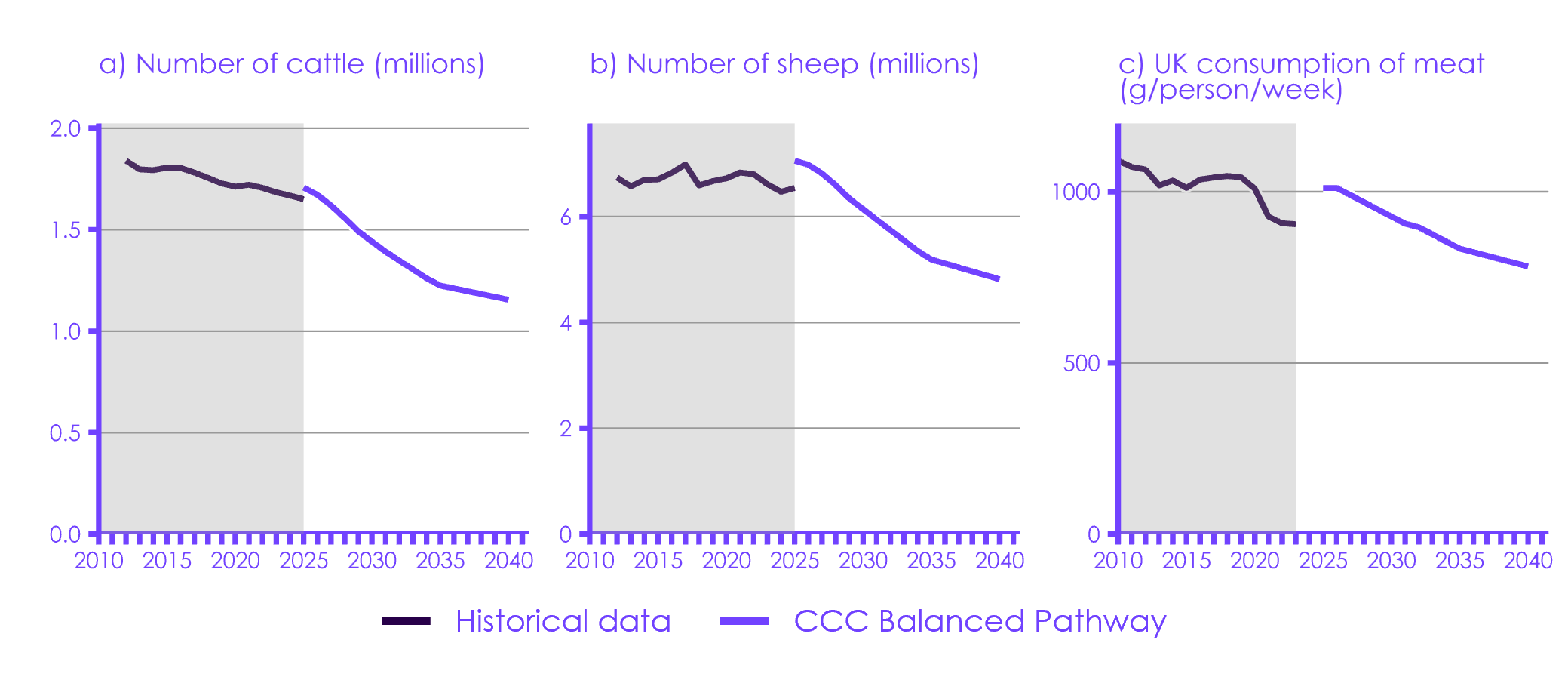 Description: Cattle numbers have steadily declined since 2012. Sheep numbers have been more variable but are now slightly below 2012 levels. UK meat consumption has fallen steadily, with a steeper decrease in more recent years. Description: Cattle numbers have steadily declined since 2012. Sheep numbers have been more variable but are now slightly below 2012 levels. UK meat consumption has fallen steadily, with a steeper decrease in more recent years.Source: Department for Environment, Food and Rural Affairs (2025) Family food statistics; Scottish Government (2025) Results from the Scottish Agricultural Census: June 2025; CCC analysis. Notes: (1) In charts a) and b), livestock numbers at the start of the CCC Balanced Pathway are higher than the most recent historical year due to later updates to underlying models. The CCC baseline aligned to the 2022-2040 Energy and Emissions Projections (EEP) available at the time of the analysis. This was subsequently updated and the 2023–2040 EEP reflected lower livestock projections. (2) In chart c), we assume that any policy interventions to support a shift towards lower-carbon foods requires time to design and implement. The reduction in meat and dairy consumption included in our Balanced Pathway in the years 2025 and 2026 therefore consists only of the reduction assumed based on the forward projected long-term trend (2001–2019). This means it is above the most recent historical years (2021–2023) where levels fell more steeply. It is too early to tell whether these reductions will continue in the long term or are just a temporary reaction to the cost-of-living crisis. |
Land use, land use change and forestry
Woodland creation in Scotland fell significantly in the last reporting year (although exceeded levels seen two years ago). However, restoration of peatlands has consistently increased at a rapid rate over recent years.
- Woodland creation: Forestry Statistics reported the planting of 8,500 hectares of new woodland in 2024/25, a 44% drop from the previous year where 15,000 hectares of new woodland were planted in Scotland, but higher than two years previously (Figure 4.3a).
- Tree planting rates almost doubled between 2022/23 and 2023/24, demonstrating significant momentum in the forestry sector. However, the Forestry Grant Scheme’s budget was cut by 41% in 2024/25, driving lower rates of funded planting and leading the Scottish Government to miss its 18,000 hectare target for 2024/25 (set before the release of the draft CCP).
- Scotland has consistently planted most new woodlands in the UK over the last 50 years, and the rates achieved in 2023/24 had been the highest reported level since 1990 (Figure 4.4). Increasing woodland creation at scale is feasible in Scotland. In the 1970s, Scotland was planting an average of 26,000 hectares of new woodland each year, largely due to tax incentives supporting the commercial forestry sector (Box 4.2).
- The increase in planting rates achieved before cuts to the Forestry Grant Scheme demonstrate the importance of consistent funding and support when seeking to upscale woodland creation. To achieve the ambition and momentum set out in the draft CCP will require clear multi-year funding commitments to rebuild confidence in the sector.
- Peatland restoration: the rate of peatland restoration has significantly increased in Scotland, almost doubling over a two-year period and reaching 14,900 hectares in 2024/25 (Figure 4.3b). This is a 41% increase on the previous reported year and the highest reported rate to date.
- To date, the Scottish Government has reported the restoration of around 90,000 hectares of degraded peatland as part of their target to reach 250,000 hectares over the decade to 2030. Despite the recent increases in rates, the target to reach 250,000 hectares of peatland under restoration by 2030 is expected to be missed.
- The draft CCP introduced an additional, later target of restoring 400,000 hectares of degraded peat by 2040. Restoration rates will have to continue to increase rapidly if this is going to be achieved.
| Figure 4.3 Land use, land use change and forestry indicators |
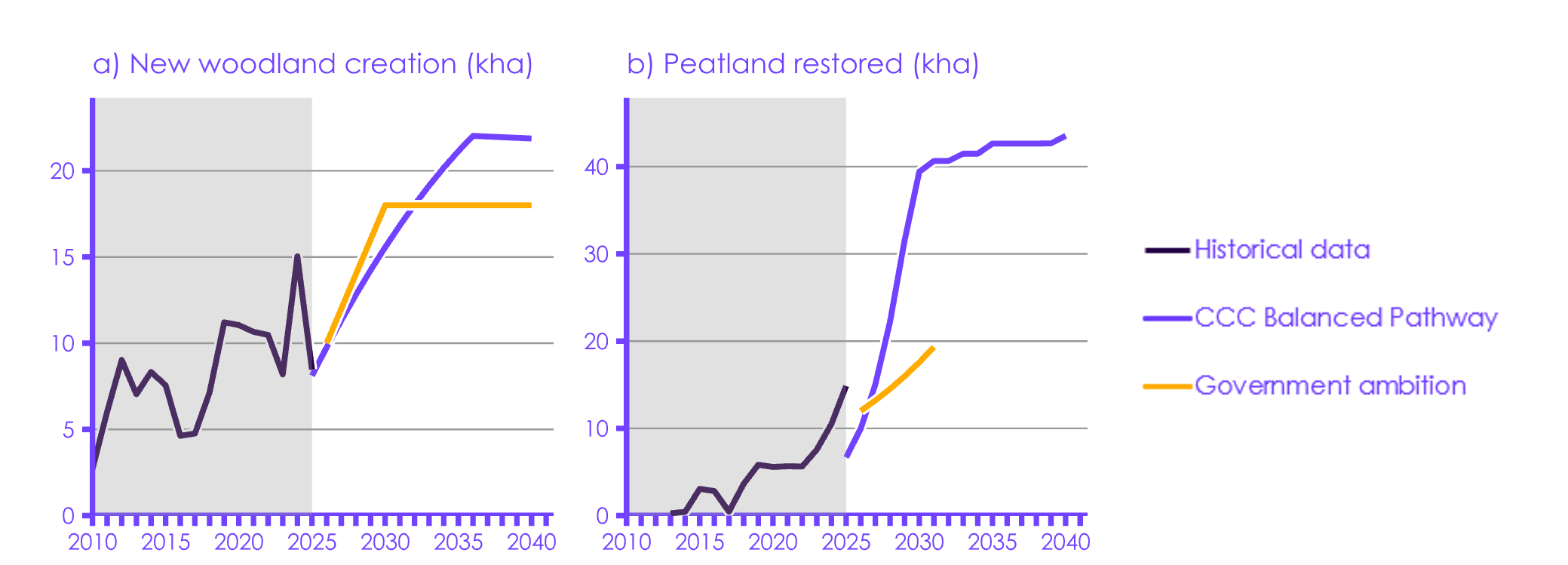 Description: Woodland creation rates have been variable in recent years but have been increasing with peak rates reached in 2023/24 before a steep fall in 2024/25. Peatland restoration rates continue to increase, with an almost doubling of reported rates since 2022/23. Description: Woodland creation rates have been variable in recent years but have been increasing with peak rates reached in 2023/24 before a steep fall in 2024/25. Peatland restoration rates continue to increase, with an almost doubling of reported rates since 2022/23. Source: Forest Research (2025) Woodland Statistics; Nature Scot (2025) Peatland Action Annual Review; Scottish Government (2025) Scotland’s Draft Climate Change Plan: 2026-2040; CCC analysis. Notes: (1) Government ambition is an umbrella term encompassing stated targets, projections and modelling assumptions – and does not necessarily represent a formal commitment from the Government. (2) The data are given for financial years rather than calendar years based on delivery reporting for these actions, for example, the data for 2025 is for 2024/25. (3) For chart b), historical peatland restoration rates include the full range of restoration activity including rewetting, while CCC projections are based on area of peatland that is rewetted only. The Government ambition is based on the policy to ‘…increase peatland restoration by 10% each year to 2030 and maintain levels after that leading to the restoration of more than 400,000 hectares by 2040’ as articulated in the draft CCP and used to inform the abatement reported. The 2025/26 Programme for Government sets a target to achieve at least 12,000 hectares of peatland restoration in 2025/26. We have not included data for government ambition post-2030 rates as the level of ambition for restoration rates after 2030 is expected to be set out in future Scottish Government plans. |
| Figure 4.4 Tree planting rates in Scotland and the UK |
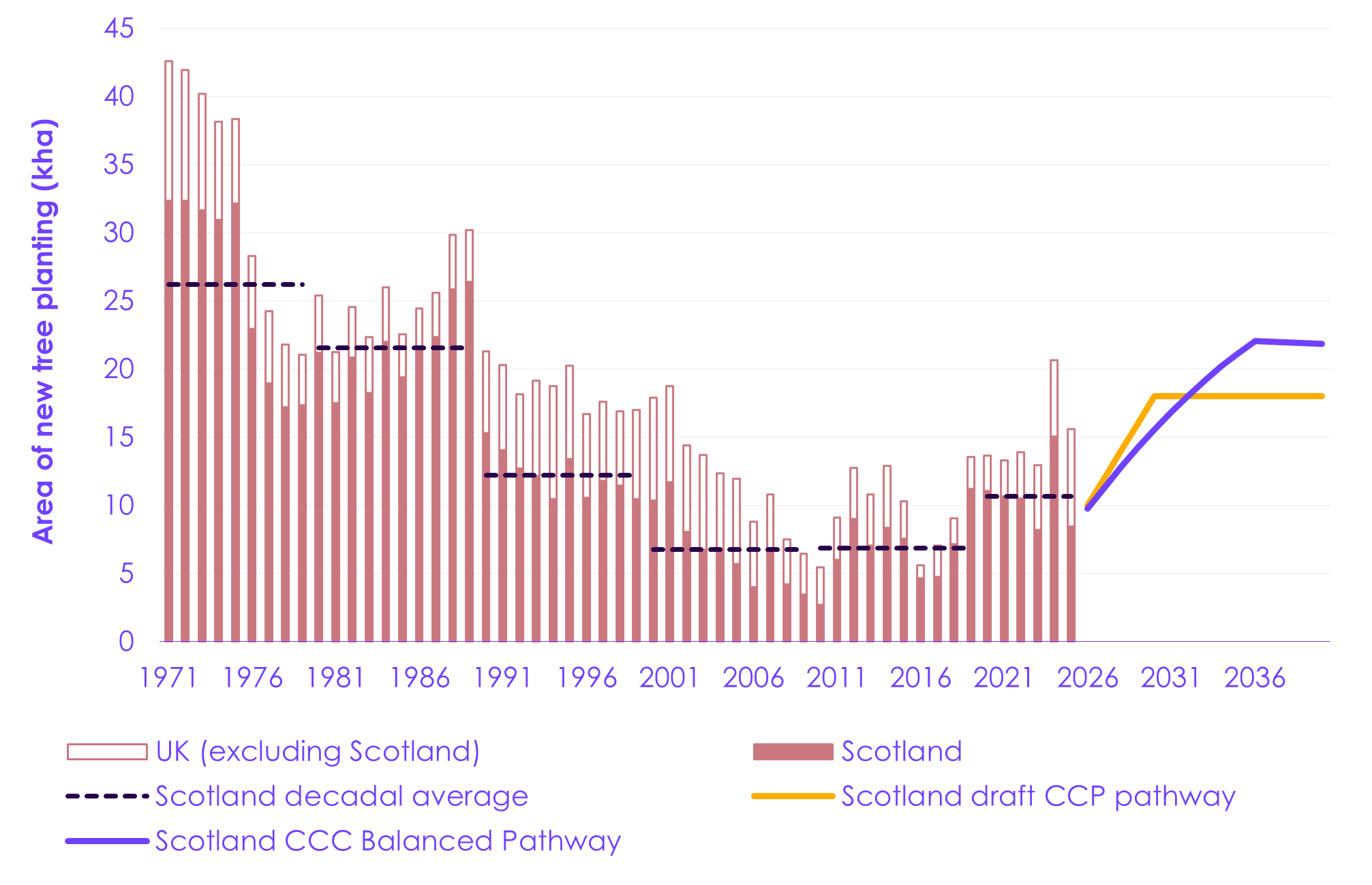 Description: Scotland has consistently delivered the highest planting rates in the UK. Though woodland creation rates have started to rise in the 2020s, they remain far below the rates achieved in the 1970s and 1980s. Description: Scotland has consistently delivered the highest planting rates in the UK. Though woodland creation rates have started to rise in the 2020s, they remain far below the rates achieved in the 1970s and 1980s.Source: Forest Research (2025) Time Series; CCC analysis. Notes: The UK values do not include data for Northern Ireland from 1971 to 1975. The data are given for financial years rather than calendar years, for example, the data for 2025 is for 2024/25. |
| Box 4.2 Historical rates of tree planting in Scotland and the UK |
|
In Scotland the CCC’s Balanced Pathway requires 8,000 hectares of woodland creation per annum in 2025, 16,800 hectares per annum in 2030, and 22,000 hectares per annum in 2040. Targets set out in the draft CCP exceed this ambition in the near term, with the Scottish Government aiming to reach 18,000 hectares by 2030, and then maintain the 2030 target through to 2040 (but they are less ambitious than the CCC’s Balanced Pathway in the long term). Scotland has exceeded these rates of planting in the past (Figure 4.4).
Source: Forest Research (2025) Time Series; Scottish Government (2025) Draft Climate Change Plan: 2026-2040. |
4.2.3 Residential and public buildings
There has been steady positive progress on heat pump deployment in Scotland, with 2024 deployment ahead of the CCC’s Balanced Pathway in 2025. However, there will need to be a rapid scale up in installations to meet the Scottish Government’s ambitious target to decarbonise heat in buildings by 2045 and to achieve Net Zero by 2045 overall.
- Heat pumps in existing homes: heat pump deployment grew by 18% between 2023 and 2024, with deployment in 2024 ahead of the CCC’s Balanced Pathway in 2025 (Figure 4.5). Heat pump deployment has been growing consistently since 2020, with an average year-on-year growth rate of 28%. However, this is still lower than the maximum growth rate of 42% (reached by 2028) needed in the CCC Balanced Pathway for Scotland. The draft CCP does not provide a heat pump deployment pathway so a comparison to what is needed cannot be made. A higher proportion of Scottish homes currently have heat pumps compared to the UK as a whole (Figure 4.6).
- Growth in heat pump deployment in recent years has been driven by an increase in the number of Scottish Government-funded installations, which were responsible for half the installations in existing homes in 2024. Since 2020, Scottish and UK Government-funded heat pump installations combined have increased 48% year-on-year. Whilst installations supported by the UK Government in Scotland have remained relatively flat, the introduction of Home Energy Scotland in 2022 saw a significant increase in the number of government-supported installations.
- The Scottish Government has an ambitious target of ensuring that homes have a decarbonised heating system by 2045, where this is reasonable and practicable. To achieve this, the Scottish Government should aim to build on, and accelerate, the recent steady increase in heat pump installations.
- In the CCC’s Balanced Pathway, the heat pump market reaches the full natural replacement rate for Scottish homes (around 170,000 heat pumps per year) by 2035. With an average boiler lasting 15 years, replacements at end-of-life then ensure that all homes can be decarbonised by 2050. This is five years behind the Scottish Government’s 2045 target to decarbonise heating systems in homes. While the draft CCP does not include a heat pump roll-out pathway, emissions fall very slowly over the first two carbon budgets. This implies very little action in increasing heat pump installations and building up supply chains. This will need to be compensated for with accelerated action later on.
- Heat pumps in new homes: the Scottish Government implemented its New Build Heat Standard in 2024, requiring new buildings to be built with zero emissions heating systems. This represents an important step in ensuring that new homes are built to high efficiency standards and without fossil fuel heating, and is ahead of the UK, for which the equivalent Future Homes Standard is yet to be implemented.
- Around one-third of new homes built in 2024 had low-carbon heating (Figure 4.7). As the regulations apply to buildings warrant applications made on or after 1 April 2024 and building warrants in Scotland last three years, it will be several years until all new buildings are being built with low-carbon heating.
- The majority of low-carbon heating systems installed in new builds between 2019 and 2024 were heat pumps, accounting for 62% of all low-carbon installations in 2024.
- Energy efficiency: there has been a steady increase in the proportion of homes with cavity wall insulation over time, supported by Scottish Government funding for fuel poor homes.[65]
| Figure 4.5 Historic heat pump deployment in existing homes compared to the CCC’s Balanced Pathway |
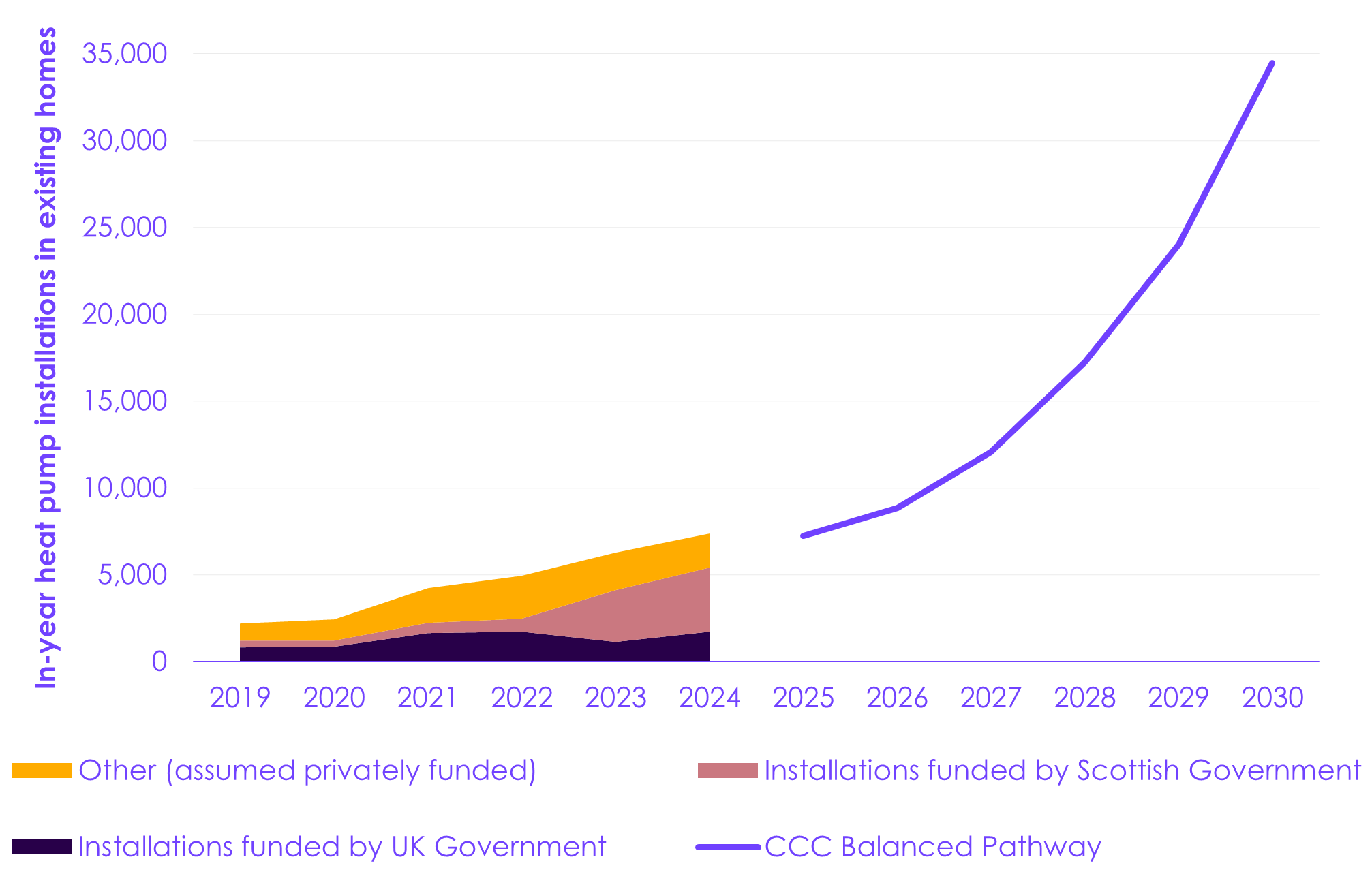 Description: Heat pump installations have grown steadily over the last five years in Scotland but need to accelerate rapidly in order to reach rates required for Net Zero. Description: Heat pump installations have grown steadily over the last five years in Scotland but need to accelerate rapidly in order to reach rates required for Net Zero.Source: Energy Savings Trust (2025) Scotland Energy Performance Certificate database; Scottish Government (2025) Heat in Buildings Progress Report 2025; Microgeneration Certification Scheme (2025) Data Dashboard; CCC analysis. Notes: (1) Installations funded by Scottish Government include installations through Home Energy Scotland and Warmer Homes Scotland funded through grants and loans. (2) Installations funded by UK Government include installations through the Energy Company Obligation and the Renewable Heat Incentive. (3) Other installations include all installations outside of these two government-funded categories, and are assumed to be private installations. |
| Figure 4.6 Historic heat pump deployment in existing homes in Scotland compared to the UK |
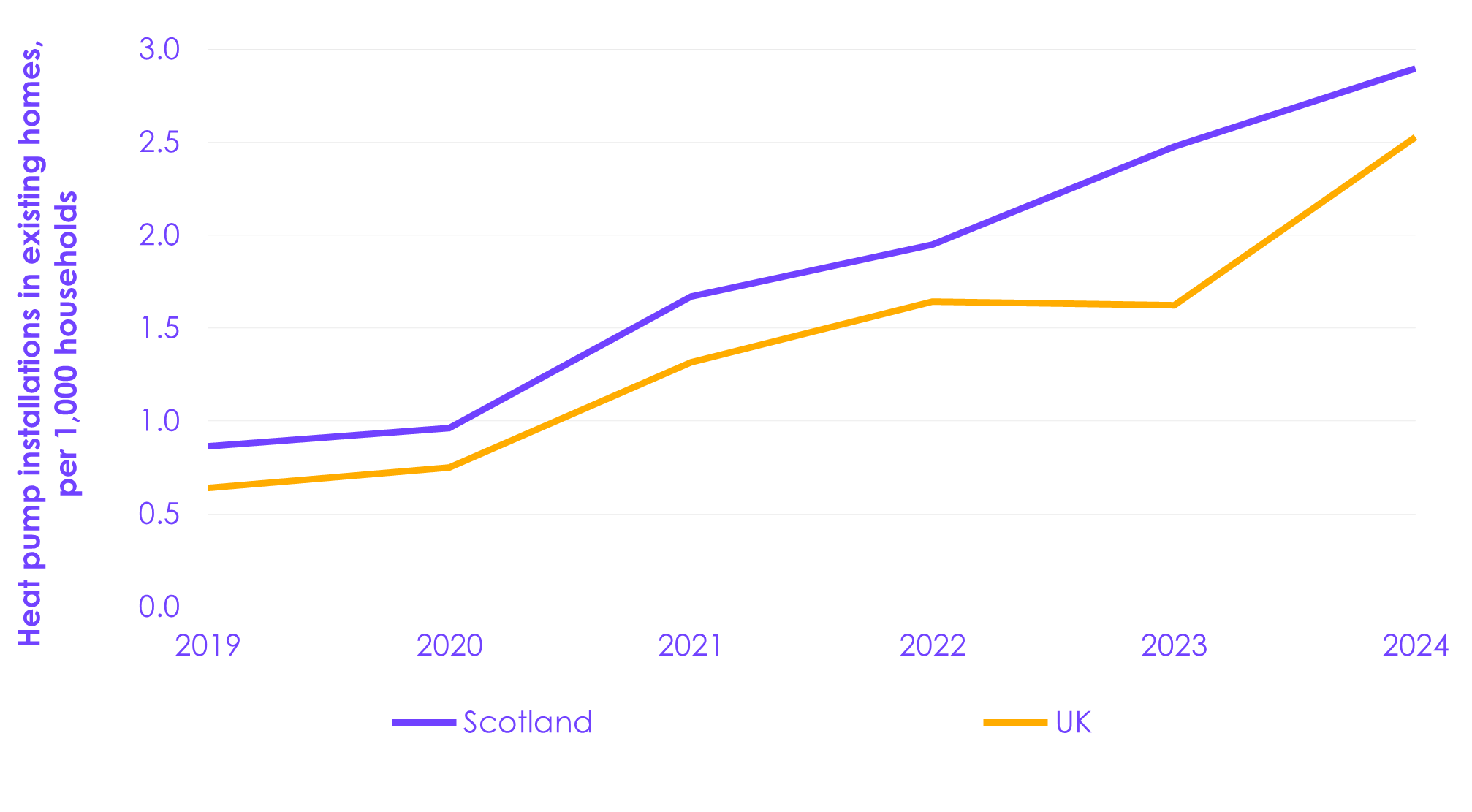 Description: Heat pump installations have grown steadily over the last five years in Scotland but need to accelerate rapidly in order to reach rates required for Net Zero. Description: Heat pump installations have grown steadily over the last five years in Scotland but need to accelerate rapidly in order to reach rates required for Net Zero.Source: Microgeneration Certification Scheme (2025) Data Dashboard; Scottish Government (2025) Scottish House Condition Survey: 2023 Key Findings; CCC analysis. |
| Figure 4.7 Proportion of new homes in Scotland with low-carbon heat, split by heating system |
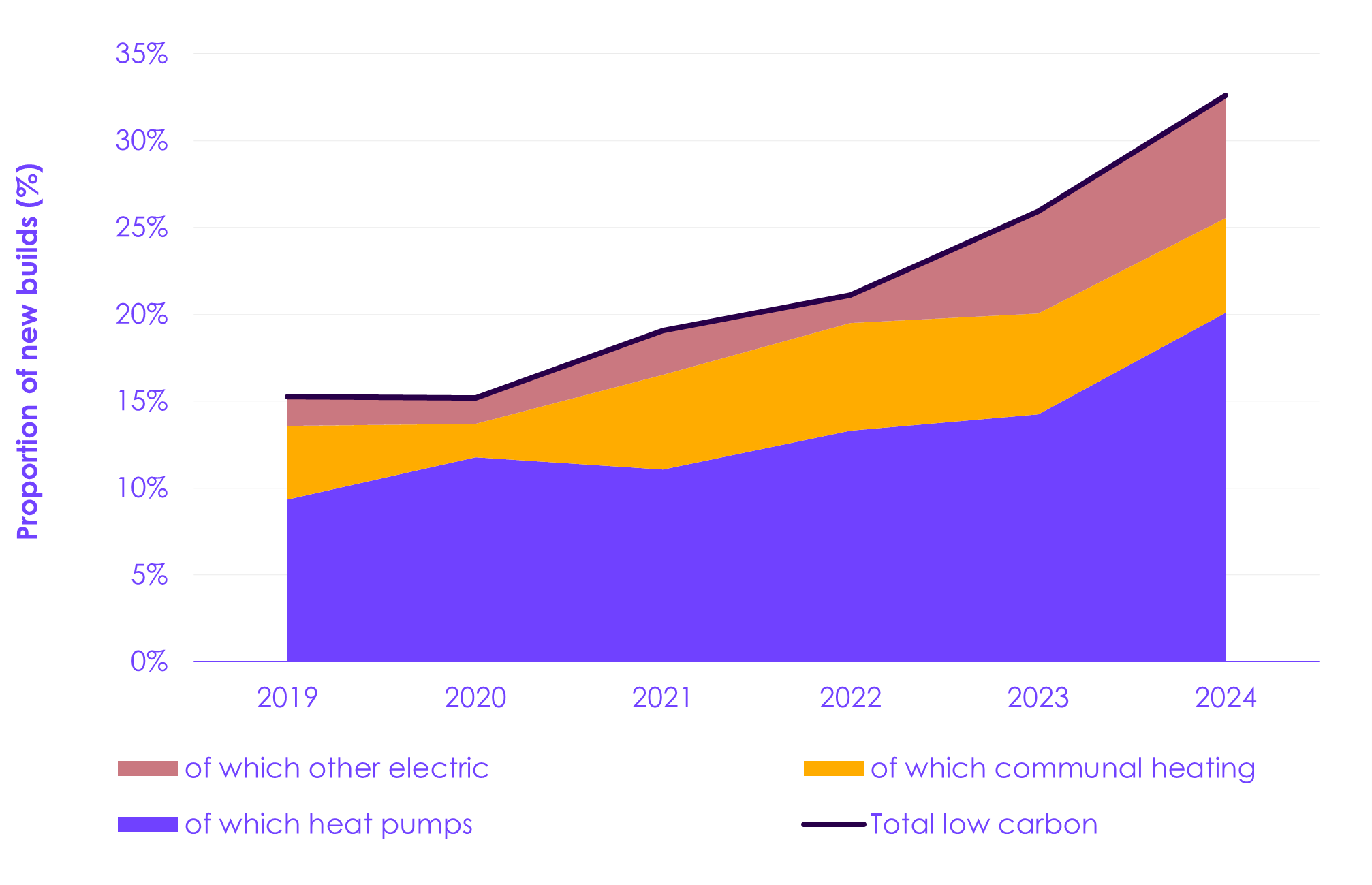 Description: The proportion of new homes built with low-carbon heating systems has been increasing over time, reaching a third of homes in 2024. |
4.2.4 Energy supply
Renewables have an essential role to play in meeting Scotland’s carbon budgets and wider UK emissions targets. Deployment of offshore and onshore wind capacity is progressing in Scotland and the Scottish Government’s 2030 ambitions remain achievable. Transmission network capacity in Scotland needs to rapidly increase to enable wider electrification across the UK.
- Variable renewables: generation from variable renewables, including onshore and offshore wind, solar photovoltaic, and hydro, increased between 2022 and 2024, and has been on an overall upward trajectory since 2010 (Figure 4.8a). Deployment of renewables will need to continue to accelerate to meet Scotland’s and the UK’s emissions and renewables targets.
- Onshore wind: between 2022 and 2024, an additional 1.3 GW of onshore wind capacity has been deployed in Scotland (Figure 4.8b), leading to 10.3 GW of installed capacity in 2024. As of 2024, 63% of onshore wind capacity in the UK was located in Scotland.
- To achieve the Scottish Government’s target of 20 GW of onshore wind by 2030, nearly 10 GW needs to be installed in the next five years, which would be a doubling of capacity. This equates to a rate of deployment approximately two and a half times higher than the average annual deployment in 2023 and 2024.
- The Scottish Government’s 20 GW target for 2030 represents 69%–74% of the UK Government’s target range for UK-wide onshore wind capacity outlined in the Clean Power 2030 Action Plan.[66]
- Projects totalling 1.1 GW of new onshore wind capacity in Scotland were successful in the UK Government’s latest Contracts for Difference allocation round.
- Offshore wind: there has been positive progress on offshore wind deployment in Scotland, with deployment in 2024 (around 1.1 GW) ahead of the CCC’s Balanced Pathway in 2025 (Figure 4.8c). Offshore wind capacity almost doubled between 2022 and 2024. Over 25% of the UK’s offshore wind capacity is in Scotland as of 2024.
- The Scottish Government currently has a target of 8–11 GW of offshore wind capacity by 2030, representing 16%–26% of the UK Government’s target range for UK wide offshore wind capacity outlined in the Clean Power 2030 Action Plan.[67];[68] Delivery in Scotland over the next five years at the average level observed in 2023 and 2024 would lead to deployment within this range. Hitting the top end of the range would require a 20% acceleration of average annual deployment observed in 2023 and 2024.
- The Scottish Government has also consulted on a new target of 40 GW of capacity by 2040. This would require a more than doubling of the annual average deployment observed in 2023 and 2024.[69]
- Projects totalling nearly 1.5 GW of new offshore wind capacity in Scotland were successful in the UK Government’s latest Contracts for Difference allocation round.
- Onshore wind: between 2022 and 2024, an additional 1.3 GW of onshore wind capacity has been deployed in Scotland (Figure 4.8b), leading to 10.3 GW of installed capacity in 2024. As of 2024, 63% of onshore wind capacity in the UK was located in Scotland.
- Transmission network: there needs to be a rapid build out of the transmission grid and an acceleration in the grid connection process, to support rapid electrification across the UK needed to achieve the UK’s 2030 Nationally Determined Contribution (NDC) and later targets. Average transmission network boundary capability stayed constant in 2023 but increased in 2024. The average transmission network boundary capability will need to almost double by 2030 (Figure 4.8d).
| Figure 4.8 Energy supply indicators |
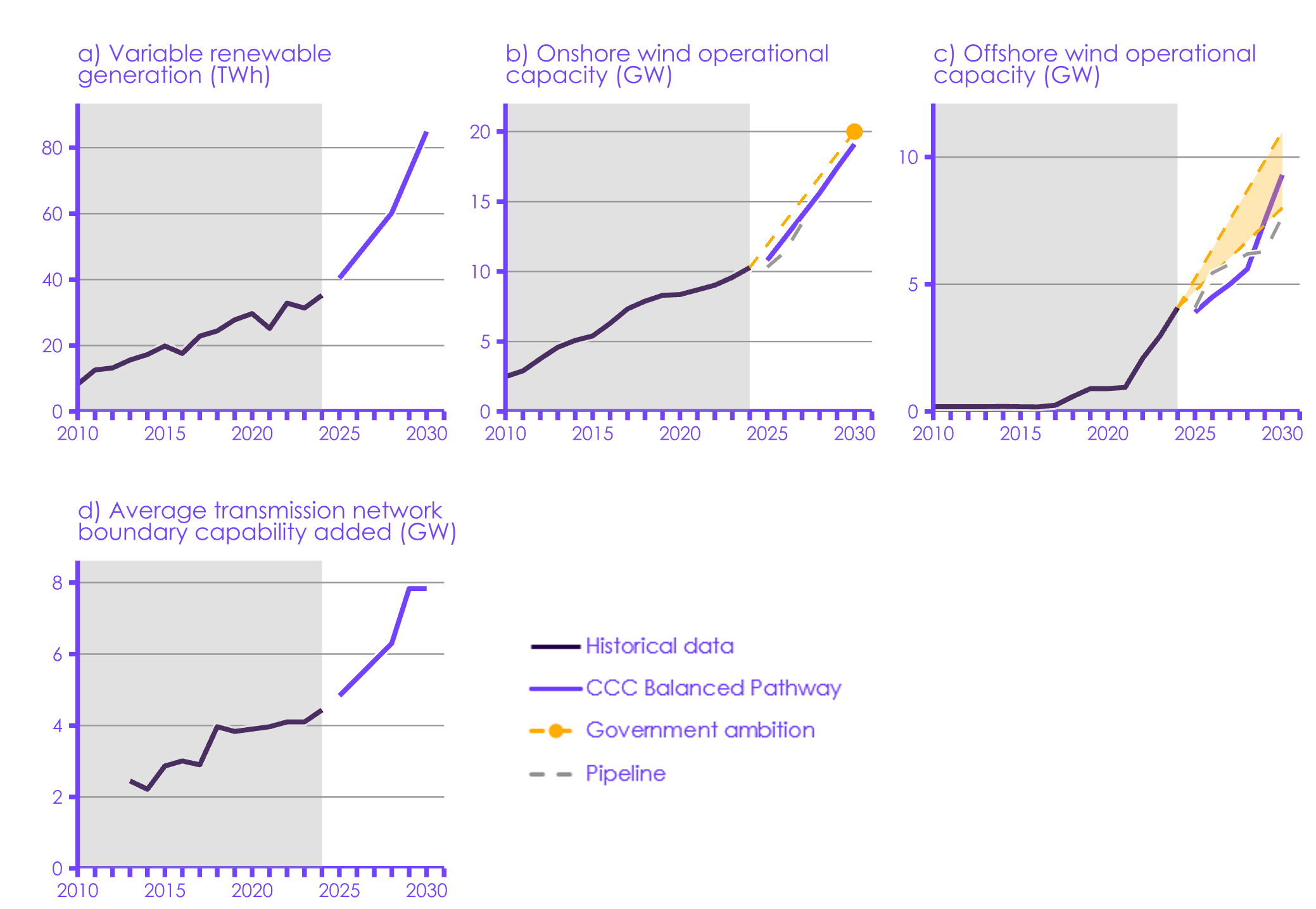 Description: Offshore and onshore wind capacity are increasing year-on-year, but deployment needs to continue to ramp up fast to achieve the Scottish Government’s ambitions. Average transmission network boundary capability stayed constant in 2023 but increased in 2024. Description: Offshore and onshore wind capacity are increasing year-on-year, but deployment needs to continue to ramp up fast to achieve the Scottish Government’s ambitions. Average transmission network boundary capability stayed constant in 2023 but increased in 2024.Source: Department for Energy Security and Net Zero (2025) Energy Trends: UK renewables; National Energy System Operator (2025) Electricity Ten Year Statement (ETYS); Scottish Government (2025) Scotland’s Draft Climate Change Plan: 2026-2040; CCC analysis. Notes: (1) Government ambition is an umbrella term encompassing stated targets, projections and modelling assumptions – and does not necessarily represent a formal commitment from the Government. (2) Dashed lines represent the linear path from the latest historical value to the Government’s ambition. (3) For charts b) and c), the pipelines represent the capacity of future projects which have signed Contracts for Difference (CfD). The pipelines could be increased in future CfD allocation rounds. (4) Chart d) shows the average capacity added to the B2, B4, and B6 transmission network boundaries. |
4.2.5 Waste management
Scotland has significantly reduced the volumes of waste sent to landfill in recent years. However, this corresponds to growth in waste incinerated via energy from waste (EfW). Household recycling rates have not improved notably for many years, which risks the delivery of emissions reduction without further action.
- Waste disposal: It is important to reduce waste both sent to landfill and incinerated via EfW.
- The volume of biodegradable municipal waste landfilled in Scotland halved from 2022 to 2024, from 0.70 Mt to 0.34 Mt (Figure 4.9a). However, the ban on biodegradable municipal waste being sent to landfill has now been postponed by two years to January 2028, to account for a gap in capacity between projected municipal waste generation and EfW capacity.
- The volume of household waste incinerated in Scotland increased by 41% from 2022 to 2024, from 0.60 Mt to 0.85 Mt (Figure 4.9b).[70] This is likely to continue to increase in the short term as new facilities come online, and in the absence of improvements in recycling.
- Recycling and waste reduction: there has been no recent progress in increasing the proportion of household waste recycled or composted, or in reducing the volume of waste generated in Scotland.
- The household recycling rate in Scotland has been between 42–46% since 2015, with a small increase of 0.8 percentage points between 2023 and 2024 and an even smaller increase between 2022 and 2023 (Figure 4.9c). This will need to increase more rapidly to keep Scotland on track moving forwards. Scotland is not expected to have achieved its target of recycling 70% of all waste by 2025.
- The volume of household waste generated increased by 0.4% from 2023 to 2024 but decreased from 2022 to 2024 (Figure 4.9d). The longer-term trend shows a gradual reduction in household waste production in Scotland of 7% between 2012 and 2024, which will need to continue.
| Figure 4.9 Waste management indicators |
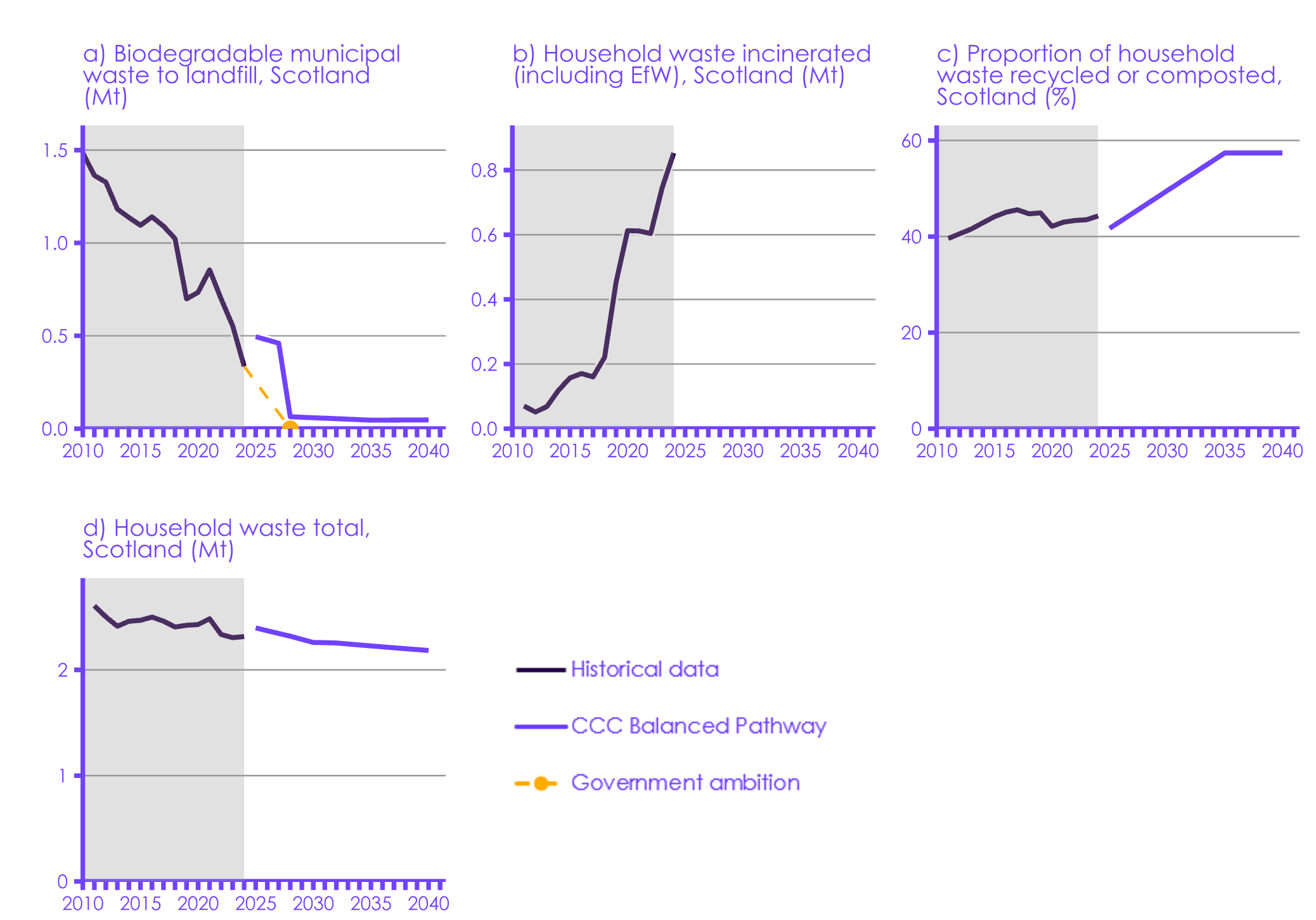 Description: There has been little change in the proportion of household waste recycled or composted. The volume of household waste incinerated has increased, including for energy from waste (EfW). The volume of biodegradable municipal waste sent to landfill has decreased. Description: There has been little change in the proportion of household waste recycled or composted. The volume of household waste incinerated has increased, including for energy from waste (EfW). The volume of biodegradable municipal waste sent to landfill has decreased.Source: Scottish Environmental Protection Agency (2025) Scottish Official Waste Statistics; Scottish Government (2025) Scotland’s Draft Climate Change Plan: 2026-2040; CCC analysis. Notes: (1) Government ambition is an umbrella term encompassing stated targets, projections and modelling assumptions – and does not necessarily represent a formal commitment from the Government. (2) Dashed lines represent the linear path from the latest historical value to the Government’s ambition. (3) Household waste refers to waste produced from households and collected by local authorities. Municipal waste is all waste collected by local authorities, including household waste and waste from businesses and public bins. Biodegradable municipal waste refers to the fraction of municipal waste, which is composed of biological matter that decomposes, e.g. food, paper and cardboard. (4) There is not direct alignment between historical data and the start of the CCC’s Balanced Pathway, because the CCC’s Balanced Pathway uses 2021 as its base year (the most recent year for which complete data for the whole of the UK was available) and assumes no progress in waste reduction or recycling from 2021 to 2025. (5) Chart a) shows the Scottish Government plan for enforcement of a ban on biodegradable municipal waste to landfill in 2028. In the draft CCP, the Scottish Government assumed this would be implemented in 2025, however the enforcement of the ban has since been delayed until 2028. In the CCC’s Balanced Pathway, we assume a near elimination of biodegradable municipal waste to landfill from 2028. (6) Chart b) shows historical data for household waste incinerated. An equivalent indicator is not available for the CCC’s Balanced Pathway, as we did not model incineration from household waste specifically. |
4.3 Cross-cutting impacts
The number of green jobs in the economy is growing. Public concern about climate change remains high. Key indicators of air quality are also improving.
- Net Zero economy: the number of green jobs in Scotland, as defined in the latest experimental statistics by the Office for National Statistics, has increased by 13% between 2022 and 2023, following a smaller decrease between 2021 and 2022 (Figure 4.10a). The largest growth was seen in the energy efficiency, low-carbon transport, waste, and renewable energy sectors.
- Public attitudes: public concern about climate change in Scotland remains high (Figure 4.10b). According to the Summer 2025 Public Attitudes Tracker, 82% of Scottish respondents were very or fairly concerned about climate change, and the 2023 Scottish Household Survey found that 74% view climate change as an immediate and urgent issue.[71];[72]
- Air quality: the concentrations of both nitrogen oxides (NOx) and particulate matter (PM10) have decreased since 2010.[73] This will have been driven by a range of factors (moving away from coal towards cleaner fuels, reduced emissions from industry, and improved emissions standards for vehicles), some of which are linked to decarbonisation efforts. As EVs and heat pumps replace petrol and diesel cars and fossil fuel boilers, there will be further improvements in air quality, with knock-on positive impacts on health.
- The concentration of NOx has approximately halved since 2010 (Figure 4.10c).
- The concentration of PM10 has declined by about a third since 2010 (Figure 4.10d).
| Figure 4.10 Cross-cutting indicators |
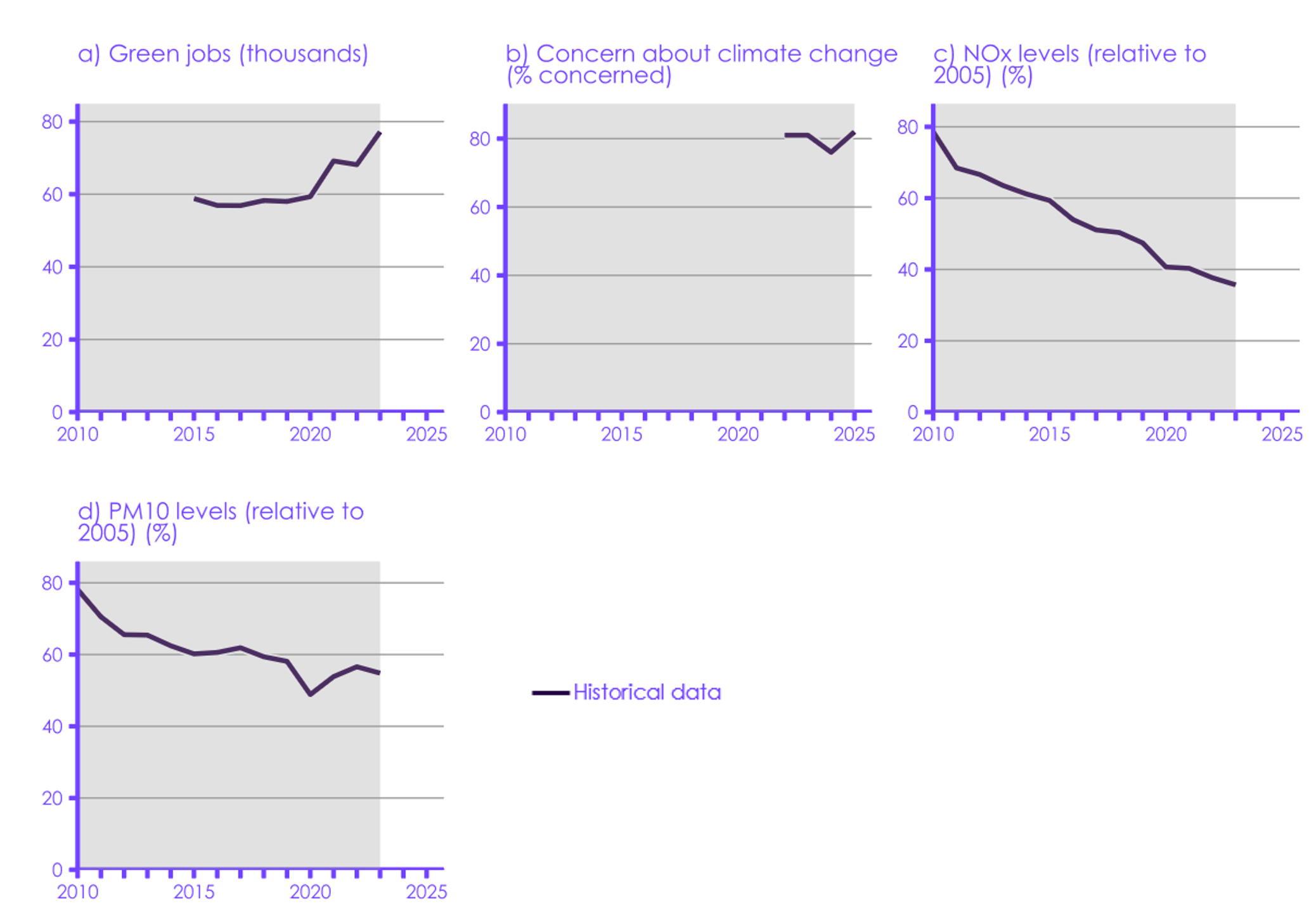 Description: Green jobs have increased in the last five years. Concern about climate change amongst the Scottish public remains high. Air quality has improved in the last fifteen years in terms of reductions in the mean concentration of nitrogen oxides (NOx) and particulate matter (PM10). Description: Green jobs have increased in the last five years. Concern about climate change amongst the Scottish public remains high. Air quality has improved in the last fifteen years in terms of reductions in the mean concentration of nitrogen oxides (NOx) and particulate matter (PM10).Source: Office for National Statistics (ONS) (2025) Estimates of green jobs, 2025; Department for Energy Security and Net Zero (2025) DESNZ Public Attitudes Tracker; National Atmospheric Emissions Inventory (2025) Air Pollutant Inventories for England, Scotland, Wales and Northern Ireland: 2005-2023. Notes: (1) It is expected that the CCC’s Balanced Pathway and the draft Climate Change Plan will lead to an increase in the number of green jobs over time, and a decrease in the concentration of NOx and PM10. However, there is no quantified pathway for these indicators. (2) For chart a), the ONS define green jobs as jobs in green industries, which include energy efficient products (including installing), repairs, renewable energy, waste, water quantity, environmental charities, and others. Some data in this dataset are provided for the UK overall (not Scotland specifically), in which case Scotland’s proportion has been estimated based on Scotland’s proportion of employment in the overall sector. (3) For chart b), ‘Concern about climate change’ is defined as people indicating that they are very concerned or fairly concerned about climate change. The number of respondents from Scotland in the Public Attitudes Tracker is relatively small, so results should be interpreted with caution. However, the data remain valuable for identifying broad trends over time, rather than precise point estimates. |
Chapter 5: Assessment of policies and plans
In this chapter, we assess the credibility of policies and plans in Scotland’s Draft Climate Change Plan: 2026-2040 (the draft CCP) to deliver the emissions reductions required to meet Scotland’s carbon budgets. We also discuss progress in developing and implementing policies over the past two years. This assessment considers policy developments since March 2024, when our 2023 Progress in reducing emissions in Scotland report was published, up until 21 January 2026, when this assessment was completed.
Our key messages are:
- There are credible plans and plans with only some risks for 91% of the emissions reductions required to meet the First Carbon Budget (2026 to 2030). This falls to 64% for the Second Carbon Budget (2031 to 2035) and 58% for the Third Carbon Budget (2036 to 2040).
- Credible plans are in place for the uptake of electric vehicles (EVs), near-term peatland restoration, further decarbonisation of energy supply, the New Build Heat Standard, and industrial decarbonisation through the UK Emissions Trading Scheme (UK ETS). Some risks exist for policies including electric heavy goods vehicle (HGV) adoption, peatland restoration expected during the Second Carbon Budget period, and UK Government policy to encourage fuel switching in industry.
- The Scottish Government is relying on emissions reductions where there are significant risks or insufficient plans in place, and on areas in which we have identified methodological concerns, particularly to meet the Second and Third Carbon Budgets.
- For the Second Carbon Budget, 36% of the required emissions savings relate to policies with significant risks, areas with insufficient plans in place, and areas of methodological concern. This increases to 42% for the Third Carbon Budget.
- The main policy area with insufficient plans in place relates to the lack of policy to decarbonise heating in buildings. There are also insufficient plans in place to decarbonise non-road mobile machinery (NRMM). The main policy areas where plans carry significant risks include the Acorn project, and therefore the delivery of carbon capture and storage (CCS) and negative emissions technologies (NETs) dependent on it; the assumption that recent energy-saving practices in buildings will be maintained; and the new industrial decarbonisation programme.
- As discussed in Chapter 3, there are some areas of methodological concern which rely on highly uncertain wider factors that put achievement of the carbon budgets at risk. These areas are the assumed inventory change for peatlands and the underlying temperature assumptions for buildings.
- Now that the Scottish Government has adopted its new system of carbon budgets and has developed a draft plan to deliver them, it is essential to make strong progress on delivery. Over the coming months, the Scottish Government will publish its final CCP as well as important new strategies and plans in a number of crucial areas, including the Heat in Buildings Strategy and Delivery Plan and the Fourth Land Use Strategy. These new documents must be used to implement the potential improvements to the draft CCP that have been identified in this report and move forward with implementing the key measures set out in the plan at pace. We have 18 priority recommendations for the Scottish Government to achieve this – these are set out in Annex 2.
5.1 Assessment of policies and plans
5.1.1 Our approach to assessing the effectiveness of policies and plans
Factors we consider in assessing government policies and plans
In this section, we analyse the risk to Scotland achieving its emissions reduction targets. We do this by assessing the credibility of the Scottish Government’s policies and plans to deliver the emissions reductions set out in the draft CCP over the first three carbon budgets.[74] See Annex 3 for more detail on our scoring criteria.
- The draft CCP lists all of the Scottish Government’s policies and plans expected to contribute to meeting Scotland’s carbon budgets, quantifying the total amount of emissions reduction that each is projected to deliver.
- The sum of these quantified policies and plans slightly exceeds the carbon budgets as the Scottish Government has considered the risk that not all policies will deliver the expected level of emissions reductions. We welcome this approach, which gives some contingency for the First Carbon Budget, but, as discussed in Chapter 3 and Section 5.1.3, for the Second and Third Carbon Budgets, the overperformance in the draft CCP pathway is less than the quantified impact of some areas in which the methodologies employed leave the pathway reliant on highly uncertain wider factors.
We have assessed policies and plans for Scotland’s first three carbon budgets, as the draft CCP covers this period.
- Our scores for each quantified area are based on our assessment of the credibility of the specified amount of abatement being delivered. In making judgements on this, we consider both confirmed policies and delivery that can be expected to occur without further policy (that is, whether it is credible that a particular solution could develop without further intervention from the Scottish Government).
- The private sector has a proven record of innovating and delivering rapid transitions in technologies and consumer choices, provided the right conditions and incentives are in place to enable this. Many low-carbon markets are already growing quickly, both in the UK and overseas, such as renewables and EVs.
- In most cases, effective delivery is likely to require both government and market action. Where technology trends are not clear and robust, policy is needed to provide confidence to investors and consumers; manage risks in new markets; remove barriers to delivery; and, in some cases, provide financial incentives. To assess our confidence in the delivery of the emissions reductions required in these areas, we assess both the policy developments set out in Section 5.2, and current and projected levels of delivery (including the indicators presented in Chapter 4).
For our assessment, we have made some technical adjustments to the published baseline to include emissions reductions that are embedded in the baseline. This means that our assessment includes all of the policies and plans required to reduce Scottish emissions from today’s levels to reach the draft CCP pathway.
- The draft CCP pathway is defined as the emissions reductions expected due to Scottish Government policies and plans included in the draft CCP. This is relative to a baseline scenario without any of the draft CCP policies and plans. However, some policy areas are reserved to the UK Government, and some emissions reductions are expected to be delivered without further policy action. Often, emissions reductions in a policy area occur due to a mixture of reserved, devolved, and private action. It is also not always clear in the draft CCP how the Scottish Government has apportioned abatement between devolved and reserved policy action.
- We have made the following technical adjustments to the baseline:
- Transport: we have included emissions reductions associated with market-led deployment of EVs and UK-wide policy to decarbonise aviation.
- Business and industrial process: we have included emissions reductions associated with UK-wide policies incentivising resource efficiency, fuel efficiency, and fuel switching.
- Residential and public buildings: we have included emissions reductions associated with the Scottish Government’s New Build Heat Standard and the assumption that recent energy-saving practices in buildings following high gas prices will be maintained.
- Energy supply: we have included emissions reductions associated with UK-wide policy to decarbonise electricity and fuel supply.
- Waste management: we have included emissions reductions arising from the reduction in biodegradable waste to landfill that has already occurred ahead of the Scottish Government’s planned ban.
- We also include the emissions savings associated with areas of methodological concern (the impact of the assumed peatland area inventory change and the effect of different underlying temperature assumptions used for buildings – see Section 3.2.2) in our assessment charts to reflect the impact they could have on meeting carbon budgets.
- We have also moved abatement associated with NRMM from the energy supply sector in the published draft CCP pathway to the sectors where the emissions savings are expected to occur (see Section 3.3.1).
Risk tolerance
Our assessment does not prescribe a specific level of acceptable risk in the Scottish Government’s plans. Some degree of risk may be justifiable where policies are expected to be deliverable, provided they are supported by contingency measures. The appropriate balance between ‘credible plans’ and those with ‘some’ or ‘significant’ risks depends on the Scottish Government’s tolerance for, and ability to mitigate, risk.
- Where higher levels of risk are deemed acceptable to the Scottish Government, it becomes especially important to have deliverable contingency plans to address potential shortfalls in delivery, and sufficient monitoring processes in place to learn from experience and improve policies as quickly as possible over time. This is particularly important for the areas of methodological concern identified in Chapter 3, as the reduction in reported emissions associated with the assumed inventory change for peatlands and the underlying temperature assumptions for buildings rely on highly uncertain wider factors.
- As technologies mature and government and industry views coalesce around an agreed vision of how the transition will be delivered, the level of risk will typically fall. Identifying the right time to provide clarity and certainty to support market development is crucial to this.
- Our priority recommendations set out the key actions to address areas in which shortfalls or risks are identified (see Section 5.3 and Annex 2).
5.1.2 Upcoming policy developments
This assessment considers policy developments since March 2024, when our 2023 Scotland progress report was published, up until 21 January 2026, when this assessment was completed. The Scottish Government has committed to publishing a number of strategies and other relevant documents in the coming months. At the time of writing, these are not yet published, so cannot directly influence our assessment of progress:
- Public Sector Fleet Decarbonisation Action Plan: the Scottish Government has consulted on a draft public sector fleet decarbonisation action plan and is due to publish the final version in early 2026.
- Fourth Land Use Strategy: this strategy will set the direction for integrated land use at the national scale and is due for publication in early 2026.
- Land Use and Agriculture Just Transition Plan: the Scottish Government has consulted on a draft land use and agriculture just transition plan and is due to publish the final version in early 2026.
- Rural Support Plan: the Scottish Government has committed to publish a rural support plan to set out how support, over the First Carbon Budget period (2026 to 2030), will deliver on the Agriculture and Rural Communities (Scotland) Act 2024 objectives, the Vision for Scottish Agriculture, the Agricultural Reform Route Map, and wider Scottish Government priorities. A new version of this plan will be published every five years.
- Heat in Buildings Strategy and Delivery Plan: the Scottish Government has committed to publish a heat in buildings strategy and delivery plan, setting out the actions required to achieve its target to decarbonise heat in buildings by 2045. This is due to be published by the end of 2026.
- Circular Economy Strategy: circular economy targets are due to be published in 2027. Under the Circular Economy (Scotland) Act 2024, the Scottish Government is required to publish a circular economy strategy and revise and republish the strategy every five years. The first circular economy strategy is due to be published in 2026.
5.1.3 Overall cross-economy assessment of the draft Climate Change Plan
The draft CCP outperforms Scotland’s first three carbon budgets but there are substantial areas in which there are significant risks or insufficient plans to deliver the required emissions reductions. As discussed in Chapter 3, there are also some areas of methodological concern which rely on highly uncertain wider factors that put achievement of the Second and Third Carbon Budgets at risk (Figure 5.1). This section provides our overall assessment of policies and plans across the economy; further details at a sector level can be found in Section 5.2 below.
First Carbon Budget (2026 to 2030)
There are credible plans and plans with only some risks in place covering 91% of the emissions reductions required to meet the First Carbon Budget. The draft CCP pathway overperforms against the First Carbon Budget, with only 72% of the policies and plans in the pathway being required to meet the target.
- There are credible plans to deliver 56% of the required emissions reductions, and some risks associated with 35% of the required emissions reductions. Credible plans are in place for policies related to the uptake of EVs, near-term peatland restoration, further decarbonisation of energy supply, the New Build Heat Standard, and industrial decarbonisation through the UK ETS.
- The remaining 9% of emissions reductions required during the First Carbon Budget period carry significant risks. These emissions reductions predominately relate to the assumption that recent energy-saving practices in buildings following high gas prices will be maintained and the new industrial decarbonisation programme.
Second Carbon Budget (2031 to 2035)
There are credible plans and plans with only some risks in place covering 64% of the emissions reductions required to meet the Second Carbon Budget. The Scottish Government is relying on emissions reductions where there are insufficient plans in place and on highly uncertain wider factors to meet the Second Carbon Budget.
- There are credible plans to deliver 44% of the required emissions reductions, and some risks associated with 19% of the required emissions reductions.[75] The areas with credible plans in place are largely the same as those assessed as credible for the First Carbon Budget.
- However, the Scottish Government is relying on areas with significant risks or insufficient plans in place, and highly uncertain wider factors that are not supported by policy levers, to deliver 36% of the required emissions savings.
- In addition to the areas with significant risks identified for the First Carbon Budget, there are significant risks associated with the Acorn project, and therefore the delivery of CCS and NETs dependent on it. There are also significant risks associated with UK-wide policy to incentivise the assumed level of resource efficiency in industry.
- There are currently insufficient plans in place to deliver the Scottish Government’s ambition to decarbonise heating in buildings, including commercial buildings in the business and industrial process sector. There are also insufficient plans in place to decarbonise NRMM.
- We have identified methodological concerns related to the assumed inventory change for peatlands and the underlying temperature assumptions for buildings, which leave the pathway relying on emissions savings that depend on highly uncertain wider factors. The emissions reductions associated with these areas during the Second Carbon Budget exceed the level of contingency included in the draft CCP pathway.
Third Carbon Budget (2036 to 2040)
The proportion of emissions reductions covered by credible plans and plans with only some risks in place reduces to 58% for the Third Carbon Budget. The Scottish Government is relying on emissions reductions where there are insufficient plans in place and on highly uncertain wider factors to meet the Third Carbon Budget.
- There are credible plans to deliver 38% of the required emissions reductions, and some risks associated with 19% of the required emissions reductions. The areas with credible plans in place are largely the same as assessed as credible for the First and Second Carbon Budgets.
- However, the Scottish Government is relying on areas with significant risks or insufficient plans in place, and highly uncertain wider factors that are not supported by policy levers, to deliver 42% of the required emissions savings.
- The areas with significant risks are the same as assessed as significant risks for the Second Carbon Budget, but these areas represent nearly twice as many emissions savings in the Third Carbon Budget. This is largely due to the scale up of NETs (see Section 3.3.1).
- The areas with insufficient plans in place are the same as assessed as insufficient for the Second Carbon Budget, but these areas represent more than four times more emissions reductions in the Third Carbon Budget. This is largely due to the ‘delay and catch up’ approach taken for buildings decarbonisation (see Section 3.3.1).
- As with the Second Carbon Budget, the emissions reductions associated with the areas of methodological concern we have identified for the Third Carbon Budget exceed the level of contingency the Scottish Government has included.
| Figure 5.1 Overall assessment of policies and plans |
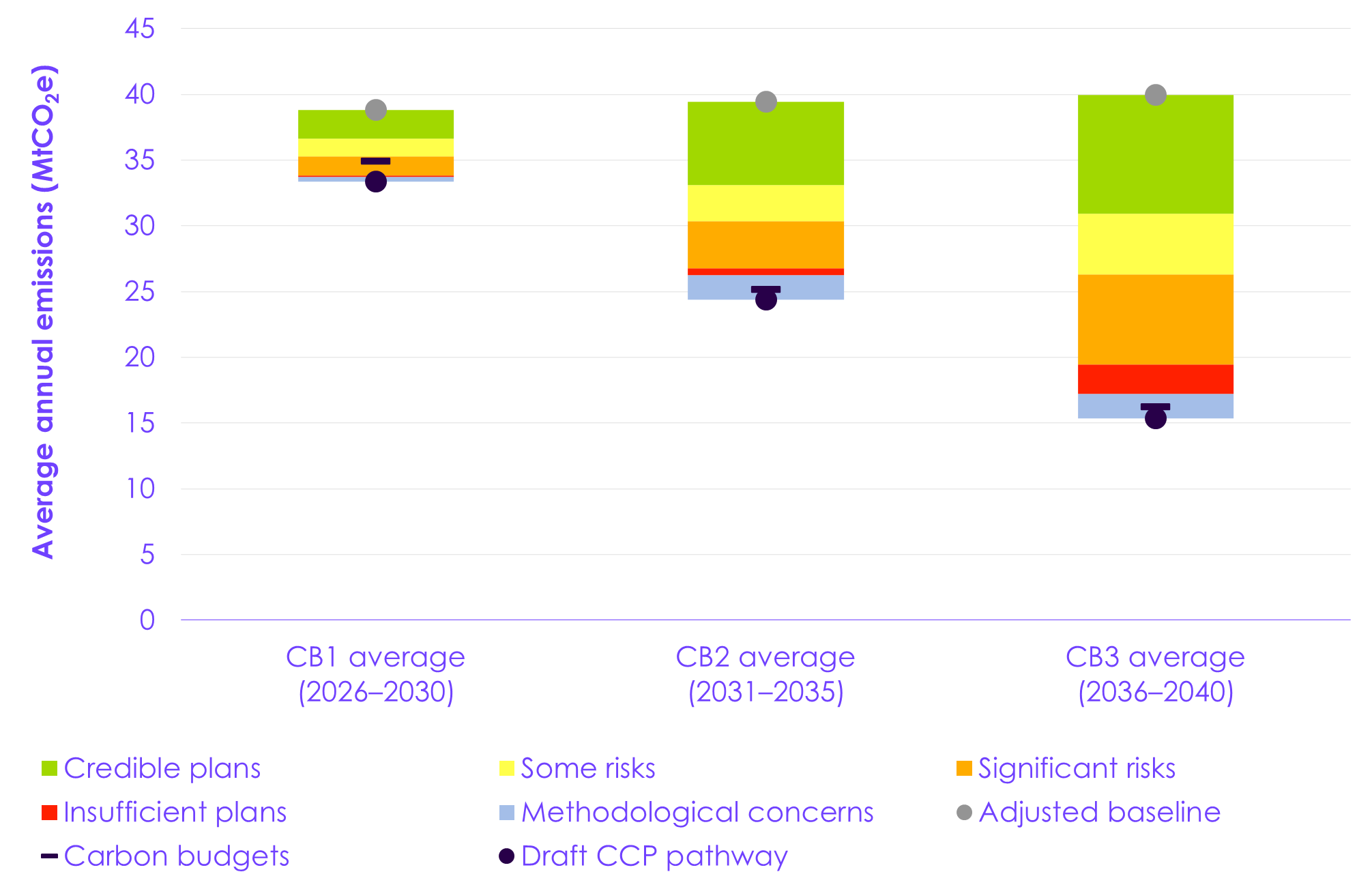 Description: Plans that are either credible or have only some risks attached are in place covering the majority of emissions reductions required to meet the First Carbon Budget. However, the Scottish Government is relying on emissions reductions where there are significant risks or insufficient plans in place, and on areas in which we have identified methodological concerns to meet the Second and Third Carbon Budgets. Description: Plans that are either credible or have only some risks attached are in place covering the majority of emissions reductions required to meet the First Carbon Budget. However, the Scottish Government is relying on emissions reductions where there are significant risks or insufficient plans in place, and on areas in which we have identified methodological concerns to meet the Second and Third Carbon Budgets.Source: Scottish Government (2025) Scotland’s Draft Climate Change Plan: 2026-2040; CCC analysis. Notes: (1) We have moved abatement from the baseline to the pathway in a number of areas to include our assessment of UK Government and private sector action. This includes emissions savings associated with the market-led deployment of electric vehicles; UK-wide policy to decarbonise aviation; UK-wide policies incentivising resource efficiency, fuel efficiency, and fuel switching; the Scottish Government’s New Build Heat Standard; the assumption that recent energy-saving practices in buildings following high gas prices will be maintained; UK-wide policy to decarbonise energy supply; and arising from the reduction in biodegradable waste to landfill that has already occurred ahead of the Scottish Government’s planned ban. (2) We also include emissions savings associated with underlying temperature assumptions used for buildings, which are an area of methodological concern, to reflect the impact they could have on meeting carbon budgets. Emissions savings associated with the peatland inventory change are already included in the draft Climate Change Plan pathway but not the baseline. (3) Areas of methodological concern refer to aspects of the draft CCP pathway where we are concerned that the modelling methodologies and assumptions are reliant on emissions savings that depend on highly uncertain wider factors. In these areas, we assess that policy levers would not be able to realise these emissions savings if these uncertain factors do not develop favourably. |
5.2 Key policy developments
5.2.1 Sectoral breakdown of key policy developments
Transport
Policy in the transport sector is partly devolved. Jointly developed by the Scottish, UK, and other national governments, the zero-emission vehicle (ZEV) mandate is the most significant policy for decarbonising cars and vans across the UK. The Scottish Government has used devolved powers to further support EV adoption in Scotland, including through targeted funding and charging infrastructure. It has also delivered several interventions to encourage modal shift while revising down its car use reduction target to one that is more credible. In shipping, devolved powers are limited to ports, harbours, inland waterways, and ferries. In aviation, Scottish Government policy powers are limited to planning and consenting regulations related to airports, airport expansions, and Air Departure Tax.
We assess that nearly all the emissions reduction associated with transport in the draft CCP is covered by either credible plans or plans with only some risk (Figure 5.2).
- Credible plans primarily support uptake of electric cars and vans, though some risks remain due to the potential use of ZEV mandate flexibilities and lower confidence in achieving the CCP pathway uptake before price parity is reached.
- There is a mix of some and significant risks associated with efforts to encourage modal shift and electric HGV adoption, as well as aviation measures including sustainable aviation fuel (SAF) uptake and fuel efficiency improvements.
- Aviation emissions abatement in the draft CCP is reliant on reserved UK Government policy, such as the SAF mandate. If emissions abatement does not increase through SAF uptake and efficiency improvements, Scottish aviation emissions are at risk of exceeding their assumed contribution to the draft CCP pathway.
| Figure 5.2 Assessment of transport policies and plans in the draft Climate Change Plan |
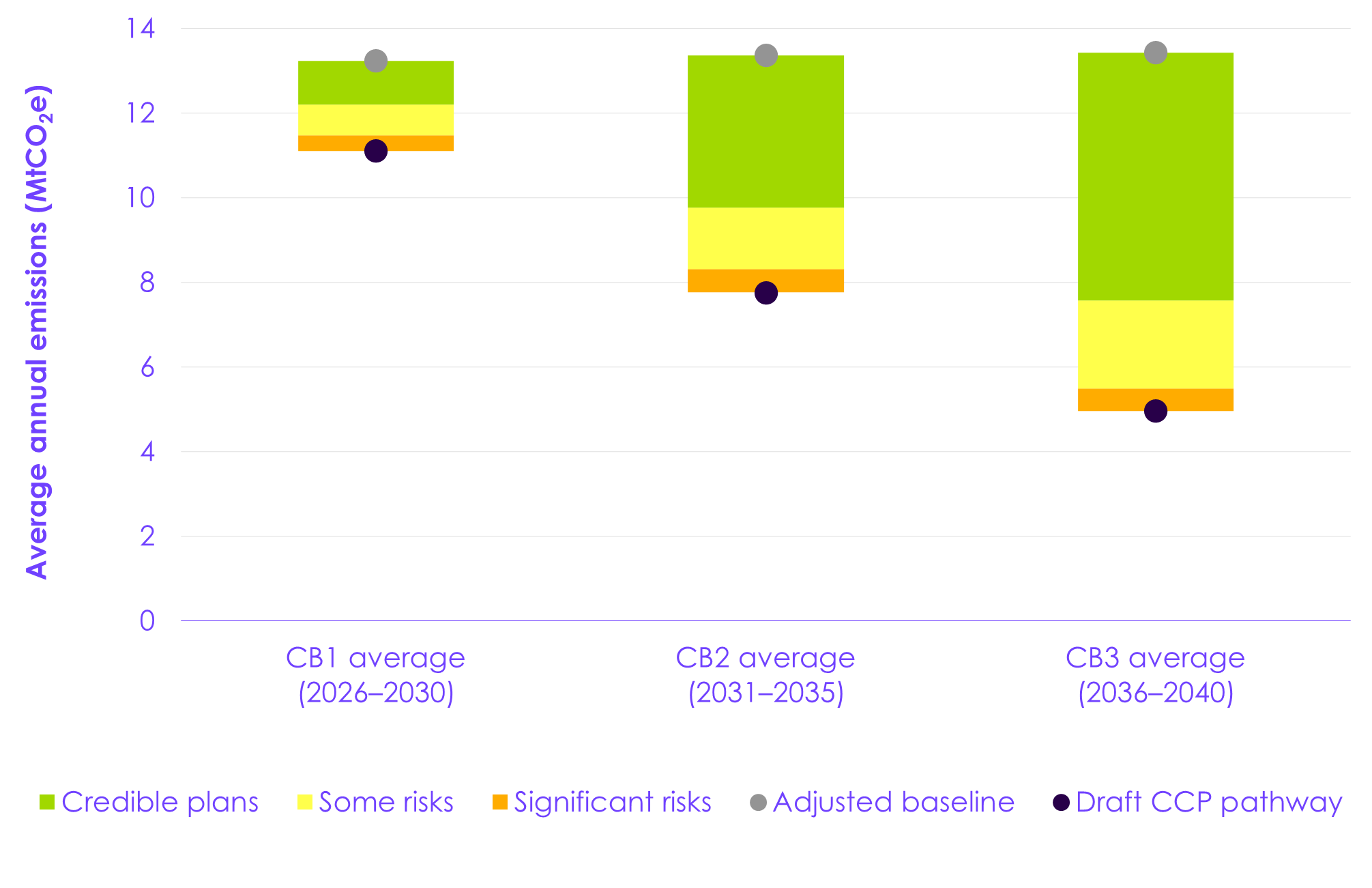 Description: Plans that are either credible or have only some risks attached are in place to deliver nearly all the abatement in the transport sector. This mostly relates to policies supporting the transition to electric vehicles. Description: Plans that are either credible or have only some risks attached are in place to deliver nearly all the abatement in the transport sector. This mostly relates to policies supporting the transition to electric vehicles.Source: Scottish Government (2025) Scotland’s Draft Climate Change Plan: 2026-2040; CCC analysis. Notes: (1) We have moved abatement from the baseline to the pathway to include our assessment of UK Government and private sector action. This includes emissions savings associated with the market-led deployment of electric vehicles and UK-wide policy to decarbonise aviation. (2) We have also moved abatement associated with non-road mobile machinery from the energy supply sector in the published draft Climate Change Plan pathway to the sectors where the emissions savings are expected to occur (transport, agriculture, business and industrial process, and residential and public buildings). |
Cars and vans
The draft CCP assumes EV uptake in line with the CCC’s Balanced Pathway, which goes beyond the ZEV mandate (see Figures 4.1a and 4.1c). EV sales in Scotland grew in 2024, reaching 12% of new car sales. Continued reductions in EV prices and growth in consumer demand are crucial to deliver this trajectory (see Figure 4.1b). The Scottish Government has supported these efforts through targeted funding, enabling infrastructure, and public engagement, which will need to continue (see Section 5.3.2).
- Funding for EVs: in addition to UK-wide EV grants, in 2025/26 the Scottish Government provided £20 million for interest-free loans to support lower-income households, small businesses, and those living in rural and remote areas to purchase used electric cars and vans.[76] The Scottish Budget 2026-27 ended funding for this scheme and instead committed increased funds to a broader programme to support low-carbon travel, including the development of new support schemes to promote EV uptake.[77]
- Expanding public charging: sustained public funding has enabled Scotland to deliver more public chargers per capita than any UK region outside London.[78] Continued action to make public charging more affordable is needed, particularly in the context of the UK Government’s proposed pay per mile charge for EVs.[79];[80]
- The Scottish Budget 2026-27 included funding for public charging, and confirmed that eligible EV charging points will receive a full exemption from non‑domestic rates for 10 years, starting on 1 April 2026.[81]
- The Scottish Government’s draft Vision Implementation Plan outlines 15 key actions to deliver Scotland’s charging network, but publication of the final plan has been delayed.[82] The UK Government’s 2025 Budget announced that it will conduct a review into the cost of public charging across the UK, reporting in 2026.[83]
- Enabling cross-pavement charging: a cross-pavement charging grant pilot worth up to £3,500 per household is available to enable access to the lower costs of home charging.[84] The results of the pilot will inform national guidance to enable home charging for the approximately 40% of households in Scotland who do not have access to off-street parking.[85]
- Informing the public: Net Zero Nation, which is Scotland’s public engagement framework for encouraging individual behaviour changes to reduce emissions, includes an information page on the benefits of EV ownership.[86]
HGVs, buses, and coaches
Given goods are moved around the UK’s internal market, HGV decarbonisation favours a UK-wide regulatory approach similar to the ZEV mandate for cars and vans. Separately, the Scottish Government is supporting the readiness for zero-emission HGVs, as well as delivery of low-carbon buses and freight modal shift.
- Regulatory mechanism for HGV decarbonisation: the draft CCP states that unified UK action on a common regulatory pathway would be the best outcome for Scotland’s transport operators. In early 2026, the UK Government opened a consultation on a regulatory framework to reduce CO2 emissions from new HGVs and phase out the sale of new non-zero emission HGVs up to 26 tonnes by 2035 and all weight classes by 2040.[87] The UK Government should work with the Scottish Government and other devolved administrations to design and implement the policy.
- Enabling modal shift and zero-emission readiness for freight: in 2025/26, £5.4 million in funding supported Freight Facilities Grants for modal shift from road to rail and water freight, an HGV Market Readiness Fund to support small and medium enterprise (SME) decarbonisation pathways and zero-emission business cases, and a Skills Challenge Fund to support heavy-duty vehicle workforce skills development and decarbonisation.[88];[89];[90];[91]
- Funding for zero-emission buses: the final round of the Scottish Zero Emission Bus Challenge Fund (ScotZEB), worth up to £45 million, will be awarded in early spring 2026. The programme has funded the delivery of hundreds of zero-emission buses and coaches, alongside charging infrastructure, with over £154 million invested by the Scottish Government since 2020.[92]
Active travel and public transport
The Scottish Government has made good progress in delivering several promising interventions to encourage modal shift but most of these are too recent to attribute any sustained changes in travel behaviour. Following a decision to revise down modal shift ambition for Scotland, the draft CCP includes further initiatives to reduce car use.
- Active travel: in the Scottish Budget 2026-27, the Scottish Government committed £40 million of funding for active travel infrastructure, which will be used to create segregated walking, wheeling, and cycling facilities; new paths connecting rural communities; improved school access; and accessibility enhancements.[93] The People and Place programme provides direct funding to Scotland’s seven Regional Transport Partnerships to deliver place-based active travel interventions. The Scottish Government’s 2023 Cycling Framework will be reviewed in 2026 to assess progress and refresh actions.
- Public transport: the Scottish Government has invested in new bus lanes and priority signals as part of the £20 million Bus Infrastructure Fund 2025/26, with increased funding announced in the Scottish Budget 2026-27.[94];[95] It has also abolished peak rail fares to encourage modal shift from car to rail; however, the pilot demonstrated only limited passenger growth.[96] In the Scottish Budget 2026-27, the Scottish Government committed £7 million to deliver a £2 bus fare cap pilot in the Highlands and Islands.[97] To improve the attractiveness of public transport, the Scottish Government is making bus service data (fares, timetables, vehicle location) publicly available from Spring 2026 and is also considering the implementation of smart ticketing.[98];[99]
- Revised target for reduced car use: the Scottish Government’s previous target to reduce car mileage levels by 20% (from a 2019 baseline) has been replaced with an ambition to achieve at least a 4% reduction (compared to a ‘business as usual’ forecast baseline). This target is more achievable and is in line with our advice, but remains under review pending the final CCP.[100] Building on the interventions above, the draft CCP sets out the following actions to deliver the target:
- A regulatory review of the Transport (Scotland) Act 2001 began in August 2025 to enable local authorities and regional transport partnerships to implement road user charging schemes if they choose. Completion is expected by early 2027.
- From September 2025, the Scottish Government is working with national, regional, and local stakeholders to develop place-based delivery plans by the end of 2027.
- A national campaign will promote the health, air quality, and environmental benefits of reduced car use.
- Rail fleet transition and electrification: the Scottish Government published its Fleet Transition Strategy which outlines how end-of-life ScotRail trains will be replaced with lower- and zero-emission trains.[101] A sustained programme of investment has delivered good progress in rail electrification in Scotland, while bringing costs down.[102] In 2025, the Scottish Government announced further electrification investment worth £342 million.[103]
Shipping
The draft CCP does not include any new shipping policy with quantified abatement. It assumes that reductions in shipping emissions largely reflect reduced activity as oil and gas production in the North Sea declines.
- While its impact is not quantified, the draft CCP does include an updated target on decarbonisation of ferries in Scottish Government ownership, aiming for 48% to be low emission by 2040.
- In 2023, the UK ETS Authority announced plans to include domestic shipping in the UK ETS to support the decarbonisation of domestic shipping, and in 2025 they announced that this inclusion would begin in July 2026.
Aviation
No new aviation policy is committed to in the draft CCP. While aviation policy is largely reserved, the Scottish Government has an important role to play in supporting aviation decarbonisation. As identified in the draft CCP, this will be through government policy such as enabling rollout of zero-emission aircraft at Highland and Islands airports, implementing the devolved Air Departure Tax, and working closely with the UK Government on aviation decarbonisation solutions.
- The Scottish Budget 2026-27 commits to implementing Scotland’s Air Departure Tax in 2027 and a Private Jet Supplement within the Air Departure Tax in 2028/29, which will introduce a higher rate of tax for private jet travel.
- Across the UK, SAF supply is increasing, and the Sustainable Aviation Fuel Bill was introduced to the UK Parliament in 2025. Significant policy gaps remain UK-wide to ensure the aviation sector takes responsibility for mitigating its emissions and ultimately achieving Net Zero for the sector by 2050. This includes paying for permanent engineered removals to balance out all remaining emissions.
Agriculture and land use
Policy in the agriculture and land use sectors is mostly devolved. There has been steady progress in the development of a post-Common Agricultural Policy in Scotland with implications for emissions reduction in the agriculture and land use sectors. Farmers are continuing to access a mix of legacy support, which includes area-based payments, whilst starting to transition to a new policy framework, with subsidies increasingly conditional on the completion of environmental audits. In land use, the highest tree planting rates since 1990 were achieved in 2023/24, before cuts to Scotland’s public forestry budget in 2024/25 led to rates almost halving the following year. Grants, advice, and capacity building for contractors and landowners have led to significant increases in annual peatland restoration. Recognising the interaction between land, its management and emissions, the Scottish Government is currently considering options for a Carbon Land Tax, with a route map to set out the framework for future tax reforms expected by Spring 2026.[104]
There are significant risks to delivery of most of the abatement in agriculture during the Second and Third Carbon Budgets. This primarily relates to a lack of detail in the Agricultural Reform Programme, with identified policies in the draft CCP focussing on high level actions or innovation (Figure 5.3).
- In the near term, there are some risks from a lack of detail regarding subsidy support available for farmers who wish to engage with the four-tier framework, introduced to replace the previous Common Agricultural Policy schemes. We assess that the risk to the emissions abatement associated with uncertainties around future agricultural support then increases to significant risks for the Second and Third Carbon Budgets.
- There is currently a lack of agricultural policy to decarbonise NRMM.[105]
- The Scottish Government includes a small decline in Scottish livestock numbers in the draft CCP baseline and pathway for agriculture, based on the FAPRI UK Trade model and reflecting long-term trends, which contributes to the decline in baseline emissions. However, it does not include proactive measures to further reduce numbers. Actions which address diet in the draft CCP are not linked with agriculture or land policy in Scotland.
- The Scottish Dietary Goals, which were set to ‘improve and support the health of the Scottish population’, would result in a 16% reduction in all meat consumption nationally if the ambition for red and processed red meat (a maximum of 70g per day per adult) were met.[106] The Scottish domestic market accounts for 29% of beef sales and 22% of sheep sales, with the majority of meat sold in the rest of the UK (see Section 4.2.2).
- Reduction of livestock numbers also releases agricultural land for carbon sequestration and provides opportunities for farms to diversify their businesses. Scotland’s land use sector will play an important role in reaching both Scotland’s and the UK’s Net Zero ambitions through its high potential for woodland creation and peatland restoration. The draft CCP does not currently set out how this will be delivered, in terms of the scale and type of land required to transition from agriculture. Policy such as the upcoming Fourth Land Use Strategy presents an opportunity to clearly integrate and align the outcomes required from agriculture and land use (see Section 5.3.2).
Actions driving current rates of peatland restoration deliver credible emissions reductions in the First Carbon Budget Period that are then maintained across the Second and Third Carbon Budgets. There are some risks associated with emissions reductions from woodland creation, and further peatland restoration action in the Second Carbon Budget period, which increase to significant risks in the Third Carbon Budget period (Figure 5.4).
- The Peatland ACTION Five Year Partnership Plan (covering 2025 to 2030), released in December 2025, addresses the support, skills and capacity required to continue upscaling rates of delivery. However, there are no plans or strategies in place to address delivery needs post-2030, which introduces some risks for future abatement.
- Actions driving current rates of woodland creation deliver emissions reductions in the Third Carbon Budget period. Increasing planting rates to reach 18,000 hectares annually by 2030 remains possible given historical precedent (see Chapter 4); however, there is no forestry strategy from 2030, and we identify some risks given previous cuts to funding rates which has affected confidence and capacity in the sector.
More than half of the projected emissions reductions from land use over the Second and Third Carbon Budgets are due to the peatland area inventory change that is assumed to take effect from 2031 in the draft CCP (see Figure 5.4). As discussed in Section 3.2.2, we have methodological concerns that this approach leaves this aspect of the Scottish Government’s pathway reliant on emissions savings that depend on highly uncertain outcomes, including the required further research being carried out and decisions on how the proposed area updates should be incorporated into the greenhouse gas inventory.
| Figure 5.3 Assessment of agriculture policies and plans in the draft Climate Change Plan |
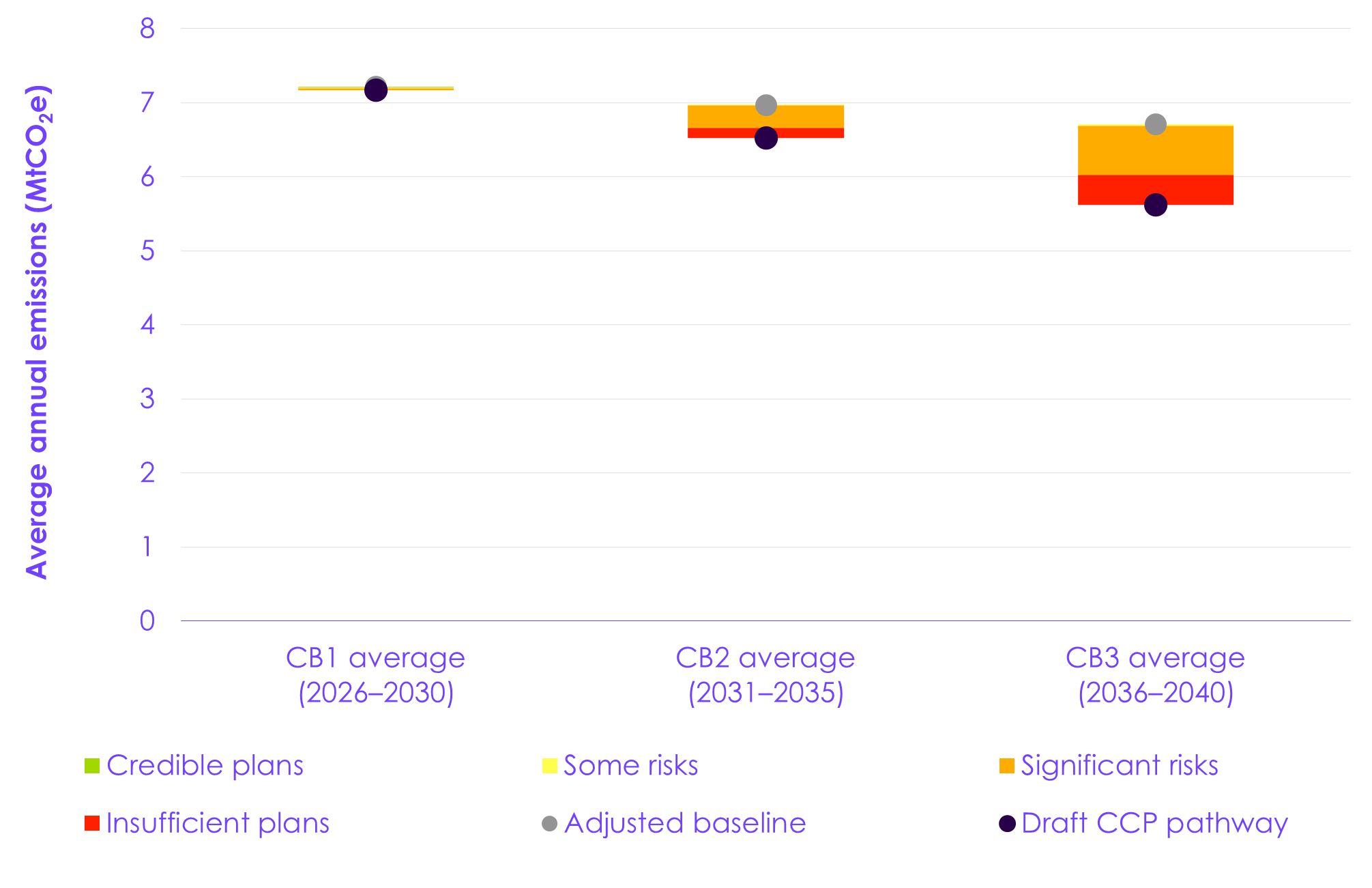 Description: There are significant risks associated with most of the abatement in agriculture during the Third Carbon Budget. This primarily relates to a lack of detail in the Agricultural Reform Programme. Description: There are significant risks associated with most of the abatement in agriculture during the Third Carbon Budget. This primarily relates to a lack of detail in the Agricultural Reform Programme.Source: Scottish Government (2025) Scotland’s Draft Climate Change Plan: 2026-2040; CCC analysis. Notes: (1) We have moved abatement associated with non-road mobile machinery from the energy supply sector in the published draft Climate Change Plan (CCP) pathway to the sectors where the emissions savings are expected to occur (transport, agriculture, business and industrial process, and residential and public buildings). (2) Agriculture emissions fall in the draft CCP baseline due to the assumption that livestock numbers will continue to fall, based on the FAPRI UK Trade model and reflecting historical trends, leading to a fall in the associated emissions. |
| Figure 5.4 Assessment of land use, land use change and forestry policies and plans in the draft Climate Change Plan |
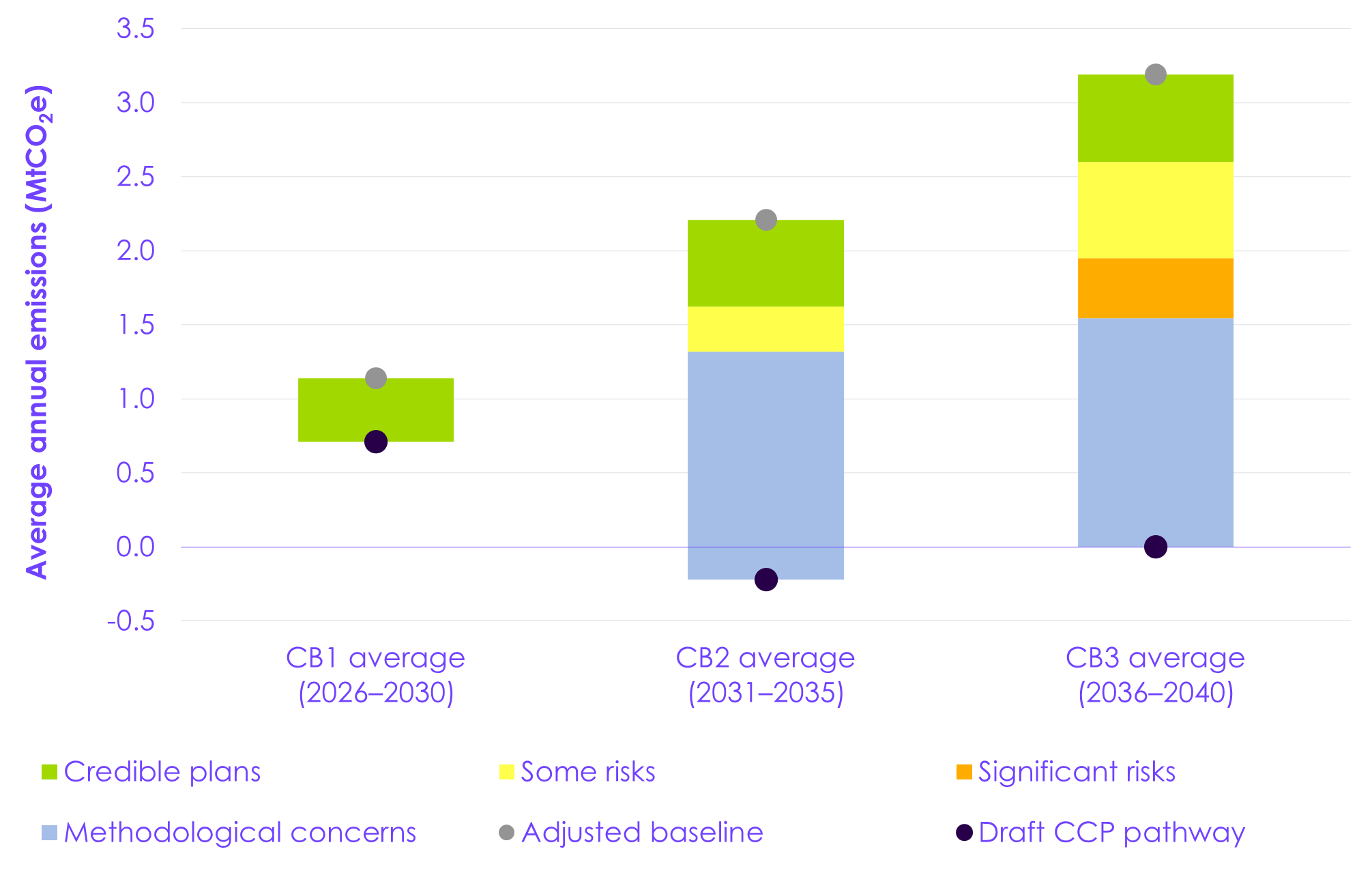 Description: Near-term peatland restoration has credible plans. There are risks with longer term action and woodland creation. There are no clear policy levers to deliver abatement associated with the peatland area correction from 2031 which delivers more than half of the expected reported emissions reductions from land use from this time onwards. Description: Near-term peatland restoration has credible plans. There are risks with longer term action and woodland creation. There are no clear policy levers to deliver abatement associated with the peatland area correction from 2031 which delivers more than half of the expected reported emissions reductions from land use from this time onwards.Source: Scottish Government (2025) Scotland’s Draft Climate Change Plan: 2026-2040; CCC analysis. Notes: (1) Baseline emissions rise over the course of the carbon budgets due to low historical tree planting rates causing the forest sink to decrease. The draft Climate Change Plan baseline also assumes that current land use actions, such as tree planting or peatland restoration, do not continue. (2) Areas of methodological concern refer to aspects of the draft CCP pathway where we are concerned that the modelling methodologies and assumptions are reliant on emissions savings that depend on highly uncertain wider factors. In these areas, we assess that policy levers would not be able to realise these emissions savings if these uncertain factors do not develop favourably. |
Productivity and low-emissions farming
The Scottish Government has prioritised increased uptake of low-emissions farming approaches, efficiency improvements, and on-farm technology and innovation in its approach to reduce direct emissions from the agriculture sector, with £197 million allocated in the Scottish Budget 2026-27. Despite the establishment of the Agriculture Reform Programme, there continues to be uncertainty regarding the levels of future agricultural support available to Scotland’s farmers and crofters.
- The Scottish Government’s Agricultural Reform Route Map sets out that at least 50% of future agriculture funding will be allocated to nature restoration and climate mitigation and adaptation. However, the list of actions available to farmers and land managers is not yet finalised and payment rates have not been communicated to the sector.[107]
- The Whole Farm Plan was introduced in 2025, requiring farmers in receipt of the Basic Payment Scheme support to complete at least two relevant assessments from a list of five audits.[108];[109] This is intended to provide a baseline from which efficiencies can be identified with potential emission reduction or biodiversity benefits. However, there is currently no requirement for farmers to act on the audit outcomes.
- In 2025 and 2026, the voluntary Scottish Suckler Beef Support Scheme (SSBSS) made support conditional by stipulating a maximum calving interval of 410 days or less, for the calf to be eligible for SSBSS payment.[110] These changes aim to encourage beef farmers to reduce the emissions intensity of production, as well as increasing financial efficiency.
- The Future Farming Investment Scheme, which allocated £21.4 million for capital items to improve efficiency or support nature and climate actions on-farm, was over-subscribed with 1,700 of around 7,500 applications receiving funding. The scheme is expected to return in 2026.
- A five-year Rural Support Plan (2026 to 2030), intended to set out a strategic vision for rural Scotland, was originally expected before the end of 2025 but is now expected before March 2026. The plan should set out details of farming, forestry, and rural development support.
Trees and woodland
Scotland leads the planting of new woodlands and forestry in the UK. Following an increase in funding in 2023/24 which led to significant growth in planting rates, the 2024/25 Forestry Grant Scheme (FGS) saw funding cuts of 41% (£32 million) leading to a drop in planting of 44% from 15,000 hectares to 8,500 hectares (see Section 4.2.2).[111] Scotland is therefore expected to have missed its previous target, set in 2020, to reach annual planting rates of 18,000 hectares by 2025.[112]
- The FGS has a budget of £53 million for 2025/26, an increase of £7.6 million on 2024/25 levels but still a reduction of 13% on 2023/24 levels.[113] Around 10,000 hectares of new planting is projected for 2025/26, including 4,000 hectares of native woodland.
- Woodland creation ambition in the draft CCP reflects these changes, as does the increased funding allocation to £58.7 million for woodland grants in the Scottish Budget 2026-27.
- If the 2025/26 planting ambition is achieved, and funding is continued, then Scotland will be on track to reach the new target of planting 18,000 hectares of new woodland each year by 2030.
- The high rates of planting achieved before cuts to the FGS demonstrate that availability of sufficient funding can drive growth in the forestry sector. However, despite the recent increases in funding, confidence in the forestry sector remains low, particularly in the wider supply chain. Clear multi-year funding commitments will be needed to rebuild confidence in the sector. Stop-start funding leads to uncertainty and damages supply chains.
- Alongside expansion of woodlands, there is support for agroforestry and farm woodlands via capital and maintenance grants under the FGS, as well as advice and guidance via the Integrating Trees Network. Despite the level of support, uptake is reported to be low with uncertainty regarding post-CAP agricultural scheme design and levels of future payment rates cited as key reasons.[114]
Peatland restoration and protection
Peatland restoration has started to rapidly increase in Scotland, reflecting the work done by the Scottish Government and Peatland ACTION to enhance delivery through building contractor capacity and reducing supply-side constraints. The highest peatland restoration rates to date were reported for 2024/25, with 14,900 hectares of degraded peatlands brought under restoration management (see Section 4.2.2).[115] The 2025/26 Programme for Government sets a target to achieve at least 12,000 hectares of restoration in 2025/26.[116]
- The Peatland ACTION Five Year Partnership Plan was published in December 2025.[117] The Plan highlights skills shortages and the need for stronger retraining policies, including expanding apprenticeships and embedding peatland restoration skills into land management courses.
- A carbon contract pilot to de-risk restoration will be trialled from 2026/27 by allowing selected applicants to forward-sell carbon credits to the Scottish Government at a fixed price, in exchange for partial grant funding.
- Plans to consult on a new Peatland Standard in 2026, a technical framework to guide and promote peatland protection, restoration, and management, have also been announced.
- Following a successful pilot scheme, Peatland ACTION launched the Project Development Support Scheme in May 2025, which aims to grow the restoration project development industry and will run for three years.[118]
- Agents will be paid per hectare of restoration and experienced agents will be expected to deliver a minimum of 250 hectares as a single or set of projects.
- New agents will be eligible for mentoring and support, with the aim to upskill and increase capacity of the industry in Scotland on the condition of developing at least one application of at least ten hectares.
- The plan to phase out the use of peat in horticulture was announced in the 2019/20 Programme for Government. While work has begun to explore potential alternatives to peat, action to ban its use has not progressed. Also delayed is the requirement for muirburn licence (for example, controlled burning of vegetation), legislation for which was introduced by the Wildlife Management and Muirburn (Scotland) Act in 2024. This is now expected in Autumn 2026.[119]
Energy crops
The Scottish Government has published analysis of the responses to the consultation on the draft bioenergy policy statement.[120] While the draft consultation explored the role of perennial energy crops as a domestically sourced feedstock, there continues to be no policy or incentives for the expansion of these crops in Scotland.
Business and industrial process
Policy in the business and industrial process sector is mostly reserved. This includes policy measures to reduce industrial electricity prices – a key enabler of industrial electrification – as well as industrial carbon capture and storage (CCS) policy, which is largely reserved to the UK Government but which the Scottish Government plans to continue supporting. The UK ETS is run jointly by the UK Government, Scottish Government, Welsh Government, and Northern Ireland’s Department of Agriculture, Environment and Rural Affairs. The Scottish Government has devolved levers over efficiency and heating measures in commercial buildings.
There are significant risks associated with most of the emissions reductions in the business and industrial process sectors (Figure 5.5).
- Significant risks relate to industrial carbon capture via the Acorn project and a new industrial decarbonisation programme that is still at the proposal stage.
- The draft CCP pathway assumes limited reductions in emissions from heating commercial buildings in the near term, before these ramp up significantly during the Third Carbon Budget period. We assess that there are currently insufficient plans to deliver the scale-up in low-carbon heating required to deliver this, beyond plans for commercial heat networks, which have some risks.
- Delivering the draft CCP pathway will also require emissions reductions from UK-wide actions. Among these, we assess that there are credible plans to deliver abatement attributed to hydrogen fuel-switching and the UK ETS, there are some risks to the abatement the Scottish Government has assumed will be achieved from UK Government policy to encourage fuel switching, and there are significant risks associated with the level of emissions reduction from industrial resource efficiency that the Scottish Government has assumed UK Government policy will deliver.
| Figure 5.5 Assessment of business and industrial process policies and plans in the draft Climate Change Plan |
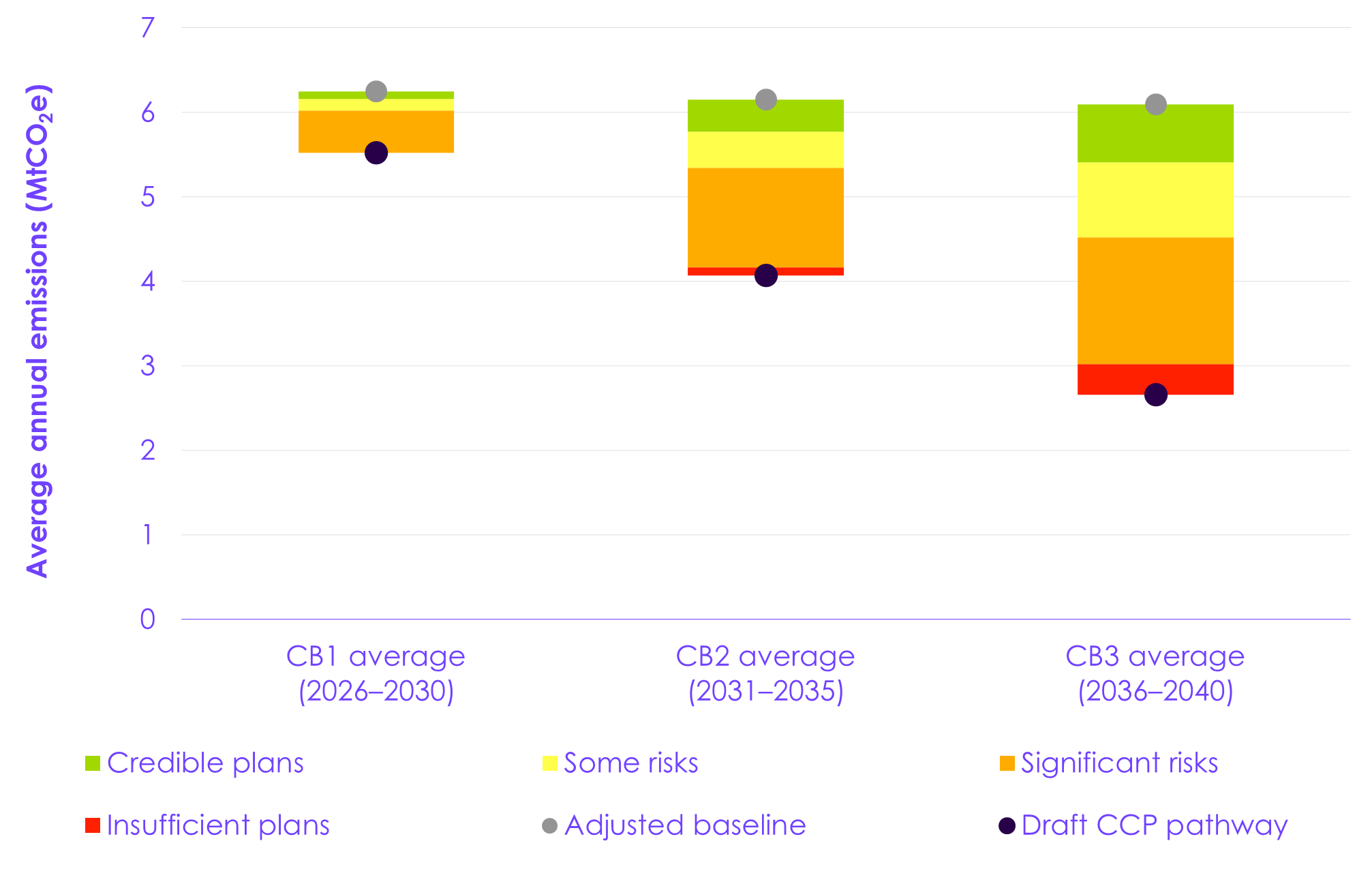 Description: There are significant risks associated with most of the abatement for the business and industrial process sectors. This includes the Acorn project and a new industrial decarbonisation programme that is still at the proposal stage. Description: There are significant risks associated with most of the abatement for the business and industrial process sectors. This includes the Acorn project and a new industrial decarbonisation programme that is still at the proposal stage.Source: Scottish Government (2025) Scotland’s Draft Climate Change Plan: 2026-2040; CCC analysis. Notes: (1) We have moved abatement from the baseline to the pathway to include our assessment of UK Government and private sector action. This includes emissions savings associated with UK-wide policies incentivising resource efficiency, fuel efficiency, and fuel switching. (2) We have also moved abatement associated with non-road mobile machinery from the energy supply sector in the published draft Climate Change Plan pathway to the sectors where the emissions savings are expected to occur (transport, agriculture, business and industrial process, and residential and public buildings). |
Industry
The Scottish Government’s plan for reducing industrial emissions relies on three main policies. The most significant is the proposed industrial decarbonisation programme, though the Scottish Government is yet to provide details about this. The other two key areas are the UK ETS and CCS policy.
Much of the emissions reduction through the UK ETS and the industrial decarbonisation programme is expected to be achieved through fuel switching. The draft CCP does not quantify this but does note that the programme ‘will aim to unlock significant industrial electrification opportunities’.[121] The draft CCP also assumes that the UK Government will deliver additional emissions reductions through policies to incentivise fuel switching and industrial resource efficiency.
- Electrification: in our 2025 Scotland’s Carbon Budgets advice, we advised that electrification is the primary route to decarbonise the sector. However, this requires UK Government action to address substantial barriers, in particular the high cost of electricity. The expected closure of the Scottish Industrial Energy Transformation Fund in March 2026 will remove the only current support to electrify Scottish industry. The Scottish Government has indicated that, starting in 2026, its proposed industrial decarbonisation programme will incentivise industrial electrification. However, this is currently only a proposal with no detail.
- Industrial CCS: the Scottish Government is working with the UK Government to accelerate the development of the Acorn project and the wider Scottish Cluster, for example via the Acorn Ministerial Forum and Acorn Operational Group (Box 5.1).
- The Scottish Government has committed £80 million to develop the Acorn project, though it is unclear when these funds will be spent or what they will be spent on.[122]
- As some potential Acorn customers have recently ceased operating, the Scottish Government will need to work with the UK Government to ensure there is enough demand to make the cluster viable. The UK Government has provided £120 million to sustain operation of the ethylene plant at Grangemouth, which should mitigate some of this risk.[123]
- Low-carbon hydrogen: the Scottish Government supports the development of a low-carbon hydrogen sector in Scotland (see the section below on energy supply). It has provided £3.1 million towards the development of a green hydrogen hub in Speyside, which plans to provide hydrogen fuel to over 40 industrial sites including whisky distilleries.[124]
- Grangemouth: the Scottish and UK Governments co-funded the Project Willow study, which identified low-carbon industrial opportunities for Grangemouth. The two governments are now co-chairing the Grangemouth Investor Taskforce with the aim of progressing the most viable opportunities. The Scottish Government has allocated £25 million in potential funding to support businesses to develop investible propositions for the site.
- Resource efficiency: Scotland’s circular economy route map includes proposals to reduce embodied emissions in the construction sector by promoting circular practices, such as greater refurbishment and reuse.[125] This could enable some emissions reduction from resource efficiency, in the absence of UK policy in this area.
| Box 5.1 The role of the Acorn project |
|
CCS is central to the draft CCP pathway. Acorn plans to provide the transport and storage (T&S) infrastructure for the Scottish Cluster, which will also include CCS customers across Scotland and a CO2 pipeline connecting Acorn to central Scotland. It is given as the underpinning for several critical pillars of the draft CCP:
Acorn could leverage Scotland’s advantages: existing oil and gas infrastructure, a skilled workforce, and vast geological storage capacity in the North Sea. However, while the UK Government has awarded the Acorn project and wider Scottish Cluster £200 million in funding to support project development, delivery depends on success via the UK Government’s cluster sequencing programme and on a positive final investment decision.[126] The UK Government is responsible for developing CCS business models and funding for T&S infrastructure, which, from the perspective of the Scottish Government, introduces uncertainty and a degree of risk around a decarbonisation approach that relies on this infrastructure. |
Commercial buildings
The Scottish Government has set a target to decarbonise heating systems in buildings by 2045, but the strategy for meeting this target is currently unclear. The planned Heat in Buildings Strategy and Delivery Plan must urgently address this. Further details that are also relevant to commercial buildings can be found in the following section on residential and public buildings, including the New Build Heat Standard, consideration of minimum energy efficiency standards, and policies to support the development of heat networks. The Scottish Government currently provides advice, loans and cashback grants to SMEs implementing energy efficiency and renewable heating measures.
Residential and public buildings
Policy in the residential and public buildings sector is mostly devolved, including planning and building regulations, energy efficiency and low-carbon heating schemes, and policy to address fuel poverty. However, policy to adjust the taxes and levies that apply to energy bills – a key enabler of the transition to low-carbon heating – is reserved to the UK Government.
We assess that there are significant risks or insufficient plans attached to the majority of the emissions reductions from residential and public buildings. This is primarily due to the lack of a long-term strategy for meeting the 2045 target for decarbonising buildings (Figure 5.6).
- The draft CCP pathway assumes limited emissions reduction from buildings over the First and Second Carbon Budgets, with the pace assumed to increase significantly over the Third Carbon Budget. As discussed in Section 3.3.1, this ‘delay and catch-up’ approach carries significant risk.
- This approach would do little to build on current progress, and then would rely on rapid expansion of low-carbon heating supply chains and growth in consumer demand in the middle of the next decade.
- A more credible approach would be to build on, and accelerate, the recent steady increase in heat pump installations. Achieving this will require faster growth of the low-carbon market in the period from 2025 to 2035 than has been modelled in the draft CCP.
- Based on the positive growth in heat pump installations in existing homes seen over recent years (see Section 4.2.3), we assess that a portion of the required market scale-up can be delivered with only some risks. However, a delivery plan and long-term policy are not yet in place, which means that the majority of the transition to low-carbon heating currently carries significant risks or insufficient plans.
- There are some risks associated with a lack of detail on how to deliver expected heat network deployment and significant risks associated with the measures required to maintain recent falls in energy use in a sustainable way (see Section 3.2.2).
- There are credible plans in place for around 10% of emissions reductions, delivered by eliminating the use of fossil fuels in new buildings.
As discussed in Section 3.2.2, we have methodological concerns about the use of 2023 emissions as a starting point for the draft CCP baseline without adjusting for temperatures (see Figure 5.6).
| Figure 5.6 Assessment of residential and public buildings policies and plans in the draft Climate Change Plan |
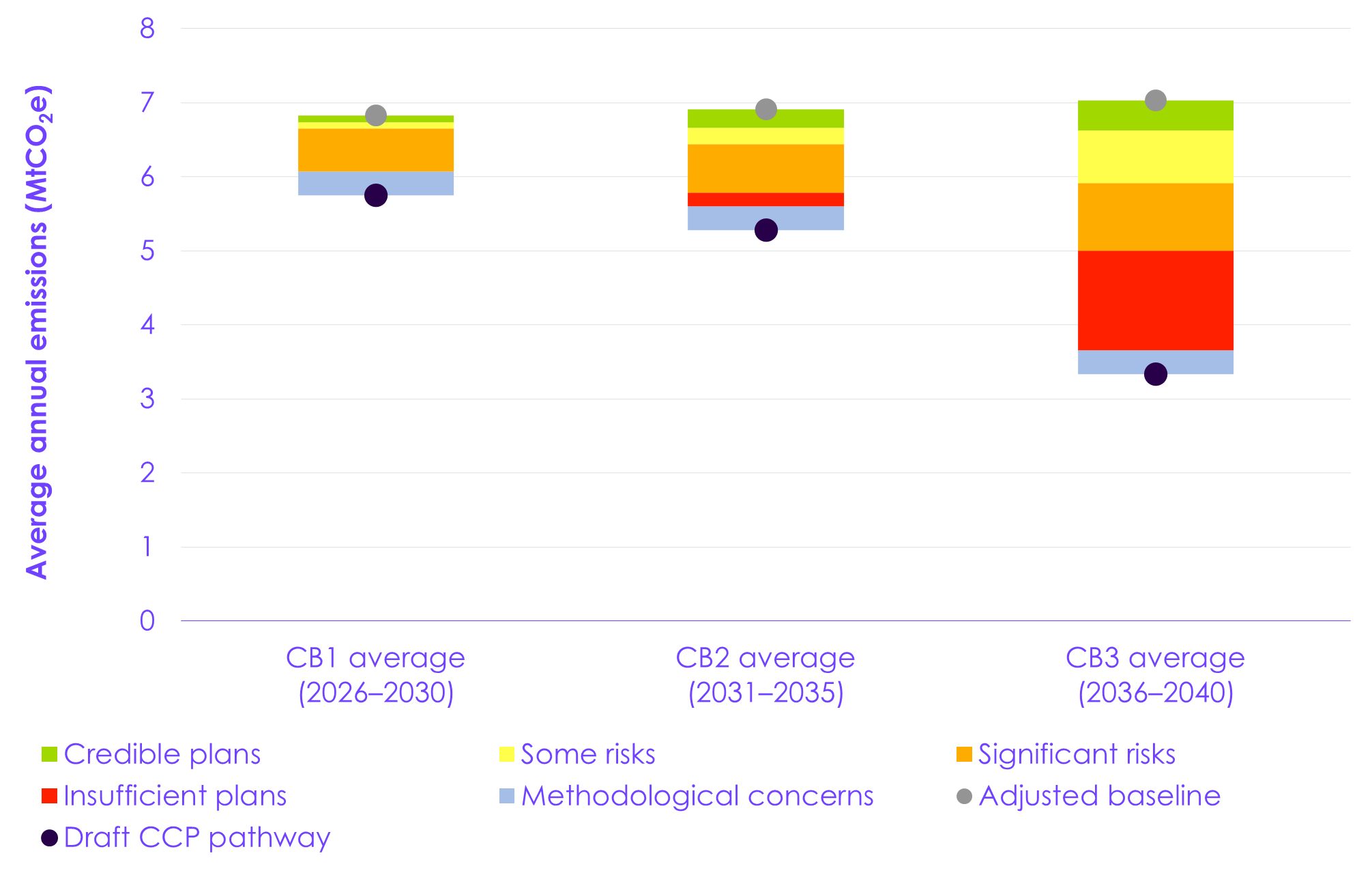 Description: We assess that there are significant risks or insufficient plans attached to the majority of the emissions reductions from residential and public buildings. This is primarily due to the lack of a long-term strategy for meeting the 2045 target for decarbonising buildings. Description: We assess that there are significant risks or insufficient plans attached to the majority of the emissions reductions from residential and public buildings. This is primarily due to the lack of a long-term strategy for meeting the 2045 target for decarbonising buildings.Source: Scottish Government (2025) Scotland’s Draft Climate Change Plan: 2026-2040; CCC analysis. Notes: (1) We have moved abatement from the baseline to the pathway to include our assessment of emissions savings associated with the Scottish Government’s New Build Heat Standard and the assumption that recent energy-saving practices in buildings following high gas prices will be maintained. (2) We also include emissions savings associated with underlying temperature assumptions used for buildings, which are an area of methodological concern, to reflect the impact they could have on meeting carbon budgets. (3) We have also moved abatement associated with non-road mobile machinery from the energy supply sector in the published draft Climate Change Plan pathway to the sectors where the emissions savings are expected to occur (transport, agriculture, business and industrial process, and residential and public buildings). (4) Areas of methodological concern refer to aspects of the draft CCP pathway where we are concerned that the modelling methodologies and assumptions are reliant on emissions savings that depend on highly uncertain wider factors. In these areas, we assess that policy levers would not be able to realise these emissions savings if these uncertain factors do not develop favourably. |
Low-carbon heat
The Scottish Government has a target to decarbonise heating systems in all buildings where ‘reasonable and practicable to do so’ by 2045. However, policies and plans to deliver the scale-up in low-carbon heating installations required to meet this target are currently missing.
- Low-carbon heating in existing homes: grants and loans available through the Home Energy Scotland scheme are currently supporting the low-carbon heating market. But funding for these is not confirmed beyond this financial year, and long-term delivery plans are not yet in place to build on this to accelerate market growth.
- The Scottish Government provides generous grants and additional interest-free loans to households for installing low-carbon heating. These apply across all tenures of housing and in the public sector.
- Funding for households is available through the Home Energy Scotland grant and loan scheme. Loans are available for a range of decarbonisation measures. Grants of up to £7,500 are available for a narrower range of low-carbon heating and energy efficiency measures, with a further £1,500 for rural households. This means households in Scotland can obtain grant funding of up to £18,000 per household, which is more generous than the England and Wales Boiler Upgrade Scheme, and supports energy efficiency and low-carbon heating measures in a joined-up way.
- Funding is available for public sector bodies under the Green Public Sector Estate Decarbonisation Scheme. This scheme is expected to continue to 2030, although the funding level has not been committed.
- The Scottish Budget 2026-27 confirmed £335 million of funding to extend support to households and businesses for low-carbon heating and energy efficiency into the coming financial year. However, the Scottish Government has yet to confirm that this will be used to continue existing grant schemes and has not yet set out plans for continued funding beyond this. Projected emissions reductions in the First Carbon Budget period are reliant on government funding. To deliver these reductions, the Scottish Government will need to commit to the expenditure required or put in place alternative policies.
- Delivering the transition to low-carbon heating will require a credible strategy – such as a combination of regulations and financial support – to grow the low-carbon heating market and incentivise households to make this transition (see Section 5.3.2).
- The Scottish Government has responded to the reports produced by the Green Heat Finance Taskforce, setting out the steps it will take to act on the Taskforce’s recommendations.[127] Along with specific recommendations, the reports highlighted the need for long-term policy clarity and investment, and effective regulation to stimulate demand for retrofits and so develop the market for finance.
- On 21 January 2026, the UK Government published its Warm Homes Plan. This includes steps announced at the Budget to remove some levies from energy bills. This is a positive step forward, however the ratio of electricity to gas prices remains high, meaning that many properties will not yet be able to see the benefits of reduced running costs from heat pumps, which are a highly efficient technology. A full assessment of the Plan will be included in our 2026 UK progress report.
- Low-carbon heating in new builds: the New Build Heat Standard was introduced in 2024 and means that new buildings can no longer use fossil fuel heating systems as their main heating system.[128] The standard applies to building warrant applications made from April 2024, so it will be several years until all new buildings are being built with low-carbon heating (see Section 4.2.3). Similar requirements have yet to be introduced in the rest of the UK.
- Heat networks: the Scottish Government sees a significant role for heat networks in both residential and public buildings, potentially delivered by requiring certain buildings to connect. However, further plans are needed on how this will be implemented. Funding uncertainty (which has now been addressed through confirmation that funding is available until 2030) has caused a dip in heat network investment in recent years.[129]
The Scottish Government is proposing a technology-neutral approach to heating choices for existing homes, beyond the potential for mandated heat network connection. There is a risk that this leads to confusion and poor decisions about heating technology choices and causes higher uptake of lower-efficiency heating technologies, such as direct electric and biomass. The Scottish Government should monitor heating technology deployment in existing homes and alter incentives if, for example, uptake of heat pumps and heat networks is too low.
Energy efficiency
Energy efficiency measures have been installed in fuel poor homes in Scotland at a steady rate over the last five years, supported by Scottish Government funding through Warmer Homes Scotland and Area Based Schemes. In non-fuel poor homes, installations are supported through Home Energy Scotland alongside support for low-carbon heating measures. Installation rates are far below what is required and growth in installations has plateaued in the last two years.
Scotland currently has regulations requiring minimum energy efficiency standards in the social-rented sector, but not in other existing buildings.
- Private rented sector: the Scottish Government has yet to implement minimum energy efficiency standards in the private rented sector. The Scottish Government has consulted on plans to apply standards for new tenancies from 2028 and all tenancies from 2033.[130]
- Owner-occupied homes and non-domestic buildings: the Scottish Government is considering setting minimum energy efficiency standards for owner-occupied homes and non-domestic buildings, but no details have been published or consulted on yet.[131]
In recent years, household energy consumption and emissions have fallen in response to high energy prices (see Section 3.2.2). While some of these reductions were probably due to positive changes that should be maintained into the future (such as reducing boiler flow temperatures, adjusting thermostats, and other steps to reduce energy bills), some may be due to undesirable practices (such as underheating homes), which are unlikely to be sustained as energy prices decrease. Maintaining the emissions reductions delivered by this fall in energy demand, without prolonging undesirable practices, will require actions to deliver further energy efficiency measures.
Enabling measures
The Scottish Government has made good progress putting in place a range of enabling measures to support decarbonising buildings. It should continue to develop these to ensure that they deliver the outcomes required.
- Local Heat and Energy Efficiency Strategies (LHEES): all local authorities in Scotland have now produced LHEES. These set out long-term frameworks for decarbonising buildings within each local authority area. The Scottish Government should use the strategies to guide future policy development and funding, and ensure that policies and resources enable the strategies to be implemented.
- Progress monitoring: the Scottish Government produces an annual Heat in Buildings Progress Report.[132] The report incorporates a monitoring framework which provides a range of useful indicators to allow policy delivery to be tracked. This monitoring should be strengthened by comparing these indicators against the targets required to deliver the Scottish Government’s pathway for decarbonising buildings.
- Energy Performance Certificates (EPCs): the Scottish Government has legislated for reforms to EPCs.[133] The changes, due to come into effect in October 2026, will make EPCs easier to understand by providing new rating systems for domestic and non-domestic buildings. The new rating systems focus on fabric performance and heating system emissions, which should make them better suited to delivering emissions reductions in buildings.
- Consumer advice: the Home Energy Scotland and Business Energy Scotland services provide advice to households and businesses on energy efficiency and heat decarbonisation. These services include signposting to funding and demonstrate a joined-up approach to decarbonising buildings across Scotland.
- However, results from the Scottish Climate Survey highlight that only 21% of respondents thought that switching from a gas boiler to a heat pump or other low-carbon heating system was among the four most effective actions someone living in Scotland could take to reduce their contribution to climate change.[134] Our UK-wide Seventh Carbon Budget advice (2025) showed that key changes households can make will be to buy electric cars and low-carbon heating systems when it is time to replace fossil fuel cars and boilers.
- This, as well as research on public engagement on the heat transition in Scotland, suggest the need for clearer communication about the role and nature of, and funding options for, low-carbon heating systems.[135];[136]
Inadequate progress is being made on workforce growth, and legal and governance issues around the decarbonisation of tenement buildings.
- Workforce growth: the workforce needed for decarbonising buildings is not yet growing at the rate required.
- The number of people in further and higher education for relevant professional skills, such as plumbing and electrical installation skills, has decreased over time, and the numbers in apprenticeships are plateauing.
- Existing professionals in Scotland can train in heat pump installation through the Heat Pump Skills Fund.[137] However, it is still in its pilot phase and uptake has been limited so far. Some of this low uptake may be attributable to delivery models; for example, while the Heat Training Grant in England is facilitated through a multi-provider approach, Scotland’s Heat Pump Skills Fund has set up a central delivery unit model.
- Tenement buildings: policy solutions are required to support the decarbonisation of tenements (see Section 5.3.2). Reforms to tenement law are required to address legal barriers and appropriate governance frameworks should be implemented. This includes where decarbonisation measures require changes to common parts of tenements. Solutions to this, including mandating owners’ associations, are currently being investigated by the Scottish Law Commission.[138]
Energy supply
Policy in the energy supply sector is mostly reserved. Scotland is part of the GB-wide electricity system, and policy decisions on oil and gas production are mostly reserved. Development of CCS, a key measure to reduce EfW emissions and provide low-carbon dispatchable electricity generation, is also mostly reserved. Nonetheless, there remains an important role for the Scottish Government. The Scottish Government has planning levers that can facilitate and support delivery of these projects, even if the development of policies and plans is mostly reserved. A significant share of the action needed on Scotland’s electricity supply relates to meeting UK-wide commitments, including the UK’s 2030 Nationally Determined Contribution (NDC). To do this, the Scottish Government must enable rapid expansion of renewable energy and ensure timely planning approval of the transmission infrastructure required to move power from generation sites to where it will be used (see Section 5.3.3). Emissions from offshore oil and gas exploration and production are out of scope of Scotland’s carbon budgets, as they are not included in the greenhouse gas (GHG) inventory for Scotland (Box 5.2).
The majority of the required abatement in the energy supply sector is covered by credible plans or plans with only some risks. This is primarily driven by continued strong progress in electricity supply (Figure 5.7). There are some areas with significant risks in the Second and Third Carbon Budgets.
- In electricity supply, the draft CCP commits to expanding Scottish renewables and reducing reliance on island diesel generators through grid upgrades and storage. Scotland will play an important role in the continued roll-out of renewable electricity, especially wind-powered generation, for which we judge there to be largely credible plans.
- There are some risks related to the emissions reductions expected from delivery of low-carbon dispatchable power in Scotland, namely the planned replacement of the Peterhead gas power plant with a gas plant with CCS facilities, and UK policy to reduce methane venting and flaring and to reduce methane leakage. While these are primarily reserved policy areas, they have a direct impact on Scottish carbon budgets.
- There are significant risks associated with plans to connect EfW sites to CCS in the Second and Third Carbon Budgets.
- Delivery across energy supply will require close coordination with the UK Government on CCS funding, market design, and regulatory frameworks.
| Figure 5.7 Assessment of energy supply policies and plans in the draft Climate Change Plan |
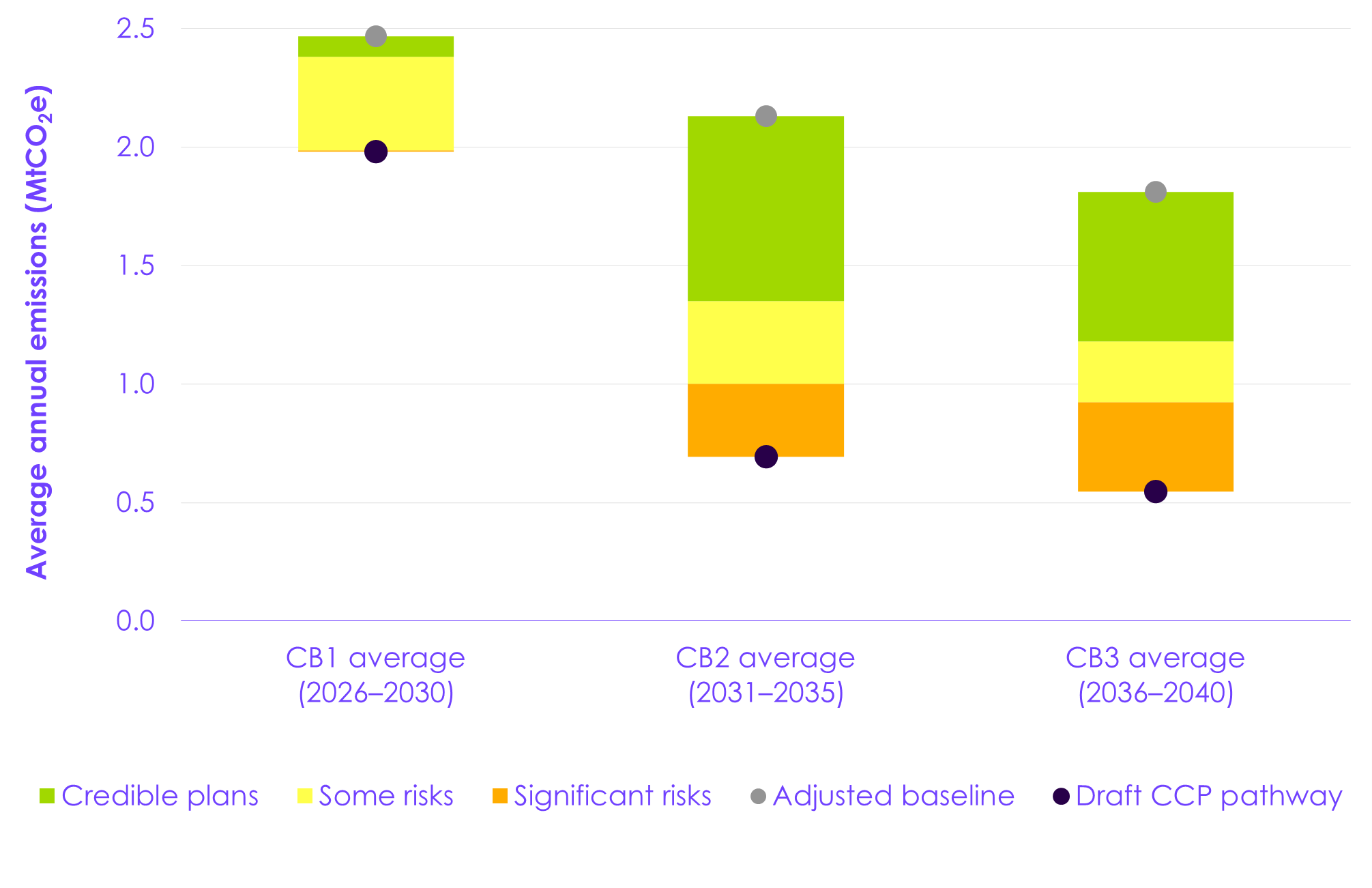 Description: The majority of the required abatement in the energy supply sector is covered by credible plans or plans with only some risks. There are some areas with significant risks in the Second and Third Carbon Budgets. Description: The majority of the required abatement in the energy supply sector is covered by credible plans or plans with only some risks. There are some areas with significant risks in the Second and Third Carbon Budgets.Source: Scottish Government (2025) Scotland’s Draft Climate Change Plan: 2026-2040; CCC analysis. Notes: (1) We have moved abatement from the baseline to the pathway to include our assessment of UK Government and private sector action. This includes emissions savings associated with UK-wide policy to decarbonise energy supply. (2) We have also moved abatement associated with non-road mobile machinery from the energy supply sector in the published draft Climate Change Plan pathway to the sectors where the emissions savings are expected to occur (transport, agriculture, business and industrial process, and residential and public buildings). (3) The baseline falls over time as activity in the fossil fuel supply sector declines due to falling demand and production in Scotland. |
Electricity supply
The draft CCP rightly identifies electricity supply as an area of significant historical progress, with emissions down 95% since 1990 (excluding EfW). However, residual sources of emissions, most significantly the Peterhead gas-fired power station and to a smaller extent island diesel generators, remain material. Further action in electricity supply will need to build on the positive progress in renewables deployment in Scotland in recent years (see Section 4.2.4). Action in Scotland will also be critical to enable the necessary expansion of the transmission network to move electricity from where it is generated to where it is used.
- Projects totalling nearly 1.5 GW of new offshore wind capacity – Berwick Bank B and Pentland Floating Offshore Wind Farm – and 1.1 GW of new onshore wind capacity in Scotland were successful in the UK Government’s latest Contracts for Difference allocation round (AR7).[139]
- The UK Government has outlined a series of reforms aimed at accelerating the planning and consenting process for electricity infrastructure in Scotland, with the UK and Scottish Governments committed to working together to implement these reforms, which were legislated for in the Planning and Infrastructure Act 2025.[140]
- Peterhead power station, Scotland’s final remaining fossil fuel power plant, plays a significant role in Scotland’s electricity related emissions. Although no formal closure date has been confirmed, the station is nearing the end of its operational life. Current assumptions within the draft CCP are that it will continue to emit at roughly 2024 levels until it stops operating in 2032.
- The proposal in the draft CCP is to replace the existing Peterhead plant with a CCS-enabled gas plant (Peterhead 2). This could support system flexibility and GB-wide security of supply alongside reducing emissions.
- The commitment that the new station will not proceed without CCS is welcome, but delivery risks are substantial. While approval under Section 36 of the Electricity Act 1989 is for Scottish ministers as the ‘appropriate authority’, assumptions for Peterhead 2 also rely critically on UK Government decisions regarding funding and the sequencing of the Acorn project, in order to enable the cluster to become operational by 2032. See Box 5.1 for further details on the role of the Acorn project.
- On islands, the draft CCP acknowledges current diesel generators’ essential role during cable outages. The ambition to phase out unabated diesel through enhanced grid links and renewable and storage solutions is positive, but timelines as specified in the draft CCP lack clarity. A firm programme for subsea cable resilience and battery deployment is needed to avoid prolonged reliance on fossil backup.
Fuel supply
Fuel supply comprises a large share of remaining energy supply emissions in Scotland, while also offering potential for scaling up new low-carbon fuel supplies to support decarbonisation across the economy.
- Fossil fuel supply: the draft CCP sets out an intention to support a managed transition for communities and workforces through the expected decline in Scotland’s oil and gas production over the plan period, reflecting the maturity of the North Sea basin and the closure of the Grangemouth refinery.
- Delivery depends in part on reserved UK Government levers such as licensing, consents, and fiscal policy, but the Scottish Government retains an important role. For example, there is welcome attention given to the importance of just transition planning via skills programmes, and targeted investment, including in Grangemouth and North-East Scotland.
- The Scottish Government has re-confirmed its finalised position of no support for onshore unconventional oil and gas, including hydraulic fracturing (fracking), and has also confirmed it will not support onshore conventional oil and gas as of June 2025.[141] It similarly confirmed no support for coal extraction in Scotland. This establishes a clear policy direction against new fossil fuel extraction onshore and is generally in line with policy positions elsewhere in the United Kingdom.
- Hydrogen: the draft CCP positions hydrogen as a key enabler for decarbonisation in industry, transport, and potentially heat, using a dual approach of electrolytic hydrogen from renewables and blue hydrogen linked to CCS. Delivery depends on rapid renewable expansion, grid upgrades, and timely CCS deployment, with limited detail in the draft CCP on costs and market readiness.
| Box 5.2 Offshore oil and gas emissions |
|
As noted in the draft Climate Change Plan, fossil fuel supply emissions in scope of Scotland’s carbon budgets include oil and gas supply emissions as a result of refining of crude oil into petroleum, the operation of terminals to manage the import and onshoring of oil and gas, leakage of gas from pipelines, and emissions associated with the onshore production of oil and gas. Offshore oil and gas production emissions are not in scope.
Responsibility for managing offshore oil and gas emissions primarily lies with the UK Government and the regulator (the North Sea Transition Authority). The Committee’s Seventh Carbon Budget advice sets out our latest advice to the UK Government on these emissions. Policy decisions on licensing and development consents for new offshore fields, including the proposed Rosebank and Jackdaw fields, lie with the Secretary of State for Energy Security and Net Zero:
|
Energy from waste
After reducing fossil-derived waste inputs, CCS is the primary route to decarbonise EfW. The Scottish Government has introduced criteria for new EfW sites to enable future decarbonisation, but planning requirements could be clearer to ensure all new EfW sites will have a viable route to connect to CCS.
- Scotland’s National Planning Framework 4 (NPF4), published in 2023, asserts that new EfW facilities will only be supported if consistent with climate change targets. Proposals must have a decarbonisation strategy aligned to the Scottish Government decarbonisation goals, demonstrate the viability of connecting to a heat network, and ‘give consideration to methods to reduce carbon emissions (for example through CCS)’.[144];[145] While requirements to align with decarbonisation goals are positive, new EfW sites should only be built where CCS viability can be demonstrated, and there are proposals to connect to CCS.
- No new sites have been granted planning permissions since NPF4 was introduced. However, four sites granted planning permission before 2023 are currently in the planning or construction phase, which will significantly increase Scotland’s EfW capacity.[146] It is not clear whether these sites can demonstrate a viable route to connecting to CCS.
- Connecting EfW sites in Scotland to CCS is dependent on the timely development of the Acorn project. This depends on key decisions by the UK Government, introducing uncertainty around the delivery of EfW decarbonisation through CCS. This is discussed in more detail in Box 5.1.
- In 2024, the UK ETS Authority announced plans to include EfW in the UK ETS from 2028 to incentivise decarbonisation of existing infrastructure.
Waste management
Policy in the waste management sector is mostly devolved, although the Scottish Government is part of efforts led by the UK Government to introduce UK-wide waste reforms including extended producer responsibility (EPR).
There are credible plans to deliver most of the abatement in the waste management sector, relating to avoided emissions from landfill associated with the diversion of biodegradable waste from landfill that has already happened in recent years (Figure 5.8).
- There is a time lag between waste being sent to landfill and the generation of emissions when waste breaks down, which means that future abatement is associated with action that has already happened. However, this has partially been offset by an increase in the volume of waste incinerated at EfW sites, and associated emissions, which are accounted for in the energy supply sector.
- There are insufficient plans for the remaining abatement in the waste management sector. In the draft CCP, this abatement is from reducing the volume of biodegradable waste sent to landfill to zero in 2025.
- A ban on sending biodegradable municipal waste to landfill was due to be implemented in Scotland from the end of 2025, whereas the draft CCP assumes this was achieved from the beginning of 2025.
- The full enforcement of the ban has now been delayed until 2028. Supporting policy to reduce waste and increase recycling rates is also only partially in place.
| Figure 5.8 Assessment of waste management policies and plans in the draft Climate Change Plan |
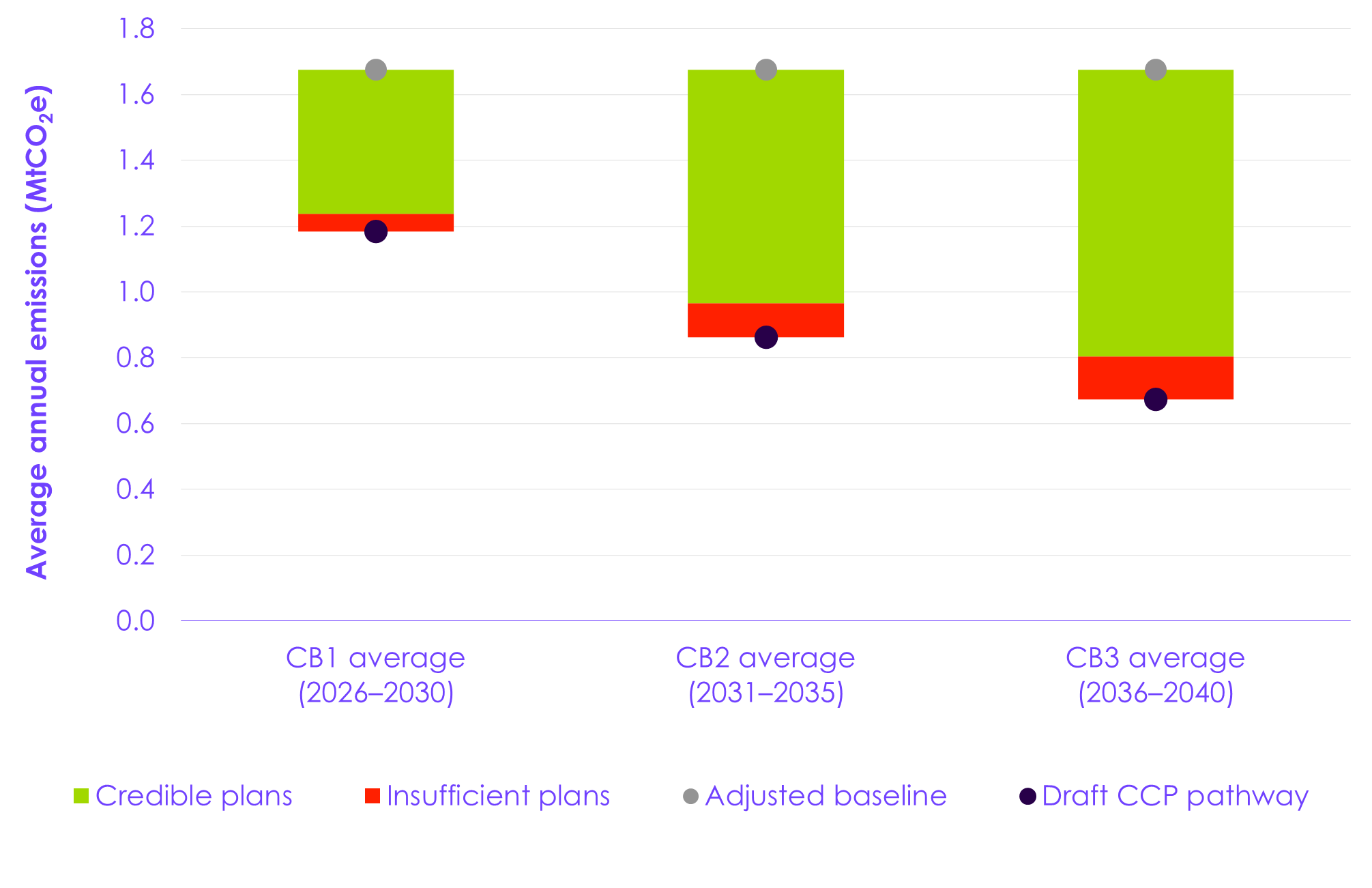 Description: There are credible plans to deliver most of the abatement in the waste management sector as this relates to action to reduce biodegradable waste to landfill that has already happened. There are insufficient plans to deliver the remaining abatement associated with eliminating biodegradable municipal waste from landfill in 2025, as the enforcement of the ban has been delayed until 2028. Description: There are credible plans to deliver most of the abatement in the waste management sector as this relates to action to reduce biodegradable waste to landfill that has already happened. There are insufficient plans to deliver the remaining abatement associated with eliminating biodegradable municipal waste from landfill in 2025, as the enforcement of the ban has been delayed until 2028.Source: Scottish Government (2025) Scotland’s Draft Climate Change Plan: 2026-2040; CCC analysis. Notes: We have moved abatement from the baseline to the pathway to include our assessment of UK Government and private sector action. This includes emissions savings arising from the reduction in biodegradable waste to landfill that has already occurred ahead of the Scottish Government’s planned ban. |
Waste reduction, recycling, and landfill
The signalling of a ban on biodegradable municipal waste to landfill, coupled with the landfill tax, has driven down volumes of waste to landfill in recent years. However, limited improvements in recycling and timing of new EfW capacity has led to the full enforcement of the ban being delayed from the end of 2025 to the start of 2028.[147] Abatement in the draft CCP from sending zero biodegradable waste to landfill in 2025 will now also be delayed. There has been some policy progress on recycling and waste reduction via the introduction of EPR for packaging. However, this is not sufficient on its own and other supporting policies are still in development.
- The decision to delay the enforcement of the ban on biodegradable waste to landfill from the end of 2025 to the start of 2028 is sensible, as without sufficient EfW and recycling infrastructure in Scotland, enforcing the ban would likely mean diverting waste to landfills in England. The Scottish Government has also completed a call for evidence on extending the ban to non-municipal biodegradable wastes.[148]
- The UK-wide EPR for packaging came into force in 2025, which should help to improve packaging recycling rates. The Deposit Return Scheme, originally planned for 2023, has been delayed again to 2027 due to disagreements over alignment with the UK scheme.
- In 2024, the Scottish Government published a Circular Economy and Waste Route Map to 2030, with £31.7 million allocated to delivering the route map in the Scottish Budget
2026-27.[149];[150] This includes promising proposals for reducing waste and increasing recycling. However, in most areas, plans are still in development. The route map includes:- By 2026, developing a statutory code of practice to improve consistency of household recycling and waste services, and introducing statutory reuse and recycling local performance targets from 2030.
- Developing options for mandatory food waste reporting for businesses by 2026, and a plan to drive behaviour change to reduce household food waste by 2027.
- There is a lack of policy to support an increase in landfill gas capture rates. The draft CCP outlines that options are currently under review.
Wastewater
There are no firm policies to enable emissions reductions from wastewater, and emissions reductions in this area do not feature in the draft CCP. However, Scottish Water has a target to reach Net Zero greenhouse gas emissions by 2040.[151] Policy is needed to drive improvements in monitoring and investment in technologies to reduce wastewater emissions.
Negative emissions technologies
Policy to deliver NETs, such as developing the associated business models and CO2 T&S infrastructure, is mostly reserved.[152] The Scottish Government has an enabling role to play in planning, permitting, and consenting for large infrastructure such as bioenergy with carbon capture and storage (BECCS) and direct air carbon capture and storage (DACCS) plants, and CO2 T&S infrastructure. It also has a direct role to play in land and agriculture policy, relevant to potential future deployment of enhanced weathering and biochar.
The Scottish Government has chosen a pathway with significant dependence on NETs, including a rapid scale-up in the late 2030s. NETs is an area with significant risk and with policy powers largely reserved to the UK Government (Figure 5.9).
| Figure 5.9 Assessment of negative emissions technologies policies and plans in the draft Climate Change Plan |
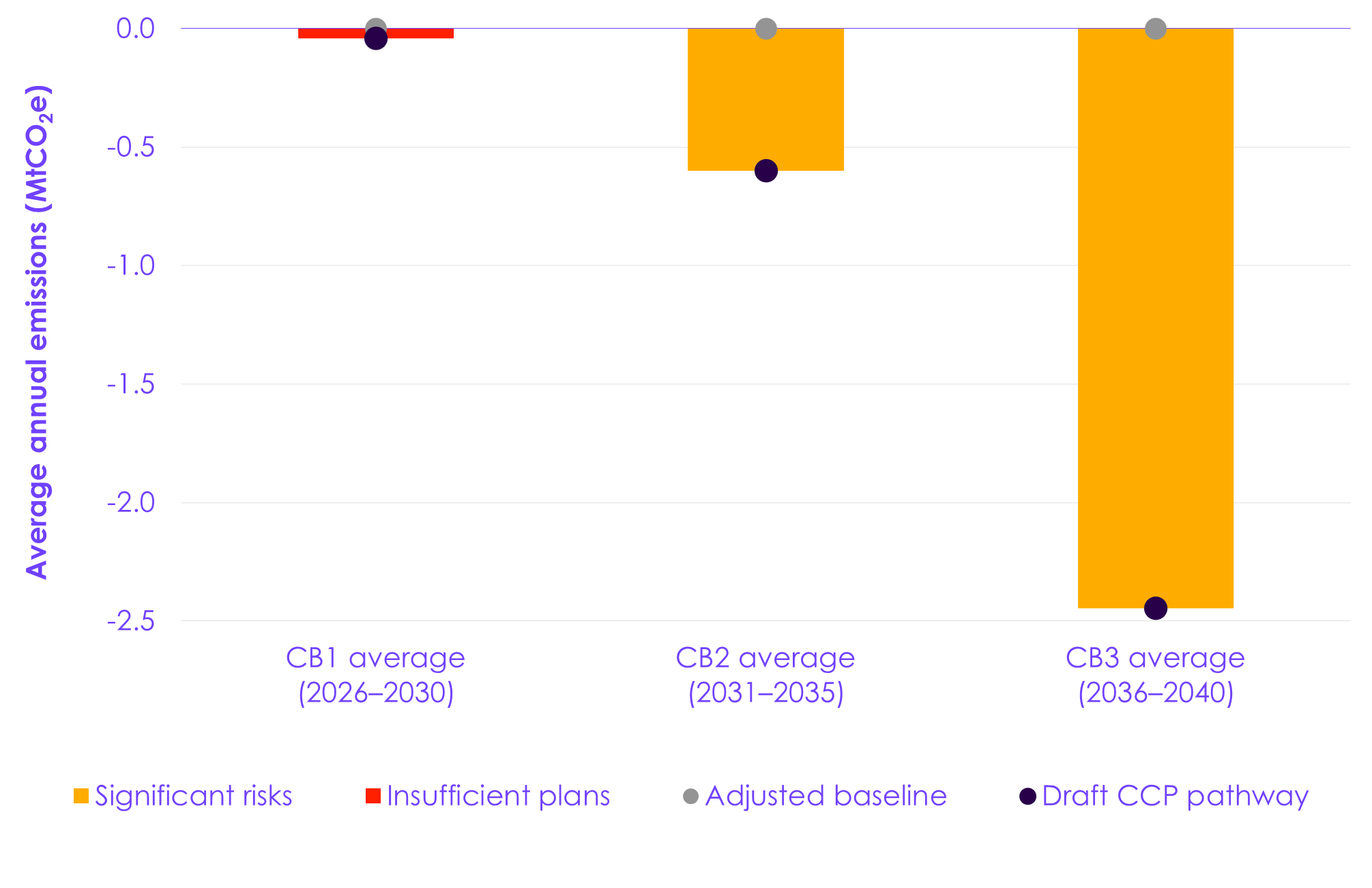 Description: There are insufficient plans to deliver any negative emissions technologies (NETs) abatement during the First Carbon Budget and significant risks to delivering the rapidly growing NETs in the Second and Third Carbon Budgets. The Acorn project is not expected to be operational until 2032 and there is uncertain policy and funding to deliver NETs in Scotland. Description: There are insufficient plans to deliver any negative emissions technologies (NETs) abatement during the First Carbon Budget and significant risks to delivering the rapidly growing NETs in the Second and Third Carbon Budgets. The Acorn project is not expected to be operational until 2032 and there is uncertain policy and funding to deliver NETs in Scotland.Source: Scottish Government (2025) Scotland’s Draft Climate Change Plan: 2026-2040; CCC analysis. |
In January 2026, South of Scotland Enterprise invested close to £1 million in Scottish carbon capture company The Carbon Removers, who plan to scale up carbon removals in Scotland and internationally.[153] This funding notwithstanding, there have been no significant developments in NETs policy from the Scottish Government since our last Scotland progress report. NETs are likely to be primarily driven by UK Government policy, which has seen important progress in recent months, though significant gaps remain, with implications for Scotland (see Section 5.3.2).
- The greenhouse gas removal (GGR) business model was published and plans to integrate GGRs into the UK ETS were confirmed.[154];[155] Together these will enable engineered removals to begin scale-up in the UK, subject to the availability of CO2 T&S infrastructure.
- The Acorn project is a core enabler of CCS-dependent NETs, but its prospects are uncertain. See Box 5.1 for further discussion of this.
- For dispersed NETs sites, such as BECCS associated with whisky distilleries or anaerobic digestors, non-pipeline transport for CO2 would be needed. The UK Government intends to consult on non-pipeline transport, but until plans are set out there is uncertainty on the viability of removals from these sites.[156]
5.2.2 Key developments on enablers of effective delivery
Governance
As set out in Chapter 1, the Scottish Government has introduced a new system of carbon budgets and has made rapid progress in legislating their levels. The draft CCP recognises that meeting these carbon budgets will require a collective effort across all areas of government and the economy. As discussed in Section 3.1, it also makes some positive steps forward in setting out details of who will be responsible for key actions and proposing a monitoring and evaluation framework, although more work is needed to ensure these are embedded in effective governance processes that ensure accountability for delivery, track progress, and allow plans to adapt when required.
The Scottish Government has also made steps to embed consideration of alignment with Scotland’s climate change objectives across a range of government decision-making processes.
- Between March and October 2024, the Scottish Government piloted a Net Zero Assessment process, applying a proportionate level of quantitative carbon assessment within relevant policy and spending decisions. The Scottish Government has since committed to embedding it into all decisions involving new and significant expenditure from 2026.[157];[158]
- An independent review supported embedding this process more widely across Scottish Government decision-making but identified a number of technical and governance recommendations for improving the process, including increasing the ‘de minimis’ threshold to expand the share of policies that require a full quantitative assessment.[159]
- Since 2024/25, each Scottish Budget has been accompanied by a climate change taxonomy assessing how the Budget will contribute to tackling climate change.[160]
- All capital and resource spending lines in the Budget are qualitatively tagged with whether they are positively, negatively, or neutrally aligned with the Scottish Government’s environmental outcomes and whether the scale of their impact will be high or low.
- The taxonomy for the Scottish Budget 2026-27 assessed 41% of capital spending and 6% of resource spending as being positive, with 7% and 2% respectively being negative.[161]
- The draft CCP commits to extending the taxonomy approach to provide a high-level assessment of all major capital projects and to report on findings in the reports required under Section 33 of the Climate Change (Scotland) Act 2009 (the Act) after the conclusion of each carbon budget period.
Public engagement and awareness of household low-carbon choices
The Scottish Government is continuing to invest in, support, and lead on climate change communication, often following best practice principles of public engagement approaches.[162];[163];[164] This includes successfully increasing the accessibility of the draft CCP through an easy-read and children’s version.[165] However, communication and engagement need to have an increased emphasis on the most impactful household low-carbon choices, clearly communicating that the key changes households can make will be to buy electric cars and low-carbon heating systems when it is time to replace fossil fuel cars and boilers (see Section 5.3.2).
- The Scottish Government committed to extend its positive deliberative engagement work by taking forward a new assembly or similar to develop a public understanding of Net Zero implications for households and businesses.[166]
- The draft CCP reiterates a strong commitment to provide the public with adequate opportunities to participate in and shape national and local decision-making in relation to Net Zero. This will be monitored through an indicator as part of the monitoring and evaluation framework, assessing public satisfaction with opportunities to influence Net Zero policies and decision-making.[167]
- Results from the Scottish Climate Survey highlight that the Scottish public is most likely to view recycling as one of the four most effective actions they can take to reduce their contribution to climate change. In contrast, switching to a low-carbon heating system, reducing meat and dairy consumption, and avoiding flying are among the actions that the public were least likely to mention as one of the four most effective actions.[168]
Workers and skills
The Scottish Government has increased efforts to support workers and communities in declining high-carbon industries, published its Green Industrial Strategy as well as some initial sectoral Just Transition Plans, and underpinned the draft CCP with statutory just transition principles and indicators.[169];[170];[171];[172];[173] This builds on advice from the Just Transition Commission, which has been extended for another five years.[174] However, developments are mostly still in planning or pilot phases, and workers face continued uncertainty due to lack of timely and proactive action.
- The Scottish Government has dedicated funding for low-carbon skills development for workers in high-carbon industries in the North East.
- This includes a £900,000 Oil and Gas Transition Training Fund, £4.5 million for the opening of an Energy Skills Transition Hub in Aberdeen, and £8.5 million in funding for offshore wind infrastructure and supply chains, to create jobs in historical oil and gas communities.[175]
- The Scottish Budget 2026-27 allocated a further £16 million for the Just Transition Fund to respond to the needs of the North East and Moray, with a focus on businesses, workers, and communities, as well as a further £3 million to support former oil and gas workers to retrain into renewable and sustainable energy jobs, co-funded by UK Government.[176]
- The Scottish Government set up a pilot for the Energy Skills Passport, a digital platform supporting professionals across the oil and gas sector to move into renewables sectors, in January 2025.[177];[178] However, the project has seen considerable delays and uptake remains low, in part as it does not yet deliver on its key objective of recognising equivalent qualifications across sectors and reducing duplicate training costs.
- Since the closure of the Grangemouth refinery in April 2025, the Scottish Government has published a Grangemouth Industrial Just Transition Plan detailing key actions to support the transition of the cluster and provide employment options and skills support, as well as a training guarantee for refinery workers.
- In October 2025, the Scottish Government announced the launch of the Grangemouth Jobs Prioritisation Scheme, aiming to give workers made redundant from the refinery priority consideration for new jobs created through the £25 million Grangemouth Just Transition Fund. The Scottish Budget 2026-27 allocated a further £16 million to help secure a sustainable future in Grangemouth as an industrial cluster.[179]
- The Scottish and UK Governments previously published a jointly commissioned feasibility study in 2024, identifying low-carbon opportunities for the site. Recent announcements suggest there are emerging plans to build a green chemical production plant on the site.[180] However, there has been a lack of coordination and no further development in terms of implementation of the plan or investment to support it, leading to continued uncertainty for refinery workers.
- The Scottish Budget 2026-27 also allocated £3 million as part of a three-year package to support communities impacted by the closure of the Fife Ethylene Plant at Mossmorran.[181]
- At the beginning of 2025, the Scottish Government launched a Heat Pump Skills Fund to upskill existing heating and plumbing businesses on heat pump installations, as well as a Zero Emissions HDV Skills Challenge Fund to support projects across Scotland to build skills needed for decarbonisation of heavy-duty vehicles.[182];[183]
- Scottish Government has set up a skills package for workers in the agriculture and land use sectors to enhance their land management and climate and nature measures. In 2024, the Scottish Government launched the Next Generation Practical Training Fund to support new entrants in farming and agriculture to get training and knowledge on various aspects of the industry, with an emphasis on climate change adaptation and mitigation practices, habitat improvements, and resilience. The Scottish Budget 2026-27 has also allocated a further £1.3 million in funding for skills for regenerative and sustainable farming and food production.[184]
Business and finance
The Scottish Government has taken some positive steps to support businesses and the economy. It published its Green Industrial Strategy, designated three new regional plans, and has supported Net Zero finance opportunities. Most policies affecting businesses are sector-specific and can be found in the sectoral sections in Section 5.2.1.
- The Scottish Government’s 2024 Green Industrial Strategy identified priority sectors for the Net Zero transition across low-carbon technologies, industry, and the services sector.[185] It set out strategies to support businesses in these sectors, including building investment and business cases, developing supply chains and the circular economy, and streamlining planning and consenting processes.
- Several sector-specific funding streams and policies were introduced. Cross-cutting initiatives introduced in the strategy, or soon after, were a National Planning Hub to build planning capacity and improve consistency in decisions, primarily focused on wind energy, and the Scottish hydrogen innovation network (SHINe) initiative, run by Scottish Enterprise to support SMEs with upskilling for wind and hydrogen opportunities.[186]
- The strategy highlighted the importance of SMEs in Scotland, particularly in the manufacturing sector. It set out SME-specific initiatives for the priority sectors. More broadly, the Actionable Climate Toolkits for Scotland (ACTS) were launched in early 2025 by the Glasgow Chamber of Commerce with support from Scottish Enterprise to help SMEs move towards Net Zero.[187] The toolkits were developed in collaboration with businesses and aim to provide detailed and sector-level guidance, an information gap identified by Scottish SMEs.[188]
- The Scottish Government announced several regional plans to support businesses and channel investment into local economies. Two new investment zones were established in Glasgow City Region and North East Scotland in a partnership between UK, Scottish, and regional governments.
- In 2025, the UK Government increased funding for the investment zones from £80 million to £160 million each over 10 years.[189] The Scottish Government is offering tax relief for businesses in the investment zones, from 2025/26.
- Grangemouth was also designated a Green Freeport, aiming to support the industrial cluster’s transition from fossil fuels to low-carbon fuel production (see also section above on workers and skills). The UK and Scottish Governments have allocated a total of £225 million to support opportunities for low-carbon fuels at Grangemouth.[190]
- The Scottish Government has implemented policies to enable businesses’ investment in natural capital. The Market Framework for Natural Capital, published in November 2024, sets out a structure for high-integrity voluntary carbon markets and the Woodland Carbon Code was updated in 2025 to enhance the veracity and uptake of carbon credits by businesses.[191] This includes aligning the minimum project duration with international standards to ensure long-term sequestration in return for carbon credits.
- Finance was identified as a priority sector in the Green Industrial Strategy, and the Scottish Government has taken steps to support its green financial sector.
- The Scottish Taskforce for Green and Sustainable Financial Services launched its recommendations in September 2024.[192] The Scottish Government’s response affirmed its commitment to promoting Scotland as a destination for green investment, delivering education and training, and innovation in green financial products to capture growth opportunities.[193]
- Following this review, Transition Finance Scotland was launched in May 2025 in partnership with the Green Finance Institute (GFI). This private sector initiative is engaging with public and private sector partners to mobilise investment into Net Zero projects and ensure public finance is leveraged to increase private investment.[194]
- The GFI is working directly with Scottish Government to support financial innovations to accelerate home decarbonisation. GFI and the Scottish Government launched a training programme in green home financing in March 2025 and published a government report on the use of green home finance products.[195]
5.3 Priority recommendations
5.3.1 Progress against priority recommendations
The Committee made 18 priority recommendations to the Scottish Government in our 2025 Scotland’s Carbon Budgets advice report, including both recommended cross-cutting actions to enable effective delivery and specific changes needed to deliver decarbonisation in particular sectors. Although we only made these recommendations nine months ago, we assess that there has been ‘good progress’ on five, ‘moderate progress’ on five, ‘some but insufficient progress’ on two, and ‘no progress’ on one. For the remaining five recommendations, it is too early to make an assessment. The full scores can be found in the supporting data published alongside this report.
5.3.2 Priority actions for the Scottish Government
Now that the Scottish Government has adopted its new system of carbon budgets and has developed a draft plan to deliver them, it is essential to make strong progress on delivery. As set out in the Act, the Scottish Government must now produce a final CCP, which will set the overall plan for how Scotland will meet its emissions targets over the next 15 years. Beyond this, the Scottish Government will publish important new strategies and plans in a number of crucial areas over the coming months including the Heat in Buildings Strategy and Delivery Plan and the Fourth Land Use Strategy. These new documents must be used to move forward with implementing the key measures set out in the plan at pace.
We have an updated set of 18 priority recommendations for the Scottish Government to achieve this – these are set out in Annex 2. Within these, there are six core themes which require particular focus over the coming year. The Scottish Government has devolved powers to deliver in each of these key areas.
Produce an effective and credible final Climate Change Plan
The Committee’s assessment of the draft CCP, set out in this report, has identified a number of improvements that should be included in the final CCP. These include addressing the risk from the methodological concerns around the assumed inventory change for peatlands and the underlying temperature assumptions for buildings. The final CCP should also make clear how energy-saving practices seen when gas prices were high will be maintained without adverse effects such as underheating of homes. Further key actions to reduce delivery risk in achieving the carbon budgets are given in the following themes. As part of the final CCP, the Scottish Government should also set out its finalised monitoring and evaluation framework, including annual pathways for sectoral emissions and all key indicators of progress. An explicit inclusion of contingency options should also be considered to make up for any potential shortfalls in the pathway (R2026-001, R2026-002, and R2026-003).
Implement a clear delivery plan for decarbonising home heating
The Scottish Government has an ambitious target to decarbonise heating in buildings by 2045 and has an opportunity to lead the way in the UK for buildings decarbonisation, with significant policy powers within its gift. However, the draft CCP lacks policy to deliver this (R2025-100, R2025-101, and R2026-006).
- In our 2023 Progress in reducing emissions in Scotland report, we welcomed the original draft Heat in Buildings Bill as a potential template for other parts of the UK (see Box 5.3).
- It is therefore disappointing that the proposals for regulations to upgrade properties at the point of sale have been abandoned, with, as yet, no specific alternative measures to deliver the target for heating to be zero emissions by 2045.
The upcoming Heat in Buildings Strategy and Delivery Plan should be published as soon as possible this year and ensure conditions are in place to ensure the required scale-up in low-carbon heat and energy efficiency measures will be achieved.
- The Scottish Government should confirm that funding announced in the Scottish Budget 2026-27 will be used to continue existing grants and top-up loans to support households with heat pump installations. Furthermore, it should set out plans for continuation of funding beyond next financial year.
- The delivery plan could include a combination of continued financial support, regulation, support for skills, public engagement on the benefit of heat pumps, and leading by example and helping to build supply chains in public sector buildings. It should include:
- Measures to enable a rapid transition from fossil-fuel heating systems to low-carbon heating in existing buildings.
- Details of plans to ensure buildings connect to heat networks where appropriate.
- Plans for improving energy efficiency in existing buildings, including a commitment to implement minimum energy efficiency standards for privately rented homes, and revised standards for social housing.
- Clear plans for how they will ensure sufficient jobs and skills are available for the delivery of decarbonisation in buildings, including consideration of next steps for the Heat Pump Skills Fund following its initial pilot phase.
- There are homes that would already benefit from lower heating bills by installing a heat pump. The UK Government’s Warm Homes Plan includes steps announced at the Budget to remove some levies from energy bills, and provide funding for fuel poor homes across the UK, following the forthcoming closure of the Energy Company Obligation scheme. The Scottish Government should develop plans accordingly, considering the homes that will see reduced running costs, to ensure that progress in heat pump deployment continues. Delays to decision-making are postponing opportunities for emissions reductions and putting targets for decarbonisation of buildings at risk.
Around 25% of homes in Scotland are within tenement buildings, with nearly a third of these built pre-1919. Meeting the Scottish Government’s targets will require an effective approach to decarbonising these buildings, which can be challenging due to traditional construction and the need to coordinate works with multiple owners. The delivery plan needs to address these challenges, including through developing appropriate governance frameworks to enable the installation of communal low-carbon heating systems where appropriate.
- High-temperature heat pumps offer a heating solution that can operate in older and less efficient properties.
- Additionally, Scotland has higher potential for communal systems and heat networks than the rest of the UK, offering an additional solution for tenement buildings.
| Box 5.3 Buildings decarbonisation policy proposals and reversals |
|
In 2021, the Scottish Government published its Heat in Buildings Strategy, outlining its plans to decarbonise buildings by 2045.[196] This was followed by proposals for a Heat in Buildings Bill in 2023.[197] The proposed legislation would have provided a long-term plan for decarbonising heating, including:
In our 2023 Scotland progress report, the Committee welcomed these proposals and suggested they could be a template for the rest of the UK. At the beginning of 2025, the Scottish Government abandoned its original proposals for the Heat in Buildings Bill, arguing that the measures would burden households and increase fuel poverty.[198] A number of industry representatives criticised this at the time, highlighting the need for certainty and raising that these delays have ‘already deterred suppliers, contractors, and installers from scaling up to meet growing demand’.[199];[200] Revised proposals were put forward without the legal prohibition of fossil fuel heating systems or the point-of-sale requirements. In November 2025, the Scottish Government put the revised proposals on hold, arguing that they could not be delivered in this parliamentary session and could not be finalised before the UK Government publishes its Warm Homes Plan and plans for rebalancing energy prices. The Scottish Government instead published the text of a draft Heat in Buildings Bill.[201] The proposed bill would:
The proposed bill does not in itself set out detailed policies for decarbonising buildings. The draft CCP sets a target for decarbonising heating systems by 2045. However, four years after the publication of the Heat in Buildings Strategy, the Scottish Government has yet to produce clear plans for delivering this target. Given there are now less than 20 years to this target date (and a gas boiler typically lasts 15 years), an ambitious delivery plan and effective implementation are now urgently needed.
|
Produce a clear strategy for delivering the required land use changes
Scotland leads the UK on planting new woodlands and restoring peatlands. These two actions will contribute significantly to both Scotland’s and the UK’s emissions targets. The upcoming Fourth Land Use Strategy needs to be clear on the types and locations of land that will be needed for each action and ensure that funding and incentives are set at the correct level. Regulation and long-term public funding should also ensure that farmers are able to take up low-regret measures to reduce emissions from managing crops and livestock (R2025-095, R2025-096, and R2025-097).
- Scotland’s land use sector will play an important role in both reaching Scotland’s and the UK’s Net Zero ambition through its high potential for woodland creation and peatland restoration. Farmers and land managers will play a crucial role in achieving this, through diversifying their operations and releasing land from conventional agricultural to new land uses and management approaches. While the draft CCP sets out important plans for tree planting and restoration of degraded peats, it currently does not set out how, where, and the scale of land that will transition from agriculture to achieve this.
- The upcoming Fourth Land Use Strategy offers an opportunity to ensure the strategic links between land use and agriculture are recognised. For it to be effective, there needs to be a connection between the opportunities for land use change identified spatially and temporally with incentives and other tools to ensure farmers and land managers are supported to deliver climate and nature goals alongside the future agricultural transition.
- While a clear strategic overview will provide confidence that the objectives for Scotland’s agriculture and land use sectors can be met, this should be accompanied with sufficient and sustained funding to deliver the necessary scale up in land actions such as woodland creation and peatland restoration. While recent cuts in the FGS led to a significant drop in tree planting, the high rates achieved before the cuts demonstrated how the availability of sufficient funding and support across the supply chain can drive growth in the forestry sector.
Enable the rapid transition to electric transport
The draft CCP pathway sees a rapid acceleration in EV sales. We expect this to be possible, driven by falling prices and a stable UK-wide policy landscape, but the Scottish Government will need to continue to support the roll-out of public charge points across Scotland in all regions and through positive public engagement on the benefit of EVs to help grow demand. This should be complemented by improvements to public transport across Scotland (R2025-093 and R2025-094).
Enhance confidence in the delivery of negative emissions technologies
The Scottish Government has chosen a draft CCP pathway that includes a significant level of reliance on NETs. The Scottish Government should publish a delivery plan setting out the expected role of each technology and the actions required to deliver them. A co-ordinated approach with the UK Government and plans for UK-wide NETs will be needed to ensure successful delivery, and the Scottish Government should set out how they intend to make Scotland an attractive location for NETs, such as through efficient planning, permitting, and consenting processes (R2026-004).
Continue to strengthen public and business engagement with a focus on impactful low-carbon choices and proactive transition plans
The draft CCP reiterates the Scottish Government’s strong commitment to public engagement. However, current approaches need to have an increased emphasis on the most impactful low-carbon household choices. In addition, the Scottish Government needs to build upon positive steps in the draft CCP and the Green Industrial Strategy to ensure that proactive transition plans are agreed with communities, workers, and businesses likely to be affected by the Net Zero transition and the reduced production and use of fossil fuels (R2025-091 and R2025-092).
5.3.3 Shared dependencies between the UK and Scottish Governments
It is also vital that the Scottish and UK Governments work together effectively to achieve progress on areas critical to their shared objectives. To deliver its contribution to UK-wide targets, including the 2030 NDC, Scotland will need to continue its strong progress in rolling out renewable electricity generation and ensure development of electricity networks can keep pace. Some decisions, including further reducing electricity prices and reaching a final investment decision on the Acorn project, are not directly within the Scottish Government’s control but will be essential to delivering Scotland’s targets, in tandem with action by the Scottish Government. The Scottish Government will need to work with a range of stakeholders, including the UK Government, businesses, and local communities to meet its carbon budgets.
Speed up transmission network build in Scotland
Expansion of the electricity transmission network is essential to enabling the utilisation of renewables. Scotland has rolled out renewable electricity generation faster than the rest of the UK, due to its natural advantages in wind generation. Further action to expand renewable capacity and transmission infrastructure in Scotland is essential to deliver Scotland’s fair contribution to UK-wide targets, including the UK’s 2030 NDC (R2026-005).
- Constraints on the transmission network mean that a significant proportion of Scotland’s renewable electricity cannot be exported and is curtailed. The Scottish Government should act to accelerate planning and consenting for electricity transmission infrastructure to boost exports of electricity from Scotland and to support the rest of the UK to decarbonise through the transition to low-carbon electric technologies. Actions to accelerate the approval of transmission network infrastructure could include:
- Enhancing planning resources across local authorities and key statutory consultees, such as Transport Scotland and NatureScot.
- Developing the National Planning Framework and National Marine Plan to improve clarity, reduce consenting risk and support a coordinated, GB-wide approach to electricity network development.
- Addressing transmission constraints can also be achieved through the deployment of efficient, flexible demand systems, including through the electrification of buildings, and energy storage. A holistic approach across network build, demand flexibility, and energy storage can minimise system costs for consumers by ensuring efficient network utilisation and reducing curtailment-related costs, which have implications for bills. The Scottish Government should act decisively to enable these measures.
Make electricity cheaper
Rapid and effective action to make electricity cheaper – building on the positive steps taken in the UK Budget 2025 – is key to incentivising households, businesses, and industries to switch to low-carbon technologies. Over time, the transition to renewables will reduce reliance on volatile wholesale gas prices, which are the main driver of current GB wholesale electricity prices. However, the UK Government has the policy levers to take immediate action to accelerate this by moving more policy costs off electricity bills. This will ensure that the price consumers pay better reflects the actual cost of supplying additional electricity.
- As part of the Budget 2025, the UK Government committed to make electricity cheaper by not extending the Energy Company Obligation and by moving 75% of the costs of the Renewables Obligation to general taxation.
- These measures are a positive step forward however more action – building on this initial progress – is needed to provide sufficient incentives for households, businesses, and industries to switch to low-carbon technologies.
Reach a final investment decision for the Acorn project
The draft CCP pathway relies on CCS to deliver the required emissions reductions in a number of sectors, including business and industrial process, energy supply, waste management, and NETs.
The Acorn project could leverage Scotland’s advantages: existing oil and gas infrastructure, skilled workforce, and vast geological storage capacity in the North Sea. However, delivery depends on the cluster securing a final investment decision and success via the UK Government’s cluster sequencing programme, which whilst Acorn received some development funding at Spending Review 2025, remains to be confirmed.
- Recent and upcoming closures of candidate emitter projects connecting to Acorn, namely the Grangemouth refinery, the Grangemouth ethanol plant, and the Fife ethylene plant (planned for early 2026), raise important questions about economic viability.
- The UK Government retains control over CCS business models and funding for the T&S infrastructure, which introduces uncertainty, and a degree of risk over a decarbonisation approach that relies on this infrastructure.
Annex 1: Sector definitions
The Climate Change (Scotland) Act 2009 specifies a set of sector definitions to be used in the Scottish Government’s climate change plans. In this annex, we summarise what is included in each sector and how they map onto the Climate Change Committee’s (CCC) sectors which we used in our 2025 advice on Scotland’s Carbon Budgets.
- Agriculture includes emissions of greenhouse gases from livestock, agricultural soils (excluding carbon stock changes which are included in the land use, land use change and forestry sector), and agricultural machinery. This is the same as the CCC’s agriculture sector.
- Business and industrial process includes emissions from fuel combustion and product use in industrial and commercial sectors, F-gas emissions from refrigeration and air conditioning, emissions from industrial off-road machinery, and emissions from industrial processes. This is equivalent to most of the CCC’s industry sector and commercial building emissions from our buildings sector.
- Energy supply includes emissions from electricity generation and other energy production activities, such as mining, refining, and manufacturing fuels. Emissions from the electricity generation used in electric technologies, such as electric vehicles in transport and heat pumps ins buildings and industry, are included in this sector. This is a combination of the CCC’s electricity supply and fuel supply sectors, with a small amount of the CCC’s industry sector and energy from waste from the CCC’s waste sector.
- Land use, land use change and forestry (LULUCF) includes emissions and removals of CO2 from changes in the carbon stock in forestland, cropland, grassland, wetlands, settlements and harvested wood products, and of other greenhouse gases from drainage (excluding croplands and intensive grasslands) and rewetting of soils, nitrogen mineralisation associated with loss and gain of soil organic matter, and fires. This is the same as the CCC’s land use sector.
- Residential and public (in relation to buildings in those sectors) includes direct emissions from residential properties, including from consumer product use, and emissions from the combustion of fuel in public sector buildings. This is the same as the CCC’s residential and non-residential buildings sectors combined but not including commercial buildings and including F-gas aerosols from the CCC’s F-gases sector, recreational use of nitrous oxide from our industry sector, accidental vehicle fires from the CCC’s surface transport sector, and home composting from our waste sector.
- Transport (including international aviation and shipping) includes direct emissions from vehicles in road transport, aviation, railways, and shipping. This is a combination of the CCC’s surface transport, aviation, and shipping sectors but not including emissions from accidental vehicle fires.
- Waste management includes emissions resulting from the treatment and disposal of solid and liquid waste, for example from landfill, incineration, and composting. This is the same as the CCC’s waste sector but not including home composting or energy from waste emissions.
- Negative emissions technologies (NETs) includes removals of CO2 from the atmosphere by a range of technologies. This is the same as the CCC’s engineered removals sector.
Annex 2: Priority recommendations
Table A2.1
Priority recommendations to the Scottish Government
| Sector | Recommendations |
|---|---|
| Cross-cutting | R2026-001 Publish the final Climate Change Plan. This should address the methodological issues around the assumed inventory change for peatlands and the underlying temperature assumptions for buildings. It should also reflect on how delivery risks can be mitigated in the areas that we have identified as having significant risks or insufficient plans.
R2026-002 Finalise the monitoring and evaluation framework as part of the final Climate Change Plan. This should clearly set out annual pathways for all key indicators of progress as well as indicative annual sectoral emissions pathways, to enable effective tracking of whether these are progressing as required to deliver the emissions reductions in the Climate Change Plan pathway. R2026-003 Set out the Scottish Government’s proposed approach to contingency planning as part of the final Climate Change Plan, to ensure a robust and adaptive approach to achieving carbon budgets and Net Zero. This should include an explicit assessment of contingency options that can be implemented to deliver additional emissions reductions to make up for any potential shortfalls in the pathway. R2025-090 Amend the Climate Change (Scotland) Act 2009 (which can be done by order) to extend the definition of greenhouse gas removals to include engineered removals. R2025-091 Work with communities, workers, and businesses to develop proactive transition plans that enable access to secure employment and business opportunities that come with the Net Zero transition. R2025-092 Work with the UK Government to communicate a clear vision to the public. Provide clear, trusted information about the most impactful low-carbon choices for households and businesses in Scotland to reduce emissions and the benefits of low-carbon choices, signposting to available sources of advice and support. |
| Transport | R2025-093 Expand provision of charging infrastructure and provide reliable public information on electric vehicles to support the successful implementation of the ZEV mandate.
R2025-094 Improve Scotland’s public transport services and active travel infrastructure through strategic investment in integrated networks, enhanced services, and dedicated walking and cycling routes, supported by long-term funding and powers for local councils. |
| Agriculture and land use | R2025-095 Provide incentives and address barriers for farmers and land and estate managers to diversify land use and management at a range of scales into woodland creation, peatland restoration, agroforestry, and renewable energy. These policies need to support and empower rural communities to deliver these changes.
R2025-096 Ensure that funding and incentives are set at the correct level to deliver the scale-up in tree planting that is needed this decade. R2025-097 Provide long-term certainty on public funding for farming practices and technologies to reduce emissions from managing crops and livestock. As part of this, ensure low-regret and low-cost measures are taken up through baseline regulations or minimum requirements in the new agricultural support mechanisms (for example, actions to deliver resource protection, enhance nature, and build resilience), especially when they can deliver efficiency improvements. |
| Business and industrial process | R2025-098 Continue to work with the UK Government to support the development of plans to develop carbon capture and storage (CCS) and hydrogen in the Scottish Cluster and work with the UK Government to develop new low-carbon industrial opportunities, such as those identified by Project Willow for Grangemouth. |
| Residential and public buildings | R2025-100 Urgently consult on and implement measures to enable a rapid transition from fossil-fuel heating systems to low-carbon heating in existing buildings.
R2025-101 Develop appropriate governance frameworks to coordinate residents in buildings containing multiple residential dwellings (in particular, tenements) to allow for the installation of communal low-carbon heating systems, where these are appropriate. R2026-006 Implement proposals for minimum energy efficiency standards for private rented homes and revised standards for social housing. Continue to develop plans for equivalent standards across tenures. |
| Waste management | R2025-102 Ensure that new energy from waste capacity is only permitted where a viable route to connecting carbon capture and storage (CCS) can be established. |
| Negative emissions technologies (NETs) | R2026-004 Publish a negative emissions technologies (NETs) delivery plan setting out the expected role of each technology and the actions required to deliver them. A co-ordinated approach with the UK Government and plans for UK-wide NETs will be needed to ensure successful delivery, and the Scottish Government should set out how they intend to make Scotland an attractive location for NETs, such as through efficient planning, permitting, and consenting processes. |
| Energy supply | R2026-005 Act to accelerate planning and consenting for electricity transmission infrastructure to boost exports of electricity from Scotland and to support the rest of the UK to decarbonise through the transition to low-carbon electric technologies. |
Annex 3: Policy assessment criteria
Our policy assessment charts track progress on what needs to be addressed in each subsector or policy area to meet the Government’s targets. For the different sectors of the economy, we have assessed the risks relating to the delivery of the Government’s targets and scored them using the criteria in Table A3.1. We assess based on these factors, taking into account the stage of the market and the progress on each area that we would expect to be appropriate at this stage.
| Table A3.1 Scoring criteria for assessing policies and plans |
|||
| Credible plans | Some risks | Significant risks | Insufficient plans |
| Credible plans with funding, enablers, and timelines in place. | Some adjustment to plans may be needed to mitigate uncertainties and delivery or funding risks. | Plans under development and/or further work needed to enact policies and overcome uncertainties and delivery or funding risks | Plans are either missing, clearly inadequate and new proposals are needed. |
Footnotes
- [1] The Scottish Government includes non-road mobile machinery (NRMM) emissions in the sectors in which they arise (agriculture, business and industrial process, residential and public buildings, and transport) in the draft Climate Change Plan but includes the emissions savings associated with NRMM in the energy supply sector. ↑
- [2] Emissions from energy from waste are accounted for in the energy supply sector. ↑
- [3] Scottish Government (2025) Scotland’s Draft Climate Change Plan: 2026-2040. https://www.gov.scot/publications/scotlands-climate-change-plan-2026-2040/. (Accessed: 15 January 2026). ↑
- [4] Climate Change (Scotland) Act 2009 (asp 12). https://www.legislation.gov.uk/asp/2009/12/contents. (Accessed: 7 October 2025). ↑
- [5] The UNFCCC is the United Nations process for negotiating a global approach to address climate change. 197 countries plus the European Union are currently party to this process. Negotiations take place through the annual Conference of the Parties (COP). COP21 in 2015 negotiated the Paris Agreement, which is the latest global agreement on climate change. ↑
- [6] Climate Change (Emissions Reduction Targets) (Scotland) Act 2019 (asp 15). https://www.legislation.gov.uk/asp/2019/15/contents. (Accessed: 7 October 2025). ↑
- [7] Climate Change (Emissions Reduction Targets) (Scotland) Act 2024 (asp 15). https://www.legislation.gov.uk/asp/2024/15/contents. (Accessed: 7 October 2025). ↑
- [8] Scottish Government (2025) Climate Change (Scotland) Act 2009 (Scottish Carbon Budgets) Amendment Regulations 2025: statement. https://www.gov.scot/publications/statement-accompany-climate-change-scotland-act-2009-scottish-carbon-budgets-amendment-regulations-2025/. (Accessed: 9 October 2025). ↑
- [9] The baseline year is 1990 for CO2, methane, and nitrous oxide, and 1995 for F-gases. We refer to this as ‘the 1990 baseline’ throughout this report. ↑
- [10] In this report, we use the sectors set out in the Climate Change (Scotland) Act 2009, which are used in Scotland’s Draft Climate Change Plan: 2026-2040. See Annex 1 for a summary of how these sectors are defined. ↑
- [11] All emissions numbers include IAS unless stated otherwise. ↑
- [12] For some sectors, the emissions changes given here for 2022 and 2023 do not sum to the total change for the two years because of rounding. ↑
- [13] Emissions are adjusted to account for year-on-year variations in temperature that lead to significant variations in actual emissions. The methodology is explained in our CCC Mitigation Monitoring Framework. ↑
- [14] In our 2025 Scotland Carbon Budgets report, this figure was 8%. The difference is due to methodological changes between the 2022 and 2023 greenhouse gas emissions inventories. ↑
- [15] 1994 used for comparison of car numbers due to data availability. ↑
- [16] Department for Transport (2025) Road traffic estimates. TRA0203: Motor vehicle traffic (vehicle kilometres) by road class, region and country in Great Britain. https://www.gov.uk/government/statistical-data-sets/road-traffic-statistics-tra#traffic-volume-in-kilometres-tra02. ↑
- [17] Department for Transport (2025) Vehicle licensing statistics. VEH1103: Licensed vehicles at the end of the quarter by body type and fuel type: Great Britain and United Kingdom. https://www.gov.uk/government/statistical-data-sets/vehicle-licensing-statistics-data-tables. ↑
- [18] Department for Transport (2025) Road traffic estimates. TRA0206: Motor vehicle traffic (vehicle kilometres) by road class, region and country in Great Britain. https://www.gov.uk/government/statistical-data-sets/road-traffic-statistics-tra#traffic-volume-in-kilometres-tra02. ↑
- [19] Defra (2025) British survey of fertiliser practice dataset. https://www.gov.uk/government/statistical-data-sets/british-survey-of-fertiliser-practice-dataset. ↑
- [20] Scottish Government (2025) Scotland’s Draft Climate Change Plan: 2026-2040. https://www.gov.scot/publications/scotlands-climate-change-plan-2026-2040/. ↑
- [21] Office for National Statistics (2025) Regional gross value added (balanced) by industry: all ITL regions. https://www.ons.gov.uk/economy/grossvalueaddedgva/datasets/nominalandrealregionalgrossvalueaddedbalancedbyindustry. ↑
- [22] Scottish Energy Statistics Hub (2024) Industrial energy productivity. https://scotland.shinyapps.io/sg-scottish-energy-statistics/_w_f04adf50/?Section=EnergyEfficiency&Subsection=DemandReduction&Chart=IndustrySevicesProductivity. ↑
- [23] Scottish Government (2025) GDP Quarterly National Accounts publication for Quarter 2 (April to June) 2025. https://www.gov.scot/publications/gdp-quarterly-national-accounts-2025-q2/pages/about-the-gdp-quarterly-national-accounts/ ↑
- [24] Department for Energy Security and Net Zero (2025) Household Energy Efficiency Statistics. https://www.gov.uk/government/collections/household-energy-efficiency-national-statistics. ↑
- [25] Department for Energy Security and Net Zero (2024) Raising product standards for space heating consultation. https://www.gov.uk/government/consultations/raising-product-standards-for-space-heating. ↑
- [26] Scottish Government (2011) Public bodies climate change duties: putting them into practice, guidance required by part four of the Climate Change (Scotland) Act 2009. https://www.gov.scot/publications/public-bodies-climate-change-duties-putting-practice-guidance-required-part/. ↑
- [27] Scottish Government (2024) Waste Incinerated in Scotland 2023. https://data.gov.scot/sepa/waste/incinerated.html. ↑
- [28] Tolvik (2024) UK Energy from Waste Statistics – 2024. https://static1.squarespace.com/static/5eabdfbe067c0b62fc7b58b7/t/6800cd36c2408b1f7ad8f645/1744883006223/uk-energy-from-waste-statistics-2024-4812.pdf. ↑
- [29] Office for Budget Responsibility (OBR) (2022) The latest evidence on the impact of Brexit on UK trade. https://obr.uk/box/the-latest-evidence-on-the-impact-of-brexit-on-uk-trade/. ↑
- [30] Department for Environment, Food and Rural Affairs (Defra) (2025) UK and England’s carbon footprint to 2022: UK consumption account methodology.
https://assets.publishing.service.gov.uk/media/68220ff3db6463b14cd81916/Summary_of_Methods_2025_final.pdf. ↑ - [31] As per section 35 of the Climate Change (Scotland) Act 2009, each climate change plan covers a 15-year period. Therefore, the draft CCP published in November 2025 covers the first three carbon budgets (2026 to 2040). The draft CCP due to be published in 2030 will cover the Second, Third, and Fourth Carbon Budgets (2031 to 2045). ↑
- [32] The Scottish Parliament (2025) Letter from the Convenor of the Net Zero, Energy and Transport Committee to the Acting Cabinet Secretary for Net Zero and Energy: what would make a ‘good’ Climate Change Plan? https://www.parliament.scot/-/media/files/committees/net-zero-energy-and-transport-committee/correspondence/2025/april-2025/letter-from-nzet-convener-to-acting-cabinet-secretary-for-net-zero-on-what-makes-a-good-ccp-4-april.pdf. ↑
- [33] Scottish Government (2025) Climate change plan: monitoring report 2025. https://www.gov.scot/publications/climate-change-plan-monitoring-report-2025/. ↑
- [34] Scottish Fiscal Commission (2025) Fiscal sustainability perspectives: climate change mitigation – September 2025. https://fiscalcommission.scot/publications/fiscal-sustainability-perspectives-climate-change-mitigation-september-2025/. ↑
- [35] Parker, T. et al. (2025) Towards improving area estimates and greenhouse gas emissions data for peat under grassland conversion in Scotland RESAS/006/23. Zenodo. https://doi.org/10.5281/zenodo.17140624. ↑
- [36] In our Scotland’s Carbon Budgets advice, we assumed that 50% of these emissions savings due to household energy-saving practices would be maintained. ↑
- [37] We have adjusted the published draft CCP to move the emissions reductions associated with non-road mobile machinery (NRMM) from energy supply to the agriculture, business and industrial process, transport, and buildings sectors based on the share of NRMM abatement in each of these sectors in our Balanced Pathway for Scotland, as set out in our 2025 Scotland’s Carbon Budgets advice. ↑
- [38] Scottish Government (2025) Scotland’s Draft Climate Change Plan: 2026-2040. https://www.gov.scot/publications/scotlands-climate-change-plan-2026-2040/. ↑
- [39] Department for Transport (2025) Vehicle licensing statistics. VEH1103: Licensed vehicles at the end of the quarter by body type and fuel type: Great Britain and United Kingdom. https://www.gov.uk/government/statistical-data-sets/vehicle-licensing-statistics-data-tables. ↑
- [40] When we refer to electric vehicles, we include only battery-electric vehicles. Hybrids (including plug-in hybrids) are not included in these percentage shares. ↑
- [41] Department for Transport (2025) Vehicle licensing statistics. VEH1153: Vehicles registered for the first time by body type, fuel type and keepership (private and company): Great Britain and United Kingdom. https://www.gov.uk/government/statistical-data-sets/vehicle-licensing-statistics-data-tables. ↑
- [42] Manufacturers can make limited use of flexibilities, such as credits for improved internal combustion engine vehicle emissions performance, to comply with the ZEV mandate. In 2025, 23% of new cars across the UK were EVs, above New Automotive’s estimated ‘real’ target of 20.5% once flexibilities are accounted for. ↑
- [43] New Automotive (2026) Electric car count – December 2025. https://newautomotive.org/ecchttps://storage.googleapis.com/public_download_assets/ecc_pdfs/20260106%20ECC%20December%202025.pdf. ↑
- [44] Department for Transport (2025) Vehicle licensing statistics. VEH1103: Licensed vehicles at the end of the quarter by body type and fuel type: Great Britain and United Kingdom. https://www.gov.uk/government/statistical-data-sets/vehicle-licensing-statistics-data-tables. ↑
- [45] Autotrader Group (2025) Electric ‘affordability gap’ drops to all-time low thanks to Government Grants and greater choice. https://plc.autotrader.co.uk/news-views/press-releases/electric-affordability-gap-drops-to-all-time-low-thanks-to-government-grants-and-greater-choice/. ↑
- [46] Cost comparisons depend on annual mileage, car type, and charging infrastructure used (home or public charging). The UK Government has announced the introduction of a 3p per mile tax on EVs from 2028. We will provide a full assessment of impact of the planned pay per mile charge for EVs in our 2026 UK progress report, but preliminary evidence suggests drivers who can primarily charge at home will continue to save money versus petrol drivers. ↑
- [47] Department for Transport (2025) Vehicle licensing statistics. VEH1153: Vehicles registered for the first time by body type, fuel type and keepership (private and company): Great Britain and United Kingdom. https://www.gov.uk/government/statistical-data-sets/vehicle-licensing-statistics-data-tables. ↑
- [48] Department for Transport (2025) Electric vehicle public charging infrastructure statistics: October 2025. https://www.gov.uk/government/statistics/electric-vehicle-public-charging-infrastructure-statistics-october-2025. ↑
- [49] Consumer Scotland (2024) Electric vehicle experience survey 2024. https://consumer.scot/media/sflf1nbh/en24-02-low-carbon-technologies-electric-vehicles-publications-yougov-research-report-pdf-version.pdf. ↑
- [50] Department for Transport (2025) Electric vehicle public charging infrastructure statistics: October 2025. https://www.gov.uk/government/statistics/electric-vehicle-public-charging-infrastructure-statistics-october-2025. ↑
- [51] Department for Transport (2025) Road traffic by local authority in 2024. https://roadtraffic.dft.gov.uk/local-authorities. ↑
- [52] Transport Scotland (2025) Draft implementation plan: Vision for Scotland’s Public Electric Vehicle Charging Network. https://www.transport.gov.scot/media/kupoeq0l/electric-vehicle-public-charging-network-implementation-plan.pdf. ↑
- [53] RAC Foundation (2021) Standing still. https://www.racfoundation.org/wp-content/uploads/standing-still-Nagler-June-2021.pdf ↑
- [54] Zapmap (2025) Zapmap Price Index. https://www.zap-map.com/ev-stats/charging-price-index. (Accessed: 15 January 2026). ↑
- [55] Department for Transport (2025) Road traffic estimates. TRA0206: Motor vehicle traffic (vehicle kilometres) by road class, region and country in Great Britain. https://www.gov.uk/government/statistical-data-sets/road-traffic-statistics-tra#traffic-volume-in-kilometres-tra02. ↑
- [56] Office for National Statistics (2025) Scotland population mid-year estimate. https://www.ons.gov.uk/peoplepopulationandcommunity/populationandmigration/populationestimates/timeseries/scpop/pop. ↑
- [57] Department for Transport (2025) Vehicle licensing statistics. VEH1153: Vehicles registered for the first time by body type, fuel type and keepership (private and company): Great Britain and United Kingdom. https://www.gov.uk/government/statistical-data-sets/vehicle-licensing-statistics-data-tables. ↑
- [58] Department for Transport (2025) NTS0206: Adult personal car access by sex, aged 17 and over: England, 1975 onwards. https://www.gov.uk/government/statistical-data-sets/nts02-driving-licence-holders. ↑
- [59] Transport Scotland (2025) Motor vehicles, traffic and driving. https://www.transport.gov.scot/publication/transport-and-travel-in-scotland-2024/motor-vehicles-traffic-and-driving/ https://www.transport.gov.scot/publication/transport-and-travel-in-scotland-2024/motor-vehicles-traffic-and-driving/. ↑
- [60] Department for Transport (2025) Vehicle licensing statistics. VEH1153: Vehicles registered for the first time by body type, fuel type and keepership (private and company): Great Britain and United Kingdom. https://www.gov.uk/government/statistical-data-sets/vehicle-licensing-statistics-data-tables. ↑
- [61] The draft CCP does not provide a pathway for livestock numbers, but assumes a continued downward projection based on the FAPRI-UK trade model. ↑
- [62] Scottish Government (2020) Scottish Agricultural Census – provisional results: June 2020. https://www.gov.scot/publications/provisional-results-scottish-agricultural-census-june-2020/pages/8/. ↑
- [63] House of Commons Library (2024) Future of Sheep Farming. https://researchbriefings.files.parliament.uk/documents/CDP-2024-0114/CDP-2024-0114.pdf. ↑
- [64] Quality Meat Scotland (2024) The Scottish Red Meat Industry Profile. https://s3.eu-west-2.amazonaws.com/quality-meat-scotland/documents/Publications/QMS-RMIP-2024.pdf. ↑
- [65] Scottish Government (2025) Scottish House Condition Survey 2023: Key Findings. https://www.gov.scot/publications/scottish-house-condition-survey-2023-key-findings/. ↑
- [66] Department for Energy Security and Net Zero (2024) Clean Power 2030 Action Plan. https://www.gov.uk/government/publications/clean-power-2030-action-plan. ↑
- [67] Scottish Government (2020) Increased offshore wind ambition by 2030. https://www.gov.scot/news/increased-offshore-wind-ambition-by-2030/. (Accessed: 16 January 2026). ↑
- [68] Department for Energy Security and Net Zero (2024) Clean Power 2030 Action Plan. https://www.gov.uk/government/publications/clean-power-2030-action-plan. ↑
- [69] Scottish Government (2025) Increasing offshore wind ambition. https://www.gov.scot/news/increasing-offshore-wind-ambition/. ↑
- [70] These figures do not match the figures for EfW permit capacity in Chapter 2, because EfW sites do not operate at 100% capacity and some waste incinerated at EfW sites is not from households. ↑
- [71] Department for Energy Security and Net Zero (2025) DESNZ Public Attitudes Tracker: Summer 2025 – Crosstabulations. https://www.gov.uk/government/statistics/desnz-public-attitudes-tracker-summer-2025. ↑
- [72] Scottish Government (no date) Scottish Household Survey Data Explorer. https://scotland.shinyapps.io/sg-scottish-household-survey-data-explorer/. (Accessed: 16 January 2026). ↑
- [73] National Atmospheric Emissions Inventory (2025) Air Pollutant Inventories for England, Scotland, Wales and Northern Ireland: 2005-2023. https://naei.energysecurity.gov.uk/reports/air-pollutant-inventories-england-scotland-wales-and-northern-ireland-2005-2023. ↑
- [74] Scottish Government (2025) Scotland’s Draft Climate Change Plan: 2026-2040. https://www.gov.scot/publications/scotlands-climate-change-plan-2026-2040/. ↑
- [75] The shares of emissions reductions covered by different scores in this section may not sum to the total change because of rounding. ↑
- [76] Transport Scotland (2025) £20 million for electric vehicle loans in 2025-26. https://www.transport.gov.scot/news/20-million-for-electric-vehicle-loans-in-2025-26/. (Accessed: 20 January 2026). ↑
- [77] Scottish Government (2026) Scottish Budget 2026-2027 – supporting documents, https://www.gov.scot/publications/scottish-budget-2026-2027/documents/. ↑
- [78] Department for Transport (2024) Public chargepoints for electric vehicles. https://www.nao.org.uk/wp-content/uploads/2024/12/public-chargepoints-for-electric-vehicles.pdf. ↑
- [79] UK Government (2025) Budget 2025. https://www.gov.uk/government/publications/budget-2025-document/budget-2025-html. ↑
- [80] Scottish Futures Trust (2022) Public EV charging in Scotland: insight report on tariffs. https://www.scottishfuturestrust.org.uk/publications/documents/public-ev-charging-in-scotland-insight-report-on-tariffs-nov-2022. ↑
- [81] Scottish Government (2026) Scottish Budget 2026-27. https://www.gov.scot/publications/scottish-budget-2026-2027/. ↑
- [82] Transport Scotland (2024) Draft electric vehicle public charging network implementation plan. https://www.transport.gov.scot/consultation/electric-vehicle-public-charging-network-implementation-plan/. ↑
- [83] UK Government (2025) Budget 2025. https://www.gov.uk/government/publications/budget-2025-document/budget-2025-html. ↑
- [84] Transport Scotland (2025) Cross-pavement charging pilot. https://www.transport.gov.scot/news/cross-pavement-charging-pilot/. ↑
- [85] Transport Scotland (2025) Draft implementation plan: Vision for Scotland’s Public Electric Vehicle Charging Network. https://www.transport.gov.scot/media/kupoeq0l/electric-vehicle-public-charging-network-implementation-plan.pdf. ↑
- [86] Net Zero Scotland (no date) Electric vehicles. https://netzeronation.scot/take-action/electric-vehicles. (Accessed: 15 January 2026). ↑
- [87] Department for Transport and Office for Zero Emission Vehicles (2026) New HGV CO2 emissions regulatory framework for the UK. https://www.gov.uk/government/consultations/new-hgv-CO2-emissions-regulatory-framework-for-the-uk. ↑
- [88] Heavy-duty vehicles include HGVs, buses, and coaches. ↑
- [89] Transport Scotland (2025) Transforming how we transport goods. https://www.transport.gov.scot/news/transforming-how-we-transport-goods/. (Accessed: 20 January 2026). ↑
- [90] Transport Scotland (2025) Decarbonising heavy duty vehicles. https://www.transport.gov.scot/news/decarbonising-heavy-duty-vehicles/. (Accessed: 20 January 2026). ↑
- [91] Transport Scotland (2025) £2 million to help decarbonise heavy goods vehicles. https://www.transport.gov.scot/news/2-million-to-help-decarbonise-heavy-goods-vehicles/. (Accessed: 20 January 2026). ↑
- [92] Transport Scotland (2025) Scottish zero emission bus challenge fund. https://www.transport.gov.scot/public-transport/buses/scottish-zero-emission-bus-challenge-fund/. (Accessed: 20 January 2026). ↑
- [93] Scottish Government (2026) Scottish Budget 2026-27. https://www.gov.scot/publications/scottish-budget-2026-2027/. ↑
- [94] Transport Scotland (2025) £20 million for improved bus infrastructure. https://www.transport.gov.scot/news/20-million-for-improved-bus-infrastructure/. (Accessed: 20 January 2026). ↑
- [95] Scottish Government (2026) Scottish Budget 2026 to 2027 – supporting documents. https://www.gov.scot/publications/scottish-budget-2026-2027/documents/. ↑
- [96] Transport Scotland (2024) ScotRail peak fares removal pilot final evaluation report: An analysis of the Fair Fares Review Pathfinder project. https://www.transport.gov.scot/media/spen0osc/scotrail-peak-fares-removal-pilot-final-evaluation-report-august-2024.pdf. (Accessed: 20 January 2026). ↑
- [97] Scottish Government (2026) Scottish Budget 2026-27. https://www.gov.scot/publications/scottish-budget-2026-2027/. ↑
- [98] Smart ticketing includes digital systems such as contactless cards, mobile apps, and smartcards that allow seamless travel across transport modes. ↑
- [99] Scottish Government (2025) Scotland’s Draft Climate Change Plan: 2026-2040 – Annex 2 sectoral annexes. https://www.gov.scot/publications/scotlands-climate-change-plan-2026-2040/documents/. ↑
- [100] The CCC’s Balanced Pathway for our 2025 Scotland’s Carbon Budgets advice includes a 4% reduction in car-kilometres in Scotland by 2030 and 6% reduction by 2035, compared to a baseline of growing car travel. This is primarily delivered by a move to buses, cycling, and walking, based on evidence of a range of successful interventions across the UK and Europe. More information can be found in our 2025 Methodology Report – UK, Northern Ireland, Wales, and Scotland carbon budget advice. ↑
- [101] Transport Scotland (2025) Rail recharged: Scotland’s fleet transition strategy – Delivering a modern fleet for a connected Scotland. https://www.transport.gov.scot/publication/rail-recharged-scotland-s-fleet-transition-strategy-delivering-a-modern-fleet-for-a-connected-scotland/. ↑
- [102] Modern Railways (2025) Scotland’s rolling programme cuts electrification costs by 26%. https://www.modernrailways.com/article/scotlands-rolling-programme-cuts-electrification-costs-26. (Accessed: 20 January 2026). ↑
- [103] Transport Scotland (2025) New battery-electric trains announced for Fife and Borders railway. https://www.transport.gov.scot/news/new-battery-electric-trains-announced-for-fife-and-borders-railway/. (Accessed: 20 January 2026). ↑
- [104] Scottish Land Commission (2025) Advice on how tax could support land reform and reduce carbon emissions from land – progress update and interim advice. https://www.landcommission.gov.scot/downloads/68be955eb0df5_Interim%20Advice%20on%20how%20tax%20could%20support%20land%20reform%20and%20reduce%20carbon%20emissions%20from%20land.pdf. ↑
- [105] We have adjusted the published draft CCP to move the emissions reductions associated with non-road mobile machinery (NRMM) from energy supply to the agriculture, business and industrial process, transport, and buildings sectors based on the share of NRMM abatement in each of these sectors in our Balanced Pathway for Scotland, as set out in our 2025 Scotland’s Carbon Budgets advice. ↑
- [106] Food Standards Scotland (2024) Modelling the impact of reductions in meat and dairy consumption on nutrient intakes and disease risk. https://www.foodstandards.gov.scot/science-and-evidence/modelling-the-impact-of-reductions-in-meat-and-dairy-consumption-on-nutrient-intakes-and-disease-risk. ↑
- [107] Scottish Government (2025) Agricultural Reform Route Map. https://www.ruralpayments.org/topics/agricultural-reform-programme/arp-route-map/. (Accessed: 20 January 2026). ↑
- [108] Audits include the Animal Health and Welfare Plan, the Biodiversity Audit, the Carbon Audit, the Integrated Pest Management Plan, and Soil Analysis. ↑
- [109] Scottish Government (2025) The Whole Farm Plan – What you need to do in 2025. https://www.ruralpayments.org/news-events/the-whole-farm-plan—what-you-need-to-do-in-2025.html. (Accessed: 20 January 2026). ↑
- [110] Scottish Government (2025) Scottish Suckler Beef Support Scheme (Mainland and Islands). https://www.ruralpayments.org/topics/all-schemes/scottish-suckler-beef-support-scheme/. (Accessed: 20 January 2026). ↑
- [111] Farm Advisory Service (2024) Forestry Grant Scheme Update. https://www.fas.scot/news/forestry-grant-scheme-update/. (Accessed: 20 January 2026). ↑
- [112] Scottish Government (2020) Update to the Climate Change Plan 2018-2032. https://www.gov.scot/binaries/content/documents/govscot/publications/strategy-plan/2020/12/securing-green-recovery-path-net-zero-update-climate-change-plan-20182032/documents/update-climate-change-plan-2018-2032-securing-green-recovery-path-net-zero/update-climate-change-plan-2018-2032-securing-green-recovery-path-net-zero/govscot%3Adocument/update-climate-change-plan-2018-2032-securing-green-recovery-path-net-zero.pdf. ↑
- [113] Scottish Forestry (2025) Forestry Grant Scheme Budget Update. https://www.forestry.gov.scot/sites/default/files/pub-documents/PDF_Grants_and_Funding_Briefing_Note_50_01082025_V1.0.pdf. ↑
- [114] Scottish Forestry (2026) Scottish Forestry Open Data: FGS Agroforestry. https://open-data-scottishforestry.hub.arcgis.com/datasets/583139f313d34f2084854e1a8d84dce1_0/explore?showTable=true. (Accessed: 20 January 2026). ↑
- [115] Nature Scot (2025) Peatland ACTION Annual Review 2024-2025. https://www.nature.scot/doc/peatland-action-annual-review-2024-2025. ↑
- [116] Scottish Government (2025) Programme for Government 2025 to 2026. https://www.gov.scot/publications/programme-government-2025-26/. ↑
- [117] Scottish Government (2025) Peatland ACTION five year partnership plan 2025 – 2030. https://www.gov.scot/publications/peatland-action-five-year-partnership-plan-2025-2030/. ↑
- [118] Nature Scot (2025) Peatland ACTION – Project Development Support Scheme – Application form. https://www.nature.scot/doc/peatland-action-project-development-support-scheme-application-form. ↑
- [119] Nature Scot (2025) Muirburn Licensing. https://www.nature.scot/professional-advice/protected-areas-and-species/licensing/muirburn-licensing. (Accessed: 20 January 2026). ↑
- [120] Scottish Government (2025) Draft bioenergy policy statement: consultation analysis. https://www.gov.scot/publications/consultation-draft-bioenergy-policy-statement-analysis-responses/documents/. ↑
- [121] Scottish Government (2025) Scotland’s Draft Climate Change Plan: 2026–2040 – Annex 3 – Monitoring and Analytical Annex. https://www.gov.scot/binaries/content/documents/govscot/publications/strategy-plan/2025/11/scotlands-climate-change-plan-2026-2040/documents/scotlands-draft-climate-change-plan-20262040-annex-3-monitoring-analytical-annex/scotlands-draft-climate-change-plan-20262040-annex-3-monitoring-analytical-annex/govscot%3Adocument/scotlands-draft-climate-change-plan-20262040-annex-3-monitoring-analytical-annex.pdf. ↑
- [122] Scottish Government (2022) Scottish Cluster support. https://www.gov.scot/news/scottish-cluster-support. (Accessed: 20 January 2026). ↑
- [123] UK Government (2025) 500 jobs protected at Grangemouth as UK Government partners with INEOS to save vital plant’s future. https://www.gov.uk/government/news/500-jobs-protected-at-grangemouth-as-uk-government-partners-with-ineos-to-save-vital-plants-future. (Accessed: 20 January 2026). ↑
- [124] Scottish Government (2024) Green hydrogen production. https://www.gov.scot/news/green-hydrogen-production. (Accessed: 20 January 2026). ↑
- [125] Scottish Government (2024) Scotland’s circular economy and waste route map to 2030. https://www.gov.scot/publications/scotlands-circular-economy-waste-route-map-2030/pages/5. ↑
- [126] Department for Energy Security and Net Zero (2025). Funding secured for Britain’s industrial future. https://www.gov.uk/government/news/funding-secured-for-britains-industrial-future. ↑
- [127] Scottish Government (2025) Green Heat Finance Taskforce reports: Scottish Government response. https://www.gov.scot/publications/scottish-government-response-green-heat-finance-taskforce/. ↑
- [128] As per The Building (Scotland) Amendment Regulations 2023, every building must be designed and constructed in such a way that the means by which space within the building is heated or cooled and by which hot water is made available in the building is not by means of a direct emission heating system. ‘Direct emission heating system’, in relation to a building, means a fixed combustion appliance installation (other than a fixed combustion appliance installation which is a source of production from which thermal energy is distributed by a heat network), the purpose of which is to produce thermal energy by which space within the building is heated or cooled, or by which hot water is made available in the building. ↑
- [129] Scottish Government (2025) Scotland’s Heat Network Fund: Application guidance. https://www.gov.scot/publications/heat-network-fund-application-guidance/. ↑
- [130] Scottish Government (2025) Private rented sector (PRS) minimum energy efficiency standard (MEES). https://consult.gov.scot/energy-and-climate-change-directorate/private-rented-minimum-energy-efficiency-standard/. ↑
- [131] Scottish Government (2025) Heat in buildings: future plans – Draft Buildings (Heating and Energy Performance) and Heat Networks (Scotland) Bill. https://www.gov.scot/publications/heat-in-buildings-plans/. ↑
- [132] Scottish Government (2025) Heat in Buildings: Progress Report 2025. https://www.gov.scot/publications/heat-buildings-progress-report-2025/. ↑
- [133] Scottish Government (2025) The Energy Performance of Buildings (Scotland) Regulations 2025. https://www.legislation.gov.uk/sdsi/2025/9780111063866/contents. ↑
- [134] Scottish Government (2025) Scottish Climate Survey: main findings. Mitigation behaviours. https://www.gov.scot/publications/scottish-climate-survey-main-findings/pages/mitigation-behaviours/. ↑
- [135] Abernethy, S., Gray, E., and Lemesheva, Y. (2024) Mapping public engagement on the heat transition in Scotland. https://www.climatexchange.org.uk/wp-content/uploads/2024/09/CXC-Mapping-public-engagement-in-the-heat-transition-September-2024-1.pdf. ↑
- [136] SECNewgate (2025) Exploring Scottish consumer attitudes towards Green Home Finance Products. Qualitative Research. https://www.greenfinanceinstitute.com/wp-content/uploads/2025/12/Scottish-consumer-attitudes-towards-green-home-finance-products-full-report.pdf. ↑
- [137] Energy Saving Trust (no date) Mobile heat pump training centre. https://energysavingtrust.org.uk/business/energy-efficiency/green-installer/heat-pump-training/. (Accessed: 20 January 2026). ↑
- [138] Scottish Law Commission (2025) Report on tenement law: compulsory owners’ associations. https://www.scotlawcom.gov.uk/files/4617/6536/0096/Report_on_Tenement_Law_Compulsory_Owners_Association.pdf. ↑
- [139] Department for Energy Security and Net Zero (2026) Contracts for Difference (CfD) allocation round 7: results. https://www.gov.uk/government/publications/contracts-for-difference-cfd-allocation-round-7-results. ↑
- [140] Department for Energy Security and Net Zero (2025) Electricity infrastructure consenting in Scotland: government response. https://www.gov.uk/government/consultations/electricity-infrastructure-consenting-in-scotland. ↑
- [141] Scottish Government (2025) Onshore conventional oil and gas: policy position. https://www.gov.scot/publications/onshore-conventional-oil-and-gas-policy-position/. ↑
- [142] National Atmospheric Emissions Inventory (2025) Devolved Government Greenhouse Gas Emissions. https://naei.energysecurity.gov.uk/greenhouse-gases/devolved-government-greenhouse-gas-emissions. ↑
- [143] UK Government (2025) North Sea Future Plan: government response. https://www.gov.uk/government/consultations/building-the-north-seas-energy-future. ↑
- [144] Scottish Government (2023) National planning framework 4. https://www.gov.scot/publications/national-planning-framework-4/. ↑
- [145] Scottish Government (2024) Scotland’s circular economy and waste route map to 2030. https://www.gov.scot/publications/scotlands-circular-economy-waste-route-map-2030/. ↑
- [146] Tolvik (2025) UK Energy from Waste Statistics – 2024. https://www.tolvik.com/report-release-tolviks-uk-energy-from-waste-statistics-2024/. ↑
- [147] Scottish Environment Protection Agency (2025) Biodegradable municipal waste landfill ban. https://beta.sepa.scot/topics/waste/landfill/biodegradable-municipal-waste-landfill-ban/. ↑
- [148] Scottish Government (2025) Reducing the landfilling of biodegradable and other wastes: call for evidence. https://www.gov.scot/publications/call-evidence-reducing-landfilling-biodegradable-wastes/. ↑
- [149] Scottish Government (2024) Scotland’s circular economy and waste route map to 2030. https://www.gov.scot/publications/scotlands-circular-economy-waste-route-map-2030/documents/. ↑
- [150] Scottish Government (2026) Scottish Budget 2026 to 2027 – supporting documents, https://www.gov.scot/publications/scottish-budget-2026-2027/documents/. ↑
- [151] Scottish Water (no date) Net Zero Emissions Route Map. https://scottishwaternetzero.co.uk. (Accessed: 20 January 2026). ↑
- [152] Negative emissions technologies are referred to as engineered greenhouse gas removals in our 2025 Scotland’s Carbon Budgets advice. ↑
- [153] South of Scotland Enterprise (2025) SOSE makes investment to help create £1bn South of Scotland business. https://www.southofscotlandenterprise.com/news/the-carbon-removers-investment. (Accessed: 20 January 2026). ↑
- [154] Department for Energy Security and Net Zero (2025) Greenhouse Gas Removals (GGR): business model. https://www.gov.uk/government/publications/greenhouse-gas-removals-ggr-business-model. ↑
- [155] Department for Energy Security and Net Zero (2025) Integrating greenhouse gas removals in the UK Emissions Trading Scheme. https://www.gov.uk/government/consultations/integrating-greenhouse-gas-removals-in-the-uk-emissions-trading-scheme. ↑
- [156] Department for Energy Security and Net Zero (2025) Committee on Climate Change 2025 progress report: government response. https://www.gov.uk/government/publications/committee-on-climate-change-2025-progress-report-government-response. ↑
- [157] Scottish Government (2026) Scottish Budget 2026 to 2027: climate change taxonomy. https://www.gov.scot/publications/scottish-budget-2026-2027-climate-change-taxonomy/. ↑
- [158] Cabinet Secretary for Climate Action and Energy (2025) Net Zero Assessment pilot and Budget 2025-26 climate change taxonomy methodology – letter to the Convenor of the Net Zero, Energy and Transport Committee. https://www.parliament.scot/-/media/files/committees/net-zero-energy-and-transport-committee/correspondence/2025/june-2025/cabseccaenet-zero-assessment-nza-pilot-project-and-climate-change-taxonomy-methodology-for-budget-20.pdf. ↑
- [159] Scottish Government (2025) Net Zero Assessment: independent review. https://www.gov.scot/publications/net-zero-assessment-independent-review/documents/. ↑
- [160] Scottish Government (2023) Scottish Budget: 2024 to 2025: Annex J – climate change assessment of the Budget. https://www.gov.scot/binaries/content/documents/govscot/publications/corporate-report/2023/12/scottish-budget-2024-25/documents/annex-j-climate-change-assessment-budget/annex-j-climate-change-assessment-budget/govscot%3Adocument/annex-j-climate-change-assessment-budget.pdf. ↑
- [161] Scottish Government (2026) Scottish Budget 2026 to 2027: climate change taxonomy. https://www.gov.scot/publications/scottish-budget-2026-2027-climate-change-taxonomy/. ↑
- [162] Millar, C. et al (2024) A review of effective public engagement on climate and implications for Scotland. https://www.climatexchange.org.uk/wp-content/uploads/2025/03/CXC-Effective-public-engagement-on-climate-and-implications-for-Scotland-November-2024.pdf. ↑
- [163] Scottish Government (2025) Scotland’s Draft Climate Change Plan: 2026-2040 – Children’s version. https://www.gov.scot/publications/scotlands-climate-change-plan-2026-2040-childrens-version/documents/. ↑
- [164] Scottish Government (2026) Scottish Budget 2026-27. https://www.gov.scot/publications/scottish-budget-2026-2027/. ↑
- [165] Scottish Government (2025) Scotland’s Draft Climate Change Plan: 2026-2040 – Easy Read version. https://www.gov.scot/publications/scotlands-climate-change-plan-2026-2040-easy-read-version/pages/2/. ↑
- [166] Scottish Government (2024) Climate change action: policy package. https://www.gov.scot/publications/climate-change-action-policy-package/. ↑
- [167] Scottish Government (2025) Scotland’s Draft Climate Change Plan: 2026–2040. Annex 3 – Monitoring and Analytical Annex. https://www.gov.scot/binaries/content/documents/govscot/publications/strategy-plan/2025/11/scotlands-climate-change-plan-2026-2040/documents/scotlands-draft-climate-change-plan-20262040-annex-3-monitoring-analytical-annex/scotlands-draft-climate-change-plan-20262040-annex-3-monitoring-analytical-annex/govscot%3Adocument/scotlands-draft-climate-change-plan-20262040-annex-3-monitoring-analytical-annex.pdf. ↑
- [168] Scottish Government (2025) Scottish Climate Survey: main findings. Mitigation behaviours. https://www.gov.scot/publications/scottish-climate-survey-main-findings/pages/mitigation-behaviours/. ↑
- [169] Scottish Government (2025) Scotland’s Draft Climate Change Plan: 2026-2040. https://www.gov.scot/publications/scotlands-climate-change-plan-2026-2040/documents/. ↑
- [170] Scottish Government (2024) Green Industrial Strategy. https://www.gov.scot/publications/green-industrial-strategy/. ↑
- [171] Scottish Government (2025) Just Transition: drat plan for transport in Scotland. https://www.gov.scot/publications/transition-draft-transition-plan-transport-scotland/. ↑
- [172] Scottish Government (2025) Supporting Scotland’s transition – land use and agriculture: consultation. https://www.gov.scot/publications/supporting-scotlands-transition-land-use-agriculture-consultation/. ↑
- [173] Scottish Government (2025) Powering Progress Together: Scotland’s offshore wind skills priorities and action plan. https://www.gov.scot/publications/scotlands-offshore-wind-skills-priorities-action-plan-powering-progress-together/pages/2/. ↑
- [174] The Scottish Beacon (2025) From the Just Transition’s National Summit. https://www.scottishbeacon.com/news/social-equality/from-the-just-transitions-national-summit/. ↑
- [175] Skills Development Scotland (2025) Oil and Gas Transition Training Fund offers pathway to clean energy jobs. https://www.skillsdevelopmentscotland.co.uk/news-events/2025/july/oil-and-gas-transition-training-fund-offers-pathway-to-clean-energy-jobs. (Accessed: 20 January 2026). ↑
- [176] Scottish Government (2026) Scottish Budget 2026-27. https://www.gov.scot/publications/scottish-budget-2026-2027/. ↑
- [177] Scottish Government (2025) Energy Skills Passport. https://www.gov.scot/news/energy-skills-passport/. ↑
- [178] Scottish Government (2025) Energy Skills Passport. https://www.gov.scot/news/energy-skills-passport/. ↑
- [179] Scottish Government (2026) Scottish Budget 2026-27. https://www.gov.scot/publications/scottish-budget-2026-2027/. ↑
- [180] Celtic Renewables (2025) Celtic Renewables appoints engineering design consultancy Allen Associates as it plans new large-scale biorefinery in Grangemouth. https://www.celtic-renewables.com/celtic-renewables-appoints-engineering-design-consultancy-allen-associates-as-it-plans-new-large-scale-biorefinery-in-grangemouth/. (Accessed: 20 January 2026). ↑
- [181] Scottish Government (2026) Scottish Budget 2026-27. https://www.gov.scot/publications/scottish-budget-2026-2027/. ↑
- [182] Scottish Government (2025) Heat in Buildings: progress report 2025. https://www.gov.scot/publications/heat-buildings-progress-report-2025/pages/8/. ↑
- [183] Transport Scotland (2025) Decarbonising Heavy Duty Vehicles. https://www.transport.gov.scot/news/decarbonising-heavy-duty-vehicles/. ↑
- [184] Scottish Government (2026) Scottish Budget 2026-27. https://www.gov.scot/publications/scottish-budget-2026-2027/. ↑
- [185] Scottish Government (2025) Green Industrial Strategy. https://www.gov.scot/publications/green-industrial-strategy/. ↑
- [186] Scottish Government (2024) Natural capital market framework. https://www.gov.scot/publications/natural-capital-market-framework/. ↑
- [187] Circular Glasgow (2025). Introducing ACTS toolkit [press release]. https://www.circularglasgow.com/scottish-enterprise-se-resources-project/. (Accessed: 20 January 2026). ↑
- [188] Circular Glasgow (no date). ACTS toolkit. https://www.circularglasgow.com/acts/. (Accessed: 20 January 2026). ↑
- [189] Scottish Government (2025) Investment to bring cash and jobs to Scotland. https://www.gov.uk/government/news/investment-zones-to-bring-jobs-and-cash-to-scotland. ↑
- [190] Scottish Government (2025) Scotland’s Draft Climate Change Plan: 2026–2040– Annex 2. https://www.gov.scot/binaries/content/documents/govscot/publications/strategy-plan/2025/11/scotlands-climate-change-plan-2026-2040/documents/scotlands-draft-climate-change-plan-20262040-annex-2-sectoral-annexes/scotlands-draft-climate-change-plan-20262040-annex-2-sectoral-annexes/govscot%3Adocument/scotlands-draft-climate-change-plan-20262040-annex-2-sectoral-annexes.pdf. ↑
- [191] Scottish Government (2025) Scotland’s Draft Climate Change Plan: 2026-2040 Business and Regulatory Impact Assessment. https://www.gov.scot/binaries/content/documents/govscot/publications/impact-assessment/2025/11/scotlands-climate-change-plan-2026-2040-bria/documents/scotlands-draft-climate-change-plan-2026-2040-business-regulatory-impact-assessment/scotlands-draft-climate-change-plan-2026-2040-business-regulatory-impact-assessment/govscot%3Adocument/scotlands-draft-climate-change-plan-2026-2040-business-regulatory-impact-assessment.pdf. ↑
- [192] Scottish Taskforce for Green and Sustainable Financial Services (2024) Final report. https://www.globalethicalfinance.org/wp-content/uploads/2024/09/GEFI705_Scottish-Taskforce-Report_SCREEN.pdf. ↑
- [193] Scottish Government (2024) Scottish Taskforce for Green and Sustainable Financial Services Recommendations: Scottish Government Response. https://www.gov.scot/publications/scottish-taskforce-green-sustainable-financial-services-final-report-sg-response/. ↑
- [194] Green Finance Institute (2025) New initiative launched to accelerate financing of net zero projects in Scotland in partnership with Green Finance Institute [press release]. https://www.greenfinanceinstitute.com/news/new-initiative-launched-to-accelerate-financing-of-net-zero-projects-in-scotland-in-partnership-with-green-finance-institute/. (Accessed: 20 January 2026). ↑
- [195] Ethical Marketing News (2026) New report identifies opportunities to unlock c.£37bn in private investment for Scotland’s home efficiency market. https://ethicalmarketingnews.com/new-report-identifies-opportunities-to-unlock-c-37bn-in-private-investment-for-scotlands-home-efficiency-market. (Accessed: 20 January 2026). ↑
- [196] Scottish Government (2021) Heat in Buildings Strategy. https://www.gov.scot/publications/heat-buildings-strategy-achieving-net-zero-emissions-scotlands-buildings/ ↑
- [197] Scottish Government (2023) Delivering net zero for Scotland’s buildings – Heat in Buildings Bill: consultation. https://www.gov.scot/publications/delivering-net-zero-scotlands-buildings-consultation-proposals-heat-buildings-bill/pages/1/ . ↑
- [198] Scottish Parliament (2025) Meeting of the Parliament, Tuesday, March 11 2025. https://www.parliament.scot/chamber-and-committees/official-report/search-what-was-said-in-parliament/meeting-of-parliament-11-03-2025?meeting=16309&iob=139313#orscontributions_M5578E429P765C2666341.
↑ - [199] Scottish Housing News (2025) Heat in Buildings Bill delay ‘risks losing next generation of workforce’. https://www.scottishhousingnews.com/articles/heat-in-buildings-bill-delay-risks-losing-next-generation-of-workforce. (Accessed: 20 January 2026). ↑
- [200] Existing Homes Alliance (2025) Open Letter from the Existing Homes Alliance. https://www.energyagency.org.uk/open-letter-from-the-existing-homes-alliance/. ↑
- [201] Scottish Government (2025) Heat in buildings: future plans – Draft Buildings (Heating and Energy Performance) and Heat Networks (Scotland) Bill. https://www.gov.scot/publications/heat-in-buildings-plans/. ↑

Topics
Back to top